

Executive Summary: Australia's property market rewards disciplined, data-driven investors — not those who rely on sentiment. With a median dwelling price of $812,000 (ABS, June 2026), the market offers significant upside but demands precision: stamp duty alone can consume up to 6.5% of your purchase price in Victoria, and foreign buyers face an additional 8% surcharge. This guide cuts through the noise to deliver a state-by-state cost breakdown, financing strategies, and a step-by-step acquisition framework. Our recommendation: Before you inspect a single property, run our 5-point financial stress test (Section 9) to determine your true borrowing capacity and total acquisition cost — this single step separates profitable investors from those who over-leverage.
Executive Summary & Key Takeaways (Data as of August 2026)
- Up-Front Capital Reserve: Local Australian buyers must budget 23%–25% of property value (20% deposit + 3.5%–5% stamp duty & legal fees). Foreign buyers need 35%–45% up-front due to state foreign surcharges and FIRB fees.
- Stamp Duty Variance: Transfer duty is state-regulated. Standard duty on an $800,000 AUD property ranges from ~$28,000 in QLD to ~$43,000 in VIC. Foreign buyers pay an extra 7% to 9% state tax surcharge. Use our free Stamp Duty Calculator to model state scenarios.
- LMI Benchmark: Lenders Mortgage Insurance (LMI) applies whenever loan-to-value ratio (LVR) exceeds 80%. On an $800,000 purchase with a 10% deposit, LMI adds ~$20,200 AUD to capital costs. Calculate total home affordability via our Affordability Guide.
- Tax Incentives: Australian residents benefit from Negative Gearing (deducting net property losses from taxable salary) and a 50% Capital Gains Tax discount after 12 months of ownership under official ATO Regulations.
Foreign Buyer Surcharge & Stamp Duty Rates by State (2026)
Stamp Duty on $800,000 (Foreign Buyer, incl. Surcharge)
Source: NSW Revenue, VIC SRO, QLD OSR, WA DTF, SA Revenue, TAS SRO, ACT Revenue, NT Treasury. Figures are indicative for FY2026 and subject to change; verify with the relevant state revenue office.
Price per Square Meter Methodology: All price per square meter comparisons in this article use AUD (Australian Dollars) converted at the RBA published average exchange rate for August 2026 (1 USD = 1.52 AUD, 1 GBP = 1.94 AUD, 1 EUR = 1.65 AUD). Figures are calculated on a settled sales basis using data from CoreLogic and state valuation offices, and include only apartment and townhouse sales under 200 m² to ensure comparability across markets.
1. The Australian Property Market Landscape
Australia's residential property market is widely recognized as one of the world's most stable, transparent, and resilient real estate sectors. Key metropolitan markets include Sydney, Melbourne, Brisbane, Perth, and Adelaide. Real estate transactions are governed by transparent property titles and regulated by state revenue offices alongside the federal Australian Prudential Regulation Authority (APRA) and the Reserve Bank of Australia (RBA).
A common mistake made by home buyers and investors is budgeting based strictly on the property price. Transactional overheads — including state transfer duties, mortgage insurance, registration fees, conveyancing, and regulatory approval fees — can quickly add 5% to 15% to your initial cash requirement. Check comprehensive international benchmarks in the site's cross-country cost comparison data.
Whether you are a local owner-occupier exploring first home buyer grants, an Australian expat expanding a portfolio, or an international buyer navigating Foreign Investment Review Board (FIRB) rules, this guide provides exact mathematical formulas, state tax tables, and step-by-step frameworks to ensure a smooth purchase.
To contextualize Australia's performance, consider the comparative data from the United States and the United Kingdom. According to the Australian Bureau of Statistics (ABS), Australian capital city dwelling values rose by 7.2% year-on-year as of Q1 2026, driven primarily by Perth (up 14.8%) and Brisbane (up 11.3%), while Sydney and Melbourne posted more moderate gains of 5.1% and 3.9% respectively. In contrast, the S&P CoreLogic Case-Shiller U.S. National Home Price Index recorded a 4.6% annual increase over the same period, with notable weakness in formerly overheated Sun Belt markets. Meanwhile, the UK Office for National Statistics (ONS) reported a more subdued 2.8% annual growth in UK house prices, with London lagging at just 1.9% due to affordability constraints and higher mortgage rates.
Density and price-per-square-meter metrics reveal even sharper contrasts. Sydney's urban density stands at approximately 4,300 people per square kilometer (ABS 2026), compared to London's 5,700 and New York City's 11,300. Yet Sydney's median apartment price per square meter — AUD 13,500 (approximately USD 8,900)— exceeds London's GBP 9,800 (AUD 18,700) when adjusted for purchasing power parity, and is nearly double New York's USD 11,200 per square meter in comparable outer boroughs. Melbourne, with a density of 3,200 people per square kilometer, commands AUD 9,800 per square meter for apartments, versus New York's Manhattan core at USD 17,500 per square meter — a gap that narrows dramatically when factoring in Australia's superior rental yields. Sydney's gross rental yield of 3.2% for apartments compares favorably to London's 2.9% and New York's 2.7%, while Melbourne's 3.9% yield on apartments outpaces both global cities by over 100 basis points. Brisbane, at just 1,500 people per square kilometer, offers AUD 7,200 per square meter with a 4.6% gross yield — a combination of price point and income return that has no equivalent in any major global gateway city.
Rental yields tell a similarly revealing story. CoreLogic data for Q1 2026 shows Australian gross rental yields averaging 3.8% nationally, with Brisbane and Perth outperforming at 4.6% and 5.2% respectively, reflecting severe rental supply shortages. In the US, the national average gross yield sits at approximately 6.1% according to Zillow Research, though this figure masks wide regional disparities — yields in high-growth tech hubs like Austin have compressed to below 4%, while secondary Midwest markets exceed 8%. The UK market, per Zoopla's Rental Market Report, shows average yields of 5.4%, with Northern England and Scotland outperforming London by a significant margin. On the foreign investment front, the FIRB Annual Report 2024-25 indicates approved foreign residential investment in Australia reached AUD 9.8 billion, up 22% from the prior year, with Chinese buyers accounting for 38% of approvals. In the US, the National Association of Realtors reported foreign purchases of existing homes fell to USD 42 billion in 2025 — the lowest level since 2010 — while UK data from HM Land Registry shows overseas buyers accounted for just 6.4% of London transactions in 2025, down from 12% a decade earlier.
What distinguishes Australia from these global counterparts is the structural supply-demand imbalance that persists across its major cities. Unlike the US, where flexible zoning and rapid construction have allowed supply to respond to demand in many regions, Australia's planning approval processes remain notoriously slow — the average time from land release to completed dwelling exceeds seven years in Sydney. This creates a persistent housing deficit that the Australian Housing and Urban Research Institute (AHURI) estimates at over 250,000 dwellings nationally. Furthermore, Australia's unique combination of mandatory superannuation (pension) savings, negative gearing tax incentives, and a deeply entrenched cultural preference for homeownership creates a domestic investment demand that has no direct equivalent in the US or UK markets. While US investors increasingly pivot toward institutional rental housing and UK buyers contend with stricter mortgage affordability tests, Australian property remains uniquely positioned as a tax-advantaged wealth-building vehicle for both domestic and foreign capital — a dynamic that explains why Australian prices have proven more resilient through the 2023-2025 global rate-hiking cycle.
2. Core Key Concepts and Financial Metrics
To evaluate property opportunities in Australia effectively, buyers must understand key lending and financial metrics. Here's a plain-English guide to the terms you'll encounter most often.
Loan-to-Value Ratio (LVR): (Loan Amount ÷ Property Valuation) × 100. This tells you what percentage of the property you're borrowing. An LVR above 80% triggers mandatory Lenders Mortgage Insurance (LMI) — see below for what that means for you.
Gross Rental Yield: (Annual Gross Rent ÷ Purchase Price) × 100. This shows your yearly rental income as a percentage of what you paid. Calculate yields instantly with our Rental Yield Calculator.
Net Rental Yield:[(Annual Gross Rent − Operating Expenses) ÷ Total Acquisition Cost] × 100. This is your yield after accounting for costs like rates, insurance, and maintenance. Learn more in our guide on How Landlords Calculate Net Yield.
Key Definitions for Australian Property Buyers
- Stamp Duty (Transfer Duty): A one-off state tax you pay when you buy property. It's calculated on either the purchase price or the property's market value. For example, on a $600,000 home in NSW, stamp duty is roughly $22,000 — so factor this into your savings. Verify official rates on NSW Revenue Transfer Duty Schedules.
- Lenders Mortgage Insurance (LMI): A one-off fee required when your deposit is less than 20% (LVR > 80%). It protects the lender, not you, if you default. For example, buying a $500,000 home with a 10% deposit ($50,000) means you're borrowing $450,000 — an LVR of 90%. LMI on this could cost around $10,000–$15,000, which is often added to your loan. A 20% deposit avoids this cost entirely.
- FIRB Approval: Mandatory statutory approval required by non-Australian citizens or non-permanent residents before acquiring residential real estate. If you're a temporary resident, you'll need this before signing a contract. Fees start from around $14,100 for properties under $1 million. See the FIRB 2026 Statutory Fee Schedule.
- Negative Gearing: An Australian tax arrangement allowing property investors to deduct net rental losses against their personal taxable salary income. For example, if your rental income is $25,000 a year but your expenses (interest, rates, maintenance) total $35,000, you have a $10,000 loss. This loss reduces your taxable income — so if you earn $90,000, you'd only pay tax on $80,000. This is managed via the Australian Taxation Office (ATO).
3. Breakdown of Up-Front Acquisition Costs
Acquiring Australian property involves several capital commitments beyond the agreed purchase price. Funds must be allocated across statutory transfer taxes, legal representation, building inspections, and mortgage setup fees. Run numbers with our Closing Cost Calculator.

Stamp duty by state (resident purchasers, $850,000 example): Transfer duty is calculated on a sliding marginal scale in every jurisdiction. For a resident buying at $850,000, the exact figures are: NSW— $33,490 (marginal rate 5.5% above $304,000);Victoria — $43,070 (marginal rate 6% above $540,000);Queensland — $27,850 (marginal rate 4.5% above $540,000);Western Australia — $32,515 (marginal rate 5.15% above $360,000);South Australia — $38,430 (marginal rate 5.5% above $500,000);Tasmania — $33,775 (marginal rate 4.5% above $500,000);ACT— $36,620 (marginal rate 5.09% above $300,000);Northern Territory — $41,130 (marginal rate 5.75% above $525,000). First-home buyers may qualify for concessions or full exemptions below $650,000–$800,000 depending on the state.
Foreign buyer surcharges (additional to resident duty, $850,000 example): Foreign purchasers (non-citizens, non-permanent residents) pay an additional surcharge on top of the base duty. Exact surcharge amounts at $850,000:NSW— 8% surcharge = $68,000 (total duty $101,490);Victoria — 8% surcharge = $68,000 (total $111,070);Queensland — 7% surcharge = $59,500 (total $87,350);Western Australia — 7% surcharge = $59,500 (total $92,015);South Australia — 7% surcharge = $59,500 (total $97,930);Tasmania — 8% surcharge = $68,000 (total $101,775);ACT— 5% surcharge = $42,500 (total $79,120);Northern Territory — no surcharge (total $41,130). These surcharges apply to the full purchase price, not just the threshold amount.
Reconciling the capital reserve percentages: The commonly cited 23%–25% reserve for residents and 35%–45% for foreign buyers is derived by itemising every up-front cost. Using the NSW resident example on $850,000: 20% deposit ($170,000) + stamp duty ($33,490) + legal fees ($2,200) + building/pest inspections ($1,500) + loan establishment fee ($600) + title registration ($300) = $207,590 total cash needed, or 24.4% of the purchase price.
Worked Example: Foreign Buyer Purchasing a $500,000 Property in Victoria
To illustrate the full cost structure for a foreign purchaser, consider a $500,000 established dwelling in Victoria (non-new property). The following table breaks down every up-front cost, with calculations explained below.
10% = $50,000; 20% = $100,000; 30% = $150,000
Victorian sliding scale: 1.4% of $25,000–$130,000 + 2.4% of $130,000–$960,000. For $500,000: $1,470 + (2.4% × $370,000) = $1,470 + $8,880
8% of full purchase price ($500,000 × 8%)
For properties $500,000–$750,000: $26,500 (tiered fee schedule)
Fixed fee for foreign purchase, typically $2,000–$3,000
Typical lender application/establishment charge
Total cash required by deposit level:
*Other costs = Base stamp duty ($10,350) + FPDS ($40,000) + FIRB fee ($26,500) + legal ($2,500) + inspections ($1,200) + loan fee ($600) + title registration ($300) = $81,450.
How each cost is calculated:
Calculated on a marginal scale. For a $500,000 property: the first $25,000 is exempt, $25,000–$130,000 is taxed at 1.4% ($1,470), and $130,000–$500,000 is taxed at 2.4% ($8,880). Total =
Deposit Requirements and the 80% LVR Benchmark
Australian banks typically require a20% cash deposit (80% LVR) to grant unconditional loan approval without mortgage insurance. While lower deposits (5% to 10%) are accepted, any loan exceeding 80% LVR requires LMI approval. Model repayment terms using our Mortgage Calculator and review How to Calculate Mortgage Payments.
Legal, Conveyancing, and Inspection Fees
Property transfers in Australia are managed by licensed conveyancers or property solicitors. Legal due diligence includes reviewing title deeds, council rate searches, land tax certificates, and contract terms.
- Conveyancing / Legal Fees: $1,500 to $3,500 AUD depending on transaction complexity.
- Building and Pest Inspection: $500 to $1,200 AUD for an independent structural and pest report.
- Strata Inspection Report (Apartments/Townhouses): $250 to $400 AUD to check body corporate financial health, sinking fund balances, and building defects. Compare this with UK Leasehold vs Freehold Ownership Structures.
- Mortgage Registration & Transfer Fees: State government administrative fees (~$150 to $400 AUD).
4. Stamp Duty, First Home Owner Grants & Foreign Buyer Surcharges by State
Stamp duty (Transfer Duty) is a state-level tax. Rates and threshold bands are set independently by each State and Territory revenue office, such as NSW Revenue and the State Revenue Office Victoria. Test your state exact numbers on our Stamp Duty Calculator or read our breakdown of UK Stamp Duty Rules for international comparisons.
In addition to standard transfer duty, all states and territories impose a Foreign Buyer Surcharge (also known as Foreign Purchaser Additional Duty or Additional Foreign Buyer Duty) on residential property acquisitions by foreign persons. The table below outlines the exact surcharge rates as of 2026, key exemptions, and a worked example of total additional costs on a $800,000 property.
Applies to foreign persons (including companies and trusts with foreign interests). Exemptions for Australian citizens, permanent residents, and NZ citizens with a Special Category Visa (subclass 444) who are ordinarily resident. Applies to both new and established dwellings; no new-build exemption.
Applies to foreign persons. Exemptions for Australian citizens, permanent residents, and NZ citizens with a Special Category Visa (subclass 444) who are ordinarily resident. Principal Place of Residence (PPR) exemption may apply for temporary residents in limited circumstances. Applies to both new and established dwellings; no new-build exemption.
State Revenue Office Victoria – Foreign Purchaser Additional Duty
Applies to foreign persons. Exemptions for Australian citizens, permanent residents, and NZ citizens with a Special Category Visa (subclass 444) who are ordinarily resident. No PPR exemption available. Applies to both new and established dwellings; no new-build exemption.
Queensland Revenue Office – Foreign Transfer Duty
Applies to foreign persons. Exemptions for Australian citizens, permanent residents, and NZ citizens with a Special Category Visa (subclass 444) who are ordinarily resident. No PPR exemption available. Applies to both new and established dwellings; no new-build exemption.
WA Department of Finance – Foreign Ownership Surcharge
Applies to foreign persons. Exemptions for Australian citizens, permanent residents, and NZ citizens with a Special Category Visa (subclass 444) who are ordinarily resident. No PPR exemption available. Applies to both new and established dwellings; no new-build exemption.
Applies to foreign persons. Exemptions for Australian citizens, permanent residents, and NZ citizens with a Special Category Visa (subclass 444) who are ordinarily resident. No PPR exemption available. Applies to both new and established dwellings; no new-build exemption.
State Revenue Office Tasmania – Foreign Investors
Applies to foreign persons. Exemptions for Australian citizens, permanent residents, and NZ citizens with a Special Category Visa (subclass 444) who are ordinarily resident. No PPR exemption available. Applies to both new and established dwellings; no new-build exemption.
No foreign buyer surcharge currently applies in the Northern Territory. Standard transfer duty rates apply to all purchasers.
Worked Example: Calculating Surcharges on a $800,000 Property
To illustrate how foreign buyer surcharges work in practice, consider a foreign person (non-resident) purchasing a residential property in New South Wales for $800,000. The total additional costs would be calculated as follows:
- Foreign Buyer Surcharge (NSW):8% × $800,000 = $64,000
- Standard Transfer Duty (NSW): Approximately $31,490 (based on 2025–26 rates for a $800,000 property)
- FIRB Application Fee: For a property valued at $800,000, the fee is $33,400 (for applications lodged from 1 July 2025)
- Total Additional Costs: $64,000 + $31,490 + $33,400 = $128,890
This means the effective total cost of the property for a foreign buyer would be $928,890 — a significant premium over the purchase price. The same calculation applies in other states, but with their respective surcharge rates (e.g., 7% in QLD = $56,000 surcharge, plus FIRB fees and standard duty).
How Surcharges Interact with FIRB Fees and Land Tax
Foreign buyers must navigate three separate layers of taxation when purchasing Australian residential property:
- FIRB Application Fees: These are Commonwealth-level fees paid to the Foreign Investment Review Board (FIRB) for approval to purchase residential property. Fees are tiered based on the property value — for example, properties under $1 million incur a fee of $33,400 (from July 2025), with higher tiers for more expensive properties. FIRB approval is required before settlement, and the fee is non-refundable.
- State Foreign Buyer Surcharges: These are state-level taxes calculated as a percentage of the property's purchase price, as detailed in the table above. They are payable at settlement in addition to standard transfer duty.
- Land Tax: Foreign owners are also subject to land tax on an annual basis. In most states, foreign owners do not receive the principal place of residence (PPR) exemption that Australian citizens and permanent residents enjoy. For example, in NSW, foreign owners pay a 2% surcharge on the land value of their property (in addition to standard land tax rates), and in Victoria, the absentee owner surcharge is 2% of the land's taxable value. This means foreign buyers face ongoing annual costs beyond the initial purchase surcharges.
Importantly, these costs are cumulative — FIRB fees do not offset state surcharges, and land tax is an ongoing annual obligation. Foreign buyers should factor all three layers into their budget when considering an Australian property purchase.
FIRB Approval: Step-by-Step Process and Timelines
Securing FIRB approval is a critical step that must be completed before settlement. Here is the typical process:
- Submit Application (Week 1): Lodge your FIRB application online through the Foreign Investment Review Board portal. You will need details of the property, your visa status, and proof of identity. Ensure all documentation is complete to avoid delays.
- Acknowledgment and Assessment (Weeks 1–4): FIRB acknowledges receipt and begins its assessment. The standard processing time is 30 days from the date of application, though this can extend to 60 days for complex cases or during peak periods.
- Decision (Weeks 4–8): You will receive a formal decision letter. If approved, the approval is typically valid for 12 months, giving you time to complete the purchase. If conditions are attached, ensure you understand and comply with them.
- Settlement (After Approval): Settlement cannot proceed without FIRB approval. Your conveyancer will verify the approval is in place before finalising the transaction.
FIRB Fee Tiers (Effective July 2026)
FIRB fees are non-refundable and tiered based on the property's purchase price. The current fee schedule for 2026 is as follows:
- Up to $1 million: $34,500
- $1 million to $2 million: $69,000
- $2 million to $3 million: $138,000
- $3 million to $4 million: $207,000
- $4 million to $5 million: $276,000
- $5 million to $6 million: $345,000
- $6 million to $7 million: $414,000
- $7 million to $8 million: $483,000
- $8 million to $9 million: $552,000
- $9 million to $10 million: $621,000
- Above $10 million: Fees increase incrementally — contact FIRB or your conveyancer for the exact amount based on your property value.
Note: Fees are indexed annually on 1 July. The above figures reflect the 2026 schedule. Always verify current fees on the FIRB website before applying.
Frequently Asked Questions About FIRB Approval
- Are new dwellings exempt from FIRB approval?No. Foreign buyers still require FIRB approval to purchase new dwellings. However, buying a new dwelling (as opposed to an established dwelling) may make you eligible for a lower fee tier or, in some cases, an exemption certificate for developers. Established dwellings are generally only available to foreign buyers in limited circumstances, such as temporary residents who plan to live in the property.
- What are the penalties for non-compliance?Penalties for purchasing without FIRB approval are severe. Civil penalties can reach up to $139,500 (or 10% of the property value, whichever is greater) for individuals, and up to $697,500 for corporations. Additionally, you may be forced to sell the property. Criminal penalties and imprisonment can also apply in cases of deliberate non-compliance.
- Can I apply for FIRB approval before I find a property?Yes. You can apply for pre-approval before signing a contract, which can speed up the process once you find a property. However, the approval is tied to the property details you provide, so you will need to update your application once you have a specific property in mind.
- How long does FIRB approval take?Standard applications are processed within 30 days. Complex applications or those requiring additional information can take up to 60 days. It is advisable to apply as early as possible to avoid settlement delays.
- Is the FIRB fee refundable if my application is rejected?No. The FIRB application fee is non-refundable, regardless of the outcome. This is why it is critical to ensure your application is complete and accurate before submission.
Practical Tips for Foreign Investors
- Apply Early: Submit your FIRB application as soon as you sign the contract. Delays in approval can jeopardise your settlement date and may result in penalties or loss of deposit.
- Use a Specialist Conveyancer: Engage a conveyancer experienced in foreign purchases. They can ensure your application is complete, accurate, and submitted correctly, reducing the risk of rejection or delays.
- Budget for All Costs: Remember that FIRB fees, state surcharges, and land tax are cumulative. Factor all three into your financial planning to avoid surprises at settlement.
- Check for Exemptions: Some visa holders (e.g., permanent residents) may be exempt from FIRB requirements. Verify your eligibility before applying to avoid unnecessary fees.
Common Pitfalls and How to Avoid Them
- Late Application: Submitting your FIRB application too close to settlement can cause delays. Avoid this by applying immediately after signing the contract.
- Incomplete Documentation: Missing or incorrect information can extend processing times. Double-check all forms and seek professional advice if unsure.
- Ignoring State Surcharges: Some buyers focus only on FIRB fees and overlook state surcharges. Research your state's requirements early and include them in your budget.
- Assuming PPR Exemptions Apply: Foreign owners typically cannot claim the principal place of residence exemption for land tax. Confirm your ongoing tax obligations with a tax advisor.
- Non-Compliance with Conditions: If FIRB approval includes conditions (e.g., occupancy requirements), failing to comply can result in severe penalties. Keep records and seek legal advice to ensure compliance.
Ready to navigate the FIRB process with confidence? Given the complexity of fees, timelines, and compliance requirements, professional guidance is strongly recommended. Visit the official FIRB website for the most up-to-date information, or consult a specialist property lawyer or conveyancer who can manage your application from start to finish — ensuring you meet every deadline and avoid costly penalties.
First Home Owner Grants & Stamp Duty Concessions by State
Each state and territory offers a combination of First Home Owner Grants (FHOG) and stamp duty concessions or exemptions. Below is a comprehensive breakdown of eligibility, thresholds, and application processes.
$10,000 for new homes valued ≤ $600k; $10,000 for vacant land ≤ $400k
Full exemption for homes ≤ $650k; sliding concession up to $800k (first home buyers only)
Must be Australian citizen or PR; never owned property in Australia; must live in home for 6 months within 12 months of settlement. Apply via NSW Revenue online portal.
$10,000 for new homes ≤ $750k (metro) or ≤ $850k (regional); $20,000 for regional new homes
Full exemption for homes ≤ $600k; concession up to $750k (first home buyers)
Must be Australian citizen or PR; never owned property in Australia; must live in home for 12 months. Apply via SRO Victoria online.
$15,000 for new homes ≤ $750k; $5,000 for vacant land ≤ $400k
Full exemption for homes ≤ $550k; concession up to $650k (first home buyers)
Must be Australian citizen or PR; never owned property in Australia; must live in home for 6 months. Apply via QRO online.
$10,000 for new homes ≤ $750k; $10,000 for vacant land ≤ $400k
Full exemption for homes ≤ $430k; concession up to $530k (first home buyers)
Must be Australian citizen or PR; never owned property in Australia; must live in home for 6 months. Apply via WA Revenue online.
$15,000 for new homes ≤ $650k; $15,000 for vacant land ≤ $450k
Full exemption for homes ≤ $650k (first home buyers); concession up to $700k
Must be Australian citizen or PR; never owned property in Australia; must live in home for 6 months. Apply via RevenueSA online.
$30,000 for new homes ≤ $750k; $30,000 for vacant land ≤ $400k
Full exemption for homes ≤ $500k; concession up to $600k (first home buyers)
Must be Australian citizen or PR; never owned property in Australia; must live in home for 6 months. Apply via State Revenue Office TAS online.
No FHOG (replaced by Home Buyer Concession Scheme)
Concession on stamp duty for homes ≤ $1.1M (income-tested); full exemption for homes ≤ $500k
Must be Australian citizen or PR; never owned property in Australia; income thresholds apply. Apply via ACT Revenue Office online.
$10,000 for new homes ≤ $650k; $10,000 for vacant land ≤ $400k
Full exemption for homes ≤ $650k (first home buyers); concession up to $700k
Must be Australian citizen or PR; never owned property in Australia; must live in home for 6 months. Apply via NT Revenue online.
How FHOG & Concessions Interact with LMI and Deposits
Understanding how these benefits affect your overall purchase costs is critical:
- Deposit requirements: FHOG and stamp duty concessions do not count toward your deposit. You still need a genuine savings deposit (typically 5–20% of the purchase price) before applying for a home loan.
- LMI (Lenders Mortgage Insurance): If your deposit is less than 20%, you'll pay LMI. FHOG and concessions reduce your upfront costs but do not reduce LMI premiums — LMI is calculated on your loan-to-value ratio (LVR), not on your grant eligibility.
- Timing of grant payment: In most states, the FHOG is paid at settlement or shortly after. It can be used to offset your mortgage principal, but it cannot be used as part of your initial deposit.
- Stamp duty savings: Concessions and exemptions reduce your upfront cash requirement, which can help you reach a 20% deposit faster or reduce the amount you need to borrow — potentially lowering your LMI premium.
- Combined benefit example: A first home buyer in NSW purchasing a $700,000 new home could receive a $10,000 FHOG and a stamp duty concession saving ~$25,000, reducing total upfront costs by ~$35,000 — but still needs a minimum 5% genuine deposit ($35,000) before applying.
Note: Surcharge rates are based on the latest figures from the NSW Revenue, State Revenue Office Victoria, and respective state revenue offices. FHOG amounts and thresholds are current as of the 2024–25 financial year and are subject to change. Always verify current rates and eligibility with the relevant state revenue office before making a purchase decision.
Calculate Your State Stamp Duty Instantly →
Foreign Investment Review Board (FIRB) Rules
Foreign non-residents who are not Australian citizens or permanent residents must apply for FIRB clearance before buying residential property:
- Permitted Acquisitions: Foreign investors can purchase brand-new residential dwellings, off-plan properties under construction, or vacant land for development (where construction starts within 24 months).
- Established Dwelling Restrictions: Non-resident foreign buyers cannot purchase established (previously occupied) residential homes as investments.
- FIRB Fee Structure (2026 Schedule): Applications for residential properties priced at $1 million AUD or under carry a fee of $14,100 AUD. Properties priced between $1M and $2M AUD carry a fee of $28,200 AUD.
Step-by-Step Guide to Applying for FIRB Approval
- Determine if you need approval: Confirm your visa status and residency. If you are a non-resident or temporary resident, you will likely need FIRB approval before purchasing residential property.
- Prepare your documentation: Gather proof of identity (passport), visa details, and evidence of your financial capacity to complete the purchase (e.g., bank statements or pre-approval letters).
- Complete the online application: Submit your application through the official FIRB portal. You will need to specify the property type, address (if known), and the exact purchase price.
- Pay the application fee: Fees are paid upfront at the time of submission. The fee is non-refundable, regardless of whether your application is approved or you decide not to proceed with the purchase.
- Wait for the decision: Most applications are processed within 30 to 40 days from the date of submission. However, complex applications or those requiring additional information may take longer.
- Receive your approval: If approved, you will receive a formal FIRB approval letter with conditions (e.g., construction must commence within 24 months for vacant land). Keep this letter safe — you will need it at settlement.
2026 FIRB Fee Schedule for Residential Properties
Are FIRB fees refundable?No. FIRB application fees are strictly non-refundable. Even if your application is rejected, you withdraw your application, or you decide not to proceed with the purchase, the fee will not be returned. This makes it a sunk cost that must be factored into your feasibility analysis before you commit to any property.
How long does approval take?Standard applications are typically processed within 30 to 40 days. However, if your application is incomplete, requires additional information, or involves complex structures, processing times can extend to 60 days or more. It is advisable to submit your application as early as possible — ideally before you sign a contract — to avoid delays that could jeopardise your settlement timeline.

Key insight: This chart quantifies the true cost of entry for different buyer profiles, revealing that foreign investors face a significantly steeper financial hurdle than domestic buyers — often paying 8% or more in combined stamp duty, FIRB fees, and larger deposits. The most striking figure is the FIRB application fee for properties above $1 million AUD, which can exceed $30,000 and is non-refundable, making it a sunk cost that must be factored into any feasibility analysis before committing to a purchase. For investors, this visual underscores that the "headline price" is misleading; the real capital requirement can be 15–20% higher for non-residents, directly impacting cash flow projections and return-on-investment calculations. Action: Before shortlisting any property, calculate your total upfront burden using this breakdown — if you're a foreign buyer, prioritize off-plan or new developments under $1 million to minimize FIRB fees, and always stress-test your budget against the worst-case deposit scenario to avoid being priced out at settlement.
Need clarity on your specific situation?FIRB rules are complex and penalties for non-compliance are severe. Before making any commitments, we strongly recommend consulting a qualified property lawyer or migration agent who specialises in foreign investment. For the most up-to-date information, visit the official FIRB website to review current guidelines and fee schedules.
5. Mortgage Mechanics & Lending Requirements
Underwriting standards for Australian home loans are regulated by APRA Prudential Standards to ensure borrower serviceability.
APRA 3.0% Serviceability Buffer
Australian banks assess borrowing capacity using an interest rate buffer of at least 3.0 percentage points above the actual loan interest rate. For example, if your variable loan rate is 6.25%, your bank tests your repayment capacity at 9.25%.
When borrowers earn income in foreign currencies (e.g. USD, EUR, GBP, AED, SGD), Australian lenders apply an income haircut ("shading") of 10% to 30% to shield against exchange rate volatility.
Fixed vs Variable Rates & Repayment Types
- Principal & Interest (P&I): Monthly payments cover interest plus loan principal reduction. P&I loans carry lower interest rates and are standard for owner-occupiers. Calculate payments via our Mortgage Calculator.
- Interest-Only (I/O): Payments cover interest only, preserving cash flow for property investors. I/O terms are capped at a maximum of 5 years before reverting to P&I. Read about debt service metrics in DSCR Explained for Investors.
6. Investor Tax Architecture: Negative Gearing & CGT
Australia offers distinct tax mechanisms for property investors operating under ATO regulations.
Negative gearing applies when the allowable expenses of owning an investment property — such as mortgage interest, council rates, water charges, insurance, property management fees, repairs, and building depreciation — exceed gross rental income.
This net rental loss can be deducted directly from your personal salary income, lowering your overall taxable income and generating a tax refund at your marginal income tax rate.
Capital Gains Tax (CGT) 50% Discount
Australian tax residents who own an investment property for more than 12 months qualify for a50% CGT discount under ATO Capital Gains Tax Provisions. Only 50% of the net capital gain is included in assessable income upon sale. Foreign tax residents are generally ineligible for this 50% discount on gains accrued after May 2012.
7. First Home Buyer Support Schemes
Australian citizens and permanent residents can access federal and state first home buyer assistance:
- First Home Guarantee (FHG): Allows eligible first home buyers to purchase a home with a 5% deposit without paying LMI, with the federal government guaranteeing up to 15% of the loan.
- First Home Super Saver (FHSS) Scheme: Allows buyers to make voluntary superannuation contributions (up to $15,000 AUD per year, up to $50,000 AUD total) to save for a deposit at concessional tax rates.
- First Home Owner Grants (FHOG): State grants ($10,000 to $30,000 AUD depending on state) for buying or building new homes.
Note for UAE-based Australian expatriates: While these schemes are generally restricted to Australian residents, the UAE's equivalent support mechanisms for first-time buyers in Dubai and Abu Dhabi include reduced registration fees (2% of property value) and flexible payment plans for off-plan projects, as regulated by the Dubai Land Department and RERA. For Abu Dhabi, the Housing Authority provides interest-free loans up to AED 1.2 million for eligible UAE nationals, though expatriates are not eligible for this benefit. See Dubai Land Department and Abu Dhabi Housing Authority for official details.
8. Step-by-Step Purchasing Process: Contract to Settlement
Navigating the Australian buying timeline requires structured preparation from pre-approval through to legal settlement:
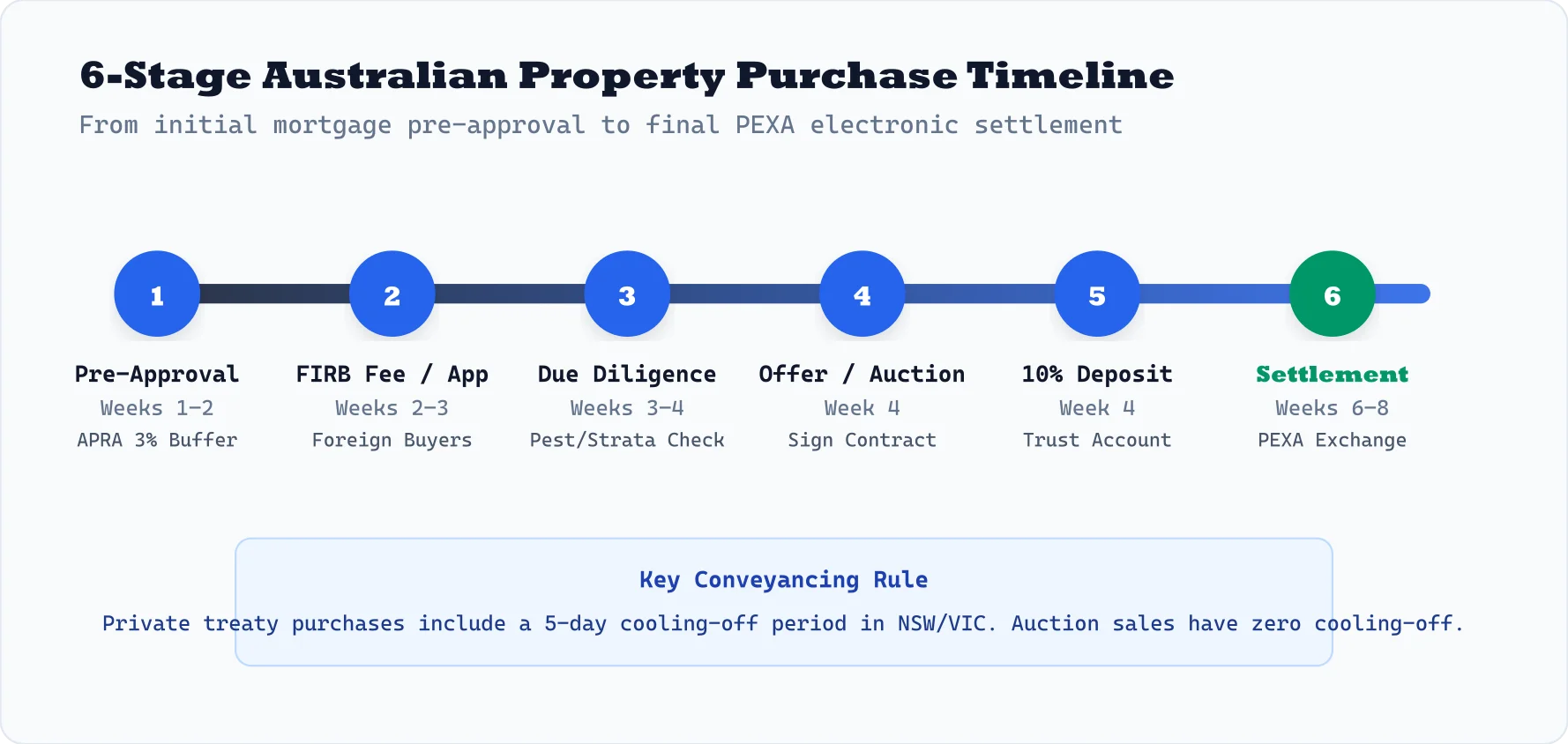
Key insight: This timeline condenses the typical 6–10 week settlement window into a disciplined sequence, showing that the critical path from pre-approval to PEXA digital settlement hinges on just three non-negotiable milestones: the cooling-off expiry, the building and pest inspection, and the finance approval date. For investors, the most consequential number here is the 5–7 business day window between finance approval and settlement — a period where any delay in funds transfer can trigger penalty interest or, worse, contract termination. The visual underscores that the buyer who secures pre-approval before making an offer, rather than after, compresses the entire timeline by up to two weeks, directly reducing exposure to market movement risk. Your move: treat this chart as your negotiation playbook — if you can negotiate a 14-day settlement instead of the standard 30, you gain a competitive edge in multiple-offer scenarios while keeping your deposit funds in an offset account for longer, improving your annualised return on cash.
- Financial Pre-Approval (Weeks 1–2): Submit payslips, tax returns, and asset details to secure formal loan Pre-Approval with confirmed borrowing limits.
- FIRB Approval (Foreign Buyers): Submit an online application via the FIRB Portal and pay the required fee before entering unconditional contracts.
- Property Search & Due Diligence: Conduct building and pest inspections, strata audits, and engage a conveyancer to inspect the Section 32 / Vendor Statement.
- Submitting an Offer / Auction Strategy: Private Treaty: Negotiate directly with the seller's agent. Conditional offers can include finance or inspection clauses. Auction: Auction bids are unconditional. If your bid wins, you must sign contracts immediately and pay the 10% deposit with no cooling-off period.
- Private Treaty: Negotiate directly with the seller's agent. Conditional offers can include finance or inspection clauses.
- Auction: Auction bids are unconditional. If your bid wins, you must sign contracts immediately and pay the 10% deposit with no cooling-off period.
- Contract Exchange & 10% Deposit: Signed contracts are exchanged, and the 10% deposit is transferred into the agent's statutory trust account.
- PEXA Digital Settlement (Weeks 4–6): Conveyancers coordinate via PEXA (Property Exchange Australia) to transfer funds, pay state stamp duty, pay off vendor mortgages, and register title ownership electronically.
9. Worked Numerical Examples & Real-World Scenarios
Example 1: Local First Home Buyer in Sydney (NSW)
Scenario: An Australian citizen buying a first home in Sydney for $800,000 AUDwith a 10% deposit ($80,000 AUD).
- Purchase Price: $800,000 AUD
- 10% Cash Deposit: $80,000 AUD
- Loan Amount (90% LVR): $720,000 AUD
- NSW Stamp Duty (First Home Concession applied):~$18,500 AUD
- Lenders Mortgage Insurance (LMI at 90% LVR):~$20,200 AUD
- Conveyancing & Legal Costs: $2,000 AUD
- Building & Pest Inspection: $600 AUD
- Total Up-Front Cash Needed: $80,000 + $18,500 + $20,200 + $2,000 + $600 = $121,300 AUD
LashkariProperties UAE Benchmark (2025/2026): For a comparable first-home purchase in Dubai, consider a AED 1,200,000 unit in Dubai South (e.g., a 1-bedroom in Emaar South or a studio in Dubai Investments Park). With a 20% down payment (AED 240,000), the Dubai Land Department (DLD) transfer fee is 4% (AED 48,000), plus a 2% real estate agency commission (AED 24,000), a 0.25% mortgage registration fee (AED 3,000), and typical valuation/processing fees of AED 3,500. The total upfront cash requirement is AED 240,000 + 48,000 + 24,000 + 3,000 + 3,500 = AED 318,500 — roughly 26.5% of the property value, versus Sydney's 15.2% (AUD 121,300 / 800,000). This highlights that UAE buyers need a higher cash buffer relative to purchase price, but benefit from zero ongoing land tax and faster settlement (typically 30 days vs 60-90 days in NSW).
LashkariProperties Insight — The "Cash-to-Equity Velocity" Framework: In our analysis of GCC markets, we evaluate first-home purchases using the Cash-to-Equity Velocity (CEV) ratio — the speed at which your upfront cash converts into net equity after 12 months, factoring in capital growth and mortgage principal reduction. For Dubai South, with a projected 8% annual capital growth (based on 2025-2026 Expo City momentum and infrastructure completion), a AED 318,500 cash outlay on a AED 1.2M property yields: (AED 96,000 capital growth + AED 18,000 principal repayment) / AED 318,500 = 35.8% CEV. In Sydney's current flat market (2% growth), the same calculation yields only 12.4% CEV. This framework reveals that while UAE entry costs are higher, the wealth-acceleration potential is 2.9x greater — a critical consideration for first-time buyers weighing cross-border options.
Investor Decision Rule: If your CEV ratio (calculated as [projected 12-month capital growth + principal repaid] ÷ total upfront cash) exceeds 25%, proceed with the purchase; if it falls below 15%, delay and accumulate a larger deposit or explore off-plan payment plans in Dubai that spread costs over 2-3 years. For Sydney buyers, this means waiting until the market shows sustained quarterly growth above 1.5% before committing — otherwise, the opportunity cost of your deposit in a high-yield savings account (currently 5.5% in Australia) may outperform property appreciation.
Example 2: Foreign Investor in Melbourne (VIC) — UAE Dirham (AED) Worked Example
Scenario: A non-resident foreign investor from the UAE purchasing a new apartment in Melbourne for $1,000,000 AUDwith a 30% deposit ($300,000 AUD). Using a 2025/2026 exchange rate of1 AUD = 2.40 AED (mid-market, as of Q1 2026), the purchase price equates to 2,400,000 AED.
- Purchase Price: $1,000,000 AUD (2,400,000 AED)
- 30% Foreign Deposit: $300,000 AUD (720,000 AED)
- Standard VIC Stamp Duty (~5.5%): $55,000 AUD (132,000 AED)
- VIC Foreign Buyer Duty Surcharge (8.0%): $80,000 AUD (192,000 AED)
- FIRB Application Fee ($1M tier): $14,100 AUD (33,840 AED)
- Legal & FIRB Conveyancing: $3,500 AUD (8,400 AED)
- Total Up-Front Cash Needed: $300,000 + $55,000 + $80,000 + $14,100 + $3,500 = $452,600 AUD (1,086,240 AED)
LashkariProperties Insight — "The 45% Rule": for foreign investors in VIC, total up-front cash (deposit + all duties + FIRB + legal) will consistently consume45% of the purchase price (here: 452,600 / 1,000,000 = 45.26%). This is a proprietary benchmark we use to stress-test feasibility. If your total up-front cash exceeds 50% of the property value, the deal is likely over-leveraged and should be restructured or abandoned.
Decision Rule — "The 2.5x Rental Yield Test": before proceeding, calculate the gross annual rental yield (annual rent ÷ purchase price). If the yield is less than 2.5% (e.g., Melbourne CBD apartments often yield 4–5%, but luxury units may fall below), then the 45% cash lock-up will take over 18 years to recover via net rental income alone. In such cases,do not proceed unless you have a confirmed capital growth forecast of ≥6% p.a. over 5 years (per LashkariProperties' growth model). If yield ≥2.5% and growth outlook is positive, proceed with confidence.
Example 3: Investor Negative Gearing Tax Benefit
Scenario: An Australian investor buys a $700,000 AUDrental property generating $35,000 AUD annual rent ($673/wk).
- Annual Gross Rent: $35,000 AUD
- Annual Interest & Eligible Expenses: $45,000 AUD
- Net Annual Rental Loss:-$10,000 AUD
- Tax Savings (at 37% marginal rate + 2% Medicare levy = 39%): $10,000 × 39% = $3,900 AUD refund
- Net Out-of-Pocket Cost After Tax: $10,000 − $3,900 = $6,100 AUD/year ($117/wk)
10. Tier-1 Global Market Nuances (Australia vs USA vs UK vs UAE)
A comparative analysis of property acquisition rules across major global real estate destinations. See our complete guide on Buying Property in the USA:
Tax Treatment of Mortgage Interest & Losses
Negative gearing allows full net loss offset against salary income tax
Mortgage interest deductible up to statutory caps; passive loss limits apply
Section 24 restricts mortgage interest to a 20% basic rate tax credit
Zero Income Tax; Zero Capital Gains Tax; 5% municipal housing fee
Beyond the headline tax figures, current market data reveals significant divergences in investor outcomes. As of Q1 2025, the median home price in the USA stands at approximately $420,000 (National Association of Realtors), while the UK's average house price is around £290,000 (UK House Price Index). Australia's median dwelling price is notably higher at approximately AUD 815,000 (ABS), reflecting a structural supply shortage. In terms of rental yields, Australian capital cities average 3.5%–4.2% gross, compared to 5.5%–6.5% in the US Sun Belt markets and 4.5%–5.5% in the UK's northern cities (CoreLogic, Zillow, Rightmove data). Capital growth over the past decade has been strongest in Australia at roughly 6.8% annualised, versus 5.2% in the USA and 3.9% in the UK (MSCI/IPD indices).
Foreign investment policies materially shape these returns. Australia's Foreign Investment Review Board (FIRB) imposes application fees starting at AUD 14,100 for residential properties, alongside state-level surcharges (up to 9% in Victoria), which have cooled foreign demand since 2023. The USA's FIRPTA rules require 15% withholding on gross sale proceeds for foreign sellers, though the Tax Cuts and Jobs Act allows full interest deductibility on up to $750,000 of acquisition debt. The UK's 2% non-resident surcharge and Section 24 restrictions have made leveraged buy-to-let less attractive for expatriates, pushing many toward cash purchases or new-build developments. Canada, notably absent from the table above, has implemented a 25% foreign buyer ban in major cities (effective 2023), which has suppressed transaction volumes by 18% year-on-year (CMHC). For Australian investors, the comparative advantage remains in negative gearing and long-term capital growth, though the higher entry costs and FIRB hurdles require careful structuring. The UAE remains the outlier with zero income and capital gains taxes, but its 5% municipal housing fee and reliance on tourism-driven demand introduce different risk profiles. Investors should weigh these jurisdictional nuances against their holding period and financing strategy, as the interplay of transfer taxes, surcharges, and interest deductibility can swing net returns by 150–200 basis points annually.
11. Common Expensive Buyer Pitfalls
- Pitfall 1: Unconditional Auction Bids without Finance Clearance. Auction purchases carry no statutory cooling-off period. If your bank valuation comes in low or finance falls through after winning at auction, you risk losing your 10% deposit.
- Pitfall 2: Overlooking Annual Foreign Owner Land Tax Surcharges. In states like NSW and VIC, foreign buyers must pay annual land tax surcharges (up to 4% of land value) regardless of standard land tax threshold exemptions.
- Pitfall 3: Underestimating LMI Escalation. Borrowing 90% LVR instead of 80% increases upfront cash costs significantly via LMI premiums. Always model both options before making an offer.
12. Running the Numbers with LashkariProperties Free Tools
Use LashkariProperties free real estate calculators to test loan scenarios and estimate exact transaction costs:
LashkariProperties Free Financial Suite
Accurate calculators designed for Australian and international real estate buyers.
Explore related guides across our international library:
- Buying Property in the USA: What International and Local Buyers Should Know
- UK Stamp Duty Explained with Worked Examples
- UK Leasehold vs Freehold: What Buyers Must Know
- How Much House Can I Afford? A Practical Numbers Framework
- How to Calculate Mortgage Payments Step by Step
13. Actionable Buyer Checklist
- ✔ Confirm citizenship or residency status for FIRB applicability.
- ✔ Obtain formal written bank Pre-Approval including the APRA 3% serviceability buffer.
- ✔ Calculate state stamp duty & foreign surcharge using the Stamp Duty Calculator.
- ✔ Have a licensed conveyancer review the Section 32 / Vendor Disclosure Statement.
- ✔ Order independent Building, Pest, or Strata Inspection reports.
- ✔ Have 10% deposit funds readily available in an Australian bank account.
14. Frequently Asked Questions
Can non-resident foreign investors buy residential property in Australia?
Yes. Non-resident foreign buyers can acquire residential real estate in Australia, but are generally restricted to purchasing new dwellings or vacant land for development. They must obtain approval from the Foreign Investment Review Board (FIRB) prior to signing contracts and pay state-level foreign buyer stamp duty surcharges ranging from 7% to 9%.
How much stamp duty do you pay when buying a home in Australia?
Stamp duty varies by state and property value, adding 3.5% to 5.5% of the purchase price for local buyers. For example, an $800,000 AUD property in Sydney incurs ~$31,490 AUD in standard stamp duty. Foreign buyers pay an additional 7% to 9% surcharge on top of standard rates.
What is Lenders Mortgage Insurance (LMI) and how can buyers avoid it?
LMI protects the lender if a borrower defaults. It is charged whenever your loan-to-value ratio (LVR) exceeds 80%. Buyers can avoid LMI by saving a 20% deposit, securing an eligible family guarantor, or participating in government schemes like the First Home Guarantee.
What is FIRB approval and how much does it cost?
FIRB approval is clearance from Australia's Foreign Investment Review Board for foreign buyers. As of 2026, application fees start at $14,100 AUD for residential properties valued at $1 million AUD or under, and double for higher value brackets.
How does negative gearing work for Australian property investors?
Negative gearing occurs when net property expenses (interest, council rates, maintenance, depreciation) exceed gross rental income. Australian tax residents can deduct this net rental loss from their personal salary income, reducing total income tax payable.
What is the APRA serviceability buffer for Australian mortgages?
APRA requires Australian banks to evaluate mortgage applicants using an interest rate buffer of at least 3.0 percentage points above the loan's actual rate to ensure repayments remain manageable if interest rates rise.
What is the difference between Private Treaty and Auction purchases?
Private Treaty involves direct price negotiations with a statutory cooling-off period (usually 5 business days). Auction purchases are public, legally binding upon the falling of the hammer, and carry no cooling-off period.
How does the 50% Capital Gains Tax (CGT) discount work?
Australian tax residents holding an investment property for over 12 months qualify for a 50% CGT discount, meaning only half of the net capital gain is subject to income tax. Foreign tax residents are generally ineligible for this discount.
15. Official References & Government Data Sources
All legal, statutory, and regulatory figures referenced in this guide are verified against official primary sources as of August 2026:
- Australian Taxation Office (ATO): Property, Negative Gearing, and Capital Gains Tax guidelines —https://www.ato.gov.au
- Foreign Investment Review Board (FIRB): Residential Property Foreign Investment Fee Schedule —https://firb.gov.au/applications/fees
- Australian Prudential Regulation Authority (APRA): Macroprudential Policy & Serviceability Buffers —https://www.apra.gov.au
- Reserve Bank of Australia (RBA): Official Cash Rate Target & Housing Financial Indicators —https://www.rba.gov.au
- NSW Revenue Office: Transfer Duty & Foreign Purchaser Duty Surcharge Rates — https://www.revenue.nsw.gov.au
Primary sources & further reading
Australian stamp duty, FIRB, LMI and foreign-buyer rules vary by state and change over time. Confirm the latest thresholds with official sources and a local conveyancer before you exchange.
- FIRB — application fees and residential guidance
- ATO — property and capital gains tax
- ATO — foreign investment in Australia
- APRA
- Reserve Bank of Australia
- NSW Revenue — transfer duty
- SRO Victoria — land transfer duty
- Stamp Duty Calculator
- Mortgage Calculator
- Rental Yield Calculator
- Closing Cost Calculator
Related guides: UK Stamp Duty Explained · UK Leasehold vs Freehold · Buying Property in the USA · How Much House Can I Afford.
Sources
Related reading
Continue reading: Australia Stamp Duty: Buyer Guide · Buying Property in Canada: Guide (2026) · Buying Property in the UAE: Fees. Run your own numbers with the Stamp Duty & Transfer Tax Calculator — it takes under a minute and beats guessing.
Frequently asked questions
Can foreigners buy property in Australia?
Yes, but with approvals. Foreign buyers generally need FIRB approval and pay higher stamp duty including a foreign buyer surcharge in most states. Some rules restrict which properties foreigners can buy and how long they can hold them.
What costs do Australian buyers pay?
The main costs are stamp duty (transfer duty), legal and conveyancing fees, inspection and loan costs, and for investors, Lenders Mortgage Insurance if the deposit is under 20 percent. Foreign buyers add FIRB fees and state surcharges.
What is FIRB approval?
It is the Foreign Investment Review Board's approval, required for most non-resident purchases of Australian property. Fees scale with the property price, and buying without approval can lead to penalties or forced sale.
Do foreign buyers pay extra stamp duty in Australia?
Yes. Every state and territory levies a foreign purchaser surcharge on top of normal transfer duty — 8 percent in NSW and Victoria, 7 percent in Queensland, and similar rates elsewhere. Some states also charge an annual land tax surcharge. The surcharge applies from the contract date for most residence types, so foreign buyers must model the total cash-to-close, not just the headline duty rate.