 By Nirmal Lashkari · Founder · Indore, Madhya Pradesh, India
$400,000 home with $80,000 down at 6.5% for 30 years produces a $2,439.28 monthly PITI payment, including $2,022.62 principal and interest, $333.33 property tax, $83.33 insurance, and no PMI or HOA. The $320,000 loan carries $408,142.36 of total interest over 360 months; adding $100 monthly reduces payoff to 314 months and saves about $61,698.47 in interest.
20.0% of price
Applied only when down payment is under 20%.
Optional extra principal. The results card still shows what +$100/month would do.
Total monthly payment: $2,439.28
| Measure | Current result | Locked base case |
|---|---|---|
| Principal & interest | $2,022.62 | $2,022.62 |
| PITI payment | $2,439.28 | $2,439.28 |
| Extra $100 payoff | 314 months | 314 months |
| Extra $100 interest saved | $61,698.47 | ~$61,698 |
If you add $100 extra each month
Payoff in 314 months instead of 360, and save $61,698.47 in interest. Same loan, extra principal only — no ZIP-level tax guess.
Bi-weekly payments
Pay half your principal & interest every two weeks — the equivalent of one extra payment a year — and you clear the loan in 290 months instead of 360, saving $93,073.37 in interest. No ZIP-level tax guess — same loan, same rate, faster amortization.
Link includes your numbers — the copied text contains a URL with price, down payment, rate, tax, and extras so anyone can reopen this exact scenario.
Estimates only. Rates, taxes, insurance, and underwriting vary by lender and location. Educational use, not financial advice.

A mortgage estimate becomes useful when it distinguishes the amount borrowed from the complete monthly housing charge. This calculator starts with home price and down payment, subtracts the down payment to produce the loan amount, and calculates principal and interest for the selected annual rate and term. It then adds monthly property tax, homeowners insurance, PMI when the down payment is below 20 percent, and HOA dues. The headline Total monthly payment is therefore a PITI-style estimate plus HOA, while Principal & interest is only the debt-service portion.
For the built-in base case, a $400,000 home with an $80,000 down payment creates a $320,000 loan. At 6.5 percent and 30 years, the calculator shows $2,022.62 of principal and interest. Annual property tax of $4,000 contributes $333.33 per month, and $1,000 of annual insurance contributes $83.33, producing a $2,439.28 total before any HOA charge. The result is an estimate from the values entered, not a lender quote, approval, or promise that a bill will remain unchanged.
That distinction prevents the most common budgeting error: comparing a listing's P&I figure with a lender's fuller escrowed payment. If the tax, insurance, PMI, or HOA fields are left at zero, the result is intentionally incomplete. Use the fields to model the property you are actually considering, then compare the resulting components rather than relying on one rounded headline.
Home price is the purchase-price input. Down payment is entered as a dollar amount, and the adjacent percentage slider changes that dollar amount in whole-percentage increments from 0 to 50 percent of the home price. The displayed percentage is calculated from down payment divided by home price, so changing either value changes the relationship. The loan amount is home price minus down payment; it is not the same thing as the cash needed to close, because this component does not model closing costs, prepaid items, or reserves.
Interest rate is entered as an annual percentage rate for the payment calculation, with increments of 0.125 percentage points and a visible range from 0 to 25. The calculator converts that percentage to a monthly rate internally. Loan term is a choice among 10, 15, 20, 25, and 30 years. A longer term lowers the scheduled principal-and-interest payment for the same balance and rate, but generally keeps the balance outstanding longer and increases the total interest reported.
The component also accepts an optional extra monthly payment. That amount is treated as additional principal in the payoff calculation. It does not change the tax, insurance, PMI, or HOA entries. The result can therefore show a shorter payoff and interest savings while the recurring housing-cost components remain the same. Use a realistic extra amount rather than one that would make ordinary months unaffordable.
Property tax and homeowners insurance are entered as annual amounts and divided by twelve for the monthly result. Entering $4,000 for tax means $333.33 per month in this model; entering $1,000 for insurance means $83.33. The calculator does not infer either amount from the home price, location, coverage, or assessment. Replace the defaults with the figures attached to a listing, an insurance indication, or another estimate you are intentionally testing.
PMI rate is entered as a yearly percentage. The visible hint says it is applied only when the down payment is under 20 percent, and the result label changes between PMI under 20 percent down and PMI none at 20 percent or more down. At the default 0.5 percent rate, a $360,000 loan would produce a modeled $150 monthly PMI amount while the down payment is below the threshold. This is a simplified flat-rate model; actual mortgage insurance pricing and cancellation mechanics can differ by product and borrower.
HOA dues are a monthly dollar input. They are added directly to the total and do not reduce the loan balance. A zero is appropriate only when the property has no recurring association charge in the scenario. If dues are billed quarterly, convert them to a monthly equivalent before entering them. Keep special assessments, utilities, maintenance, and repairs outside this result unless you add them to your own budget separately.
Consider the default $400,000 home and $80,000 down payment. With 6.5 percent, a 30-year term, $4,000 annual tax, $1,000 annual insurance, no HOA, and no extra payment, the loan amount is $320,000. The monthly P&I result is $2,022.62, taxes are $333.33, insurance is $83.33, PMI is $0, and the total monthly payment is $2,439.28. The result card also reports total interest over the payoff period and an estimated payoff date based on the calculated number of months.
Now change only the down payment to 10 percent, or $40,000. The loan becomes $360,000, and the model applies PMI because the down payment is below 20 percent. At the same 6.5 percent rate and 30-year term, P&I is about $2,275.44 and modeled PMI is $150 per month; adding the same tax and insurance produces about $2,842.11 per month. Returning to 20 percent down removes that modeled PMI and lowers the balance at the same time.
For a term comparison, keep the $320,000 balance and 6.5 percent rate but select 15 years. P&I rises to about $2,787.54, while the scheduled interest total is about $181,758 rather than about $408,142 over 30 years. The shorter term is not automatically better: the calculator shows the payment trade-off, while your cash-flow plan determines whether the higher required amount is sustainable. This is the kind of controlled comparison that makes each input change interpretable.
Start with Total monthly payment because it combines the modeled recurring components. Read Principal & interest next to understand the amount tied to the loan itself. Property taxes, Homeowners insurance, PMI, and HOA dues explain why the total can be materially higher than P&I. Loan amount tells you what the amortization calculation is actually retiring. Total interest over the displayed payoff months describes interest under the modeled schedule, not a universal cost for every loan with the same purchase price.
The payment-proof table places the current result beside a locked base case. Its rows include principal and interest, PITI payment, the payoff months for an extra $100 payment, and the interest saved by that extra $100 case. The locked values are a reference point for checking the model with the default scenario; they are not a second quote or a recommendation. If your current inputs differ, a difference is expected and should be traced to the changed price, down payment, rate, term, or recurring costs.
The calculator also always computes a separate +$100 comparison, even if Extra monthly payment is zero. The highlighted comparison states what adding $100 each month would do to payoff timing and interest. If you enter another extra amount, the main result reflects that amount, while the proof comparison remains specifically about $100. Keeping those two views separate avoids confusing a hypothetical benchmark with your chosen payment.
An amortization schedule assigns each payment between interest and principal and tracks the remaining balance. Early in a fixed-rate loan, interest is calculated on a larger balance, so the interest share is high. On the $320,000, 6.5 percent, 30-year example, first-month interest is $1,733.33 and principal is about $289.29 within the $2,022.62 P&I payment. As principal falls, later payments contain more principal even though the scheduled P&I amount is unchanged.
Adding $100 per month to the base example produces a payoff in 314 months rather than 360 and saves about $61,698 of interest in the component's model. The exact result comes from repeated recalculation of interest and balance, not from simply subtracting $100 from the final bill. An extra payment is most influential when it is applied consistently and early, because reducing principal earlier removes future interest on that dollar.
Use the schedule controls when you need to inspect particular payment numbers. The table can be filtered by month, which is useful for checking the first payment, an annual checkpoint, or the projected final period. Treat the estimated payoff date as a model output based on today's date and the selected number of months; it is not a contractual maturity date and does not account for payment holidays, rate changes, refinancing, or servicing adjustments.
The first mistake is leaving annual tax and insurance at generic values while treating the result as property-specific. The second is entering an APR when the field expects the annual interest-rate input used for the payment calculation. The third is forgetting that PMI is modeled only below 20 percent down, or assuming that a zero HOA means the home has no other ownership costs. The fourth is comparing a 15-year and 30-year loan by payment alone without also reading total interest and payoff timing.
A disciplined comparison changes one family of assumptions at a time. First hold rate, term, tax, insurance, PMI rate, and HOA constant while testing 10, 20, and 30 percent down. Then hold the balance constant while comparing available rates. Finally compare terms and extra payments. Record Total monthly payment, Loan amount, Total interest, payoff months, and any Interest saved by extra payments. This makes it clear whether an improvement came from more cash upfront, a lower rate, a shorter schedule, or accelerated principal.
Do not use the calculator to hide costs it does not implement. Closing costs, maintenance, utilities, repairs, transaction fees, changing assessments, and lender-specific charges require separate budgeting. The component also does not model adjustable-rate resets or a changing insurance premium. Its strength is a transparent fixed-rate scenario; its limitation is equally important to state before acting on the result.
Begin with the home price and down payment you can actually test. Enter the quoted rate and term, then replace tax and insurance defaults with property-specific annual estimates. Add PMI and HOA only when they belong in the scenario. Read the full result, inspect the proof table, and run one downside case such as a higher rate or larger HOA. If the payment works only with an aggressive extra amount, rerun it with zero extra payment to see the required baseline.
When the question changes from payment to buying power, continue to the home-affordability calculator and use this tool to test the resulting price with taxes, insurance, PMI, and HOA included. When the question changes to balance by month, use the amortization-schedule calculator. When the question is whether an existing loan could improve, use the refinance calculator. For a focused principal-acceleration decision, the extra-payment calculator is the natural sibling. These tools answer adjacent questions without pretending that one output covers all of them.
The share action copies a summary containing the home price, down payment and percentage, rate, term, total monthly payment, P&I, total interest, payoff months, and a URL carrying the current inputs. That makes a scenario easy to revisit or discuss. Before making a commitment, compare the estimate with the actual disclosure or quote you receive and verify every assumption that materially affects affordability.
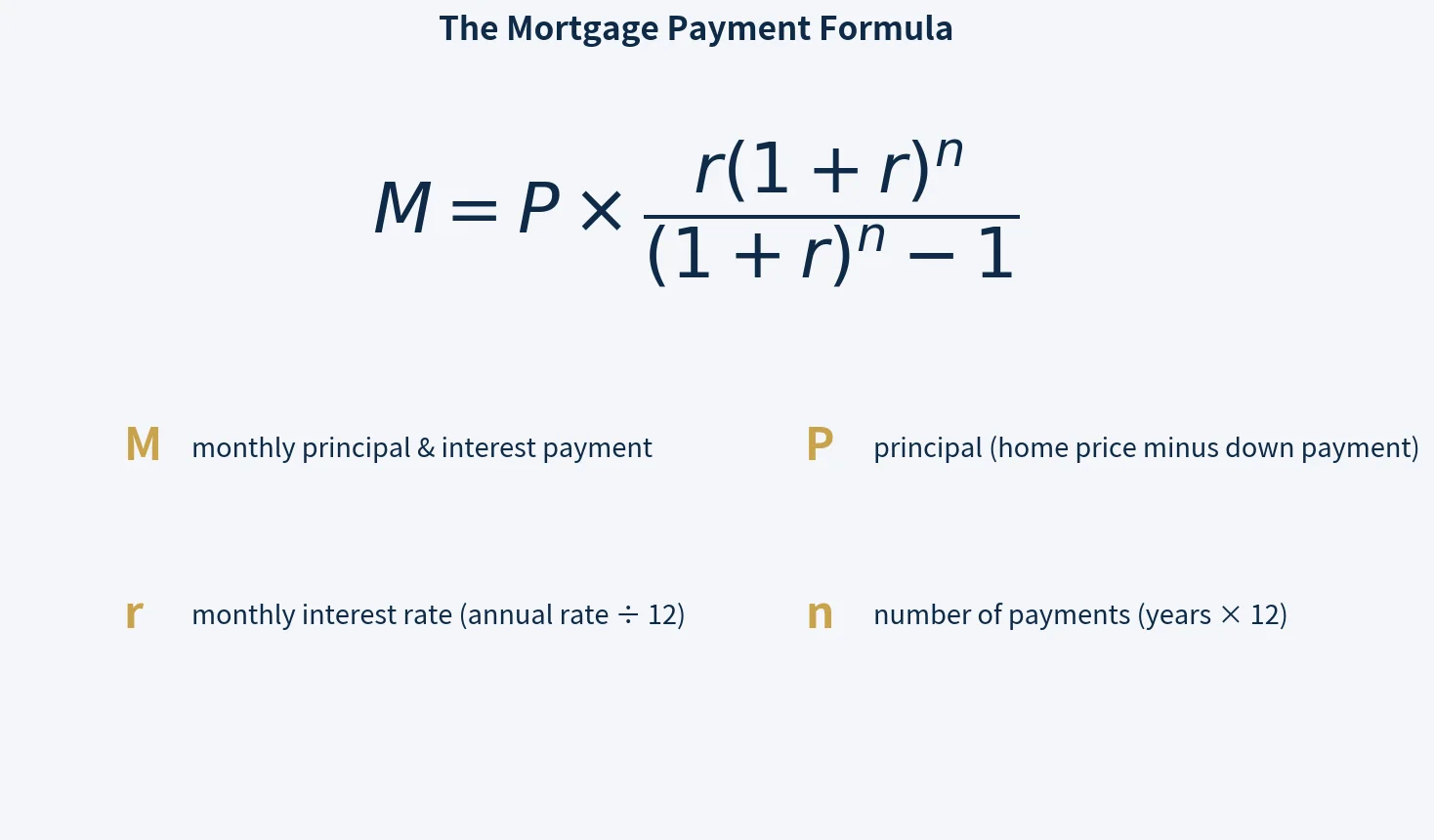
Principal and interest use the standard fixed-rate formula: M = P × [r(1+r)^n] / [(1+r)^n − 1], where r is the monthly rate and n is the number of months. Taxes, insurance, PMI when loan-to-value is above 80%, and HOA are then added to produce a PITI-style total.
Yes, if you enter them. Open Taxes, insurance, PMI & HOA and add your annual tax bill and insurance premium. Leaving those at zero returns principal and interest only, which understates the real payment — by $416.67 a month on the $400,000 example on this page.
Yes. It adds monthly principal and interest, monthly property tax from the annual tax input, monthly homeowners insurance from the annual insurance input, modeled PMI when down payment is under 20 percent, and monthly HOA dues.
The term selector offers 10, 15, 20, 25, and 30 years. The selected term changes the number of scheduled monthly payments and the resulting principal-and-interest calculation.
The calculator subtracts the down payment dollar amount from the home price. It does not add closing costs or other cash-to-close items to the loan amount.
The component applies the entered PMI rate only when the down payment is under 20 percent. At 20 percent or more, its PMI result is zero and the label identifies that state.
It is modeled as extra principal. The result can show fewer payoff months, lower total interest, and interest saved, while taxes, insurance, PMI, and HOA inputs remain separate recurring costs.
The calculator always runs a second scenario with exactly $100 of extra monthly payment and shows its payoff and interest effect, even when your Extra monthly payment field is zero.
Differences can come from the rate, term, tax, insurance, PMI, HOA, rounding, escrow assumptions, lender fees, or loan features. This component is a fixed-rate estimate based only on its visible inputs.
Yes. The share action copies a summary and a URL containing the current price, down payment, rate, term, tax, insurance, PMI, HOA, and extra-payment values.
Canada land transfer tax: which provinces charge it, the exact Ontario and BC band math, first-time buyer rebates, the Toronto municipal tax, and how it fits.
USA closing costs: the 2-5% breakdown, what varies by state — transfer taxes, attorney states, title premiums — and how to compare Loan Estimates.
UAE off-plan property: Dubai's 4% DLD fee and registration costs, how developer payment plans really work, RERA escrow protection, worked numbers on a AED 2.2.
How we calculate: calculatePiti in mortgage-piti.ts; regression locks in mortgage-piti.test.ts
Last reviewed: . Learn more about Nirmal Lashkari and LashkariProperties.
Disclaimer: This calculator provides estimates for informational purposes only and is not financial, tax, or legal advice. Verify figures with a qualified professional before making decisions.