

Closing costs are the cash and prepaid items due around settlement in the United States. A 2–5% planning range is a starting estimate, not a national promise: the Loan Estimate and Closing Disclosure determine the actual fees, credits and cash-to-close for your loan. Some costs may be offset by seller or lender credits or handled through loan structure, but they are not free. The part buyers underestimate is how much the bill varies by state, county, property, lender and closing practice.
At a glance: the decision in 60 seconds
- Plan for closing costs separately from the down payment, then replace the planning range with the lender's Loan Estimate and the title/settlement quote.
- For a $400,000 teaching scenario, an escrow-style example totals $12,800 (3.2%) while a high-tax attorney-style example totals $18,300 (4.6%); neither is a quote for a specific state.
- The biggest state-sensitive lines are transfer/recording taxes, title and settlement charges, attorney or escrow practice, and prepaid taxes, insurance and interest.
- Compare at least three Loan Estimates on the same rate, loan amount and closing date; then check the Closing Disclosure at least three business days before closing.
- This is educational information, not legal, tax, lending or financial advice. Ask the lender, title company, closing attorney and relevant government office to confirm your transaction.
Disclosure and scope
LashkariProperties is an educational real-estate publisher, not a lender, title insurer, attorney or government agency. Dollar amounts in the worked examples and chart are labelled illustrative assumptions; they do not predict your closing statement. State, county, city, property type, loan program, credit profile, lender, title risk and contract terms can change the result. Use official documents and qualified local professionals for a real purchase.
Article checked 23 August 2026. Source pages carry their own publication or review dates below; a source check date records when this guide was reviewed, not a promise that a tax, fee or lender rule remains unchanged.
Calculator note: the linked tools are estimates, not Loan Estimates or Closing Disclosures. Enter only figures you are comfortable using in a web calculator, avoid unnecessary personal identifiers, and review the site's Privacy Policy before using a tool. Keep the official lender disclosure as the controlling document.
What is inside the closing cost bill
For covered consumer mortgage applications, the Consumer Financial Protection Bureau's Loan Estimate guidance says the lender must provide a three-page Loan Estimate within three business days of receiving the application. It shows the estimated rate, payment, total closing costs, taxes and insurance, and special loan features. The CFPB notes that some products, including reverse mortgages and HELOCs, use different disclosures. Read the form that applies to your loan rather than assuming every mortgage follows the same workflow.
- Origination — lender fees, underwriting, points (usually 0.5% to 1.5% of the loan)
- Title — search, insurance, settlement fee (1% to 2% of the price in many states)
- Government — recording fees, transfer taxes (state-dependent, can be 1% to 2%+ of price)
- Prepaids — first year's homeowners insurance, escrowed taxes, prepaid interest
The Closing Cost Calculator assembles these into one cash-to-close figure, and the Down Payment Calculator separates the deposit from the fees so the total cash you need never surprises you at the table.
What genuinely varies by state
State variation usually comes from four separate questions: does the state, county or city impose a transfer tax; what recording charges apply; which title and settlement services are customary and shop-able; and does the transaction use an attorney, escrow agent or both. Pennsylvania's official guidance says its Commonwealth realty transfer tax is 1% and that an additional local tax is often collected; New York's official page separates state transfer-tax guidance from its mortgage-recording-tax resources. These are verification paths, not universal quotes. Start with the relevant Pennsylvania Department of Revenue page, New York transfer-tax page, county recorder, state regulator and title/settlement provider.
Additional city, district or luxury taxes can layer on top of a base bill in specific markets. New York City's official real-property-transfer-tax page publishes its own rates and thresholds, while New York State maintains separate transfer-tax guidance. Confirm the exact jurisdiction and effective date before relying on a threshold; never copy a New York City rule into all of New York State or another market.
| Example jurisdiction | Official path checked | What to verify before budgeting |
|---|---|---|
| Pennsylvania | PA Department of Revenue, checked 23 Aug 2026 | The Commonwealth 1% layer plus the county/municipality/school-district local layer; ask the county Recorder of Deeds who collects and allocates it. |
| New York State | NY Department of Taxation and Finance, updated 1 Jun 2026 | State transfer tax applies when consideration exceeds $500; separate state, county, city and mortgage-recording components by location. |
| New York City | NYC Finance RPTT, official city path | City transfer-tax rates, thresholds and filing responsibility; do not substitute NYC rules for the rest of New York State. |
| Texas or Colorado | County recorder/clerk plus title or settlement provider | Do not assume a zero-tax or low-fee result from a national article; confirm recording, title, escrow/attorney and local charges for the exact county. |
Use this call/email template: ‘I am buying a [property type] at [price] in [county/city]. Which transfer, documentary, recording, mortgage-recording, title and settlement charges apply; who normally pays each; and what official fee schedule or filing page should I use? Please separate buyer-paid items, seller-paid items, credits and prorations.’ Save the reply with the Loan Estimate and title quote.
A worked example: $400,000 in a typical escrow state
Build a realistic bill for a $400,000 purchase with 20 percent down in an escrow state with modest transfer taxes. Origination and points run about $3,000. Appraisal, credit, and flood services run about $700. Title search, insurance, and settlement run about $2,800. Recording fees run about $300. Transfer tax at a modest 0.5 percent is $2,000. Prepaids — roughly two months of property taxes, a year of homeowners insurance, and prepaid interest — run about $4,000. Total: roughly $12,800, or about 3.2 percent of the price.
Now move the same purchase to a high-transfer-tax, attorney state: transfer tax at 1.5 percent adds $6,000, the attorney adds $1,500, and title premiums run higher, pushing the total toward $19,000. The house costs the same; the closing table does not. The Closing Cost Calculator lets you set your own percentages so your state's reality, not a national average, drives the number.
Chart and data note: the scenario bars below use the same illustrative $400,000 purchase and $320,000 loan as the worked example. The companion USA closing-cost scenarios CSV lists each component, total and assumption note so you can replace the teaching inputs; it is not a state survey or lender estimate.
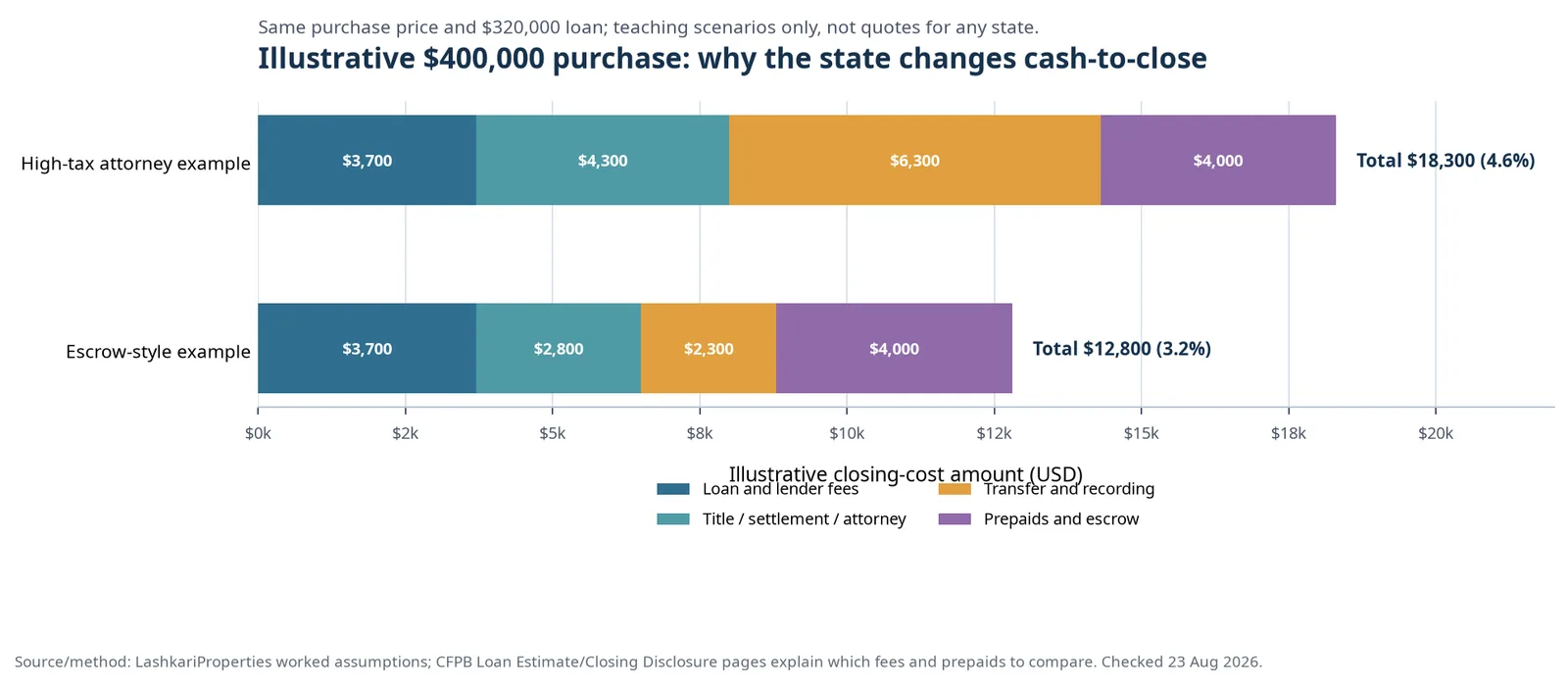
Text alternative for the chart: the escrow-style teaching case is $3,700 lender fees + $2,800 title/settlement + $2,300 transfer/recording + $4,000 prepaids/escrow = $12,800, or 3.2% of $400,000. The high-tax attorney-style teaching case is $3,700 + $4,300 + $6,300 + $4,000 = $18,300, or 4.6%. The difference is not a prediction; it is a prompt to obtain state, county and provider-specific quotes.
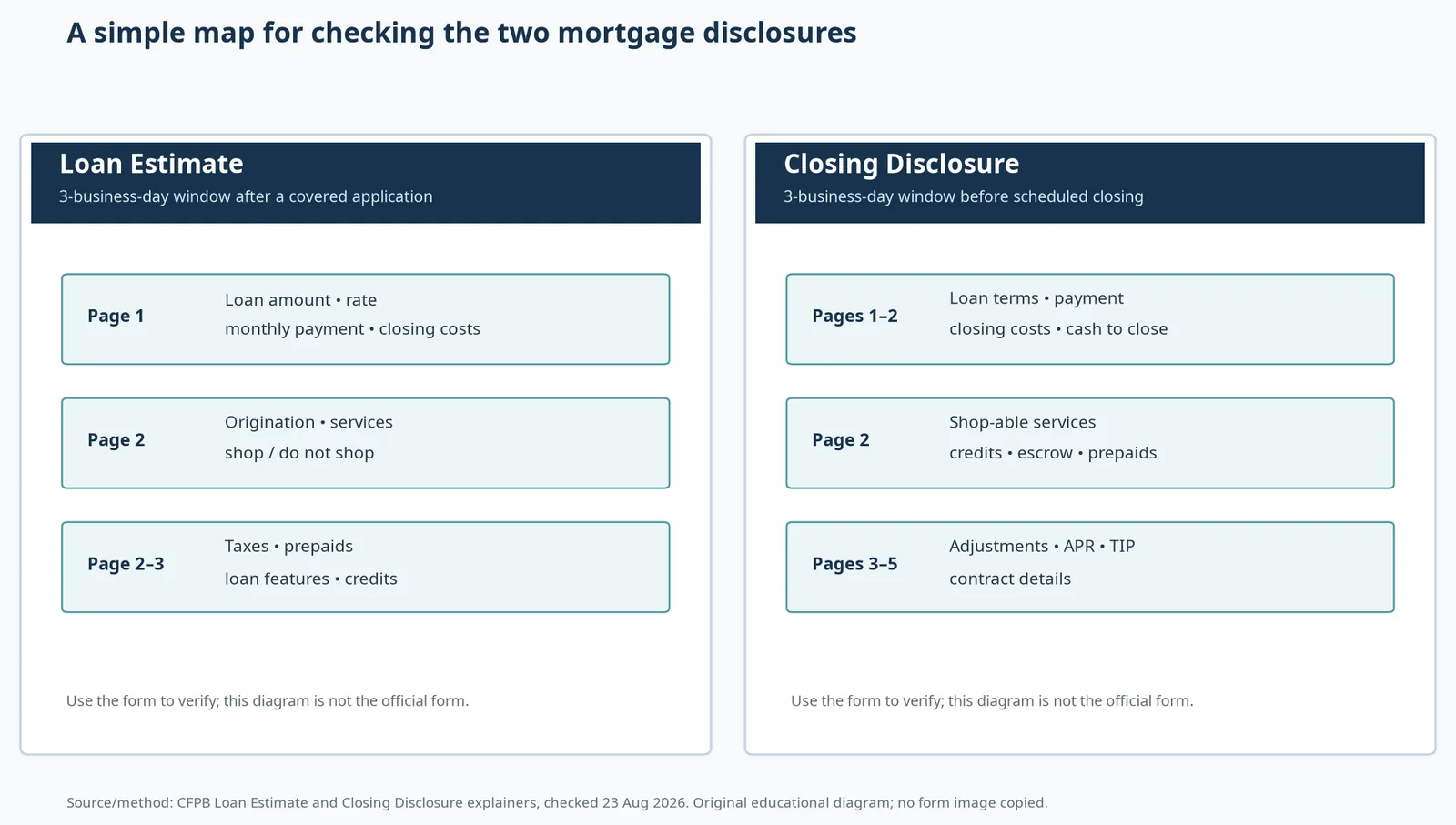
Text alternative for the disclosure map: the Loan Estimate is the early comparison form, showing loan amount, rate, payment, closing costs, origination and services. The Closing Disclosure arrives at least three business days before scheduled closing and should be checked for loan terms, cash to close, credits, adjustments, shop-able services and contract details. The CFPB pages linked above are the source and the actual lender documents control.
Why the loan amount matters as much as the price
Several closing cost lines scale with the loan, not the home. Origination fees, points, and lender title policies are quoted as percentages of the borrowed amount, so a 10 percent down payment on a $400,000 home produces a $360,000 loan with higher closing costs than a 20 percent down payment at $320,000. On the worked example, the difference in lender-based fees between the two deposits is roughly $1,000 — one more reason the Down Payment Calculator and the LTV Calculator should be run together before you commit to a deposit.
How to lower the bill
Closing costs are negotiable in some transactions, but the contract, loan program and market control the outcome. Compare at least three Loan Estimates using the same rate, loan amount and closing date; the CFPB Loan Estimate page explains why the standard form helps comparison. Ask whether lender credits, seller credits or points change the rate and total cost, and do not assume a credit is tax-free or permitted under your loan program without confirmation. Prepaid interest accrues by day, so a late-month closing may reduce that one line, but compare the full prorations and timing with the closing agent rather than treating month-end as a universal saving.
Ask for the itemized title and settlement quote before you commit to a title company, and ask your lender which services you are allowed to shop for — by law they must tell you. The single best tool for the whole exercise is the Closing Cost Calculator: put your real numbers in, adjust the percentages to your state, and you will walk into the settlement with a number you have already seen.
How to read the Loan Estimate
The Loan Estimate is the single most useful document in the closing cost process, and most buyers never fully read it. Page one shows the loan amount, rate, monthly payment, and total closing costs in a box — that box is the number to compare across lenders. Page two itemizes the fees: origination charges in section A, services you cannot shop for in section B, services you can shop for in section C, and taxes plus prepaids in sections E through H. Anything in section C — title search, title insurance, settlement — is fair game to compare on your own, and lenders must give you a written list of providers.
The three-day rule matters as much as the numbers: the CFPB Closing Disclosure explainer says lenders must provide the Closing Disclosure three business days before scheduled closing. Use that time to check the name, loan terms, rate, payment, closing costs, cash to close, credits, adjustments and shop-able service prices against the latest Loan Estimate. Fee-change limits depend on the applicable disclosure and tolerance rules in Regulation Z; ask the lender and closing professional to explain any difference before signing. Keep the Closing Cost Calculator worksheet as a comparison aid, not as a substitute for the official disclosure.
Closing costs and your rate: the trade you are actually making
Every lender quote is a trade between upfront points and the monthly rate. One point is 1 percent of the loan amount paid at closing to buy the rate down — on a $320,000 loan, one point is $3,200, typically reducing the rate by about a quarter of a percentage point. A lender quoting zero points and a higher rate is simply moving the same cost from closing day into the monthly payment. The correct comparison is not the rate or the fees in isolation; it is the total cost of each offer over the years you expect to keep the loan.
The rule of thumb: if you plan to hold the mortgage for more than about five years, buying down the rate often pays for itself; if you expect to refinance or sell sooner, take the no-points offer and keep the cash. The Refinance Calculator shows the break-even on both sides of the same trade, and the Mortgage Calculator compares the monthly payments side by side.
Jumbo loans and first-time buyer programs
Jumbo classification is not one universal closing-cost surcharge. The FHFA 2026 release sets the one-unit baseline conforming loan limit at $832,750 in most US areas and the high-cost-area ceiling at $1,249,125, with different limits for some counties, unit counts and special areas. A loan above the applicable conforming limit may have different underwriting, reserve, appraisal and pricing requirements; ask the lender for a written fee and rate comparison instead of adding an unsupported percentage.
First-time buyer programs change the cash side. FHA loans allow as little as 3.5 percent down but charge an upfront mortgage insurance premium of 1.75 percent of the loan plus a monthly premium for the life of the loan. VA loans have no down payment and no mortgage insurance, but add a funding fee. Down payment assistance programs in many states and counties cover part or all of the deposit in exchange for higher rates or a second lien. Each program moves the closing cost total in a different direction — the Down Payment Calculator and the PMI Calculator make the deposit-versus-insurance trade visible before you commit to a loan type.
State and county verification checklist
- Identify the exact state, county and city, then ask the recorder, revenue/tax office or official property-transfer page which transfer, documentary, mansion or recording taxes apply and who pays them.
- Ask the title or settlement provider for an itemized quote separating title search, owner's policy, lender's policy, settlement/escrow and recording charges; confirm which services you may shop for.
- If an attorney closing is customary or required, obtain the legal-fee quote and ask whether the attorney also handles title, escrow, recording or lender conditions.
- Give the lender the same purchase price, loan amount, points, closing date and insurance/tax assumptions when comparing Loan Estimates.
- Recheck the county-specific conforming loan limit if the loan may be jumbo; FHFA's 2026 map and list are the verification path.
A closing cost checklist before you sign
- Compare three Loan Estimates on the same rate, loan amount, and closing date
- Shop the section C services — title and settlement are negotiable
- Ask for seller credits and know your market's typical range (often 2-3% of price)
- Schedule closing in the last week of the month to minimize prepaid interest
- Verify every line on the Closing Disclosure against the estimate within the 10% tolerance
- Keep a cash reserve above cash-to-close for the first repair and the first escrow true-up
One more line belongs on the checklist: the title insurance policy itself. Owners' title insurance protects against title defects discovered after closing — a prior lien, a forged signature, an undisclosed heir — and it is a one-time premium that stays in force for as long as you or your heirs own the home, unlike the lender's policy, which is required by the mortgage and disappears when the loan is paid off. The owner's policy is typically a few hundred dollars in most states and is the one closing cost that is genuinely insurance rather than a fee for paperwork. Ask your title company for both policies in one quote, and do not let a lender steer you to a title provider without checking the owner's policy price first — it is frequently the difference between two comparable quotes.
Work the list in order and the closing table loses its power to surprise. The lender must give you the estimate, the title company must quote before you commit, and the seller's credit is a negotiation line like the price itself. The Closing Cost Calculator turns the checklist into a number, and the Home Affordability Calculator makes sure the cash-to-close fits inside the savings plan that funds the purchase.
Closing costs versus cash-to-close
Cash-to-close is the final figure on the Closing Disclosure — the deposit, all closing costs, and the prepaids, minus any lender credits and seller credits, plus or minus prorations. On the worked example, 20 percent down is $80,000 and the costs are about $12,800, so cash-to-close is roughly $92,800 before credits. If the seller contributes 2 percent ($8,000), it drops to about $84,800.
That is the number to save toward, not the down payment alone. Credits may lower it, but the lender and closing agent control what is permitted and how it appears on the disclosure. Keep a reserve beyond cash-to-close for the first repair, escrow adjustment and moving cost; the down payment gets attention, but the settlement statement is the amount due for this transaction.
That is the number to save toward, not the down payment alone. Budget it with the Closing Cost Calculator, confirm every line against the Loan Estimate and then the Closing Disclosure (which must match the estimate within a 10 percent tolerance for most fees), and keep a reserve for the first surprise repair. The USA country hub and the buying property in the USA guide cover the rest of the buying process, and the Mortgage Calculator shows what the monthly side will look like after the table clears.
Sources
- CFPB — What is a Loan Estimate? — standard form, timing and comparison guidance, page last reviewed 9 August 2024
- CFPB — Closing Disclosure explainer — three-business-day review window and line-by-line checks, page last modified 10 October 2023
- CFPB — Regulation Z — official consumer-credit disclosure regulations and tolerance framework, checked 23 August 2026
- FHFA — 2026 conforming loan limit release — 2026 baseline and high-cost ceiling, released 25 November 2025
- Pennsylvania Department of Revenue — Realty Transfer Tax — 1% Commonwealth layer and local-tax pathway, checked 23 August 2026
- New York State Department of Taxation and Finance — Real estate transfer tax — state threshold and filing guidance, updated 1 June 2026
- CFPB — Understanding the closing process — buyer closing guidance, checked 23 August 2026
- HUD — Closing costs and RESPA — federal housing/settlement reference, checked 23 August 2026
- NYC Finance — Real Property Transfer Tax — city rates and thresholds, checked 23 August 2026
Related reading
Continue reading: The 28/36 Rule: Still Useful in 2026? · Closing Costs Explained for Buyers · Debt-to-Income Ratio for Home Buyers. Run your own numbers with the Closing Cost Calculator — it takes under a minute and beats guessing.
Why the same $400,000 home costs differently in two states
Compare a $400,000 purchase in Texas and in New York to see how much the state drives the bill. In Texas, the buyer's title policy is set by regulated rates around $2,400, the lender's title policy adds roughly $100, and the transfer tax is zero — but property taxes are high, so the escrow holds two months of $800 tax payments. In New York, the buyer pays the mansion tax at 1 percent on homes over $1 million (not this one), the transfer tax is split with the seller, and the mortgage recording tax adds roughly $1,000 to $2,000. The same borrower can see a $3,000 swing in cash-to-close for an identical house. That is why the state matters as much as the loan terms, and why buyers should always build a state-specific closing-cost line item before comparing offers.
- Itemise every line with the Closing Cost Calculator and the Down Payment Calculator.
Frequently asked questions
How much are closing costs in the USA?
Typically 2 to 5 percent of the purchase price, in cash on top of the down payment. On a $400,000 home that is roughly $8,000 to $20,000 depending on the state, the lender, and whether transfer taxes are high.
Which states have the highest closing costs?
High transfer tax states like Pennsylvania, New York, and the District of Columbia, plus attorney-closing states like New York, Georgia, and South Carolina, tend to have the highest totals. States like Colorado and Arizona have low recording fees and escrow closings.
Can closing costs be negotiated?
Yes. Compare Loan Estimates from at least three lenders, ask for seller credits (commonly 2-3% of the price), and schedule closing near the end of the month to reduce prepaid interest. Lender title and origination fees are the most negotiable lines.
What is the difference between closing costs and down payment?
The down payment is the equity you bring (for example 20% of the price). Closing costs are the fees to originate the loan and transfer the title, on top of the down payment — both must be cash at closing and neither can be financed.
Do closing costs depend on the loan amount?
Partly. Origination fees, points, and lender title insurance scale with the loan amount, so a smaller down payment (bigger loan) increases those lines. Transfer taxes and recording fees scale with the price instead.
Which states have the lowest closing costs?
States that use escrow-style closings with low transfer taxes tend to be cheapest: Colorado, Arizona, Idaho, and Washington routinely land under 2.5 percent of purchase price. The most expensive states are those with high transfer taxes and mandatory attorney fees — Pennsylvania, New York, Delaware, and the District of Columbia can push past 4 percent. Title insurance costs also vary widely because most states regulate the rates while Texas and a few others allow competition.