


Why this guide, and what you'll be able to do
Buying property in the United States looks deceptively similar to buying in London, Sydney or Dubai — you find a place, sign papers, wire money. In practice, the American process has more moving parts than most other Tier-1 markets: 50 sets of state law, an appraisal that can veto your price, a lender-controlled escrow that pays your taxes and insurance for you, and an exit tax (FIRPTA) that quietly withholds up to 15% of your sale proceeds if you're a foreign owner.
This guide is written for two overlapping audiences: American residents buying a primary home or investment property, and international buyers — from London, Toronto, Sydney, Dubai and further afield — who see the US as a hard-currency, freehold-friendly market with deep rental demand. By the end, you'll be able to build a realistic cash-to-close estimate, understand where domestic and foreign paths diverge, and know exactly which checks to run before you sign.
Educational content, not personalised financial, tax or legal advice. Rules differ by state and change over time. Always verify current numbers with a licensed mortgage broker, CPA and real-estate attorney in the specific state you're buying in. Where we cite ranges, they are illustrative national averages sourced from public housing data.
You'll see numbers throughout. Every worked example uses the same free tools you can open in a second tab: the Mortgage Calculator,Closing Cost Calculator,Property Tax Calculatorand Down Payment Calculator. If a broker or agent shows you a figure that doesn't match your calculator output within a few hundred dollars, that's a signal to ask more questions.
Key definitions and formulas
Before we get into the process, pin these terms. They come up in every US real-estate contract and Loan Estimate.
Core cash-flow formulas
PITIis the standard shorthand for your monthly housing cost on a mortgaged US property:
PITI = Principal + Interest + Property Taxes + Insurance
Lenders qualify you against your gross monthly income using two ratios:
- Front-end (housing) ratio= PITI ÷ gross monthly income. Conservative cap: 28%.
- Back-end (total debt) ratio= (PITI + all other debt payments) ÷ gross monthly income. Conservative cap: 36%; many conventional loans allow up to 43–45%.
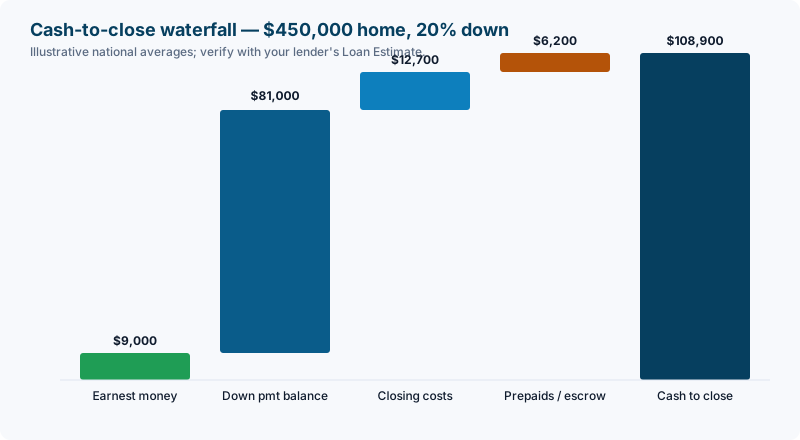
Cash to close — the number that actually leaves your bank account:
Cash to close = Down payment + Closing costs + Prepaid escrow − Earnest money − Lender credits
Loan-to-Value (LTV)— used to determine whether you'll pay PMI:
LTV = Loan amount ÷ Appraised value (or purchase price, whichever is lower)
Terms every US contract will use
- Earnest Money Deposit (EMD)— a good-faith deposit, typically 1–3% of purchase price, held in escrow.
- Contingencies — clauses that let you walk away without losing EMD (inspection, financing, appraisal, sale of current home).
- Escrow — a neutral third party holding funds and documents until closing. Also, the lender's account that pays your taxes and insurance monthly.
- Title insurance — protects the owner (and separately, the lender) from defects in the property's ownership history.
- Loan Estimate (LE)— a standardised three-page form the lender must issue within 3 business days of application. Compare LEs from at least three lenders.
- Closing Disclosure (CD)— the final version of the LE, delivered at least 3 business days before closing.
- Fee simple / freehold — the highest form of ownership in the US; the default for houses.
- Condominium (condo)— you own the unit; a homeowners' association (HOA) owns the common areas.
- Co-operative (co-op)— you own shares in a corporation that owns the building. Common in New York City; boards can reject buyers.
Terms specifically for foreign buyers
- FIRPTA— the Foreign Investment in Real Property Tax Act. When a foreign person sells US real estate, the buyer must withhold up to 15% of the gross sale price for the IRS.
- ITIN— Individual Taxpayer Identification Number, issued by the IRS to non-US persons. Required to file US tax returns.
- Non-QM loan — a mortgage outside the Qualified Mortgage box; the usual home for foreign-national and self-employed borrowers.
"Underwrite the deal as if you were the bank. If your own numbers don't approve you, you're not really approved — you're just currently allowed to spend."
Why these numbers matter for buyers, investors and landlords
Property is the largest single purchase most households ever make, and the second-largest for investors after equities. Small differences at the underwriting stage compound over decades. Consider three quick illustrations:
- Rate spread on a foreign-national loan.A 1.5% premium on a $360,000 loan is roughly $360 more per month in interest in year one — and about $59,000 more in total interest over a 30-year term. That's the difference between a cash-flowing rental and a break-even one.
- Property-tax reassessment.A buyer in New Jersey who under-budgets by 0.5% of purchase price on tax will burn ~$2,250 a year on a $450,000 home. Over a 7-year hold, that's $15,750 that never appeared in the pro-forma.
- FIRPTA surprise.A foreign owner selling a $600,000 home may see $90,000 withheld at closing until a US tax return is filed. If they didn't plan for the working-capital gap, the "profit" is locked up for 6–12 months.
None of these are dramatic on their own. Stacked together, they're the difference between a good deal and a mediocre one. That's why the rest of this guide focuses on numbers you can verify, not on abstract advice.
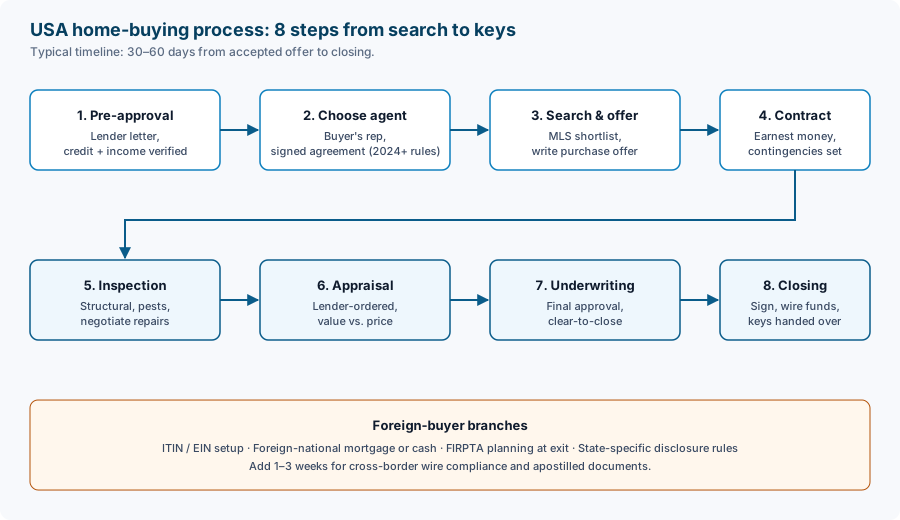
The 8-step US home-buying process
Most transactions follow the same skeleton, whether you're a first-time buyer in Columbus or a Dubai-based investor buying a Miami condo.
Step 1 — Pre-approval
Before you tour a single home, get a written pre-approval from at least one US lender. A pre-approval is stronger than a pre-qualification: the lender has actually reviewed pay stubs, tax returns and pulled credit. In competitive markets, listing agents throw away offers without one.
Foreign buyers who won't finance can substitute a proof of funds letter from a US or international bank, ideally on bank letterhead in English. Sellers accept an all-cash offer only if the funds are clearly available and liquid.
Step 2 — Choose a buyer's agent
Following the National Association of Realtors settlement that took effect in August 2024, buyers must now sign a written representation agreement with their agent before touring a home, and the buyer's agent commission is negotiated up front rather than automatically paid from the listing side. Budget for the possibility that you'll pay your agent 2–3% directly if the seller doesn't cover it.
Step 3 — Search and make an offer
Most residential listings appear on a regional MLS (Multiple Listing Service) syndicated to portals like Zillow, Redfin and Realtor.com. Your written offer will specify price, financing type, EMD amount, contingencies, and requested closing date. Expect a counteroffer.
Step 4 — Purchase contract and earnest money
Once the seller accepts, you sign a state-specific purchase contract and wire EMD into escrow. From here, "the clock" starts on your contingencies — inspection typically has to be completed within 7–14 days, appraisal within 14–21 days.
Step 5 — Home inspection
Hire a licensed inspector. A residential inspection costs $400–$700 and is the cheapest insurance you'll buy in the transaction. In older housing stock, order specialist add-ons: termites/wood-destroying organisms in the south-east, radon in the Midwest and Northeast, mold and stucco moisture intrusion in Florida.
Step 6 — Appraisal
The lender orders an appraisal to confirm the home's value supports the loan. If the appraisal comes in below purchase price, you have three options: renegotiate down, bring extra cash to make up the gap, or invoke the appraisal contingency and walk away with your EMD.
Step 7 — Underwriting
The underwriter does the deep dive: verifies income, assets, employment, title, insurance and appraisal. This is where cross-border wires get delayed. Foreign buyers should build in a 1–3 week buffer for source-of-funds documentation.
Step 8 — Closing
Signing takes 1–2 hours in an attorney's office or title company. You'll sign the Closing Disclosure, the deed, the note and mortgage. Funds are wired the same day; the deed is recorded at the county recorder within 24–48 hours. You now legally own the property.
Wire-fraud scams targeting closing funds are one of the most common losses in US real estate. Confirm wire instructionsverballyusing a phone number you already have on file — never a number from the email that contained the instructions. The FBI's IC3 unit tracks these losses in the billions annually.
Financing: how domestic and foreign paths diverge
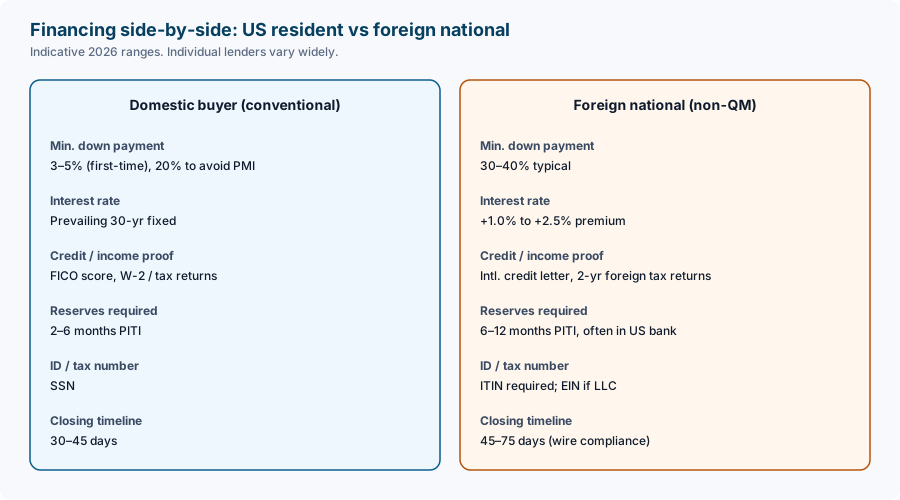
The single biggest difference between a local and international buyer is the mortgage. Domestic buyers have access to the deepest, cheapest mortgage market in the world. Foreign nationals live in a smaller pool — non-QM lenders, private banks and portfolio lenders — where terms are safer for the bank but pricier for the borrower.
Domestic buyer options
- Conventional (Fannie/Freddie conforming)— the default loan. Down payment starts at 3% for first-time buyers, 5% otherwise. Below 20% down, expect PMI of 0.5–1.5% of the loan per year.
- FHA— insured by the Federal Housing Administration. 3.5% down with a 580+ FICO score, but comes with upfront and annual mortgage insurance premiums.
- VA— for active-duty service members, veterans and certain spouses. 0% down, no PMI. Extraordinary product if you qualify.
- USDA Rural — 0% down in designated rural areas, income capped.
- Jumbo — loans above the conforming limit (roughly $806,500 in most counties as of 2026, higher in high-cost areas). Stricter credit and reserve requirements.
Foreign-national financing
Most large US retail banks won't originate a mortgage for a borrower without a US credit history. The market for foreign-national loans instead runs through:
- Specialist non-QM lenders (HomeXpress, Lendai, Champions Funding and others).
- Private banking arms of global banks with US operations (HSBC US, Citi Private Bank, some regional banks in Florida and Texas).
- Foreign branches of your own bank that book the loan against overseas assets.
Typical terms in 2026:
- Loan-to-value capped at 60–70% (30–40% down).
- Interest-rate premium of 1.0–2.5 percentage points over prevailing conventional rates.
- 6–12 months of PITI reserves, often required to sit in a US bank account.
- An international credit letter, or 2 years of foreign tax returns translated and certified.
- US ID via ITIN (individual) or EIN (LLC).
Get Loan Estimates from at least three lenders — one big retail bank, one non-QM specialist, and one broker who shops multiple wholesale channels. The rate spread between the best and worst LE on the same file is routinely 0.5–1.0%. On a $360,000 loan, that's a real-money difference of thousands of dollars over even a few years.
Cash purchases
Roughly a third of US home sales in 2026 are all-cash. Cash accelerates closing (14–21 days is realistic), removes appraisal and financing contingencies, and typically wins bidding wars at equal price. The trade-off: opportunity cost of the capital, and losing the mortgage-interest deduction on Schedule A.
Cash buyers should still order title insurance and a full inspection. Skipping these is one of the most expensive "savings" in real estate.
DSCR and portfolio loans for investors
A quietly important product for both domestic investors and foreign buyers is the DSCR (Debt-Service Coverage Ratio) loan. Instead of qualifying the borrower on personal income, the lender qualifies the property on projected rental cash flow. Typical structure:
- Minimum DSCR of 1.10–1.25 (property rent covers debt service by 10–25%).
- Down payment of 20–25% for US borrowers, 30–35% for foreign nationals.
- No W-2, tax return or DTI review — a rental appraisal (Form 1007) drives underwriting.
- Rates typically 0.75–1.5% above owner-occupied conventional.
- Loans commonly close into an LLC, which most conventional lenders won't do.
DSCR products are one reason a foreign investor can scale a US portfolio faster than a domestic W-2 buyer: after the first two or three homes, personal-income underwriting caps out but property-based underwriting doesn't.
Interest-rate strategy: locks, buydowns and refinancing
American mortgage rates move daily. Once you have a signed contract, most lenders let you lock a rate for 30, 45 or 60 days — longer locks cost slightly more. A 2-1 buydown, where the seller (or builder) pays to reduce your rate by 2% in year one and 1% in year two, has become common on new-build inventory in 2026 as builders defend list prices. Verify that the buydown is a genuine reduction and not simply financed into your price.
Refinancing is a distinctly American advantage. Unlike much of Europe, US homeowners can refinance a 30-year fixed mortgage with no prepayment penalty and roughly $3,000–$5,000 in refi costs. A common rule of thumb: refinance when prevailing rates are at least 0.75% below your locked rate and you plan to hold long enough to recoup the closing costs (typically 24–36 months).
Closing costs, line by line
US closing costs land in a wider range than most Tier-1 markets. Expect 3–5% of purchase price for buyers, split across four buckets: lender fees, third-party fees, prepaids and government charges.
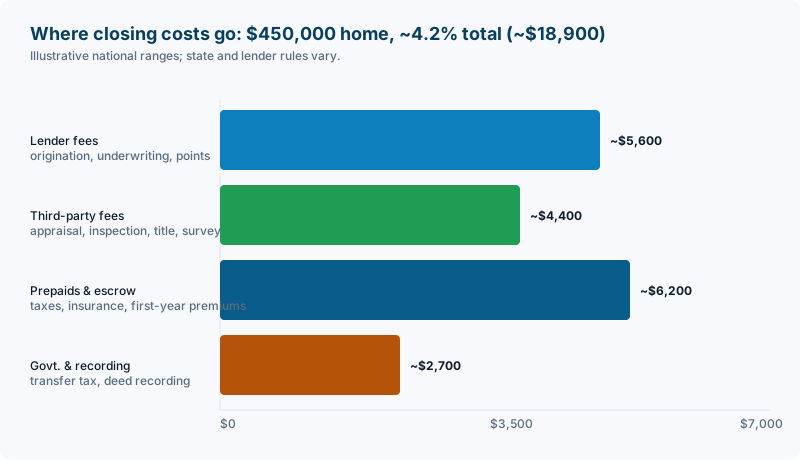
Lender fees (paid to your mortgage lender)
- Origination fee — 0.5–1.0% of the loan.
- Discount points — optional; each point is 1% of the loan and typically buys down the rate by 0.25%.
- Underwriting, processing, application fees — flat $500–$1,500 combined.
- Rate-lock extension — if closing slips beyond the lock period, expect a per-day fee.
Third-party fees
- Appraisal: $500–$800 (higher for jumbo or complex properties).
- Home inspection: $400–$700 (add $150–$400 per specialty add-on).
- Title search + owner's + lender's title insurance: 0.5–1.0% of price.
- Survey: $400–$800 (required in some states).
- Attorney or settlement fee: $500–$1,500.
Prepaids and escrow reserves
- Homeowner's insurance — first-year premium paid at closing.
- Property tax reserve — often 2–6 months collected upfront to seed the escrow account.
- Prepaid mortgage interest for the partial month of closing.
- Flood insurance premium if the home is in a FEMA-designated flood zone.
Government and recording fees
- Deed recording fee ($30–$200 depending on county).
- State/city transfer tax — this is the biggest wildcard. Zero in Texas; roughly 1.4% in New York State; up to 2.2% in Miami-Dade for higher-price homes.
- Mortgage recording tax — meaningful in New York (up to 1.925% on the loan for homes over $500k).
Some fees are negotiable but rarely negotiated: HOA transfer/document fees ($200–$800), condo estoppel or "resale certificate" fees, mansion tax (New York applies 1% to $1M+ homes), and out-of-state notary fees for remote signings. Ask your closing agent for the full itemised CD three business days before closing and audit it against your LE. Anything on the CD that wasn't on the LE, or has moved by more than allowed tolerance, is worth challenging.
Property taxes, income tax and FIRPTA
Property tax basics
Property tax in the USA is levied by counties and municipalities, not the federal government. Rates vary dramatically. New Jersey averages the highest effective property-tax rate at roughly 2.2% of home value; Hawaii the lowest at ~0.3%. National average is around 1.1%.
Illustrative effective property-tax rate — selected states (2026 estimate)
Two critical nuances get missed:
- Reassessment at sale. Many jurisdictions reassess the property at your purchase price rather than continuing the seller's old assessed value. In California, Proposition 13 caps annual increases at 2%but resets the base at sale. Always model post-sale taxes, not the seller's current bill.
- Homestead / owner-occupied exemptions. Investors and foreign owners typically don't qualify for these exemptions, so their tax bill on the same home can be materially higher than an owner-occupier's.
Ongoing US income tax on rental property
US rental income is taxable to both residents and non-residents. Foreign owners are, by default, subject to a 30% withholding tax on gross rental income unless they file IRS Form W-8ECI and elect to be taxed on net effectively-connected income. Almost every foreign landlord should make this election; without it, tax is levied before deducting mortgage interest, depreciation, HOA fees or property management.
FIRPTA at exit
FIRPTA is the single biggest surprise for international sellers. Under current rules, when a foreign person sells US real property, the buyer must withhold up to 15% of the gross sale price and remit it to the IRS. Not the profit — the gross price. Exceptions and reductions exist:
- Sales under $300,000 to a buyer who will use the home as a personal residence — 0% withholding.
- Sales between $300,000 and $1,000,000 to such a buyer — 10% withholding.
- All other cases — 15% withholding.
- A withholding certificate (Form 8288-B) filed before closing can reduce the amount held to match the actual expected tax.
The full IRS overview is atirs.gov/FIRPTA. Plan cash-flow around it: many foreign sellers see their proceeds "trapped" for 6–12 months until the next US tax filing reconciles the actual liability.
FIRPTA rules interact with tax treaties, entity structures (LLC vs individual), and how long you held the property. Always engage a US CPA with cross-border experience before you list the property, not after you sign the contract.
Estate tax exposure for non-residents
A frequently overlooked risk: US real estate owned directly by a non-resident, non-citizen is included in their US estate on death, with a federal exemption of just $60,000 (versus $13.99M+ for US persons in 2026). Above that threshold, the estate can face US federal estate tax at rates up to 40%. Holding structures — a foreign corporation, a US LLC owned by a foreign trust, or a life-insurance overlay — should be discussed with a cross-border attorney before you buy, not after.
Three worked examples
Numbers make the theory concrete. Every example here can be reproduced in our free calculators; the tool links are in Section 12.
Example A — Domestic first-time buyer, Ohio, 5% down
Priya, a software engineer in Columbus, buys her first home for $310,000 with a conventional loan.
Interest rate (30-yr fixed, illustrative)
Priya's PITI is roughly 30% of her $102,000 gross salary — right at the conservative front-end ratio ceiling. She should keep at least three months of PITI in reserves after closing and can drop PMI once she reaches 20% equity (either by paying down or through home-price appreciation, subject to lender rules).
Example B — Domestic investor, Texas duplex, 25% down
Marcus buys a duplex in Fort Worth for $385,000 as a rental. Investor loans price 0.5–0.75% above owner-occupied conventional.
Property tax (Texas, ~1.65%, no homestead)
Cash-on-cash return on Marcus's ~$110,000 all-in cash outlay is a modest 4.5%. That's a thin margin — any six-week vacancy erases the year's cash flow. He should stress-test at 10% and 15% vacancy before committing.
Example C — Foreign national, Florida condo, 35% down
Faisal, a Dubai-based executive, buys a $560,000 condo in Miami through a US LLC.
Property tax (Florida, ~0.85%, non-homestead)
Faisal should also budget for FIRPTA planning at exit: on a hypothetical future sale at $700,000, up to $105,000 could be withheld. Filing IRS Form 8288-B before closing on that sale can reduce the withhold to the actual expected liability, but requires several months of lead time.
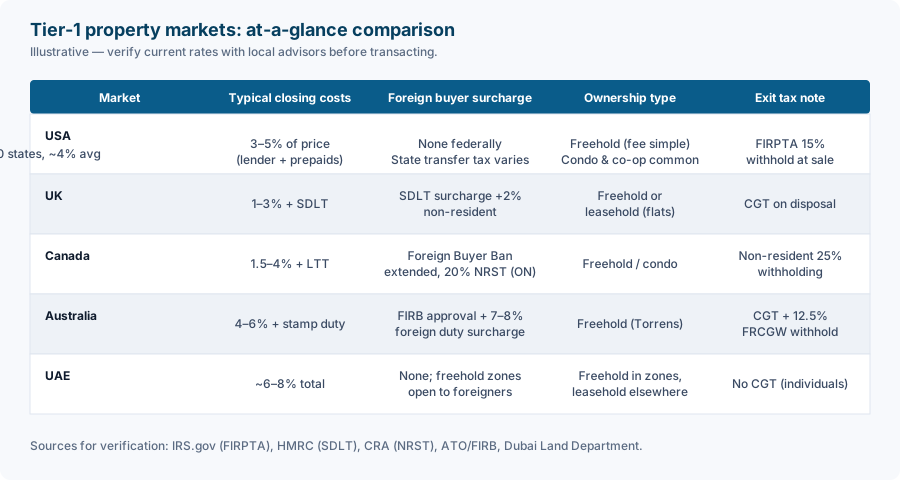
Tier-1 market nuances
Buyers evaluating the USA against other Tier-1 markets should understand where the American system is friendlier than the alternatives, and where it's more burdensome.
USA vs UK
The US charges no equivalent of UKStamp Duty Land Tax. However, ongoing US property taxes (0.3–2.2% annually) generally exceed UK council tax, so total lifetime cost can be comparable. Freehold is the US default; the leasehold-flat model that dominates UK cities barely exists — read our leasehold vs freehold breakdown for the UK contrast.
USA vs Canada
Canada extended the Foreign Buyer Ban into 2027, and Ontario's Non-Resident Speculation Tax remains at 25% for non-resident buyers. The US has no federal foreign-buyer ban and no federal foreign-buyer surcharge. This structural openness is a major reason capital rotates from Canadian to US property.
USA vs Australia
Australia requires Foreign Investment Review Board (FIRB) approval and layers a foreign-duty surcharge of 7–8% in most states — see our Australia buying guide. In the US, foreign buyers need only an ITIN; no purchase-approval regime applies. On exit, however, the US FIRPTA withhold (15%) is broadly comparable to Australia's Foreign Resident Capital Gains Withholding (12.5%).
USA vs UAE
Dubai's freehold zones remain open to any nationality with no foreign surcharge and no annual property tax on individuals. The trade-off: US property is denominated in a global reserve currency, has 30-year fixed-rate mortgages (rare globally), and deep secondary-market liquidity.
State-level nuance inside the USA itself
A common mistake among international buyers is treating the USA as a single market. It isn't. Practical differences at the state level often matter more than differences between countries:
- Attorney vs title-company states. New York, New Jersey, Massachusetts, Connecticut, Georgia and South Carolina require an attorney at closing. California, Texas and Arizona typically use a title company or escrow officer.
- Community property vs common law. Nine states, including California, Texas and Arizona, treat marital property as community property, which affects how title is taken and how estate planning works.
- Recourse vs non-recourse mortgages. In non-recourse states (about a dozen, including California and Arizona for purchase-money loans), the lender's only remedy on default is the property itself. In recourse states, they can pursue your other assets.
- Insurance markets. Florida, California and Louisiana have seen major insurers exit or restrict new policies. Confirm that homeowner's insurance is quotable at your target address before you go under contract — not after.
- Rent control and eviction rules. Investor economics differ starkly between California, Oregon and New York (tenant-protective) and Texas, Florida and North Carolina (landlord-friendly).
International buyers often forget that USD strength or weakness silently rewrites their return. A GBP-based investor who bought a US property in 2013 and sold in 2022 earned a currency tailwind of ~25% on top of any real appreciation. The reverse can happen just as easily.
Common mistakes and myths
1. "The seller's tax bill is my tax bill"
False in most states. Assessments frequently reset at purchase, so a home taxed at $4,200 for the seller can jump to $7,500 for you overnight. Always ask the county assessor for the projected reassessment.
2. "Pre-approval means I'm approved"
False. Pre-approval is a conditional preliminary review. Final approval happens only after underwriting on the specific property, including the appraisal. Do not open new credit lines, change jobs, or make large deposits between pre-approval and closing.
3. "Foreigners can't get a US mortgage"
Myth. Foreign nationals routinely finance US property — with more down payment, a rate premium, and more documentation. The market for these loans is well established, particularly in Florida, Texas, California and New York.
4. "An LLC always saves me tax"
Nuanced. LLCs offer liability protection and can help with estate-tax exposure for foreign owners, but the LLC itself doesn't reduce federal income tax on rental income — a single-member LLC is a pass-through by default. And LLCs complicate residential financing: most conventional lenders won't lend to an LLC, forcing you into portfolio or DSCR products at higher rates.
5. "Skip the owner's title insurance to save money"
Dangerous. Lender's title insurance protects the bank, not you. If a heir or lien claimant surfaces years later, your equity is at risk without owner's coverage. It's a one-time premium of a few thousand dollars for lifetime protection.
6. "Cash offers automatically win"
Not always. In slower markets, sellers care more about certainty of close than method of payment. A well-structured financed offer with a large EMD, short contingency windows and pre-underwritten pre-approval can beat a slower cash offer with unverified proof of funds.
7. "I'll figure out FIRPTA at sale"
Costly. FIRPTA planning belongs in the buying stage — because how you take title (individual, LLC, corporation, trust) drives the withhold rate, treaty benefits and post-sale filing burden years later. Structuring after the fact is expensive if it's even possible.
8. "HOA fees are a minor line item"
Not in condos, master-planned communities, or newer suburban developments. A Miami waterfront condo can easily charge $900–$2,000 per month in HOA dues covering building insurance, reserves, amenities and staff. After the Surfside collapse, Florida also introduced mandatory milestone inspections and structural integrity reserve studies — special assessments running into five or six figures are now a real risk. Read at least the last three years of HOA meeting minutes and the current reserve study before you sign.
9. "I don't need flood insurance if I'm not on the coast"
More than 20% of federal flood-insurance claims come from properties outside FEMA's designated high-risk zones. Inland flash flooding, storm-drain failures and hurricanes moving inland regularly damage homes many miles from the water. Coverage runs $500–$2,500 per year via the National Flood Insurance Program and can be even less through private carriers in low-risk zones. Skipping it saves pennies on the dollar of your equity.
10. "The listing agent's numbers are neutral"
They aren't. The listing agent has a fiduciary duty to the seller, not to you. Every figure in the listing package — projected rent, comparable sales, tax estimate, HOA history — should be independently verified before you rely on it. This is the single cheapest form of due diligence and is skipped by first-time buyers more often than any other check.
Deep dive: what foreign buyers most often miss
If you're buying from outside the US, the process holds a handful of specific traps that domestic buyers never encounter. The most common:
Source-of-funds documentation
Every US bank receiving a large inbound wire runs anti-money-laundering (AML) checks. Expect to provide: the account statement showing the source funds sat for 60+ days; the origin of any large deposit into that account; and, for gifted funds, a signed gift letter from the donor. Wires from certain jurisdictions face additional review. Build a 2–4 week buffer.
Choosing individual vs LLC vs corporation title
The single most consequential structuring decision. Broad strokes:
- Individual name — cheapest, simplest, but exposes the owner to full US estate-tax on death with only a $60,000 exemption.
- Single-member US LLC— provides liability protection; taxed as a disregarded entity by default (pass-through). Doesn't solve the estate-tax issue on its own.
- US LLC owned by a foreign corporation — often used to block US estate-tax exposure, at the cost of higher compliance and possible branch-profits tax.
- Foreign trust or family foundation — sometimes used for large portfolios; complex and requires specialist counsel.
The right answer depends on your citizenship, home-country tax rules, treaty position and holding horizon. There is no universally correct structure.
Opening a US bank account before you buy
Most foreign-national lenders require the borrower to hold reserves in a US bank account. Some private banks (HSBC US, JPMorgan Chase Private Client, Citi International Personal Bank) will open accounts remotely for qualifying international clients; most retail banks require an in-person visit. Start this process at least 60 days before your target closing.
Currency and hedging
The single largest cost most foreign buyers overlook. Wiring GBP, EUR or AED and converting through a retail bank can cost 2–4% in fees plus a spread. Purpose-built FX providers (Wise, OFX, Currencies Direct and similar) typically reduce this to 0.3–0.7%. On a $560,000 purchase, the difference is roughly $10,000–$20,000 — larger than most closing-cost line items and completely avoidable.
Getting into US credit history early
Even if you don't need a mortgage this time, opening a US credit card as soon as you have an ITIN (some issuers accept ITIN-only applications) starts building the FICO score that will unlock much better financing on your next US purchase. Two years of on-time payments typically move a foreign buyer from non-QM into near-conventional pricing.
Some overseas "US property investment" seminars quietly recommend title structures optimised for the seminar operator, not for you. Any structure that costs more than $2,000–$4,000 to set up and adds annual compliance should be justified in writing by a cross-border CPA who has no stake in the sale.
How this connects to related property metrics
The purchase decision isn't isolated. Every buyer, whether investing or owner-occupying, is implicitly evaluating a small family of connected metrics:
- Affordability ratio — total PITI ÷ gross income. Owner-occupiers cap at 28–36%; see our affordability framework.
- Rental yield — annual rent ÷ purchase price. Gross yield anchors the ceiling of what an investor can rationally pay.
- Cap rate — Net Operating Income ÷ price. The investor's equivalent of a bond yield.
- Cash-on-cash return — annual pre-tax cash flow ÷ actual cash invested. Sensitive to financing terms.
- Debt Service Coverage Ratio (DSCR)— NOI ÷ annual debt service. DSCR loans, popular for foreign investors, typically require ≥1.10–1.25.
- Break-even occupancy — the vacancy rate at which cash flow becomes zero.
- Total return — cash flow plus principal paydown plus appreciation, minus taxes and transaction costs.
A single strong metric doesn't validate a deal. A property with a 7% cap rate in a stagnant market can underperform a 4.5% cap in a rapidly appreciating one. Model at least three of these together before committing.
Run the numbers with free calculators
Every worked example in this guide was built using LashkariProperties' free tools. Open them in a second tab as you evaluate a specific listing:
Model principal, interest, taxes and insurance across any rate, term and down payment. Compare conventional vs foreign-national scenarios side by side.
Estimate lender fees, prepaids, title insurance and transfer taxes for your specific state. Reconcile against your Loan Estimate.
Project year-one and 10-year property-tax cost by state, including reassessment scenarios and homestead-exemption impact.
Solve for the down payment that keeps PITI below your target ratio, or reverse-engineer the price you can afford at a given cash outlay.
See the full library at lashkariproperties.com/tools. Every calculator is free and requires no sign-up.
Suggested workflow with the four calculators
- Start with the Down Payment Calculatorto establish your realistic cash budget.
- Feed the resulting price into the Mortgage Calculatorfor two scenarios: your best-case rate and a stress-test rate 1% higher.
- Use the Property Tax Calculatorwith a post-sale reassessment assumption, not the seller's current bill.
- Finally, run the Closing Cost Calculatorto build your cash-to-close estimate, then add a 10% buffer.
Buy-decision framework
Boil the process down to five sequential questions. Each one maps to a single calculator, and each answer feeds the next.
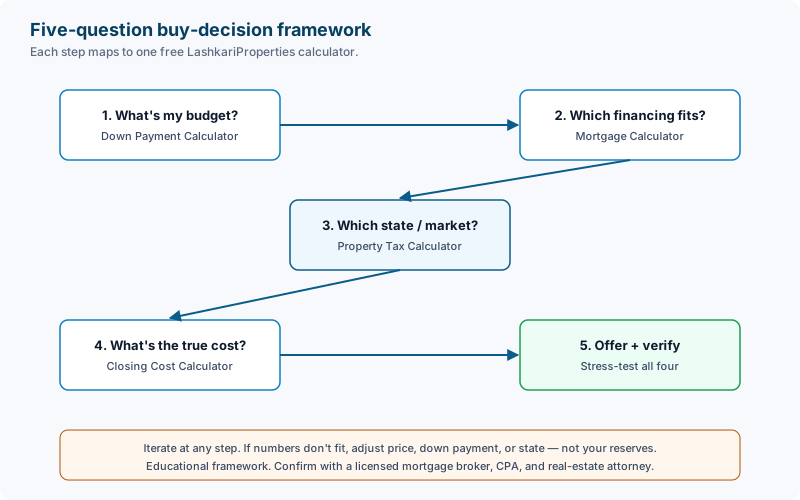
- What's my budget?— Set a hard cash-to-close ceiling and monthly PITI ceiling before you tour a single home.
- Which financing fits?— Conventional, FHA, VA, jumbo or foreign-national non-QM. Get three Loan Estimates.
- Which state and market?— Property tax, transfer tax and reassessment rules vary by 3× or more across states.
- What's the true all-in cost?— Reconstruct PITI, closing costs, HOA and reserves. Not the sticker price.
- Offer, verify, close.— Every negotiated number belongs in your calculator before it goes into a contract.
Actionable checklist
Use this before making an offer on any US property, whether you live in Chicago or Chennai.
Before you tour
- Pull US credit reports from all three bureaus (domestic buyers).
- Obtain ITIN or start EIN application if buying via LLC (foreign buyers).
- Get Loan Estimates from 3+ lenders on the same file.
- Confirm cash-to-close ceiling using the Down Payment Calculator.
- Open a US bank account and season funds for 60+ days (foreign buyers).
Before you offer
- Model post-sale property-tax reassessment, not the seller's bill.
- Pull HOA / condo documents and read the reserve study.
- Check flood zone status on FEMA's flood map service.
- Verify last five years of transfer history on the county recorder website.
- Run the Mortgage + Closing Cost + Property Tax calculators for this specific home.
Between offer and closing
- Order licensed inspection within contingency window.
- Order specialist inspections (termite, radon, mold, stucco) as region requires.
- Compare the Closing Disclosure to your original Loan Estimate line by line.
- Confirm wire instructions verbally on a known phone number.
- Bring photo ID, cashier's check (if required) and wire receipt to closing.
After closing (often skipped)
- Record the deed and confirm it appears in the county recorder database.
- File homestead exemption paperwork (owner-occupiers).
- Set up automatic property-tax and insurance payments if not escrowed.
- Save the Closing Disclosure — you'll need it for tax filings and future basis calculations.
- For foreign owners: file Form W-8ECI with your property manager to elect net-basis US tax on rents.
Frequently asked questions
Yes. There is no federal law preventing non-US citizens from buying residential property. Non-residents can hold title in their own name, through a US LLC, or via a trust. Financing options are narrower and pricier, and FIRPTA withholding applies when the property is later sold.
How much down payment do I need to buy a house in the USA?
US residents can qualify for conventional loans with as little as 3–5% down, FHA loans with 3.5% down, and VA loans with 0% down if eligible. Foreign nationals typically need 30–40% down through non-QM lenders. Below 20% down on a conventional loan, you'll also pay Private Mortgage Insurance (PMI).
What are typical closing costs in the USA?
Closing costs generally run 3–5% of the purchase price. On a $450,000 home, that's roughly $13,500–$22,500. The four buckets are lender fees, third-party services (title, appraisal, inspection), prepaid taxes and insurance, and government recording and transfer taxes.
Do foreigners pay more tax when selling US property?
Foreign sellers are subject to FIRPTA withholding of up to 15% of the gross sale price at closing. This is a prepayment, not a final tax; a US tax return (Form 1040-NR) reconciles the actual capital-gains liability. A withholding certificate (Form 8288-B) filed before closing can reduce the amount held.
How long does it take to buy a house in the USA?
From accepted offer to closing usually takes 30–45 days for financed purchases and 14–21 days for all-cash deals. Foreign-national mortgages often stretch the timeline to 45–75 days because of cross-border wire compliance and document translation.
Do I need a Social Security Number to buy US property?
No. Non-US persons can use an Individual Taxpayer Identification Number (ITIN), issued by the IRS. Buyers acquiring through an LLC use an Employer Identification Number (EIN) instead. Neither requires a US visa.
Which US state is cheapest to buy property in?
West Virginia, Mississippi, Arkansas and Oklahoma consistently show the lowest median home prices. However, low prices do not automatically mean low total cost — property-tax rates in Illinois, New Jersey and Texas can offset a low sticker price, and insurance can be high in hurricane- or wildfire-exposed regions.
Lender's title insurance is required for any mortgage. Owner's title insurance is optional but strongly recommended — it's a one-time premium that protects your equity for as long as you own the property.
Can I get a US mortgage on a tourist visa?
You do not need a US visa to obtain a foreign-national mortgage. Lenders assess income and reserves in your home country. Some banks require you to open a US bank account and hold 6–12 months of PITI reserves onshore.
What is an escrow account in a US mortgage?
Two different meanings. During the transaction, escrow is a neutral third party holding funds and documents. After closing, "escrow" or "impound account" refers to the lender's account that collects a portion of your mortgage payment each month and pays your property tax and insurance bills on your behalf when due.
Do I need a real-estate attorney to buy US property?
Attorney involvement is mandatory in states such as New York, Massachusetts, Georgia, New Jersey and South Carolina. In title-company states like California, Texas or Arizona, it is optional but recommended for foreign buyers, unusual property types, or complex transactions.
Yes. Most jurisdictions reassess a property at its new purchase price at sale, which can significantly raise the tax bill for the new owner. California caps annual increases at 2% under Proposition 13, but resets the base at sale. Always underwrite the post-sale reassessed tax, not the seller's current bill.
Conclusion and next steps
Buying property in the USA rewards buyers who bring a spreadsheet, not a hunch. Domestic buyers benefit from one of the world's deepest, cheapest mortgage markets, but often under-model the ongoing cost — taxes, insurance, HOA, PMI and maintenance can outweigh the mortgage itself. International buyers gain access to a genuinely open, freehold-friendly market, but pay for it in higher down payments, rate premiums, and a set of exit-tax rules that need planning at the buying stage, not at sale.
The best move right now is not to search harder — it's to model harder. Pick a real listing you'd consider buying, and run it through four calculators in sequence: Down Payment,Mortgage,Property Tax, and Closing Cost. Compare your numbers against any Loan Estimate you've been given. If they line up within a few hundred dollars, you're ready to negotiate from a position of understanding. If they don't, you've just identified where to ask the next hard question.
Continue with our related guides: How Much House Can I Afford? for the affordability framework, and How to Calculate Mortgage Payments Step by Stepfor the math behind the number your lender quotes you.
This article is educational and not personalised financial, tax or legal advice. Rules and rates change; state and local variations are substantial. Always verify current numbers and structures with a licensed mortgage broker, US CPA and real-estate attorney in your target state before entering any contract.
Related guides
- How Much House Can I Afford? A Practical Numbers Framework
- How to Calculate Mortgage Payments Step by Step
- UK Stamp Duty Explained with Worked Examples
- UK Leasehold vs Freehold: What Buyers Must Know
- Buying Property in Australia: Costs, Taxes, and Process
Authoritative references
- IRS — FIRPTA withholding for foreign persons selling US property.
- Consumer Financial Protection Bureau — Owning a Home resource centre (Loan Estimate, Closing Disclosure).
- FHFA — annual conforming loan-limit announcements.
- FEMA — Flood Map Service Center.
- Federal Reserve Bank of St. Louis — FRED database for mortgage and housing indicators.
Sources
Related reading
Continue reading: Australia Stamp Duty: Buyer Guide · Buying Property in Australia: Costs · Buying Property in Canada: Guide (2026). Run your own numbers with the Free Mortgage Calculator — it takes under a minute and beats guessing.
Frequently asked questions
Can foreigners buy property in the USA?
Yes. There are no restrictions on foreign ownership, and non-residents can buy with cash or obtain mortgages, usually with larger deposits and higher rates. Closing, taxes, and financing rules vary by state.
What costs do US property buyers pay?
Closing costs typically run 2 to 5 percent of the price, covering title insurance, appraisal, loan origination, and government fees. Property taxes are set locally and vary enormously, and buyers should budget them separately from the purchase price.
What is the US buying process?
It runs from offer and acceptance to a contract, through the inspection and appraisal period, to the lender's final approval and a closing where title transfers. A real-estate attorney or closing agent, a home inspection, and a lender's underwriting are the three moving parts most buyers underestimate.
Can a foreigner get a US mortgage?
Yes, with a Social Security number or ITIN, a US bank account, and typically 20 to 40 percent down. Rates for foreign nationals run about 0.25 to 1 percentage point higher than domestic borrowers because lenders see more risk, and some banks require larger reserves. Cash purchases are simpler: no mortgage underwriting, though you still need an ITIN to register the title and open utilities in most states.