


Why the deposit is only the start
Most first-time buyers save for one number: the deposit. Then, four to six weeks before completion, a solicitor, escrow agent, or mortgage broker sends a document that quietly doubles the cash requirement. Stamp duty, title fees, lender charges, appraisal, survey, insurance prepayments, moving costs, a broken boiler that "should hold another winter" — the list is long, and each item is real.
The gap between the deposit and the true cash cost of buying is where first-time buyers most often stall. It is also the gap where regrettable financial shortcuts happen — draining an emergency fund, taking a personal loan the week before closing, or moving into an unfurnished home with a maxed-out credit card. All of these are avoidable with a clearer picture of what buying actually costs.
This guide is that picture. We break every extra cost into a discrete line item, show worked examples in five Tier-1 markets, and give you a repeatable framework you can plug into free tools like the LashkariProperties Closing Cost Calculatorand the Down Payment Calculator. The aim is simple: no surprises on completion day, and a healthy cash cushion on the other side.
Educational content only
This article is written for education. It is not personalised financial, tax, or legal advice. Rules and rates in the USA, UK, Canada, Australia, and UAE change frequently and differ by state, province, and emirate. Always verify final numbers with a licensed local professional before you commit funds.
Definitions and formulas
Before we can budget accurately, the vocabulary has to be clean. First-time buyers repeatedly conflate closing costs with the down payment, or the deposit with the mortgage reserve. The definitions below are the ones lenders, conveyancers, and regulators use.
Down payment (deposit)
The portion of the purchase price you pay in cash. In the USA and Canada this is called the down payment; in the UK, Australia and UAE it is usually the deposit. It becomes home equity from day one. Read our companion piece on whether a20% down payment is really required for a deeper look at deposit sizing.
Closing / conveyancing costs
Fees required to complete the transaction. These include lender origination fees, title or land registry fees, legal/solicitor fees, escrow, transfer taxes, stamp duty, insurance prepayments, and appraisal. They do not build equity. See our detailed guide on closing costs explained for buyers.
Inspections and surveys
Third-party reports on the physical condition of the property: building/structural surveys, pest, radon or asbestos checks, and lender-required appraisal. Usually non-refundable, paid before completion.
Moving and setup costs
Movers, packing materials, utility connection deposits, cleaning, lock changes, mail forwarding, and short-term storage.
Furnishings and essentials
Day-one essentials — bed, fridge, curtains, cookware — plus any immediate repair items flagged by inspection.
Cash reserves
Liquid savings held after completion. In the US, lenders often require documented reserves in months of PITI (principal, interest, taxes, insurance). Consumer regulators such as the US Consumer Financial Protection Bureaurecommend three to six months of essential expenses as an emergency baseline.
The core formula
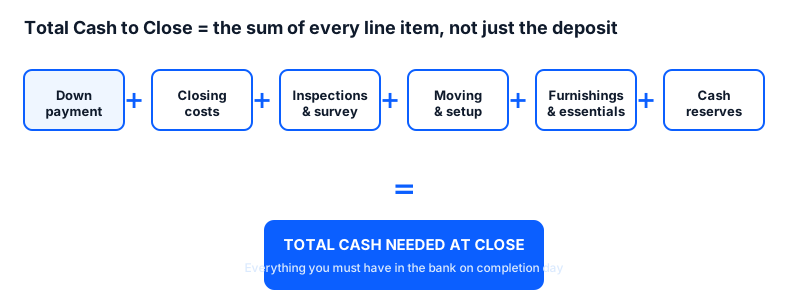
In plain English:
Total cash needed = Down payment + Closing/conveyancing + Inspections + Moving + Furnishings + Reserves + Contingency buffer.
Every subsequent section unpacks one of these terms and shows how to size it responsibly.
The two dates that matter: exchange and completion
In every Tier-1 market there are two moments when money leaves your account in large quantities. The first is exchange (or offer acceptance in the US, unconditional in Australia, MOU signing in the UAE): here you commit part of the deposit, sometimes a holding deposit only, and inspection fees. The second is completion (closing): here the balance of the deposit, all closing costs, taxes, duties, and prepayments hit at once. Buyers who plan around only the second date routinely find themselves scrambling for cash in the two weeks before, when their savings are already earmarked. Map the money against both dates from the beginning — most solicitors and title agents will provide a preliminary settlement statement roughly two weeks out that you can pressure-test.
Fixed vs. variable costs
Within the extras, some line items are effectively fixed regardless of price (inspection fees, lock changes, most moving quotes for a comparable-size home) and some scale directly with the purchase price (transfer taxes, agent commissions, mortgage registration in the UAE, land transfer taxes in Canada). This distinction matters when you stretch on price: an extra $50,000 on the purchase price does not add $50,000 to your cash bill — it adds the deposit share of that plus the percentage-based extras, which can easily reach $54,000 to $58,000 of additional cash before you hold the keys.
Why this matters for buyers, investors and landlords
The consequences of underestimating extra costs are not academic. Consumer-finance research from the US Federal Reserve's SHED survey has repeatedly shown that a significant share of adults cannot cover a $400 emergency in cash. When you multiply that fragility by the reality of homeownership — a broken HVAC unit in month three, a leaking roof discovered after the first storm — the case for a buffer becomes obvious.
For owner-occupiers
Every dollar spent on the deposit is a dollar that cannot cushion a shock. Owner-occupiers underestimate two categories most: closing costs (perceived as small, actually 2%–5% of price) and post-close reserves (perceived as optional, actually essential). A third under-appreciated category is the standing-order shock: property tax, HOA or service charge, insurance and higher utilities that all begin standing orders in the first 30 days. On paper these are recurring costs, not buying costs, but they overlap with the buying-costs period and drain the same account.
There is also a psychological effect that under-budgeting produces: buyers who close with empty accounts tend to defer maintenance far too long, allowing a $400 problem to become a $4,000 problem. A cash-thin household is a household that cannot say yes to a Saturday-morning plumber, and repair economics punish that particular delay very steeply. Reserves aren't a nice-to-have — they are what makes the difference between owning a home and camping in it.
For investors
Investors face the same extra costs plus additional ones: void periods, tenant find fees, higher stamp duty in the UK and Australia on additional dwellings (the UK's 5% Additional Property SDLT surcharge and equivalent state surcharges in NSW and Victoria are common surprises), and typically higher lender fees on buy-to-let mortgages. If your LTVis aggressive and your reserves are thin, one bad quarter — an interest-rate reset, a two-month void, or a boiler replacement — can force a distressed sale. Sophisticated investors write a formal cash-to-close-and-hold figure for every deal: acquisition cash plus a stress-tested six months of negative cash flow. A property that cashflows positively in a base case may still fail this test.
For landlords
Landlords must reserve for capital expenditure (a new roof, boiler, appliances) on top of a monthly operating buffer. A common industry rule of thumb is 5%–10% of gross rent set aside for capex, on top of maintenance and vacancy allowances. Landlords also carry a compliance cost that owner-occupiers don't: safety certificates (gas, electrical, EPC in the UK; smoke alarm compliance in most Australian states), landlord insurance, and license fees in cities that require them. None of these are one-off — they refresh annually or every few years — but the first-cycle cost lands in the same period as the buying costs.
For renters becoming owners
Renters underestimate one thing above all: the loss of the landlord as a buffer. As a renter, a failed appliance is a call and an inconvenience; as an owner, it is a bank transfer. Realistically model at least $2,000–$3,000 (or equivalent) of first-year unplanned repairs even in a well-inspected home. This is not pessimism — it is the median outcome in industry data on first-year homeowner repairs.
"The most expensive mistake a first-time buyer makes is confusing the deposit with the cost of buying."
Anatomy of every non-deposit cost line
This section is intentionally granular. It exists so you can go through your own budget line by line and place a defensible number next to each item.
Closing / conveyancing costs, unpacked
Closing costs in the US and conveyancing costs in the UK and Commonwealth markets do the same thing — pay for the legal and administrative machinery that transfers title. But the composition differs sharply.
- Lender-side fees: origination, underwriting, credit report, application, and rate-lock extension fees. In the US these are itemised on the Loan Estimate; in the UK they appear as arrangement, booking, and valuation fees; in Australia they include the loan application, settlement, and lender's title-insurance surcharge on high-LTV deals.
- Government / statutory fees: transfer tax, stamp duty, land registry, mortgage registration, notary. This is usually the largest single closing-cost line outside the US and can dwarf the lender fees.
- Third-party fees: title search and insurance (US), local authority searches (UK), strata report (Australia), NOC (UAE), settlement agent or trustee office fees.
- Prepayments and escrow items: the first year of homeowner insurance, several months of property tax held in escrow, prepaid interest to the end of the closing month, and any HOA transfer fee or capital contribution.
- Buyer-broker or agent fees: increasingly relevant in the US after 2024 industry changes; standard 2%+VAT in the UAE; typically vendor-paid in the UK and Australia but negotiable.
The single most useful discipline is to price all five sub-categories separately rather than using a single blended percentage. A blended 3% might be right in Texas and wildly wrong in Sydney — or in Vancouver in a year the province introduces an additional foreign-buyer tax.
Inspections, surveys and appraisal, unpacked
Physical due diligence is where buyers most often skimp — and where the savings are most often false economies. A$200 inspection that catches a $10,000 roof issue is not an expense, it is an option premium. The main lines:
- General home inspection or building survey: the whole-house visual and mechanical check. US home inspection $300–$700; UK RICS Level 2 £400–£950 or Level 3 £600–£1,500; Australia $400–$700 combined building & pest; UAE snagging inspection AED 1,500–3,500.
- Specialist inspections: pest, radon, mould, sewer scope, chimney, pool, HVAC. Each runs $100–$400 in the US. In older UK homes, a damp survey can add £250–£500.
- Lender's appraisal / valuation: ordered by the lender but paid by the buyer in most markets. $400–$800 in the US; £150–£400 in the UK; AED 2,500–3,500 in the UAE.
- Strata / management pack: for apartments and body-corporate homes — critical because it reveals pending special levies. AUD 250–450 in Australia; UK leasehold management pack £200–£400.
For a first-time buyer, budgeting the maximum of these ranges is prudent — you rarely need only one report and you cannot recover the cost if the deal collapses.
Moving and setup, unpacked
Moving is the category buyers assume they can handle for free with friends and a rented van. Sometimes that works. More often it doesn't, because completion dates slip and the day you have to be out of your rental is not the day the seller hands over the keys. Budget line items to consider:
- Professional movers (or a rental truck plus fuel) — get three quotes.
- Packing materials and, for long-distance moves, insurance.
- Short-term storage if there's a gap between move-out and move-in.
- Utility connection and disconnection fees. UAE DEWA security deposits are refundable but sizeable (AED 1,000–4,000 depending on villa vs. apartment). Australian utility connection fees are usually modest but frequent.
- Cleaning of both the old rental (to protect the security deposit) and the new home.
- Locksmith or smart-lock installation. Cheap in absolute terms but almost always forgotten.
- Address changes: driver's licence, bank cards, insurance, subscriptions, and — in the UAE and Australia — sometimes visa or residency address updates.
- Temporary overlap costs: the last week of rent plus the first week of mortgage interest, plus any prorated council tax or HOA that falls in the gap.
Furnishings, appliances, and essentials, unpacked
The best discipline here is a two-list approach: a Day-One list and a Month-Six list. The Day-One list is short and non-negotiable. The Month-Six list is where most of the cost hides — and where most first-time buyers overshoot by 50% to 100% because they conflate needs with wants.
Day-One list (typical for a two-bedroom home): bed and mattress, refrigerator, washing machine, cooker or hob, basic cookware and utensils, curtains or blinds, cleaning supplies, safety essentials (smoke alarm, fire blanket, first-aid kit), and, if not provided, a hot water system or its servicing.
Month-Six list: dining table, sofa, wardrobes, home office setup, garden furniture, decor, additional appliances. These can wait — and buying them slowly means catching sales instead of paying full price.
A realistic Day-One budget in Tier-1 markets is $3,000–$7,500 for an unfurnished two-bedroom home, depending on whether appliances are included in the sale. If white goods are included, expect to spend closer to the lower bound; if not, plan for the upper bound.
Cash reserves and the buffer, unpacked
The reserve is where consumer finance guidance and lender requirements sometimes diverge. Lender reserves are typically measured in months of PITI — say, two months for a conforming loan and six months for a jumbo or investment property. Personal-finance reserves are typically measured in months of total essential expenses, which is a larger number because it includes food, transport, insurance, and childcare in addition to housing.
Use the larger of the two figures. If your lender needs to see two months of PITI ($6,000) and your household essential expenses are $4,000/month, then a three-month reserve is $12,000 — the lender minimum is not your target. Target the larger.
Where to keep the reserve matters. It must be liquid within 48 hours and not exposed to market volatility. High-yield savings, money-market funds, or notice accounts with a short notice period are appropriate. Retirement accounts, brokerage accounts holding equities, and any illiquid instrument are not.
Contingency buffer
On top of everything above, professional cost estimators add a contingency buffer — typically 5% to 15% of the non-deposit total — for items you didn't foresee. This is not padding; it is a formal acknowledgement that project estimates are always low. A 10% contingency on a $30,000 extras budget is $3,000. That is exactly the kind of number that pays for an unexpected repair in month two without touching the reserve.
Step-by-step budgeting process
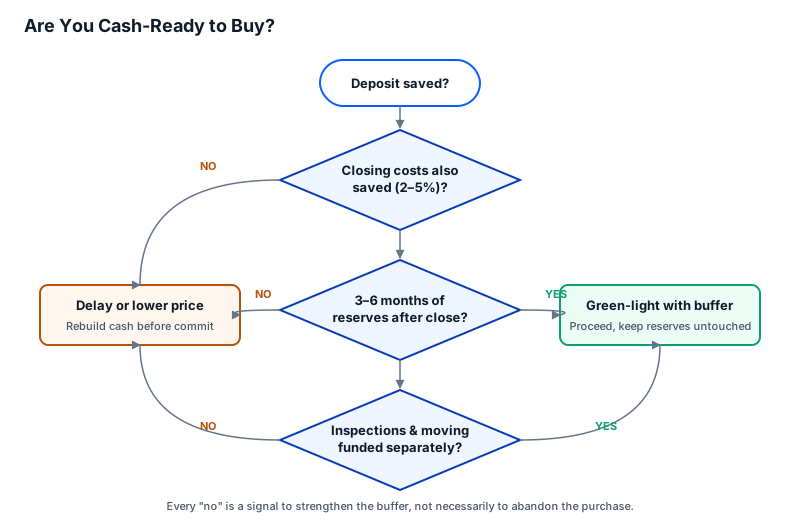
Use the six-step process below to translate a purchase price into a complete cash requirement.
Step 1 — Set the deposit target
Choose a target loan-to-value ratio based on lender minimums, mortgage-insurance thresholds, and your household risk profile. In the US, putting down less than 20% commonly triggers private mortgage insurance (PMI). In Canada, less than 20% triggers CMHC insurance. In the UK, higher LTVs mean higher fixed rates. Model the trade-off with adown payment calculator before committing.
Step 2 — Estimate closing / conveyancing costs
Use a first-pass estimate of 2%–5% of the purchase price for most Tier-1 markets, adjusting for transfer taxes and duties that vary heavily by location. Confirm with aclosing cost calculator and a Loan Estimate (US) or Illustration (UK) from your lender.
Step 3 — Budget inspections, appraisal and survey
Get quotes from at least two providers. Typical ranges: US home inspection $300–$700, appraisal $400–$800; UK RICS Level 2 or 3 survey £400–£1,500; Australia building & pest $400–$700 AUD; UAE property valuation AED 2,500–3,500 typical.
Step 4 — Plan moving and setup
List every item that flips from renter to owner: movers, storage, utility deposits (some UAE and Australian utilities require significant refundable deposits), cleaning, lock changes, and cost of any short-term overlap between old rent and new mortgage.
Step 5 — Budget furnishings and immediate essentials
Split into day-one essentials (bed, fridge, curtains, cookware, safety items) and defer-able items (dining table, decor). Furnish only day-one items with the initial cash budget; defer the rest for month three or later. This single discipline saves most buyers thousands.
Step 6 — Set the post-close reserve
Calculate three to six months of essential monthly expenses using a housing cost calculator. Add mortgage payment, property taxes, insurance, utilities, transport, food, and childcare. That number, multiplied by three at minimum, is what stays in the bank on completion day.
Worked numerical examples
The three examples below use realistic assumptions for three Tier-1 markets. Numbers are illustrative — always confirm rates locally.
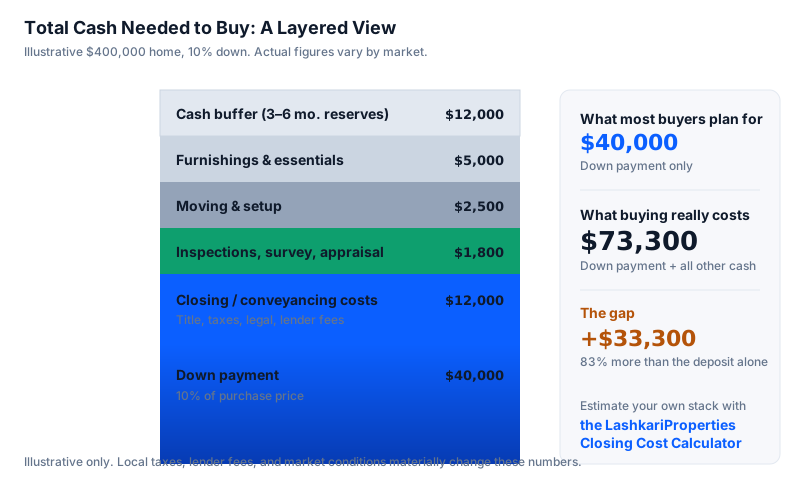
Example 1 — USA: $400,000 home, 10% down (Texas)
Total cash needed at close — US, $400,000 purchase, 10% down
Closing costs (title, lender, taxes, insurance prepay)
Moving (local, one-bedroom to two-bedroom)
Cash reserves (3 months PITI + utilities)
Contingency buffer (10% of the above extras)
The buyer who saved "just the deposit" of $40,000 is short by about $35,000. The gap is nearly as large as the deposit itself.
Example 2 — UK: £350,000 home, 15% deposit (England, not first-time-buyer relief eligible)
Total cash needed at completion — UK, £350,000 purchase, 15% deposit
Stamp Duty Land Tax (illustrative standard rate)
Buildings insurance (year 1) + life cover setup
3-month reserve (mortgage + council tax + utilities)
The UK stamp duty line alone — verify current rates and reliefs on GOV.UK— usually surprises first-time buyers when they miss out on relief thresholds by a few thousand pounds.
Example 3 — UAE: AED 1,500,000 apartment, 20% deposit (Dubai)
Total cash needed — UAE, AED 1,500,000 purchase, 20% deposit
Mortgage registration (0.25% + fixed fees)
Move-in fees (many Dubai communities) + DEWA deposit
3-month reserve (mortgage + service charge + utilities)
In Dubai, the deposit is only about two-thirds of the true cash requirement — one of the largest deposit-to-total ratios among Tier-1 markets. Always confirm the current fee schedule on the Dubai Land Departmentsite.
Best practice
Build each of the three examples above in your own spreadsheet using your target price. Force yourself to write a number in every row — even a rough one. The line you leave blank is the line that will surprise you at completion.
Example 4 — Canada: CAD 700,000 condo, 10% down (Toronto)
Toronto is a particularly useful case study because it combines a provincial land transfer tax (LTT) with a municipal LTT, meaning the transfer-tax line is roughly double what a comparable buyer in most other Canadian cities would pay. First-time-buyer rebates partially offset both, subject to eligibility on the CRA and City of Toronto sites.
Total cash needed — Canada, CAD 700,000 purchase, 10% down (illustrative Toronto)
Down payment (10%: 5% on first $500k, 10% on remainder)
Provincial + municipal LTT (post first-time-buyer rebate, illustrative)
Legal fees + disbursements + title insurance
Home inspection + status certificate review
Appraisal (waived by many lenders on high-ratio insured deals)
Moving + storage + condo elevator booking
3-month reserve (mortgage + condo fees + property tax + utilities)
Note that with less than 20% down the mortgage is CMHC-insured and the premium is added to the loan — it does not need to be paid in cash — but the sales tax on the CMHC premium (in Ontario, Quebec, Manitoba, and Saskatchewan) does need to be paid in cash. Confirm with CMHC.
Example 5 — Australia: AUD 800,000 home, 15% deposit (Melbourne, first-home buyer)
Australia's state stamp duties are structured with generous first-home-buyer concessions, but they cliff-edge at specific price thresholds. Buying just above a threshold can cost tens of thousands more than buying just below it.
Total cash needed — Australia, AUD 800,000, 15% deposit, first-home buyer, VIC (illustrative)
Stamp duty (illustrative concessional rate)
Lender's Mortgage Insurance (capitalised, cash portion of setup fees)
Verify current concessions and thresholds directly with the Victorian State Revenue Officeor your equivalent state authority.
Reading across the five examples
Aggregating the five worked scenarios, the extras (everything beyond the deposit) range from roughly 8% to 11% of the purchase price in three of the five markets, roughly 5%–6% in Canada with rebates, and reach 11% in the UAE case where transfer-tax and agency fees stack. Across all five, the deposit represents roughly 55%–75% of the total cash needed — never more than three-quarters, and never a safe planning assumption on its own.
Tier-1 market nuances
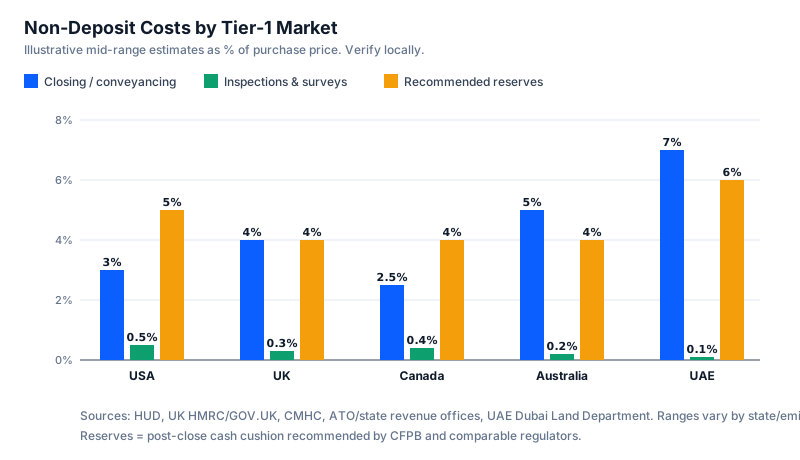
Theshapeof the cost stack differs by country. Below are the specific line items that most catch first-time buyers off-guard.
USA
Closing costs typically total 2%–5% of the purchase price. Transfer taxes, title insurance, and lender fees vary enormously by state (Texas is cheap, New York City is expensive). Below 20% down usually triggers PMI. Escrow accounts pre-fund property taxes and homeowner insurance. Guidance: CFPB Owning a Home.
UK
Stamp Duty Land Tax (or LBTT in Scotland, LTT in Wales) is the biggest variable. First-time buyer relief can eliminate SDLT under a threshold, so knowing the price band boundaries matters. Solicitor conveyancing, searches, and the lender's product fee round out the bill. Guidance: GOV.UK SDLT.
Canada
Land transfer tax is provincial (and municipal in Toronto). CMHC mortgage default insurance applies below 20% down and is capitalised into the loan but still affects cash flow. New builds also carry GST/HST. Guidance: CMHC Home Buying.
Australia
State-based stamp duty is often the biggest surprise, though most states offer meaningful first-home-buyer concessions or exemptions under specific price thresholds. Lenders Mortgage Insurance (LMI) applies below 20% deposit. Conveyancing and pest & building inspections are standard. Verify concessions on your state revenue office site.
UAE
Dubai and Abu Dhabi charge distinct government transfer fees (4% DLD in Dubai, ~2% in Abu Dhabi). Agent commissions (~2% + VAT), mortgage registration, and community move-in fees add up quickly. Non-resident buyers often face higher deposit requirements (25%+ common). Verify at the Dubai Land Departmentor Abu Dhabi DMT.
Rules change — verify locally
Stamp duty thresholds, insurance triggers, and first-time-buyer concessions change with most annual budgets. Every figure in this article is illustrative. Always check the current rate before you commit.
Common mistakes and myths
Myth 1 — "20% down means I'm covered"
A 20% deposit avoids some insurance premiums but says nothing about closing costs, reserves, moving, or furnishings. Buyers who wipe out their savings to reach 20% and then move in with zero cash are often more fragile than those who put down 10% and keep a strong buffer.
Myth 2 — "Closing costs get rolled into the loan"
Sometimes, partially. Some fees can be capitalised, but not all — and doing so increases your LTV, monthly payment, and total lifetime interest. Always price the trade-off before assuming.
Myth 3 — "I'll furnish over time, no need to budget"
True in spirit, but there are day-one non-negotiables: a bed, a place to cook, safety items, curtains for privacy. Underestimating even those items sends most buyers to high-interest store credit within 60 days.
Myth 4 — "Reserves are a lender formality"
Lenders may require documented reserves, but even where they don't, statistics on unexpected home repairs make a reserve non-negotiable. Standard industry rules of thumb (e.g. 1% of the home's value per year for maintenance) exist for a reason.
Myth 5 — "First-time-buyer schemes cover the extras"
Government programmes typically reduce a single line — stamp duty, deposit, or interest. They rarely fund moving, furnishings, or reserves. Read each scheme's fine print at source, not third-party summaries.
Mistake 1 — Timing new debt around completion
Taking on a new car loan, a store card, or even a large credit-card balance between mortgage approval and completion is a common way to have final approval revoked. Keep the debt profile flat from pre-approval to completion.
Mistake 2 — Ignoring the standing-order shock
Owner-occupancy layers property tax, service charge/HOA, buildings insurance, and higher utilities onto a rental-scale budget. Model the new monthly total with a housing cost calculator before committing.
Mistake 3 — Confusing gross savings with usable savings
Money locked in illiquid investments, retirement accounts with penalties, or long-notice ISAs is not the same as cash you can wire to a solicitor on Tuesday. Track a liquid-cash number separately.
Mistake 4 — Buying at the top of your approval
A mortgage pre-approval is a ceiling, not a target. Buying at 100% of your approval maximises the deposit and the extras simultaneously — and leaves nothing for the reserve. A defensible discipline is to buy at 85%–90% of your approved ceiling and put the difference in cash into the buffer. The house you can afford is not the house the bank will lend on; it is the house that leaves you liquid on the other side.
Mistake 5 — Skipping the survey to save the price of the survey
Especially common in the UK, where the lender's valuation is often mistaken for a survey. It is not. A lender's valuation is a desktop-plus-drive-by check that the house is worth what you're paying; it is not a condition report. Skipping a proper survey to save £600 has, in industry data, a materially negative expected value for buyers of homes older than about 25 years.
Mistake 6 — Underestimating the standing-order shock
The month after completion is the most expensive month of your life as a homeowner. Property tax standing orders start, service charge/HOA hits, buildings insurance runs, utility bills scale up to reflect a larger space, and if you moved in during winter, heating costs spike. Model this month before you complete — and add its total to your reserve rather than assuming a smoother ramp.
Mistake 7 — Treating first-time-buyer schemes as a full solution
Schemes are usually narrow: they reduce one line item, not the whole bill. A UK first-time-buyer SDLT relief is welcome, but it does not fund your reserve. A Canadian FHSA gives you a tax-advantaged deposit vehicle but does not lower your Toronto LTT. A US state DPA program may cover down payment or closing but rarely both, and often carries recapture provisions if you sell within a defined period. Read the fine print at the source.
How this connects to other property metrics
The full cash requirement doesn't sit in isolation — it interlocks with several metrics you should already be tracking as a first-time buyer or investor.
Affordability
Most affordability rules (28/36 in the US, 4.5x income guideline in the UK, GDS/TDS in Canada) test monthly capacity. But if the deposit-plus-extras drains you, the monthly payment stops being the binding constraint — cash liquidity does. Cross-reference with our How much house can I afford guide.
Loan-to-value (LTV)
Lower LTV means smaller loan, lower rate tier in most markets, and no PMI/LMI/CMHC. But pushing LTV too low by depleting reserves is a false economy. See What is LTV ratio.
Mortgage payment
The monthly payment sets the reserve target. Ourstep-by-step mortgage payment guide shows how principal, interest, taxes, and insurance combine into the PITI figure you'll multiply by 3–6 for reserves.
Debt-to-income ratio (DTI)
Any new debt on top of the mortgage — often taken to fund furnishings — pushes DTI up and reduces future borrowing headroom. Keeping the extras in the cash budget preserves that headroom.
Cash flow (for investors)
An investor's cash flow model must include the same extras plus vacancy, capex, and management. Underestimating extras is the single largest cause of first-time landlord losses.
Rental yield
Rental yield is usually calculated on the purchase price plus acquisition costs — not on the purchase price alone. An investor who ignores the extras will systematically overstate yield by 0.3–0.7 percentage points, which is often the difference between a positive-cash-flow and negative-cash-flow property once financing is factored in.
Capital growth expectations
Every non-deposit cost is a drag on your first-cycle return: closing costs need to be recovered from capital growth before any real return accrues. On a five-year hold, this typically requires 2%–5% of price growth just to break even after acquisition costs — before any factoring of selling costs on the way out. This is why real estate is generally a poor short-hold asset.
Run the numbers with free calculators
Estimating from a blog article is a starting point. Stress-testing your own numbers is where confidence comes from. The three free LashkariProperties calculators below map directly onto the line items in this guide.
Recommended calculator sequence
- Down Payment Calculator — set the deposit target and see the LTV, insurance triggers, and monthly implication side by side. Open the tool →
- Closing Cost Calculator — enter price and market to see typical transaction cost breakdowns. Open the tool →
- Housing Cost Calculator — model your total monthly cost of ownership so you can size the 3–6 month reserve accurately. Open the tool →
Run all three in the same session with the same purchase price. The outputs combine into your total cash requirement.
Once you have those numbers, add three lines the calculators don't cover — inspections/survey, moving, day-one furnishings — and you have a defensible total.
A realistic 12-month savings and preparation timeline
Extras rarely blow up buyers because they are expensive. They blow up buyers because they arrive concentrated. A realistic timeline spreads the effort across the twelve months before completion.
Months 12 to 9 — foundation
Set the target price band and target completion date. Run a first pass through the down payment calculator and closing cost calculator to establish a total cash requirement. Open a dedicated high-yield savings account for the buying fund and set automatic transfers. Get a soft credit check to know where you stand before formal pre-approval reduces flexibility.
Months 9 to 6 — build the deposit
Front-load the deposit into your dedicated fund. Keep the buffer physically separate — a different institution if possible — so you can't rationalise dipping into it. Begin light research on solicitors, mortgage brokers, and inspectors so you have a shortlist ready when you're transaction-ready. Freeze major new debt (car loans especially).
Months 6 to 3 — pre-approval and refinement
Obtain formal pre-approval. Use the lender's estimated closing cost sheet to refine your total. Start collecting fixed-price inspection quotes so you know exactly what those lines will cost when you're under offer. Continue building the deposit while beginning to segregate the reserve into a second, less-accessible pocket.
Months 3 to 1 — under offer
Once an offer is accepted, immediate cash outflows begin: earnest money or holding deposit, inspection payments, sometimes an initial legal retainer. These are non-refundable in most scenarios if you walk away. Reconfirm every closing cost line against the lender's formal Loan Estimate (US) or Illustration (UK). Move any remaining funds needed for completion into an instant-access account.
Completion month
Wire the balance of the deposit and closing costs. Take possession, complete the walkthrough or handover, run the utilities and locks setup. Keep the reserve untouched. Track your first-month standing-order shock separately so you can compare it to your model — the delta is the calibration you'll use for future property decisions.
Months 1 to 6 post-completion
Do not rebuild the reserve out of the housing-cost budget — rebuild it out of income surplus, and prioritise it over discretionary spending. This is also the phase where deferred furnishings should slowly land, ideally financed from monthly income rather than from any remaining cash pile.
Actionable framework & checklist
Print this checklist, or paste it into a spreadsheet. Do not open an offer without a number next to every line.
Pre-offer cash checklist
- Target purchase price documented, with a hard ceiling
- Deposit target set with a target LTV and insurance trigger checked
- Closing / conveyancing estimate obtained from a calculator and a lender quote
- Inspection, survey, and appraisal quotes gathered from at least two providers
- Moving budget with quotes if using professionals
- Day-one furnishings list separated from a "later" list
- Post-close reserve target = 3–6 months of essential expenses
- Contingency buffer of 10% of the extras added on top
- Liquid-cash total confirmed against real bank balances (not retirement)
- Debt profile flat since pre-approval — no new loans or store cards
- All figures verified against local government or lender sources
- Written note of what is not covered by any first-time buyer scheme
Warning — do not tap these to close
Retirement accounts with early-withdrawal penalties, long-notice fixed-term savings, and money you have earmarked for tax bills are not liquid buying funds. Treat them as untouchable unless you have consulted a licensed professional.
Ready to size your total cash requirement?
Model your deposit, closing costs, and monthly housing bill with three free LashkariProperties calculators — no signup required.
Frequently asked questions
How much cash do first-time buyers really need beyond the down payment?
Plan for roughly 2%–5% of the purchase price for closing / conveyancing costs, a few hundred to a few thousand for inspections and surveys, one-off moving and setup, essential furnishings, and a post-close cash reserve of three to six months of housing expenses. On a $400,000 home this often adds $30,000–$40,000 on top of the deposit.
What are closing costs and how are they different from the down payment?
Closing costs are the fees required to complete the transaction — lender fees, title/legal, taxes and duties, escrow items, and insurance prepayments. The down payment goes toward the purchase price and becomes home equity. Closing costs do not build equity.
Do I really need cash reserves after buying a home?
Yes. Most consumer-finance authorities recommend three to six months of essential expenses in liquid savings after closing. Many lenders also require documented reserves — especially for jumbo loans or investment properties.
Are inspection and survey fees refundable if I walk away?
Generally no. Inspection and survey fees are paid to third-party professionals for work already performed and are usually non-refundable, even if the deal falls through.
How much should I budget for moving into a first home?
For a local move, most first-time buyers spend $500–$2,500 on movers, packing, and utility connections. Long-distance and international moves can run into five figures. Add temporary storage, cleaning, deposits, and lock changes for a realistic total.
Can I use a personal loan or credit card to cover extra buying costs?
Technically yes, but it is rarely a good idea. New debt taken on close to completion can change your debt-to-income ratio and jeopardise mortgage approval. It also erodes the cash buffer you need in the first months of ownership.
What is the difference between mortgage reserves and an emergency fund?
Mortgage reserves are what a lender requires to see in your accounts — often expressed in months of PITI. Your emergency fund is a broader personal cushion covering all essential expenses. Reserves are a subset of a well-run emergency fund.
Do closing costs vary between the USA, UK, Canada, Australia and the UAE?
Significantly. US buyers typically face 2%–5% in closing costs; UK buyers face conveyancing plus SDLT; Canadian buyers pay land transfer taxes and legal fees; Australians pay state stamp duty and registration; UAE buyers commonly pay DLD/DMT fees plus agent and mortgage registration.
Is 20% down payment still the goal, or should I put down less and keep cash?
It depends on total cost. A 20% deposit typically avoids private mortgage insurance and lowers monthly cost, but wiping out reserves to hit 20% can leave you exposed. Many first-time buyers do better with 5%–15% down plus a well-funded buffer.
How do I estimate all these costs before making an offer?
Use free calculators to model each layer separately: a down payment calculator for the deposit target, a closing cost calculator for transaction fees, and a housing cost calculator for the monthly total. LashkariProperties offers all three at lashkariproperties.com/tools.
What is a realistic cash buffer for a first-time buyer?
A defensible baseline is three months of essential expenses in cash after all buying costs are paid. Six months is stronger, especially for single-income households, self-employed buyers, or properties needing near-term repairs.
Do first-time buyer schemes cover any of these extra costs?
Some do — UK Stamp Duty relief, US state down-payment assistance, and Canadian FHSA-style accounts can reduce specific line items. They rarely cover moving, furnishings, or reserves. Check government sources before assuming.
Stress-test scenarios — what if things go wrong?
The value of a buffer is only visible when tested. Below are five stress-test scenarios that first-time buyers meet with distressing regularity in the first two years of ownership.
Scenario A — Boiler / HVAC failure in month three
Replacement cost: $4,000–$9,000 in the US, £2,000–£4,500 in the UK, similar ranges in Australia. Buyers with a 3-month reserve absorb this without borrowing. Buyers with no reserve add high-interest debt that materially raises housing cost for a year or more.
Scenario B — Interest rate reset on a variable or short-fixed mortgage
A 1.5 percentage-point rate rise on a $400,000 mortgage adds roughly $500/month, or $6,000/year. If you were budgeting exactly to your fixed rate, this is a real household-income event. A reserve gives you time to adjust — refinance, cut discretionary spending — rather than crisis-cutting.
Scenario C — Job loss or income disruption
The classic case for a six-month reserve. Even for dual-income households, one job loss is a meaningful event; a three-month reserve at essential-expense level typically covers the notice period and a modest job search.
Scenario D — Undiscovered defect surfaces after completion
Even a thorough inspection cannot see behind walls or under floors. A significant repair in the first year — a leaking shower, subsidence, electrical rewiring — is not a rare event. Industry surveys of first-year homeowner spending consistently show 1%–4% of purchase price on unplanned work.
Scenario E — Special levy on a condo or leasehold building
An owner of an apartment can be assessed a special levy for a major building repair with 30 to 90 days' notice. Reading the strata or management-pack accounts before purchase is your first line of defence; a reserve is your second.
How to stress-test
For each scenario, ask: does the reserve I plan to hold on completion day cover this? If two of the five would deplete or exceed your reserve, size up the buffer before you complete — not after.
Conclusion & next steps
The deposit is a milestone, not a finish line. First-time buyers who cross the threshold with a full picture of closing costs, inspections, moving, furnishings, and reserves are the ones who avoid the two most damaging outcomes: last-minute borrowing that jeopardises mortgage approval, and a first year of ownership spent in financial anxiety instead of building a home.
The framework is simple, if not always easy:
- Write down every line, not just the deposit.
- Verify each line against a local, authoritative source.
- Model the numbers with the free calculators linked throughout this guide.
- Keep a reserve untouched — it is not optional.
When you're ready, run your target purchase through the three key tools: Down Payment,Closing Cost, and Housing Cost. Then read our companion guides onhow much house you can afford and what closing costs actually cover.
Sources
Related reading
Continue reading: The 28/36 Rule: Still Useful in 2026? · Closing Costs Explained for Buyers · Debt-to-Income Ratio for Home Buyers. Run your own numbers with the Down Payment Calculator — it takes under a minute and beats guessing.
Related reading
- How Much House Can I Afford? A Practical Numbers Framework
- How to Calculate Mortgage Payments Step by Step
- Is a 20% Down Payment Required? What Buyers Actually Need
- What Is LTV Ratio and Why Lenders Care
- Closing Costs Explained: What Home Buyers Actually Pay
Last updated:5 August 2026. This article is reviewed twice a year to keep tax thresholds and typical fee ranges current. If you spot a figure that no longer matches your local reality,let us know.
Frequently asked questions
What costs come on top of the deposit?
Stamp duty or transfer tax, legal and conveyancing fees, surveys, lender arrangement fees, searches, and the moving and furnishing costs after completion. Together they can add several percent to the purchase price and often catch first-time buyers off guard.
How much do first-time buyers need in total?
A realistic planning rule is the deposit plus roughly 3 to 5 percent of the price for costs, plus a household reserve. The gap between the deposit and the true cash cost is where first-time buyers most often stall, so build the full picture before you offer.
What is cash-to-close?
It is the total money due at completion: deposit, closing or legal costs, transfer taxes, lender fees, and prepaid items. The Closing Cost Calculator builds it line by line so completion day holds no invoice you have not already seen.
What is the cheapest month to buy a first home?
January and February are historically the best for negotiating: listings are low but so is competition, and sellers who list in winter are usually motivated. December can work because buyers are distracted by holidays. September and October see the most inventory but also the most bidding. The savings from negotiating 2 to 3 percent off list price usually dwarf any seasonal interest-rate differences.