


This article explains general concepts and typical ranges. It is not personalised financial, tax, or legal advice. Rules, thresholds and rates change frequently and vary by country, state, and lender. Always verify figures with a licensed local professional before making a purchase decision.
1. What Are Closing Costs? A Working Definition
Closing costs are the collection of fees, taxes and prepaid items that must be settled the day a property legally changes hands. They are separate from — and additional to — your down payment. In the United States they are formally disclosed on a Closing Disclosure; in the United Kingdom they appear on your solicitor's completion statement; in Australia they show up on your conveyancer's settlement statement; and in the UAE they are captured in the Dubai Land Department transfer breakdown.
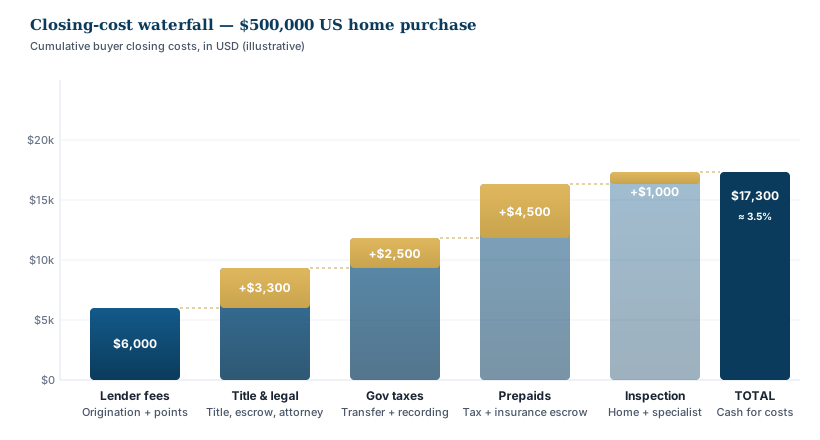
A useful mental model is that closing costs sit in five buckets. Every fee you'll ever see on a closing statement, in any Tier-1 market, drops into one of them. Learn the five buckets once and you'll never be blindsided by a line item again, whether you're buying a starter home in Ohio, a leasehold flat in London, a duplex in Toronto, an off-plan tower in Dubai Marina, or a Queenslander in Brisbane.
- Lender fees — costs charged by the bank to originate and underwrite your mortgage.
- Title, legal and conveyancing — fees to verify ownership and transfer legal title.
- Government taxes and recording — transfer taxes, stamp duty, registration and DLD fees.
- Prepaid escrow items — property tax, homeowners insurance and interest paid up-front.
- Inspection and due diligence — home inspection, survey, and specialist reports.
The reason closing costs feel so complex is not that any single bucket is hard to understand — it's that most buyers first encounter them as one giant undifferentiated number on a Loan Estimate, three days after they've fallen in love with a property. By that point, emotional commitment has already outrun analytical rigour. The purpose of this guide is to reverse that sequence: understand the buckets before you tour a single listing, and the numbers become predictable rather than mysterious.
One more definitional note. Closing costs are conceptually distinct from ongoing costs of ownership — the monthly mortgage payment, council tax or property tax, homeowners association dues, service charges, insurance renewals, and maintenance. Ongoing costs live in your household budget after you move in. Closing costs are almost entirely paid in a single day, in cleared funds, and if you're short by even $500, the transaction cannot legally complete. That is why we treat them with disproportionate care in this guide.
When any advisor quotes you a percentage for "closing costs," ask which of the five buckets they are including. Some quotes exclude prepaid items or taxes — the two biggest surprises for first-time buyers. The industry-standard shorthand of "2%–5% of purchase price" almost always refers to the US market and often excludes upfront mortgage insurance premium, transfer taxes above 1%, and full 12-month insurance prepayment. Always ask the quoter to itemise.
Closing costs vs. cash to close vs. total cost of purchase
These three terms are often used interchangeably. They shouldn't be. Understanding the difference is the first step to avoiding an unpleasant last-minute wire transfer.
All third-party fees, taxes and prepaids at settlement
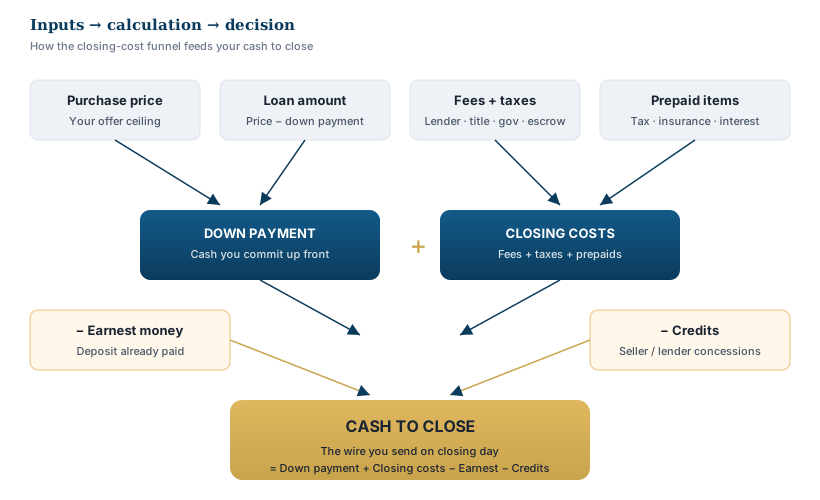
Down payment + closing costs − earnest money − credits
Cash to close + moving + immediate repairs + first-year running costs
2. Why Closing Costs Matter More Than Buyers Think
A 3% closing-cost surprise on a $450,000 home is $13,500 — real money that has to hit an escrow account in cleared funds on completion day. Buyers who fixate only on the down payment routinely arrive at closing short. Lenders will not fund the loan if the shortfall isn't cured, which means either a delayed closing, a last-minute cash scramble, or a collapsed deal that costs the buyer their earnest money deposit and, sometimes, their locked interest rate.
For investors and landlords, closing costs matter for a different reason: they reduce day-one equity and stretch the break-even horizon. If you buy a rental at $300,000 and pay $12,000 in closing costs, your true cost basis is $312,000. That extra $12,000 has to be recovered through appreciation and net rental income before you are truly ahead — which is why sophisticated buyers add closing costs to their cost basis when computing capitalised returns and rental yield. A landlord who models a 6% gross yield on $300,000 but ignores $12,000 in acquisition costs has actually locked in a 5.77% yield on true capital deployed. That 23-basis-point gap compounds over a 10- or 15-year hold.
Renters considering the leap to ownership face a subtler version of the same problem. They typically compare monthly rent to a projected monthly mortgage payment and conclude that buying is cheaper. Almost no such comparison survives contact with the closing statement. The one-off transaction costs — often equal to 6–12 months of rent — must be amortised over an expected hold period before any monthly comparison is meaningful. Ourrent vs buy decision framework walks through that adjustment in detail.
Even move-up buyers underestimate. Selling one home and buying another triggers two sets of transaction costs — often 8–15% of the transacted value combined. That is the primary reason housing economists observe such low residential mobility in Tier-1 markets: transaction friction, not lifestyle preference, is what keeps many households in properties they have outgrown.
"Every 1% of closing costs you underestimate is one less month of emergency reserves after you move in. Buyers who close with $500 left over regret it within 90 days."
The three risks of underestimating
- Failed completion — the transaction cannot close, earnest money is at risk.
- Depleted reserves — you close successfully but have no cushion for repairs, appliances, or a job disruption.
- Distorted returns — for investors, ignoring closing costs inflates projected cash-on-cash yield by 1–3 percentage points.
The behavioural trap of the "headline number"
Property portals list one number: the asking price. Mortgage brokers quote a second: the monthly payment. Neither of those anchors tells you what actually leaves your bank account on closing day. Behavioural economists call this the availability heuristic — buyers substitute the number they see most often (the sticker price) for the number that actually matters (cash to close). Escape the trap by writing your cash-to-close estimate at the top of every property shortlist. The number should update as your target price and negotiations evolve, not as an afterthought.
3. The Itemized Fee List: Every Line You'll See
Below is the master itemized list. Not every buyer pays every line; the mix depends on market, loan type and lender. Use this as your reference when you review a Loan Estimate, Closing Disclosure, or completion statement.
3.1 Lender fees
Lender fees are the charges your mortgage provider levies to originate, underwrite and disburse the loan. In competitive lending markets — the US, UK, Australia and Canada in particular — these are the most negotiable of all closing costs. Two lenders quoting the same interest rate can charge $3,000 apart in origination fees for an identical loan. The single highest-return activity a buyer can perform is to request formal quotes (Loan Estimates in the US, illustrations in the UK) from at least three lenders and compare them line by line.
Lender's charge to process and issue the loan
Optional prepaid interest to lower your rate
Independent value opinion required by lender
Upfront PMI/MIP on low-down-payment loans
3.2 Title, legal and conveyancing
Title fees exist because property law demands a chain of documented ownership. Every previous sale, mortgage, lien, easement and boundary dispute must be verified and cleared before the lender will fund your loan. In the US, this work is done by a title company and insured by a title-insurance policy. In the UK, a solicitor or licensed conveyancer performs the equivalent process against Land Registry data. In Australia, a conveyancer verifies the certificate of title. Each system produces the same commercial outcome — clean, insurable title — through different institutional means.
Fees to transfer legal title and insure it
Protects you against future title defects
Third-party who holds funds until closing
3.3 Government taxes and recording
Government charges are the least negotiable and often the largest single line on a buyer's closing statement. Unlike lender fees, you cannot shop them. Unlike prepaid items, you do not get them back. They are transactional taxes on the transfer of ownership, levied by national, state, provincial or municipal governments — and the differences between jurisdictions are enormous.
3.4 Prepaid escrow items
This bucket confuses buyers more than any other, because prepaids are not fees at all. You will owe property tax and insurance whether or not you have a mortgage; the lender simply requires that some months are paid in advance and held in an escrow account so that future bills — which secure the lender's collateral — cannot be missed. Psychologically, prepaids feel like extra costs. Economically, they are cash-flow timing.
Prepaid items are not fees for services — they are amounts you owe anyway, but which the lender collects up front and holds in escrow so future bills are paid on time.
- Prepaid property tax — typically 2–12 months of tax, depending on when in the tax year you close.
- Prepaid homeowners insurance — 12 months' premium collected at closing.
- Prepaid mortgage interest — daily interest from the closing date to the first mortgage payment.
- Initial escrow deposit — a 2-month cushion for taxes and insurance.
- HOA or service-charge prepayments — condo, co-op, or leasehold prepaid dues.
3.5 Inspection and due diligence
Inspection costs are the smallest bucket but arguably the highest ROI. A$200 home inspection that surfaces a $12,000 roof replacement gives the buyer either a negotiating lever or an early exit before earnest money becomes non-refundable. Skipping inspection to "save" $500 is one of the worst decisions a first-time buyer can make. Even in fiercely competitive markets where buyers waive inspection contingencies to strengthen offers, we recommend performing the inspection for information only — you may not be able to renegotiate, but you'll know exactly what you're inheriting.
- Home inspection — $300–$600 in the US, £400–£900 in the UK for a home buyer's report.
- Pest, radon, mold, or well tests — $75–$300 each where applicable.
- Survey / boundary survey — $400–$1,000, often required by lender.
- Building or structural report — £500–£1,500 in the UK for a Level 3 survey.
4. Who Pays What: Buyer vs Seller
Buyers pay the majority of closing costs in most markets, but sellers pay too — and the split matters when you're negotiating. Here is a Tier-1 comparison of typical customs. Local practice and the sales contract override defaults, so always read your paperwork.
Lender fees, title insurance, escrow, prepaids, transfer tax (varies)
Real-estate commission (5%–6%), owner's title in some states, transfer tax in some states
SDLT, solicitor, searches, survey, mortgage fees
Estate agent commission (1%–3% + VAT), own solicitor, EPC
Land transfer tax, legal fees, title insurance, home inspection
Real-estate commission (3.5%–5%), own legal, mortgage discharge
Stamp duty, conveyancer, transfer fee, building/pest inspection
Agent commission (2%–3%), marketing, discharge of mortgage
DLD 4% fee, trustee registration, mortgage registration, agent commission (2% + VAT)
NOC fee, agent share (occasionally), service-charge clearances
"Seller concessions" or "vendor contributions" are contractually agreed credits from seller to buyer to cover part of the buyer's closing costs. In a soft market, asking for 2%–3% is common; in a hot market you may get zero. This is one of the highest-leverage negotiation levers a buyer has after price itself.
How to spot who really pays what
Custom is not law. In every Tier-1 market, the sales contract can shift charges from one party to the other. What matters is what your specific contract says, not what "usually" happens. When you receive the draft contract, work line by line against the itemised fee lists above and mark each entry with "B" (buyer), "S" (seller), or "Split." This 20-minute exercise regularly surfaces $2,000–$5,000 in mis-allocated fees that your solicitor or attorney can push back on before signing.
Sellers and buyers also face different tax treatment on identical fees. A US seller can deduct their real-estate commission from capital-gains proceeds; the buyer cannot deduct any equivalent. UK sellers pay their own solicitor and estate agent from proceeds; buyers pay theirs from savings. Understanding whose after-tax pocket each fee comes from often opens creative negotiation solutions — a $5,000 seller credit at closing can be worth more or less than a $5,000 price reduction depending on tax posture, mortgage insurance thresholds and appraisal risk.
5. The Cash-to-Close Formula
Every buyer should be able to recite this formula from memory before making an offer:
Each input can be estimated within an acceptable margin of error long before you formally apply for a mortgage. That is exactly the point: you should treat your first offer as aninformedoffer, not an experimental one.
Notice what the formula does not include: monthly mortgage payment, moving costs, immediate repairs, new appliances or furniture. Those are real costs but they are not cash-to-close. Confusing the two is the second most common budgeting mistake among first-time buyers (after ignoring closing costs entirely). Keep the two budgets clean and separate — one for the closing event, one for the first 90 days of ownership.
Also note the asymmetry: earnest money and credits are subtracted, not added, because you have already committed the earnest money (it's currently sitting in an escrow account, not in your bank) and because credits are money you don't need to bring. A very common source of buyer panic in the final week before closing is forgetting that the earnest money is already "in the system" and mentally double-counting it against savings. Read your escrow account balance before you calculate.
6. Step-by-Step: Estimating Your Own Numbers
Here is the process we teach in our first-time buyer workshops. Work through it once with realistic inputs before you contact a lender — you'll ask sharper questions and negotiate from a stronger position.
- Step 1 — Fix the purchase price and loan amount: start with the ceiling price you are prepared to offer. Subtract your target down payment. That's your loan amount. Use our down payment calculator to check whether that mix keeps your LTV in a favourable band.
- Step 2 — Estimate lender fees: assume 0.75%–1.25% of the loan amount for origination and underwriting. Add $500 for appraisal and credit. If your down payment is below 20% (US) or you're using a high-LTV product, add mortgage insurance.
- Step 3 — Estimate title, legal, and conveyancing: budget 0.5%–1.5% of the purchase price. In the UK, add fixed solicitor fees (£800–£1,800) and search costs (£300–£500) separately.
- Step 4 — Add the government tax layer This is the biggest single variable. Look up your specific jurisdiction. See §8 for Tier-1 nuances.
- Step 5 — Add prepaid items: add 12 months of insurance premium, 2–6 months of property tax (or council tax pro-rata in the UK), and roughly 15 days of mortgage interest as a rounding buffer.
- Step 6 — Subtract earnest money and credits: your earnest money (usually 1%–3% of price in the US, 10% deposit at exchange in the UK) is already sitting in escrow. Subtract it, plus any lender credit or seller concession you've negotiated.
- Step 7 — Add a 10%–15% contingency: because appraisals come in low, rate locks expire, and title searches surface surprise liens. Underwrite your cash buffer, not your best case.
What to do with the estimate
A completed cash-to-close estimate has three practical uses. First, it tells you whether you actually have enough saved — verify your liquid savings covers the estimate plus 3–6 months of post-closing reserves. Second, it becomes the basis for your affordability ceiling: back-solve for the price at which the numbers still work with your current savings. Third, it becomes the reference document you use to challenge every Loan Estimate you subsequently receive. If a lender's estimate exceeds yours by more than 10%, ask specifically which line items diverge, and why.
Re-run the estimate each time a material variable changes: a new property, a new rate quote, a change in loan type, a shift in your down-payment plan, or a change in negotiated concessions. The estimate is a living document from search to closing, not a one-off exercise.
7. Three Worked Examples
Numbers make the abstract concrete. Below are three realistic scenarios — a US first-time buyer, a UK second-stepper and a UAE off-plan investor — with every line broken out. Figures are illustrative for education; verify your own with a lender.
Example A — US first-time buyer, $450,000 home in Austin, Texas
Illustrative buyer closing statement — Austin, TX
Attorney (Texas requires attorney or title co.)
Cash to close (down payment + net closing costs)
Reading: Closing costs alone are 5.4% of the purchase price — largely because FHA's 1.75% upfront MIP is a big single line. This buyer needed roughly 8.8% of the price in cash to close, well above the "5% down" headline.
Example B — UK second-time buyer, £425,000 flat in Manchester
Illustrative buyer completion statement — Manchester, UK
Stamp Duty Land Tax (non-first-time buyer)
Deposit paid at exchange (10% already gone)
Reading: UK closing costs are dominated by SDLT — here 74% of all fees. The rest is modest by international standards. Note that half of the deposit is typically wired at exchange, not completion.
Example C — UAE off-plan investor, AED 1,800,000 apartment in Dubai Marina
Illustrative buyer settlement — Dubai, UAE
Real-estate agent commission (2% + 5% VAT)
Mortgage registration (0.25% of loan + AED 290)
Reading: UAE buyers face the highest headline percentage — closing costs here are 7.5% of price. The DLD fee alone (4%) is larger than the entire buyer-side stack in many US states.
Every worked example above is illustrative — actual costs vary with lender, city, and product. Use our
for a personalised estimate that accepts your specific city and loan type.
8. Tier-1 Market Nuances: US, UK, Canada, Australia, UAE
No two Tier-1 property markets treat closing costs the same way. Below are the nuances that most affect buyer cash flow. Consult a licensed local professional before relying on any figure — these details change with each budget cycle.
8.1 United States
US closing costs are the most fragmented globally. State transfer taxes range from 0% (Texas, several others) to more than 2% (Delaware, parts of New York City with mansion tax). The federal TRID rule requires a standardised Loan Estimate within three business days of application and a Closing Disclosure at least three business days before closing — take advantage of that window to shop title providers, which is your legal right and often overlooked. The Consumer Financial Protection Bureau publishes plain-English guidance on both documents at consumer finance.gov.
Loan type matters enormously. Conventional loans typically carry the lowest closing costs at higher down payments. FHA loans add a 1.75% upfront mortgage insurance premium that often single-handedly turns a "low-cost" quote into the most expensive option overall. VA loans include a funding fee of 1.25%–3.3% depending on service and down-payment history. USDA rural loans carry a 1% guarantee fee. When comparing offers, always convert to total cash needed at closing, not to origination fee alone.
8.2 United Kingdom
Stamp Duty Land Tax dominates UK buyer costs. As of 2026, England and Northern Ireland apply tiered rates on the portion of the price above each threshold, with a lower rate band for first-time buyers on qualifying homes. Scotland uses Land and Buildings Transaction Tax; Wales uses Land Transaction Tax. Current rates and thresholds are published by HM Revenue & Customs atgov.uk/stamp-duty-land-tax. Buyers should also budget for search fees, a Land Registry fee, and — if buying leasehold — a leasehold information pack from the freeholder.
A distinctive feature of the English and Welsh system is the "exchange of contracts" moment — typically 1–4 weeks before completion — at which the buyer becomes legally bound and traditionally pays a 10% deposit to the seller's solicitor. This deposit is real cash out of your account long before completion day, and it is often overlooked in cash-flow planning. If you are buying and selling simultaneously, your solicitor can normally use the incoming deposit from your buyer to fund the outgoing deposit to your seller — but confirm the mechanics with your solicitor early, not on the day.
Buyers of additional properties (second homes, buy-to-let) pay a further 3-percentage-point SDLT surcharge on the entire price, not just the portion above thresholds. Non-UK-resident buyers pay an additional 2-percentage-point surcharge on top of that. The cumulative effect on a £700,000 buy-to-let purchase by a non-resident can push the effective stamp duty rate above 12% — a scenario every cross-border investor should model before signing anything.
8.3 Canada
Provincial land transfer taxes range from 0.5% to 2%, with Toronto adding a municipal LTT on top, effectively doubling the bill for Toronto buyers. First-time buyer rebates apply in Ontario, BC, and PEI. CMHC insurance is required on any mortgage above 80% LTV and can be added to the loan (but the premium PST cannot). Refer to the Canada Mortgage and Housing Corporation atcmhc-schl.gc.cafor current insurance premium tables.
A quirk of the Canadian system: while CMHC insurance premiums can be capitalised into the loan, the provincial sales tax on those premiums (charged in Ontario, Quebec, Manitoba and Saskatchewan) must be paid in cash at closing. On a $500,000 mortgage with a 5% down payment, the PST alone can exceed $2,000. Foreign-buyer taxes in Ontario (25%) and BC (20%) additionally apply to non-resident purchasers in designated regions — always verify residency status against the current provincial rules.
8.4 Australia
Australian stamp duty is state-based and steeply progressive — a $900,000 home in Sydney can trigger $35,000+ in duty. First home owner grants and stamp-duty concessions vary widely by state and change with each state budget. The Reserve Bank of Australiapublishes housing-cost research that provides useful context on total buyer expenditure.
Australia's Lenders Mortgage Insurance (LMI) is the direct analogue of US PMI and Canadian CMHC insurance. It kicks in on any loan above 80% LVR and is typically added to the loan principal, meaning you pay interest on the premium for the life of the loan. On a $700,000 loan at 90% LVR, LMI can add $12,000–$18,000 to your debt on day one. First-home buyers accessing government schemes such as the First Home Guarantee can bypass LMI entirely — a benefit worth many multiples of any modest stamp-duty concession. Check current eligibility with a licensed mortgage broker; scheme rules and caps evolve annually.
8.5 UAE (Dubai focus)
The 4% Dubai Land Department transfer fee is fixed by law and paid on the day of transfer. Custom in Dubai has increasingly shifted the DLD fee entirely to the buyer, although the underlying law splits it. Off-plan buyers pay Oqood registration in place of the transfer fee at initial registration, with the balance settled at handover. Agent commission of 2% plus VAT is standard and paid by the buyer.
Two nuances catch international investors off-guard. First, expat resale mortgages require a minimum 20% down payment for properties under AED 5 million and 30% above that threshold. Second, non-Emirati buyers are generally restricted to designated "freehold" zones such as Dubai Marina, Downtown, Business Bay, Palm Jumeirah, JVC, and Dubai Hills — the freehold register is maintained by the Dubai Land Department. Buying outside these zones is possible only through leasehold or usufruct structures, each with different cost and exit profiles. Confirm the zoning status of any specific tower or plot before making an offer.
Abu Dhabi operates a materially different transfer-fee regime (currently 2%), and the other emirates each set their own rules. Do not assume that "UAE" is one closing-cost jurisdiction — it is seven, with Dubai the most-documented and most-transacted.
9. Common Mistakes and Myths
The same avoidable errors repeat across first-time purchases. Here are the ten most consequential.
- Confusing "down payment" with "cash to close."The down payment is one input into cash to close, not the whole answer.
- Assuming the seller pays closing costs. Sellers pay some — commission, discharge fees — but the buyer's stack is separate and larger in most markets.
- Skipping the Loan Estimate comparison. Getting quotes from three lenders is the single highest-ROI action a buyer can take. Origination fees and title provider choice alone can differ by $2,000+.
- Ignoring prepaids. Prepaid tax and insurance are real cash out of pocket, not soft costs.
- Forgetting about the appraisal gap. If your home appraises below contract price, you cover the shortfall — usually in cash — or renegotiate.
- Rolling everything into the loan. Yes, it lowers cash needed today; it also increases lifetime interest by tens of thousands.
- Treating quoted percentages as gospel."2%–5%" is a starting range, not a personalised estimate. Your ZIP code, loan type, and lender each shift it.
- Underestimating UK SDLT bands. Buyers routinely forget the additional 3% surcharge on second homes and buy-to-let.
- Failing to reserve a contingency.A 10–15% contingency above the estimate is not paranoia — it's normal.
- Wiring funds without verifying instructions. Closing-day wire fraud is the fastest-growing property-related fraud in Tier-1 markets. Always call the escrow office at a number you verified independently.
Never approve a last-minute change of wire instructions received by email. Confirm any change verbally with your escrow officer using a phone number you obtained at the start of the transaction, not from the email itself.
10. How Closing Costs Connect to Other Buyer Metrics
Closing costs don't live in isolation. They ripple through every other number that matters to a buyer or investor.
Not directly affected, but rolling closing costs into the loan raises LTV, which can trigger mortgage insurance.
Higher rolled-in closing costs raise monthly payment, worsening DTI at qualification.
For investors, closing costs increase the cash-invested denominator, lowering yield.
Every 1% of closing costs adds roughly 3–6 months to the point at which selling covers costs.
Most closing costs add to your basis, reducing capital-gains tax on future sale.
The single most important number for surviving month 1–12 of homeownership.
For a deeper treatment of these connections see our companion guides on LTV ratio,how much house you can afford, and calculating mortgage payments step by step.
11. Running the Numbers with Free Calculators
Rather than doing three parallel spreadsheets by hand, plug your numbers into the free tools on LashkariProperties. Each calculator is designed to feed the next — start with price and down payment, then layer closing costs, then stress-test the resulting mortgage payment.
Enter price, loan amount and location. Get an itemised buyer closing-cost estimate with market-specific taxes and fees.
See how different down-payment percentages change your loan amount, LTV, and mortgage insurance requirement.
Combine principal, rate and term to see your true monthly payment — including taxes and insurance where applicable.
A recommended sequence: Down Payment → Closing Costs → Mortgage. Doing them in that order surfaces cash-to-close problems before you fall in love with a specific property.
12. The Buyer's Closing-Cost Checklist
Print or save this before you make an offer. Every item is a real-money decision.
- I have Loan Estimates from at least three lenders.
- I have identified my transfer tax / stamp duty / DLD bill by post code.
- I have confirmed which items are fixed vs. negotiable.
- I have shopped title, escrow, or conveyancer providers.
- I have modelled 3, 6, and 12 months of prepaid property tax scenarios.
- I have priced 12 months of homeowners / buildings insurance.
- I have factored earnest money already deposited into cash-to-close.
- I have asked the seller for a concession (or intentionally chosen not to).
- I have a written wire-instruction verification protocol.
- I have a 10%–15% cash contingency above my best estimate.
- I have modelled the impact of rolling costs into the loan and rejected/accepted it consciously.
- I have savings equal to at least three months of the new monthly payment after closing.
you sign a purchase contract. Discovering a gap after you're under contract limits your negotiating power to almost zero.
13. Frequently Asked Questions
Closing costs are the third-party fees, taxes and prepaid items a buyer (and sometimes seller) pays at settlement in addition to the down payment. They typically include lender fees, title and legal costs, taxes such as transfer or stamp duty, and prepaid escrow items like homeowners insurance and property tax.
How much are closing costs for a home buyer?
In the United States, buyer closing costs typically run 2%–5% of the purchase price. In the UK they range from about 1.5%–4% (plus SDLT on higher-priced homes). Canadian buyers usually pay 1.5%–4%, Australians 4%–6%, and UAE buyers around 6%–8% including the 4% DLD transfer fee.
What is the difference between closing costs and cash to close?
Closing costs are the fees and taxes owed at settlement. Cash to close is the total wire or cashier's check the buyer brings, which equals the down payment plus closing costs minus any earnest money deposit and lender or seller credits.
Who pays closing costs — buyer or seller?
Both parties pay closing costs, but the split varies. In the US the buyer typically pays lender and title fees while the seller pays real-estate commissions. In the UK and Australia the buyer pays stamp duty; in the UAE the buyer pays the 4% DLD fee. Local custom and the sales contract determine the exact split.
Can closing costs be rolled into the mortgage?
Some closing costs can be financed by increasing the loan amount, using a lender credit in exchange for a higher rate, or negotiating seller concessions. Prepaid items and the down payment generally cannot be rolled in. Financing costs raises your monthly payment and total interest.
In most Tier-1 markets, only certain items are deductible or add to your cost basis. In the US, mortgage interest, points and property taxes are generally deductible while title and transfer fees increase basis. Rules differ by country and change frequently — verify with a licensed tax professional.
Closing costs are paid on the closing or completion date, typically via wire transfer or cashier's check. In the US you receive a Closing Disclosure at least three business days before closing. In the UK you send funds to your solicitor before completion day.
How do I estimate closing costs before making an offer?
Use a closing cost calculator that accepts the purchase price, loan amount, location and loan type, then adds jurisdiction-specific taxes such as US transfer tax, UK SDLT, Australian stamp duty or UAE DLD fee. Add a 10%–15% buffer for surprises.
Do first-time buyers pay less in closing costs?
In some markets, yes. UK first-time buyers get SDLT relief up to certain price thresholds, Australian states offer first home owner concessions, and Canadian buyers may qualify for the Home Buyers' Plan and land transfer tax rebates. US programs typically involve down-payment assistance rather than closing-cost reductions.
What happens if I can't afford the closing costs?
Options include negotiating seller concessions, accepting a lender credit in exchange for a higher rate, applying for down-payment or closing-cost assistance programs, or delaying the purchase to save more. Never wire more than you can afford — the deal will not complete without full funds at closing.
Some are, some are not. Lender origination fees, title insurance provider, and inspection services can often be shopped. Government transfer taxes, recording fees and stamp duty are fixed. Always compare Loan Estimates from at least three lenders.
How much should I save for closing costs in addition to the down payment?
A safe rule is to save an additional 3%–5% of the purchase price on top of your down payment in the US and Canada, 1.5%–4% in the UK excluding SDLT, 4%–6% in Australia, and 6%–8% in the UAE. Always confirm with a lender before committing.
14. Conclusion and Next Steps
Closing costs are neither mysterious nor unknowable — they are simply the sum of five predictable buckets, calibrated to your market. The buyers who close smoothly are the ones who itemise those buckets before they make an offer, negotiate the negotiable lines, and keep a contingency for the rest. The buyers who don't are the ones who discover, three business days before completion, that they are $8,000 short.
Your next three moves:
- Open the closing cost calculator and run your target property.
- Cross-check the resulting monthly payment with the mortgage calculator and confirm your down payment mix.
- Read our companion guides on whether 20% down is really required and the rent vs buy decision framework before committing.
Great buying decisions start with unromantic arithmetic. Do the arithmetic first, and the rest of the process feels dramatically less stressful. The buyers who close with the least drama are almost always the ones who arrived at their first lender meeting already knowing the answer within 5%. That kind of preparation is not talent — it is a two-hour spreadsheet exercise anyone can do, using the framework in this guide and the free calculators linked throughout.
If you take one thing from this article, let it be this: closing costs are the single most predictable large expense you will incur as a buyer, provided you look at them early enough. They only become unpredictable when they are ignored. Build the estimate before you tour, refine it as you offer, and verify it against the Loan Estimate the moment it arrives. That single discipline puts you ahead of the majority of first-time buyers in any Tier-1 market.
This article is educational and does not constitute financial, legal or tax advice. Fees, taxes and thresholds change frequently; always confirm current figures with a licensed professional in your jurisdiction before making a purchase decision.
- How Much House Can I Afford? A Practical Numbers Framework
- How to Calculate Mortgage Payments Step by Step
- Is a 20% Down Payment Required? What Buyers Actually Need
- What Is LTV Ratio and Why Lenders Care
- Rent vs Buy: A Numbers-First Decision Framework
Estimate your cash to close
Get a personalised itemised estimate in under 2 minutes.
Sources
Related reading
Continue reading: The 28/36 Rule: Still Useful in 2026? · Debt-to-Income Ratio for Home Buyers · Are Extra Mortgage Payments Worth It?. Run your own numbers with the Closing Cost Calculator — it takes under a minute and beats guessing.
Frequently asked questions
What are closing costs?
Closing costs are the fees, taxes, and prepaid items settled the day a property legally changes hands — separate from and additional to your down payment. They include title, appraisal, loan origination, legal fees, and transfer taxes.
How much should I budget for closing costs?
A common planning range is 2 to 5 percent of the purchase price, varying by market, state, and lender. The Closing Cost Calculator turns the individual line items into a cash-to-close figure before you make an offer.
What is included in closing costs?
Five buckets cover almost every fee: lender and origination charges, third-party services like title and appraisal, taxes and government fees, prepaid items such as insurance, and miscellaneous escrow or legal costs. Learn the five and no closing statement can surprise you.
Which closing costs can buyers avoid?
You can shop for and negotiate most of them: lender fees are negotiable if you compare Loan Estimates, the lender's title insurance can be replaced with a cheaper insurer in most states, and sellers sometimes agree to pay transfer taxes in slower markets. Non-negotiable items are government recording fees and property taxes already accrued. Expect to save 0.5 to 1 percent of the purchase price just by shopping lenders.