

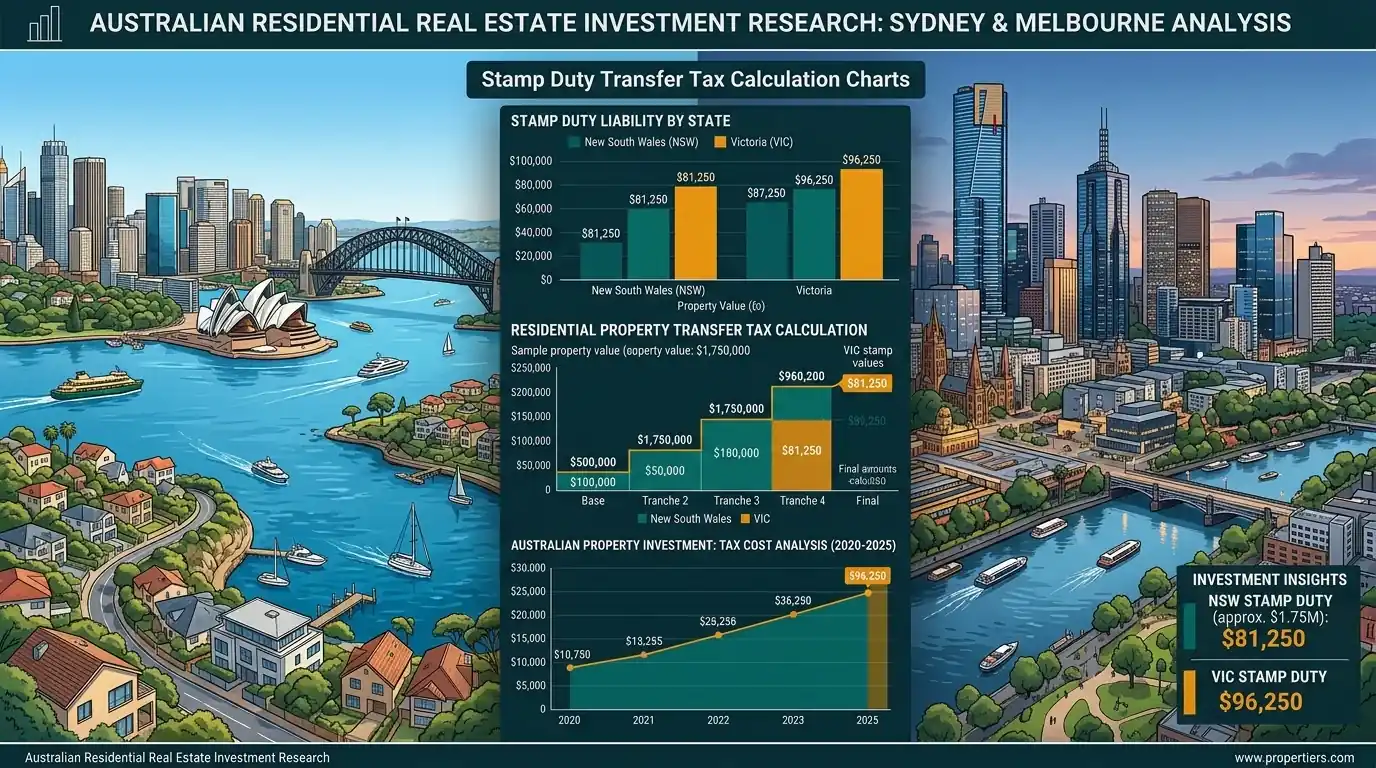
1. Introduction & Overview of Australian Stamp Duty (Transfer Duty)
Buying real estate in Australia — whether a primary residence, an investment property, or commercial real estate — involves significant upfront transaction costs beyond the purchase price. The largest upfront transaction expense facing buyers is Stamp Duty (statutorily known as Transfer Dutyacross Australian states and territories).
In Australia, stamp duty is governed and collected individually by state and territory revenue offices, such as Revenue NSW, the State Revenue Office (SRO) Victoria, and the Queensland Revenue Office (QRO). Because there is no single national federal stamp duty rate, property transfer tax rates, exemption thresholds, first-home buyer concessions, and foreign purchaser surcharges vary dramatically depending on the state or territory in which the property is located.
According to research from the Australian Taxation Office (ATO) and state revenue departments, stamp duty can add between 3% and 7% to the purchase price for Australian permanent residents and citizens, and up to 12% to 15% for foreign buyers subject to additional purchaser duty surcharges and Foreign Investment Review Board (FIRB) application fees.
Failing to accurately calculate stamp duty prior to placing an offer or bidding at auction can disrupt mortgage settlement financing, leading to severe financial penalties or default. In this flagship guide, we break down every state-by-state calculation formula, concession threshold, foreign buyer rule, and cost mitigation strategy required to estimate property transfer costs in Australia with mathematical precision.

2. How Australian Stamp Duty is Calculated (Progressive Rate Tiers)
Australian stamp duty is calculated on a progressive bracket scale applied to either the unencumbered property market value or the contract purchase price, whichever is higher. Similar to personal income tax brackets, higher marginal rates apply to incremental portions of property value above specific dollar thresholds.
📌 General Stamp Duty Calculation Formula
Total Stamp Duty Payable = Base Fixed Duty Amount + (Marginal Tax Rate % × Property Value Portion above Tier Threshold)
Example Scenario: A residential property in Sydney purchased for $900,000 incurs base duty on lower brackets plus a marginal rate (typically 4.5% to 5.5%) on the amount exceeding the bracket threshold.
To compute instant, accurate stamp duty estimates for any Australian property transaction, use our interactive Stamp Duty Calculator.

3. State-by-State Stamp Duty Comparison (NSW, VIC, QLD, WA, SA, TAS, ACT, NT)
Because property taxes are state-administered, transfer duty obligations differ significantly depending on the jurisdiction. Below is the detailed comparative matrix of transfer duty frameworks across all Australian states and territories:
As shown above, Queensland and the ACT offer lower owner-occupier transfer duty rates compared to Victoria and South Australia, making upfront transaction costs significantly lower in Brisbane and Canberra.
4. Foreign Buyer Surcharges & Foreign Investment Review Board (FIRB) Rules
Foreign investors purchasing residential real estate in Australia face substantial additional tax surcharges designed to prioritize local buyers and control housing affordability. Under Australian taxation laws, foreign purchasers include non-citizens and temporary visa holders who do not hold permanent residency or Australian/New Zealand citizenship.

4.1 Foreign Purchaser Additional Duty (FPAD) Rates
State revenue offices levy an additional foreign buyer stamp duty surcharge on top of standard transfer duty rates:
- New South Wales:8.0% Foreign Purchaser Duty Surcharge.
- Victoria:8.0% Foreign Purchaser Additional Duty (FPAD).
- Queensland:8.0% Additional Foreign Acquirer Duty (AFAD).
- Western Australia:7.0% Foreign Buyer Duty.
- South Australia:7.0% Foreign Ownership Surcharge.
- Tasmania:4.0% Foreign Passenger Surcharge.
4.2 Foreign Investment Review Board (FIRB) Application Fees
In addition to state-level stamp duty surcharges, non-resident foreign investors must obtain prior approval from the Foreign Investment Review Board (FIRB) before entering a binding contract to acquire Australian residential property. FIRB application fees are tiered based on property purchase price:
FIRB Application Fee (Established Dwellings - Rare Approval)
$44,100 (3x fee multiplier for established homes)
5. First Home Buyer Exemptions, Concessions, and Grants
To assist first-time property buyers in entering the housing market, Australian federal and state governments provide significant stamp duty exemptions, rate concessions, and cash grants.

5.1 State-by-State First Home Buyer Thresholds
- New South Wales (First Home Buyers Assistance Scheme): Full stamp duty exemption on new and existing homes valued up to $800,000; concessional duty rates on homes valued between $800,000 and $1,000,000.
- Victoria (First Home Owner Duty Exemption): Full stamp duty exemption on homes valued up to $600,000; progressive duty concessions on homes valued between $600,001 and $750,000.
- Queensland (First Home Concession): Full transfer duty exemption on homes valued up to $700,000; concessional rates up to $800,000.
- Western Australia (First Home Owner Rate): Full stamp duty exemption on vacant land up to $300,000 and homes up to $450,000; concessions up to $535,000.
Calculate Your Upfront Australian Property Transaction Costs
Input property location, purchase price, buyer status, and residency to receive a complete line-item breakdown of stamp duty and transfer costs.
6. Stamp Duty vs Annual Land Tax (Key Distinctions for Investors)
Property buyers frequently confuse Stamp Duty (a one-off upfront transfer tax paid at property settlement) with Land Tax (an ongoing annual state holding tax levied on the unimproved land value of investment properties above state tax-free thresholds).

While primary residences (owner-occupied homes) are generally exempt from annual Land Tax across all Australian states, buy-to-let residential investment properties and commercial holdings incur annual land tax liabilities once cumulative land holdings exceed state thresholds (e.g., $1,075,000 in NSW; $50,000 for trusts in VIC).
7. Off-the-Plan Concessions & Refurbishment Savings
Purchasing a property "off-the-plan" (before or during construction) offers substantial stamp duty savings in select Australian states, such as Victoria and Western Australia. Off-the-plan concessions allow transfer duty to be calculated on the land value and partial construction completed at the contract date, rather than the finished post-construction property value.
For example, buying a $750,000 off-the-plan apartment in Melbourne prior to construction commencement can reduce taxable duty value to $250,000 (land value portion), generating over $20,000 in upfront stamp duty savings for eligible owner-occupier buyers.
8. Worked Real-World Case Studies
To illustrate how stamp duty, foreign purchaser surcharges, and first-home concessions apply across different transaction types, let us examine four realistic case studies.
Case Study A: Sydney First Home Buyer (NSW Exemption)
- Buyer Status: Australian Citizen, First Home Buyer
- Property Location: Parramatta, Sydney, NSW
- Purchase Price: $780,000 (Established Apartment)
- Standard Stamp Duty:~$30,090
- First Home Buyer Concession:100% Full Exemption ($0 Duty)
- Total Stamp Duty Payable: $0 (Saving $30,090)
Case Study B: Melbourne Investors (Local vs Foreign Buyer Surcharge)
- Property Location: Southbank, Melbourne, Victoria
- Purchase Price: $850,000 (Investment Property)
- Local Australian Investor Duty: $46,070 (Standard SRO Rates)
- Foreign Investor Duty (Standard + 8% FPAD): $46,070 + $68,000 = $114,070 Total Duty
- Additional FIRB Fee (Foreigner): $14,700
- Total Upfront Government Fees (Foreigner): $128,770
Case Study C: Brisbane Owner-Occupier Upgrade
- Buyer Status: Upgrading Owner-Occupier
- Property Location: Paddington, Brisbane, QLD
- Purchase Price: $1,250,000
- QLD Home Concession Duty: $44,025
- Total Upfront Transfer Tax: $44,025
Case Study D: Perth Off-the-Plan Apartment Purchase
- Property Location: East Perth, Western Australia
- Purchase Price: $650,000
- Off-the-Plan Concession Tax Base: $280,000 (Deducting $370,000 construction value)
- Concessional Duty Payable: $8,215 (saving ~$15,800)
To evaluate how stamp duty outlays impact overall property returns, analyze your rental income using our Rental Yield Calculator and review total settlement costs with our Closing Cost Calculator.
9. LashkariProperties AI Property Analyzer
Calculating state-by-state stamp duty, foreign buyer surcharges, land tax thresholds, and settlement outlays manually across multiple Australian property candidates can take hours. To streamline deal analysis, LashkariProperties has built an artificial intelligence deal underwriting platform.
Analyze Australian Property Deals Instantly with AI
Paste any Australian Realestate.com.au or Domain listing URL to receive instant stamp duty breakdowns, settlement cost line items, and rental yield projections.
10. Frequently Asked Questions
When is stamp duty due after purchasing property in Australia?
In most Australian states (such as NSW, Victoria, and Queensland), stamp duty must be paid either at property settlement or within 30 to 90 days of signing the unconditional contract of sale, whichever occurs first.
Can I add stamp duty onto my mortgage loan in Australia?
Stamp duty cannot be directly added to your mortgage principal. It must be paid out of pocket as cash equity at settlement. However, having higher cash reserves allows you to borrow a higher Loan-to-Value (LTV) ratio mortgage, indirectly financing the transaction.
Do foreign buyers pay extra stamp duty in Australia?
Yes, non-resident foreign purchasers pay a Foreign Purchaser Surcharge of 7.0% to 8.0% on top of standard state transfer duty in NSW, Victoria, Queensland, Western Australia, South Australia, and Tasmania.
How does the First Home Buyers Assistance Scheme work in NSW?
In NSW, eligible first home buyers purchasing new or existing homes valued up to $800,000 receive a 100% full stamp duty exemption. Concessional duty rates apply to properties valued between $800,000 and $1,000,000.
What is the difference between stamp duty and land tax in Australia?
Stamp duty is a one-off upfront transfer tax paid when buying a property. Land tax is an annual recurring state holding tax levied on the unimproved land value of investment properties exceeding state tax-free thresholds.
Do Australian permanent residents pay foreign buyer stamp duty?
No, Australian permanent residents and New Zealand citizens holding a Subclass 444 visa who meet residency requirements are exempt from foreign purchaser duty surcharges and pay standard Australian resident duty rates.
Are off-the-plan property purchases exempt from stamp duty?
Off-the-plan purchases are not completely exempt, but select states like Victoria and Western Australia offer substantial duty concessions by calculating transfer tax solely on the land value before construction takes place.
How much is FIRB application fee for foreign buyers?
FIRB application fees start at $14,700 for residential properties valued up to $1,000,000, increasing to $29,500 for properties between $1m and $2m, and higher for more expensive properties.
How does buying through a self-managed super fund (SMSF) affect stamp duty?
Purchasing residential real estate inside an SMSF incurs standard state transfer duty rates. However, transferring property between related entities or updating Bare Trust deeds may qualify for nominal duty concessions depending on state law.
How can I minimize stamp duty legally in Australia?
You can minimize stamp duty by utilizing first home buyer exemptions, purchasing off-the-plan properties, applying for owner-occupier concessions, or structuring property acquisitions prior to major construction value additions.
11. Legal & Financial Disclaimer
Educational Purpose Only: The contents of this guide, including all stamp duty formulas, state rate tables, FIRB fees, and tax commentary, are provided strictly for educational and informational purposes. This content does not constitute financial, legal, conveyancing, or tax advice. Stamp duty rates and foreign buyer surcharges are subject to statutory amendments by state revenue authorities. Always consult a qualified conveyancer, solicitor, or registered tax agent before making property purchasing decisions in Australia.
12. Related Real Estate Investment Guides
Explore our cornerstone research guides to build your property investment knowledge:
- UK Stamp Duty Explained: Complete SDLT Guide
- Buying Property in Canada: Stress Test & Foreign Buyer Rules
- UK Buy-to-Let Yield: How to Calculate Net Returns Properly
- How Much House Can I Afford: Affordability Framework
- Explore All LashkariProperties Country Guides
- Browse Full LashkariProperties Blog Index
- View All Property Calculators
13. Historical Development of Australian Property Transfer Taxes
To understand the modern framework of Australian stamp duty, real estate buyers must examine the historical origin of property transfer taxation in Australia. Stamp duty was originally introduced during the 19th century under colonial British administrative law to validate legal contracts and land titles.
Following Australian Federation in 1901, the power to levy transfer duty on real property remained under state jurisdiction. Over the past fifty years, stamp duty has evolved from a nominal administrative processing fee into one of the largest revenue streams for state governments, funding public infrastructure, hospitals, schools, and transportation networks.
However, because stamp duty revenue is tied to property transaction volumes and rising median dwelling prices, state tax receipts fluctuate significantly during property market cycles. This has sparked ongoing policy debates across Australia regarding whether upfront stamp duty should be replaced by a broad-based, lower annual land tax.
14. Complete State-by-State Marginal Rate Tiers & Calculation Examples
Below is the detailed marginal bracket schedule applied by state revenue offices across Australia:
14.1 New South Wales (Revenue NSW) Detailed Rate Tiers
- $0 to $16,000: $1.25 per $100 (minimum $10).
- $16,001 to $36,000: $200 + 1.5% of value over $16,000.
- $36,001 to $93,000: $500 + 2.0% of value over $36,000.
- $93,001 to $351,000: $1,640 + 3.5% of value over $93,000.
- $351,001 to $1,168,000: $10,670 + 4.5% of value over $351,000.
- Over $1,168,000: $47,435 + 5.5% of value over $1,168,000.
- Premium Duty (> $3,501,000 for residential): $175,750 + 7.0% of value over $3,501,000.
14.2 Victoria (State Revenue Office VIC) Detailed Rate Tiers
- $0 to $25,000:1.4% of property market value.
- $25,001 to $130,000: $350 + 2.4% of value over $25,000.
- $130,001 to $960,000: $2,870 + 6.0% of value over $130,000.
- Over $960,000 (up to $2m):5.5% flat rate of total purchase price.
- Premium Rate (> $2,000,000): $110,000 + 6.5% of value over $2,000,000.
15. Land Tax Foreign Owner Surcharge (Annual Holding Tax Impact)
In addition to the one-off Foreign Purchaser Additional Duty (FPAD) paid at property acquisition, foreign real estate investors holding Australian residential property are subject to an annual Land Tax Foreign Owner Surcharge:
- New South Wales:4.0% annual land tax surcharge on taxable unimproved land value (zero threshold).
- Victoria:4.0% annual vacant residential land tax / foreign trust surcharge.
- Queensland:2.0% annual foreign owner land tax surcharge for cumulative land holdings over $350,000.
For a foreign investor owning a Sydney apartment with an unimproved land value component of $400,000, the 4% annual surcharge adds $16,000 per year in recurring tax holding costs, which must be factored into your long-term rental yield modeling.
16. SMSF Property Acquisitions & Bare Trust Transfer Rules
Investing in Australian real estate through a Self-Managed Super Fund (SMSF) utilizing a Limited Recourse Borrowing Arrangement (LRBA) involves specific stamp duty considerations:
When an SMSF acquires property using a Bare Trust (Custodian Trust) structure, stamp duty is paid once on the initial contract of sale. When the underlying mortgage is fully repaid and legal title transfers from the Bare Trustee to the SMSF Trustee, state revenue offices grant a nominal stamp duty concession (typically $50 to $500 duty) provided the transfer strictly complies with superannuation deed rules.
17. Commercial vs Residential Property Stamp Duty Differences
Stamp duty rules differ significantly between residential and commercial real estate acquisitions in Australia:
- South Australia Commercial Exemption: South Australia completely abolished stamp duty on commercial property transfers, making Adelaide commercial assets highly attractive to institutional investors.
- GST (Goods and Services Tax) Interaction: Commercial property sales in Australia attract 10% GST unless sold as a "Going Concern" (a fully leased commercial property). Stamp duty is calculated on the GST-inclusive purchase price if GST applies to the transaction.
18. Capital Gains Tax (CGT) Main Residence Exemption & 50% CGT Discount
While stamp duty is paid upon property entry (purchase), selling property triggers federal Capital Gains Tax (CGT) managed by the ATO:
- Main Residence Exemption: An Australian resident's primary home is 100% exempt from Capital Gains Tax upon sale.
- 50% CGT Discount: Australian tax residents who hold an investment property for longer than 12 months receive a 50% discount on taxable capital gains upon sale. Foreign non-residents are ineligible for the 50% CGT discount on capital gains accrued after May 2012.
19. Comprehensive Buyer Transaction Checklist
To avoid settlement delays and unexpected tax liabilities when buying property in Australia, follow this comprehensive checklist:
- [x]Verify State Jurisdiction: Identify the exact state revenue office governing the property location (Revenue NSW, SRO VIC, QRO, etc.).
- [x]Calculate Total Transfer Duty: Factor in base progressive rates plus any applicable foreign purchaser surcharges (4%-8%).
- [x]Check FIRB Approval Requirements: Foreign non-residents must secure FIRB clearance and pay the tiered application fee before signing binding contracts.
- [x]Confirm First Home Buyer Eligibility: Verify purchase price thresholds and residency requirements for state duty concessions.
- [x]Review Land Tax Thresholds: Calculate potential recurring annual land tax outlays for investment properties.
20. In-Depth State Analysis: Queensland Transfer Duty & First Home Concessions
Queensland represents one of the fastest-growing real estate markets in Australia, driven by strong interstate migration from Sydney and Melbourne. Transfer duty in Queensland is administered by the Queensland Revenue Office (QRO) under the Duties Act 2001.
Queensland offers two distinct transfer duty rate scales: the Home Concession Ratefor owner-occupiers purchasing a primary residence, and the Investment / Standard Ratefor buy-to-let investors and commercial buyers.
Queensland Owner-Occupier Home Concession Tiers
- $0 to $350,000:1.0% on portion over $10,000 ($1,000 max duty up to $350k).
- $350,001 to $540,000: $3,500 + 3.5% of value over $350,000.
- $540,001 to $1,000,000: $10,150 + 4.5% of value over $540,000.
- Over $1,000,000: $30,850 + 5.75% of value over $1,000,000.
Under Queensland's enhanced First Home Concession scheme, first home buyers purchasing a home valued up to $700,000 pay zero transfer duty, saving up to $17,350 compared to standard investor rates.
21. In-Depth State Analysis: Western Australia RevenueWA Rates
Western Australia applies progressive transfer duty under the Duties Act 2008 managed by RevenueWA. WA provides specialized concessional rates for residential properties and primary home buyers.
Western Australia General Residential Transfer Duty Rates
- $0 to $120,000:1.90% of unencumbered market value.
- $120,001 to $150,000: $2,280 + 2.85% of value over $120,000.
- $150,001 to $360,000: $3,135 + 3.80% of value over $150,000.
- $360,001 to $725,000: $11,115 + 4.75% of value over $360,000.
- Over $725,000: $28,453 + 5.15% of value over $725,000.
22. In-Depth State Analysis: South Australia & Northern Territory
South Australia (RevenueSA) and the Northern Territory (Territory Revenue Office) utilize distinct transfer tax calculation formulas:
- South Australia Abolition of Commercial Duty: South Australia abolished stamp duty on commercial and industrial property acquisitions in July 2018. However, residential property purchases remain subject to progressive duty up to 5.5% on portions above $500,000.
- Northern Territory Formula-Based Duty: The NT applies a mathematical polynomial formula to calculate transfer duty on property values up to $525,000, above which a flat 5.95% rate applies.
23. Mortgage Registration & Titles Office Fees across Australia
In addition to stamp duty, property buyers must pay state Land Titles Office registration fees when recording legal transfer deeds and registering mortgage documents:
$98.30 to $3,800 (Sliding scale by property value)
24. Conclusion & Strategic Next Steps for Australian Property Buyers
Accurately estimating stamp duty and upfront settlement costs is essential for successful property acquisition across Australia. By accounting for state progressive rate brackets, foreign buyer surcharges, FIRB application fees, and title registration costs, property buyers can secure financing with confidence.
To begin analyzing potential property candidates, calculate your exact upfront tax outlays using our Stamp Duty Calculator, simulate mortgage borrowing options with our Mortgage Calculator, test rental cash flows with our Rental Yield Calculator, and utilize our AI Property Analyzer to evaluate deals in real time.
25. Foreign Investment Review Board (FIRB) Compliance & Penalties
Navigating Australian Foreign Investment Review Board (FIRB) regulations requires strict compliance with federal laws under the Foreign Acquisitions and Takeovers Act 1975. Foreign investors who fail to secure written FIRB clearance before acquiring residential property face severe civil and criminal penalties enforced by the ATO.
Key FIRB Restrictions for Non-Resident Foreign Buyers
- New Dwellings Only: Non-resident foreign investors are generally permitted to acquire new residential dwellings, off-the-plan properties, or vacant residential land for development, but are prohibited from purchasing established (second-hand) residential homes.
- Established Home Exception for Temporary Residents: Temporary visa holders (such as 482 work visa holders or student visa holders) may apply for FIRB approval to purchase one established home to reside in as their primary residence during their stay in Australia, but must sell the property within 3 months of leaving Australia or when their visa expires.
- Vacant Land Development Requirements: Foreign investors purchasing vacant residential land must complete construction of a dwelling within 4 years of receiving FIRB approval.
- Annual Vacancy Fee Surcharge: Foreign owners of Australian residential property must lodge an annual vacancy return with the ATO. If the property is not occupied by the owner or rented out for at least 183 days (6 months) in a 12-month period, the ATO levies an Annual Vacancy Fee equivalent to the initial FIRB application fee.
26. Stamp Duty Liabilities in Corporate Trustee and Family Trust Acquisitions
Purchasing Australian residential or commercial real estate inside a discretionary family trust, unit trust, or corporate trustee entity involves specialized stamp duty considerations across state jurisdictions:
26.1 Foreign Trust Surcharge Risks
State revenue offices in NSW, Victoria, and Queensland apply foreign purchaser stamp duty surcharges (8.0%) to trust property acquisitions if the trust deed allows potential foreign beneficiaries to receive trust distributions or capital allocations.
To avoid triggering accidental 8% foreign buyer surcharges on discretionary family trusts established for Australian resident beneficiaries, property investors must ensure the trust deed contains an explicit, irrevocable clause permanently excluding foreign persons from being potential beneficiaries.
27. Conveyancing Procedures & PEXA Settlement Integration
In modern Australian property transactions, settlement and stamp duty verification are executed electronically via the Property Exchange Australia (PEXA) digital conveyancing platform.
Prior to settlement day, your conveyancer or solicitor prepares an electronic transfer document and verifies stamp duty assessment through the state revenue office portal (such as Revenue NSW ECN or SRO VIC Duties Online). On settlement day, PEXA coordinates the simultaneous transfer of purchase funds, mortgage loan disbursements, and instant payment of stamp duty directly to the state revenue department.
28. Frequently Asked Questions (Extended Analysis)
Below is additional detailed analysis addressing critical buyer questions regarding Australian transfer duty and acquisition costs:
Can I claim stamp duty as a tax deduction on my Australian tax return?
No, stamp duty paid on the purchase of a property cannot be claimed as an immediate tax deduction against annual income. However, stamp duty is added to the property's Capital Gains Tax (CGT) cost base, reducing your taxable capital gain when you eventually sell the property.
How does buying property with a spouse or partner affect first home concessions?
To qualify for first home buyer stamp duty exemptions or concessions, both buying partners must generally meet the eligibility criteria. If one partner has previously owned residential real estate anywhere in Australia, first home concessions are usually disqualified for the joint transaction.
29. Comprehensive State Exemption & Concession Reference Guide
Below is the detailed statutory reference table detailing specific stamp duty exemptions and concessions across all eight Australian states and territories:
New or existing homes up to $800,000; vacant land up to $350,000.
100% full transfer duty exemption ($0 payable). Concessions up to $1,000,000.
Property distribution to named beneficiaries under a valid Will.
Nominal $50 duty per transfer transaction.
Primary residence valued up to $600,000. Must occupy for 12 continuous months.
100% full transfer duty exemption. Tapered concession up to $750,000.
Transfer of residential property between married or de facto partners.
100% full stamp duty exemption for principal place of residence.
Primary home valued up to $700,000. No prior residential property ownership.
100% full transfer duty exemption (saves up to $17,350). Concessions up to $800,000.
Primary residence purchase by any owner-occupier (not first home buyers).
Concessional rates up to $350,000 ($1.0% base rate saving up to $7,175).
Home purchase value up to $450,000; vacant land up to $300,000.
100% full transfer duty exemption. Concessional rate up to $535,000.
New home construction or eligible off-the-plan property acquisition.
Abolition of stamp duty on eligible new home purchases for first home buyers.
30. Detailed Worked Numerical Calculation Scenarios
To ensure property buyers understand how these complex state rate tiers, foreign surcharges, and closing costs operate together, let us analyze four additional in-depth worked numerical calculations.
Scenario E: Sydney Foreign Investor Purchasing a $1,500,000 Luxury Apartment
- Buyer Profile: Foreign Non-Resident Investor
- Property Location: Chatswood, Sydney, NSW
- Purchase Price: $1,500,000
- NSW Base Transfer Duty: $47,435 + (5.5% × $332,000) = $65,695 Base Duty
- NSW Foreign Purchaser Surcharge (8.0% of $1.5m): $120,000 Surcharge
- Combined NSW Duty Payable: $65,695 + $120,000 = $185,695 Total Duty
- FIRB Application Fee (New Home): $29,500 Fee
- Legal & Conveyancing Outlays: $3,500
- Total Upfront Government & Settlement Fees: $218,695 (14.58% of purchase price)
Scenario F: Melbourne First Home Buyer Purchasing a $680,000 Townhouse
- Buyer Profile: Australian Permanent Resident, First Home Buyer
- Property Location: Richmond, Melbourne, VIC
- Purchase Price: $680,000
- Standard VIC Duty:~$35,470
- VIC First Home Buyer Tapered Concession: Concession formula reduces duty to $18,917
- Total Duty Payable: $18,917 (saving $16,553)
Scenario G: Brisbane Commercial Office Building ($2,800,000)
- Buyer Profile: Corporate Entity
- Property Location: Fortitude Valley, Brisbane, QLD
- Purchase Price: $2,800,000 (Plus GST as commercial property)
- Contract Price including GST (10%): $3,080,000
- QLD Transfer Duty Calculation Base: $3,080,000
- QLD Commercial Duty: $30,850 + (5.75% × $2,080,000) = $150,450 Duty
Scenario H: Adelaide Residential Investment Property ($650,000)
- Buyer Profile: Local BTL Investor
- Property Location: Glenelg, Adelaide, SA
- Purchase Price: $650,000
- SA Transfer Duty: $26,830 + (5.5% × $150,000) = $35,080 Duty
31. Strategic Recommendations for Australian Property Investors
To maximize net investment returns when building a real estate portfolio across Australian state jurisdictions, apply these institutional underwriting recommendations:
- Prioritize High-Yield Growth Hubs: Evaluate regional hubs in Queensland and Western Australia where lower property entry prices and moderate transfer duty rates preserve cash equity.
- Leverage Off-the-Plan Duty Concessions: In states like Victoria and WA, buying off-the-plan reduces taxable duty value to the land portion, preserving capital for property improvements.
- Structure Family Trusts Correctly: Ensure discretionary trust deeds contain explicit foreign person exclusion clauses to avoid triggering mandatory 8% foreign buyer surcharges.
- Maintain Capital Reserve Margins: Budget for upfront stamp duty, land titles registration fees, conveyancing, and annual land tax holding costs prior to submitting binding purchase offers.
32. Deep Macroeconomic Analysis of Australian Real Estate Taxation
Property taxation across Australia's six states and two self-governing territories represents a complex ecosystem where fiscal federalism, state budget dependence, and housing affordability policies intersect. Understanding the broader economic mechanisms driving state stamp duty policy provides real estate investors with valuable foresight when building multi-state property portfolios.
32.1 Fiscal Federalism & State Revenue Dependence
Under the Australian constitutional framework, the Federal Government collects Goods and Services Tax (GST), personal income tax, and corporate tax, redistributing GST revenue back to states via the Commonwealth Grants Commission. However, because state governments bear primary financial responsibility for funding public hospitals, schools, police forces, and transport infrastructure, state-administered property taxes — specifically Transfer Duty and Land Tax — represent the largest source of independent state tax revenue.
During housing market booms, rising property sales volumes and surging median house prices generate massive windfalls for state treasuries. For example, during peak market cycles in New South Wales and Victoria, transfer duty collections exceed $10 billion annually per state. Conversely, during market downturns, stamp duty revenue contracts sharply, placing pressure on state budgets and prompting temporary stimulus measures such as expanded first-home buyer concessions or off-the-plan duty discounts.
32.2 Stamp Duty vs Broad-Based Annual Land Tax Reform Debates
Leading Australian economists, the Productivity Commission, and the Reserve Bank of Australia (RBA) have long identified upfront stamp duty as an inefficient tax that creates friction in the housing market. By imposing a heavy upfront tax penalty ($30,000 to $60,000+) on property transactions, stamp duty discourages homeowners from downsizing, moving closer to employment hubs, or upgrading properties as family needs change.
In response to these economic concerns, the Australian Capital Territory (ACT) initiated a progressive 20-year transition in 2012 to phase out upfront stamp duty entirely, replacing it with an incremental, broad-based annual land tax on general rates. Similarly, New South Wales briefly introduced the First Home Buyer Choice scheme, allowing eligible first home buyers to choose between paying a one-off upfront stamp duty or a lower annual land tax. While legislative adjustments continue to evolve, property investors must monitor state policy changes as reform proposals gain momentum across state parliaments.
33. Tenancy Laws, Rental Income Taxation & Negative Gearing
When purchasing residential real estate in Australia for investment purposes, stamp duty represents just one component of your overall financial framework. Investors must also account for federal income tax treatment managed by the ATO:
33.1 Negative Gearing Tax Offsets
Australia is one of the few OECD nations that permits Negative Gearingfor residential property investments. If the annual deductible expenses of owning an investment property (including mortgage interest, agent management fees, council rates, water charges, landlord insurance, and building depreciation) exceed the gross rental income generated, the net loss can be offset against your personal salary income, reducing your overall personal tax liability.
33.2 Tax Depreciation Schedules (Division 40 & Division 43)
To maximize annual tax efficiency and net cash flow, property investors should order a professional Tax Depreciation Schedule from a qualified quantity surveyor (such as BMT or Quantity Surveyors Australia). Quantity surveyors inspect the property and prepare a 40-year tax depreciation schedule detailing deductible claims for:
- Division 43 Capital Works Allowance:2.5% per annum tax deduction on the original structural construction cost of residential buildings constructed after September 15, 1987.
- Division 40 Plant and Equipment Depreciation: Deductions for landlord-installed appliances, carpets, air conditioning units, blinds, and hot water systems in new residential properties.
34. Strategic Settlement Financing & Deposit Bond Management
When purchasing property in Australia, settlement typically occurs 30, 60, or 90 days after exchanging unconditional contracts. Property buyers must manage their cash liquidity to ensure both the contract deposit (typically 10% of purchase price) and stamp duty funds are fully available prior to settlement day.
Buyers who have significant equity tied up in an existing property but lack immediate cash liquidity for the 10% deposit can utilize a Deposit Bond (a financial guarantee issued by an insurance company guaranteeing deposit payment at settlement). However, stamp duty itself cannot be paid via a deposit bond and must be settled in cleared funds on settlement day via PEXA electronic conveyancing.
35. State-by-State Regional Housing Market Dynamics & Yield Profiles
In addition to evaluating stamp duty transfer tax costs, property investors must analyze regional market fundamentals across capital cities and regional growth corridors to optimize total return on capital.
35.1 Greater Sydney & Regional NSW
Sydney represents Australia's largest and highest-priced real estate market, with median house prices exceeding $1.4 million. While high capital values compress gross rental yields to 3.2%–4.2% in inner rings, regional hubs such as Newcastle, Wollongong, Central Coast, and Dubbo offer higher gross yields (5.0%–6.5%) alongside lower stamp duty entry thresholds.
35.2 Greater Melbourne & Regional Victoria
Melbourne's residential property market provides extensive choices across infill apartments, middle-ring suburban houses, and outer growth corridors. Regional Victorian centers like Geelong, Ballarat, and Bendigo attract strong tenant demand, supported by rail infrastructure and competitive land transfer duty concessions.
35.3 Greater Brisbane & South East Queensland (SEQ)
South East Queensland — encompassing Brisbane, the Gold Coast, and the Sunshine Coast — continues to experience strong demographic growth driven by net internal migration. QLD's lower owner-occupier transfer duty rates and competitive median prices ($850,000) deliver high rental yields (5.2%–6.8%) and solid capital growth prospects ahead of major global sporting events.
35.4 Greater Perth & Regional WA
Perth's housing market offers some of the highest rental yields in metropolitan Australia (6.0%–7.5%), driven by strong employment growth in resources, mining, and technology. RevenueWA's first home buyer duty exemptions up to $450,000 provide excellent entry opportunities for emerging investors.
36. Summary Checklist for Australian Real Estate Buyers
Before executing an unconditional contract of sale or bidding at auction in Australia, confirm that you have completed each step of this underwriting checklist:
- [x]Identify State Tax Jurisdiction: Determine the exact state revenue office governing the property (Revenue NSW, SRO VIC, QRO, RevenueWA, etc.).
- [x]Calculate Upfront Transfer Duty: Factor in base progressive rates plus any applicable foreign purchaser surcharges (4%-8%).
- [x]Verify FIRB Status & Application Fees: Foreign non-residents must secure FIRB approval and budget for tiered application fees ($14,700+) prior to signing binding contracts.
- [x]Check First Home Buyer Eligibility: Confirm purchase price thresholds and continuous 12-month owner-occupier residency rules for state duty exemptions.
- [x]Assess Ongoing Land Tax Liabilities: Review cumulative unimproved land holdings against state tax-free thresholds to model recurring holding costs.
37. Legal Conveyancing & Title Search Verification Guidelines
When purchasing Australian real estate, your solicitor or licensed conveyancer conducts essential due diligence title searches prior to settlement to verify clear ownership and identify any encumbrances that could affect property value or transfer duty assessment.
- Title Search & Certificate of Title: Verifies registered legal owners, mortgage caveats, easements, and covenants registered on the land title.
- Local Council Rate Certificate (Section 603 / Section 175): Confirms outstanding municipal council rates and water access charges, ensuring adjustments are calculated at settlement.
- Land Tax Certificate (Section 47 NSW / Section 154 VIC): Verifies whether the vendor owes unpaid state land tax that could attach as a charge on the land following settlement.
- Planning & Zoning Certificates: Details local council zoning permissions, bushfire threat overlays, flood planning zones, and heritage conservation orders affecting building modifications.
38. Conclusion & Final Investment Summary
In conclusion, mastering Australian stamp duty transfer tax rules is an essential requirement for buyers entering the Australian real estate market. By understanding state progressive rate tiers, foreign purchaser surcharges, FIRB application fees, and first-home concessions, property buyers can structure transactions efficiently and avoid costly settlement disruptions.
To evaluate potential property acquisitions across Australia, start by simulating your exact transfer tax outlays with our Stamp Duty Calculator, test mortgage borrowing power with our Mortgage Calculator, calculate net cash flows with our Rental Yield Calculator, and utilize our AI Property Analyzer to analyze property deals in real time.
39. Resource Center & External Official Authorities
For further legal, taxation, and statutory research, refer to these direct official state and federal government authorities:
- Australian Taxation Office (ATO) - Property Capital Gains Tax & FIRB Rules
- Revenue NSW - Transfer Duty Rates & First Home Buyers Assistance Scheme
- State Revenue Office Victoria - Land Transfer Duty Calculator & FPAD Surcharges
- Queensland Revenue Office - Transfer Duty Rates & Home Concessions
Sources
Related reading
Continue reading: Buying Property in Australia: Costs · Buying Property in Canada: Guide (2026) · Buying Property in the UAE: Fees. Run your own numbers with the Stamp Duty & Transfer Tax Calculator — it takes under a minute and beats guessing.
Frequently asked questions
What is stamp duty in Australia?
Stamp duty — officially transfer duty — is a state and territory tax charged on property purchases, collected by offices such as Revenue NSW and the Victorian SRO. It is one of the largest upfront costs beyond the purchase price.
Who pays stamp duty in Australia?
The buyer pays it, at rates that differ by state, price band, and buyer status. First-home buyers often qualify for concessions or exemptions, while foreign buyers face an additional surcharge on top of the standard duty.
How is Australian stamp duty calculated?
It is charged on progressive rate tiers: each slice of the price is taxed at its own rate, and the duty is the sum of the slices. Concessions, off-the-plan discounts, and foreign surcharges change the final figure, so confirm the live rates with the relevant state revenue office.
Can stamp duty be added to the mortgage in Australia?
Usually not. Most lenders require stamp duty (transfer duty) to be paid in cash at settlement on top of the deposit, because it is not part of the property's loan-to-value ratio. Some states allow duty on the mortgage itself, and a few buyers use personal loans or lender cash-out after settlement, but the standard position is that duty is a cash cost you must budget for before settlement.