


1. The Reality of UK Buy-to-Let Yields in 2026
Investing in UK residential buy-to-let (BTL) real estate remains one of the most reliable long-term wealth-building vehicles when evaluated with financial precision. However, relying solely on headline "gross yield" figures promoted by estate agency sales listings often leads property investors into negative cash flow traps. In the modern UK tax, legal, and macroeconomic environment, calculating your true net rental yield is the single most critical task before submitting a binding offer on any residential investment property.
Between changing monetary policy interest rates governed by the Bank of England, stricter stress-testing criteria enforced by commercial mortgage lenders, and statutory tax rules under Section 24, calculating gross yield alone provides a dangerously incomplete view of property profitability. A residential property advertised with an attractive 7.8% gross yield might deliver a paltry 1.8% net cash yield after factoring in letting agency management fees, building service charges, mandatory council licensing, tenant void periods, landlord insurance, ongoing maintenance reserves, and higher-rate personal tax liabilities.
Over the past decade, the UK property market has undergone a fundamental structural transformation. Historical real estate investment models that relied on cheap 75% loan-to-value (LTV) interest-only mortgages at 2% interest rates alongside full tax-deductibility of finance costs no longer exist. Today, successful property investors must operate as disciplined financial analysts. Every investment decision requires evaluating net operating income (NOI), cash-on-cash return, debt service coverage ratio (DSCR), and net post-tax yield inside optimized ownership structures.
To evaluate potential UK property acquisitions with institutional accuracy, real estate investors must implement a standardized, multi-variable cash flow model. In this comprehensive flagship guide, we break down every operational expense, tax adjustment, regional yield trend, and capital outlay required to determine exact net returns on UK buy-to-let investments in 2026 and beyond.
1.1 Historical Evolution of UK Buy-to-Let Returns (1996 – 2026)
To fully understand the modern landscape of UK rental yields, property investors must examine the three distinct historical eras of the UK private rented sector (PRS) over the past thirty years:
- The Golden Era (1996 – 2007): The introduction of unregulated Buy-to-Let mortgage products in 1996 revolutionized property ownership. Landlords enjoyed 85% LTV interest-only borrowing at low rates, 100% tax-deductible mortgage interest, zero stamp duty surcharges, and rapid double-digit annual capital appreciation. Gross rental yields routinely exceeded 9% in major cities.
- The Financial Crisis & Low Interest Rate Era (2008 – 2021): Following the 2008 global financial crisis, the Bank of England slashed the base rate to historic lows between 0.10% and 0.50%. While property prices rose dramatically, compressing gross yields to 4%–6%, ultra-cheap borrowing costs (2% interest rates) created exceptionally high Cash-on-Cash returns for leveraged investors.
- The Modern Institutional & Regulatory Era (2022 – 2026): The combination of rising global inflation, Bank of England base rate adjustments, full Section 24 tax relief phase-outs, 3% to 5% SDLT surcharges, and tightening EPC energy efficiency mandates transformed the market. Successful investing now requires strict net yield discipline, professional corporate structuring, and rigorous cash flow stress testing.
Today, amateur landlords relying on high personal leverage and informal accounting are exiting the market, creating prime acquisition opportunities for sophisticated investors who utilize institutional financial modeling.

2. Gross Rental Yield vs Net Rental Yield (Definitions & Formulas)
Before diving into complex operational expense modeling, we must establish clear mathematical definitions and formulas for the core financial metrics used in real estate deal analysis. While both gross yield and net yield express rental income as a percentage of property value, their underlying formulas and practical applications differ fundamentally.
Gross Rental Yield: Definition & Calculation
Gross rental yield represents the basic annual rental return generated by a property relative to its baseline purchase price, completely ignoring all ongoing operational expenses, financing costs, and acquisition taxes. It serves as a rapid screening tool to compare initial property candidates across different geographical markets.
Gross Yield (%) = (Annual Gross Rental Income ÷ Property Purchase Price) × 100
Example Scenario: A two-bedroom terraced house in Manchester purchased for £220,000 that generates £1,350 per month in gross rent (£16,200 per year) yields:
(£16,200 ÷ £220,000) × 100 = 7.36% Gross Rental Yield
While a 7.36% gross yield appears attractive on paper, it overstates the actual cash return because it assumes zero vacancy, zero management expenses, zero repairs, zero insurance, zero service charges, and zero acquisition taxes. Evaluating properties purely on gross yield frequently leads investors to overpay for high-maintenance assets.
Net Rental Yield: Definition & Calculation
Net rental yield provides a true, institutional-grade reflection of investment performance. It subtracts all mandatory annual operating expenses from annual gross rental income and divides the resulting Net Operating Income (NOI) by total capital deployed to acquire the asset (purchase price plus Stamp Duty Land Tax, legal fees, survey charges, and initial refurbishment costs):
Net Yield (%) = [(Annual Gross Rent - Total Annual Operating Expenses) ÷ Total Property Acquisition Capital] × 100
Where Total Property Acquisition Capital = Purchase Price + Stamp Duty Land Tax (SDLT) + Legal & Conveyancing Fees + Valuation & Survey Fees + Initial Repairs
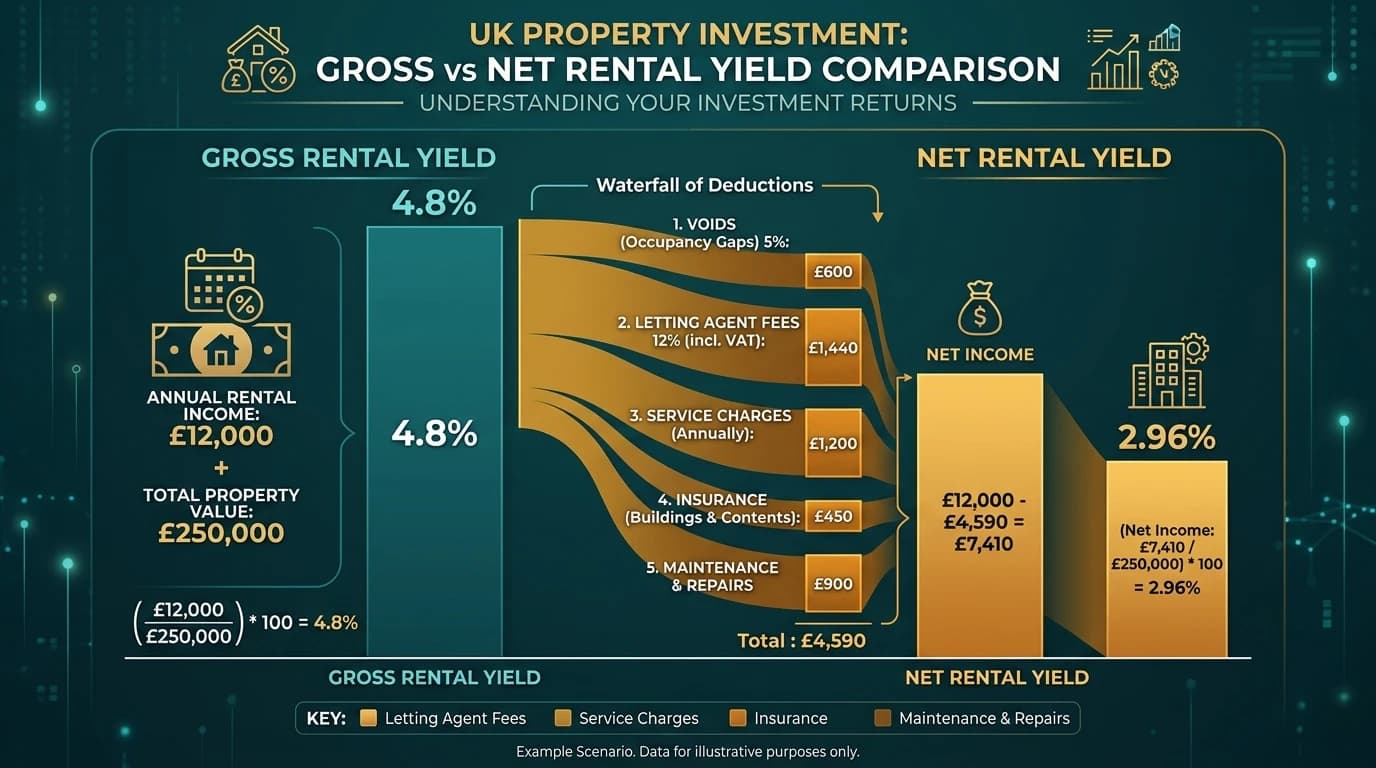
By accounting for both operational leakage and total capital outlays, net rental yield reveals the true earning power of the property. To run quick scenario analyses across multiple property candidates, use our interactive Rental Yield Calculator.
3. Step-by-Step Net Deduction Model
To compute an exact net rental yield, property investors must systematically account for every ongoing operating expense. Leaving out even a single expense category — such as landlord insurance or annual safety compliance certifications — will inflate your projected returns and distort financial forecasts.
Below is the institutional itemized breakdown of mandatory annual operating deductions that must be subtracted from gross rental income:
| Operating Expense Category | Standard Industry Benchmark | Detailed Operational Impact & Description |
|---|---|---|
| Letting Agency Management Fees | 10% – 15% + VAT (12% – 18% total gross rent) | Includes full tenant management, rent collection, repair dispatch, and quarterly property inspections. Tenant-find only services typically cost 1 month's rent. |
| Tenant Void Allowance | 4% – 8% of annual gross rent | Budgets for temporary vacancy between tenancy contracts. Equivalent to 2 to 4 weeks of unoccupied rent loss per calendar year. |
| Maintenance & Repairs Reserve | 5% – 10% of gross rent (or 1% property value/yr) | Covers ongoing plumbing, electrical repairs, boiler servicing, safety checks, appliance replacement, and interior redecoration between tenancies. |
| Leasehold Service Charges | £1,200 – £4,500+ per annum | Applies to leasehold apartments and gated developments. Covers communal cleaning, lift maintenance, block building insurance, and concierge staff. |
| Ground Rent (Leasehold) | £0 – £350 per annum | Annual ground rent payable to the freeholder. Note that the Leasehold Reform (Ground Rent) Act 2022 caps ground rent on new leases to a peppercorn (£0). |
| Landlord Buildings & Liability Insurance | £250 – £650 per annum | Specialist landlord insurance covering structural building damage, property owner liability, and optional rent guarantee protection cover. |
| Statutory Safety Compliance & Licensing | £300 – £800 per annum | Annual Gas Safety Certificates (CP12), Electrical Installation Condition Reports (EICR every 5 yrs), EPC renewals, smoke alarm testing, and selective council licenses. |
| Accountancy & Legal Administration | £300 – £1,200 per annum | Filing annual tax returns, SPV company accounts with Companies House, micro-entity accounts preparation, and confirmation statement filings. |
3.1 Energy Performance Certificate (EPC) Retrofit Costs & Yield Depreciation
A critical operational factor impacting long-term net yield is property energy efficiency compliance. UK government regulations require private rented sector properties to meet minimum Energy Performance Certificate (EPC) ratings.
Retrofitting older Victorian, Edwardian, and pre-war UK housing stock from an EPC rating of D or E up to the target C rating represents a significant capital outlay that must be amortized within your yield calculations:
| Energy Efficiency Upgrade Measure | Typical Installation Cost Range | Estimated EPC Point Increase | Impact on Operational Cash Flow |
|---|---|---|---|
| Internal / External Wall Insulation | £4,500 – £11,000 | +10 to +18 points | High capital cost; significantly reduces space heating demand and tenant turnover. |
| Loft & Attic Insulation Top-Up (300mm) | £500 – £1,200 | +4 to +8 points | High ROI intervention; immediate improvement in thermal performance. |
| A-Rated Condensing Boiler Upgrade | £2,200 – £3,500 | +5 to +10 points | Replaces aging boilers, eliminates frequent emergency call-out maintenance expenses. |
| Double Glazing Window Replacement | £3,500 – £7,500 | +3 to +6 points | Improves security and tenant retention while preventing damp and condensation. |
| Solar PV Roof Panel Installation | £4,000 – £6,500 | +8 to +14 points | Attracts premium eco-conscious professional tenants willing to pay higher rent. |
When all operating expenses are summed together, operational leakage typically absorbs 25% to 40% of total gross rental income in well-managed single-let residential properties, and up to 50% in multi-unit HMO properties.
Calculate Your Monthly Net Property Cash Flow
Input your exact rental income, mortgage interest, agency fees, and reserve buffers into our specialized tool.
4. Section 24 Mortgage Interest Tax Relief & Tax Efficiency
One of the most consequential legal shifts in UK property taxation occurred with the phased introduction of Section 24 of the Finance (No. 2) Act 2015, overseen by HM Revenue & Customs (HMRC). Prior to Section 24, individual landlords could deduct 100% of mortgage interest payments from their gross rental income as a standard business expense before calculating their personal income tax liabilities.
Under Section 24, mortgage interest is no longer treated as an allowable expense for individual property owners. Instead, individual landlords receive a flat 20% basic-rate tax credit on their total mortgage finance costs. For higher-rate (40%) and additional-rate (45%) taxpayers, this creates a severe tax penalty, as rental income is taxed on gross revenue rather than net profit.
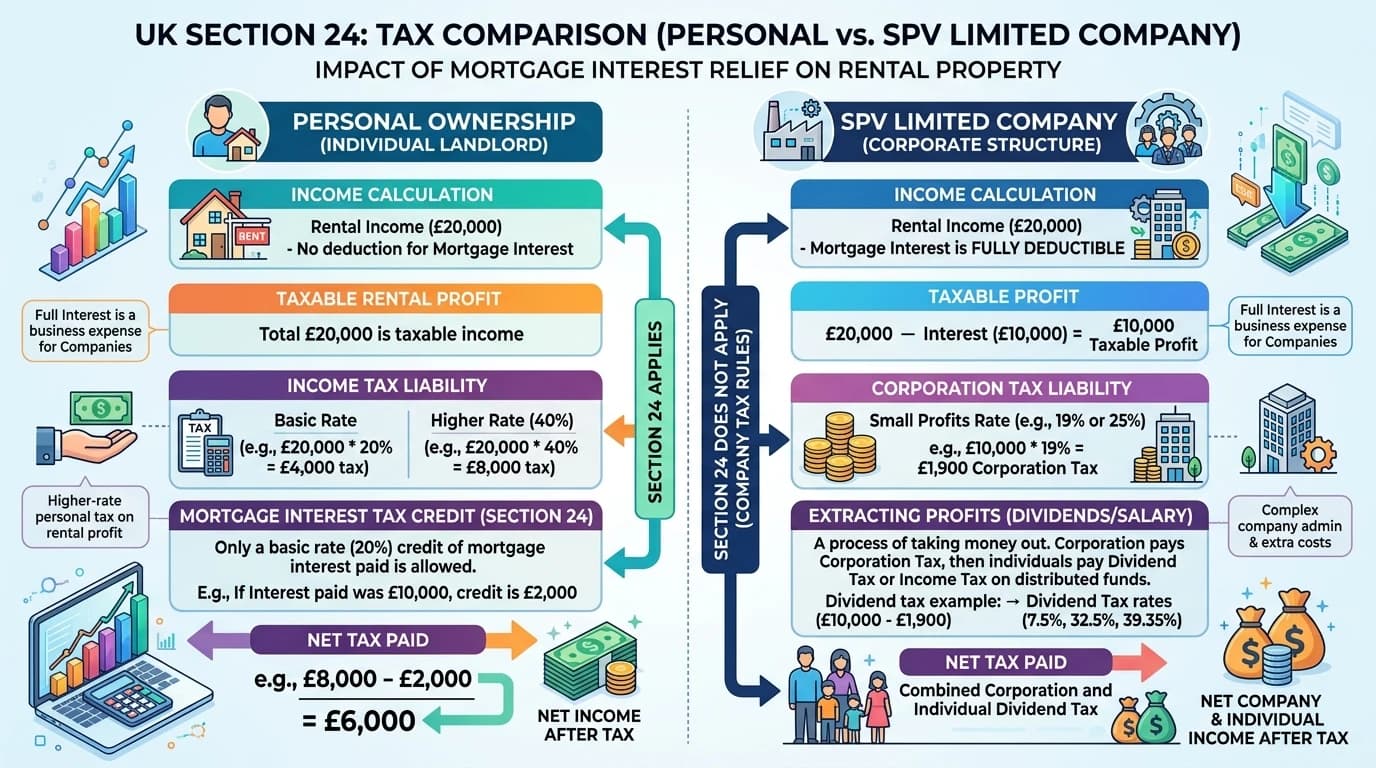
Mathematical Demonstration: Personal Ownership vs. SPV Limited Company
To understand the dramatic financial impact of Section 24, let us compare an individual higher-rate (40%) taxpayer purchasing a BTL property in their personal name versus acquiring the exact same property inside a Special Purpose Vehicle (SPV) Limited Company:
| Financial Item | Personal Name (40% Taxpayer) | SPV Limited Company (Corporation Tax) |
|---|---|---|
| Annual Gross Rental Income | £20,000 | £20,000 |
| Annual Operating Expenses (Agent, Repairs, Ins.) | -£4,000 | -£4,000 |
| Annual Mortgage Interest Paid | -£12,000 | -£12,000 |
| Taxable Profit Calculation Base | £16,000 (£20k rent - £4k ops) | £4,000 (£20k rent - £4k ops - £12k interest) |
| Initial Income Tax / Corp Tax Due | £6,400 (40% of £16,000) | £760 (19% Corporation Tax on £4,000) |
| Less Section 24 Tax Relief Credit (20% of £12k) | -£2,400 | N/A (Interest 100% deducted prior to tax) |
| Final Tax Bill Payable | £4,000 | £760 |
| Net Pre-Tax Cash Flow (£20k rent - £4k ops - £12k interest) | £4,000 | £4,000 |
| Net Post-Tax Cash Remaining in Hand | £0 (£4,000 - £4,000 tax) | £3,240 (£4,000 - £760 tax) |
As demonstrated above, Section 24 completely wipes out the individual landlord's cash flow, reducing net post-tax profit to £0, whereas the SPV Limited Company retains £3,240 in net post-tax cash. Consequently, over 80% of new UK buy-to-let mortgage applications are now executed through SPV Limited Company structures.
4.1 Mortgage Interest Coverage Ratio (ICR) & Stress Testing Framework
When underwriting buy-to-let mortgage applications, commercial lenders do not assess properties purely on rental yield. Instead, they apply strict Interest Coverage Ratio (ICR) stress tests regulated by the Prudential Regulation Authority (PRA).
The ICR formula evaluates whether gross rental income sufficiently covers mortgage interest payments under a hypothetical stress rate (typically 5.5% to 7.0%):
ICR = Gross Monthly Rent ÷ (Monthly Mortgage Interest Payment at Stress Rate)
Standard lender ICR requirements:
- SPV Limited Company Borrowers:125% ICR at stress rate.
- Personal Name Basic-Rate Taxpayers:125% ICR at stress rate.
- Personal Name Higher-Rate (40%) Taxpayers:145% to 155% ICR at stress rate.
4.2 Non-Resident Landlord Scheme (NRLS) & Overseas Investors
For international investors purchasing UK buy-to-let properties from overseas (such as investors based in the UAE, Hong Kong, Singapore, United States, or European Union), specific tax rules apply under the Non-Resident Landlord Scheme (NRLS) managed by HMRC.
Under the NRLS, letting agents or tenants are legally required to withhold 20% basic-rate tax from gross rental payments unless the overseas landlord has received explicit approval from HMRC to receive rent gross via an NRL1 application form. Furthermore, non-resident buyers face an additional 2% SDLT surcharge on top of the standard 3%–5% BTL rates when acquiring residential real estate in England and Northern Ireland.
5. Void Periods, Maintenance Budgeting, and Cash Flow Risk Buffers
Unplanned vacancy and unexpected capital expenditures are the two primary causes of severe cash flow strain in residential real estate portfolios. Many novice investors make the mistake of modeling properties assuming 100% occupancy 365 days a year. Even in high-demand rental hotspots like Manchester, Birmingham, and Bristol, tenant turnover, referencing procedures, redecoration, and minor repairs result in periodic void weeks.
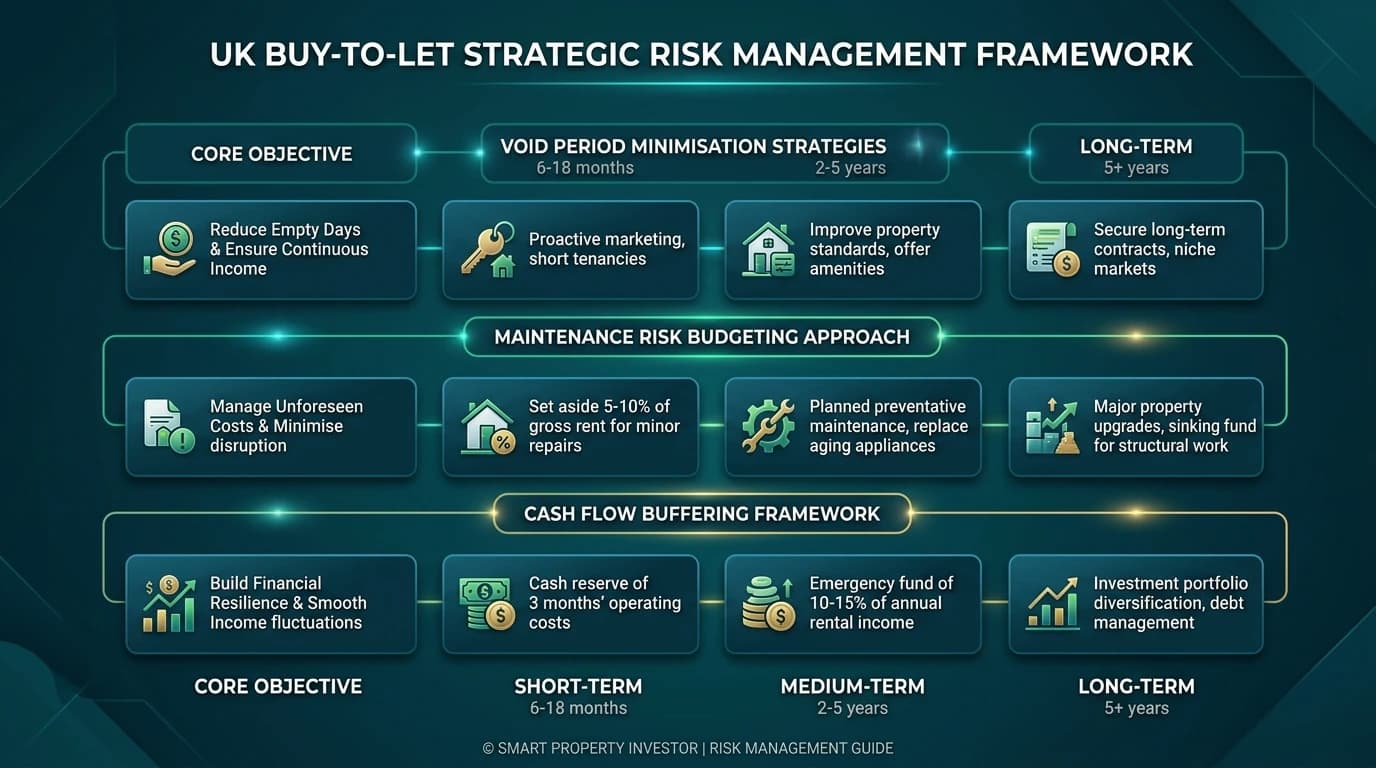
To protect your portfolio against cash flow disruption, incorporate a mandatory void reserve into your monthly operating budget based on property type and location:
- Prime Professional Single-Lets (Cities): Budget 4% of annual rent (~2 weeks void per year). High tenant demand and short re-letting times keep vacancy minimal.
- Suburban Family Homes: Budget 6% of annual rent (~3 weeks void per year). Longer average tenancies (2–4 years), but longer turnaround times during tenancy transitions.
- Student HMO Properties: Budget 8% of annual rent (~4 weeks void per year). Summer void periods between academic terms require careful cash flow smoothing.
Establishing a Capital Expenditure (CapEx) Reserve Fund
In addition to routine day-to-day maintenance (plumbing leaks, appliance repairs, lock changes), property investors must budget for long-term capital replacement cycles (CapEx). Key replacement lifecycles include:
- Gas Boiler & Central Heating System: Expected lifespan 10–15 years; replacement cost £2,200 – £3,800.
- Kitchen Replacement: Expected lifespan 12–15 years; replacement cost £4,500 – £8,500.
- Bathroom Refurbishment: Expected lifespan 12–15 years; replacement cost £3,000 – £6,000.
- Roof Repairs / Maintenance: Expected lifespan 25–30 years; major overhaul cost £5,000 – £12,000+.
Establishing an earmarked cash reserve account holding at least 3 to 6 months of gross rental payments plus mortgage interest ensures your property business remains solvent through unexpected maintenance emergencies.
6. Stamp Duty Land Tax (SDLT) Surcharges & Capitalizing Acquisition Costs
Calculating true net rental yield requires evaluating net operating income against total capital deployed, not just the property purchase price. In England and Northern Ireland, buying an additional residential property (a buy-to-let or second home) triggers higher rates of Stamp Duty Land Tax (SDLT).
The additional property SDLT surcharge imposes a flat 5% tax premium across all purchase price bands above £40,000 (raised from 3% in October 2024). Below is the statutory SDLT rate tier structure for additional residential properties:
| Property Purchase Price Portion | Standard Main Residence Rate | Additional Property BTL Rate (Inc. Surcharge) |
|---|---|---|
| Up to £125,000 | 0% | 5% |
| £125,001 to £250,000 | 2% | 7% |
| £250,001 to £925,000 | 5% | 10% |
| £925,001 to £1,500,000 | 10% | 15% |
| Over £1,500,000 | 12% | 17% |
To calculate exact upfront tax obligations for any purchase price, use our dedicated Stamp Duty Calculator. For detailed line-item breakdowns of legal fees, conveyancing, survey costs, and mortgage arrangement fees, use our Closing Cost Calculator and read our comprehensive analysis on UK Stamp Duty Explained.
7. Regional Rental Yield Analysis Across the UK
Rental yields vary dramatically across UK regions due to wide disparities in property purchase prices, wage growth, tenant demographics, and regional economic performance. While London and the South East generate substantial long-term capital appreciation, northern regional cities and Scotland deliver significantly higher immediate rental yields.
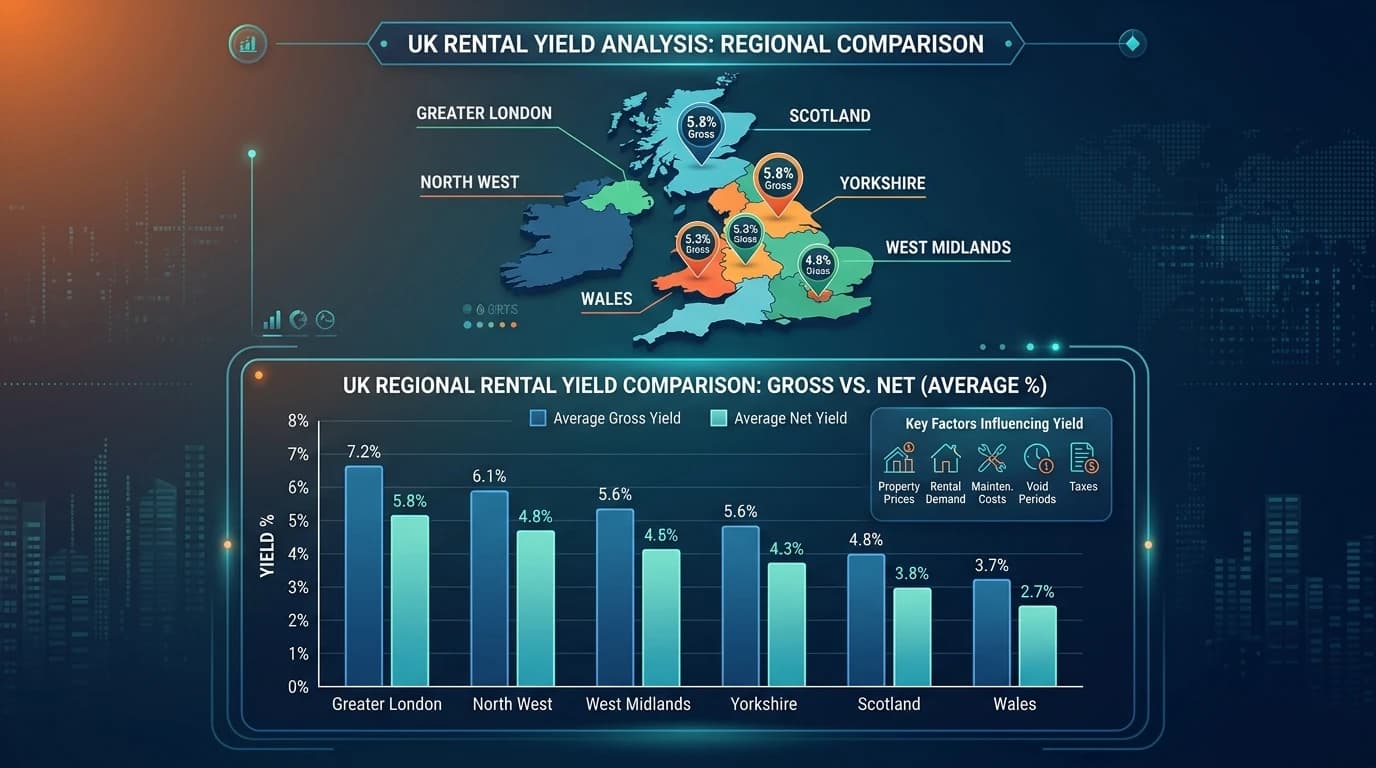
Below is an in-depth regional yield comparative matrix based on official data from the Office for National Statistics (ONS) and live market transactions:
| UK Regional Market Hub | Avg Purchase Price | Avg Monthly Rent | Average Gross Yield | Estimated Net Yield | Key Investment Characteristics |
|---|---|---|---|---|---|
| North West (Manchester / Liverpool) | £215,000 | £1,350 | 7.53% | 5.20% | Strong tenant demand from young professionals and university graduates. Excellent cash flow stability. |
| Yorkshire & The Humber (Leeds / Sheffield) | £205,000 | £1,220 | 7.14% | 4.95% | High affordability ratio, expanding financial and technology sectors, strong student and graduate rental market. |
| West Midlands (Birmingham) | £235,000 | £1,380 | 7.04% | 4.80% | HS2 infrastructure connectivity, major corporate relocations, solid balance between yield and growth. |
| Scotland (Glasgow / Dundee / Aberdeen) | £185,000 | £1,150 | 7.45% | 5.15% | Lower entry purchase prices, robust tenant demand, distinct Scottish legal tenancy framework (PRT). |
| North East (Newcastle / Sunderland) | £160,000 | £980 | 7.35% | 5.05% | Lowest capital entry barriers, high gross yields, requires diligent tenant vetting and local management. |
| Greater London (Outer Boroughs) | £540,000 | £2,250 | 5.00% | 3.10% | High capital values compress yields; excellent long-term capital growth and tenant retention. |
| South East (Reading / Brighton) | £385,000 | £1,750 | 5.45% | 3.55% | Commuter belt demand, stable employment base, moderate yields with capital preservation focus. |
For investors focused primarily on immediate net cash flow, northern regional cities offer compelling yield fundamentals compared to southern markets.
8. Real-World Worked Case Studies
To demonstrate how gross yield, operational expenses, acquisition taxes, and net yield come together in practice, let us analyze five detailed, real-world case studies representing different UK property investment strategies.
Case Study A: Manchester Terraced House (High Cash Flow Focus)
An investor purchases a two-bedroom Victorian terraced property in Salford, Greater Manchester, aimed at young professional tenants.
- Property Purchase Price: £210,000
- Stamp Duty Land Tax (Additional BTL 3% Rate): £6,300
- Legal Fees, Survey & Mortgage Fees: £3,200
- Initial Paint & Minor Refurbishment: £2,000
- Total Capital Deployed: £221,500
- Monthly Gross Rent: £1,300 (£15,600 per annum)
- Annual Letting Agency Fees (12% inc VAT): £1,872
- Annual Maintenance Reserve (7%): £1,092
- Annual Void Reserve (4% / 2 weeks): £624
- Landlord Insurance: £320
- Gas & Safety Certifications: £150
- Total Annual Operating Expenses: £4,058
- Net Operating Income (NOI): £11,542 (£15,600 - £4,058)
- Gross Rental Yield: (£15,600 ÷ £210,000) × 100 = 7.43% Gross Yield
- True Net Rental Yield: (£11,542 ÷ £221,500) × 100 = 5.21% Net Yield
Case Study B: Birmingham Suburban Apartment (Balanced Growth & Yield)
An investor acquires a modern two-bedroom leasehold apartment in Digbeth, Birmingham.
- Property Purchase Price: £245,000
- Acquisition Costs (SDLT + Legal + Valuation): £13,850
- Total Capital Deployed: £258,850
- Monthly Gross Rent: £1,450 (£17,400 per annum)
- Annual Letting Agency Fees (14% inc VAT): £2,436
- Annual Leasehold Service Charge: £2,100
- Annual Ground Rent: £150
- Annual Maintenance Reserve (5%): £870
- Annual Void Reserve (4%): £696
- Landlord Insurance: £350
- Total Annual Operating Expenses: £6,602
- Net Operating Income (NOI): £10,798 (£17,400 - £6,602)
- Gross Rental Yield: (£17,400 ÷ £245,000) × 100 = 7.10% Gross Yield
- True Net Rental Yield: (£10,798 ÷ £258,850) × 100 = 4.17% Net Yield
Case Study C: Outer London Flat (Capital Preservation Focus)
An investor purchases a one-bedroom apartment in Croydon, Outer London.
- Property Purchase Price: £380,000
- Acquisition Costs (SDLT + Legal + Survey): £22,400
- Total Capital Deployed: £402,400
- Monthly Gross Rent: £1,750 (£21,000 per annum)
- Annual Letting Agency Fees (12% inc VAT): £2,520
- Annual Service Charge: £2,800
- Annual Maintenance & Void Reserve (8% combined): £1,680
- Landlord Insurance & Compliance: £500
- Total Annual Operating Expenses: £7,500
- Net Operating Income (NOI): £13,500 (£21,000 - £7,500)
- Gross Rental Yield: (£21,000 ÷ £380,000) × 100 = 5.53% Gross Yield
- True Net Rental Yield: (£13,500 ÷ £402,400) × 100 = 3.35% Net Yield
Case Study D: Liverpool HMO 6-Bed Student Property (Multi-Let Conversion)
An experienced investor acquires a large Victorian property in Wavertree, Liverpool, operating as a licensed 6-bedroom House in Multiple Occupation (HMO).
- Property Purchase Price: £280,000
- Acquisition Costs & Mandatory HMO Licensing: £18,500
- Total Capital Deployed: £298,500
- Monthly Rent (£525/room × 6 rooms): £3,150 (£37,800 per annum)
- Landlord-Paid Utilities (Gas, Elec, Water, Wifi, Council Tax): £5,400/year
- HMO Specialist Management Fee (15% inc VAT): £5,670/year
- Maintenance & Wear-and-Tear Reserve (10%): £3,780/year
- Void Allowance (6% / 3 weeks student term gap): £2,268/year
- Insurance & Mandatory Safety Compliance: £850/year
- Total Annual Operating Expenses: £17,968
- Net Operating Income (NOI): £19,832 (£37,800 - £17,968)
- Gross Rental Yield: (£37,800 ÷ £280,000) × 100 = 13.50% Gross Yield
- True Net Rental Yield: (£19,832 ÷ £298,500) × 100 = 6.64% Net Yield
Case Study E: Sheffield Commercial-to-Residential Conversion
An investor converts a vacant high-street commercial office building into 4 modern self-contained residential apartments under Permitted Development Rights (PDR).
- Commercial Purchase Price: £220,000
- PDR Conversion Refurbishment & Build Costs: £160,000
- Professional Fees, SDLT & Finance Holding Costs: £25,000
- Total Capital Deployed: £405,000
- Combined Monthly Rent (4 Flats @ £850/mo): £3,400 (£40,800 per annum)
- Annual Letting Agency Fees (12% inc VAT): £4,896
- Annual Maintenance & Insurance Reserves (8%): £3,264
- Annual Void Reserve (4%): £1,632
- Total Annual Operating Expenses: £9,792
- Net Operating Income (NOI): £31,008 (£40,800 - £9,792)
- Gross Rental Yield: (£40,800 ÷ £405,000) × 100 = 10.07% Gross Yield
- True Net Rental Yield: (£31,008 ÷ £405,000) × 100 = 7.65% Net Yield
Before investing in leasehold property developments, ensure you understand the critical legal and structural nuances explained in our UK Leasehold vs Freehold Guide.
9. Common Yield Trap Pitfalls & How to Avoid Them
In property investing, high advertised yield figures can often conceal serious underlying financial risks. Experienced investors actively screen properties for "yield traps"— assets that display high gross yields but suffer from structural operational defects that erode net returns over time.
1. The HMO High-Yield Illusion
Houses in Multiple Occupation (HMOs) frequently advertise gross yields of 11% to 14%. However, HMO landlords are responsible for paying all utility bills (council tax, gas, electricity, water, broadband), securing mandatory HMO licenses, complying with fire safety regulations, and managing frequent tenant turnover. After deducting utilities and management fees (typically 15%–18%), net yields often contract to 5%–6% while demanding heavy operational effort.
2. Escalating Leasehold Service Charges
Modern luxury apartment complexes featuring concierges, underground parking, swimming pools, and gym facilities often charge initial service charges of £2,500/year. Over time, building management costs, cladding remediations, and reserve fund top-ups can drive service charges above £5,000/year, severely depressing net rental yields.
3. Short Leasehold Depreciation
Leasehold flats with fewer than 80 years remaining on the lease sell at substantial market discounts, artificially raising their gross rental yield. However, extending a lease under 80 years incurs heavy "marriage value" premiums under UK leasehold law, requiring tens of thousands of pounds in capital outlay.
4. Low-Demand Capital Depreciation Locations
Properties in economically declining towns may offer 9% gross yields due to ultra-low purchase prices (£70,000). However, persistent capital depreciation, tenant non-payment risk, and high local void rates often turn these high-yield promises into severe net financial losses.
10. Cash-on-Cash Return & Advanced Return on Equity Metrics
While net rental yield measures income performance against total asset value, leveraged property investors rely on Cash-on-Cash (CoC) Returnto measure annual cash flow returned relative to the actual out-of-pocket equity capital invested.
Cash-on-Cash Return (%) = (Annual Pre-Tax Net Cash Flow after Debt Service ÷ Total Out-of-Pocket Equity Invested) × 100
Where Total Out-of-Pocket Equity Invested = Cash Deposit (e.g. 25%) + SDLT + Legal Fees + Survey & Refurbishment Costs
Consider a property purchased for £200,000 using a 75% LTV mortgage (£150,000 mortgage at 4.5% interest = £6,750 annual interest) with a £50,000 cash deposit and £10,000 acquisition costs (£60,000 total out-of-pocket equity). If the property generates £11,000 in Net Operating Income (NOI):
- Annual Pre-Tax Cash Flow: £11,000 NOI - £6,750 Mortgage Interest = £4,250 Net Cash Flow
- Cash-on-Cash Return: (£4,250 ÷ £60,000) × 100 = 7.08% Cash-on-Cash Return
To evaluate how much mortgage debt your household income and deposit can support, review our framework on How Much House Can I Afford and simulate borrowing options using our Mortgage Calculator.
11. LashkariProperties AI Property Analyzer
Manually calculating net yields, Section 24 tax liabilities, regional expense benchmarks, and cash-on-cash returns across dozens of property listings can take hours. To streamline your property search and deal underwriting, LashkariProperties has built an advanced artificial intelligence deal analysis suite.
Evaluate UK Property Deals Instantly with AI
Paste any UK Rightmove or Zoopla property listing URL to receive instant net yield breakdowns, cash-on-cash projections, and automated risk checks.
12. Frequently Asked Questions
What is a good gross rental yield for UK Buy-to-Let properties?
A gross rental yield between 6% and 8% is generally considered solid for UK residential property. Regional cities in the North West and Scotland often yield 7% to 9%, while London typically generates 4% to 5.5% gross due to elevated property purchase prices.
How does Section 24 affect my net rental yield?
Section 24 restricts individual landlords from deducting mortgage interest directly from gross rental income. Instead, individual landlords receive a 20% basic rate tax credit on interest payments, which significantly reduces net yields for higher-rate and additional-rate taxpayers compared to operating via a Special Purpose Vehicle (SPV) Limited Company.
What is the difference between gross yield and net yield?
Gross yield measures annual rental income divided by the property purchase price. Net yield accounts for all operating expenses including letting fees, maintenance, service charges, insurance, void periods, and tax liabilities divided by total acquisition capital invested.
How much allowance should I budget for tenant void periods?
Industry best practice recommends budgeting 4% to 8% of annual gross rent for void periods (equivalent to 2 to 4 weeks of unoccupied vacancy per year), depending on location, demand, and property condition.
Why should purchase costs like SDLT be included in yield calculations?
Including Stamp Duty Land Tax (SDLT), legal fees, valuation charges, and refurbishment costs reflects true total capital deployed. Calculating returns solely on the purchase price overstates your true return on equity.
How do letting agency management fees impact net yields?
Fully managed agency fees typically range between 10% and 15% plus VAT (12% to 18% total). Tenant-find only services usually cost 1 month's rent. These fees directly reduce your annual net operating income.
Should I invest through a personal name or an SPV Limited Company?
Investing via an SPV Limited Company allows 100% of mortgage interest to be treated as an allowable business expense for Corporation Tax purposes. This is generally preferred for higher-rate taxpayers and portfolio investors despite slightly higher mortgage rates and accountancy fees.
What is Cash-on-Cash Return and how does it differ from yield?
Cash-on-Cash Return measures annual net pre-tax cash flow divided by the actual net cash invested out of pocket (down payment plus closing costs), whereas yield evaluates income relative to total asset value.
How do leasehold ground rents and service charges affect yield in flats?
High service charges and escalating ground rents significantly reduce net rental yields on leasehold flats. Always deduct annual service charges in full when calculating net yield.
Can I increase net yields without raising tenant rent?
Yes, by refinancing mortgage rates, reducing letting agent fees through hybrid models, securing tax efficiencies via SPV structures, energy efficiency upgrades to lower maintenance, and minimizing tenant turnover.
13. Legal & Financial Disclaimer
Educational Purpose Only: The contents of this guide, including all yield calculations, tax models, and market commentary, are provided strictly for educational and informational purposes. This content does not constitute financial, investment, legal, or tax advice. Tax regulations, including Stamp Duty Land Tax (SDLT) rates and Section 24 mortgage interest relief rules, are subject to change by UK authorities. Always consult a qualified tax advisor, independent financial advisor (IFA), or solicitor before making property investment decisions.
14. Related Real Estate Investment Guides
Explore our cornerstone research guides to build your property investment knowledge:
- UK Stamp Duty Explained: Complete SDLT Guide
- UK Leasehold vs Freehold Guide: Key Differences for Investors
- Buying Property in Canada: Stress Test & Foreign Buyer Rules
- How Much House Can I Afford: Affordability Framework
- Explore All LashkariProperties Country Guides
- Browse Full LashkariProperties Blog Index
- View All Property Calculators
15. Macroeconomic Housing Supply Deficit & Tenant Rent Demand Dynamics
Understanding the long-term cash flow trajectory of UK buy-to-let investments requires examining structural supply and demand imbalances across the UK housing market. The UK faces a chronic deficit in new residential housing construction relative to net household formation.
According to government housing delivery statistics, the UK requires approximately 300,000 new homes per year to meet expanding demographic demand. However, historical annual completions have consistently lagged behind targets, averaging between 180,000 and 220,000 new units annually. This persistent structural undersupply supports rental prices across major urban centers, creating a resilient income floor for buy-to-let landlords.
Furthermore, stringent mortgage affordability criteria imposed on first-time buyers — such as the Bank of England's 4.5x income loan cap and stress-tested interest rates — have extended the average age of UK homeownership. As a result, millions of young professionals and working families remain in the private rented sector for longer durations, driving up tenant retention rates and reducing structural void risks for high-quality properties.
16. Advanced Real Estate Metrics: NOI, Cap Rate, and DSCR
In addition to Gross Yield and Net Yield, institutional property analysts rely on three core metrics to evaluate real estate performance and risk profile:
- Net Operating Income (NOI): Calculated as Annual Gross Rental Income minus Total Annual Operating Expenses (excluding mortgage interest and income taxes). NOI represents the un-leveraged cash flow generated by the real estate asset itself: NOI = Gross Annual Rent - Operating Expenses
- Capitalization Rate (Cap Rate): Expresses Net Operating Income as a percentage of current market property value. Unlike net yield, Cap Rate measures pure un-leveraged operational earning power: Cap Rate (%) = (NOI ÷ Current Market Value) × 100
- Debt Service Coverage Ratio (DSCR): Evaluates whether the property's Net Operating Income is sufficient to cover annual principal and interest debt payments: DSCR = NOI ÷ Annual Total Debt Service Payments Commercial lenders generally require a minimum DSCR of 1.25x to 1.35x to approve property financing.
17. Comprehensive Landlord Insurance Policies & Asset Protection
Protecting your property asset against catastrophic loss requires maintaining specialized landlord insurance policies rather than standard homeowner insurance, which becomes void if the property is rented to third-party tenants.
| Landlord Insurance Coverage Type | Standard Annual Premium Benchmark | Key Coverage Protections Provided |
|---|---|---|
| Buildings Insurance | £200 – £450 / year | Protects the physical structure against fire, flood, storm, subsidence, and escape of water damage. Rebuild value benchmark. |
| Property Owner Liability Insurance | Included / £50 / year | Provides £2m to £5m in legal liability cover if a tenant or visitor suffers injury or property damage due to a building defect. |
| Rent Guarantee & Legal Expenses Cover | £150 – £350 / year | Covers unpaid rent for up to 12 months if a tenant defaults, plus solicitor fees for Section 8 and Section 21 eviction proceedings. |
| Contents Insurance (Furnished Lettings) | £80 – £200 / year | Covers landlord-owned carpets, white goods, furniture, and fixtures against accidental damage or loss. |
18. Devolved Property Taxes: LTT in Wales & LBTT in Scotland
Property investors acquiring assets outside England and Northern Ireland must apply the devolved property purchase tax rates governed by regional governments:
- Scotland - Land and Buildings Transaction Tax (LBTT): Scotland imposes the Additional Dwelling Supplement (ADS) of 8% on top of standard LBTT rates for buy-to-let and second home purchases (raised from 6% on 5 December 2024).
- Wales - Land Transaction Tax (LTT): Wales applies higher residential LTT rates for additional properties, starting at 5% on purchase prices up to £180,000, rising to 8.5% on portions between £180,000 and £250,000 (rates raised by one point on 11 December 2024).
19. Internal Rate of Return (IRR) & Multi-Year Equity Growth Modeling
While Cash-on-Cash return evaluates year-one cash flow, long-term investors evaluate property performance over a 10-year holding period using the Internal Rate of Return (IRR). IRR measures the annualized compound return incorporating initial out-of-pocket equity, monthly net cash flow, mortgage debt paydown (equity accumulation), and net proceeds upon final resale after capital gains tax (CGT).
Over a 10-year investment horizon, a UK buy-to-let property with a 5.2% net rental yield and a modest 3.5% annual capital growth rate typically delivers an overall IRR of 11.5% to 14.2%on initial invested equity, demonstrating the powerful wealth-compounding capacity of leveraged real estate investments.
20. Refinancing Strategies & Portfolio Equity Extraction
As property values appreciate over a 3-to-5 year mortgage fixed-rate term, landlords can utilize strategic refinancing to extract accumulated equity tax-free while maintaining healthy debt coverage. When refinancing a UK buy-to-let property, commercial lenders assess both current market valuation (supported by a Royal Institution of Chartered Surveyors [RICS] survey) and updated rental income.
By executing a partial equity release up to 75% LTV, property investors can generate capital to fund subsequent property deposits without triggering immediate Capital Gains Tax (CGT) liabilities. However, investors must ensure that the increased mortgage debt burden does not compress net operating cash flow below minimum safety buffers or breach lender Interest Coverage Ratio (ICR) thresholds.
21. Summary & Investment Checklist
To summarize, evaluating UK buy-to-let properties with institutional financial accuracy requires following this step-by-step framework:
- Calculate Headline Gross Yield: Use annual gross rent divided by purchase price as an initial market screening tool.
- Itemize Operating Expenses: Subtract letting agent fees (12%-18%), void allowances (4%-8%), maintenance reserves (5%-10%), service charges, ground rents, landlord insurance, and compliance licensing.
- Capitalize Upfront Acquisition Outlays: Add Stamp Duty Land Tax (SDLT additional rates), legal conveyancing fees, survey costs, and initial refurbishment into the total capital denominator.
- Structure for Tax Efficiency: Evaluate personal ownership vs. SPV Limited Company structures to mitigate Section 24 mortgage interest restrictions.
- Monitor Cash-on-Cash Return & Net Yield: Target net yields above 5.0% and Cash-on-Cash returns above 7.0% for sustainable long-term cash flow.
22. Section 8 and Section 21 Eviction Reform & Legal Risk Management
In addition to financial and tax considerations, property investors must evaluate evolving tenancy legislation governing landlord possession rights in England and Wales. The Renters (Reform) Bill introduces major structural changes to private rented sector tenancies, most notably the proposed abolition of Section 21 "no-fault" evictions.
Under the revised legal framework, all tenancies will transition to periodic (open-ended) contracts, and landlords seeking possession must rely on expanded statutory grounds under Section 8 of the Housing Act 1988 (such as mandatory possession grounds for persistent rent arrears, property sale, or moving family members). Landlords must incorporate rigorous tenant referencing, credit scoring, income verification, and legal expense insurance to safeguard operational cash flow against prolonged possession proceedings.
23. Environmental & Social Sustainability in Property Investments
Modern property investors increasingly recognize that sustainability interventions directly enhance tenant retention and long-term net yield. High-energy-efficiency homes (EPC Rating B or A) command premium rental values from corporate tenants while benefiting from lower utility bills and reduced maintenance turnover.
Furthermore, major UK mortgage lenders now offer "Green Buy-to-Let Mortgages"— discounted interest rates and lower arrangement fees for properties with an EPC rating of C or above — reducing annual interest expenses and expanding net margins for sustainable property assets.
24. Conclusion & Strategic Next Steps for UK Landlords
Navigating the modern UK buy-to-let market requires shifting from simple gross yield estimates to comprehensive net financial analysis. By factoring in all operational expenses, Section 24 tax relief structures, capital reserve buffers, and acquisition taxes, investors can build resilient, highly profitable property portfolios that generate sustainable long-term cash flow.
To begin analyzing potential investment opportunities, start by running your target property figures through our Rental Yield Calculator, estimate your exact tax outlays with our Stamp Duty Calculator, and utilize our AI Property Analyzer to evaluate property deals in real time.
25. Executive Investment Checklist Summary
Before submitting a formal purchase offer on any UK residential investment property, ensure you have completed each step of the following institutional underwriting checklist:
- [x]Verify Gross Rental Income: Cross-reference estate agent rent projections with local ONS private rental statistics and comparable live market listings within a 0.5-mile radius.
- [x]Calculate Total Capital Outlay: Include purchase price, additional rate Stamp Duty Land Tax (SDLT), solicitor conveyancing fees, RICS survey charges, and initial refurbishment reserves.
- [x]Deduct Full Operating Leakage: Subtract letting agent fees (12%-18% inc VAT), void allowance (4%-8%), maintenance reserve (5%-10%), service charges, ground rent, landlord insurance, and statutory compliance certifications.
- [x]Test Section 24 Tax Exposure: Compare net returns under personal ownership vs. an SPV Limited Company corporate structure.
- [x]Stress Test Mortgage Affordability: Confirm the property achieves at least 125% to 145% Interest Coverage Ratio (ICR) at current stress test rates.
Sources
Related reading
Continue reading: Australia Stamp Duty: Buyer Guide · Buying Property in Australia: Costs · Buying Property in Canada: Guide (2026). Run your own numbers with the Rental Yield Calculator — it takes under a minute and beats guessing.
Frequently asked questions
How do you calculate UK buy-to-let yield?
Gross yield is annual rent divided by the property price, times 100. Net yield subtracts the costs a landlord actually bears — voids, management, insurance, repairs, tax — and is the number that should drive the decision.
What is a good buy-to-let yield in the UK?
There is no universal figure; yields vary by region and property type. The honest benchmark is your mortgage rate plus the cost of voids and management, so a gross yield that looks strong can disappear once net costs and higher-rate environments are applied.
What costs reduce a UK landlord's net yield?
Stamp duty on purchase, voids between tenancies, letting and management fees, repairs and maintenance, insurance, and tax on rental income. Run the yield with all of them included before comparing one property to another.
How do UK buy-to-let taxes affect net yield?
Three taxes stack on top of your gross yield: income tax on rental profits (at your marginal rate, with mortgage interest only partially deductible), stamp duty at 3 to 5 percentage points above residential rates on new purchases, and capital gains tax at 18 or 24 percent on sale. A 5.5 percent gross yield can drop to 4 percent or less net of tax for a higher-rate landlord, which is why many investors now hold property through limited companies.