


1. What is UK Leasehold vs Freehold & Why It Matters to Property Buyers
When purchasing residential property in the United Kingdom, understanding the fundamental legal distinction between Freehold and Leasehold ownership is the single most critical factor determining long-term property value, monthly ongoing liabilities, mortgageability, and resale liquidity. Unlike real estate transactions in many global jurisdictions where buyers acquire outright fee simple title to both the land and building, the UK property market operates under a dual-tenure legal system rooted in historical land law.
Simply defined,Freehold ownership grants absolute title to the land and the building standing upon it in perpetuity. A freeholder owns the property outright, with no landlord, no ground rent fees, no lease expiration dates, and direct control over building maintenance. Conversely,Leasehold ownership grants the buyer a long-term contractual lease agreement to occupy a specific apartment or building unit for a fixed number of years (typically 99, 125, or 999 years at inception), while the underlying land and structural envelope remain owned by a third-party freeholder or landlord.
⚠️ The Golden Rule of UK Leasehold Property
A leasehold property is a wasting asset. As the unexpired term of the lease ticks down toward zero, the property's market value declines, loan eligibility narrows under commercial lender guidelines, and the statutory cost to extend the lease escalates exponentially once the term drops below 80 years.
In England and Wales, over 4.8 million residential properties are held under leasehold title — representing approximately 20% of the total housing stock and over 70% of all flat sales in major urban centers such as London, Manchester, and Birmingham. While leasehold flat ownership is standard for apartment living, failing to audit unexpired lease length, ground rent escalation schedules, and service charge reserve funds during conveyancing can lead to catastrophic financial losses.
By mastering the mathematical mechanics of statutory lease extensions, auditing LPE1 conveyancing forms, and factoring in legal reforms under the GOV.UK Leasehold and Freehold Reform Act 2024(note that provisions are not yet in force across all existing leases), buyers can protect their equity capital and run precise purchase financial models using free tools like the LashkariProperties Stamp Duty Calculator.
The Structural Shift: From Feudal Land Rules to 2024 Reform Legislation
To evaluate leasehold risks accurately, buyers must understand the historical evolution of UK land tenure. For centuries, landed estates leased property to tenants while retaining underlying land ownership. In modern multi-story apartment developments, leasehold contracts solve a practical legal problem: defining shared structural responsibility for roofs, foundations, and communal hallways across multiple flat owners.
However, aggressive commercial landlord practices during the 2000s and 2010s introduced predatory lease clauses, such as 10-year doubling ground rent schedules and unchecked management fees. In response, official advisory bodies like the UK Leasehold Advisory Service (LEASE) and institutional mortgage groups operating under UK Finance Lenders' Handbook rules established strict mortgageability parameters. The passage of the Leasehold Reform (Ground Rent) Act 2022 and the Leasehold and Freehold Reform Act 2024 has introduced historic protections, including 990-year lease extension rights and bans on ground rent for new residential leases.
Economic Scale of the UK Residential Leasehold Sector
The financial footprint of the UK residential leasehold market is immense. Institutional pension funds, private equity vehicles, and sovereign wealth investors hold billions of pounds in ground rent portfolios. Historically, developers constructed purpose-built apartment blocks and sold individual units on 125-year lease terms while retaining the underlying land freehold as a long-term income stream.
However, when private real estate investors or home buyers acquire a leasehold property, they are entering into a long-term contract governed by statutory landlord-tenant legislation. Understanding the balance of power between leaseholders and freeholders is critical for evaluating property valuation risk, rental yields, and exit liquidity.
2. Core Legal Definitions & Tenure Structures Explained
To navigate property conveyancing in the UK, buyers must understand four primary property tenure categories:
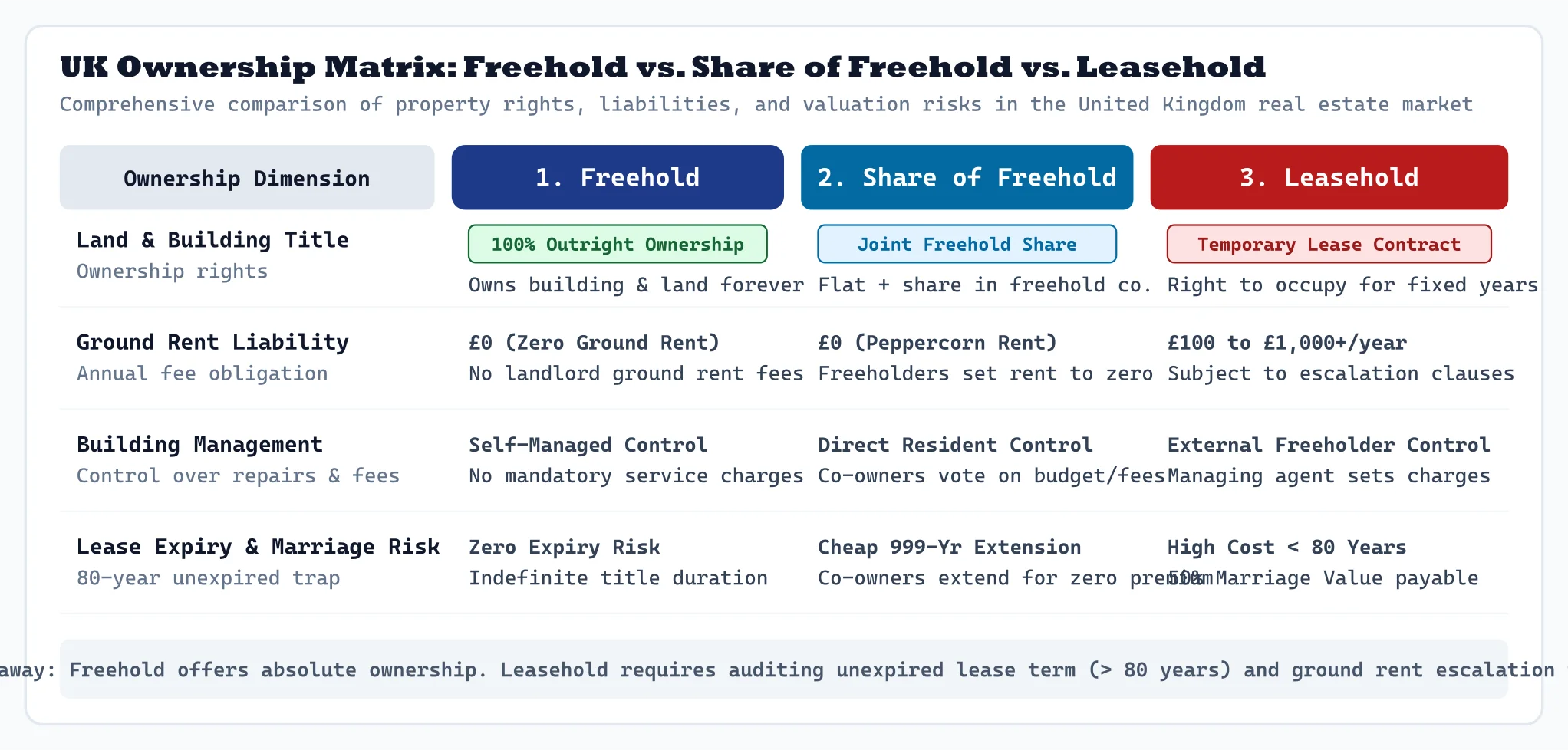
A. Freehold (Absolute Title in Fee Simple)
A Freehold title grants complete, unconditional ownership of the property, the land beneath it, and the airspace above it. Freeholders have total autonomy over maintenance, structural extensions, and property modifications (subject to local planning permission). Freehold houses represent the traditional gold standard of UK homeownership, carrying zero ground rent obligations and zero lease expiration risks.
B. Share of Freehold (Co-Operative Freehold Ownership)
Popular in converted period houses and boutique flat blocks,Share of Freeholdoccurs when flat owners individually hold a long leasehold interest in their apartment, while collectively owning equal shares in a corporate management company (or joint title names) that owns the underlying freehold of the building.
💡 Why Share of Freehold is Highly Desirable
Because the leaseholders control their own freehold company, co-owners can vote to extend their individual leases up to 999 years for zero premium payment (paying only shared legal fees), set ground rent to zero (peppercorn), and control service charge budgets directly without paying third-party landlord markups.
C. Leasehold (Long Contractual Lease)
Under a standard Leasehold arrangement, the buyer owns the internal demise of the property for the remaining duration of the lease contract. The external brickwork, roof, communal hallways, foundations, and land remain the property of the Freeholder (Landlord). The leaseholder pays annual Ground Rent to the freeholder and annual Service Charges to cover building maintenance managed by the freeholder or their appointed Managing Agent.
D. Commonhold (The Rare Multi-Unit Freehold Alternative)
Introduced by the Commonhold and Leasehold Reform Act 2002, Commonhold allows flat owners to own their individual units as freeholders, while a Commonhold Association owns and manages communal building areas. Although widely used in North America (Condominiums) and Australia (Strata Title), Commonhold adoption in the UK remains extremely rare due to historic developer preference for leasehold ground rent monetization.
Detailed Statutory Analysis of Tenure Rights
Under English land law, property ownership rights are categorized under distinct statutory regimes:
- Freehold Property Title: Registered under Law of Property Act 1925 rules, granting absolute ownership of land and buildings without time limits or recurring ground landlord fees.
- Share of Freehold Entities: Formed under the Companies Act 2006 as private limited companies (Management Companies) where each flat owner holds one equal voting share, giving resident owners collective control over lease terms.
- Long Leasehold Contracts: Governed by the Landlord and Tenant Act 1985 and Leasehold Reform Act 1967, establishing formal obligations for ground rent, building insurance, and communal maintenance.
3. The 80-Year Unexpired Lease Trap & Marriage Value Math
The single most critical financial threshold in UK leasehold property is the80-year unexpired lease term limit.
A. The Statutory 80-Year Marriage Value Cliff Edge
Under the statutory provisions of the Leasehold Reform, Housing and Urban Development Act 1993, when a residential lease has 80 years or more remaining on its unexpired term, the statutory extension premium paid to the freeholder is calculated based on two elements:
- Diminution in Freeholder's Interest: The loss in capital value to the freeholder from delaying their reversionary right to repossess the property.
- Capitalised Ground Rent: The net present value of the remaining ground rent stream forfeited by the freeholder.
However, the moment a lease's unexpired term drops below 80 years, a mandatory third element is added to the statutory calculation by law: Marriage Value.
🚨 The 50% Marriage Value Statutory Penalty
Marriage Value represents the potential increase in the property's total capital value created by extending the lease. By statutory law,50% of this total Marriage Value must be paid directly to the freeholder as part of the lease extension premium. This single rule increases lease extension costs by 150% to 300% overnight!
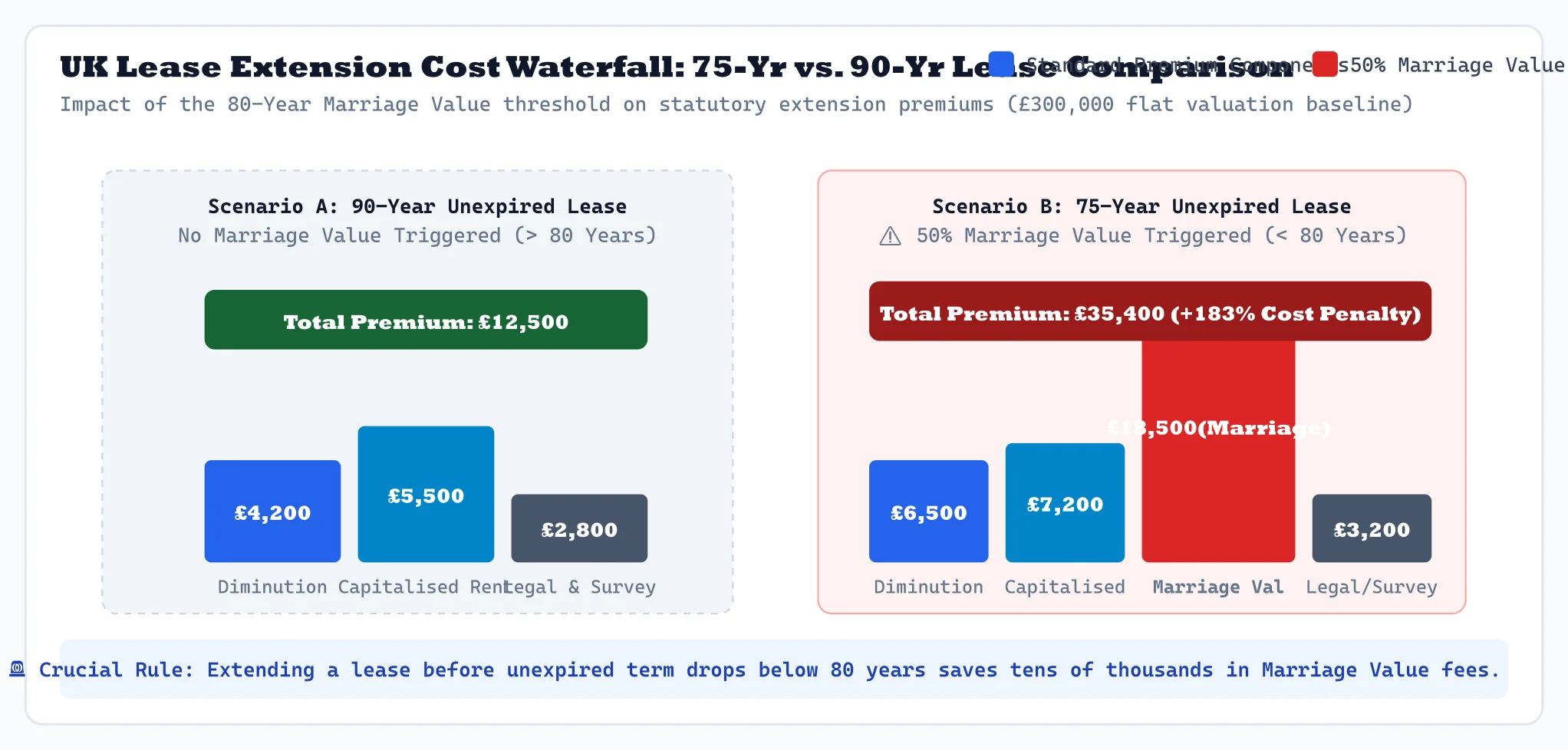
B. Worked Mathematical Case Study: 90-Year Lease vs. 75-Year Lease
Let's evaluate the exact statutory extension cost difference for a London apartment valued at £300,000 with a £150/year ground rent:
Scenario A: 90 Years Remaining (> 80 Yrs)
Scenario B: 75 Years Remaining (< 80 Yrs)
Conveyancing Takeaway: If you are purchasing a leasehold flat with 81 to 85 years remaining, you must either extend the lease immediately upon completion or require the seller to serve a formal Section 42 Tenant's Notice of Claim prior to completion and assign the benefit to you at closing!
Mathematical Valuation Mechanics of Reversionary Interest
When a professional valuation surveyor assesses a leasehold property under the RICS Property Valuation Standards, the total property value is split into two components: the Leaseholder's Interest and the Freeholder's Reversionary Interest.
The Freeholder's Reversionary Interest represents the net present value of the property when it reverts back to the landlord at the end of the lease term, discounted at an institutional deferment rate (typically 4.75% to 5.0% for residential property). When the remaining lease term exceeds 80 years, the present value of the reversion is minimal. However, as the lease unexpired term drops below 80 years, the reversionary value expands rapidly, driving up the statutory lease extension cost.
Furthermore, the statutory 50% Marriage Value split mandated by the 1993 Act requires leaseholders to pay half of the total capital value unlocked by bringing the lease back to full market value. For example, if extending an unexpired 72-year lease increases a London flat's market value from £380,000 to £430,000 (a £50,000 gain), the Marriage Value component alone adds £25,000 (50% of £50k) directly to the freeholder's valuation claim!
4. Ground Rent Escalation Clauses & Mortgageability Limits
Ground rent is an annual fee paid by the leaseholder to the freeholder for the right to occupy the land. While historic ground rents were nominal (e.g. a "peppercorn" or £10 per year), developer practices in the 2000s created aggressive escalation clauses that can render properties unmortgageable.
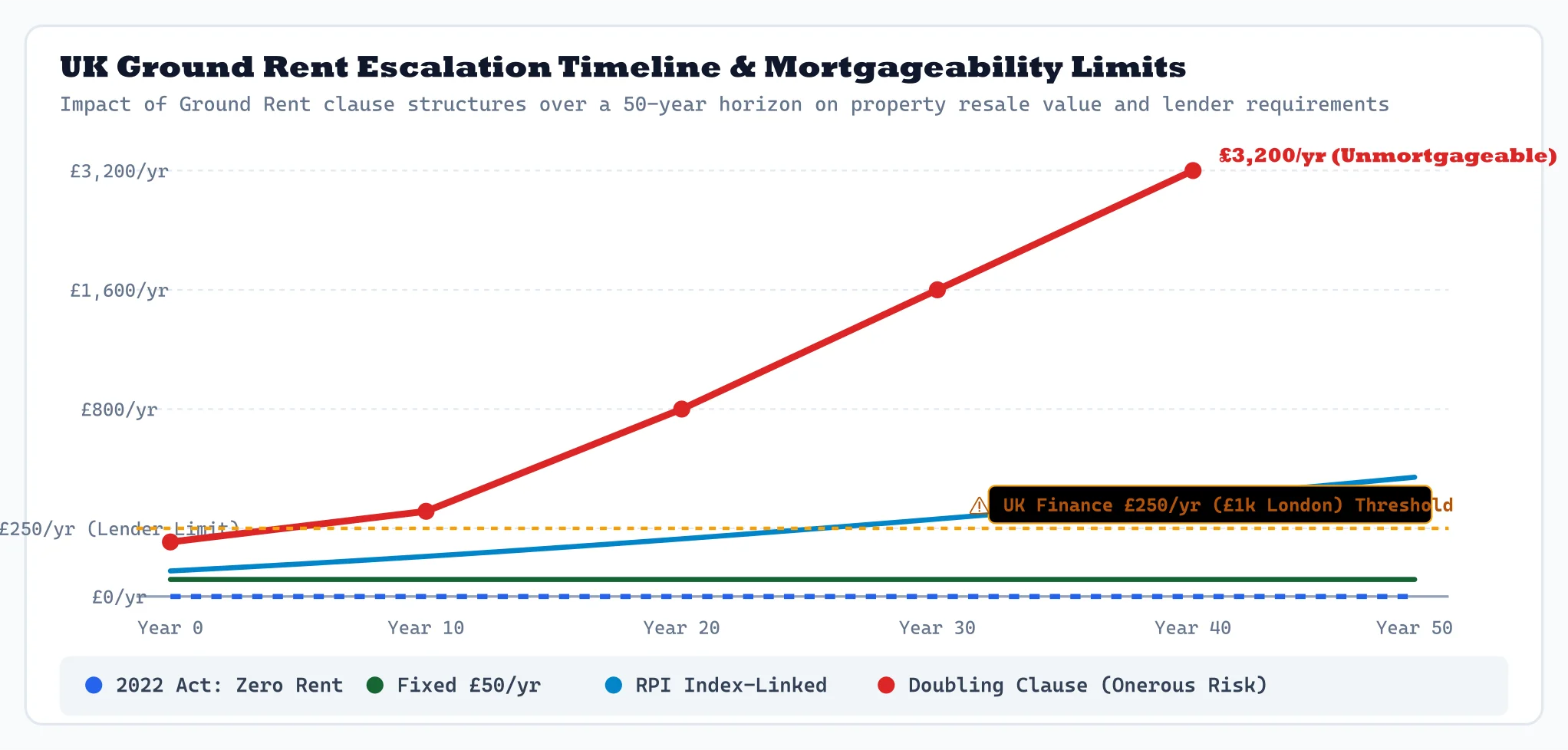
A. Types of Ground Rent Clause Structures
- Peppercorn / Zero Ground Rent: Zero financial liability. Standard for Share of Freehold and all new residential leases under the Leasehold Reform (Ground Rent) Act 2022.
- Fixed Ground Rent: A fixed annual fee (e.g. £100/year for the entire term). Highly predictable and mortgageable.
- RPI / Index-Linked Escalation: Ground rent increases every 10 to 25 years in line with the UK Retail Price Index (RPI) inflation rate. Generally accepted by mortgage lenders if starting rent is low.
- Onerous Doubling Clauses (Toxic Leases): Ground rent doubles every 10 or 15 years (e.g. £250 in Year 1, £500 in Year 10, £1,000 in Year 20, £2,000 in Year 30, £4,000 in Year 40). These clauses create compounding financial traps that destroy property value.
B. Mortgage Lender Thresholds & The Housing Act 1988 Trap
Major UK mortgage lenders operating under UK Finance Lenders' Handbook guidelines enforce strict underwriting rules regarding ground rent:
⚠️ The £250 / £1,000 Housing Act Threshold Danger
Under the Housing Act 1988, if annual ground rent exceeds £250 per year outside Londonor £1,000 per year in Greater London, the lease legally transforms into an Assured Shorthold Tenancy (AST). If the leaseholder defaults on ground rent payments by even a small margin, the freeholder can apply to repossess the property under Ground 8 mandatory possession rules — wiping out the buyer's equity and the mortgage lender's security!
As a result, UK mortgage lenders automatically decline mortgage applications for properties where ground rent exceeds 0.1% of the property's market value or breaches the £250/£1,000 threshold without a mandatory Deed of Variation or Indemnity Policy protection.
Legal Remediation Strategies for Onerous Ground Rent Clauses
For property owners trapped in leases with doubling ground rent clauses, three legal remediation options exist:
- Statutory Lease Extension under the 1993 Act: Exercising formal statutory rights to extend the lease by 90 years (or 990 years under 2024 reform proposals) automatically reduces the ground rent to a peppercorn (£0) by law.
- Voluntary Deed of Variation: Negotiating directly with the freeholder to replace a doubling clause with an RPI inflation-linked schedule or a fixed ground rent cap below £250/year.
- Lender Indemnity Policy: Purchasing a specialized legal indemnity insurance policy to cover UK Finance lender risks when ground rent exceeds the £250 (£1,000 London) Housing Act threshold.
5. Service Charges, Reserve Funds & Section 20 Notices
While ground rent pays for the underlying land,Service Chargescover the ongoing operational cost of maintaining, insuring, and managing the physical building structure and common areas.
A. Components of a Standard Annual Service Charge Budget
- Building Insurance Premium: Landlord block insurance covering structural damage, fire, and flood.
- Communal Utilities & Cleaning: Electricity for hallways/elevators, window cleaning, and grounds maintenance.
- Plant & Mechanical Servicing: Lift inspections, fire alarm testing, and communal boiler servicing.
- Managing Agent Fees: Professional fees charged by the property management firm (typically £250–£450 per flat annually).
- Reserve / Sinking Fund Contribution: Long-term savings allocated for major capital works (e.g. roof replacement, external repainting, elevator replacement every 15–20 years).
B. Section 20 Major Works Consultation Notices
Under Section 20 of the Landlord and Tenant Act 1985 (as amended by the Commonhold and Leasehold Reform Act 2002), freeholders and managing agents must follow a strict 3-stage statutory consultation process before undertaking major building works:
A landlord must serve a Section 20 Notice if:
- The cost of building works will exceed £250 per individual leaseholder.
- Any long-term qualifying service agreement (e.g. 3-year maintenance contract) exceeds £100 per leaseholder per year.
If a landlord fails to follow Section 20 consultation procedures, the maximum statutory amount they can legally recover from each leaseholder is capped at just £250 — regardless of how much money was actually spent!
C. Post-Grenfell EWS1 Cladding Certificates
For multi-story apartment buildings (especially those over 11 meters or 18 meters in height), buyers must verify the External Wall System (EWS1) Certificateduring conveyancing. A rating of A1 or B1 confirms fire safety compliance, while an A3 or B2 rating indicates combustible cladding, triggering potential major works liabilities running into tens of thousands of pounds per flat.
Auditing Managing Agent Budgets & First-tier Tribunal Remedies
Leaseholders dissatisfied with unreasonable service charge increases have statutory rights under Section 27A of the Landlord and Tenant Act 1985 to apply to the First-tier Tribunal (Property Chamber) for a determination of service charge reasonableness.
The Tribunal evaluates whether management fees align with market benchmarks, whether maintenance works were executed to a satisfactory standard, and whether managing agents complied with the RICS Service Charge Residential Management Code. If the Tribunal finds service charges unreasonable, it has the legal authority to reduce service charge demands retroactively.
6. 4-Step Conveyancing Due Diligence Framework
Before executing purchase contracts on a UK leasehold property, follow this 4-step due diligence workflow:
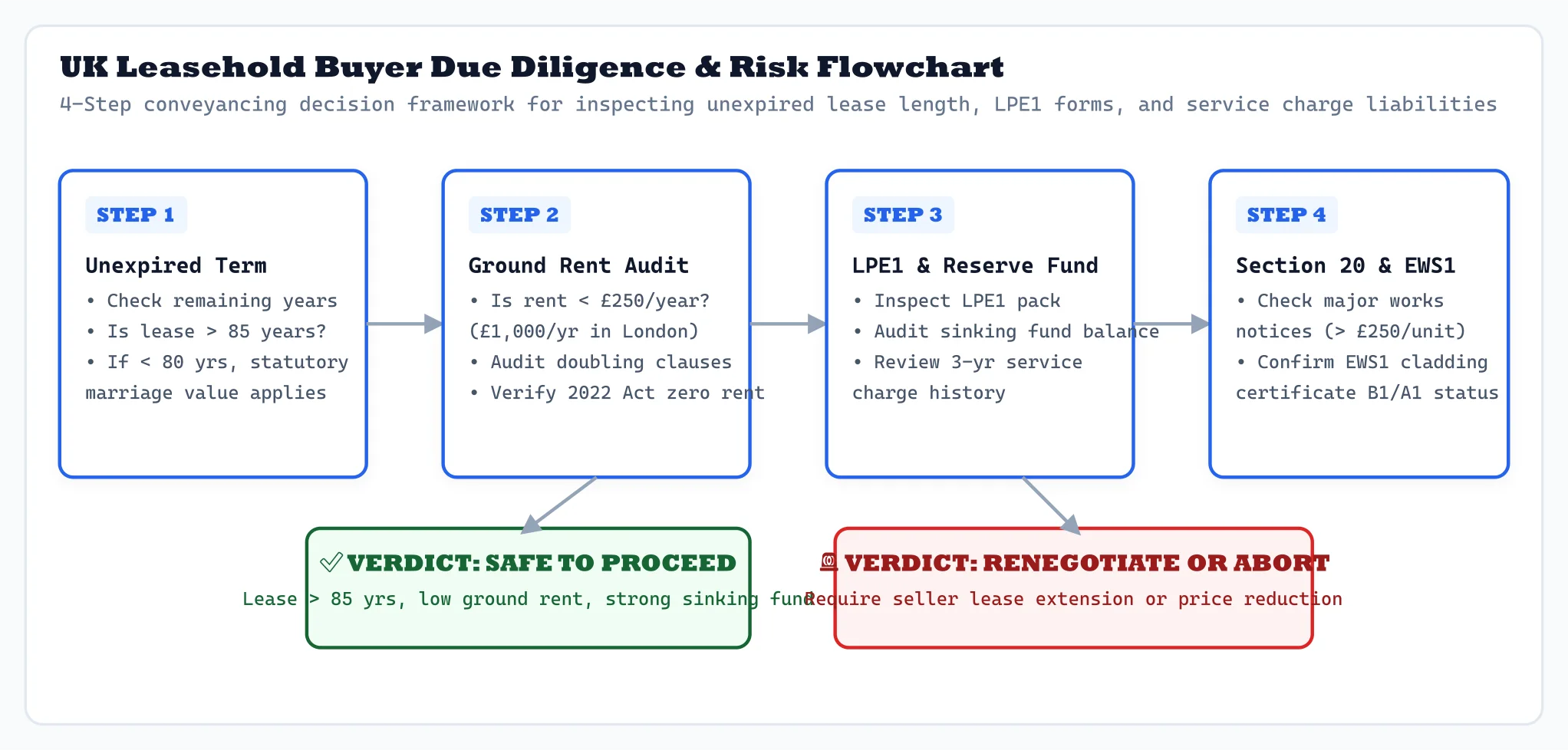
- Stage 1: Land Registry Lease Term Audit: Order official copies of the Register of Title and Lease Plan. Calculate exact unexpired lease years. If remaining term is < 85 years, budget for lease extension or negotiate price reductions.
- Stage 2: Ground Rent Clause & Threshold Audit: Review the lease contract for escalation frequency (Fixed vs RPI vs Doubling). Verify that starting rent does not exceed £250/yr (£1k London) or 0.1% of property value.
- Stage 3: Management Pack (LPE1 Form) Audit: Obtain the official Law Society LPE1 (Leasehold Property Enquiries) pack. Audit 3 years of audited service charge statements, current sinking fund balances, and managing agent performance.
- Stage 4: Section 20 & Building Safety Audit: Inspect managing agent meeting minutes for pending major structural works, roof repairs, elevator overhauls, or EWS1 cladding remediation notices.
Comprehensive Conveyancing Checklist for UK Solicitors
During formal conveyancing, your legal solicitor must request and inspect the complete Leasehold Property Enquiries (LPE1) pack from the landlord's managing agent. Key documents to audit include:
- 3 Years of Audited Accounts: Verify historic service charge expenditure trends and identify recurring budget deficits.
- Fire Risk Assessment (FRA): Confirm building compliance with the Regulatory Reform (Fire Safety) Order 2005 and Building Safety Act 2022.
- Asbestos & Lift Inspection Certificates: Inspect statutory safety compliance certificates for communal mechanical plant and structural insulation.
- Right to Manage (RTM) Notices: Check whether leaseholders have initiated formal Right to Manage proceedings under Chapter 1 of the Commonhold and Leasehold Reform Act 2002.
7. 3 Worked Real-World Examples (Real Estate Scenarios)
Let's examine three detailed mathematical case studies across major UK property markets:
Example 1: Short-Lease Flat in Battersea, London
An investor evaluates a 2-bedroom flat in Battersea listed for £450,000 (20% below local market value).
- Unexpired Lease Term:76 Years Remaining (< 80-Year Marriage Value Cliff)
- Ground Rent: £200/year (Doubling every 25 years)
- Annual Service Charge: £3,200/year
- Statutory Lease Extension Cost: Premium (£32,000) + Marriage Value (£16,000) + Legal/Surveyor Fees (£3,500) = £51,500
Financial Analysis: True Cost = Purchase Price (£450,000) + Lease Extension (£51,500) + Stamp Duty (£12,500) = £514,000.
Verdict: RENEGOTIATE OR ABORT.The 20% discount is consumed by extension costs. Buyer requires seller to serve Section 42 Notice prior to exchange.
Example 2: Share of Freehold Flat in Ancoats, Manchester
A first-time buyer acquires a modern apartment in Manchester for £220,000 with Share of Freehold.
- Unexpired Lease Term:999 Years (Peppercorn Rent)
- Ground Rent: £0 / year
- Annual Service Charge: £1,400/year (Self-managed by resident management company)
- Sinking Fund Balance: £45,000 in reserve account
Financial Analysis: Zero lease extension risk, zero ground rent liability, direct resident control over management budgets.
Verdict: HIGHLY RECOMMENDED (PRIME ASSET).Excellent long-term liquidity and mortgageability.
Example 3: Freehold House in Edgbaston, Birmingham
A family purchases a 3-bedroom Victorian house in Birmingham for £310,000 with Freehold Title.
- Tenure Title: Freehold (Absolute Title Fee Simple)
- Ground Rent: £0
- Service Charge: £0
- Building Insurance: £350/year (Direct landlord hazard policy)
Financial Analysis: Complete operational autonomy. No landlord approvals required for extensions or maintenance.
Verdict: GOLD STANDARD OWNERSHIP.Zero tenure-related valuation degradation.
Detailed Cash Flow Modeling Across Ownership Models
To illustrate the operational financial impact of tenure types over a 10-year holding period, consider three real estate investors purchasing identical £300,000 residential units in major regional UK cities:
Investor A (Standard Leasehold Flat): Purchases a flat with 82 years remaining. Over a 10-year hold, cumulative service charges (£2,200/yr) total £22,000, ground rent (£250/yr) totals £2,500, and mandatory lease extension premium at Year 8 (when lease drops to 74 years) costs £38,000. Total 10-year tenure overhead = £62,500.
Investor B (Share of Freehold Flat): Purchases an apartment with a 999-year lease and Share of Freehold. Service charges (£1,200/yr) total £12,000, ground rent is £0, and lease extension costs are £0. Total 10-year tenure overhead = £12,000.
Investor C (Freehold House): Purchases a standalone house. Direct maintenance and building insurance (£800/yr) total £8,000 over 10 years, ground rent is £0, and lease extension costs are £0. Total 10-year tenure overhead = £8,000.
8. International Market Comparison: USA, UK, Canada, Australia & UAE
Property tenure legal frameworks differ significantly across global Tier-1 real estate markets:
Subject to 80-yr Marriage Value & Leasehold Reform Act 2024 (990-yr extensions).
Fee Simple dominates residential homes. Co-op apartments in NYC evaluate board approval.
Strata corporations govern shared multi-unit buildings with mandatory reserve fund studies.
Owners Corporation manages common property under state Strata Schemes Management Acts.
Foreign non-residents own 100% freehold title in designated Dubai/Abu Dhabi investment zones.
In-Depth Cross-Border Tenure Analysis
In the United States, residential property is predominantly owned under Fee Simple Absolute, granting unrestricted ownership of land and buildings. In major urban centers like New York City, Housing Cooperatives (Co-ops) require buyers to purchase shares in a corporation that owns the building, accompanied by a proprietary lease.
In Canada and Australia, multi-family apartment ownership utilizes Strata Titleframeworks. Strata owners hold title to their unit plus an undivided interest in common property, governed by elected Owners Corporations under strict statutory reserve fund auditing laws. In the UAE (Dubai), foreign buyers can purchase 100% Freehold title in designated investment zones (e.g. Dubai Marina, Downtown) or 99-year Usufruct leasehold rights in non-freehold areas.
Global Institutional Trends in Multi-Family Residential Title
Comparing global real estate markets highlights why the UK's leasehold system is undergoing reform. In Germany and France, apartment buyers own co-ownership shares (Wohnungseigentum and Copropriété) governed by strict statutory co-owner assemblies. In the United States, commercial developers utilize ground leases for multi-family developments, but residential single-family homes are almost universally Fee Simple.
In Australia and Canada, Strata Title legislation ensures that all unit owners hold an undivided share in common property and mandates third-party depreciation studies to maintain reserve funds. The UK Leasehold and Freehold Reform Act 2024 represents an effort to align UK property rights with these modern international standards.
9. The 8 Most Dangerous Leasehold Myths Debunked
🚨 Myth #1: "Leasehold Means You Own the Land"
Reality: You only own the right to occupy the interior space for the duration of the lease contract. The land remains owned by the freeholder.
🚨 Myth #2: "A 99-Year Lease is Essentially Freehold"
Reality: A 99-year lease reaches the critical 80-year marriage value threshold after just 19 years of ownership, severely impacting resale value.
🚨 Myth #3: "Share of Freehold Means You Don't Need a Lease"
Reality: Share of Freehold properties still require an underlying lease contract to define apartment boundaries and service charge obligations.
🚨 Myth #4: "Service Charges Can Never Increase"
Reality: Service charges fluctuate annually based on actual building insurance, utility inflation, maintenance contracts, and reserve fund top-ups.
🚨 Myth #5: "You Can Extend a Lease For Free After 2 Years"
Reality: You gain statutory rights to extend after 2 years of ownership under the 1993 Act, but you must still pay the freeholder's valuation premium and legal costs.
🚨 Myth #6: "Ground Rent and Service Charge are the Same Thing"
Reality: Ground rent is rental income paid to the landlord for land use. Service charges pay for actual building maintenance and insurance.
🚨 Myth #7: "Lenders Don't Care About Lease Length Above 70 Years"
Reality: UK Finance lenders require a minimum of 70 to 85 years remaining at completion plus 30 years post-mortgage term (e.g. 70 + 25 = 95 years required).
🚨 Myth #8: "The 2024 Reform Act Abolishes All Existing Ground Rent"
Reality: The 2022 Act banned ground rent on new leases, but existing pre-2022 leases retain contractual ground rent obligations until extended or varied.
Right to Manage (RTM) & Collective Enfranchisement Mechanics
When leaseholders in a multi-unit block face persistent poor service from an absentee freeholder or expensive managing agent, English law provides two powerful statutory remedies under the Commonhold and Leasehold Reform Act 2002:
- Right to Manage (RTM): Allows qualifying leaseholders in a residential block (where at least 50% of flat owners participate and at least 75% of the floor area is residential) to take over building management without buying the freehold. RTM eliminates landlord management markups and allows residents to select their own managing agents.
- Collective Enfranchisement: Grants qualifying leaseholders the legal right to compel the freeholder to sell the building's freehold title to a leaseholder-owned company at an independently appraised market value.
10. Connecting Leasehold Costs to Property Metrics & Lashkari Tools
Leasehold financial obligations directly impact net rental yields, cash flow returns, and overall transaction costs:
- Stamp Duty Tax Calculation: Calculate UK Stamp Duty Land Tax (SDLT) obligations including the 3% or 5% higher rates for additional dwellings on our Stamp Duty Calculator and read our UK Stamp Duty Guide.
- Home Affordability & Closing Costs: Factor service charges and legal fees into your budget using the Home Affordability Calculator and Closing Cost Calculator.
- International Buyer Guides: Compare international buying rules in our guides: Buying Property in the USA, Buying Property in Australia, How Much House Can I Afford, and Debt-to-Income Ratio Guide.
Conveyancing Fee Breakdown & Management Pack Costs
When purchasing a UK leasehold property, buyers must budget for specific legal conveyancing disbursements that do not apply to freehold transactions:
- LPE1 Management Pack Fee: Charged by the freeholder or managing agent to provide leasehold enquiry responses, typically ranging from £250 to £500 + VAT.
- Notice of Transfer & Charge Fees: Formal legal notices served on the landlord post-completion to record new ownership and mortgage details (£50–£150 per notice).
- Deed of Covenant Fee: A legal document executed by the buyer promising to abide by existing lease covenants (£100–£300).
- Certificate of Compliance Fee: Fee paid to the managing agent to register the Land Registry transfer restriction (£100–£250).
11. Actionable Framework & 12-Point Buyer Due Diligence Checklist
Verified on Land Registry title plan (> 85 years remaining).
Verified under £250/yr (£1,000 London) or peppercorn.
Confirmed no 10-year doubling clauses exist.
Obtained official Law Society LPE1 conveyancing pack.
Audited last 3 years of accounts for cost inflation.
Verified healthy reserve fund balance for capital repairs.
Confirmed zero outstanding major works consultation notices.
Verified EWS1 fire safety rating (A1 or B1 rating).
Checked lease clauses for tenant subletting permissions.
Verified landlord consent rules for pets and internal works.
Impact of Interest Rate Cycles on Lease Extension Funding
Macroeconomic conditions directly influence leasehold valuation dynamics. When mortgage interest rates rise, borrowing costs increase for investors financing statutory lease extension premiums.
Under RICS valuation practices, higher interest rate environments elevate discount rates applied to reversionary land calculations, slightly reducing freeholder reversion values. However, elevated inflation expands RPI-linked ground rent streams, creating offsetting valuation pressures. Real estate investors must model lease extension costs against baseline property appreciation to protect net asset yields.
12. Frequently Asked Questions (PAA Style)
What is the main difference between freehold and leasehold in the UK?
Freehold means you own the property and the underlying land outright in perpetuity. Leasehold means you own the right to occupy the building for a fixed period (e.g. 99 or 125 years) under a lease agreement, while the land is owned by a freeholder.
Is it risky to buy a leasehold property in the UK?
Leasehold properties carry specific risks, including diminishing lease length, unbudgeted service charge increases, doubling ground rent clauses, and high lease extension costs if the unexpired term drops below 80 years.
What happens when a leasehold drops below 80 years?
When a lease drops below 80 years, statutory Marriage Value becomes payable to the freeholder upon extension under the Leasehold Reform, Housing and Urban Development Act 1993, increasing extension costs by 50% or more.
How much does it cost to extend a lease on a UK flat?
Lease extension costs depend on unexpired lease length, property market value, and ground rent. Leases over 85 years typically cost £5,000–£12,000, whereas leases under 80 years can cost £30,000–£60,000 due to Marriage Value.
What is ground rent and why is doubling ground rent dangerous?
Ground rent is an annual fee paid by the leaseholder to the freeholder. Doubling clauses double ground rent every 10 or 15 years, quickly making the property unmortgageable under UK Finance lender guidelines.
What is a service charge and how can I check if it is reasonable?
Service charges cover building maintenance, communal utilities, insurance, and management. You can verify reasonableness by requesting 3 years of audited service charge accounts and checking LPE1 conveyancing forms.
What is Share of Freehold and is it better than standard leasehold?
Share of Freehold means leaseholders collectively own the freehold entity that owns the building land. It is superior to standard leasehold because co-owners can extend leases for zero premium and control service charges.
Can a landlord force me to pay for major building repairs under Section 20?
Yes, under Section 20 of the Landlord and Tenant Act 1985, landlords can recover major repair costs exceeding £250 per tenant, provided they follow mandatory statutory consultation procedures.
How will the UK Leasehold and Freehold Reform Act 2024 affect property owners?
The 2024 Reform Act extends statutory lease extension terms to 990 years, bans ground rent on new residential leases, and proposes abolishing Marriage Value calculations for existing short-lease property owners.
What free calculators can I use to estimate buying costs like UK Stamp Duty?
You can calculate purchase tax and affordability using the free LashkariProperties Stamp Duty Calculator at lashkariproperties.com/tools/stamp-duty-calculator.
Auditing Managing Agent Performance & Contract Covenants
Evaluating a managing agent's operational capability is critical during property due diligence. Professional property management companies should be accredited by the Property Ombudsman or ARMA (Association of Residential Managing Agents).
During conveyancing, verify whether the managing agent maintains segregated client bank accounts for service charge funds and reserve accounts. Ensure that reserve funds are held in interest-bearing trust accounts under Section 42 of the Landlord and Tenant Act 1987, protecting leaseholder funds from managing agent insolvency.
Short-Term Rental (Airbnb) Covenants & Forfeiture Risks
Property investors planning to operate short-term vacation rentals (such as Airbnb or Booking.com) on a UK leasehold flat must audit lease user covenants carefully.
Standard residential leases contain strict covenants prohibiting business use, restricting occupation to a 'single private dwelling', or forbidding subletting without landlord consent. Courts in England and Wales have repeatedly ruled that operating a flat as a short-term holiday let breaches single private dwelling covenants, exposing the leaseholder to freeholder injunctions, legal costs, and potential lease forfeiture!
Strategic Lease Extension Negotiation Playbook for Investors
When negotiating lease extensions on short-lease investment properties, real estate buyers should execute a 3-stage statutory playbook:
- Serve Section 42 Notice Prior to Exchange: Require the seller (who meets the 2-year ownership condition) to serve the formal Section 42 Notice of Claim on the freeholder before contracts are exchanged.
- Assign Benefit of Notice at Completion: Assign the benefit of the Section 42 Notice to the buyer at closing, enabling the buyer to complete the statutory lease extension immediately without waiting 2 years.
- Instruct Specialist RICS Valuer: Hire an expert RICS surveyor to negotiate the counter-notice premium under Section 45 with the freeholder's valuer or present evidence to the First-tier Tribunal.
Leasehold Forfeiture Mechanics & Law Commission Reforms
One of the most controversial aspects of UK leasehold law is the landlord's statutory right of Forfeiture.
Under Section 146 of the Law of Property Act 1925, if a leaseholder breaches lease covenants or defaults on ground rent or service charges exceeding £350 (or unpaid for over 3 years), a freeholder can apply to court to forfeit the lease. If granted, forfeiture terminates the lease contract entirely, allowing the freeholder to repossess the property without compensating the leaseholder for their accumulated equity!
The UK Law Commission and the Leasehold and Freehold Reform Act 2024 have proposed replacing draconian forfeiture rules with a modern enforcement mechanism similar to mortgage possession proceedings, ensuring that leaseholders retain their underlying capital equity even if a dispute over service charges arises.
Managing Service Charge Arrears & Dispute Resolution
When leaseholders dispute service charge invoices due to unexpected cost increases or uncompleted maintenance, paying under formal protest is essential.
Withholding service charge payments entirely can trigger legal action from managing agents, adding legal costs and administrative fees to the outstanding balance. Real estate advisors recommend sending written notice stating that service charges are paid 'under reservation of rights', preserving the leaseholder's statutory legal right to challenge fee reasonableness before the First-tier Tribunal under Section 27A of the 1985 Act.
First-tier Tribunal Evidence Procedures & RICS Expert Witnesses
If a lease extension valuation dispute between a leaseholder and freeholder cannot be resolved informally, either party can apply to the First-tier Tribunal (Property Chamber) for a binding valuation determination.
During Tribunal proceedings, both parties present expert valuation evidence prepared by RICS registered valuers. The Tribunal evaluates comparable market sales of extended leases, unexpired lease relativity curves (such as Gerald Eve or Savills relativity graphs), and current capitalisation yields to fix the statutory lease extension premium.
Land Registry Title Register & Lease Plan Audit Masterclass
During property conveyancing, buyers should request official copies of the Land Registry Title Register (Form OC1) and Title Plan.
The Title Register confirms the official property class of title (Absolute, Qualified, or Possessory), the exact names of registered proprietors, registered rights of way, and registered charges or mortgages. The Lease Plan defines the precise red-line physical boundaries of the flat demise, identifying shared communal areas, parking spaces, storage lockers, and structural demise boundaries.
Historical Timeline of Key UK Property Legislation (1925–2024)
Understanding the legal framework governing English residential property requires reviewing key statutory enactments:
Established modern system of legal estates (Freehold and Leasehold).
Defined core property ownership rights in England and Wales.
Granted enfranchisement rights to leasehold house owners.
Allowed house leaseholders to compel landlords to sell the freehold.
Regulated service charges, reasonableness tests, and Section 20 notices.
Protected leaseholders from unbudgeted major work cost spikes (> £250/unit).
Established £250 (£1,000 London) ground rent AST threshold rules.
Created mortgageability risks for ground rents exceeding 0.1% of value.
Created statutory 90-year lease extension rights and Marriage Value.
Mandated 50% Marriage Value split for leases under 80 years unexpired.
Introduced Commonhold title and Right to Manage (RTM) procedures.
Allowed leaseholders to take over building management directly.
Banned ground rent on all new residential lease contracts.
Set ground rent to zero (peppercorn) for new residential leases.
Extended statutory extension terms to 990 years and abolished marriage value.
Historic ongoing reform package improving leaseholder rights.
Essential Glossary of Key UK Leasehold Terminology
- Demise: The exact physical boundary of the property leased to the buyer (e.g. interior walls, floorboards, and ceiling plaster of a flat).
- Freeholder (Lessor): The landlord who owns the underlying land and structural building envelope in perpetuity.
- Leaseholder (Lessee): The buyer who holds contractual rights to occupy the property for a specified unexpired term.
- Peppercorn Rent: A nominal ground rent of £0, ensuring zero ongoing financial liability to the landlord.
- Reversion: The legal right of the freeholder to repossess the property when the lease unexpired term reaches zero.
- Sinking Fund (Reserve Fund): A communal savings fund collected via service charges to pay for future capital building repairs.
- Section 42 Notice: Formal statutory notice served on the freeholder initiating a compulsory lease extension claim under the 1993 Act.
13. Conclusion & Next Steps
Understanding UK Leasehold vs Freehold is essential for securing real estate equity. Calculate your purchase taxes in seconds on the Lashkari Stamp Duty Calculator.
Written by Lashkari Real Estate Research Team
Educational Disclaimer: This article is for educational purposes only. Always consult a licensed solicitor or legal conveyancer before committing capital.
Primary sources & further reading
UK leasehold rules change. Confirm extension rights, ground rent reform, and lender handbook criteria with current primary sources before you exchange.
- GOV.UK — extending or buying a lease
- Leasehold Advisory Service (LEASE)
- UK Finance Lenders' Handbook
- RICS real estate standards
- Stamp Duty Calculator
- Home Affordability Calculator
- Closing Cost Calculator
Related guides: UK Stamp Duty Explained · How Much House Can I Afford · Debt-to-Income Ratio · Buying Property in the USA.
Sources
Related reading
Continue reading: Australia Stamp Duty: Buyer Guide · Buying Property in Australia: Costs · Buying Property in Canada: Guide (2026). Run your own numbers with the Stamp Duty & Transfer Tax Calculator — it takes under a minute and beats guessing.
Frequently asked questions
What is the difference between leasehold and freehold in the UK?
Freehold means you own the building and the land indefinitely. Leasehold means you own the right to occupy for a fixed term, typically of a flat, with ground rent and service charges. Over 70 percent of flats in major urban centres are leasehold.
Why is a short lease a problem?
A leasehold is a wasting asset: as the unexpired term falls, the property's value and mortgageability decline, and extending a lease under about 80 years becomes more expensive. Always check the remaining term in years before offering.
What questions should I ask before buying a leasehold?
Ask the remaining term, ground rent and how it increases, service-charge history and planned major works, who repairs what, and whether you can sublet. A cheap flat on a poorly drafted lease is usually a future negotiation with a freeholder.
Is leasehold being abolished in England?
Not yet, but it is being reformed. The Leasehold and Freehold Reform Act 2024 bans new leasehold houses, caps ground rents at a peppercorn, extends standard lease terms to 990 years for new flats, and makes it cheaper and easier to buy the freehold or extend a lease. Existing leases remain, but the balance of power between leaseholders and freeholders is shifting — the reforms are being phased in through 2026.