 By Nirmal Lashkari · Founder · Indore, Madhya Pradesh, India
$300,000 loan at 7% annual interest over 240 months, the estimated monthly EMI is $2,325.90. The corresponding total interest is $258,215.23 and total repayment is $558,215.23; these figures use the standard fixed-rate amortization formula and are rounded to cents for display.
Monthly EMI: $2,325.90

An equated monthly installment is the fixed monthly amount that repays a reducing-balance loan over the tenure you enter. The amount is not merely a price tag for the thing being financed. It is a recurring claim on future income, repeated for every month in the schedule. That makes the calculator useful before an application: it turns a proposed loan into a concrete number that can be compared with rent, household bills, savings, and other obligations.
The component is intentionally narrow. It asks for a loan amount in dollars, an annual interest rate shown as percent per annum, and a tenure in months. It then returns three outputs: Monthly EMI, Total interest, and Total payment. It does not add fees, insurance, taxes, deposits, or other borrowing costs. Keeping that boundary visible prevents a clean installment estimate from being mistaken for the full cost of a purchase.
Loan amount is the principal being modeled, not necessarily the sticker price of an asset. If a vehicle costs $32,000 and you pay $5,000 from savings, the amount to enter for this loan is $27,000 before any financed fees. Entering the full purchase price would overstate every output. The field accepts a non-negative number and displays a dollar prefix, so it is designed for a currency amount rather than a percentage or a monthly payment.
Interest rate is the annual rate expressed as a percentage per annum. A value of 7 means 7% per year, not 0.07 entered as a percent display. The field allows tenths, such as 6.5 or 7.1, which is useful when comparing quoted rates. Tenure is the number of monthly installments: 60 means five years, 120 means ten years, and 240 means twenty years. The component requires at least one month, so a whole-month schedule is the intended use.
The calculator uses the standard fixed-payment amortization relationship. First, the annual percentage is converted to a monthly rate by dividing by twelve. Interest for a month is then calculated on the outstanding balance. The EMI covers that month's interest, and the remainder reduces principal. As the balance declines, the interest part declines too, while the principal part grows. The payment can remain level even though its internal composition changes.
In notation, the payment is P times r times (1 plus r) raised to n, divided by (1 plus r) raised to n minus one, where P is the loan amount, r is the monthly rate, and n is the number of months. At a zero rate, the limiting result is simply principal divided by months. The displayed outputs are therefore connected: Total payment equals the monthly EMI multiplied by the number of payments, and Total interest is Total payment minus the original loan amount, subject to normal currency formatting and rounding.
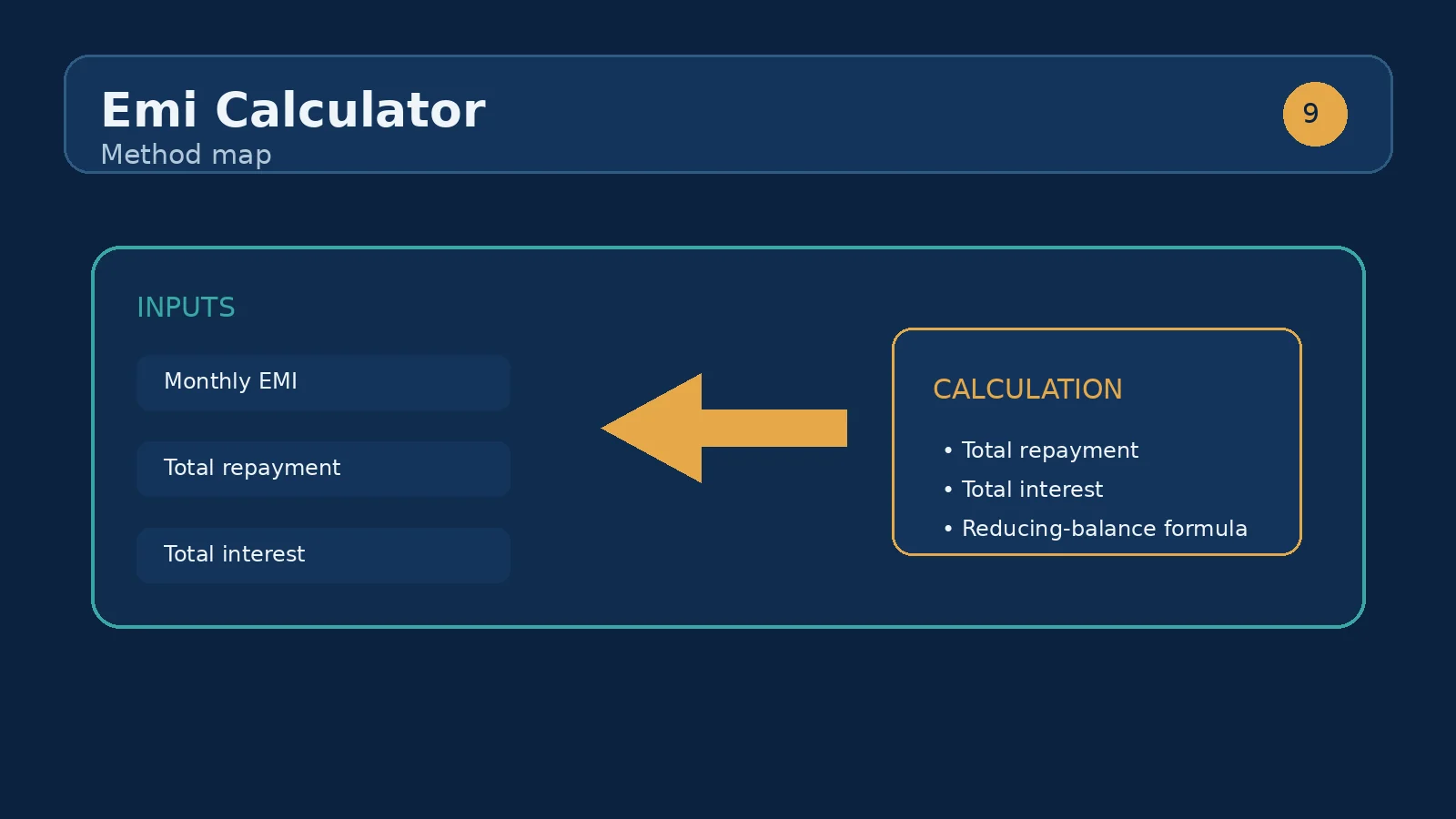
Enter a loan amount of $300,000, an interest rate of 7%, and a tenure of 240 months. The monthly rate is 7% divided by twelve, and the schedule contains 240 payments. The resulting EMI is approximately $2,326.97 per month. Across the full schedule, the borrower pays approximately $558,472.68. Subtracting the $300,000 principal leaves approximately $258,472.68 in total interest.
This example shows why the three outputs belong together. The EMI answers the monthly-budget question. Total interest answers the financing-cost question. Total payment answers the amount sent to the lender over the entire modeled schedule. None of these numbers includes an unentered origination fee or a separate insurance charge. If such costs are financed into the loan, they should first be reflected in the loan amount; if paid separately, they remain outside this result.
Tenure is often the easiest way to make an installment look smaller, but the lower monthly figure can be purchased with more months of interest. Using the same $300,000 principal and 7% annual rate, a 120-month schedule produces an EMI of about $3,483.06 and total interest of about $117,967. The 240-month schedule produces the approximately $2,326.97 EMI above and about $258,473 of interest. The longer option lowers the monthly claim by about $1,156, but adds roughly $140,506 of interest.
A shorter tenure is not automatically better if its payment leaves no room for ordinary volatility. The useful comparison is the shortest schedule that a realistic budget can carry, not the schedule with the smallest headline EMI. Run the same loan through several month counts, record both the EMI and Total interest, and then consider whether the cash-flow difference is worth the additional financing cost.
A rate comparison is meaningful only when the loan amount and number of months stay fixed. For example, on $300,000 over 240 months, changing the rate from 7% to 6% lowers the EMI from about $2,326.97 to about $2,149.29 and lowers total interest from about $258,473 to about $215,829. The difference is not a guarantee of what a lender will offer; it is a controlled sensitivity test showing how the calculator responds to the rate input.
Principal comparisons work the same way. If the rate and tenure remain 7% and 240 months, a $250,000 loan has a lower EMI than the $300,000 example because every scheduled interest and principal amount is based on a smaller balance. This is why a larger deposit or a smaller purchase can change the monthly result without changing the quoted rate. Use separate runs rather than changing all three inputs at once, so you can identify which assumption caused the output to move.
Monthly EMI is the primary recurring output. Treat it as the modeled installment for the entered principal, annual rate, and month count. It is not an affordability approval and it is not a promise that a real account will use the same payment frequency, rounding, or rate convention. Total interest is the cumulative financing charge implied by the schedule. A high total-interest figure does not mean the arithmetic is wrong; it often reflects a long tenure or a high rate applied over many months.
Total payment is the sum of all scheduled EMIs. In the worked scenario, it is the principal plus total interest. This output is especially useful when comparing two tenures that have similar monthly payments but different end dates. Read the labels as a set: an EMI that fits this month's budget can still produce an expensive Total payment, while a low Total interest path can demand a monthly EMI that is impractical.
The most common error is entering the purchase price when the loan amount is smaller. Another is entering 0.07 instead of 7 in a field labeled percent per annum. Users also sometimes type years into Tenure even though the field explicitly says months; entering 20 means twenty payments, not twenty years. A fourth mistake is comparing a reducing-balance EMI with a flat-rate quote without first confirming that the underlying methods match.
Before relying on a result, check the unit beside every field, make sure the rate is plausible for the quote being modeled, and convert the desired term into months. Then change only one input and observe whether the direction makes sense: a larger principal should increase the EMI, a higher rate should increase it, and a longer tenure should generally reduce the EMI while increasing the number of payments. Keep fees and optional add-ons in a separate note unless you deliberately include them in principal.
Once the installment is clear, use the Loan Comparison Calculator when you have two formal offers and need to compare rates, fees, or terms together. EMI alone cannot reveal a processing fee or a prepayment restriction. If the question is whether your income and existing debts can support the proposed borrowing, move to the Loan Eligibility Calculator or the Debt-to-Income Ratio Calculator instead; those tools answer a qualification question that this component does not implement.
For an existing loan, the Extra Payment Calculator is the natural follow-up. Entering an additional recurring amount there can show how a smaller balance changes the payoff path and interest cost. The transition is practical: this EMI calculator prices the original schedule, while a sibling repayment tool can test what happens after you choose to pay more than the displayed Monthly EMI.
An EMI is a fixed monthly payment that covers both interest and principal, so the loan is fully repaid by the end of the tenure.
Yes, a longer tenure lowers the monthly EMI but increases the total interest paid over the life of the loan.
No. This calculator models principal and interest from the three visible inputs. Fees, insurance, taxes, and other charges are outside the result unless you deliberately include a financed charge in the loan amount.
The principal is spread across more monthly payments, so each payment is usually smaller. Interest is then calculated across more months, which commonly increases Total interest and Total payment.
Enter 7 for a 7% annual rate because the field is labeled percent per annum and displays a percent suffix. Entering 0.07 would model a much smaller percentage.
Convert years to months first. Five years is 60 months, ten years is 120 months, and twenty years is 240 months. The component labels the input in months and requires at least one month.
Total payment is the sum of every scheduled EMI. At a positive interest rate, that sum includes the original principal plus the accumulated interest shown separately as Total interest.
No. It prices the loan scenario you enter. Approval can depend on income, existing obligations, credit assessment, documentation, product rules, and other factors that are not inputs in this component.
How we calculate: calcEmi in calculators.ts; regression checks in calculators.test.ts
Last reviewed: . Learn more about Nirmal Lashkari and LashkariProperties.
Disclaimer: This calculator provides estimates for informational purposes only and is not financial, tax, or legal advice. Verify figures with a qualified professional before making decisions.