Buying property abroad means buying two things at once: the home and the rulebook. Ownership structures, purchase taxes, financing rules, and the cost of holding a property differ sharply between countries, and a strategy that is sensible in one market can be expensive in another. The guides in this hub cover the markets our readers buy in most — the United States, the United Kingdom, Australia, and the UAE — with the costs and rules that actually differ.
Three differences dominate every cross-border comparison. Deposit expectations vary from about 5 percent in some first-time schemes to 25 percent for expat buyers elsewhere. Purchase taxes are structured completely differently — banded stamp duty in the UK, state-level transfer taxes and property taxes in the US, stamp duty and a land-rich system in Australia, and registration fees in the UAE. And financing for non-residents is almost always more expensive: larger deposits, higher rates, and fewer products. None of these is a reason not to buy; all of them are reasons to price the purchase before you fall in love with a specific home.
What differs most between markets
- US: property taxes set locally and varying enormously; closing costs of 2 to 5 percent; non-resident mortgages available with larger deposits
- UK: banded stamp duty, freehold versus leasehold, and the chain system; non-resident surcharges can apply
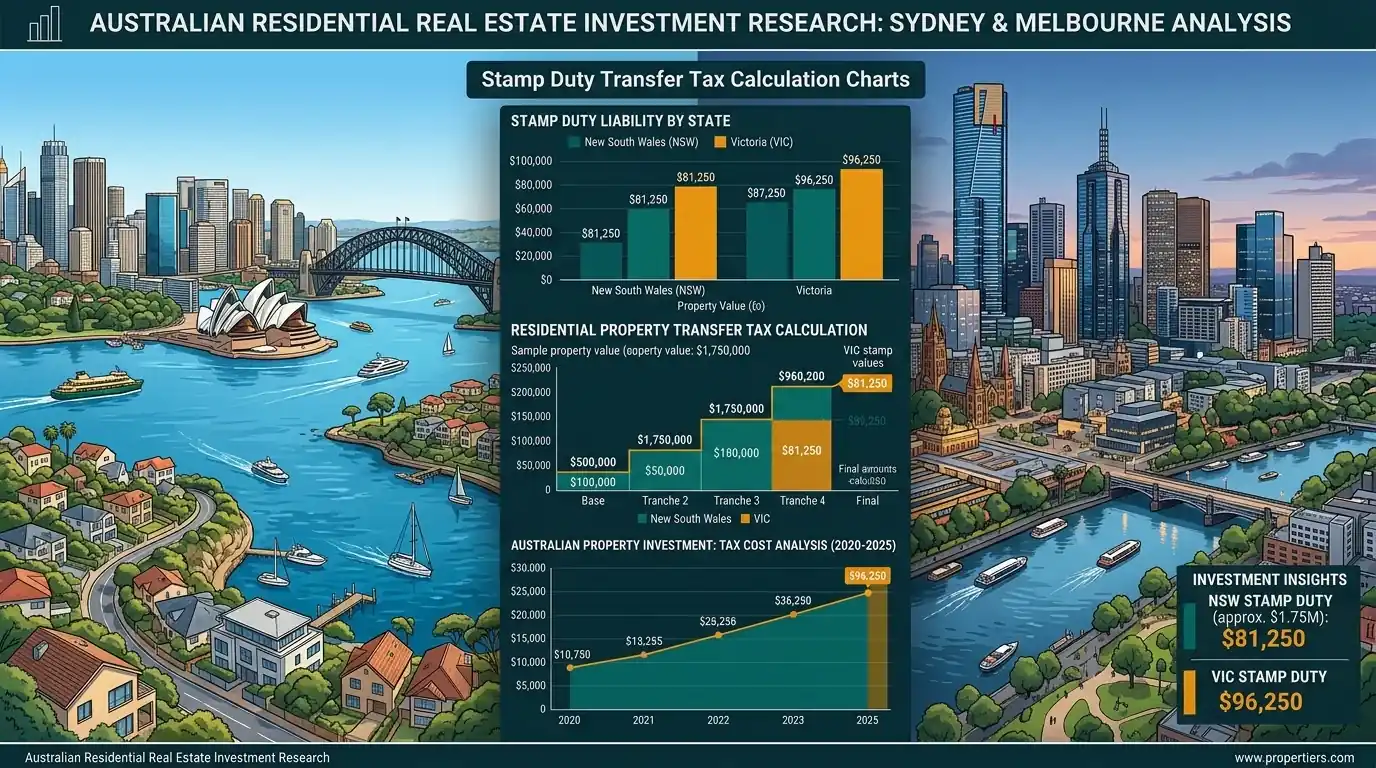
- Australia: stamp duty on purchase, Lenders Mortgage Insurance below 20 percent down, and a heavier debt culture
- UAE: expat deposits of 20 to 25 percent, off-plan supply pipelines, and a dollar-pegged currency that removes one variable
- Everywhere: currency, if you are buying outside your home currency, can move your cost more than the local price does
The Stamp Duty Calculator rehearses the UK band method, the Currency Converter prices the exchange-rate side of a cross-border purchase, and the Housing Cost Calculator puts property tax, insurance, and running costs on one monthly page so two countries can be compared without your head spinning. The country guides below then go market by market through the process, the costs, and the traps.
A worked cross-border comparison
Put the same $300,000 home in each market and the cost structure diverges quickly. In the US, a 5 percent deposit of $15,000 gets you in with PMI, and the annual running cost is dominated by locally set property tax. In the UK, a £300,000 purchase carries banded stamp duty at completion plus council tax every year, and leasehold flats add service charges and ground rent. In Australia, a 5 percent deposit brings Lenders Mortgage Insurance and stamp duty is due at purchase. In the UAE, an expat buyer needs $75,000 down at 25 percent, but most areas have no annual property tax — a holding-cost advantage that can offset the larger deposit over time.
Notice what the comparison teaches: no market is cheap overall, they are just expensive in different places. The US front-loads insurance and annual tax, the UK front-loads purchase tax and lease charges, Australia front-loads stamp duty and insurance, and the UAE front-loads the deposit. The honest way to choose is to total each market's purchase cost plus five years of holding cost plus the cost of your money, and compare the four totals on one page.
The four country guides below go market by market through the process, the purchase taxes, and the traps, and each one ends with the same instruction: confirm the live rates with the relevant authority before you exchange, because a remembered table from a news article is not a budget. The calculators — Stamp Duty Calculator, Currency Converter, and Housing Cost Calculator — turn the rulebook into your numbers.
For a one-page view of each market, the USA, UK, Canada, Australia, and UAE country hubs put the deposit norms, transfer taxes, holding costs, and buying process in order — so you can compare all five markets side by side before you open a single guide.
Frequently asked questions
Can foreigners buy property in the USA, UK, Australia, or UAE?
Yes, in all four. There are no nationality restrictions on ownership in the US, UK, or Australia, and expats can buy in the UAE's designated freehold areas. The practical differences are financing — non-residents typically need larger deposits and pay higher rates — and tax, including potential surcharges.
Which country has the cheapest property taxes?
There is no simple answer because each market taxes differently: the US raises revenue through locally set property taxes, the UK through stamp duty at purchase and council tax on holding, Australia through stamp duty and land tax, and the UAE through registration fees with no annual property tax in most areas. Compare total purchase-plus-holding cost, not one line.
What is the best country for a foreign property investor?
The best market is the one your own financing, tax position, and exit plan can tolerate — not the one with the most attractive headline yield. Run the same deal through each country's deposit rules, taxes, and holding costs, and choose where your numbers survive the unkind assumptions.
How much deposit do expats need to buy property abroad?
Non-resident buyers commonly face 25 to 40 percent deposits for mortgages in most markets, with higher rates than residents. Cash purchases avoid the lending side entirely but still face the purchase taxes. Confirm the current lender requirements for your nationality and market before you reserve anything.