

SCOPE BANNER — This is a Dubai-focused off-plan buying guide checked 23 August 2026. AED figures are illustrative planning scenarios, not developer quotes, legal conclusions or guarantees. Dubai, Abu Dhabi and Sharjah have different authorities and schedules; foreign buyers may also owe tax or reporting obligations in their home country. Confirm the exact SPA/Oqood, DLD/RERA project status, fee payer, escrow details, lender terms, insurance and immigration criteria with the relevant official service and qualified advisers.
Byline and funding disclosure: Nirmal Lashkari is the editorial author; this byline is not a claim of regulated legal, tax, lending or immigration credentials. The worked figures are deterministic editorial examples using the assumptions stated on this page. No developer, agent, lender, visa adviser or data sponsor paid for this guide, and no affiliate relationship is assumed from the linked tools.
Update cadence: DLD/UAE service routes and rule-sensitive wording were reviewed 23 August 2026. External service pages and project records can change; recheck them and the signed contract immediately before paying or signing. This guide does not automatically refresh a developer's project status, completion date, escrow balance or visa eligibility.
TL;DR: the five checks before you pay a Dubai off-plan deposit
- Check the project, developer, Oqood path and project escrow account through DLD/RERA routes before transferring funds; save the project reference and account details.
- Convert the SPA into a cash calendar: signing, each construction milestone, DLD/admin/registration lines, mortgage or cash at handover, service-charge deposit and contingency.
- Stress the handover valuation below the contract price and ask the lender what happens if finance is lower, the unit is delayed or your income/circumstances change.
- Read delay, cancellation, assignment, late-payment, defect, service-charge and exit clauses with a UAE conveyancer; escrow is not a guarantee of timely completion or price.
- Treat Golden Visa, tax, ownership, insurance and residency as separate eligibility questions; a purchase does not automatically create any immigration or tax outcome.
Off-plan means a unit purchased from a developer before completion, paid for on a schedule and delivered later. Its payment timing, project registration, escrow route and construction risk differ from a resale purchase. This guide uses Dubai examples; do not transfer its fee assumptions to another emirate.
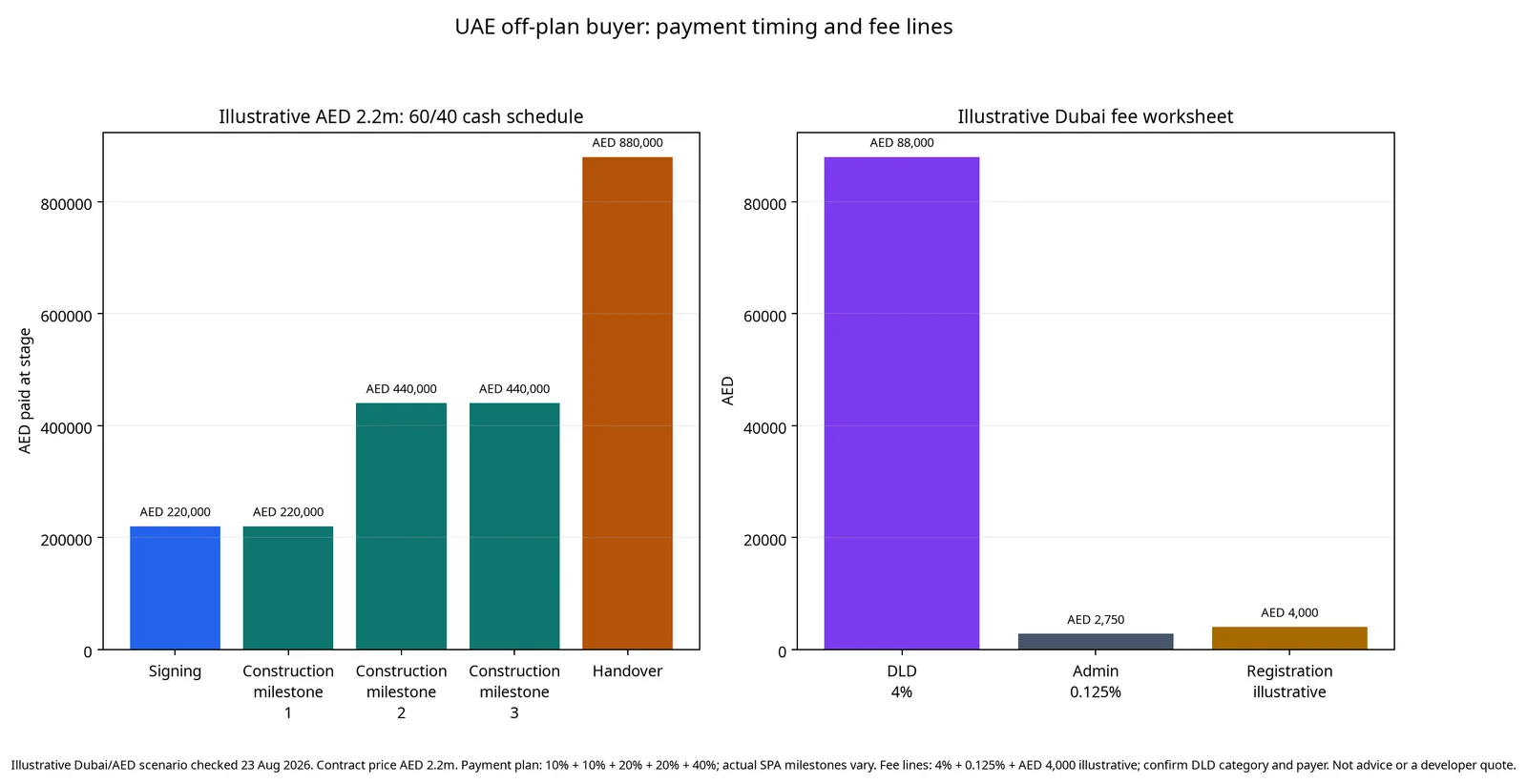
| Stage | Share | Illustrative AED | Buyer check |
|---|---|---|---|
| Signing | 10% | AED 220,000 | Confirm due date, escrow account and refund/termination treatment |
| Construction milestone 1 | 10% | AED 220,000 | Match the milestone to the approved project update |
| Construction milestone 2 | 20% | AED 440,000 | Do not pay against an unverified trigger |
| Construction milestone 3 | 20% | AED 440,000 | Keep a reserve for delay and other costs |
| Handover | 40% | AED 880,000 | Stress valuation and arrange finance/cash early |
| Line | Illustrative AED | Formula / treatment |
|---|---|---|
| Contract price | AED 2,200,000 | Scenario input |
| DLD line | AED 88,000 | 4% × AED 2,200,000 planning assumption |
| Admin line | AED 2,750 | 0.125% × AED 2,200,000 planning assumption |
| Registration line | AED 4,000 | Illustrative registration assumption |
| Subtotal | AED 94,750 | Sum of three fee lines; excludes other costs |
Off-plan is how many buyers access a Dubai development before completion — a unit purchased from the developer, paid for on a schedule, and handed over later. The appeal is the payment plan: instead of one mortgage and a lump deposit, you pay instalments during construction, which may reduce the initial cash requirement. The catch is that off-plan has its own fee structure, protection rules and risks, and they work differently from a resale purchase. This guide covers Dubai Land Department fees with worked numbers, payment plans, DLD/Oqood and escrow verification, and the risks to price before you sign.
The DLD fee: 4 percent plus the small print
For planning only, this Dubai example uses a 4 percent DLD development-contract/transfer line, a 0.125 percent admin assumption and an AED 4,000 registration assumption. DLD's official FAQ distinguishes service questions such as the 4 percent development-contract fee, while exact charges depend on the service category, property, contract and current schedule. Do not carry Dubai assumptions to Abu Dhabi or Sharjah; confirm the fee payer, timing and current amount in writing.
On the illustrative AED 2.2 million Dubai apartment, 4 percent is AED 88,000, 0.125 percent is AED 2,750 and the assumed registration line is AED 4,000, producing an illustrative subtotal of AED 94,750 before other costs. This is a reproducible worksheet, not a current quote. The Stamp Duty Calculator can model the scenario, but the signed SPA and DLD service page control the transaction.
When the fee is paid on off-plan
The off-plan twist is timing. The relevant DLD/Oqood registration and development-contract lines may be due at signing, during the schedule or at handover depending on the project and service category. Do not assume that a fee is financeable or payable at one universal point: ask the developer and conveyancer to identify the payer, due date, refund/termination treatment and whether any lender permits it within the financing structure.
Some emirates and some projects reduce or defer fees on off-plan purchases until completion. The amounts above are the standard Dubai structure — confirm the exact project schedule in writing before you commit, because the difference between AED 90,000 at signing and AED 90,000 at handover is a cash-flow question, not a cost question.
How payment plans actually work
Developers publish their own payment plans. The sequence in the worksheet and figure below is an illustrative 60/40 planning case: 10 percent on signing, 10 percent and 20 percent at construction milestones, 20 percent at a later milestone, and 40 percent at handover. Other contracts use 50/50, post-handover instalments or different dates; only the signed SPA and payment schedule determine your obligation.
The payment schedule is the real price of entry. In the illustrative AED 2.2 million worksheet, the first two stages total AED 440,000 and the handover stage is AED 880,000; the exact timing depends on the SPA. UAE lenders apply their own resident/non-resident, property, income, valuation and completion criteria, so do not treat a 75–80 percent LTV range as a promise. Arrange a lender conversation well before handover and stress a lower valuation. The Down Payment Calculator and Mortgage Calculator model the planning case, not approval.
RERA escrow and the Oqood
Dubai has a project-registration and escrow framework for off-plan sales. DLD's official Register Project service describes project registration and opening an escrow account for off-plan sales, with an Oqood portal submission, unit survey/technical report steps, account-custodian request, DLD review and certificate. Treat Oqood and escrow as verification steps, not as a promise that the unit cannot be disputed, construction will be on time or your capital will be returned immediately.
Protection has limits. Escrow does not remove delay, construction-defect, valuation, liquidity, contract or market risk. Before paying, match the project name/reference, developer, Oqood route and escrow information to DLD's current service records and your SPA; ask who controls the account and what the contract says about cancellation, delay and refunds. Use the DLD FAQ and DLD Register Project service as official starting points, then obtain professional review.
The risks to price before you sign
Three risks dominate off-plan purchases. The first is delay: handover dates slip, sometimes by years, and your cash is locked in the payment schedule while it slips. The second is market risk at completion: the lender's valuation at handover can come in below your contract price if the market fell during construction, which means the mortgage covers less and you must bridge the difference in cash — exactly the scenario that squeezed buyers who signed in 2021-2022 at peak prices. The third is developer-specific: a developer that fails mid way leaves you in a claims process, protected but delayed.
The mitigation is the same discipline you would use on any large purchase: run the numbers at the contract price and a lower handover valuation; verify the project/developer/Oqood/escrow route through DLD; obtain a handover financing view early; and keep a cash reserve for delay, service charges, fit-out and legal/insurance costs. The Down Payment Calculator and Mortgage Calculator show planning cases, while the UAE country hub provides related costs.
Service charges and handover costs
The purchase fees are only the first layer. At handover, ask the developer or owners' association for the service-charge budget, deposit, building operating costs, fit-out/furniture requirements and any title-deed or registration lines. Service charges vary by building, unit area, amenities, approved budget and local rules; do not use a generic AED-per-square-foot range as a quote. Obtain the project's written schedule and model it as a permanent recurring cash line, separate from mortgage and one-time fees.
Buyers who compare only the headline price and the DLD fee miss the real total cost of ownership. The service charge often exceeds the annual mortgage interest difference between comparable buildings, and it is baked into every resale yield in the market. Model it before you choose between projects, and compare it with the Cash Flow Calculator alongside the mortgage, because the service charge is the number that turns a good yield into a bad one on paper.
What tax-free means for an off-plan buyer
Do not let the phrase 'tax-free' stand in for tax advice. UAE and emirate-level treatment, VAT/business activity, property fees and home-country reporting can differ by investor, activity, residence and transaction. The AED 2.2 million worksheet therefore excludes tax and should not be read as a tax outcome. Ask a UAE tax adviser and your home-country adviser about rental income, gains, entity ownership, withholding/reporting and currency conversion before relying on a return.
Cross-border ownership is not tax-planning-free. Investors may have home-country filing, worldwide-income, controlled-entity, withholding or gain-reporting obligations even when a UAE calculation excludes tax. Use the Currency Converter and ROI Calculator for labelled planning scenarios, then have a qualified adviser confirm the after-tax position; calculator outputs are not a tax determination.
The Golden Visa and residency angle
Property ownership may create a Golden Visa application route, but it is a separate immigration process. The DLD investor service checked 23 August 2026 states that an investor owning property with a purchase value of at least AED 2 million at the time of purchase may apply for a renewable 10-year residence permit, with family sponsorship; it also describes a bank letter showing AED 2 million paid for a mortgaged property. Eligibility, documents, medical/service steps and acceptance are not guaranteed by buying an off-plan unit. The UAE Government Golden Visa page and DLD investor service are the official starting points.
The visa changes the purchase's purpose but not its arithmetic. Do not model AED 2 million as an automatic benefit or a universal floor for every applicant: confirm property value, paid amount, ownership/registration evidence, mortgage treatment, nationality/status and current application requirements with DLD/GDRFA or a licensed adviser. If the visa is central to the decision, make the purchase conditional on written professional confirmation where the contract permits.
How to verify a developer before you sign
- Confirm the project is registered with RERA and has a valid Oqood registration path
- Check the developer's DLD license number and on-time handover record across past projects
- Verify the escrow account details appear in the sale agreement and match RERA's records
- Read the penalty clauses: late-delivery compensation and the buyer's exit rights before completion
- Compare the same floor plan across two or three comparable projects for price and service charge
Do not rely on a brochure statement that a project is registered. Match the project and developer to DLD/RERA service records, verify the escrow/Oqood route and ask for written evidence of the payment account, construction status, delay rights and prior handovers. The check is not a guarantee; it is a way to turn a marketing promise into documented questions before the deposit is irreversible.
Off-plan versus resale: the full cost comparison
A resale comparison must use the actual SPA and fee schedule. Resale usually requires completed-property financing and may include an agent fee; off-plan may use construction instalments but carries completion, valuation and handover-financing risk. For this guide, the AED 94,750 subtotal is only the illustrative Dubai worksheet above—not a universal government-fee total. Compare the two paths line by line: DLD/service category, admin/registration, agent, mortgage, service charge, fit-out, insurance, taxes/reporting and timing.
Fee timing is an operating detail that can change by service, project and transfer route. Do not rely on an unlinked same-day-transfer discount or a brochure number; confirm the current DLD fee schedule, payer and due date in writing with DLD and your conveyancer/developer. Keep every fee as a separate line in the Closing Cost Calculator rather than folding it into the headline price.
Off-plan makes sense when the developer is reputable, the payment schedule fits your cash-flow, and you plan to hold through completion. It is a worse fit for buyers who need a rental income soon, who may sell before handover, or who are financing a large share of the price — because the mortgage cannot start until the unit exists. Match the purchase structure to your cash-flow, not to the marketing, and the off-plan discount becomes a genuine advantage instead of a financed bet. It is a leveraged bet on the finished value — nothing more, nothing less. Run the worked numbers with the Stamp Duty Calculator and Mortgage Calculator, compare against the resale path in the same building, and sign with both eyes on the handover date, not the brochure.
Sources and check dates
- Dubai Land Department — Frequently Asked Questions — Development Services FAQ covering escrow, project progress, Oqood/sale registration and the 4% development-contract-fee question; checked 23 August 2026.
- Dubai Land Department — Register Project — project-registration and escrow-account service, including Oqood portal, technical report, account-custodian and DLD review steps; checked 23 August 2026.
- Dubai Land Department — Golden Visa application, investor — AED 2m property-value application route, 10-year renewable permit wording, family sponsorship and mortgaged-property paid-amount evidence; checked 23 August 2026.
- UAE Government — Golden Visa — official long-term residence and digital-service route; checked 23 August 2026.
- LashkariProperties — UAE country hub — related local-cost and tool navigation; verify the linked official service before acting.
Related reading
Continue reading: Australia Stamp Duty: Buyer Guide · Buying Property in Australia: Costs · Buying Property in Canada: Guide (2026). Run your own numbers with the Stamp Duty & Transfer Tax Calculator — it takes under a minute and beats guessing.
How off-plan payment plans are actually structured
Dubai developers can offer 50/50, post-handover or other structures, but there is no universal milestone calendar. Compare the exact percentage, date, trigger, late-payment remedy, cancellation/assignment treatment and handover condition in the SPA. A payment plan and an escrow route do not make timing the only variable: completion, valuation, defects, service charges, finance, resale liquidity and contract rights remain separate risks.
- Model the fees and cash timing with the Closing Cost Calculator and the Currency Converter.
Frequently asked questions
How much are Dubai Land Department fees on off-plan property?
This guide's Dubai worksheet uses 4% + an illustrative 0.125% admin line + an illustrative AED 4,000 registration line, totalling AED 94,750 on AED 2.2m. Confirm the exact DLD service category, payer, timing and current fee before signing; do not apply it to another emirate.
Is off-plan property safe to buy in Dubai?
Use DLD's Register Project/Oqood and escrow routes to verify the project before paying. The framework is designed for off-plan project registration and escrow administration, but it does not remove delay, defect, valuation, contract, liquidity or market risk; obtain the SPA and professional review.
How do Dubai off-plan payment plans work?
You pay according to the developer's signed SPA: it may use milestone instalments, 60/40, 50/50, post-handover payments or another structure. Compare the percentage, due date, trigger, late-payment remedy, cancellation/assignment terms and handover balance; no generic milestone percentage overrides the contract.
Can you get a mortgage on an off-plan property in the UAE?
Financing is often considered for the handover balance rather than construction instalments, but lender policy varies by resident status, property, valuation, income, project and completion stage. Ask the lender for written criteria and stress a lower handover valuation; no LTV range on this page is a promise.
What is an Oqood in Dubai?
Oqood is the DLD registration route/document associated with an off-plan sale. Confirm the exact document, project registration and issuance timing through DLD/Oqood and your conveyancer; do not treat a sales receipt or brochure as equivalent to registered ownership evidence.
What happens if the developer delays an off-plan project in Dubai?
Escrow and project-registration rules do not make a delayed handover harmless or guarantee a particular refund, compensation or completion date. Read the SPA's delay, cancellation, refund and dispute clauses, verify project status through DLD, and underwrite a later handover with a cash reserve. Do not use an uncited '6 to 12 months is common' assumption as a forecast.