


SCOPE BANNER — Canada-only guide; CAD worked examples checked 23 August 2026. Mortgage qualification, transfer taxes and foreign-buyer rules vary by province, municipality, buyer status and property type. Use the official links below and obtain written advice before relying on a result.
At a glance: the five-minute Canada buying check
- 1. Run the qualifying-rate test before viewing; the stressed payment, not the advertised payment, sets the borrowing ceiling.
- 2. Price the down payment and mortgage-insurance premium using the current purchase-price bands.
- 3. Calculate provincial and municipal land-transfer taxes separately from cash-to-close.
- 4. Add legal, registration, inspection, insurance, condo and reserve costs, then keep a post-closing cash reserve.
- 5. If you are a non-Canadian or non-resident, check the federal Act and provincial surcharge before signing an offer.
Professional boundary: this is educational planning content, not mortgage approval, tax or legal advice, immigration advice, a lender quote or a guarantee. A Canadian mortgage broker/lender, provincial tax authority and real-estate lawyer control the current answer for your facts.
| Purchase price | Current minimum down payment |
|---|---|
| $500,000 or less | 5% of the purchase price |
| Over $500,000 to $1.5 million | 5% of the first $500,000 plus 10% of the portion above $500,000 |
| $1.5 million or more | 20% of the purchase price |
Buying property in Canada is decided by two numbers before you ever see a listing: the mortgage stress test, which qualifies you at a rate higher than the one you actually pay, and land transfer tax, which most provinces charge at purchase. Get those two right and the rest of the process — the deposit, the insurance, the closing costs, the lawyer — is mostly predictable arithmetic. Get them wrong and you will discover the problem in the same week you become a homeowner.
This guide walks through the Canadian buying equation in order: the stress test, the down payment and CMHC insurance, land transfer tax with a real Toronto example, the closing costs beyond the deposit, the annual cost of holding, and the extra rules for foreign and out-of-province buyers. Every number is worked so you can reproduce it.
The mortgage stress test comes first
For uninsured mortgages at federally regulated lenders, the OSFI minimum qualifying rate is currently the greater of the contract rate plus 2 percentage points or 5.25% (OSFI page modified 29 January 2026; checked here 23 August 2026). This is a qualifying stress test, not the rate you pay. Do not apply it identically to every insured, private or non-federally regulated product; ask the lender which test applies to your application.
Here is what that difference looks like in dollars. Take a $560,000 loan over 25 years. At a quoted rate of 4.5 percent, the monthly payment is about $3,113. Under the stress test — say 6.5 percent — the same loan costs about $3,781 a month. That is $668 more each month, or roughly $8,000 a year of payment capacity you need to already have. The Mortgage Calculator shows your real payment, and the Home Affordability Calculator runs the stressed version so you know your true ceiling before you view anything.
Down payment and mortgage insurance (CMHC)
The current Canada.ca down-payment guidance sets 5 percent on the first $500,000, 10 percent on the portion from $500,000 to $1.5 million, and 20 percent at $1.5 million or more (page dated 15 October 2025; checked here 23 August 2026). Below 20 percent down, you will typically need mortgage loan insurance; eligibility and lender overlays still matter.
A worked example shows the cost of a thin deposit. Buy a $500,000 home with 5 percent down: the base loan is $475,000. FCAC says mortgage-loan-insurance premiums currently range from 0.6% to 4.5% of the mortgage amount depending on the down payment; a 4% planning assumption would be $19,000 added to the balance, but the insurer's current premium table controls. If the premium is financed, you also pay mortgage interest on it. The same home with 20 percent down needs $100,000 of deposit and typically avoids mortgage loan insurance. The LTV Calculator shows the threshold and the Down Payment Calculator prices the trade-off.
Land transfer tax — the second bill
Most provinces charge land transfer tax at purchase, and it is a completion-day cash cost, not automatically part of the mortgage. In Ontario, the official land-transfer-tax page confirms the provincial tax and says first-time buyers may qualify for a refund; the calculation page provides the current bands. Toronto buyers may also owe the City's municipal land transfer tax, and the City's current MLTT/MNRST page warns that graduated high-value residential rates took effect 1 April 2026. Run the exact property through the official provincial and municipal calculators.
Worked Ontario/Toronto condo illustration: on a $700,000 purchase, applying the published Ontario marginal bands gives $10,475 provincial LTT; the draft assumes the same $10,475 municipal MLTT, for $20,950 total. This is a calculation example, not a universal 2026 Toronto quote: the City's 1 April 2026 graduated-rate change applies to specified high-value single-family properties, so run the exact property through the City MLTT/MNRST calculator and confirm first-time-buyer rebates. The Stamp Duty Calculator is a planning aid, not the official assessment.
Closing costs beyond the deposit
The cash you need on closing day is not just the deposit. Legal, registration, title-insurance, inspection, appraisal, moving and adjustment costs vary by province, property and provider. In this worksheet, $4,600 for legal plus registration is an explicitly illustrative assumption—not a quoted Canadian tariff—so request a written lawyer estimate and title-insurance quote before treating it as cash-to-close.
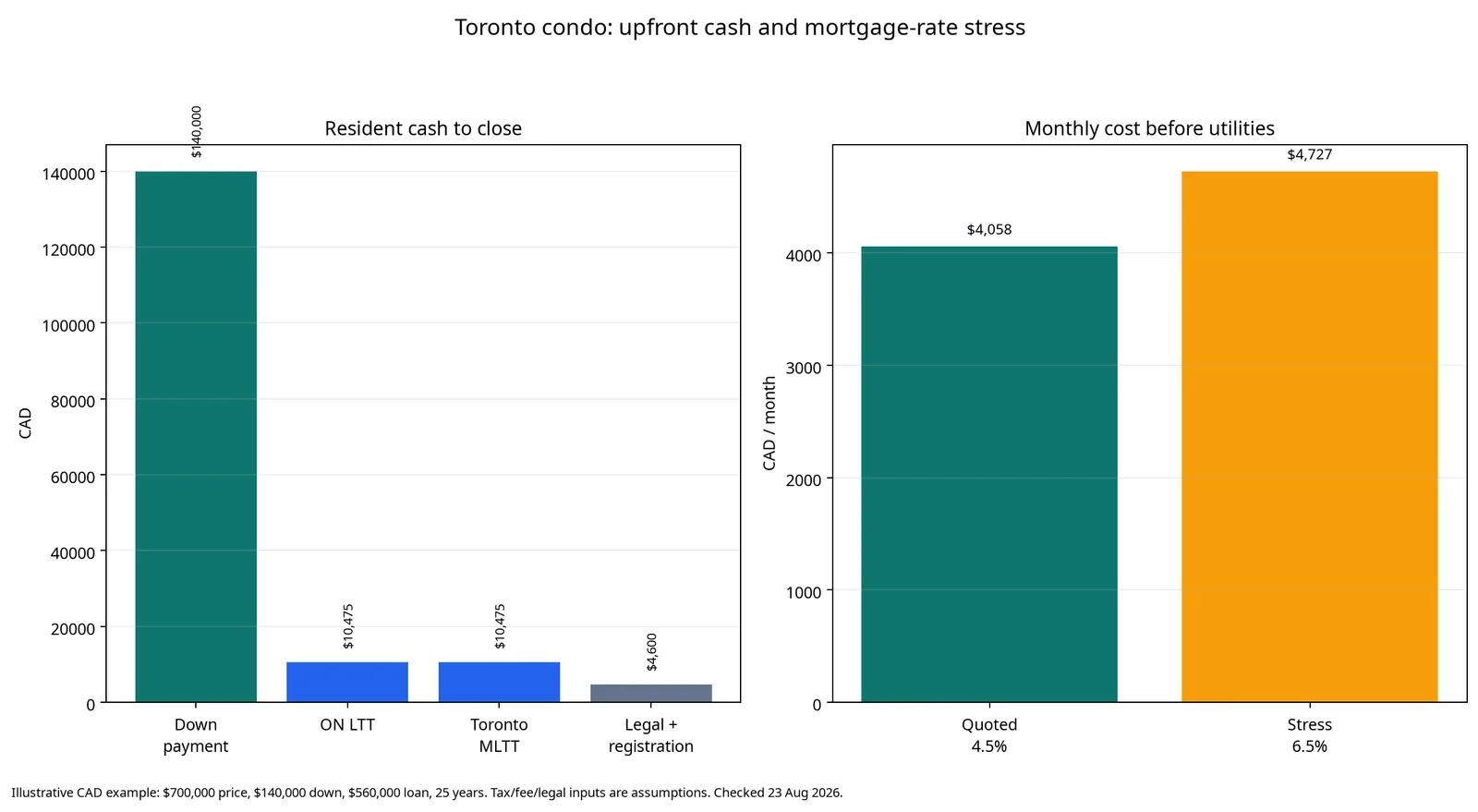
Put it together for the resident buyer: $140,000 down payment plus $20,950 land transfer tax plus $4,600 legal and registration equals $165,550 of illustrative cash-to-close — and the property tax account and any condo reserve requirements come on top of that. The Closing Cost Calculator builds your own cash-to-close figure so completion day holds no invoice you have not seen.
| Toronto worksheet item | Illustrative CAD amount | How to verify |
|---|---|---|
| 20% down payment | $140,000 | 20% of the $700,000 example price |
| Ontario LTT | $10,475 | Apply the official provincial marginal bands |
| Toronto MLTT | $10,475 | Run the City's current MLTT calculator; property type matters |
| Legal + registration | $4,600 | Illustrative assumption; obtain a written lawyer/provider estimate |
| Resident cash-to-close | $165,550 | Sum the four rows; exclude reserve, adjustments and other provider charges |
| Ontario NRST scenario | $175,000 | 25% of $700,000 only if the covered status/property rules apply |
The buying process in Canada
- Get pre-approved before viewings — the stress test sets your ceiling, and sellers and agents ask for the pre-approval letter
- Make an offer with conditions: financing and a home inspection are the two conditions a buyer should normally keep
- Hire a real estate lawyer for title search, the land transfer tax filing, and the closing statement
- Close: transfer the funds, register the title, and set up the property tax account
The process typically runs four to six weeks from accepted offer to closing, and the closing date — often 30, 60, or 90 days out — is negotiated into the offer itself. In a competitive market, shorter closes are used as leverage; the trade-off is that a rushed closing leaves less time for the lawyer's due diligence and your inspection.
Annual holding costs
The monthly cost of ownership continues after closing. Property tax is set locally, not by a Canadian national average. This worksheet uses 0.85 percent of value as a clearly labelled planning assumption — $5,950 a year on the $700,000 example — and $450 a month as an illustrative condo fee. Replace both with the municipal tax bill, condo budget and current insurance quote. Utilities, repairs, special assessments and a reserve complete the picture. The Housing Cost Calculator turns those local inputs into one monthly number.
Foreign and out-of-province buyers
Non-Canadian and non-resident buyers must separate two questions. Federally, the Department of Finance Canada announcement says the federal prohibition was extended to 1 January 2027, subject to the Act's exemptions; confirm the current Act and regulations with a lawyer. Provincially, Ontario's NRST page states a 25% rate for designated residential land acquired by covered foreign entities, in addition to Ontario LTT, but lists property-type and status exclusions, exemptions and a possible rebate. A $175,000 NRST amount on $700,000 is only a scenario, not a universal liability. Financing and provincial rules require status-specific confirmation before an offer.
How to run your own numbers
The order that prevents self-deception is: affordability first (stressed rate), then the mortgage payment at your actual rate, then the deposit and insurance trade-off, then land-transfer tax and closing costs, then annual holding cost and reserve. The Home Affordability Calculator, Mortgage Calculator, LTV Calculator, Stamp Duty Calculator, and Housing Cost Calculator cover the sequence in about ten minutes. Record the input date, currency, province/municipality, buyer status, rate, amortization, tax bill and condo fee; do not enter SINs, passports or other sensitive identifiers into a calculator. If the stressed numbers fit your budget with a reserve intact, the deal is worth viewing; if they only fit at the quoted rate, the price is too high for the stated assumptions.
Property types: freehold, condo, and co-op
Canada offers three ownership structures, and they carry different costs. A freehold house includes the land and the building, and your monthly carrying cost is the mortgage, property tax, utilities, insurance, and maintenance — all yours to manage. A condo or strata unit is a freehold title to your suite plus a share of the common property, with monthly maintenance fees that cover the building envelope, elevators, lobby, and reserve fund; those fees typically run $0.50 to $1.00 per square foot a month and rise as buildings age. A co-op is different again — you buy shares in a corporation that owns the building, financing is harder to arrange, and most lenders treat them differently.
The practical rule for condos is to read the reserve fund study, not the brochure. A well-funded reserve means predictable fees; a chronically underfunded reserve means a special assessment arrives exactly when you least expect it, sometimes in the tens of thousands of dollars. Ask for the status certificate, the last two years of minutes, and the reserve fund balance before you offer, and factor the monthly fee into the Housing Cost Calculator alongside tax and insurance.
Pre-approval and the rate you actually get
A mortgage pre-approval can set a lender's qualifying ceiling and may include a rate hold, but the period and conditions are lender-specific—do not assume 120 days or treat a pre-approval as final approval. Canadian mortgages renew at the product's stated term; confirm the term, amortization, renewal process and follow-on rate in writing because the purchase rate does not govern the entire amortization.
Rate shopping is real money. On the $560,000 example, a quarter-point difference — 4.5 versus 4.75 percent — changes the payment by about $80 a month, which is roughly $24,000 over a 25-year amortization. The Mortgage Calculator makes that sensitivity visible in seconds, and the Refinance Calculator shows what a renewal at a different rate will do to the same balance.
First-time buyer programs
Several programs can change cash-to-close, but eligibility and tax treatment must be verified. The federal Home Buyers' Plan allows eligible withdrawals from an RRSP subject to current limits and repayment rules; the First Home Savings Account has its own contribution and withdrawal rules. New-construction purchases may carry GST/HST: the rate depends on the province and transaction, so never use a blanket 5% Ontario assumption. Ontario's first-time-buyer land-transfer-tax refund has eligibility and a maximum refund; calculate it from the official page rather than assuming every buyer receives it.
These programs change the cash-to-close, not the monthly payment, and eligibility rules shift. Verify the current limits for your province and status before you plan around them — a program you assume but do not confirm is a budget hole on completion day.
One worked example, end to end
Put the whole Canadian equation on one page with the $700,000 Toronto condo. With 20 percent down you bring $140,000; land transfer tax adds $20,950; legal and registration add about $4,600 — a cash-to-close of roughly $165,550. Monthly, the mortgage at 4.5 percent is $3,113, property tax at about 0.85 percent is $496, and condo fees around $450 bring the true monthly cost to about $4,060.
Now apply the stress test to the same purchase: the mortgage alone becomes $3,781 a month, and with tax and fees the stressed cost is about $4,727 — roughly $670 a month more than the quoted number. That is the figure you must qualify against and the one your budget must survive. If $4,727 a month fits with a reserve intact, the condo is affordable the honest way; if only the $4,060 fits, you are one renewal away from trouble.
Run your own version of that table before you offer — the Mortgage Calculator, Stamp Duty Calculator, Closing Cost Calculator, and Housing Cost Calculator build it in minutes. And when you are ready, the Canada country hub keeps the same numbers in one place alongside the tools.
Off-plan and pre-construction purchases
Pre-construction condos change the cash-flow timeline, but there is no universal Canadian deposit schedule or completion date. Your agreement may require instalments during construction and closing months or years later; read the deposit milestones, occupancy/interim-occupancy terms, assignment restrictions, HST treatment, financing deadline and appraisal shortfall clause with a lawyer. The price is fixed in the contract, but the lender's later appraisal and your qualifying rate can differ from today's assumptions, leaving a cash gap if the finished value or borrowing capacity is lower than expected.
Two practical rules for pre-construction. First, price it with the Mortgage Calculator at closing-day rates, not today's rates, because the rate you qualify for in three years will not be the rate in the brochure. Second, keep the pre-construction deposit schedule, the HST on the new build, and the status-certificate expectations in the Closing Cost Calculator so cash-to-close is one number instead of three surprises.
The reserve that makes ownership survivable
Every figure in this guide assumes the budget works at the moment of purchase. What separates buyers who sleep well from buyers who do not is the reserve: enough cash to carry the home for three to six months of full housing cost — stressed rate included — after closing. The boiler or roof on a freehold house, the special assessment on a condo, a job change, or a rate move at renewal all arrive without notice, and the emergency fund is what turns them from a crisis into an inconvenience.
A reasonable target is three to six months of the $4,727 stressed monthly cost from the worked example — roughly $14,000 to $28,000 on top of the cash-to-close. If the numbers only work with every dollar deployed into the deposit, the purchase is financed at the exact edge of your capacity, and the market has a habit of finding that edge. Keep the reserve, run the calculators again the day before you offer, and let the honest numbers — not the brochure — decide. Canada's combination of a stress test, transfer taxes, and property taxes makes it a market where the arithmetic wins or loses deals long before the inspection does.
Sources and check dates
- [1] Financial Consumer Agency of Canada — Down payment and mortgage loan insurance — page dated 15 October 2025; checked 23 August 2026.
- [2] OSFI — Minimum qualifying rate for uninsured mortgages — modified 29 January 2026; checked 23 August 2026.
- [3] Ontario — Land Transfer Tax and official calculation page — checked 23 August 2026.
- [4] City of Toronto — MLTT/MNRST — 2026 rate-change notice; checked 23 August 2026.
- [5] Ontario — Non-Resident Speculation Tax — 25% rule, designated-land scope and exemptions; checked 23 August 2026.
- [6] Department of Finance Canada — foreign-ownership ban extension — 4 February 2024 release; checked 23 August 2026.
- [7] Canada Revenue Agency — Home Buyers' Plan and First Home Savings Account — eligibility and limits change; checked 23 August 2026.
- [8] CMHC — Housing market information — research route, not a substitute for a local tax bill; checked 23 August 2026.
Related reading
Continue reading: Australia Stamp Duty: Buyer Guide · Buying Property in Australia: Costs · Buying Property in the UAE: Fees. Run your own numbers with the Free Mortgage Calculator — it takes under a minute and beats guessing.
Frequently asked questions
What is the Canadian mortgage stress test?
For federally regulated lenders, OSFI's current minimum qualifying rate for uninsured mortgages is the greater of the contract rate plus 2 percentage points or 5.25%; insured and other products can have different rules. The $560,000 at 4.5% versus 6.5% figures in this guide are illustrative payments, not an approval result.
How much is land transfer tax in Canada?
It is set by province and, in some cities, municipality. Ontario's official calculation uses marginal bands, and Toronto may add its own MLTT; on the $700,000 worksheet, $10,475 provincial plus an illustrative $10,475 municipal tax gives $20,950, subject to current property-type rules, rebates and the City's 2026 rate change. Use the official provincial/municipal calculators rather than treating that scenario as a universal quote.
What is CMHC insurance in Canada?
Below 20% down, mortgage loan insurance is typically required. FCAC says premiums range from 0.6% to 4.5% of the mortgage amount depending on the down payment; a 4% figure on a $475,000 base loan is only an illustrative $19,000 planning assumption. The insurer's current premium table and lender terms control.
Can a foreigner buy property in Canada?
The federal prohibition was extended to 1 January 2027, subject to the Act's exemptions. It is separate from provincial taxes such as Ontario's NRST, which has its own covered statuses, designated-land scope, exemptions and possible rebate. Confirm the current Act, regulations and provincial rule with a Canadian real-estate lawyer before signing.
How long does buying a house take in Canada?
From accepted offer to closing, typically four to six weeks. The closing date is negotiated into the offer — commonly 30, 60, or 90 days — and competitive markets favour shorter closes, which leave less time for inspection and legal due diligence.
Do foreigners need approval to buy property in Canada?
The federal prohibition was extended to 1 January 2027, subject to the Act's exemptions. It is separate from provincial taxes such as Ontario's NRST, which has its own covered statuses, designated-land scope, exemptions and possible rebate. Confirm the current Act, regulations and provincial rule with a Canadian real-estate lawyer before signing.