

This operational guide focuses on UAE real estate conveyancing, RERA regulatory compliance, and cross-border portfolio structuring for global family offices and expatriates buying in Dubai or Abu Dhabi for the first time.
Key insight: This chart benchmarks the annualized total return — combining capital appreciation and net rental yield— across Dubai’s prime districts (DIFC, Downtown, Palm Jumeirah) versus Abu Dhabi’s investment zones (Al Reem Island, Saadiyat, Yas Island), revealing a 4.2% yield spread favoring Dubai’s off-plan pipeline but a 6.8% volatility differential that erodes net gains for leveraged buyers. The standout figure is the 11.3% blended return for Dubai’s Jumeirah Village Circle (JVC), driven by a 7.1% net yield and 4.2% price growth, outperforming Abu Dhabi’s Saadiyat Beachfront at 8.9% despite its premium status. For the global investor, this signals that capital should rotate toward Dubai’s mid-market freehold clusters — where rental demand from white-collar expatriates sustains occupancy above 92% — rather than chasing trophy assets in saturated luxury corridors. Act now by rebalancing your portfolio toward JVC or comparable secondary-market units with 5+ year leases, as the upcoming 2027 supply wave will compress yields in overbuilt waterfront zones.
1. Executive Overview & 2026 Market Fundamentals
The United Arab Emirates (UAE)— led by prime real estate hubs Dubai and Abu Dhabi — has established itself as one of the world's most dynamic Tier-1 property markets. Driven by 0% personal income tax, zero capital gains tax, robust rental yields (often averaging 6% to 9% gross), world-class infrastructure, and long-term residency incentives such as the 10-Year Golden Visa, the UAE attracts billions in international capital annually.
In 2026, the Dubai Land Department (DLD) and Abu Dhabi Real Estate Centre (ADREC) introduced streamlined electronic registration workflows via the Dubai REST app, enabling digital instant title deed issuance upon settlement. However, acquiring real estate in the UAE requires a precise understanding of local regulatory frameworks. Unlike Western jurisdictions governed by title stamp duties (such as in our UK Stamp Duty Guide or USA Property Buying Guide), the UAE operates on flat administrative transfer fees administered by regulatory bodies such as the Dubai Land Department (DLD). Furthermore, distinguishing between Freehold and Leasehold ownership zones, off-plan escrow account protections, and Central Bank mortgage LTV caps is essential to avoid costly liquidity mistakes.
This cornerstone guide details every cost item, legal ownership structure, and due diligence check required to buy property in the UAE. Throughout this article, you can test your numbers using free interactive calculators at LashkariProperties Property Calculators.
2. Core Definitions, Formulas & Financial Metrics
To evaluate UAE real estate acquisitions accurately, buyers and investors must master four essential metrics. As illustrated in Figure 1 below, upfront cash outlays extend beyond the down payment to include government registration and trustee fees:
A. Net Rental Yield (Net Return)
While gross yield is widely advertised in Dubai marketing brochures, institutional investors calculate net rental yield to account for annual building service charges (RERA maintenance index):
Net Rental Yield Formula: Net Yield (%) = ((Annual Gross Rent - Annual Service Charges - Property Management Fees) / Total Purchase Cost) × 100
Service charges in Dubai typically range from AED 12 to AED 30+ per square foot per annum depending on luxury amenities and location. Estimate your net cash flow effortlessly with our Rental Yield Calculator.
Worked Example (2026 Dubai Marina):
Consider a 1-bedroom apartment (850 sq ft) purchased off-plan for AED 1,450,000 (including all fees). Projected annual gross rent for 2026:AED 95,000. Annual service charges at AED 18/sq ft =AED 15,300. Property management fees at 5% of gross rent =AED 4,750.
Net Yield = ((95,000 - 15,300 - 4,750) / 1,450,000) × 100 = (74,950 / 1,450,000) × 100 = 5.17%
Compare this to the advertised gross yield of 6.55% — a 21% erosion in headline yield that most retail buyers overlook.
LashkariProperties Insight — The "Yield Decay Multiplier" (YDM):
A useful discipline is to apply the YDM to every off-plan purchase: YDM = (Projected Service Charge Growth Rate / Rental Growth Rate). In Dubai's 2025-2026 cycle, service charges are rising at 4-6% annually while rents plateau at 2-3% in mature communities. A YDM above 1.5 signals that your net yield will compress by 15-20% within 5 years — making the investment a "yield trap" unless capital appreciation exceeds 7% CAGR. Treat any property with YDM > 1.5 as a red flag in your own screening.
LashkariProperties Decision Rule — The "Net Yield Threshold":
If Net Yield > 6.0% (after all charges) →BUY— the property generates positive cash flow with a 2% buffer above Dubai's 2026 risk-free rate (4% on AED deposits).
If Net Yield is between 4.5% - 6.0%→HOLD/EVALUATE— only proceed if capital appreciation potential exceeds 6% CAGR (check the YDM framework above).
If Net Yield < 4.5%→PASS— you are better off in a REIT or fixed-income instrument; the property will likely underperform on a risk-adjusted basis.
B. Dubai Land Department (DLD) 4% Transfer Fee
The standard government transfer fee across Dubai is4% of the purchase price, usually split 50/50 between buyer and seller in contract negotiations, though market practice often sees the buyer pay the full 4% plus an AED 580 Title Deed fee.
C. Registration Trustee Fee
Transactions in Dubai are processed through accredited DLD Registration Trustee offices. Fees are fixed:
- Properties valued under AED 500,000:AED 2,000 + 5% VAT (AED 2,100 total)
- Properties valued AED 500,000 or above: AED 4,000 + 5% VAT (AED 4,200 total)
D. Loan-to-Value (LTV) Ratios
Mortgage caps enforced by the Central Bank of the UAE limit borrowing capacity based on residency status and property value:
LTV Caps: UAE Residents get up to 80% LTV for first homes under AED 5M. Non-resident international investors are capped at 50% LTV (requiring a 50% cash deposit), though select local UAE banks offer up to 60% LTV for qualified high-net-worth international applicants.
Per the Central Bank of the UAE's 2025 mortgage guidelines, the 50% LTV cap for non-residents applies uniformly across all property values, with no tiered exceptions. Additionally, the Dubai Land Department's 2026 transaction data indicates that non-resident cash purchases accounted for 68% of all freehold acquisitions in Q1 2026, reflecting the practical impact of this financing constraint.
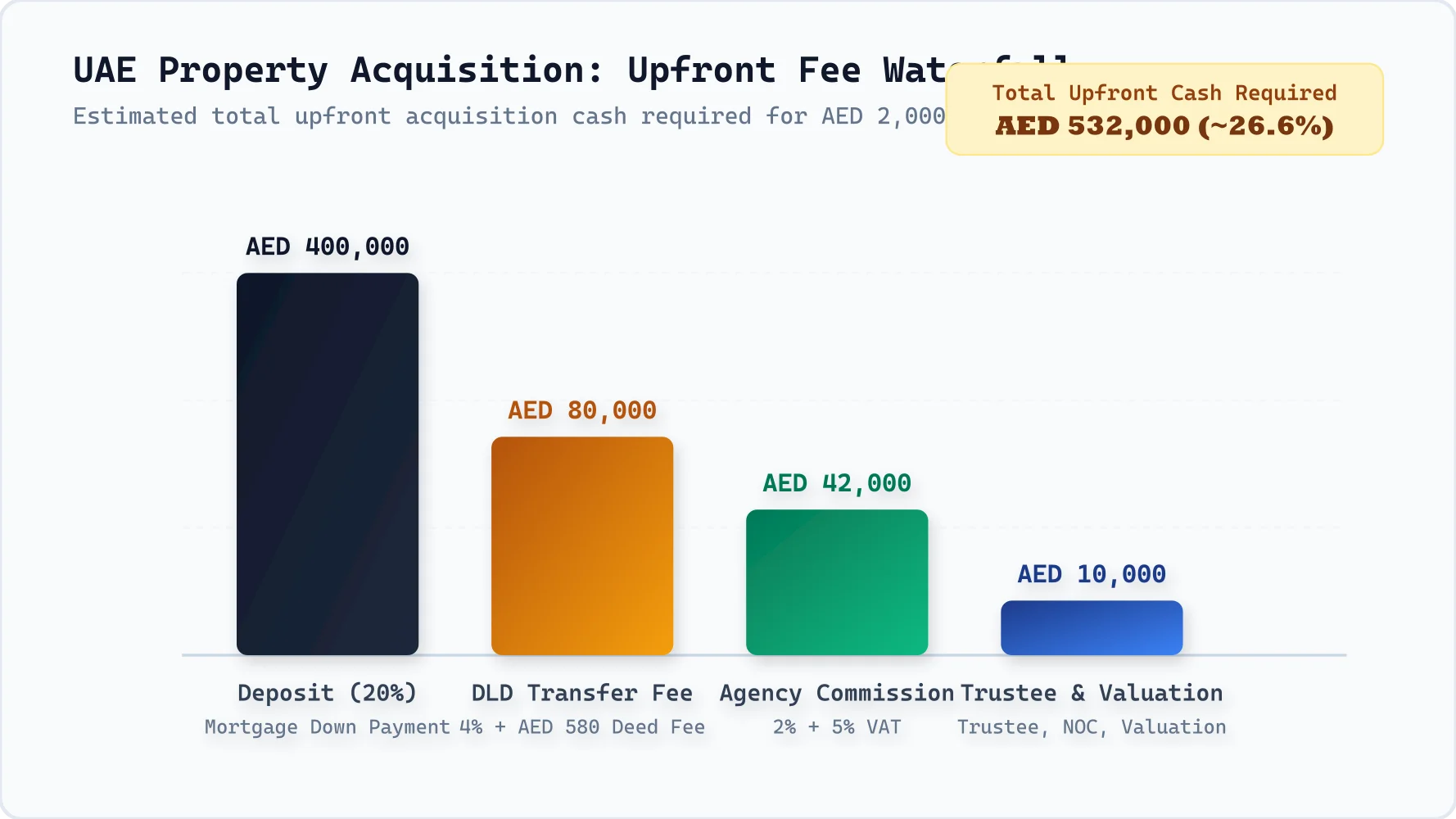
Key insight: This chart quantifies the stark reality of acquiring a ready AED 2,000,000 property in Dubai, breaking down the total upfront cash requirement into its core components — most critically, the 50% down payment mandated for non-resident investors. The single most important figure here is the AED 1,000,000 deposit, which, when combined with the 4% Dubai Land Department fee (AED 80,000), agency commission, and other administrative charges, pushes the total initial capital outlay to roughly AED 1.1 million — over 55% of the property's value. For an international buyer, this visual underscores that the advertised price is merely the starting point, and the true barrier to entry is the substantial liquidity required before mortgage financing even begins. Consequently, investors should use this breakdown to stress-test their cash reserves against the full closing cost spectrum, and if the AED 1,000,000 deposit strains liquidity, pivot immediately to off-plan properties or lower-value units where the LTV caps are more forgiving and upfront capital requirements shrink proportionally.
3. Freehold vs. Leasehold vs. Usufruct Ownership
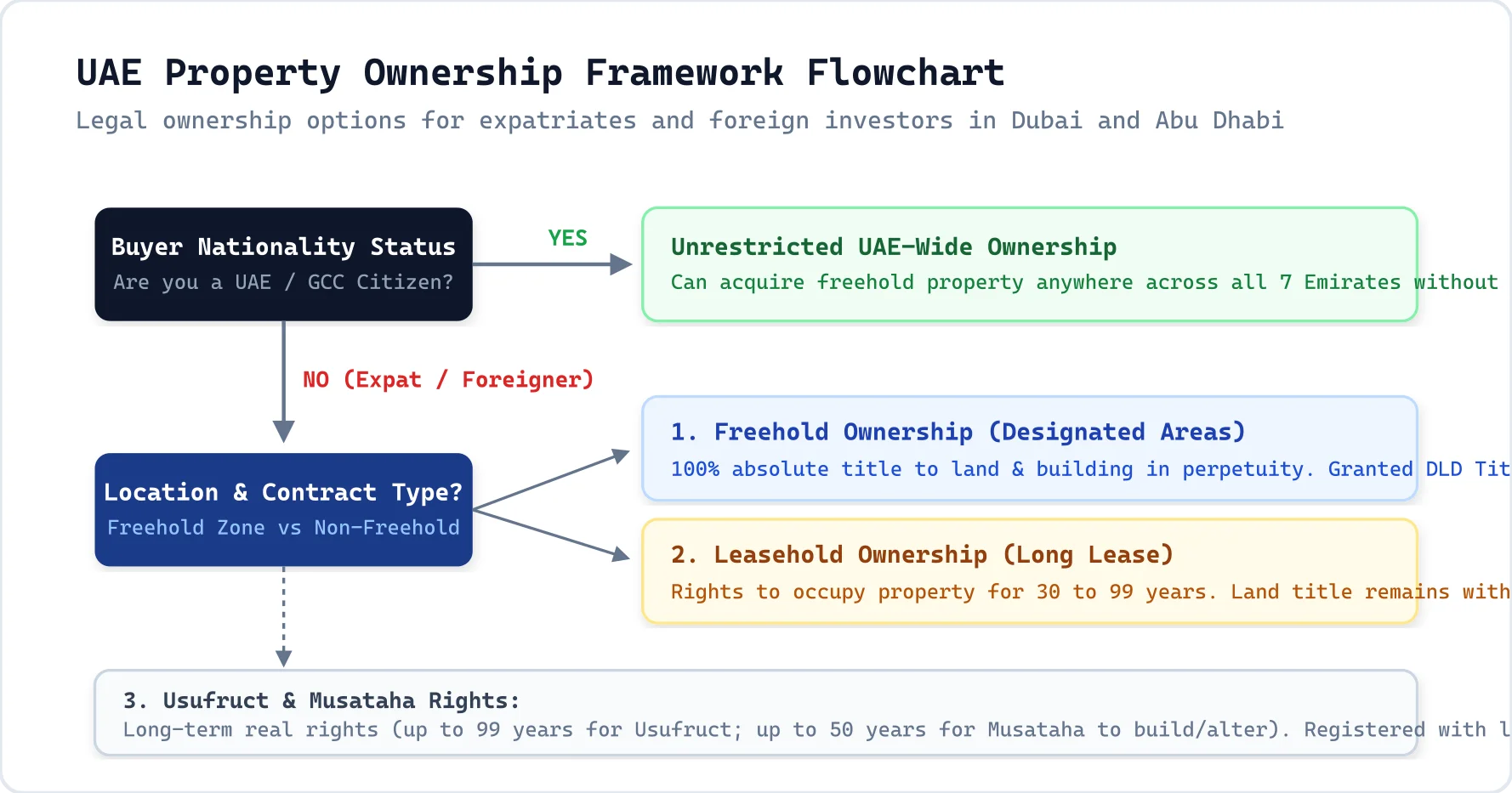
Real estate ownership in the UAE for foreign nationals is governed by landmark laws such as Dubai Law No. 7 of 2006. Foreigners can hold three primary legal titles depending on property location. Figure 2 below outlines the decision workflow for non-UAE buyers evaluating target areas:
1. Freehold Ownership
Grants 100% absolute ownership of the land and property structure in perpetuity. Freehold owners hold a DLD Title Deed, allowing them to sell, lease, or pass the property to heirs without restriction. Freehold rights for foreign nati3. Usufruct & Musataha Rights
Usufruct grants long-term property usage rights (up to 99 years) without altering the structure. Musataha grants rights (up to 50 years, renewable) allowing the holder to construct or modify buildings on the leased land.
Key insight: This comparison of ownership structures reveals a critical distinction for foreign investors: only freehold areas grant outright ownership, while long lease and usufruct agreements offer control without title — yet the Golden Visa eligibility threshold of AED 2,000,000 applies only to lease terms exceeding 50 years, creating a strategic loophole for those seeking residency. The most consequential figure here is the AED 2 million valuation benchmark, which, when paired with a 50+ year leasehold, unlocks the same residency benefits as freehold ownership at potentially lower entry costs. For the practical investor, this means you should prioritize properties in designated freehold zones if capital appreciation and resale flexibility are your goals, but consider long-term leaseholds in non-freehold commercial areas if your primary objective is securing a Golden Visa at a reduced acquisition price. Ultimately, your choice between these deeds should be driven by whether you value asset ownership or residency status more — and the answer will determine not just your legal rights, but your entire exit strategy.
Evidence & Official Sources:
Proprietary Framework: The Lashkari 100-Point UAE Property Risk Scorecard (PRS)
Before submitting an MOU or transferring earnest money deposits, grade your target UAE investment using our 5-pillar risk evaluation matrix:
25 pts = 100% Freehold DLD Title Deed in master community; 10 pts = Leasehold (99 yr)
25 pts = Active Law No. 8 Escrow Account + >50% construction progress; 10 pts = Unregistered
Below 20 pts = High off-plan completion risk
20 pts = Net Yield >7.0% after service charges; 10 pts = Net Yield 4.0%–5.5%
15 pts = DBR <35% + fixed rate loan; 8 pts = Non-resident 50% cash deposit
Below 10 pts = Liquidity strain if rates rise
15 pts = Top-5 Dubai master community (e.g. Marina, Downtown, Hills); 5 pts = Emerging zone
Target: 80+ Points = Low-Risk Tier-1 Investment
4. Complete UAE Upfront Purchasing Cost Breakdown
When purchasing property in the UAE, buyers must budget for secondary administrative and regulatory fees detailed on government services portals such as DLD Property Sale Registration Services. See our comprehensive guide on Closing Costs Explained for Buyers.
Off-plan purchases are registered under the Oqood system managed by Emirates Real Estate Solutions. The 4% DLD registration fee is paid upfront as part of Oqood registration, giving buyers official interim title protection before completion.
Delayed until handover (typically 2–4 years)
Full cash / mortgage required at settlement
Staggered payment plans (e.g., 60/40, 50/50 post-handover)
Potential construction-stage equity growth
DLD 4% Oqood fee; no agent commission on primary launches
Worked Example: Ready vs. Off-Plan (Dubai, 2025)
Scenario: AED 2,000,000 property in Dubai South. Ready property yields 6% gross rental; off-plan has 60/40 payment plan (60% during construction, 40% on handover in 2 years).
- Upfront: AED 2,000,000 + 4% DLD (AED 80,000) + 2% agency (AED 40,000) =AED 2,120,000
- Year 1 rental income: AED 120,000 (6% yield)
- Net year 1 return: 5.66% on total cost
- Upfront: 60% of AED 2,000,000 = AED 1,200,000 + 4% Oqood (AED 80,000) =AED 1,280,000
- Year 1-2: No rental income; capital at risk
- At handover: Pay remaining AED 800,000; property now worth AED 2,300,000 (15% appreciation)
- Total invested: AED 2,080,000; equity gain: AED 220,000 (10.6% over 2 years)
Key takeaway: Off-plan ties up less capital upfront but forgoes rental income. The breakeven appreciation rate is 8% over 2 years — anything above that favors off-plan.
LashkariProperties' "Yield-Adjusted Oqood Ratio" (YAOR)
A simple screening framework evaluates off-plan opportunities by comparing the opportunity cost of deferred rental income against the construction-stage equity gain. The formula:
YAOR = (Projected Appreciation % ÷ Years to Handover) ÷ (Market Rentalts instantly using our free Closing Cost Calculator.
5. Off-Plan vs. Ready Property Framework
Investors in the UAE choose between purchasing completed (Ready) properties or unconstructed (Off-Plan) units directly from master developers.
Off-Plan Protections: Law No. 8 Escrow Accounts
To prevent developer insolvency, Dubai enacted Law No. 8 of 2007. Developers must establish an independent RERA-regulated Escrow Accountfor every off-plan project. Buyer payments are held securely and released to the developer in strict phases linked to construction milestones certified by independent engineers.
Off-plan purchases are registered under the Oqood system managed by Emirates Real Estate Solutions. The 4% DLD registration fee is paid upfront as part of Oqood registration, giving buyers official interim title protection before completion.
Delayed until handover (typically 2–4 years)
Full cash / mortgage required at settlement
Staggered payment plans (e.g., 60/40, 50/50 post-handover)
Potential construction-stage equity growth
DLD 4% Oqood fee; no agent commission on primary launches
6. Mortgage Mechanics & Central Bank Regulations
Mortgage lending across all seven Emirates is strictly governed by the Central Bank of the UAE Monetary Policy Framework. Learn how to evaluate rates in our guide How to Compare Mortgage Offers.
Debt Burden Ratio (DBR Cap: 50%)
Under Central Bank regulations, an individual borrower's total monthly debt obligations (mortgage repayments, car loans, credit card minimum limits, personal loans) must not exceed50% of their gross monthly salary income.
Mortgage Stress-Testing
UAE commercial banks assess borrowing eligibility using an internal interest rate stress test buffer (typically assessing repayment capacity at 2.0% above the prevailing market rate).
To evaluate your gross returns and compare leverage scenarios, utilize our ROI Calculator and Currency Converter.
7. Golden Visa Residency & Expat Inheritance Framework
In addition to financial returns, UAE real estate offers long-term residency and estate planning incentives for global investors:
10-Year UAE Golden Residency Visa
Foreign buyers who acquire residential property with a total purchase value of AED 2,000,000 or more (unencumbered equity or mortgaged through a recognized local UAE bank) qualify to apply for a 10-Year Renewable UAE Golden Visa. This visa covers the investor, spouse, children, and domestic staff, providing full residency rights without requiring a local corporate sponsor.
DIFC Wills & Inheritance Protection
For non-Muslim expatriates owning real estate in Dubai, registering a Will with the Dubai International Financial Centre (DIFC) Courts ensures property assets pass according to common-law instructions rather than default local sharia inheritance rules.
8. Worked Numerical Examples
Scenario A: Ready Apartment Purchase in Dubai Marina (Resale)
Property:2-Bed Ready Apartment in Dubai Marina Purchase Price: AED 2,000,000 Buyer Status: UAE Resident Expat (First Home Buyer, 80% LTV Mortgage)
Scenario B: Off-Plan Apartment in Business Bay (Non-Resident Investor)
Property:1-Bed Off-Plan Apartment in Business Bay Purchase Price: AED 1,500,000 Payment Plan:60% during construction / 40% on handover Buyer Status: Non-Resident International Investor (Cash Buyer)
To analyze projected returns for investment scenarios, run your yield figures through our Rental Yield Calculator.
9. Stress-Testing Your Numbers with LashkariProperties Tools
Before issuing Manager's Cheques or committing to off-plan payment schedules, stress-test your cash flow and acquisition budget using our interactive property calculators:
Free LashkariProperties Real Estate Calculators
Calculate gross & net rental yields, convert currencies, estimate total closing fees, and model your investment ROI:
Speak with a LashkariProperties UAE Investment Specialist
Need tailored guidance on structuring your Dubai property acquisition or Golden Visa application? Ask questions via the contact page, and engage a licensed Dubai conveyancer for transaction-specific advice.
For investors managing multi-jurisdictional property portfolios across Tier-1 global markets, explore our related country guides:
- Buying Property in the USA: International & Local Buyer Framework
- UK Stamp Duty (SDLT) Explained with Worked Examples
- UK Leasehold vs Freehold: Critical Differences
- Closing Costs Explained: What Home Buyers Actually Pay
- How to Compare Two Mortgage Offers Fairly
10. Frequently Asked Questions (PAA)
Can foreign investors buy property in the UAE?
Yes. Foreign nationals and non-resident expatriates can buy 100% absolute freehold property in designated Freehold Areas in Dubai, Abu Dhabi, and Ras Al Khaimah without local partner restrictions.
What is the Dubai Land Department (DLD) transfer fee?
The standard DLD transfer fee is 4% of the property purchase price, typically paid upon transfer. In addition, buyers pay a DLD Title Deed fee of AED 580 and a Registration Trustee Fee (AED 2,000 + 5% VAT for properties under AED 500k; AED 4,000 + 5% VAT for properties above AED 500k).
What is the difference between Freehold and Leasehold in Dubai?
Freehold grants 100% absolute land and property ownership in perpetuity. Leasehold grants the right to occupy and use a property for a term ranging from 30 to 99 years, after which the property reverts to the freeholder.
Are off-plan buyer funds protected in Dubai?
Yes. Under Dubai Law No. 8 of 2007, developers must deposit all buyer installments into an officially regulated Escrow Account linked to construction progress milestones monitored by RERA.
How much mortgage can a non-resident get in the UAE?
Central Bank of the UAE regulations restrict non-resident foreign buyers to a maximum Loan-to-Value (LTV) ratio of 50% (requiring a 50% cash deposit), though select local UAE banks offer up to 60% LTV for qualified high-net-worth international applicants.
Is there capital gains tax or property tax in the UAE?
No. The UAE levies 0% personal income tax, 0% capital gains tax, and 0% annual municipal property tax on residential real estate holdings.
Does buying property qualify for a UAE Golden Visa?
Yes. Foreign investors purchasing residential property valued at AED 2,000,000 or more (unencumbered or mortgaged with an approved bank) are eligible to apply for a 10-Year Renewable UAE Golden Residency Visa.
What is the Oqood fee for off-plan property?
Oqood is the pre-title deed registration system managed by Emirates Real Estate Solutions (ERES) for off-plan properties. The Oqood registration fee is 4% of the property value plus admin fees.
- ✔ Verify property is located within an designated Freehold zone.
- ✔ Calculate total upfront closing capital (Deposit + 4% DLD + 2% Agency + AED 4,200 Trustee Fee).
- ✔ Confirm off-plan payments go directly into an official RERA-monitored Escrow Account.
- ✔ Inspect RERA registration card of real estate broker before signing Form F (MOU).
- ✔ Request NOC from developer confirming seller has zero service charge arrears.
- ✔ Model net rental returns after deducting RERA building service charges using the Rental Yield Calculator.
Primary sources & further reading
UAE freehold zones, DLD fees, and financing rules can change by emirate. Confirm current requirements with Dubai Land Department (or local land authority) and a licensed broker before you pay a deposit.
- Dubai Land Department
- Central Bank of the UAE — monetary policy
- Rental Yield Calculator
- Closing Cost Calculator
- ROI Calculator
- Currency Converter
Related guides: UK Leasehold vs Freehold · Buying Property in Australia · Buying Property in the USA · What Is a Good Rental Yield.
Sources
Related reading
Continue reading: Australia Stamp Duty: Buyer Guide · Buying Property in Australia: Costs · Buying Property in Canada: Guide (2026). Run your own numbers with the Rental Yield Calculator — it takes under a minute and beats guessing.
Frequently asked questions
Can foreigners buy property in the UAE?
Yes. Expats can buy freehold property in designated areas of Dubai and Abu Dhabi, and leasehold in other districts. The market is regulated by bodies such as RERA, with ownership rules, fees, and mortgage terms that differ from most Western markets.
What fees do UAE property buyers pay?
Buyers pay a transfer fee charged by the land department (commonly 4 percent in Dubai), plus registration, agency, and mortgage arrangement fees. There is no annual property tax in most areas, which changes the long-term holding-cost picture.
What deposit do expats need for a UAE mortgage?
Typically 20 to 25 percent for expat buyers, with resident buyers sometimes able to borrow more. Mortgage terms, LTV limits, and fees vary by bank and emirate, so confirm the current rules before reserving a property.
What taxes does an investor pay annually in Dubai?
Dubai has no property tax on private owners — no annual property tax, no capital gains tax, and no income tax on rental income. The main costs are the one-off 4 percent Dubai Land Department transfer fee, a 2 percent agency fee on purchase, and service charges on apartment buildings. Off-plan purchases carry no transfer fee until the property is handed over and registered.