


1. What is DSCR & Why It Matters to Real Estate Investors
In real estate financing, few metrics hold as much weight with commercial lenders, private underwriters, and non-QM mortgage institutions as the Debt Service Coverage Ratio (DSCR). Whether you are expanding a single-family rental portfolio in the United States, acquiring a Buy-to-Let apartment in the United Kingdom, or securing commercial financing in Dubai, DSCR is the ultimate benchmark lenders use to determine loan approval, interest rate pricing, and maximum leverage.
Simply defined, the Debt Service Coverage Ratio measures a property’s ability to generate sufficient net operating income (NOI) to cover its annual mortgage debt obligations. Unlike conventional residential mortgages that evaluate your personal W-2 income, tax returns, and personal debt-to-income (DTI) ratios,DSCR loans evaluate the property itself as an independent business entity.
A property with strong personal tax returns but negative rental cash flow will fail DSCR underwriting. Conversely, an investor with complex tax returns but a highly profitable property producing 1.35x DSCR can secure fast institutional financing.
Understanding DSCR is critical for real estate investors aiming to scale beyond personal borrowing limits. Conventional residential mortgages often cap individual investors at 4 to 10 mortgaged properties due to strict personal debt-to-income limitations. DSCR lending removes this barrier, enabling investors to acquire an unlimited number of cash-flowing residential and commercial properties based strictly on asset performance.
However, failing to calculate DSCR accurately during deal underwriting can lead to sudden loan rejections, unbudgeted down payment demands, or predatory interest rate hikes at the closing table. By mastering the mathematical mechanics of DSCR, understanding lender coverage thresholds, and learning how to adjust operating expenses, you can structure deals that pass institutional underwriting with ease using free tools like the LashkariProperties DSCR Calculator.
Institutional Lenders vs. Non-QM Private Credit Underwriting
To appreciate why Debt Service Coverage Ratio financing has grown rapidly among real estate investors, one must examine the fundamental shift in institutional capital allocation. Following global bank capital requirements (such as Basel III and local national lending limits), traditional commercial banks reduced their appetite for portfolio mortgage holding. Private credit funds and non-agency non-QM mortgage originators stepped in to bridge this liquidity gap.
Traditional residential mortgages are underwritten for secondary market purchase by government-sponsored entities like Fannie Mae and Freddie Mac. These entities enforce strict personal income verification rules, assessing W-2 income, tax returns, debt-to-income (DTI) ceilings, and personal liability exposure. When an investor reaches 4 to 10 mortgaged properties, conforming guidelines restrict further conventional borrowing regardless of asset profitability.
In contrast, DSCR loan originators sell their mortgage debt directly to private institutional asset managers and pension funds via Residential Mortgage-Backed Securities (RMBS). Institutional buyers of DSCR debt do not care about the borrower's personal salary; they care about property cash flow reliability, local rental vacancy trends, and asset collateral values. This structural difference makes DSCR financing the primary tool for professional investors scaling real estate portfolios.
Furthermore, institutional capital markets have created dedicated secondary markets for residential mortgage-backed securities (RMBS) backed by DSCR loans. This institutional secondary market liquidity ensures that DSCR loan rates remain competitive, providing investors with reliable capital partners to fund long-term buy-and-hold strategies without risking personal credit degradation.
Secondary Market Capital Securitization & Credit Liquidity
The expansion of Debt Service Coverage Ratio lending has fundamentally restructured private credit markets. In traditional mortgage banking, loans remain on a regional bank's balance sheet or are packaged into Fannie Mae agency debt. However, agency guidelines limit individual investors to 4 to 10 conventional mortgaged properties due to personal DTI restrictions.
Private DSCR originators solve this scalability barrier by pooling income-generating real estate mortgages into private-label Residential Mortgage-Backed Securities (RMBS). Pension funds, insurance companies, and institutional asset managers purchase these RMBS bonds for predictable yield backed by real property collateral. Because institutional bond buyers evaluate portfolio cash flow stability rather than personal W-2 tax returns, investors with strong credit scores can acquire unlimited income-producing properties.
2. Core DSCR Formulas & Net Operating Income (NOI) Math
To model DSCR accurately, you must understand the exact mathematical relationship between Net Operating Income (NOI) and Debt Service.
A. The Fundamental DSCR Formula
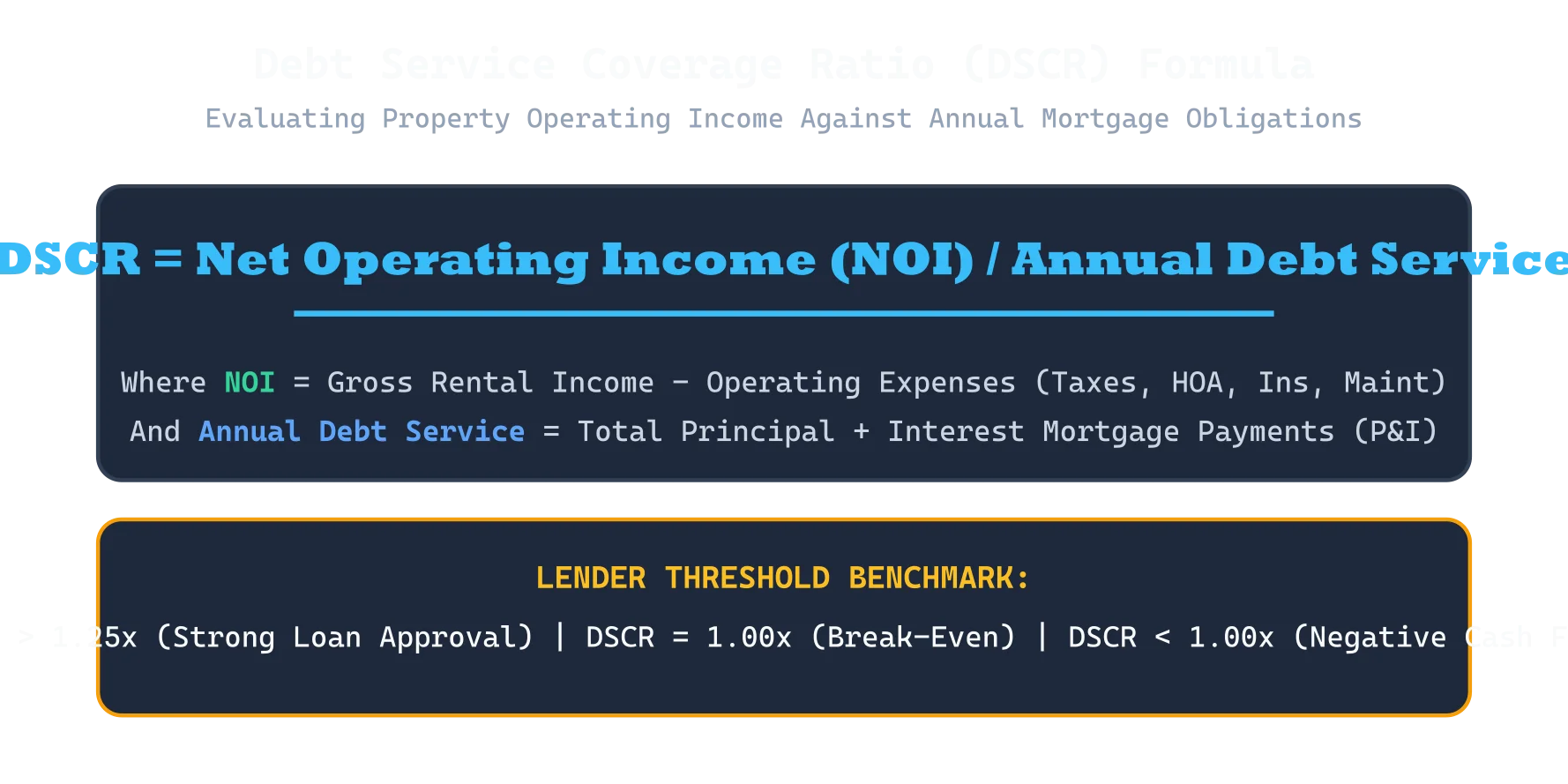
The Debt Service Coverage Ratio is calculated by dividing annual Net Operating Income (NOI) by total Annual Debt Service:
📐 Debt Service Coverage Ratio (DSCR) Formula
DSCR = Net Operating Income (NOI) / Annual Debt Service
Example: If a property produces $30,000 in annual NOI and requires $24,000 in annual mortgage payments, the DSCR is 1.25x ($30,000 / $24,000).
B. Calculating Net Operating Income (NOI) Accurately
Net Operating Income represents the annual revenue generated by a property after deducting all essential operating expenses, but before deducting mortgage payments and income taxes:
NOI = Gross Operating Income - Total Operating Expenses
Operating Expenses Include:
- Real Estate Property Taxes (Municipal/County reassessed at prospective purchase contract price)
- Landlord Hazard & Flood Insurance (12-month prepaid binder quotes)
- HOA / Strata Service Charges (All mandatory dues)
- Property Management Fees (typically 8%–10% of gross rent, even if self-managed)
- Maintenance & Repair Reserves (typically 5%–8% of gross rent)
- Vacancy Allowance Reserves (typically 5%–10% of gross rent)
- Capital Expenditure Reserves ($250–$500 per unit annually for structural HVAC/roof replacements)
Critical Exclusion: Mortgage principal and interest payments (P&I) are never included in operating expenses because debt service is the denominator of the DSCR equation.
C. Annual Debt Service Components
Annual Debt Service includes the total principal and interest (P&I) payments required by the mortgage contract over a 12-month period:
Annual Debt Service = Monthly Mortgage Payment (P&I) × 12
Advanced Underwriting Audit of Operating Expense Deductions
A common point of confusion during loan underwriting is the difference between an investor's self-reported Net Operating Income (NOI) and the lender's audited underwriting NOI. Commercial underwriters operate under conservative risk parameters, mandating standardized expense deductions across all property submissions:
- Property Tax Reassessment Adjustment: In jurisdictions where real estate sales trigger tax reassessments (such as California Proposition 13 or UK Stamp Duty valuations), underwriters replace the seller's historic tax bill with a prospective property tax calculation based on the new purchase contract price.
- Landlord Insurance Binder Verification: Lenders require binding 12-month insurance policy quotes prior to closing. In coastal or wildfire-prone regions (e.g. Florida, Gulf Coast, California), rising insurance rates can consume up to 20% of gross rental income, directly compressing the calculated DSCR.
- Property Management Fee Allowance: Underwriters automatically apply an 8% to 10% property management fee deduction to gross rent, even if the investor intends to self-manage the asset. This guarantees loan viability if a third-party management firm must step in.
- Vacancy & Credit Loss Reserve: Lenders apply a mandatory 5% to 10% vacancy haircut to gross potential rental revenue, regardless of historic 100% occupancy performance.
- Capital Expenditure (CapEx) Reserve Deductions: Underwriters deduct $250 to $500 per unit per year for multi-family assets to fund long-term structural replacements (roofs, HVAC systems, water heaters, plumbing).
Underwriting Expense Haircuts & Appraiser Audit Mechanics
Commercial mortgage underwriters apply standardized risk haircuts when auditing an investor's self-reported Net Operating Income (NOI). To ensure loan safety across economic cycles, underwriters enforce conservative expense parameters:
- Prospective Tax Reassessment Audit: Underwriters replace historic seller property tax bills with a prospective tax calculation based on the new purchase contract price, preventing post-closing cash flow shocks in reassessment jurisdictions.
- Landlord Hazard Insurance Binders: Lenders require binding 12-month prepaid insurance policies. In high-risk coastal or storm-prone zones, insurance premiums can consume up to 18% of gross revenue, directly compressing calculated DSCR ratios.
- Mandatory Property Management Allowance: Underwriters deduct an 8% to 10% management fee from gross rent, even if the investor intends to self-manage the asset, ensuring asset viability if third-party management is required.
- Vacancy & Reserve Haircuts: Lenders apply a mandatory 5% to 10% vacancy allowance and deduct $250 to $500 per unit annually for long-term structural CapEx reserves.
3. Lender Underwriting Thresholds & Coverage Risk Spectrum
Lenders categorize DSCR ratios into risk bands that determine loan eligibility, maximum loan-to-value (LTV) limits, and interest rate pricing:
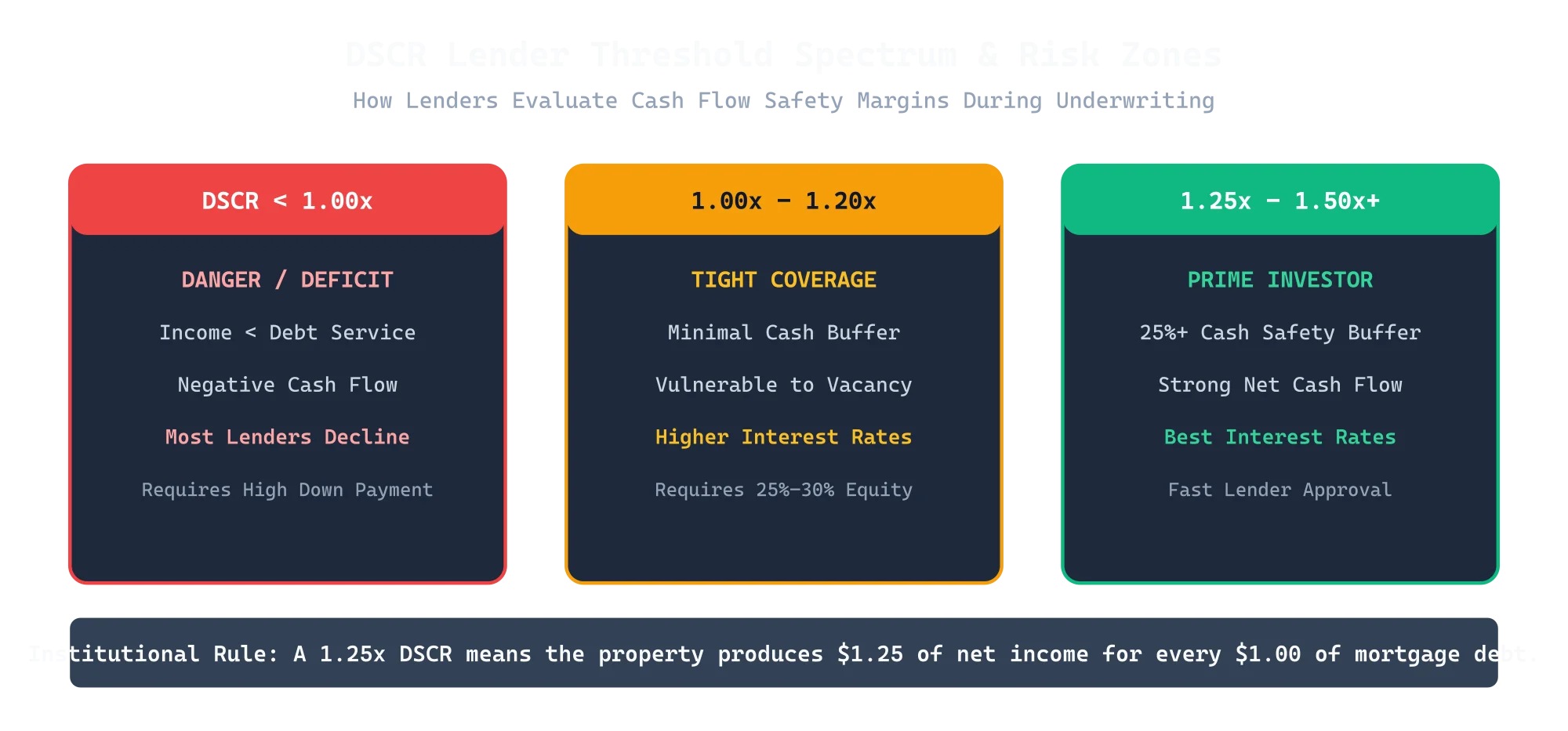
High Risk. Income falls short of debt. Requires specialized 'No-Ratio' programs at premium interest rates.
Moderate Risk. Property barely covers mortgage. Strict reserves required (6–12 months PITIA).
20%–25% cash buffer. Best interest rate pricing and standard underwriting.
Low Risk. Strong cash flow safety margin. Fast track approval and maximum leverage options.
Detailed Underwriting Risk Bands for Real Estate Financing
Commercial mortgage underwriters categorize DSCR ratios into four distinct risk tiers. Each tier governs available loan-to-value (LTV) limits, interest rate pricing, and liquid cash reserve requirements:
Category Tier 1: Negative Coverage (DSCR < 1.00x) Properties in this tier generate less net rental income than required to service monthly mortgage principal and interest payments. While standard commercial lenders decline these applications, specialized non-QM lenders offer 'No-Ratio' programs. However, these programs cap maximum LTV at 65% to 70% and charge interest rates 1.50% to 2.50% higher than market baselines.
Category Tier 2: Break-Even Coverage (1.00x – 1.15x) Properties in this range cover debt service but leave minimal safety buffer for unbudgeted maintenance or tenant vacancy. Lenders require 6 to 12 months of mortgage reserves (PITIA) held in liquid bank accounts and cap leverage at 70% to 75% LTV.
Category Tier 3: Standard Commercial Benchmark (1.20x – 1.25x) The 1.25x DSCR ratio is the golden standard across commercial real estate financing. A 1.25x ratio means the property generates 25% more Net Operating Income than required to cover annual mortgage payments, unlocking competitive interest rates and 75% to 80% LTV financing.
Category Tier 4: Prime Investment Grade (1.35x – 1.50x+) Assets producing 1.35x or higher DSCR represent low credit risk. Lenders offer fast-track underwriting, reduced reserve requirements, lower interest rate margins, and maximum 80% LTV leverage.
DSCR Stress-Testing & Interest Rate Sensitivity Matrix
Interest rates directly impact annual debt service. When interest rates rise by 1.50% (150 basis points), annual debt service expands significantly, compressing DSCR coverage ratios across the portfolio.
Requires Rate Buy-Down / Higher Down Payment
Granular Breakdown of Lender Risk Tiers
Commercial credit committees evaluate DSCR loan files under four distinct underwriting risk tiers:
Underwriting Tier 1 (DSCR < 1.00x - Deficit Coverage): Net rental income falls short of monthly debt service. Specialized non-QM lenders offer 'No-Ratio' programs for these deals, but mandate 30% to 35% down payments and charge interest rate premiums of 1.50% to 2.50%.
Underwriting Tier 2 (DSCR 1.00x – 1.15x - Tight Coverage): Property covers mortgage payments with minimal cash cushion. Lenders cap maximum leverage at 70% to 75% LTV and mandate 6 to 12 months of mortgage PITIA reserves in liquid accounts.
Underwriting Tier 3 (DSCR 1.20x – 1.25x - Commercial Benchmark): The 1.25x ratio is the standard industry target, providing a 25% cash buffer above debt service and unlocking standard interest pricing at 75% to 80% LTV.
Underwriting Tier 4 (DSCR 1.35x+ - Prime Investment Grade): High cash flow coverage representing minimal credit risk. Lenders offer fast-track processing, reduced reserve requirements, and optimal pricing terms.
4. Step-by-Step DSCR Underwriting Process
Follow this 6-stage underwriting framework before submitting a formal loan application to a commercial lender or private credit fund:
- Stage 1: Appraisal Market Rent Verification — Obtain independent comparable rental data (Fannie Mae Form 1007 Rent Schedule for single-family rentals or Form 1025 for small multi-family). Underwriters qualify rent based on the lower of actual in-place lease rent or appraiser market rent.
- Stage 2: Municipal Tax & Insurance Audit — Calculate prospective property taxes based on new purchase pricing and request binding landlord hazard insurance quotes.
- Stage 3: Operating Expense Deduction Calculation — Apply mandatory lender haircuts: 10% property management fee, 5% to 10% vacancy allowance, and $300/unit CapEx reserve.
- Stage 4: Net Operating Income (NOI) Derivation — Subtract total audited operating expenses from gross market rent.
- Stage 5: Annual Debt Service Modeling — Compute monthly principal and interest (P&I) payments across prospective note rates (e.g. 6.5%, 7.0%, 7.5%) and multiply by 12.
- Stage 6: DSCR Calculation & Stress-Testing — Divide audited NOI by annual debt service. If the ratio falls below 1.25x, evaluate improvement levers using the Lashkari DSCR Calculator.
5. 3 Worked Numerical Examples (Real-World Scenarios)
Let's examine three detailed mathematical case studies across Tier-1 real estate markets:
Example 1: Single-Family Rental in Dallas, Texas (USA)
An investor acquires a single-family rental in Dallas for $350,000 using a US DSCR loan program.
- Gross Monthly Rent: $3,200 ($38,400 / year)
- Annual Operating Expenses: Property Tax ($6,200) + Insurance ($1,800) + Maintenance/Vacancy ($2,000) = $10,000
- Net Operating Income (NOI): $38,400 - $10,000 = $28,400 / year
- Mortgage Loan ($262,500 at 75% LTV, 6.8% interest): Monthly P&I = $1,711 ($20,532 / year)
DSCR Calculation: $28,400 / $20,532 = 1.38x DSCR
Verdict: APPROVED.Exceeds 1.25x threshold cleanly. Investor qualifies for prime interest rates without tax return verification.
Example 2: Buy-to-Let Apartment in Manchester (UK)
An investor purchases a 2-bedroom apartment in Manchester for £220,000 via a UK Limited Company (SPV).
- Gross Annual Rent: £15,600 (£1,300 / month)
- Annual Operating Expenses: Service Charge (£1,400) + Insurance (£400) = £1,800
- Net Operating Income (NOI): £15,600 - £1,800 = £13,800 / year
- Mortgage Debt (£165,000 at 75% LTV, 5.2% interest): Annual Interest = £8,580
UK ICR Calculation: £13,800 / £8,580 = 160.8% ICR (1.60x DSCR)
Verdict: APPROVED.Comfortably passes the Bank of England PRA 125% ICR stress test threshold for UK SPVs.
Example 3: Commercial Property in Dubai Marina (UAE)
A commercial investor purchases a retail unit in Dubai Marina for AED 3,000,000 with 40% down.
- Gross Annual Rent: AED 270,000
- Annual Service Charges & Management: AED 30,000
- Net Operating Income (NOI): AED 240,000 / year
- Annual Debt Service (AED 1,800,000 loan at 6.0% interest): AED 154,000 / year
DSCR Calculation: AED 240,000 / AED 154,000 = 1.55x DSCR
Verdict: APPROVED.Exceeds Central Bank of the UAE (CBUAE) 1.25x commercial underwriting standards.
Comprehensive Mathematical Walkthrough of 3 Worked Examples
Let's perform a step-by-step mathematical breakdown of the three worked case studies to illustrate how different operating expenses and tax structures affect final DSCR qualification:
Dallas, Texas Single-Family Rental Breakdown: Gross Rent: $3,200/month ($38,400/year). Property Tax: $6,200/year. Insurance: $1,800/year. Maintenance/Vacancy Haircut: $2,000/year. Total Expenses = $10,000/year. Net Operating Income (NOI) = $38,400 - $10,000 = $28,400/year. Loan: $262,500 at 6.8% fixed interest (75% LTV on $350k price). Monthly P&I = $1,711 ($20,532 annual debt service). Calculated DSCR = $28,400 / $20,532 = 1.38x DSCR. Result: Approved with fast-track processing.
Manchester, UK Buy-to-Let SPV Breakdown: Gross Rent: £1,300/month (£15,600/year). Service Charge & Ground Rent: £1,400/year. Landlord Insurance: £400/year. Total Expenses = £1,800/year. Net Operating Income (NOI) = £15,600 - £1,800 = £13,800/year. Debt: £165,000 interest-only mortgage at 5.2% interest (75% LTV on £220k price). Annual Interest Debt Service = £8,580. Calculated ICR = £13,800 / £8,580 = 160.8% ICR (1.60x DSCR). Result: Exceeds Bank of England PRA 125% ICR requirement for Limited Companies.
Dubai Marina, UAE Commercial Retail Unit Breakdown: Gross Rent: AED 270,000/year. Service Charges: AED 30,000/year. Net Operating Income (NOI) = AED 240,000/year. Mortgage: AED 1,800,000 loan at 6.0% interest (60% LTV on AED 3M price). Annual Debt Service = AED 154,000/year. Calculated DSCR = AED 240,000 / AED 154,000 = 1.55x DSCR. Result: Approved under Central Bank of the UAE commercial guidelines.
6. Tier-1 Market Lending Nuances: USA, UK, Canada, Australia & UAE
Lending rules differ significantly across international real estate jurisdictions:
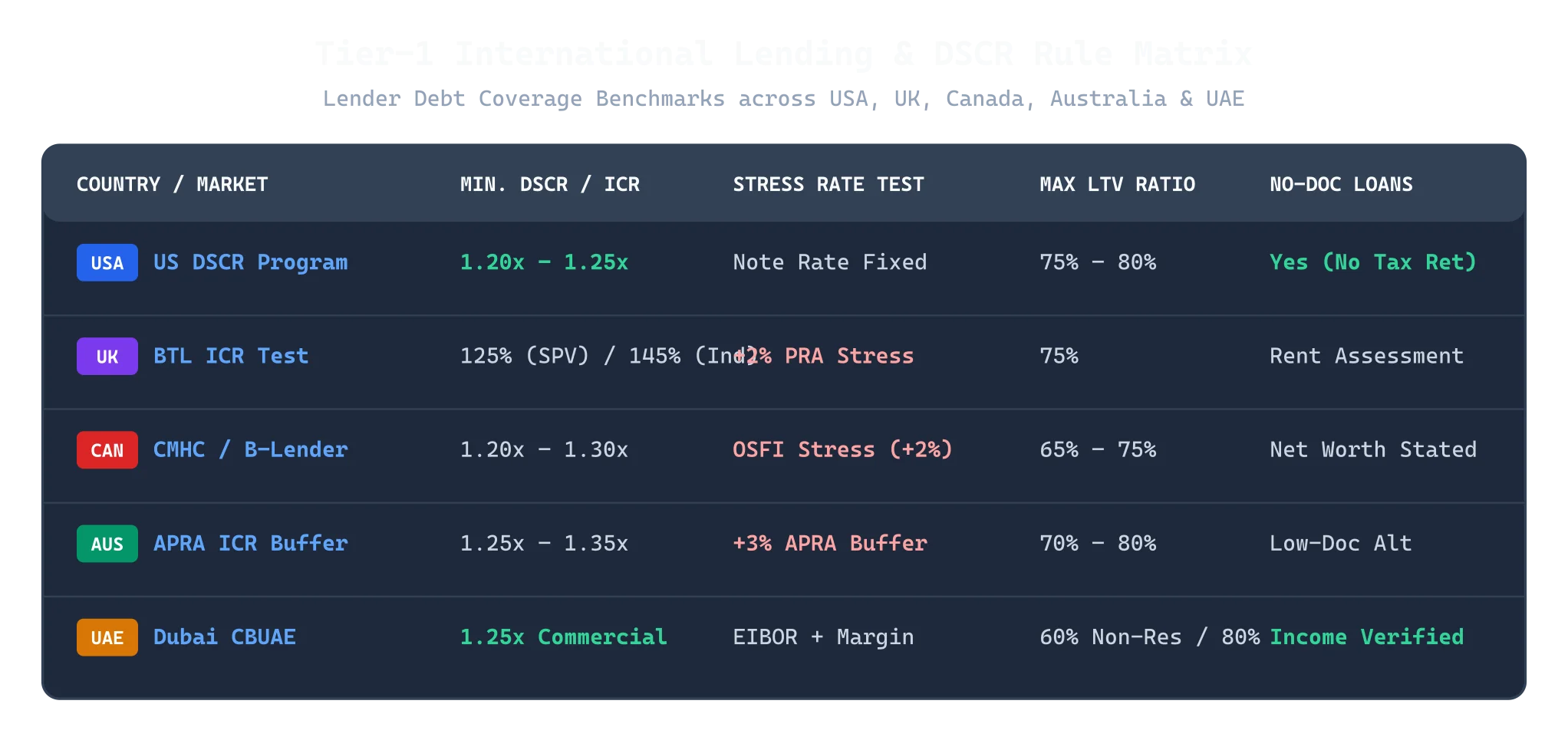
No tax returns or W-2 income required. Based 100% on property cash flow.
PRA Stress Test requires qualifying at higher interest rate buffers (+2%).
CMHC insured loans require 1.20x; OSFI B-20 stress test applies to personal lines.
APRA mandates a 3.0 percentage point interest rate serviceability buffer.
CBUAE guidelines enforce strict 60% LTV caps for foreign non-resident buyers.
Cross-Border International Lending Rules & Authoritative Citations
Navigating international real estate financing requires understanding jurisdiction-specific regulations, tax surcharges, and debt service frameworks across major global real estate markets:
United States (US Non-QM DSCR Market): The US Non-QM market offers the most flexible DSCR products globally. Loans can be closed in the name of single-member LLCs or holding companies under guidelines established by private credit underwriters and Fannie Mae Form 1007 Rent Schedule appraisal standards. Foreign non-resident buyers face FIRPTA 15% tax withholding rules upon eventual asset sale.
United Kingdom (PRA Buy-to-Let ICR Framework): Under Bank of England Prudential Regulation Authority (PRA SS13/16 Guidelines) rules, UK lenders evaluate Interest Coverage Ratio (ICR). Due to Section 24 tax changes restricting personal mortgage interest deductions, individual high-rate taxpayers face a strict 145% ICR benchmark. Buying through a Limited Company Special Purpose Vehicle (SPV) reduces the ICR requirement to 125% and allows full mortgage interest tax deductions as a business expense.
Canada & Australia Regulatory Frameworks: Canadian commercial lenders enforce Debt Coverage Ratios starting at 1.20x to 1.30x under Office of the Superintendent of Financial Institutions (OSFI Guideline B-20). In Australia, the Australian Prudential Regulation Authority (APRA Prudential Practice Guide APG 223) mandates a 3.0 percentage point interest rate buffer on mortgage serviceability calculations.
United Arab Emirates (Dubai CBUAE Market): In Dubai, commercial mortgage financing requires a minimum 1.25x DSCR under Central Bank of the UAE (CBUAE Mortgage Regulations). Foreign non-resident investors face maximum 60% LTV limits and a 4% Dubai Land Department (DLD) transfer fee.
Cross-Border Regulatory Compliance & Institutional Standards
Navigating international real estate investment requires adherence to local regulatory frameworks across Tier-1 markets:
United States (Non-QM Framework): Loans qualify based on property cash flow verified via Fannie Mae Form 1007 Rent Schedule appraisals. Foreign non-resident buyers must account for 15% FIRPTA tax withholding rules upon asset sale.
United Kingdom (PRA Buy-to-Let Rules): Lenders enforce Bank of England PRA SS13/16 Guidelines. Individual landlords face a 145% Interest Coverage Ratio (ICR) test due to Clause 24 tax rules, whereas Limited Company Special Purpose Vehicles (SPVs) qualify at 125% ICR.
Canada & Australia Regulations: Canadian commercial loans require 1.20x to 1.30x coverage under OSFI Guideline B-20 rules. Australian lenders apply a mandatory 3.0 percentage point interest rate buffer under APRA Prudential Practice Guide APG 223.
United Arab Emirates (Dubai Commercial Rules): Commercial mortgages require minimum 1.25x DSCR under Central Bank of the UAE (CBUAE) regulations, with non-resident buyers subject to a 60% LTV cap.
7. The 8 Most Dangerous DSCR Myths
🚨 Myth #1: "DSCR Uses Gross Rent Without Expenses"
Reality: Lenders always deduct property taxes, insurance, HOA fees, and maintenance reserves from gross rent to arrive at true Net Operating Income (NOI).
🚨 Myth #2: "You Cannot Get a DSCR Loan Under 1.0x"
Reality: Specialized US Non-QM lenders offer 'No-Ratio' DSCR loans for properties under 1.0x, but require 30%–35% down payments and charge higher interest rates.
🚨 Myth #3: "DSCR Loans Check Your Personal Income Taxes"
Reality: Pure DSCR loans explicitly ignore personal W-2s, 1099s, and tax returns. Qualification relies entirely on property NOI and credit score.
🚨 Myth #4: "DSCR is the Same as Cap Rate"
Reality: Cap Rate measures unleveraged return on price ($ NOI / Price $), while DSCR measures debt coverage ($ NOI / Debt $).
Reality: A 1.0x DSCR is break-even. Single month vacancies or repair bills immediately push monthly cash flow into negative territory.
🚨 Myth #6: "DSCR Interest Rates are Identical to Conventional Rates"
Reality: Non-QM DSCR loans carry interest rates 0.75% to 1.50% higher than conventional conforming residential mortgages due to non-agency risk.
🚨 Myth #7: "Short-Term Rental (Airbnb) Income Qualifies at 100%"
Reality: Lenders apply a 15%–20% haircut or mandate AirDNA 50th percentile historical averages rather than peak seasonal projections.
🚨 Myth #8: "DSCR Loans Don't Require Cash Reserves"
Reality: Lenders typically mandate 3 to 12 months of mortgage PITIA reserves in liquid bank accounts at closing.
Detailed Technical Debunking of 8 Common DSCR Myths
Misunderstandings about DSCR underwriting lead to costly mistakes. Here is the technical reality behind common investor misconceptions:
- Myth 1: "DSCR Uses Gross Rent Without Expense Haircuts"— Reality: Lenders always deduct property taxes, insurance, HOA dues, management, vacancy reserves, and CapEx from gross rent to determine true Net Operating Income.
- Myth 2: "Properties with DSCR < 1.0x Cannot Be Financed"— Reality: Specialized US Non-QM lenders offer 'No-Ratio' DSCR programs for cash-deficit properties, but mandate 30% to 35% down payments and charge higher interest rates.
- Myth 3: "Lenders Audit Personal W-2 Income Taxes on DSCR Loans"— Reality: Pure DSCR programs ignore personal tax returns, W-2s, and personal DTI ratios entirely. Qualification relies 100% on property cash flow and borrower credit score.
- Myth 4: "DSCR and Cap Rate Measure the Same Financial Metric"— Reality: Cap Rate measures an unleveraged asset's return relative to price ($ NOI / Price $), while DSCR measures debt coverage ($ NOI / Debt Service $).
- Myth 5: "A 1.00x Break-Even DSCR is Safe"— Reality: A 1.00x DSCR leaves zero cash buffer. Single-month vacancies or minor maintenance expenses immediately push monthly cash flow negative.
- Myth 6: "DSCR Interest Rates Match Conventional Rates"— Reality: DSCR loan interest rates carry a 0.75% to 1.50% premium over conventional conforming residential mortgages due to non-agency risk.
- Myth 7: "Short-Term Rental (Airbnb) Income Qualifies at 100%"— Reality: Lenders apply 15% to 25% management/cleaning haircuts or qualify income using AirDNA 50th percentile historical market averages rather than seasonal peak projections.
- Myth 8: "DSCR Loans Require Zero Cash Reserves at Closing"— Reality: Lenders mandate 3 to 12 months of mortgage PITIA payments held in liquid bank accounts at loan closing.
Technical Reality Behind 8 Common Investor Misconceptions
Avoiding costly loan underwriting errors requires distinguishing real estate financing myths from technical underwriting reality:
- Misconception 1: "Gross Rent Determines DSCR"— Reality: Underwriters always deduct property taxes, landlord insurance, HOA dues, management fees, and vacancy reserves to determine Net Operating Income.
- Misconception 2: "Sub-1.0x DSCR Deals Cannot Close"— Reality: 'No-Ratio' DSCR loans exist for deficit cash flow properties, but require 30% to 35% equity down payments and higher interest note rates.
- Misconception 3: "DSCR Lenders Audit Personal Tax Returns"— Reality: Pure DSCR loans evaluate property NOI and borrower FICO credit score, completely bypassing personal W-2s, 1099s, and personal DTI ratios.
- Misconception 4: "DSCR Matches Cap Rate"— Reality: Cap Rate measures unleveraged return on price ($ NOI / Price $), while DSCR measures property debt service coverage ($ NOI / Annual Debt Service $).
- Misconception 5: "Break-Even 1.00x DSCR Holds Zero Risk"— Reality: A 1.00x DSCR leaves zero cash cushion. A single month of vacancy or unexpected repair pushes monthly cash flow into negative territory.
- Misconception 6: "DSCR Rates Match Conforming Mortgages"— Reality: Non-QM DSCR loans carry a 0.75% to 1.50% interest rate premium due to private non-agency capital structures.
- Misconception 7: "Short-Term Vacation Rental Income Qualifies at 100%"— Reality: Lenders apply 15% to 25% management haircuts or qualify short-term rentals using AirDNA 50th percentile market averages.
- Misconception 8: "DSCR Loans Require Zero Bank Reserves"— Reality: Lenders mandate 3 to 12 months of mortgage PITIA reserves verified in liquid bank accounts prior to closing.
8. How DSCR Connects to Cap Rate, Cash Flow, LTV & Debt
DSCR is interconnected with every fundamental property metric across your financial model:
- DSCR vs. Cash Flow: Net Monthly Cash Flow equals $(NOI - Debt Service) / 12$. A higher DSCR directly expands monthly net cash flow. To calculate cash flow, use our Cash-on-Cash Return Guide and Cash Flow Calculator.
- DSCR vs. Cap Rate: High Cap Rate properties in secondary markets produce higher DSCRs due to larger NOI relative to purchase price. Read our guides on Cap Rate Explained for Investors and Cap Rate vs Cash Flow: Which Metric Should Guide Your Decision.
- DSCR vs. Affordability & Mortgages: Learn more about mortgage servicing in our guides How Much House Can I Afford and How to Calculate Mortgage Payments Step by Step.
- DSCR vs. LTV: Lowering your Loan-to-Value (LTV) ratio reduces loan debt service, immediately elevating your DSCR.
9. 5 Tactical Levers to Improve DSCR on a Deal
If a property deal fails to meet the lender's 1.25x DSCR target, apply these 5 tactical levers:
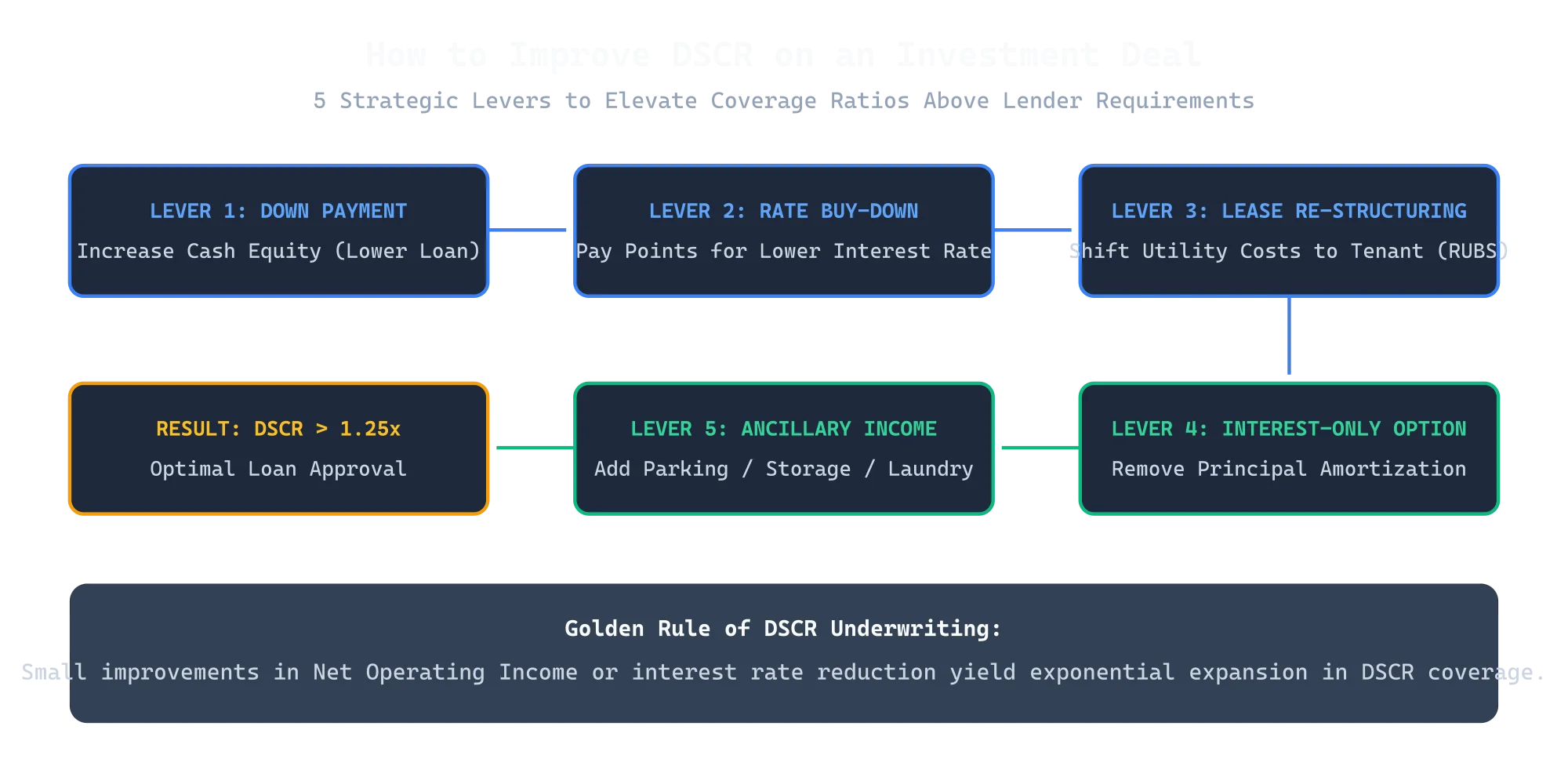
🛠️ Lever 1: Increase Down Payment (Lower Loan Amount)
Putting down 25% instead of 20% lowers annual debt service, directly boosting DSCR above 1.25x.
🛠️ Lever 2: Buy Down the Mortgage Interest Rate
Paying 1 to 2 discount points upfront reduces monthly P&I interest payments permanently, increasing your DSCR ratio.
🛠️ Lever 3: Restructure Tenant Utility Billing (RUBS)
Shifting water, trash, or electric expenses to tenants lowers landlord operating costs, expanding NOI.
🛠️ Lever 4: Select an Interest-Only (I/O) Loan Period
Choosing a 3 to 10-year interest-only mortgage structure removes principal repayment during initial years, drastically reducing annual debt service.
🛠️ Lever 5: Add Ancillary Property Income
Monetizing storage units, parking spots, or laundry facilities adds high-margin revenue directly to NOI.
Detailed Underwriting Mechanics of 5 Tactical Improvement Levers
If preliminary underwriting indicates a property deal falls short of the lender's 1.25x DSCR benchmark, real estate investors can execute five proven tactical levers to optimize deal structure:
Tactical Lever 1: Capital Equity Down Payment Adjustments Increasing your down payment from 20% to 25% or 30% lowers mortgage principal, reducing annual debt service and elevating DSCR above 1.25x.
Tactical Lever 2: Upfront Interest Rate Buy-Down (Discount Points) Paying discount points (1 to 2 points upfront at closing) permanently reduces your note interest rate, lowering monthly P&I payments and boosting DSCR coverage.
Tactical Lever 3: Ratio Utility Billing Systems (RUBS) Lease Structuring Transitioning multi-family tenant leases to RUBS utility bill-backs shifts water, sewer, trash, and energy expenses to tenants, increasing landlord Net Operating Income dollar-for-dollar.
Tactical Lever 4: Interest-Only (I/O) Payment Terms Selecting an initial 3 to 10-year interest-only mortgage structure removes monthly principal amortization, reducing annual debt service by 15% to 25% during initial holding periods.
Tactical Lever 5: Ancillary Revenue Monetization Monetizing property storage units, reserved parking spaces, or laundry facilities adds high-margin revenue directly to Net Operating Income.
Actionable Financial Mechanics of 5 DSCR Improvement Levers
When preliminary property underwriting falls below a lender's required 1.25x DSCR target, investors can execute five strategic levers to optimize deal structure:
Strategy Lever 1: Down Payment Equity Boost Increasing down payment from 20% to 25% or 30% lowers total loan principal, reducing monthly P&I debt service and elevating calculated DSCR above 1.25x.
Strategy Lever 2: Interest Rate Discount Point Buy-Down Paying 1 to 2 upfront discount points at closing permanently lowers the note interest rate, reducing monthly mortgage payments and improving debt coverage.
Strategy Lever 3: RUBS Lease Expense Restructuring Implementing Ratio Utility Billing Systems (RUBS) shifts water, sewer, and trash utility costs to tenants, expanding landlord Net Operating Income dollar-for-dollar.
Strategy Lever 4: Interest-Only (I/O) Payment Terms Selecting a 3 to 10-year interest-only loan period eliminates monthly principal amortization during initial holding years, reducing annual debt service by 15% to 25%.
Strategy Lever 5: Ancillary Revenue Monetization Monetizing storage lockers, dedicated parking bays, or coin-operated laundry facilities adds high-margin revenue directly to Net Operating Income.
10. Testing Numbers with LashkariProperties Free Tools
Stress-test your loan underwriting in seconds using free tools on LashkariProperties.com:
- Calculate DSCR coverage: DSCR Calculator
- Model monthly net cash flow: Cash Flow Calculator
- Evaluate gross and net yields: Rental Yield Calculator
- Calculate mortgage EMI: Mortgage Calculator
DSCR Refinancing & Seasoning Underwriting Rules
When refinancing an existing DSCR loan, real estate investors can leverage market appreciation and expanded Net Operating Income (NOI) to execute cash-out refinances without personal income documentation:
- Step-Down Prepayment Penalty Schedules: Non-QM DSCR loans frequently incorporate step-down prepayment penalties (such as 5-4-3-2-1 structures). A 5-year step-down charges a 5% fee if refinanced in Year 1, scaling down by 1% annually until expiring in Year 6. Investors planning shorter hold periods can negotiate a 1-year prepayment clause in exchange for a slight note rate adjustment.
- Loan Seasoning & Appraisal Timing: Underwriters mandate a minimum 6-month ownership seasoning period before recognizing new appraisal market values for cash-out refinances capped at 70% to 75% LTV.
11. Actionable Framework & 12-Point Investor Checklist
Verified with Fannie Mae 1007 Rent Schedule appraisal.
Itemized taxes, insurance, HOA, maintenance.
Property generates 25%+ cash coverage buffer.
Modelled +1.5% rate increase; DSCR remains > 1.10x.
6 months PITIA reserves verified in liquid bank accounts.
Evaluated 25% down option for optimal rate pricing.
Calculated break-even payback on upfront discount points.
Verified tenant utility bill-back responsibilities.
Reviewed 3-2-1 or 5-year step-down prepayment clauses.
Factored in non-resident fees (FIRB/SDLT/NRST).
Specialized Asset Class Underwriting: Short-Term Rentals & Multi-Family
Underwriting rules adapt when financing specialized real estate asset classes:
- Short-Term Rental (STR Airbnb) Qualification: Lenders qualify vacation rental properties using historical 12-month trailing revenue (T12 statements) or independent third-party market reports (AirDNA 50th percentile benchmarks). Underwriters apply a 20% to 25% management and cleaning expense haircut to account for turnover costs.
- Commercial Multi-Family (5+ Units): Multi-family properties with 5 or more units transition from residential non-QM guidelines into institutional commercial underwriting. Lenders require environmental Phase I reports, structural engineering inspections, and 12-month operating cash flow histories.
Standard Loan Document Checklist for DSCR Submissions
To streamline processing and accelerate loan closing timelines, real estate investors should compile a standard documentation binder containing:
- Entity Formation Documents: Articles of Organization, Operating Agreement, Certificate of Good Standing, and Employer Identification Number (EIN) for LLC or SPV entity.
- Property Revenue Evidence: Executed tenant lease contracts, 2 months of bank deposit statements, or Fannie Mae Form 1007 rent appraisals.
- Liquidity Verification:2 to 3 months of bank or brokerage statements demonstrating 6 to 12 months of mortgage PITIA reserves.
- Insurance & Title Commitments: Binding 12-month landlord hazard insurance declarations and preliminary title commitments.
12. Frequently Asked Questions (PAA Style)
What is a good DSCR ratio for real estate investors?
A DSCR of 1.25x or higher is considered strong by most commercial and non-QM residential lenders. This means the property generates 25% more net operating income than required to cover annual mortgage debt service.
How do you calculate DSCR on a rental property?
DSCR is calculated by dividing annual Net Operating Income (NOI) by total Annual Debt Service (principal + interest). Formula: DSCR = NOI / Annual Debt Service.
What is the difference between DSCR and Cap Rate?
Cap Rate measures an unleveraged asset's rate of return relative to its purchase price (NOI / Price), whereas DSCR measures a leveraged asset's ability to cover its specific mortgage debt payments (NOI / Debt Service).
Can you get a real estate loan if your DSCR is under 1.0?
Yes, specialized US Non-QM lenders offer 'No-Ratio' or 'No-Income' DSCR loans for properties with ratios below 1.0x, but they require larger down payments (30%-35%) and charge higher interest rates.
Higher interest rates increase your monthly mortgage debt service, which lowers your DSCR. Buying down the interest rate via discount points directly reduces debt service and elevates your DSCR ratio.
What expenses are deducted when calculating Net Operating Income (NOI)?
NOI deducts property taxes, landlord insurance, HOA/service fees, maintenance reserves, property management fees, and vacancy allowances from gross rental income. Mortgage debt service is NOT deducted from NOI.
How does a US DSCR loan differ from a conventional mortgage?
US DSCR loans qualify investors based solely on the property's rental cash flow rather than personal W-2 income, tax returns, or employment history.
What is the UK equivalent of DSCR for Buy-to-Let mortgages?
In the UK, lenders use the Interest Coverage Ratio (ICR), which requires rental income to cover mortgage interest by 125% for limited companies (SPVs) or 145% for individual higher-rate taxpayers.
How can I improve DSCR on a deal that fails lender requirements?
You can elevate DSCR by increasing your down payment (lowering loan balance), buying down the interest rate, restructuring leases to shift utility costs to tenants, or opting for an interest-only loan period.
What free tool can I use to calculate DSCR?
You can test different rental income, expense, and loan scenarios using the free LashkariProperties DSCR Calculator at lashkariproperties.com/tools/dscr-calculator.
13. Conclusion & Next Steps
Mastering DSCR is the cornerstone of scaling a profitable real estate portfolio across Tier-1 markets. Test your deals in seconds on the Lashkari DSCR Calculator.
Written by Lashkari Real Estate Research Team
Educational Disclaimer: This article is for educational purposes only. Always consult a licensed mortgage broker or financial advisor before committing capital.
Primary sources & further reading
Verify DSCR / ICR thresholds and lending practice with current primary sources for your market. Ranges in this guide are educational.
- Fannie Mae single-family resources (USA)
- Bank of England / PRA — buy-to-let underwriting (UK)
- OSFI — Canadian federal financial regulation
- APRA — Australian prudential standards
- Central Bank of the UAE
- DSCR Calculator
- Cash Flow Calculator
- Rental Yield Calculator
- Mortgage Calculator
Related guides: Cash-on-Cash Return · Cap Rate Explained · Cap Rate vs Cash Flow · How Much House Can I Afford · How to Calculate Mortgage Payments.
Sources
Related reading
Continue reading: Break-Even Occupancy for Landlords · How to Calculate Rental Yield (2026) · Cap Rate Explained for Investors. Run your own numbers with the DSCR Calculator — it takes under a minute and beats guessing.
Frequently asked questions
What is DSCR in property investing?
Debt Service Coverage Ratio measures whether a property's net operating income covers its annual mortgage payments. It is the metric commercial lenders and non-QM lenders use to underwrite rental properties, often replacing personal income checks.
What is a good DSCR for a rental property?
Most lenders look for at least 1.25, with 1.00 to 1.24 fundable under stricter terms at some programs. A property producing 1.35x DSCR can secure faster approval and better pricing than a marginally qualifying one.
How do I improve my DSCR?
Raise qualifying income (market rent, ancillary income the lender accepts), or lower debt service through a larger deposit, a rate buydown, or a tax appeal. Verify which rent basis and income streams your lender actually qualifies before changing anything.
Do banks still lend below 1.25 DSCR?
Sometimes, with conditions. Fannie Mae's DSCR loan program allows ratios as low as 1.0 with compensating factors like higher reserves or stronger credit, and portfolio lenders write loans down to 1.1 or 1.15. Below 1.0, the loan is technically negative cash flow and most lenders decline. Small-balance commercial lenders are the most flexible because they underwrite the property and the borrower together rather than just the ratio.