

Quick answer
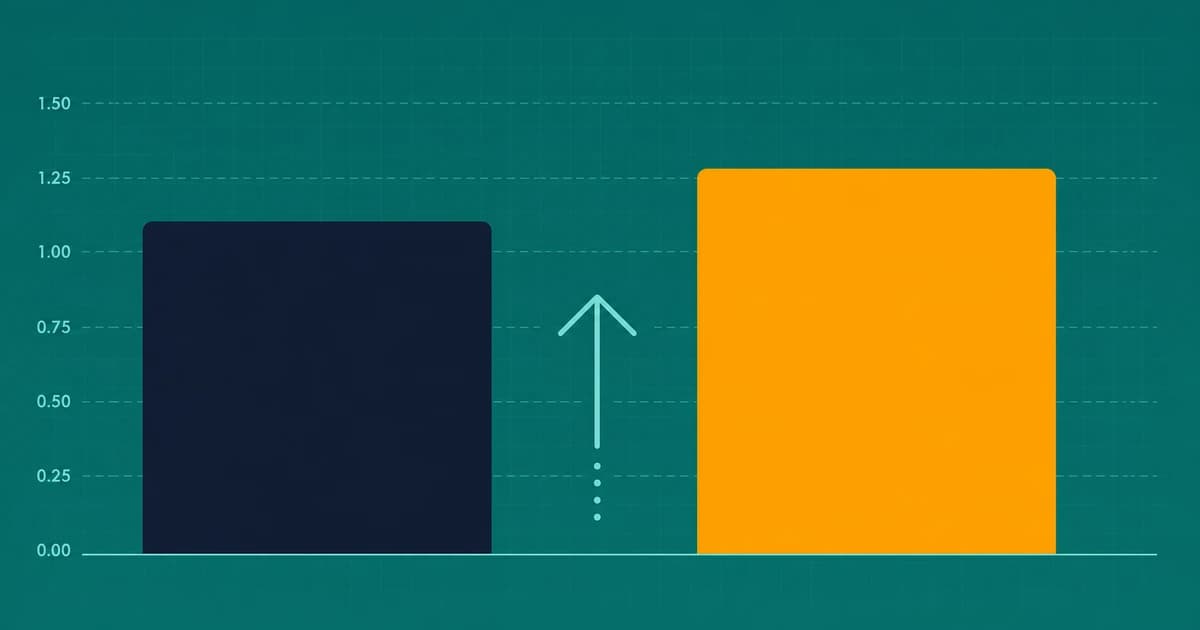
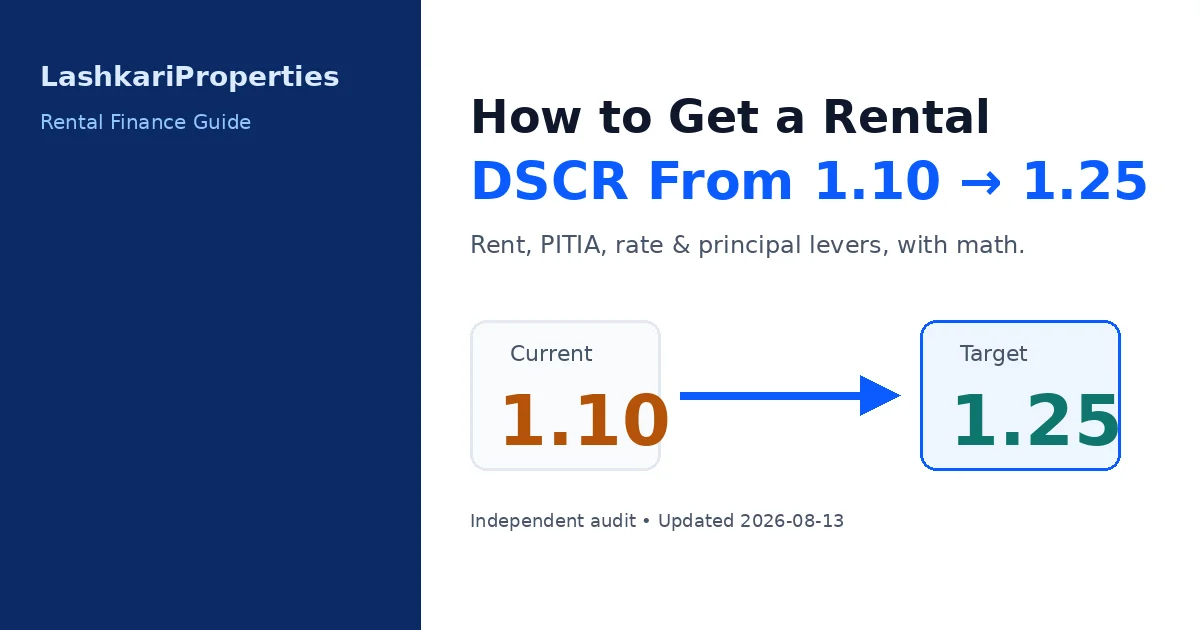
To move a rental DSCR from 1.10 to 1.25, you must widen the gap between qualifying income and qualifying debt service by roughly 13.6% — either by raising qualifying rent by ~13.6% of its current level, cutting debt service by ~12% of its current level, or combining smaller changes on both sides. The exact dollar change depends on your starting numbers; use the DSCR Calculator to model your specific property.
1. DSCR at a Glance
The Debt Service Coverage Ratio (DSCR) is the lender's single most important test for a rental property loan. It compares the property's qualifying monthly income against its qualifying monthly debt service. In residential non-QM lending, that debt service is almost always PITIA: Principal, Interest, Taxes, Insurance, and Association dues.
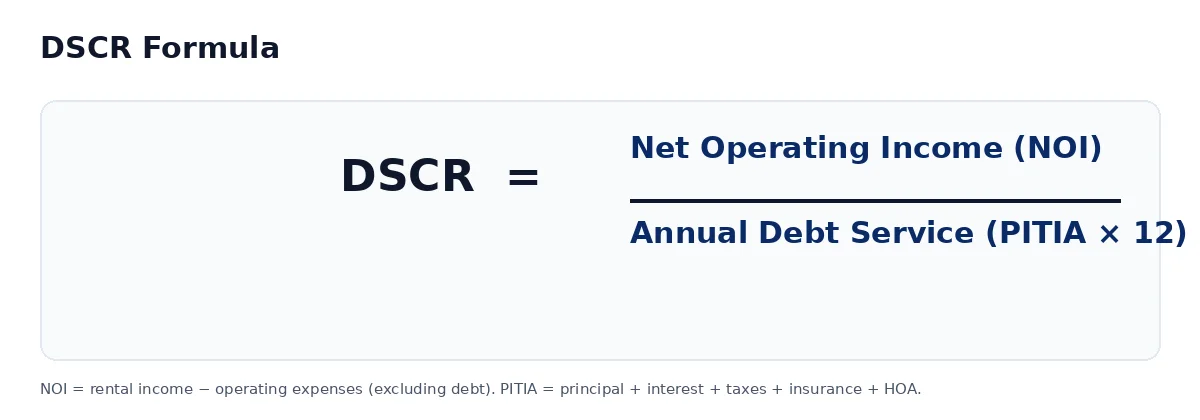
Interpretation is simple:
- DSCR < 1.00 — the property does not cover its own debt service.
- DSCR = 1.00 — break-even.
- DSCR 1.00–1.24 — fundable at many lenders, often with LTV, reserve, or pricing overlays.
- DSCR ≥ 1.25 — typically unlocks the best pricing tiers and highest leverage. Requirements vary by lender and program.
As of 2026, published lender guidelines from firms including Griffin Funding, 1st NWM, Zeitro, Sistar Mortgage, JVM Lending, and Total Quality Lending consistently frame 1.25 as the "strong" benchmark, with a large fundable band down to 1.00 (and even sub-1.00 programs). Confirm requirements with your specific lender before making decisions.
2. Why Your DSCR Is 1.10
A DSCR of 1.10 is not a failure — it means the property produces just 10% more qualifying income than its qualifying debt service. Common root causes:
- Rate environment. Investor mortgage rates in 2026 sit roughly 1–2 points above owner-occupied rates, inflating the "I" in PITIA.
- Rising insurance. Coastal, wildfire, and hail-belt premiums have doubled or tripled in some markets since 2022.
- Reassessed property taxes. Recent sales frequently trigger a tax reassessment that lags initial underwriting.
- Under-market rent. Legacy leases, below-market renewals, or missing ancillary income (parking, pets, storage).
- Wrong rent basis. Using gross rent when the lender qualifies on the lesser of appraisal Form 1007 and executed lease.
- HOA dues. Frequently overlooked in early back-of-envelope math.
Before choosing a strategy, verify each PITIA line and each rent figure. In practice, input errors account for a large share of "low DSCR" results — the property is often fine; the inputs were not.
3. How Much Improvement You Actually Need
Assume a concrete baseline that many investors will recognize:
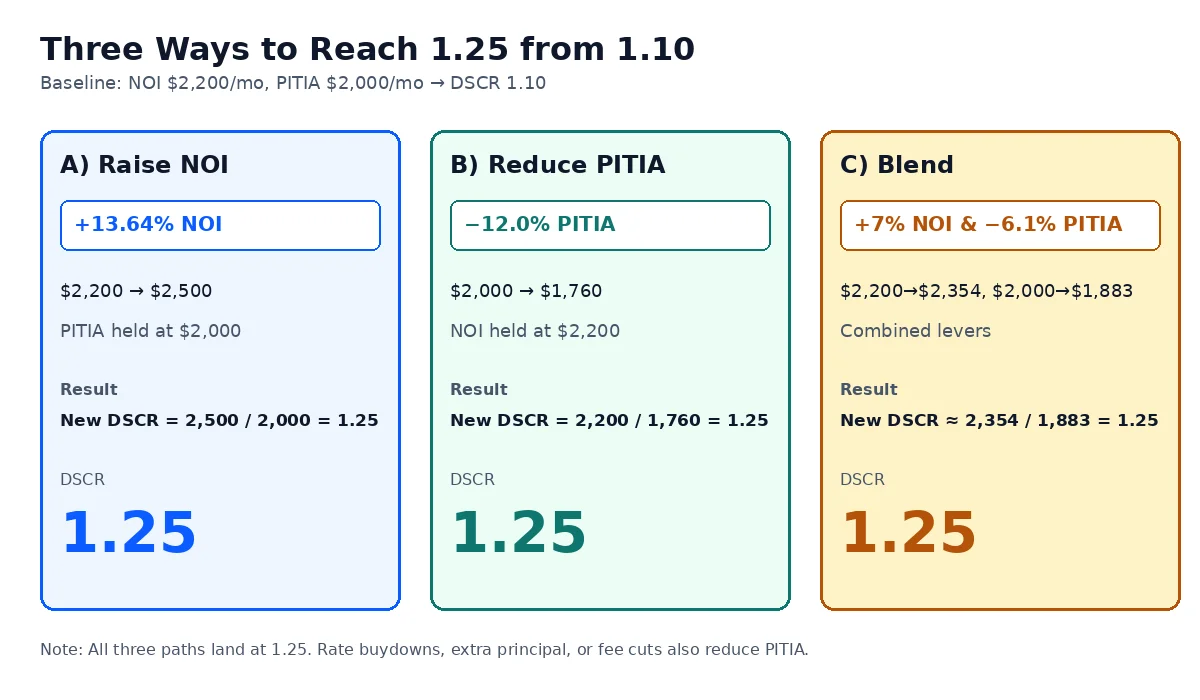
Path A — hold PITIA constant, raise rent. Required rent = 1.25 × $2,000 = $2,500. That's a $300 monthly gap, or a 13.6% rent increase.
Path B — hold rent constant, cut debt service. Required PITIA = $2,200 ÷ 1.25 = $1,760. That's a $240 monthly reduction, or a 12.0% PITIA cut.
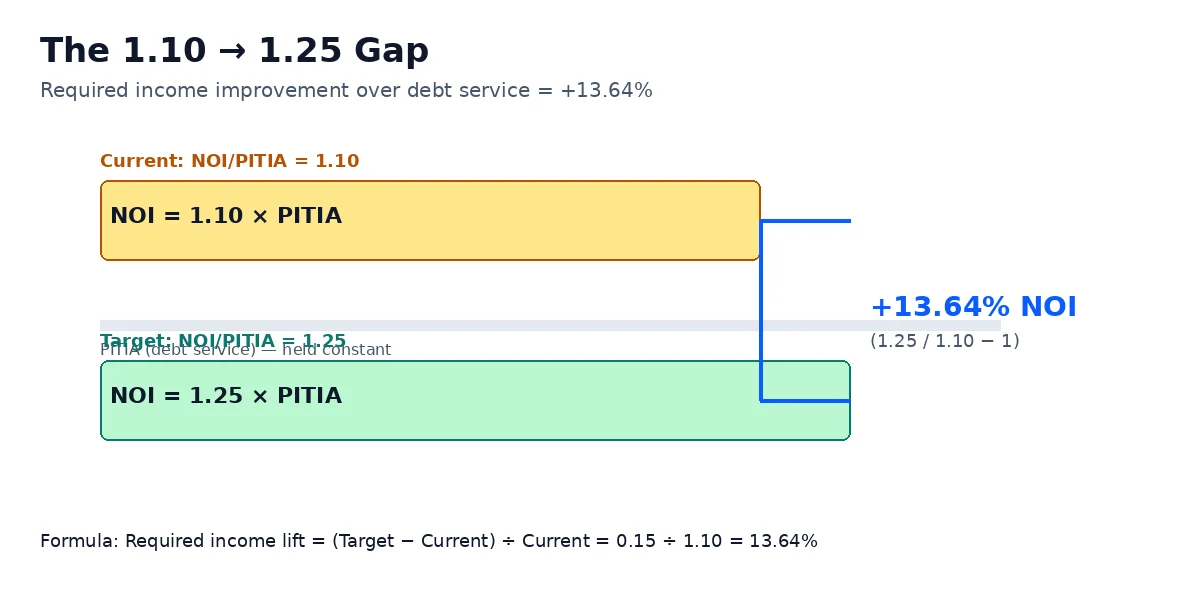
A useful general identity: to lift DSCR from d0 to d1 while holding one side constant, you need to change the other side by a factor of d1/d0. For 1.10 → 1.25 that's 1.1364× — a 13.64% adjustment in whichever variable you move.
4. Seven Ways to Improve DSCR (and What Each Actually Changes)
4.1 Raise qualifying rent to market
What it changes: the numerator. Impact: direct and linear. Limitations: lenders qualify on the lesser of appraisal Form 1007 market rent and executed lease at many programs. Simply raising a lease above the appraiser's opinion may not count. Rent-controlled or long-lease jurisdictions cap this lever.
4.2 Reduce monthly debt service via rate
What it changes: the "I" in PITIA. A 50 bps rate cut on a $300,000 reference loan reduces P&I by roughly $95–$110/month (≈$102).Cost: discount points typically run 1–4% of loan amount for meaningful buydowns. Break-even: usually 3–6 years — verify against expected hold.
4.3 Increase down payment (reduce loan amount)
What it changes: the "P" and "I" in PITIA.Impact: declining marginal DSCR per additional dollar of equity, because taxes/insurance/HOA don't scale down. Trade-off: opportunity cost of trapped capital; every $10,000 of extra down payment might buy only 0.02–0.04 of DSCR.
4.4 Contest property taxes
What it changes: the "T" in PITIA. Often overlooked. In many U.S. jurisdictions a formal appeal after a purchase-driven reassessment can trim 10–20% off the assessed value.
4.5 Reshop insurance
What it changes: the "I" (insurance) in PITIA. Comparing 3+ carriers and adjusting deductible, roof-coverage type, and wind/hail schedules can save 10–25% in many markets.
4.6 Add qualifying income streams
Some programs allow pet rent, parking, storage, and short-term rental income (Airbnb/VRBO via AirDNA or 12-month statements, typically with a haircut). Others do not. Ask before assuming.
4.7 Combination strategy
The most realistic path. Three or four small wins — a modest rent bump, a tax appeal, an insurance reshop, and a slight rate buydown — almost always beats trying to force one lever alone.
5. Five Detailed Worked Scenarios
All scenarios use Baseline Case A unless noted: rent $2,200, PITIA $2,000, current DSCR 1.10, target 1.25. For the scenarios below we use a representative loan of $229,000 at 7.50% (30-yr amortization), giving P&I of ≈$1,601/mo; adding $200/mo taxes, $150/mo insurance and $50/mo HOA yields PITIA ≈ $2,001 — which we round to the $2,000 baseline for clarity. (Rate-buydown and per-$10k figures elsewhere use a generic $300,000 reference loan and are labeled as such.) Use the calculator for your exact numbers.
Scenario 1 — Rent-only increase
- Required rent: $2,500
- Dollar gap: $300/month or+13.64%
- Feasibility check: compare to appraiser Form 1007 comps. If market rent supports it, feasible on turnover.
- New DSCR: $2,500 ÷ $2,000 = 1.25 ✅
Scenario 2 — Debt-service reduction only
- Required PITIA: $1,760
- Dollar reduction: $240/month or−12.0%
- Possible mix: −$100 rate buydown, −$50 tax appeal, −$40 insurance reshop, −$50 HOA challenge = $240.
- New DSCR: $2,200 ÷ $1,760 = 1.25 ✅
Scenario 3 — Additional equity
At 7.50% / 30-yr, each $10,000 of principal reduction cuts P&I by ~$69.9/month. To cut PITIA by $240 you'd need roughly $34,000 extra down. That $34,000 buys 0.15 of DSCR — an implicit return of ~$2,880/yr in reduced P&I on $34k = ~8.5% pre-tax. Whether that beats redeploying the capital elsewhere is an opportunity cost question, not a DSCR question.
Scenario 4 — Property income improvements
- Add pet rent ($40/mo), storage ($25/mo), reserved parking ($35/mo) = +$100/mo, if the lender counts them.
- Reduce vacancy assumption from 8% to 5% at underwriting (program permitting): effective rent +$66/mo on a $2,200 base.
- Blended new rent: $2,366. New DSCR: 2,366 ÷ 2,000 = 1.18 — closer, not there.
Scenario 5 — Combination strategy
- Rent: +$150 to $2,350 (lease turnover + light unit refresh)
- Tax appeal: −$40/mo PITIA
- Insurance reshop: −$30/mo PITIA
- Rate buydown 25 bps: −$50/mo PITIA
- New rent: $2,350. New PITIA: $1,880.DSCR = 1.25 ✅
Scenario 5 is usually the most realistic path from 1.10 to 1.25 — small, defensible changes on both sides of the ratio.
6. The 1.10 → 1.15 → 1.20 → 1.25 Progression Table
Baseline Case A ($2,200 rent, $2,000 PITIA).
Notice how a linear DSCR change requires a linear percentage change on either side. If you can only find a 5% rent bump and a 5% PITIA cut, you'll land near 1.21 — real, but short of 1.25.
7. Your Spreadsheet DSCR vs the Lender's Underwritten DSCR
Two ratios exist for every property:
- Mathematical DSCR— what your spreadsheet says based on the numbers you choose.
- Underwritten DSCR— what the lender's system produces after applying its own rules.
They diverge because lenders apply:
- Rent source rules. Lesser of lease vs. appraiser Form 1007 (Fannie 1007) is common; some allow the higher of the two, some allow AirDNA for short-term rentals.
- PITIA definition. Most use full PITIA. A minority use ITIA (interest-only) for qualifying — this substantially raises DSCR on paper. Verify.
- Vacancy assumptions.A default vacancy factor (often 0% at residential DSCR programs) may differ from the 5–8% investors use.
- Insurance and tax escrow. Lenders may use the higher of quoted premium and their internal minimum.
- HOA verification. If HOA dues aren't documented, the lender may load an estimate.
- Loan program overlays. Investor-only, foreign-national, or short-term rental overlays alter the rent counted.
Never assume your calculator's output is the number the lender will see. Ask for the lender's DSCR worksheet before spending money to change any variable.
8. The Decision Framework — What Should You Change First?
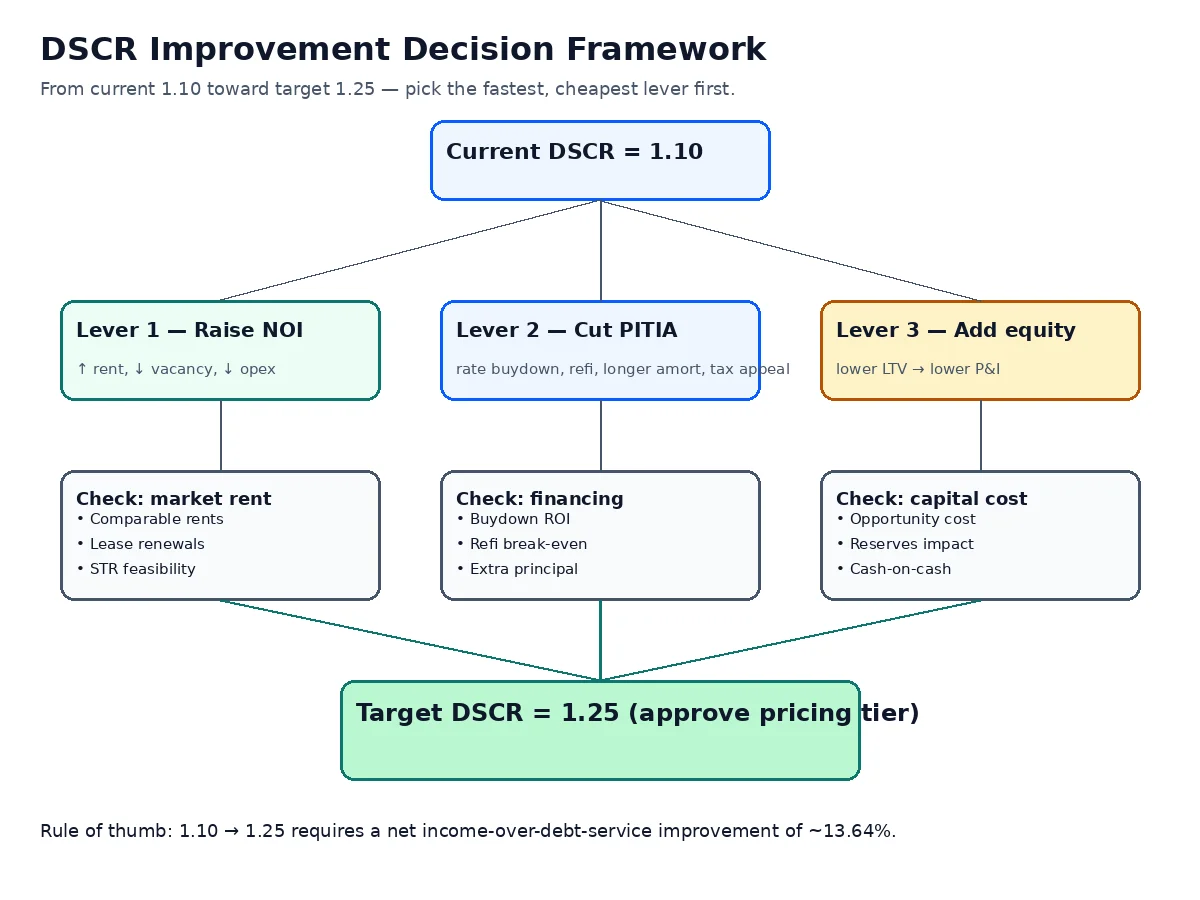
- Verify the lender's DSCR method — PITIA vs ITIA, rent source rule, vacancy factor.
- Verify current qualifying rent — lease vs Form 1007 vs AirDNA (where allowed).
- Verify PITIA line items — recent tax bill, quoted insurance, current HOA statement.
- Calculate the exact DSCR gap — apply the 1.25/1.10 = 1.1364 identity.
- Test rent improvement — turnover, ancillary fees, market comps.
- Test debt-service reduction — tax appeal, insurance reshop, HOA verification, rate buydown.
- Test additional equity — compute DSCR gain per $10k and compare to your alternatives.
- Compare cost per 0.01 of DSCR— the cheapest 0.15 of DSCR wins.
- Recalculate DSCRin the DSCR Calculator.
- Confirm eligibility with the actual lender before locking or closing.
9. Mistakes That Keep a 1.10 DSCR Stuck
- Using gross rent when the lender uses lesser-of-two.
- Using last year's property tax instead of the reassessed number.
- Underestimating insurance in coastal, wildfire, or hail zones.
- Forgetting HOA dues entirely.
- Assuming every lender computes DSCR identically.
- Assuming projected rent counts before appraisal supports it.
- Treating listing rent as qualifying rent.
- Ignoring vacancy or lender-specific rent haircuts.
- Fixating on DSCR while ignoring interest rate, fees, and reserves — a 1.30 DSCR at 9% may lose to a 1.20 DSCR at 7%.
- Refinancing without a break-even model.
- Paying discount points on a property you'll sell within the buydown break-even window.
10. When 1.25 Simply Isn't Achievable
Sometimes the property doesn't support 1.25 at all — the market rent is what it is, the taxes and insurance are what they are, and the loan amount you need to close is the loan amount. In those cases you have three honest options:
- Accept a lower-tier program. Many lenders fund 1.00–1.24 with LTV or reserve overlays; the rate is higher but the deal closes.
- Increase equity beyond target. Compute the marginal DSCR per dollar and stop when the alternative use of capital beats the DSCR gain.
- Walk away.A property that requires $60,000 of forced equity and a 3-year tax appeal just to hit 1.25 is a warning, not a puzzle. Model the opportunity cost against a different property in Rental Yield Calculator and Cash Flow Calculator.
11. DSCR Calculator Walkthrough
Open the LashkariProperties DSCR Calculator in a new tab and enter:
- Qualifying rent — the lesser of your executed lease and appraisal Form 1007 for the most conservative view.
- Principal & interest — from your rate lock or scenario.
- Property taxes — most recent bill; reassessed if applicable.
- Insurance — quoted premium (not last year's).
- HOA dues — current statement.
Read the DSCR output. Then run four saved scenarios:
- 1.10 baseline — as-is.
- 1.15 — rent +4.55% or PITIA −4.35%.
- 1.20 — rent +9.09% or PITIA −8.35%.
- 1.25 — rent +13.64% or PITIA −12.00%.
Also cross-check the underlying cash flow in Cash Flow Calculator and stress-test occupancy with Break-Even Occupancy Calculator. For a foundational refresher, see DSCR Explained for Investors, and confirm the property still makes sense on yield via How to Calculate Rental Yield and What Is a Good Rental Yield?. Complete the property side with the Property Due Diligence Checklist.
12. FAQ
How much do I need to raise rent to move DSCR from 1.10 to 1.25?
Approximately 13.64%of current qualifying rent, holding PITIA constant. On $2,200 rent that's ~$300/month.
No. As of 2026, published guidelines from Griffin Funding, JVM Lending, Zeitro, 1st NWM, Sistar Mortgage, and Total Quality Lending frame 1.25 as the best-pricing benchmark, with a fundable band down to 1.00 and sub-1.00 programs at reduced LTV. Confirm per lender.
Does paying points to buy down the rate improve DSCR?
Yes — lower interest reduces PITIA. Whether it's economical depends on hold period and break-even.
Most residential DSCR programs qualify on PITIA. Some allow ITIA. Ask the lender.
Can I use projected market rent instead of my lease?
Many lenders use the lesser of Form 1007 and executed lease; some allow the higher; some allow AirDNA for STR. Program-dependent.
How does a larger down payment affect DSCR?
It cuts P&I linearly. Roughly $34,000 of extra equity at 7.50% cuts PITIA by ~$240/month — enough to move Baseline A from 1.10 to 1.25. Marginal returns decline as LTV drops.
Sometimes. Non-QM STR programs may accept 12-month statements or AirDNA, usually with a haircut.
1.25+ is the widely quoted threshold in 2026 for top pricing tiers.
Only if the new PITIA is meaningfully lower and break-even is shorter than remaining hold. Model both in the calculator.
How is DSCR different from cash-on-cash return?
DSCR is a lender affordability lens (income ÷ debt service). Cash-on-cash is an investor return lens (post-debt cash flow ÷ cash invested).
13. Your Action Plan
- Verify every PITIA line and the exact rent basis your lender will use.
- Compute your DSCR gap using the 1.25/1.10 = 1.1364 identity.
- Model rent-only, PITIA-only, and combination paths in the DSCR Calculator.
- Choose the cheapest path per 0.01 of DSCR.
- Confirm eligibility with the actual lender before spending money on any lever.
Disclaimer. This article is educational only. It is not financial, tax, legal, or lending advice. DSCR loan requirements vary by lender, program, and jurisdiction and change over time. Verify current requirements with a qualified professional or lender before making decisions. No loan approval, DSCR outcome, interest rate, or investment return is promised.
Sources
- Griffin Funding — DSCR Loan overview. griffinfunding.com/non-qm-mortgages/dscr-loans/(accessed 2026-08-13).
- 1st NWM — DSCR Loan Requirements 2026: The Complete Guide. 1stnwm.com(accessed 2026-08-13).
- Sistar Mortgage — DSCR Loan Rates 2026. sistarmortgage.com(accessed 2026-08-13).
- Zeitro — 2026 DSCR Loan Requirements. zeitro.com(accessed 2026-08-13).
- Total Quality Lending — DSCR Loan Requirements 2026. total quality lending.com(accessed 2026-08-13).
- JVM Lending — DSCR Loan Requirements: 7 Essential Rules 2026. jvmlending.com(accessed 2026-08-13).
- Foundation Mortgage — How Much Rental Income Do You Need to Qualify for a DSCR Loan. foundation mortgage.com(accessed 2026-08-13).
- Lendmire — DSCR Loans Explained: 2026 Guide. lendmire.com(accessed 2026-08-13).
- Investopedia — Debt-Service Coverage Ratio (DSCR). investopedia.com(accessed 2026-08-13).
- Kiavi — The Complete Guide to DSCR Rental Property Loans. kiavi.com(accessed 2026-08-13).
Sources
Related reading
Continue reading: How Landlords Calculate Net Yield (2026) · Rental Yield vs Total Return · Rental Yield vs Total Return. Run your own numbers with the DSCR Calculator — it takes under a minute and beats guessing.
Frequently asked questions
What is a rental DSCR?
Debt Service Coverage Ratio compares a property's qualifying rental income against its qualifying debt service, usually PITIA: principal, interest, taxes, insurance, and association dues. A ratio of 1.25 means income covers the debt service 1.25 times.
What does a 1.25 DSCR mean?
It is the benchmark most lenders quote for strong pricing tiers in 2026. A 1.10 DSCR means the property covers its debt by just 10 percent, which is fundable at many lenders but with stricter LTV, reserve, or pricing overlays.
How do I raise my DSCR from 1.10 to 1.25?
Widen the gap between income and debt service by roughly 13.6 percent: raise qualifying rent, cut debt service through a rate buydown or tax appeal, or combine smaller moves on both sides. Model each path in the DSCR Calculator before committing.
How much more rent do you need to move from 1.10 to 1.25 DSCR?
Roughly 13 to 14 percent more net operating income, because 1.25 divided by 1.10 is about 1.136 — and that assumes expenses stay flat. In practice you usually need closer to 15 to 20 percent more gross rent once the extra income is taxed by vacancy, management, and maintenance. On a property where $1,100 a month of NOI is needed, you are looking for about $150 to $220 a month of additional rent, either through market-rate increases or by adding an income stream like storage.