


At a glance: calculate the number that can survive a bad month
- Gross yield = annual rent ÷ property value. Use it as a quick first screen, not as take-home return.
- Net yield = (annual rent − vacancy − insurance − maintenance − management − property tax/other operating costs) ÷ property value.
- In the worked USD examples, gross yield is 7.8% on the $285,000 flat but net yield is 4.8%; the $215,000 flat moves from 8.1% gross to 5.1% net.
- Before comparing listings, use a defensible rent, mark every unknown cost as an assumption, stress one input at a time and keep purchase price/current value consistent.
Scope and check date: this guide was checked on 23 August 2026. The worked examples use USD, unlevered property-level arithmetic and no income tax or mortgage interest. They are illustrative teaching cases, not local yield benchmarks, forecasts, valuations or investment advice. Vacancy, insurance, tax, regulation and rent evidence must be replaced with current property- and jurisdiction-specific inputs.
Two investors can look at the same $285,000 flat, quote two different yields, and both be doing the arithmetic correctly. That is the first problem with rental yield: the word is used for at least two numbers. One is a marketing figure built from headline rent and asking price. The other is closer to what you keep after the lights stay on, a tap fails in February, and the next tenant takes three weeks to move in.
If you only remember one distinction, remember this. Gross yield is annual rent divided by the property's value. Net yield subtracts the annual cost of owning and operating the property first. Gross is a first screen. Net is the number you should argue about before you instruct a solicitor.
Write the two formulas down before you open a spreadsheet
Gross yield = (annual rent / property value) x 100. Net yield = ((annual rent minus annual operating costs) / property value) x 100. Use the same denominator every time you compare two buildings. Mixing purchase price on one deal with a recent appraisal on another will make a tired asset look like a star.
Annual rent means the rent you can defend, not the rent in the brochure. If the unit is empty, use what similar homes on the same street actually let for in the last quarter. If it is occupied below market, decide whether you are underwriting the current lease or the lease you hope to sign. Those are different investments.
A worked example on a $285,000 flat
Take a two-bedroom that costs $285,000 all-in as the purchase price. Realistic monthly rent is $1,850, so annual rent is $22,200. Gross yield is 22,200 / 285,000, which is 7.8 percent. That is the number most listings stop at, because it is tidy and it does not require anyone to open an insurance quote.
Now add costs that rarely appear on the card in the window. Four empty weeks in a year is roughly one month of rent: $1,850. Landlord insurance: $1,140. A maintenance budget for small replacements, not a full kitchen: $2,200. A managing agent at 8 percent of collected rent: $1,776. Property tax or local rates: $1,680. That is $8,646 leaving the account before you have paid a mortgage or income tax.
- Annual rent: $22,200 USD
- Operating costs: $8,646 USD
- Net income: $13,554 USD
- Net yield on $285,000 USD: 4.8 percent
| Line item | 285k flat — annual USD |
|---|---|
| Annual rent | $22,200 |
| Vacancy: four weeks | $1,850 |
| Landlord insurance | $1,140 |
| Maintenance reserve | $2,200 |
| Managing agent | $1,776 |
| Property tax / local rates | $1,680 |
| Total operating costs | $8,646 |
| Net income | $13,554 |
| Gross yield → net yield | 7.8% → 4.8% |
The listing did not lie. It answered a different question. A 7.8 percent gross that becomes 4.8 percent net is not a disaster, but it is no longer the high-yield story someone pitched. If your loan on this building costs more than 4.8 percent interest, the rent is not carrying the debt on an unlevered basis. You would be relying on the tenant, plus price growth, plus your own cash, to make the year work.
What 'good' actually means in a real market
There is no universal good yield. A 4.8 percent net yield in a city where a long-term fixed mortgage costs 6 percent is a different decision from 4.8 percent where you can borrow at 4 percent and local prices have a long habit of compounding. Yield has to be judged against the alternatives you actually have, not against a blog post that says 7 percent is the magic line.
We look at four comparisons before we call a yield acceptable. First, the interest rate on the loan you would actually be offered, not a headline tracker from last year. Second, the yield on a boring alternative: a government bond, a REIT, or even a cash rate you can get without a leaking gutter. Third, the vacancy and tenant quality that is normal for that street, not the city average. Fourth, how much of the return you are quietly assuming will come from price growth. A low yield in a supply-constrained neighbourhood can be rational if you are honest that you are paying for scarcity. A high yield next to a factory can still be a poor buy if the rent only exists because the last tenant had not yet left.
Yield also moves with the cycle. When purchase prices run ahead of rents, advertised yields compress and people start saying the market is 'about capital growth now.' When prices stall and rents catch up, the same streets suddenly look like income products. Neither story is a law. It is just the ratio doing arithmetic.
Yield is not cash-on-cash return
Cash-on-cash return divides the same net income by the cash you put in — deposit, purchase costs, and any refurbishment — not by the property value. On the $285,000 flat, suppose you put down $71,250 (25 percent) and pay $8,550 in purchase costs. Cash in is $79,800. Net income of $13,554 looks like 17 percent cash-on-cash, which is a flattering poster, until you notice that mortgage interest has not been deducted. Do not mix an unlevered net yield with a geared cash-on-cash number and call them the same thing.
If you finance the purchase, interest is a cost of the capital structure, not of the building. That is why investors still look at yield on value: it lets you compare two buildings before you decide how to pay for them. Then you layer the loan on top and ask a simpler question. After the mortgage leaves the account, is the cash that remains a number you can live with through a void and a boiler replacement in the same year?
Costs people still leave out
- Letting fees and inventory costs each time a tenant changes
- Safety certificates, licensing, and inspection fees in regulated cities
- Service charges and ground rent on leasehold flats
- A sinking-fund contribution for a roof, lift, or facade you do not control
- Higher insurance after a claim or in a flood belt
- Your own time, if you are the emergency plumber at 11pm
You do not need a perfect forecast of every line. You need a budget that would not embarrass you if a sceptical partner read it. If a cost is unknown, put a round number in and mark it as assumed. Then raise it by a third and see whether the deal still stands. A yield that only works when every assumption is kind is not a yield. It is a hope.
Common mistakes
- Using asking rent instead of the rent a similar unit actually achieved
- Assuming zero vacancy because the current tenant has been there five years
- Treating a one-off refurbishment as if kitchens never age
- Comparing a furnished short-let headline with a 12-month unfurnished yield
- Using today's value when you want to judge the original purchase, or the old purchase price when you want to know current performance. Both are valid. They are different questions.
- Ignoring tax. Yield before tax is not take-home pay, and we will not invent your local tax treatment here.
How to use the free calculators
Put the purchase price or current value, plus a rent you can defend, into the Rental Yield Calculator. Add the annual costs you can already evidence: an insurance quote, last year's repairs, the managing agent's percentage, property tax. If you do not know vacancy, start with two to four weeks and watch how fast the net figure moves. When you want the same property as a levered investment, open the ROI Calculator with your deposit and loan terms so you are not comparing an unlevered 4.8 percent with someone else's geared headline. The calculator uses visible labels and keyboard-focusable inputs; do not enter sensitive personal data. Check the Privacy Policy, and use the formulas or downloadable CSV if a result is not exposed clearly to assistive technology.
Step by step: running the yield on a $215,000 flat
The fastest way to learn the calculation is to run one from scratch. Take a $215,000 one-bedroom. Do the work in six steps: confirm a defensible monthly rent; multiply by 12; divide by the purchase price; list every annual cost the landlord still bears; subtract those costs from the annual rent; and divide again by the price. Each step is ten seconds of arithmetic. The gap between the two answers is where the real yield lives.
- Step 1: comparable rent of $1,450 a month, so annual rent is $17,400
- Step 2: gross yield = 17,400 / 215,000, which is 8.1 percent
- Step 3: costs — four void weeks ($1,450), insurance ($760), maintenance ($1,420), managing agent at 9 percent of collected rent ($1,440), property tax ($1,410): total $6,480
- Step 4: net income = 17,400 minus 6,480, which is $10,920
- Step 5: net yield = 10,920 / 215,000, which is 5.1 percent
- Step 6: decide whether 5.1 percent net beats what your money earns without the keys
Notice what changed between the two yields. Gross said 8.1 percent, which sounds like a landlord's market. Net said 5.1 percent, which is a defensible but ordinary return. Nothing about the flat changed. The only difference is whether the costs were allowed to speak. When someone quotes you a yield, ask which of these two numbers they mean before you compare it with anything else.
Furnished short-lets and the yield trap
Short-let yields are quoted on an occupancy assumption, and that assumption is the whole game. A flat earning $3,200 a month at full occupancy shows a spectacular headline yield on paper. The honest version subtracts the months it sits empty, the platform fees, the cleaning after every stay, the wear on furniture, and the extra insurance. Run the same unit at 65 percent occupancy instead of 90 percent and a marketing yield of 12 percent can become an operating reality closer to 7 percent, before you have bought a single new mattress.
Short-lets are a legitimate business. They are just a different investment from a 12-month let, and they should be compared on net yield per year actually occupied, not on a nightly rate multiplied by 365. If a deal is only worth doing at 95 percent occupancy and your city's tourist calendar has four quiet months, the deal is not worth doing.
How yields move as prices and rents drift apart
Yield is a ratio, so it moves when either side moves. When prices run ahead of rents, yields compress and markets start describing themselves as growth stories. When prices stall and rents catch up, the same streets look like income products again. Neither mood is a law of physics. If you want a sense of what is normal for your market, what is a good rental yield has the benchmarks investors actually compare against, and our Rental Yield Calculator will turn your own numbers into a net figure in seconds.
Sensitivity: how the yield moves when one input changes
Because yield is a simple ratio, small input changes move it in predictable ways. On the $215,000 flat, try moving one lever at a time. If the rent falls $100 a month, annual rent drops to $16,200, gross yield falls from 8.1 percent to 7.5 percent, and net yield falls from 5.1 percent to 4.5 percent. If vacancy stretches from four weeks to ten, add another $1,450 of cost: net income falls to $9,470 and net yield to 4.4 percent. If the purchase price were $240,000 instead, the same $17,400 rent and $6,480 of costs would produce a 4.6 percent net yield — almost a point lower, on an identical flat.
- Rent down $100 a month: gross 7.5 percent, net 4.5 percent
- Vacancy up to ten weeks: net yield 4.4 percent
- Price $240,000 instead of $215,000: net yield 4.6 percent
- Costs up 20 percent ($7,776): net yield 4.5 percent
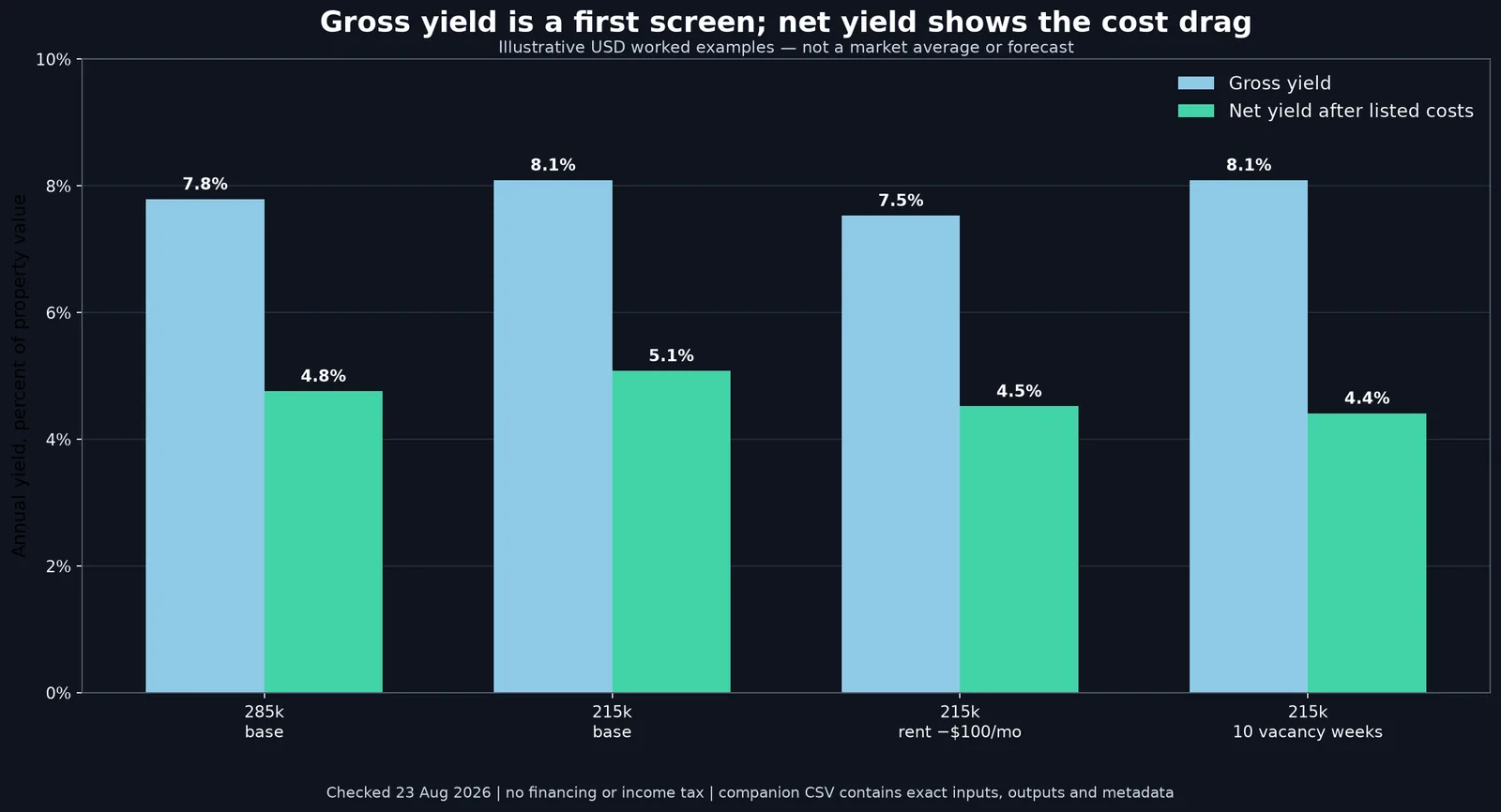
Figure text alternative: the $285,000 USD base case moves from 7.8% gross to 4.8% net. The $215,000 USD base case moves from 8.1% to 5.1%. On the same $215,000 case, reducing rent by $100 per month moves net yield to 4.5%; extending vacancy to ten weeks moves it to 4.4%. The CSV records the inputs and derived net income for each case.
The pattern to internalise is that net yield is a sharper instrument than gross yield: the same disappointments that barely dent the gross number cut straight through the net one. That is precisely why the net figure is the one to negotiate with. If a seller's '8 percent yield' evaporates to 4.5 percent under honest costs, the conversation has changed from the purchase price to whether the purchase should happen at all.
Sources and local data routes
| Use this source for | Source route | Scope / caution |
|---|---|---|
| Rental-income and operating-expense tax concepts in the US | IRS Publication 527 | US-specific. Confirm the property type, ownership structure and current tax year. |
| US property-price history | FHFA House Price Index | Single-family repeat-sales index with local geographies; use it as a data route, not a forecast. |
| UK property-price history | HM Land Registry UK HPI reports | Official UK statistics with provisional estimates and revisions; do not treat a first estimate as final. |
| UK rental-income tax route | GOV.UK renting-out-a-property tax guidance | UK-specific. Allowable expenses and reporting depend on the owner and property facts. |
| Professional valuation terminology | RICS standards and guidance | Use the applicable valuation standard and a qualified local valuer for a decision-grade valuation. |
| Plain-language yield orientation | NAB rental-yield explainer | Secondary educational context; it does not replace local rent, tax or expense evidence. |
For Canada, Australia or another jurisdiction, replace the USD worksheet with that market's tax authority, statistics office, local rent comparables and property-specific operating quotes. Keep the same formula, but do not import another country's vacancy, tax, insurance or expense assumptions. This article is educational research, not financial, tax or legal advice.
Related reading
Continue reading: Break-Even Occupancy for Landlords · How to Calculate Rental Yield (2026) · Cap Rate Explained for Investors. Run your own numbers with the Rent vs Buy Calculator — it takes under a minute and beats guessing.
Why yield alone never tells the whole story
Two properties can show the identical 7 percent yield and be completely different investments. The first is a low-maintenance new build in a growth suburb where rents rise 5 percent a year; the second is an older building with a 15 percent expense ratio, a tenant turnover every 18 months, and flat rents. Yield captures only the current year's snapshot — it says nothing about growth, vacancy risk, or what the property will be worth in a decade. Investors who buy purely on headline yield routinely end up with high-yield, low-total-return portfolios. That is why professional landlords pair the yield calculation with the cap rate, cash flow, and a realistic appreciation assumption, and why you should model the same three numbers before committing capital.
Frequently asked questions
What is the rental yield formula?
Gross rental yield is annual rent divided by property value, multiplied by 100. Net rental yield is (annual rent minus annual operating costs) divided by property value, multiplied by 100. On the $285,000 example above, gross is 7.8 percent and net is 4.8 percent.
How do you calculate net rental yield?
Start with a defensible annual rent, subtract every annual cost the landlord still bears — vacancy, insurance, maintenance, management, property tax — then divide the result by the property value and multiply by 100. On a $215,000 flat with $17,400 of rent and $6,480 of costs, net yield is 5.1 percent.
Is rental yield calculated on purchase price or current value?
Both, and they answer different questions. Dividing by what you paid measures the return on your original purchase. Dividing by current value measures how the asset performs today. Use the same denominator whenever you compare two properties, and say which one you used.
Does rental yield include mortgage payments?
No. Rental yield is an unlevered metric: it ignores financing so you can compare buildings before you decide how to pay for them. Once a loan is added, the honest numbers are cash flow and cash-on-cash return, which is why investors use the ROI Calculator for the levered version.
What is a good rental yield in 2026?
There is no universal number and this guide does not set a 6–8% gross or 4–6% net target. Compare the net result with your actual financing cost, a low-risk alternative and current local evidence for comparable properties. A benchmark is useful only when its market, property type, date and calculation method match your case.
What expenses should you subtract for net yield?
Include everything it takes to keep the property rented and habitable: management fees, property tax, insurance, maintenance, vacancy allowance, and landlord-paid utilities. Exclude the mortgage payment, because financing is a decision, not an operating cost — that is what separates net yield from cash flow. Do not assume a universal expense ratio: property age, lease type, management, climate, insurance market and local charges can move the result materially. If an assumption is unusually low, ask for evidence.
This article is educational. It is not financial advice, tax advice, or a recommendation to buy any property. Yields vary by market, by tax treatment, and by the quality of the numbers you type in. Check figures with a qualified adviser when you need a personal recommendation.