


Executive summary for a busy reader
- Commercial property is a lease-and-cash-flow decision: rebuild NOI, test tenant concentration and stress the vacancy before trusting a headline yield.
- For the worked USD example, $48,000 passing rent becomes $40,800 NOI after $7,200 of landlord costs; the illustrative 1.16 DSCR leaves only $5,625 before tax in the base year.
- The eight-month vacancy stress demands $73,950 of cash in lost rent, fit-out and debt service, so liquidity can matter more than the brochure cap rate.
- Start with the downloadable checklist, then have a local solicitor, valuer/surveyor, lender, accountant and planning professional review the actual property and lease.
Jurisdiction signpost: this guide uses USD examples and US OCC/FDIC regulatory links only for a risk-management frame. UK, Australian, Canadian and other markets have different taxes, lease forms, planning/use rules, tenant protections and lender practices; those local rules are out of scope here and must be checked with local professionals.
A three-bed house can lose one tenant and still have two rooms producing rent, or be re-let in a fortnight. A single-let shop can go from fully occupied to zero income on a Friday afternoon. That concentration of risk is the starting point for commercial property, not a footnote you read after you have fallen for the brickwork.
The building still matters. Location still matters. But in commercial, the lease is a large part of what you are buying. Length, break clauses, who repairs the roof, how rent is reviewed, and whether the tenant is a household-name chemist or a new cafe with one thin year of accounts — those clauses are the product. Two adjoining units can be different investments because the paper inside them is different.
At a glance: the commercial investment decision
- Build NOI from passing rent minus the landlord costs you still bear; do not call passing rent a cap rate.
- Stress the lease: tenant break, expiry, rent review, re-letting time, fit-out contribution and empty-property costs.
- Run DSCR with the proposed debt and at least one rent/vacancy downside case; a current tenant paying on time is not a guarantee.
- Compare office, retail, industrial and specialist assets by tenant replaceability, use flexibility, repair burden and liquidity—not by yield alone.
- This is educational information, not financial, lending, valuation, tax, legal or planning advice. Read the actual lease with qualified local professionals.
Disclosure, scope and check date
LashkariProperties is an educational real-estate publisher, not a lender, valuer, solicitor, tax adviser or investment adviser. This guide was checked on 23 August 2026. Every dollar sign ($) in the worked examples means USD, and the financing illustrations use a US-style dollar example; the arithmetic is not an AUD, CAD, NZD or other local-market quote. OCC and FDIC links are US regulatory resources, included for risk-management framing only. Dollar amounts, cap rates, DSCR and vacancy outcomes are illustrative arithmetic from the stated teaching assumptions, not market benchmarks, lender requirements or forecasts. Commercial property rules, taxes, planning, lease forms and financing terms vary by jurisdiction and asset.
Calculator note: the linked tools are planning aids, not a valuation or credit decision. The current linked tools run as browser-based arithmetic components; targeted source review found no calculator-specific localStorage/sessionStorage write or calculator API submission path. Their input fields have visible labels and their results are rendered as text; use keyboard Tab/Shift+Tab to move through fields and results. If an assistive technology cannot read a result, use the formulas and downloadable CSV on this page instead. Avoid entering names, account numbers, tax identifiers or other sensitive information, review the site's Privacy Policy, and replace every illustrative input with the actual lease, operating statement, lender term sheet, valuation and local professional advice.
Do these three checks before you offer
- 1. Request the executed lease, all amendments and the tenant's payment/guarantor evidence; write down term, break, rent review and repair obligations in plain English.
- 2. Rebuild NOI from the operating statement, then run DSCR with a rent haircut, a vacancy period and realistic fit-out/marketing costs—not only the fully occupied case.
- 3. Get written local quotes and professional sign-off for valuation, survey, legal/title, planning/use, tax, insurance, lending and empty-property costs before committing capital.
Download or print the commercial pre-offer checklist to take to the solicitor, valuer, lender and property manager. It is a planning checklist, not a substitute for jurisdiction-specific advice.
A practical first 7–14 days
- Days 1–2: ask the agent/seller for the executed lease, amendments, rent schedule, arrears history, tenant/guarantor evidence, service-charge accounts and title/planning documents.
- Days 3–5: instruct a commercial solicitor and independent valuer/surveyor; ask the lender or broker for written LTV, DSCR, rate, fee, guarantee and stress-test terms.
- Days 6–9: rebuild NOI, inspect the building, confirm use/licensing, model vacancy and fit-out cash demand, and obtain written local tax, insurance, legal and repair quotes.
- Days 10–14: compare the base case with a downside case, resolve open lease clauses, and make an offer only after the professionals identify what is still unknown.
What you are actually underwriting
Residential underwriting asks: will someone want to sleep here, and what does that rent look like against the mortgage? Commercial underwriting asks: will this specific tenant, in this specific use, keep paying for the next five or ten years, and what is the unit worth if they do not? The second question is harsher, which is why advertised yields are often higher. Higher yield is frequently the market's way of saying the vacancy, when it comes, will last.
Lease language you should be able to explain in plain words includes the term, any tenant break, the rent-review method (open market, index, fixed steps), whether the lease is effectively full repairing and insuring, and any rent-free or fit-out contribution you have promised. If you cannot explain those, you do not yet know what you own.
Cap rate, NOI, and why the brochure yield is not NOI
Net operating income, NOI, is rent that stays after the operating costs the landlord still bears, and before debt. Capitalisation rate, or cap rate, is NOI divided by price. It is the commercial cousin of net yield, and it is how two shops on the same parade can be compared without arguing about each buyer's mortgage. A cap rate is not a promise. It is last year's (or next year's) income dressed as a percentage of today's price.
Brochures often quote a 'yield' on passing rent before voids, before a roof reserve, and sometimes before the insurance the landlord still pays. Ask for the cost list. If the seller cannot produce one, build your own and use that for the cap rate. Optimistic cap rates are a sales tool. The OCC commercial real-estate lending handbook and FDIC CRE lending resources frame income-producing property as a risk-management and underwriting exercise, not as a single yield number.
| Asset type | What to test first | Typical downside trigger |
|---|---|---|
| Office | Tenant demand, building quality, fit-out obligation, lease expiry and local vacancy | A tenant break or outdated space creates long downtime and a large re-letting fit-out. |
| Retail | Footfall, parking, catchment, use class, tenant sales resilience and competition | A weak trading location can make the headline rent impossible to replace. |
| Industrial / logistics | Access, loading, power, clear height, tenant concentration and lease term | Specialised specification or a single occupier can reduce the replacement pool. |
| Storage / medical / alternatives | Licensing, planning use, operator quality, capex and specialist demand | A planning or operating restriction can reduce both income and exit liquidity. |
Table 1 text alternative: office risk centres on tenant demand, building quality and fit-out; retail on footfall, catchment and use flexibility; industrial/logistics on access, specification and tenant concentration; specialist assets on licensing, planning and operator quality. In every row, the downside is a smaller or slower replacement market if the tenant leaves. The article thumbnail and author portrait are context/branding visuals, not evidence; the underwriting bridge, tables and downloadable data carry the decision evidence. The chart's CSV long description supplies the detailed numeric bridge for screen-reader users who need more than the concise alt text.
Worked example: a $640,000 shop and an eight-month hole
Checked 23 August 2026 — illustrative USD teaching case, not a market benchmark: a neighbourhood shop is priced at $640,000. The tenant pays $48,000 a year on a lease with four years left and no break. Headline yield on passing rent is 7.5 percent. The landlord still pays building insurance of $2,400, puts $3,200 a year toward a roof that is not young, and allows $1,600 for landlord items the lease does not push across. Operating costs: $7,200. NOI: $40,800. Cap rate: 6.4 percent. Already the brochure and the file disagree.
Checked 23 August 2026 — illustrative USD financing case, not a lender quote: the example assumes 60 percent funding, or $384,000, at 6.8 percent over 20 years with a fully amortising principal-and-interest payment. The monthly payment is about $2,931, or $35,175 a year, rounded to the nearest dollar. Debt service coverage is 40,800 / 35,175, which is 1.16. Lenders set their own underwriting standards; the OCC and FDIC materials support disciplined review of income-producing real estate but do not prescribe one DSCR for every deal. A 1.16 DSCR is thin in this teaching case and should be re-tested if the tenant looks fragile or rent falls.
Visual and data note: the bridge below uses the same illustrative USD $640,000 shop, $48,000 passing rent, $7,200 operating costs, $40,800 NOI, $35,175 annual debt service and 8-month vacancy stress described in this section. The fully amortising loan uses monthly principal-and-interest arithmetic over 20 years; displayed amounts are rounded to the nearest dollar. The companion commercial underwriting CSV lists the exact rows and arithmetic. Its columns are scenario, line_item, amount_usd and sign; the file includes the assumptions and a no-advice/no-warranty terms line. It is not a market dataset or lender term sheet.
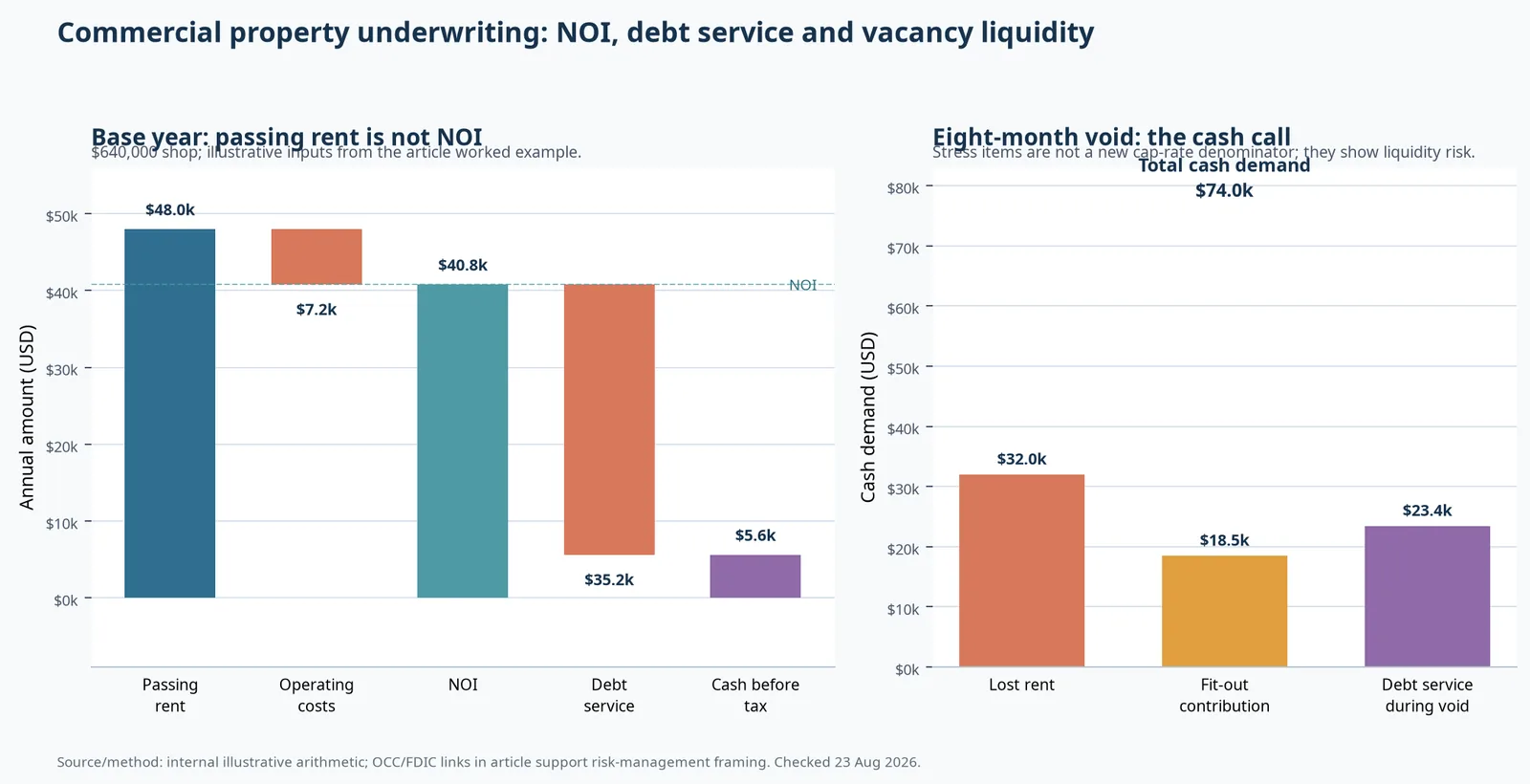
Text alternative for the chart: base-year passing rent is $48,000 USD; insurance, roof reserve and landlord items total $7,200 USD; NOI is $40,800 USD; annual debt service is $35,175 USD; cash before tax is $5,625 USD. In the vacancy stress, $32,000 USD lost rent + $18,500 USD fit-out contribution + $23,450 USD debt service during the eight-month void = $73,950 USD cash demand. This is a liquidity test, not a revised cap-rate denominator.
Now the tenant leaves. Re-letting takes eight months. Lost rent is $32,000. A new tenant wants a modest fit-out contribution of $18,500. The mortgage does not pause: eight months of payments is about $23,450. In one vacancy you have spent, in cash, something like $73,950 that the 6.4 percent cap rate never mentioned. A residential void of three weeks is a bad month. This is a bad year.
- Passing rent $48,000 on $640,000 looks like 7.5 percent
- NOI $40,800 is a 6.4 percent cap rate
- Annual debt service about $35,175; DSCR about 1.16
- An eight-month void plus a small fit-out can consume more than a year of NOI
Financing is a different conversation
Residential lenders underwrite you, then the house. Commercial lenders underwrite the income, then you. They will read the lease. They will ask who the tenant is and how replaceable they are. They will haircut the rent if it looks above what a new tenant would pay. Deposits are often larger, terms often shorter, and personal guarantees more common than first-time commercial buyers expect.
That is not hostility. It is what a concentrated income stream deserves. If you want the higher advertised yield, you are also volunteering for a credit committee that cares about DSCR more than your salary. Bring a cash-flow sheet, not a story about the parade 'always being busy on Saturdays.'
Tenant quality is a credit opinion
A national tenant on a long lease without a break is, all else equal, a different risk from an independent trader on a three-year term. The national tenant will usually mean a lower cap rate — you pay more for the same rent — because the income is more believable. The independent trader may pay a higher rent per square foot and still be the worse investment if their accounts are thin. Walk the unit, read the accounts if you can get them, and ask what the unit re-lets for if this name disappears.
Use also matters. A shop that only works as a hot-food takeaway, or an office that only works for one awkward tenant, has a smaller replacement market. Planning use classes and licensing are part of due diligence, not a lawyer's hobby.
Common mistakes
- Applying residential intuition about voids to a single-let commercial unit
- Believing the brochure yield without building NOI yourself
- Ignoring a tenant break that sits two years before the loan is repaid
- Forgetting fit-out, empty-property costs, and marketing when you model vacancy
- Borrowing to a 1.10 DSCR because the current tenant has paid on time so far
- Buying a specialised building because it was cheaper per square foot
How to use the free calculators
Start with the Cap Rate Calculator and enter NOI, not passing rent, unless you have truly landlord-free income. Put the same NOI and the proposed loan into the DSCR Calculator and see whether a 10 percent rent haircut still clears the kind of coverage a lender quotes. Then run the Cash Flow Calculator with a vacancy year, not only a full year, so the eight-month hole is visible before you offer. A commercial deal that only works in the fully occupied column is a residential habit wearing a commercial coat.
Offices, retail, and industrial are different assets
The word commercial covers markets that behave differently, and treating them as one can hide risk. Industrial/logistics, retail, offices and specialist assets each depend on a different replacement market: access and specification for industrial, footfall and use flexibility for retail, tenant demand and fit-out for offices, and licensing/planning/operator quality for alternatives. These are decision lenses, not claims about universal performance. You are not buying 'commercial property'. You are buying one asset, in one location, with one lease and one local demand pattern.
- Industrial and logistics: often longer leases, national tenants, simpler buildings, strong occupier demand in many markets
- Retail: extreme spread between prime and secondary; footfall, parking, and online competition set the risk
- Offices: modern well-located stock trades very differently from older secondary space; fit-out and amenity matter
- Alternatives — storage, medical, data, car parks — can behave differently again, and often reward specialist knowledge
When someone offers you a 'commercial yield', the first question is which column the building sits in, and the second is how replaceable its tenants are. A logistics shed with a five-year lease to a parcel company and a secondary shop with a two-year lease to an independent trader are both 'commercial', and they share almost nothing else.
Single-let versus multi-let: two shapes of risk
A single-let building is one tenant, one lease, one cheque. It is simple to manage and the income is concentrated: when that tenant leaves, income goes to zero overnight, and the re-letting period is measured in months. A multi-let building spreads the risk across several tenants and income streams, so one vacancy is a hole rather than a wipeout — but it brings active management: rent collection from several parties, expiring leases on a calendar, vacancies to market, and service-charge administration. The extra yield on a single-let is often exactly the price of that concentration, and the lower yield on a multi-let is the price of not having to worry about one Friday afternoon.
The costs of buying commercial property
Commercial purchases carry their own cost stack: legal fees for a more complex lease and title, valuation and survey costs scaled to a bigger building, a lender's arrangement fee on a commercial mortgage, and in many countries a transfer tax on the purchase price. Add professional advice on the lease before you sign — a commercial lease is a contract with obligations that run for years, not a house-purchase form. Request written local quotes for tax, legal, survey, valuation, lender, insurance, fit-out and empty-property costs; do not use a universal 1–2% rule as a substitute for the actual cost schedule.
A checklist before you sign a commercial lease
| Lease clause | Question to answer before signing |
|---|---|
| Term and expiry | How many years remain, and does the loan outlast the lease or break window? |
| Break clause | Who can break, on what notice/conditions, and who carries the cash cost if it is exercised? |
| Rent review | Is rent reviewed to open market, an index, fixed steps, a cap/floor or another formula? |
| Repair and insurance | Does the landlord or tenant pay for roof, structure, plant, reinstatement and building insurance? |
| Use and assignment | Can a replacement tenant legally operate, assign the lease or change use if the current tenant leaves? |
| Service charge / incentives | Are there caps, catch-up charges, rent-free periods, fit-out contributions or major works? |
Read the lease like a contract, because it is one, and it will outlive the agent who handed it to you. Check the term and every break clause, and what happens to each side's money at a break. Identify who repairs and insures what, and whether the lease is effectively full repairing and insuring — the phrase that quietly hands the roof to you. Read the rent-review method and model it: a review indexed to inflation can raise your cost while the tenant's rent is frozen. Confirm the use class and any restrictions on what the unit can become if this tenant leaves, and check the service charge for any catch-up or major-works provisions. Then ask the question the lease cannot answer: what would this unit re-let for if the tenant left tomorrow?
- Term, break clauses, and who pays what at a break
- Repairing and insuring obligations — where the roof actually sits
- Rent review method, modelled forward, not just read
- Use class and re-letting flexibility if the tenant leaves
- Service charge history and any major-works provisions
Worked example: a three-unit parade with one vacancy
A small parade of three units is priced at $720,000. Passing rents are $2,600, $2,000, and $1,500 a month, so full-year income is $73,200. The landlord still bears insurance of $2,900, common-area costs of $3,600, and a maintenance reserve of $2,900. NOI is $63,800, a cap rate of 8.9 percent on the asking price.
Now one unit — the $1,500 one, a quarter of the income — goes empty for four months. Lost rent is $6,000, re-letting costs eat another $1,800, and the empty unit still draws some common costs. The year's income falls to roughly $55,000, and the cap rate on the same price drops to about 7.6 percent. Nothing else changed. A single vacancy in one of three units quietly moved the deal nearly a point and a half.
That is the argument for the multi-let in miniature: the building survived. The single-let equivalent would have gone from 7.5 percent to zero in the same four months. And it is the argument for modelling vacancy before you buy: a commercial investment that assumes 100 percent occupancy forever is a residential habit, and a 90 percent occupancy model is the minimum an adult should carry into a negotiation.
In practice, commercial property is the opposite of set-and-forget. A higher headline yield than a chosen residential comparable is not a law and can reflect vacancy, lease, tenant or liquidity risk. The investors who do well are the ones who read the lease, build NOI from the cost list rather than the brochure, model the vacancy before they buy, and let the lender's DSCR standard discipline the deal instead of resenting it.
Sources
- OCC — Comptroller's Handbook: Commercial Real Estate Lending — prudent income-producing real-estate lending risk framework, March 2022 and checked 23 August 2026
- FDIC — Commercial Real Estate Lending — underwriting, appraisal and concentration-risk resources, last updated 19 December 2025 and checked 23 August 2026
- Investopedia — Commercial Real Estate — general terminology reference, checked 23 August 2026
- NAIOP — Commercial real estate research — industry research route, checked 23 August 2026
Related reading
Continue reading: Break-Even Occupancy for Landlords · How to Calculate Rental Yield (2026) · Cap Rate Explained for Investors. Run your own numbers with the Cap Rate Calculator — it takes under a minute and beats guessing.
Triple net leases: the landlord's favourite structure
Under a triple net (NNN) lease, the tenant pays property taxes, insurance, and common-area maintenance on top of base rent, which means the landlord's operating expenses can approach zero. National retail chains and many office tenants sign NNN leases, and investors price them at lower cap rates precisely because the income is steadier. The trade-off is control: you give up day-to-day decisions about the building, and a single anchor tenant's failure can wipe out the cash flow until a replacement is found. Before underwriting any NNN deal, verify the tenant's credit, the lease's remaining term, and whether the rent resets on a fixed schedule or on the consumer price index.
- Run the deal through the Cap Rate Calculator and the Cash Flow Calculator before making an offer.
- Compare the NNN cap rate against a gross-lease building with the Investment Calculator.
Frequently asked questions
What is commercial property investment?
It is buying a building that produces business income — offices, retail, industrial, or alternatives such as storage and medical — where the lease, the tenant, and the use largely determine the value. It can offer a higher headline yield than some residential comparables, but that is not universal and often reflects tenant, vacancy, lease or liquidity risk.
What is a good cap rate for commercial property?
There is no universal number. Cap rates vary by asset class, location, tenant quality, lease term, vacancy risk and market conditions. Use the cap rate as one comparison, then test NOI, tenant concentration, re-letting cost, debt service and exit liquidity against the actual property and alternatives.
How much deposit do I need for a commercial mortgage?
There is no universal deposit percentage. Loan-to-value, DSCR, asset type, tenant quality, borrower strength, lender policy and the valuation all affect the offer. The worked example assumes 60% funding only to show the arithmetic; it is not a market norm or approval expectation. Ask lenders for written term sheets and personal-guarantee conditions.
What is DSCR and why do lenders use it?
Debt service coverage ratio is net operating income divided by annual debt payments. A ratio of 1.25 means the teaching NOI covers annual debt service 1.25 times. Lenders set their own thresholds and may stress rent, vacancy, interest rates and expenses; the OCC and FDIC resources do not create one universal DSCR rule.
What happens when a commercial tenant leaves?
Re-letting takes months, not weeks, and the mortgage does not pause. In the example above, an eight-month void plus a small fit-out contribution consumed more cash than a full year of net income. That is why vacancy modelling is the centrepiece of commercial underwriting.
Is commercial property riskier than residential?
In the ways that matter, usually yes: income is concentrated in fewer tenants, voids last longer, leases carry heavier obligations, and lending standards are stricter. The higher advertised yields are partly compensation for that risk, and partly a warning about it.
What is the difference between single-tenant and multi-tenant commercial property?
Single-tenant buildings are typically net-leased to one strong credit tenant, which produces steadier income but concentration risk and harder financing for small investors. Multi-tenant properties spread vacancy risk across several businesses — one empty shop costs you a fraction of the income rather than all of it — but require active management, leasing overhead, and more capital for improvements. Multi-tenant usually trades at higher cap rates to compensate for the extra work.
This article is educational only. It is not financial, lending, valuation, tax, legal, planning or investment advice, a credit assessment, or a recommendation to buy commercial property. Leases, lending tests, planning rules, taxes, insurance and tenant protections are local. Have a qualified solicitor, valuer, lender, accountant and relevant planning authority review the actual property and lease before committing capital.