


Break any monthly payment into principal, interest, taxes, and insurance — so you know the true housing cost before you make an offer. Whether you are buying your first home, upgrading, or refinancing, the same formula applies, and this guide walks you through it step by step.
Most buyers shop for a home by looking at the listing price. Lenders, however, don't care about the listing price — they care about one number: the monthly payment. And the payment they qualify you for is rarely the payment you should actually plan around, because the figure on a loan estimate is only part of what leaves your bank account each month.
A monthly mortgage payment is really a stack of up to five separate costs: principal (the money that actually reduces your debt),interest (the lender's charge),property taxes,homeowners insurance, and — depending on the property and your down payment — mortgage insurance, HOA dues, or service charges. Together, these are commonly called PITI. Understanding how to calculate each layer, by hand and with a free mortgage calculator, is the single most useful skill you can bring to a purchase decision. It tells you what a home really costs, what you can truly afford, and how much room you have if rates move against you.
In this guide you'll learn the exact formula lenders use, a seven-step process to build a full payment from scratch, three fully worked examples (including the USA, Canada, and the UAE), the market-specific wrinkles that trip buyers up in the UK, Australia, and beyond, and a pre-offer checklist you can run in under ten minutes. Every number in the examples has been calculated and cross-checked, and where a rule differs by country or state, we say so — because a formula is universal, but taxes, insurance, and lending rules are not.
Your true monthly housing cost =principal + interest + taxes + insurance + recurring fees — and the formula in this article lets you compute every layer before you ever speak to a lender.
Key definitions and the mortgage payment formula
Before touching a calculator, get fluent in the five terms that drive every monthly payment. These definitions appear on loan documents in every Tier-1 market, even when the local terminology differs slightly.
Principal (P)
The principal is the amount you actually borrow: the purchase price minus your down payment. On a $500,000 home with 20% down, the principal is $400,000. Every other number in this article flows from this one. Note that principal isnotthe purchase price — a surprisingly common mix-up that throws off affordability math by tens of thousands.
Interest rate (and the monthly rate, r)
The rate your lender quotes is an annual rate, but payments are monthly, so the formula uses the monthly rate: r = annual rate ÷ 12. At a 6.5% annual rate,r = 0.065 ÷ 12 ≈ 0.005417. In the UK and Australia you'll often see variable or tracker rates; in Canada, fixed rates reset every 1–5 years within a longer amortization. The formula is identical in all cases — only the input changes.
Number of payments (n)
n = loan term in years × 12. A 30-year term means 360 payments; a 25-year term (standard in Canada and the UK) means 300. This exponent is why term length has such an outsized effect on total interest, as the examples below show.
The amortization formula
Every fixed-rate, fully amortizing mortgage in the world uses the same equation to set the monthly principal-and-interest payment:
M = P × r (1+r)^n ÷ ((1+r)^n − 1)
- M= monthly principal & interest payment
- P= loan principal (price − down payment)
- r= monthly interest rate (annual rate ÷ 12)
- n= total number of monthly payments (years × 12)
This formula guarantees two things: the payment stays identical every month, and the balance hits exactly zero after the final payment. What changes month to month is the split — early payments are mostly interest, late payments are mostly principal. That shifting split is the entire subject of the amortization section below.
PITI: the four layers of a monthly payment
The slice that reduces your loan balance and builds equity.
The lender's charge for the money, calculated each month on the remaining balance.
Property taxes set by your local authority, usually collected monthly into an escrow (impound) account and paid by the servicer on your behalf.
Homeowners (building) insurance, required by virtually every lender, plus mortgage insurance (PMI/MIP in the US, CMHC insurance in Canada, LMI in Australia) when your down payment is small.
Add HOA or condo dues, ground rent (common on UK leaseholds), or building service charges (standard in UAE apartment towers) and you have the true monthly housing cost — the number this article teaches you to build from the ground up.
Why the full payment matters more than the sticker price
Three groups of readers need this skill, and each needs it for a slightly different reason.
First-time and move-up buyers
Lenders in the US commonly qualify borrowers using a28/36 debt-to-income guideline — housing costs up to 28% of gross monthly income and total debt up to 36% — and automated underwriting can stretch even further. But "what a bank will lend you" and "what fits your life" are different numbers. A buyer earning $9,000 a month might be qualified for a $2,520 housing payment, yet if childcare, savings goals, and commuting already consume $4,500, that payment leaves no slack. Computing PITI yourself, before you fall in love with a listing, keeps the emotional part of the decision honest. If you're still setting your overall budget ceiling, our companion guide How Much House Can I Afford? A Practical Numbers Frameworkwalks through the income side of the equation.
Investors and landlords
For an investor, the monthly payment is the single largest line item in cash-flow analysis. Rental yield, cash-on-cash return, and break-even occupancy all subtract PITI (plus maintenance and management) from gross rent. A property that "cash flows" against principal-and-interest alone can turn negative the moment taxes and insurance are added — a mistake that sinks more first-time landlords than vacancies do. Accurate payment math is the foundation of every sound investment filter.
Anyone comparing offers
Two homes at the same price can differ by hundreds of dollars a month once taxes and insurance enter the picture: a new-build in a high-tax county versus an older home one town over, or a condo with $600 monthly dues versus a townhouse with none. Price is what you negotiate; payment is what you live with. Buyers who calculate both homes' full PITI before offering routinely discover that the "more expensive" home is cheaper to own.
"You don't buy a house for its price. You buy it for its monthly cost — and the monthly cost is the part you can calculate in advance, to the dollar."
This article is educational, not personalized financial, tax, or legal advice. Tax rates, insurance costs, and lending rules vary by country, state, and even municipality. Always verify figures for your specific property with a licensed local professional before committing.
How to calculate mortgage payments: the 7-step process
Here is the complete process, from a blank page to a stress-tested monthly number. Each step builds on the last, and the worked examples in the next section follow it exactly.
1. Gather the three loan inputs
You need only three numbers to compute principal and interest: the loan principal (price minus down payment), the annual interest rate (from a lender quote, rate comparison site, or central-bank average), and the term in years. Example: $400,000 borrowed at 6.5% for 30 years.
2. Convert to monthly figures
Divide the annual rate by 12:r = 0.065 ÷ 12 = 0.0054167. Multiply years by 12:n = 30 × 12 = 360. Everything in the formula now speaks the language of months.
3. Apply the payment formula
Compute (1 + r)ⁿfirst: (1.0054167)360≈ 7.0201. Then the numerator:400,000 × 0.0054167 × 7.0201 ≈ 15,212. Then the denominator:7.0201 − 1 = 6.0201. Divide:15,212 ÷ 6.0201 ≈ $2,528. That's your monthly principal-and-interest payment. A phone calculator handles this in under a minute — and you can sanity-check it instantly with a mortgage calculator.
4. Add monthly property taxes
Find the effective annual tax rate for the specific property (the listing usually shows last year's tax bill; your county assessor, council, or municipal portal publishes rates). Monthly taxes =assessed value × annual rate ÷ 12. At a 1.1% effective rate on a $500,000 home: $5,500 ÷ 12 ≈ $458/month.
5. Add insurance and other recurring costs
Divide the annual homeowners insurance premium by 12 (a $1,800 policy ≈ $150/month). Add mortgage insurance if your down payment is below the local threshold — roughly 0.3–1.5% of the loan annually in the US, structured differently in Canada and Australia (see the market nuances). Then add HOA, condo, strata, or service charges.
6. Sum the full PITI
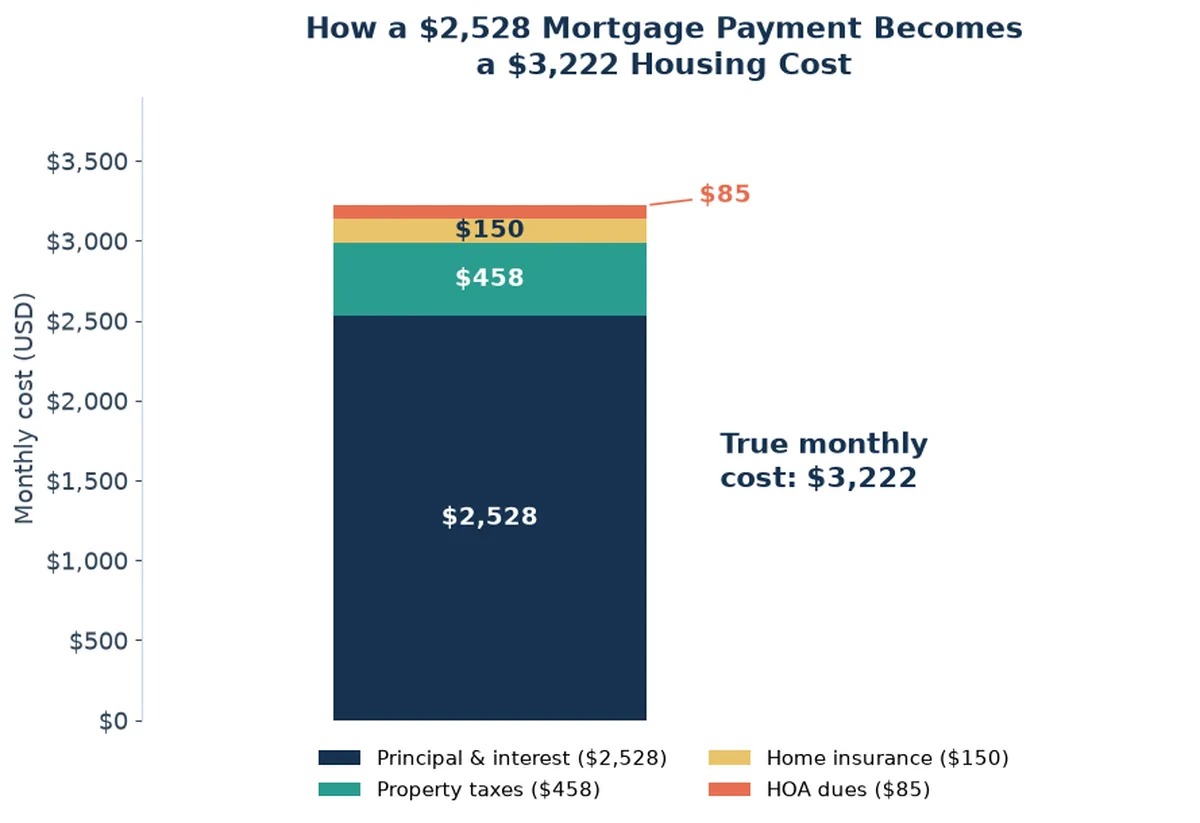
Stack the layers: $2,528 + $458 + $150 + $85 HOA = $3,222. This — not the $2,528 a lender quote headlines — is the number that must fit your budget, and the number investors subtract from rent.
7. Stress-test before you offer
Recalculate the payment at a rate 1–2 percentage points higher. In variable-rate markets (UK, Australia) or renewal markets (Canada), this isn't pessimism — it's what regulators themselves require. If the stressed payment still fits your budget with room to save, the home is genuinely affordable. If it doesn't, adjust the price range, not the stress test.
Do steps 1–6 by hand once — it takes five minutes and builds permanent intuition. Then use calculators for speed and scenario comparison. Understanding the formula is what lets you spot a lender quote or online estimate that doesn't add up.
Worked examples: from formula to full monthly cost
Theory becomes useful only when it survives contact with real numbers. Here are three complete examples — a typical US purchase, a Canadian purchase with a stress test, and a UAE expat purchase — plus the sensitivity tables that show how rates and terms move the payment.
Example 1: A$200,000 home in the United States
Assume a $500,000 purchase price, 20% down ($100,000), a $400,000 loan at 6.5% fixed for 30 years, a 1.1% effective property-tax rate, a $1,800 annual insurance premium, and $85 monthly HOA dues.
Building the full monthly payment — US example
M = P × r (1+r)ⁿ ÷ ((1+r)ⁿ − 1), P= $400,000, r= 0.065/12, n= 360
The mortgage payment is $2,528 — but the home costs $3,222 a month, 27% more. A buyer who budgeted against the headline payment alone would feel a $694 monthly shortfall from day one. And the first payment is almost entirely interest: of that first $2,528, roughly $2,167 is interest and only $362 reduces the balance.
Example 2: An $800,000 home in Toronto, Canada
Canadian mortgages work differently in two ways that matter for payment math: rates are typically fixed for only 1–5 years within a 25-year amortization, and federally regulated lenders must qualify you at the higher of your contract rate plus 2 percentage points, or 5.25% — the OSFI stress test. Assume an $800,000 CAD purchase with 20% down ($160,000), a $640,000 loan at 4.9% fixed for 5 years, amortized over 25 years, and a 0.64% effective property-tax rate (Toronto's mill rate is comparatively low, though price levels are high).
- Contract payment: M with P = $640,000, r = 0.049/12, n = 300 →$3,704/month principal and interest.
- Property taxes: $800,000 × 0.64% ÷ 12 ≈$427/month.
- Full monthly cost (before utilities):≈$4,131.
- Stress-test qualification: the lender must test affordability at 6.9% (4.9% + 2%), which implies a payment of roughly $4,480/month. If your income supports $3,704 but not $4,480, the application fails even though you'd never actually pay the higher figure at the contract rate.
This is why Canadian buyers must compute two payments: the one they'll make and the one they're qualified against. Buyers putting less than 20% down also pay CMHC mortgage-default insurance (0.6–4.0% of the loan, typically added to the principal), which raises every subsequent payment — see Is a 20% Down Payment Required? What Buyers Actually Needfor the trade-offs.
Example 3: An AED 2,100,000 apartment in Dubai, UAE
Dubai purchases add a wrinkle: there is no annual property tax, but towers levy service charges per square foot that behave like one. Assume a AED 2,100,000 apartment with 30% down (the common expatriate minimum for a first property is 20–25%; 30% keeps the example conservative), a AED 1,470,000 loan at 4.99% fixed for 25 years, building insurance of AED 2,400/year, and service charges of AED 18/sq ft on a 1,100 sq ft unit.
- Principal & interest: M with P = AED 1,470,000, r = 0.0499/12, n = 300 → ≈AED 8,585/month.
- Insurance: AED 2,400 ÷ 12 =AED 200/month.
- Service charges:1,100 sq ft × AED 18 ÷ 12 =AED 1,650/month.
- True monthly cost:≈AED 10,435 — about 22% above the loan payment alone.
Buyers should also budget for one-off costs like the 4% Dubai Land Department transfer fee — covered in Closing Costs Explained: What Home Buyers Actually Pay — but those don't affect the monthly figure. The lesson generalizes: every market has a recurring cost hiding outside the loan payment. Your job is to find it and price it.
How the interest rate moves the payment
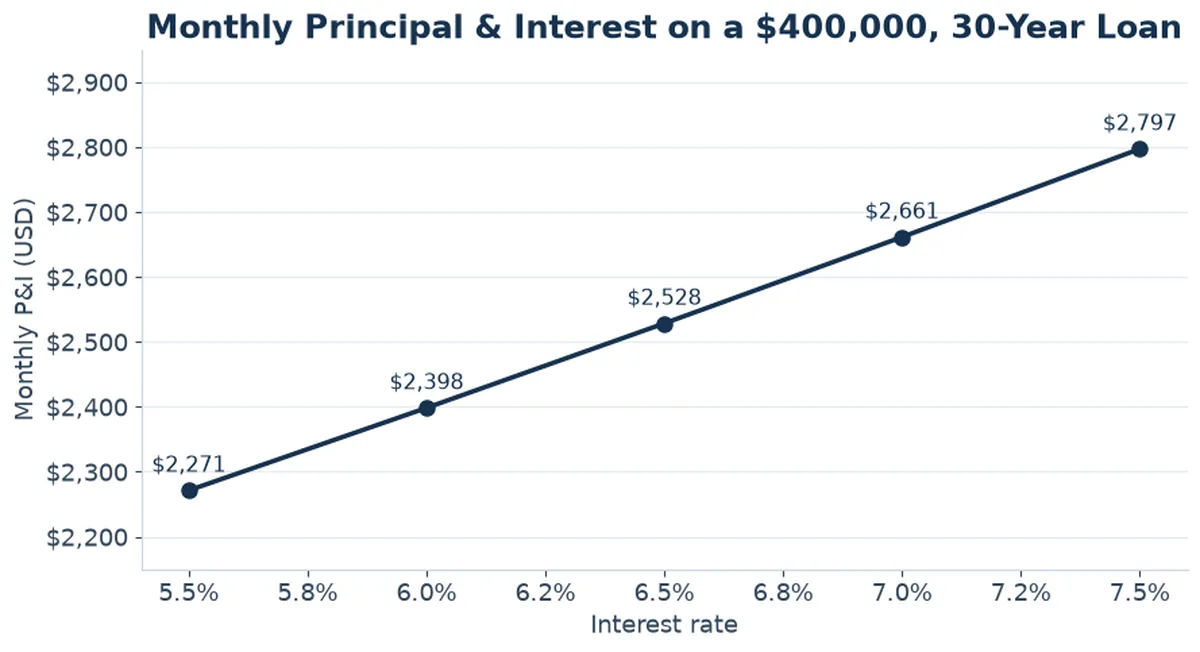
Holding the US loan constant ($400,000, 30 years), each half-point of rate changes the payment by roughly $125–$135 a month:
Monthly principal & interest on a $400,000, 30-year loan, by rate
Two points of rate — 5.5% to 7.5% — cost $526 more every month and nearly $190,000 more over the loan's life. This is the arithmetic behind rate shopping, discount points, and lock timing.
How the term moves the payment (and total interest)
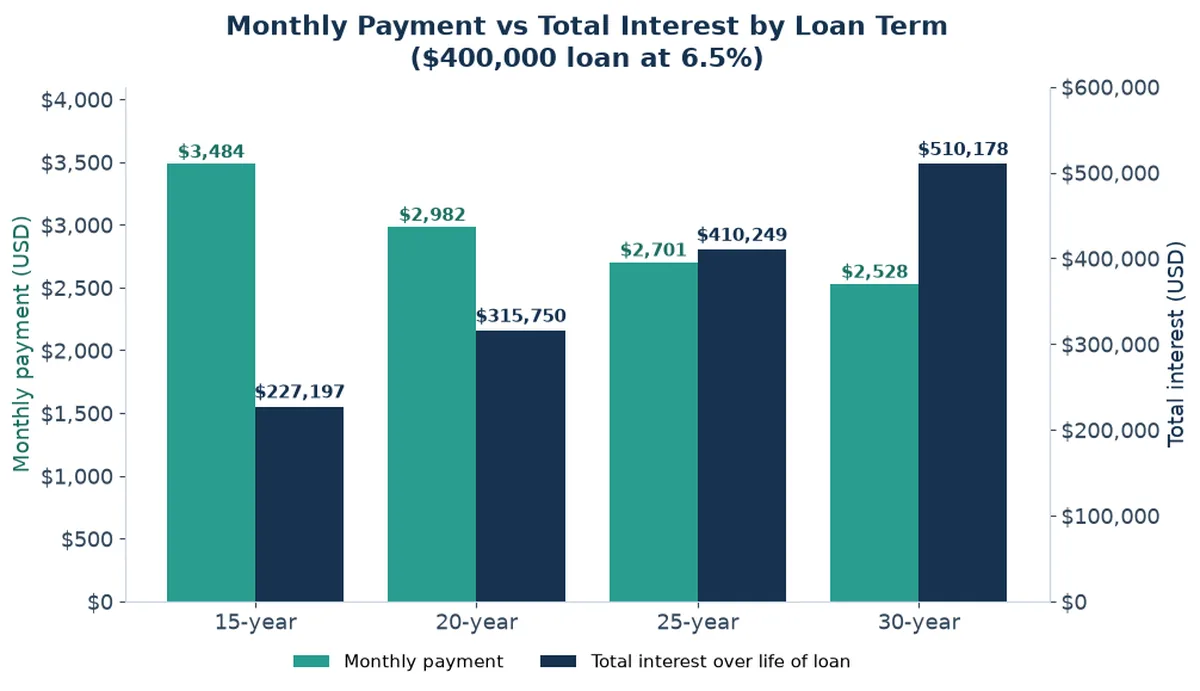
Same loan, different terms — $400,000 at 6.5%
The 15-year term costs $956 more per month but saves $282,981 in interest versus the 30-year. There's no universally "right" answer — the shorter term is forced savings, the longer term is flexibility. Many buyers take the 30-year and prepay voluntarily; the discipline is what matters.
Where your money actually goes: the amortization reality check
The amortization schedule explains why homeowners feel like they "pay forever and own nothing" in the early years. On the US example loan, after five years — 60 payments totalling $151,696 — the balance has fallen only to $374,444. You've paid down just $25,556 of principal; the other $126,140 was interest. The crossover point, where more of each payment goes to principal than interest, doesn't arrive until around year 19–20 on a 30-year loan at 6.5%.
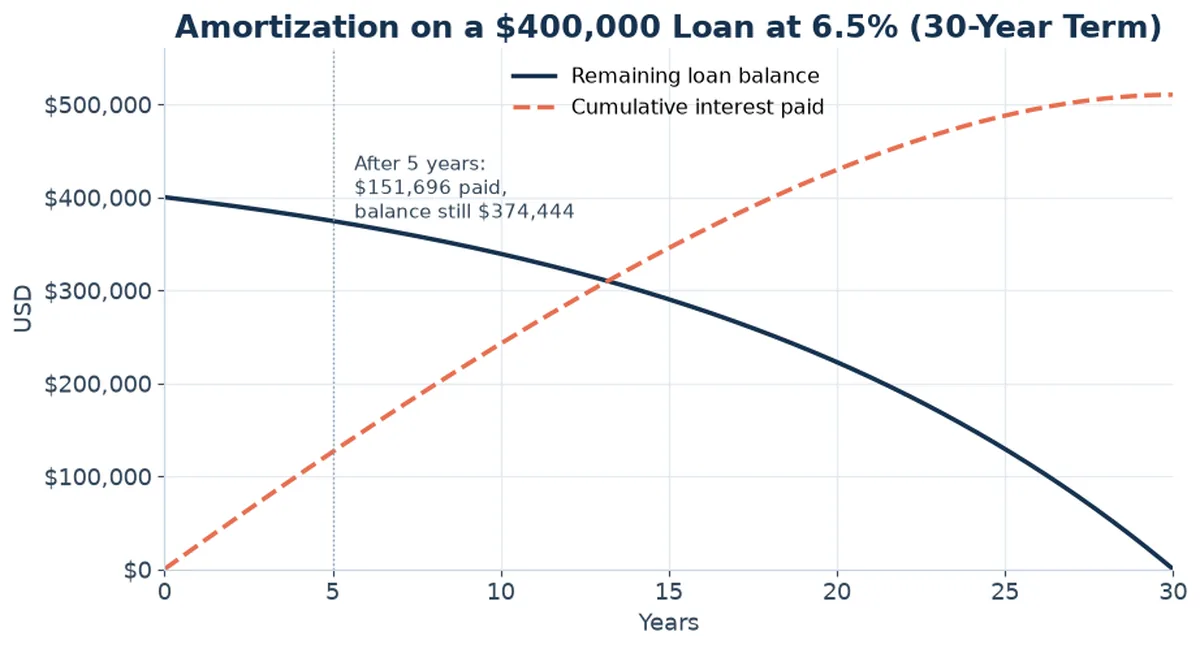
The flip side is powerful: because early interest is calculated on the full balance,extra principal payments in the early years are disproportionately effective. Adding just $200 a month to the US example payment pays the loan off about 5.6 years early and saves roughly $111,892 in interest. You can model your own extra-payment scenarios in seconds with an amortization schedule calculator.
Every figure in this section was computed with the standard amortization formula and cross-checked programmatically. Currency figures are rounded to the nearest whole unit; local tax rates and premiums are illustrative — always substitute your property's actual numbers.
Tier-1 market nuances: same formula, different rules
The payment formula is universal, but the surrounding machinery — rate structure, taxes, insurance, and qualification rules — differs meaningfully across the markets LashkariProperties readers buy in. Here's what changes the math in each.
- Fixed for the full term. The 30-year fixed rate is the national default, so the payment you calculate today is the payment you keep (taxes and insurance aside).
- Escrow is standard. Most lenders collect taxes and insurance monthly into escrow and recalculate annually — expect a small payment adjustment each year even on a fixed loan.
- PMI below 20% down. Private mortgage insurance (typically 0.3–1.5% of the loan per year, depending on credit and LTV) is added to the monthly payment but can be cancelled once you reach 20% equity on conventional loans. FHA loans carry MIP with different, often lifetime, rules.
- Tax rates are hyper-local. Effective property-tax rates range from under 0.4% in some states to over 2% in parts of New Jersey, Texas, and Illinois — a swing of nearly $700/month on a $500,000 home.
- Fix for 2–5 years, then re-fix. Most UK borrowers fix for a short initial period; the payment you compute applies only until the deal ends. Always model the reversion or your expected re-fix rate, not just the teaser.
- 25-year terms are the norm, though 30–35-year terms have become common for first-time buyers stretching affordability.
- Council tax is paid by the occupant, not escrowed by the lender — it won't appear in your mortgage payment but absolutely belongs in your monthly housing budget (typically £120–£350/month depending on band and local authority).
- Leasehold adds recurring costs: ground rent and service charges on flats can run £1,500–£4,000+ per year in city developments. Lenders assess these in affordability, so should you.
- Affordability stress: lenders test whether you could still pay at a rate typically around 3 points above the reversion rate, per Bank of England / FCA framework rules.
Canada
- Short fixes inside long amortizations: as Example 2 showed, expect to renew — and re-price — your rate several times within a 25-year amortization. Payment risk lives at renewal, not origination.
- The federal stress test (the higher of contract + 2% or 5.25%) applies to most borrowers, including renewals with a new lender. Compute both payments before shopping.
- CMHC insurance below 20% down is usually rolled into the principal rather than paid monthly — your payment rises because P rises, and the premium is not removable later.
- Interest is compounded semi-annually by lawon fixed mortgages, which makes the effective monthly rate a hair lower than annual ÷ 12. Online Canadian calculators handle this automatically; by-hand estimates will be very slightly conservative.
Australia
- Variable rates dominate. Most Australian loans float with the RBA cash rate, so the payment is a moving target — the stress test in Step 7 is essential, not optional. APRA requires lenders to assess serviceability at a buffer (currently 3 percentage points) above the loan rate.
- 30-year terms are standard.
- Offset accounts change the math: savings parked in an offset reduce the balance interest is charged on, without changing the contractual payment — a uniquely Australian (and partly British) feature worth modelling.
- LMI below 20% deposit (Lenders Mortgage Insurance) protects the lender, not you, and is usually capitalised into the loan like Canada's premium.
- Council rates and strata fees sit outside the loan payment; strata on apartments can rival UAE service charges.
- Shorter fixes, then EIBOR-linked variables: introductory fixed periods of 1–5 years typically reprice against benchmark rates, so model the post-fix payment.
- 25-year maximum terms and caps on loan-to-value (around 75–80% for expatriate first homes, lower for subsequent properties) shape the principal before the formula even runs.
- No annual property tax — but service charges per square foot act as a de facto one, and vary enormously between buildings (AED 10–30+/sq ft/year). Two identical apartments in different towers can differ by hundreds of dollars a month.
- Debt-burden ratio cap: UAE Central Bank rules generally limit total monthly debt repayments to around 50% of income.
Tax rates, insurance requirements, LTV caps, and stress-test rules change frequently and vary by emirate, province, state, or council. Treat the figures above as structure, not gospel, and confirm current rules with your lender, conveyancer, or regulator before relying on them.
Common mistakes and myths about mortgage payments
Mistake 1: Budgeting against principal & interest only
The most expensive error is also the most common. As Example 1 showed, taxes, insurance, and dues added 27% to the headline payment. Every affordability decision should be made against full PITI plus recurring fees — or, better, against total housing cost including utilities and a maintenance reserve (a common rule of thumb: 1% of the home's value per year).
Mistake 2: Dividing the annual rate by 12 in the wrong place
By-hand calculators frequently plug the annual rate into the formula where the monthly rate belongs, or use n = years instead of n = payments. Both errors produce payments wildly off — often an order of magnitude. Convert first (Step 2), compute second (Step 3), always.
Mistake 3: Confusing the interest rate with the APR
The note rate drives the payment formula. The APR (or APRC in the UK, comparison rate in Australia) bundles fees into an annualized cost for comparing loans — it should never enter the payment calculation. Two loans can share a note rate and have very different APRs.
Myth: "A bigger down payment always saves money"
A larger down payment shrinks P and therefore the payment — but it also concentrates capital in an illiquid asset. At the margin, the question is whether avoiding PMI and interest beats the alternative use of the cash, given your emergency fund and risk tolerance. The math, not the mantra, should decide; see Is a 20% Down Payment Required?
Mistake 4: Ignoring the renewal (or re-fix) payment
In Canada, the UK, Australia, and the UAE, the payment you calculate at origination is temporary. Buyers who budget to the limit at the teaser rate discover at renewal that their payment can jump hundreds of dollars. Always run Step 7 at a realistic future rate, not an optimistic one.
Mistake 5: Assuming escrow means "handled forever"
Escrow accounts are recalculated annually. Rising assessments, tax-rate increases, and insurance premium hikes (which have been steep in many US states) flow straight into your monthly payment, sometimes with an escrow-shortage catch-up on top. Review the annual escrow statement; don't just file it.
Mistake 6: Forgetting the payment is front-loaded with interest
Sellers who move within five years are often shocked at how little equity the loan itself has built — $25,556 after five years in Example 1. If you expect to sell quickly, closing costs plus slow amortization can erase modest price gains. Run the schedule before assuming a short hold works.
Myth: "Extra payments don't matter at low balances"
Actually, extra principal matters most exactly when the balance is high. Because each month's interest equals balance × r, every dollar of principal removed early eliminates interest on itself for decades. The $200/month prepayment in our example saved $111,892 — nearly 44% of it in the first ten years' worth of avoided interest.
How the payment connects to other property metrics
The monthly payment is the hub; these are the spokes. Mastering the connections is what separates buyers who react from buyers who decide.
Loan-to-value (LTV)
LTV = loan ÷ property value. It determines your rate band, whether mortgage insurance applies, and — in Canada, Australia, and the UAE — whether you're even eligible for the loan. Because P sits inside both LTV and the payment formula, one down-payment decision moves everything at once. Full explainer: What Is LTV Ratio and Why Lenders Care.
Debt-to-income (DTI) and affordability
DTI divides your full PITI (plus other debts) by gross income — the exact number this article teaches you to build. That's why payment mathprecedesaffordability math: you can't compute the ratio without the payment. Framework: How Much House Can I Afford?
Amortization and equity
The amortization schedule converts your fixed payment into a month-by-month equity build. It's the tool for answering "how much will I still owe in year 7?", "when does PMI drop off?", and "what does $300 extra per month actually buy me?" — questions every owner asks eventually.
Cash flow and rental yield (investors)
Gross yield ignores the payment entirely; net cash flow subtracts it. A 7% gross yield evaporates quickly once PITI, management, maintenance, and vacancy are deducted. Investors should compute the payment at purchase price and at renewal-rate scenarios before modelling any yield.
Rent vs. buy
The entire rent-vs-buy decision reduces to comparing full monthly housing cost (PITI + maintenance − principal build-up) against rent, adjusted for time horizon. The payment calculation is half of that comparison: Rent vs Buy: A Numbers-First Decision Framework.
Run the numbers: free calculators that do the heavy lifting
Doing the formula by hand builds understanding; calculators build speed and scenario depth. LashkariProperties maintains a free suite designed to mirror each layer of this article — no sign-up, no email gate:
- Mortgage calculator— enter price, down payment, rate, and term to get the monthly principal-and-interest payment instantly. Use it to replicate Examples 1–3 with your own numbers.
- EMI calculator — the same amortizing-payment math in equated-monthly-installment form, handy for markets (and lenders) that quote loans as EMIs.
- Amortization schedule calculator — generates the full month-by-month table: principal vs. interest per payment, remaining balance, equity build, and the effect of extra payments. This is the fastest way to find your PMI-removal date or model prepayment strategies.
- Housing cost calculator — stacks the payment with taxes, insurance, HOA/service charges, utilities, and maintenance into one true monthly cost — the exact number this article argues you should budget against.
A practical workflow: (1) hand-calculate the payment once to anchor your intuition; (2) verify it in the mortgage calculator; (3) open the amortization schedule to see the five-year balance and prepayment effects; (4) finish in the housing cost calculator to produce the all-in monthly figure you'll actually budget and compare against rent or against your income. Browse the full suite at LashkariProperties Tools.
Verify your own payment in 60 seconds
Plug your price, rate, and term into the free tools and compare the result against any lender quote you've received.
Actionable framework: the pre-offer payment checklist
Run this before making any offer. It takes under ten minutes per property and will catch every common payment mistake in this article.
- Compute P:purchase price minus your actual (liquid) down payment — not the price.
- Convert and compute: monthly rate r = annual ÷ 12; payments n = years × 12; apply M = P × r (1+r)ⁿ ÷ ((1+r)ⁿ − 1).
- Verifythe result in the mortgage calculator — numbers should match to the dollar.
- Pull the real tax bill for the specific property (listing history, county assessor, council band) — never a national average.
- Price insurance with an actual quote, especially in high-risk zones (flood, wildfire, hurricane).
- Add recurring fees: HOA, condo, strata, service charges, ground rent — ask for the current annual figure in writing.
- Include mortgage insurance if your down payment is below the local threshold; note whether it's monthly or capitalized.
- Sum full PITI + fees and compare against 28% of gross income as a first-pass ceiling — then against your own budget, which is the real ceiling.
- Stress-test at contract rate + 1–2 points (mandatory in Canada, effectively required in the UK, Australia, and the UAE).
- Check the five-year balance in the amortization schedule if you might sell or refinance within seven years.
- Model one prepayment scenario (e.g., +$200/month) so you know the value of future flexibility.
- Document the all-in number and compare every shortlisted home on true monthly cost — not price.
Frequently asked questions
What is the formula for calculating a mortgage payment?
The standard fixed-rate formula is M = P × r (1+r)ⁿ ÷ ((1+r)ⁿ − 1), where M is the monthly principal-and-interest payment, P is the loan principal, r is the monthly interest rate (annual rate ÷ 12), and n is the total number of monthly payments (years × 12).
How much is the monthly payment on a $400,000 mortgage?
At a 6.5% fixed rate over 30 years, principal and interest is about $2,528/month. Adding typical property taxes (~$458) and homeowners insurance (~$150) brings the full monthly housing cost to roughly $3,100–$3,200 before any HOA dues.
Principal, Interest, Taxes, and Insurance — the four components of most monthly mortgage payments. Principal and interest repay the loan; property taxes and homeowners insurance are usually collected monthly into an escrow account.
How do I calculate principal and interest on a mortgage?
Divide the annual rate by 12 for the monthly rate, multiply the term in years by 12 for the payment count, then apply the formula M = P × r (1+r)ⁿ ÷ ((1+r)ⁿ − 1). The result is the combined monthly principal-and-interest payment; the internal split changes every month as the balance falls.
How much of my first mortgage payment goes to principal?
Very little at first. On a $400,000 loan at 6.5%, only about $362 of the first $2,528 payment (≈14%) reduces the principal; the other $2,167 is interest. The principal share grows every month, crossing 50% only around year 19–20 on a 30-year term.
How does the interest rate affect my monthly payment?
Each percentage point is significant. On a $400,000, 30-year loan, moving from 6.0% to 7.0% raises monthly principal and interest from about $2,398 to $2,661 — roughly $263 more per month and about $95,000 more in total interest over the full term.
A table showing every payment over the life of the loan, split into principal and interest, with the remaining balance after each payment. It reveals how interest-heavy early payments are and quantifies the payoff impact of extra payments.
It depends on cash flow and discipline. On a $400,000 loan at 6.5%, a 30-year term costs $2,528/month and $510,178 total interest, while a 15-year term costs $3,484/month but only $227,197 interest — a saving of about $282,981. A common middle path: take the 30-year for flexibility and prepay voluntarily.
Do property taxes change my monthly mortgage payment?
Yes, when taxes are escrowed. Lenders recalculate the escrow portion annually, so reassessments and rate changes raise (or occasionally lower) your total payment even on a fixed-rate loan. Insurance premium increases flow through the same mechanism.
How can I lower my monthly mortgage payment?
The main levers: a larger down payment (smaller P), a lower rate (credit improvement, discount points, or lender shopping — even 0.25% matters), alonger term (lower payment, more total interest), and removing mortgage insurance at 20% equity. Buying a less expensive home lowers every layer simultaneously.
What is the difference between a mortgage payment and total housing cost?
The mortgage payment covers principal and interest only. Total housing cost adds property taxes, insurance, mortgage insurance, HOA/strata/service charges, utilities, and maintenance — typically 20–40% more than the mortgage payment alone. Budget against the total.
How do lenders decide how much I can borrow?
Most use debt-to-income limits: the common US guideline is28/36 (housing ≤ 28% of gross income, total debt ≤ 36%). Canada applies a stress test at the higher of contract + 2% or 5.25%; the UK and Australia use affordability buffers (often ~3 points) above the pay rate; the UAE caps total debt service around 50% of income.
Conclusion and next steps
You now have everything required to deconstruct any mortgage offer in any Tier-1 market: the universal formula (M = P × r (1+r)ⁿ ÷ ((1+r)ⁿ − 1)), the seven-step process that stacks taxes, insurance, and fees into a true monthly cost, worked examples you can replicate, and a checklist that fits on an index card. The buyers who negotiate best aren't the ones with the most cash — they're the ones who know, to the dollar, what a home will cost them each month and what happens to that number if rates move.
Three concrete next steps. First, take a property you're actually considering and run it through the checklist above — by hand once, then in the mortgage calculator and housing cost calculator to verify every layer. Second, open the amortization schedule calculator and find your five-year balance and your prepayment scenario — those two numbers change how you think about the loan. Third, set your price ceiling from the stressed payment, not the teaser payment, and let that ceiling — not the market's excitement — drive your offer.
From here, the natural follow-on reads are How Much House Can I Afford? for the income side of the equation and Closing Costs Explainedfor the one-off costs that sit alongside your new monthly payment. You'll find more guides like this in our Buying Guidescategory.
LashkariProperties is a free property-tools platform that helps buyers, investors, landlords, and renters run the numbers before they commit. Our guides pair transparent, replicable math with free calculators — every worked example on this page can be reproduced with the tools linked throughout.
Keep reading
How Much House Can I Afford? A Practical Numbers Framework
Set your ceiling from income and DTI before you shop — the other half of the affordability equation.
Is a 20% Down Payment Required? What Buyers Actually Need
How down-payment size moves your payment, your rate, and your mortgage insurance.
What Is LTV Ratio and Why Lenders Care
The ratio that decides your rate band, insurance requirement, and loan eligibility.
Rent vs Buy: A Numbers-First Decision Framework
Compare true monthly housing cost against rent, adjusted for time horizon.
Disclaimer: This article is for general educational purposes only and does not constitute financial, tax, legal, or investment advice. Interest rates, tax rules, insurance costs, and lending regulations vary by jurisdiction and change over time; the figures in worked examples are illustrative. Consult a licensed mortgage professional, tax adviser, or conveyancer in your market before making any purchase or borrowing decision. No investment returns are promised or implied.
Sources & further reading
- Consumer Financial Protection Bureau (CFPB) — Owning a Home (US mortgage payments, escrow, and loan estimates)
- Federal Reserve — Mortgage & Foreclosure Resources
- OSFI — Guideline B-20: Residential Mortgage Underwriting (Canada stress test)
- Bank of England — Mortgage affordability rules
- APRA — Loan serviceability buffer (Australia)
- Central Bank of the UAE — Banking regulations (mortgage LTV & debt-burden caps)
- Reserve Bank of Australia — Cash rate and lending context
Sources
- CFPB — What is included in a mortgage payment
- Consumer Financial Protection Bureau — Mortgage Payment Calculator
Related reading
Continue reading: The 28/36 Rule: Still Useful in 2026? · Closing Costs Explained for Buyers · Debt-to-Income Ratio for Home Buyers. Run your own numbers with the Free Mortgage Calculator — it takes under a minute and beats guessing.
Frequently asked questions
How is a mortgage payment calculated?
Lenders take the loan amount, divide the annual rate into monthly installments, and amortise it over the term, producing a fixed principal-and-interest payment. Taxes and insurance are added on top as separate lines.
What is the mortgage payment formula?
The standard amortising formula combines the loan amount, monthly rate, and number of months into a single payment: M = P[r (1+r)^n] / [(1+r)^n - 1]. The Mortgage Calculator does the arithmetic and adds tax, insurance, and fees for the true housing cost.
What is included in my monthly mortgage payment?
Up to five pieces: principal, interest, property taxes, homeowners insurance, and mortgage insurance if your deposit is thin. The listing price is irrelevant to lenders; the monthly payment is the number that decides everything.
How do property taxes and insurance change the monthly payment?
Most lenders collect them inside your payment through an escrow account, adding the annual tax and insurance premium divided by 12. On a $300,000 loan, taxes of $3,600 and insurance of $1,200 a year add $400 to a payment that might otherwise be $1,800. Escrow payments can rise every year when assessments go up, which is why your monthly bill can change even with a fixed interest rate.