


What Stamp Duty actually is
Stamp Duty Land Tax (SDLT) is a tax charged by HMRC on purchases of land and property in England and Northern Ireland. Scotland charges its own Land and Buildings Transaction Tax (LBTT) and Wales charges Land Transaction Tax (LTT)— three different taxes with the same purpose but different bands and reliefs. When people say "stamp duty" they usually mean SDLT.
SDLT is charged on the purchase price (technically, the chargeable consideration),noton the mortgage. It is due within14 days of completion and — in practice — is filed and paid on your behalf by your conveyancing solicitor using cleared funds from your buying account.
Two design choices in SDLT trip almost every buyer up:
- It is marginal, not flat — each slice of the purchase price is taxed at its own band rate, like income tax.
- Your buyer status changes the table entirely: a first-time buyer, a home mover, an investor and a non-resident each read different rows.
Fast definition
SDLT = the sum of (each price slice × that slice’s band rate), plus surcharges if any apply. The result depends on the price, whether you are a first-time buyer, whether you will own another home afterwards, and your UK-residence status.
A brief history of SDLT — and why it keeps changing
Stamp duty in the UK is one of the oldest taxes still in operation. It began as a literal stamp on legal documents introduced in 1694 to fund war with France, and for three centuries it applied to a broad range of transactions from newspapers to playing cards. Modern Stamp Duty Land Taxin its current form dates from December 2003, when Gordon Brown replaced the old document-based stamp duty with a transaction tax specifically on land and property. The current progressive, banded structure — where each slice of price is taxed at its own rate — arrived only in 2014, when George Osborne's Autumn Statement replaced the old "slab" system that had produced brutal cliff edges at every threshold.
Since then SDLT has been rewritten repeatedly. The3% additional-property surcharge arrived in April 2016.First-time buyer relief was introduced in November 2017 and expanded in 2022. The2% non-UK-resident surcharge followed in April 2021. A pandemic-era stamp duty "holiday" temporarily lifted the nil-rate threshold to £500,000 from July 2020 through September 2021, driving one of the hottest transactional markets on record. In September 2022 the mini-Budget nudged thresholds up again — most of which survived — before the October 2024 Budget raised the additional-dwelling surcharge from 3% to 5%, and the April 2025 changes returned the nil-rate band to £125,000 and the FTB threshold to £300,000.
Two lessons follow. First,SDLT is politically volatile. Rates change on average every 18–24 months, often with only weeks of notice and usually taking effect at a completion date the government controls. Second,old advice is dangerous advice: a blog post written in 2023, however well-crafted, is now materially wrong on nil-rate bands, on surcharges and on first-time-buyer thresholds. Always confirm against a current source — either GOV.UKor a calculator maintained to the same rate table.
Design intent
The Treasury uses SDLT as a lever, not just as a revenue tool. The additional-property surcharge is designed to cool investor demand; first-time buyer relief is designed to warm the entry level; the non-resident surcharge is designed to price in domestic priority. When you read a Budget headline about SDLT, ask which lever is being pulled — the market response often follows the intent.
Why the bands catch buyers out
For a typical £500,000 UK purchase, SDLT is the second-largest cash line item after the deposit. Yet many buyers only look it up once — usually the week they exchange contracts — by which point it is far too late to influence the price they offer, their mortgage size, or their remaining cash buffer.
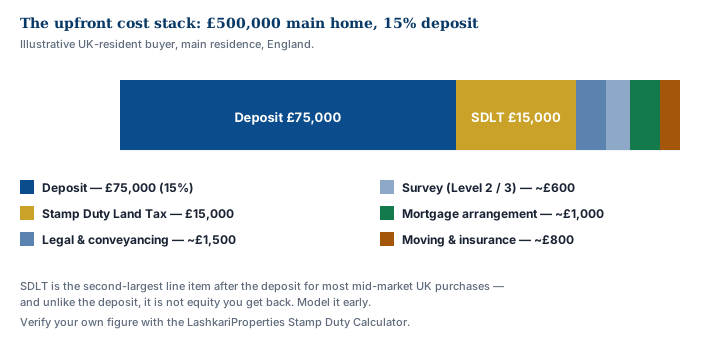
Beyond the cash impact, SDLT changes buyer behaviour: it warps offers around band thresholds, it makes the timing of your previous sale worth thousands, and — for investors — it can turn a marginal buy-to-let into a loss-maker on day one. Understanding the bands is a genuine investing skill, not just tax admin.
Best practice
Model your SDLTbefore you make an offer, not after your solicitor emails you a completion statement. Use it to set your maximum bid — including a stress test at £5,000 above your ideal price.
Residential SDLT rates for 2026
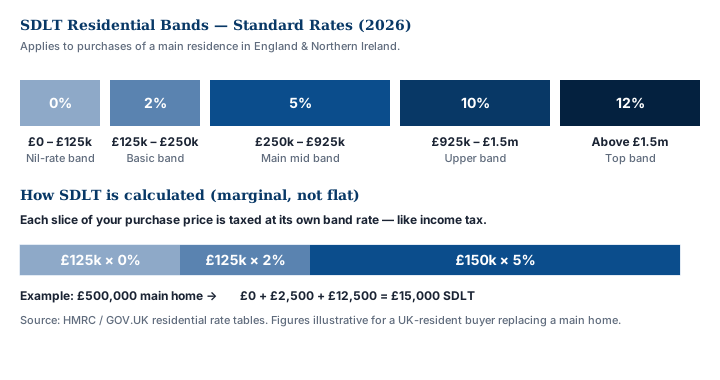
The HMRC residential band table below applies to a UK-resident buyer purchasing a home in England or Northern Ireland that will be their only residential property (or that replaces their existing main home). Rates reflect the changes that took effect on 1 April 2025.
| Price band | Rate |
|---|---|
| Up to £125,000 (nil-rate band, returned to £125k on 1 April 2025) | 0% |
| £125,001 to £250,000 | 2% |
| £250,001 to £925,000 | 5% |
| £925,001 to £1,500,000 | 10% |
| Above £1,500,000 | 12% |
Because SDLT is marginal, a £250,000 purchase pays £2,500 (0% + £125,000 × 2%), not £5,000, and a £250,001 purchase pays only 5p more — not "5% of the whole lot". This is the single most common misconception in the market.
Watch out
The pre-April 2025 temporary nil-rate band of £250,000 has ended. Buyers relying on old blog posts, screenshots or estate-agent PDFs may still see the outdated £250,000 threshold — always verify against HMRC or a current calculator before you offer.
First-time buyer relief
A qualifying first-time buyer reads a different table. To qualify you must:
- Never have owned a freehold or leasehold interest in any residential property anywhere in the world (individually or jointly).
- Intend to occupy the property as your only or main residence.
- Pay a purchase price of £500,000 or less — above that, the relief is lost entirely and standard rates apply.
| Price band | Rate |
|---|---|
| Up to £300,000 | 0% |
| £300,001 to £500,000 | 5% |
| Above £500,000 | Relief lost entirely — standard rates apply |
The relief is generous but binary: buying at £500,000 pays £10,000 SDLT (0% + £200,000 × 5%), while buying at £510,000 pays £15,500 under standard rates —£5,500 extra tax for £10,000 more house. This is the classic cliff-edge that pulls transactions into the £490,000–£500,000 band on Zoopla and Rightmove.
Definition — "First-time buyer"
HMRC's test is stricter than the everyday meaning. Even inheriting a share of a family home historically, or being named on an overseas property deed, can disqualify you. If in doubt, ask your solicitor to check before you rely on the relief in your budget.
The 5% additional-property surcharge
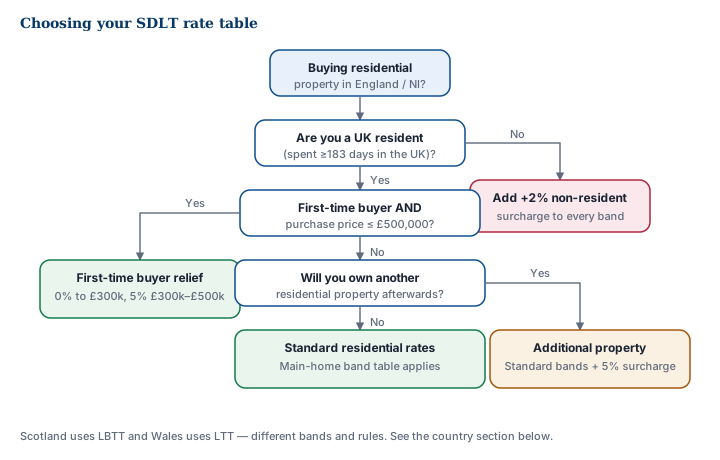
If, at the end of the day of completion, you (or your spouse/civil partner) will own two or more residential properties anywhere in the world and you are not replacing your main home, HMRC applies the higher-rate additional-dwelling surcharge (HRAD). The surcharge is a flat5%added to every SDLT band and applies whenever the additional purchase is £40,000 or more.
HRAD sits at 5% today because the government raised it from 3% to 5% at the Autumn Budget on 30 October 2024. Every buy-to-let, holiday let and second home purchased since then reads the surcharge column.
| Price band | Rate (standard band + 5% surcharge) |
|---|---|
| Up to £125,000 | 5% |
| £125,001 to £250,000 | 7% |
| £250,001 to £925,000 | 10% |
| £925,001 to £1,500,000 | 15% |
| Above £1,500,000 | 17% |
The "replacement of main residence" carve-out
If you are selling your existing main home on the same day you buy the new one, the surcharge does not apply — even if the transactions technically overlap by minutes. If your sale slips and you complete on the new home first while still owning the old one, the surcharge is due upfront, but you can reclaim it if you sell the old main residence within three years.
Common trap
Owning even a small share of another residential property — a buy-to-let inherited from a parent, or a co-owned holiday flat with a sibling — can trigger the 5% surcharge on your next main-home purchase if you buy before you dispose of it. Always disclose all property interests to your solicitor.
The 2% non-UK-resident surcharge
Since 1 April 2021 a2% non-UK-resident surcharge has applied to residential purchases by buyers who fail HMRC's residence test — broadly, spending fewer than 183 days in the UK in the 12-month period around the transaction. The 2% is added to every band and stacks with the 5% HRAD if it also applies.
For a non-UK-resident investor buying an additional dwelling above £1.5m, the top marginal SDLT rate is therefore: 12% (top band) + 5% (HRAD) + 2% (non-resident) = 19%.
Refund route for non-residents who move to the UK
If you subsequently spend at least 183 days in the UK in any continuous 365-day period beginning up to 364 days before, and ending 365 days after, the effective date of the transaction, you can typically reclaim the 2% surcharge from HMRC.
Other reliefs, exemptions & edge cases
Beyond first-time buyer relief and the surcharges, SDLT contains a long tail of reliefs and edge cases that account for a surprising share of real transactions. The following are the ones buyers actually encounter — not exhaustive, but enough to know when to ask a solicitor.
Multiple Dwellings Relief (MDR) — abolished
Multiple Dwellings Relief, which allowed buyers acquiring two or more dwellings in a single transaction to average the price for SDLT purposes, was abolished on1 June 2024 for the vast majority of transactions. Buyers who exchanged before that date but complete later can still claim it under transitional rules — a genuinely narrow window that continues to trip up investors relying on outdated tax planning.
Mixed-use property
Buildings that are part residential and part commercial — a flat above a shop, a working farm with a farmhouse — are charged at then on-residential SDLT rates, which are gentler than residential rates and which do not attract the 5% HRAD or the 2% non-resident surcharge. HMRC has, however, tightened the interpretation heavily since 2019 and challenges most mixed-use claims. Do not assume mixed-use treatment without a written opinion.
| Purchase price | Rate |
|---|---|
| Up to £150,000 | 0% |
| £150,001 to £250,000 | 2% |
| Above £250,000 | 5% |
Companies buying residential property
A residential purchase by a company or partnership above £500,000 is generally charged at a punitive flat17%under the "enveloped dwellings" rules — designed to discourage the historic use of corporate wrappers to sidestep SDLT and stamp duty on shares. Reliefs exist for genuine property-rental businesses and property developers, but the default is the flat 17% rate.
Transfers between spouses and on divorce
A transfer of property between spouses or civil partners for no consideration is not chargeable to SDLT. Property transfers pursuant to a court order on divorce or dissolution are similarly outside the scope. If any consideration is paid — including the assumption of mortgage debt — SDLT may apply on that amount.
Shared ownership and staircasing
Shared-ownership buyers can either pay SDLT on the market value of the whole property up front ("market value election") or pay in stages as they staircase up. The election locks in the current rate table, which can be an advantage or disadvantage depending on Budget cycles. First-time buyer relief is available for shared-ownership purchases where the full market value is £500,000 or less.
Uninhabitable property
A property that is genuinely uninhabitable — no working kitchen, no working bathroom, structurally unsafe — can be re-classified as non-residential for SDLT purposes, dropping the effective rate materially. The bar HMRC applies is high. Dilapidation, damp or a tired 1970s bathroom does not count; the property must objectively not be capable of use as a dwelling. Get evidence in writing from your surveyor before claiming.
Annexes and "granny flats"
A property containing a self-contained annex (typically for a family member) can qualify for treatment as a single dwelling if the annex fails a "subsidiary dwelling" test — broadly, its value is less than one-third of the total price. If it passes as a separate dwelling, the surcharge may apply to the whole transaction unless subsidiary-dwelling rules disapply it. This is worth a specific written opinion at the offer stage.
Chain-break refunds and the 3-year rule
A recurring theme in the reliefs above is that SDLT is not final on completion day. HMRC allows a refund of the 5% HRAD if the previous main home is sold within three years, and of the 2% non-resident surcharge if the buyer subsequently meets the 183-day test. Both refunds require an active claim within a fixed window — usually 12 months of the qualifying event. Diary the deadline; do not rely on your solicitor to chase.
How to calculate SDLT step by step
Every SDLT figure — from a £180,000 first flat to a £2.5m Belgravia townhouse — follows the same five-step method:
- Identify your buyer status. First-time buyer, replacing main home, additional dwelling, or non-resident? Combinations are possible.
- Select the correct band table. Use the standard, FTB, additional-property or non-resident table (or the appropriate combination).
- Slice the purchase price into the portions that fall inside each band.
- Apply each rate to its slice, add any surcharge percentages that apply to the whole price, and sum the components.
- Verify with a calculator. Cross-check against the LashkariProperties Stamp Duty Calculator.
"The bands aren't the hard part. The hard part is knowing which table to open — and that depends on who you are, not just what you're buying."
Six worked purchase examples
The examples below use current 2026 rates. All figures assume completion in 2026, England or Northern Ireland, and — unless stated — a UK-resident buyer. You can reproduce each of them exactly with the calculator link at the end.
Example 1 — First-time buyer, £280,000 flat
Amina, a UK-resident nurse, is buying her first flat in Nottingham for £280,000. She qualifies for first-time buyer relief because the price is under £500,000.
The standard-rate figure would have been £4,000 — the FTB relief saves Amina every penny of it.
Example 2 — Home mover, £425,000 house
Ben and Jo are selling their existing home in Leeds and buying a family house for £425,000 on the same day.
Effective rate: 2.65% of the purchase price.
Example 3 — Buy-to-let investor, £220,000 terrace
Priya, who already owns her home in Manchester, buys a £220,000 terrace in Sheffield to let out.
Effective rate: 5.86%. On a rental yield of £11,000/year, SDLT alone is more than the first year's gross rent — a real cash-flow drag.
Example 4 — Home mover, £750,000 semi
Chen and family are moving from a Reading flat to a £750,000semi-detached house in Twickenham.
Effective rate: 3.67%. SDLT alone equals roughly nine monthly mortgage payments on a typical loan.
Example 5 — Non-resident investor, £550,000 London flat
A Dubai-based investor buys a £550,000London flat as a buy-to-let. She already owns property overseas and does not meet the UK residence test.
Effective rate: 10.18%. Non-resident investors should build SDLT into gross yield calculations — it can flip a "5% yield" into a 3.5% net-of-tax return over the typical hold horizon.
Example 6 — Prime purchase, £1,600,000 townhouse
A returning expat purchases a £1,600,000 townhouse in Kensington after selling their previous London flat.
Effective rate: 6.61%. At this price point every £10,000 above the £1.5m threshold costs an extra £1,200 in SDLT — worth remembering when negotiating.
Cross-check tip
Recompute each example in the Stamp Duty Calculator. If your number differs by more than £1, revisit your buyer-status assumption — that's almost always the source of the discrepancy.
Negotiating around band thresholds
Because SDLT is banded, every threshold creates a genuine negotiation lever. It rarely makes sense to walk from a deal over £500 of stamp duty — but knowing how the bands warp behaviour on both sides of the table lets you write better offers.
The £250,000 pinch point
Because the rate jumps from 2% to 5% at £250,000, every £1,000 above the threshold costs £30 more in SDLT than every £1,000 just below it. Sellers price to £249,950 on Rightmove for exactly this reason. If you are offering just above the threshold, negotiating the price to £250,000 saves nothing (0.05p) but negotiating to £249,999 saves the same 0.05p — the marginal jump is smaller than intuition suggests. In practice, the real fight is over the headline asking price sellers use to attract viewers, not the £250,001 vs £250,000 difference.
The £500,000 FTB cliff edge
This is the sharpest threshold in the SDLT system. A first-time buyer at £500,000 pays £10,000. At £510,000, standard rates apply and SDLT is £15,500. Buying at £510,000 rather than £500,000 costs you £10,000 more for the house and £5,500 more in tax — an effective marginal rate of 155% on the first £10,000 above the cliff. Realistic negotiation targets: get the asking price to £500,000 exactly, or move up to a property where the extra house more than justifies the loss of relief (typically £520,000+).
The £925,000 and £1.5m thresholds
At £925,000 the marginal rate jumps from 5% to 10%; at £1.5m from 10% to 12%. For prime-market buyers these thresholds shape London and South East transaction prices visibly on Land Registry data — bunching just below the thresholds and thinning just above. If you are the buyer, the negotiating asymmetry is on your side above the threshold: the seller wants to avoid languishing in the price band just above it, so a firm offer at £924,000 often beats a hesitant offer at £940,000.
Practical technique
When you are within £15,000 of a band threshold on either side, write your offer as two lines:"Price: [X]. Fixtures & fittings: [Y] via separate contract."Chattels (curtains, carpets, freestanding appliances) can be sold separately at a fair value without attracting SDLT — HMRC scrutinises abusive allocations, but a genuine £3,000 for a kitchen table and freestanding fridge-freezer is defensible and can nudge you back below a threshold. Never inflate; HMRC will disallow, and your solicitor will refuse to file it.
Sequencing your sale and purchase
For upsizers replacing their main home, the biggest SDLT lever is sequence, not price. Complete the sale on the same day as the purchase and you never touch the 5% surcharge. Complete the purchase first, and you pay the surcharge upfront and reclaim it later — a cash-flow hit of tens of thousands of pounds you may need bridging finance to cover.
On a £750,000 upsize, completing on the same day saves £37,500 in upfront cash versus completing first and reclaiming — money you can deploy into deposit, renovation or reserves. Ask your solicitor to model the two scenarios on the completion statement before agreeing exchange dates.
Scotland (LBTT) & Wales (LTT)
The devolved administrations set their own bands. Buyers moving across the UK's internal borders — or investors comparing markets — should never assume SDLT rules travel with them.
Scotland — Land and Buildings Transaction Tax (LBTT)
The Additional Dwelling Supplement (ADS) for second homes and buy-to-lets in Scotland is8%on the whole price (raised from 6% on 5 December 2024).
Wales — Land Transaction Tax (LTT)
| Price band | Rate |
|---|---|
| Up to £180,000 | 0% |
| £180,001 to £250,000 | 3.5% |
| £250,001 to £400,000 | 5% |
| £400,001 to £750,000 | 7.5% |
| £750,001 to £1,500,000 | 10% |
| Above £1,500,000 | 12% |
Wales hasno first-time buyer relief — a deliberate policy choice, offset by a higher zero-rate threshold. Higher-rate LTT for additional dwellings starts at a minimum effective rate of 5% and rises through steeper bands to 17%.
Cross-border pitfall
The Welsh border runs through several commuter belts. If you view homes in Chester (England, SDLT) and Wrexham (Wales, LTT) in the same week, check both tax bills before comparing offers — a "cheaper" property across the border can carry a higher effective tax bill.
Tier-1 market context
UK stamp duty is often described as punishing by international standards. Compared with other Tier-1 property markets, the picture is more nuanced.
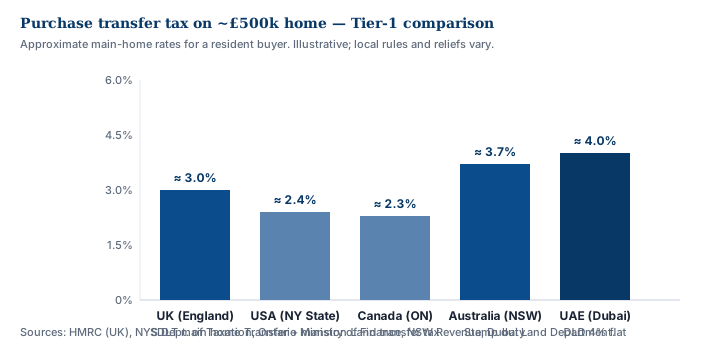
- USA (New York State): the state transfer tax is ~0.4%, plus a "mansion tax" of 1%+ on purchases above $1m and rising to 3.9% at $25m. On a £500k-equivalent home it lands around 2.4% — but property taxes are then far higher annually. See our USA buying guide.
- Canada (Ontario): combined provincial + Toronto land transfer tax reaches ~2.3% at £500k, with a 25% Non-Resident Speculation Tax on top for foreign buyers.
- Australia (New South Wales): stamp duty is progressive and roughly 3.7% at £500k, with a punitive surcharge for foreign buyers. Our Australia guide covers the state-by-state variation.
- UAE (Dubai): a flat 4% Dubai Land Department fee applies to every registered transaction, regardless of nationality, but there is no annual property tax and no capital gains tax.
- UK:~3.0% at £500k for a main-home mover, rising sharply above £925k and via the surcharges. First-time buyers pay materially less than in most Tier-1 peers up to £500k.
Themarginal UK rate is higher than most peers at the top end. But at first-time buyer prices under £500k, the UK is competitive — a nuance often lost in headline comparisons.
Common mistakes & myths
Myth 1 — "Stamp duty is a flat percentage"
It isn't. SDLT is marginal. If you see a headline like "5% stamp duty on a £500k home" the writer is quoting the top band, not the effective rate — which is 3.0% on that price.
Myth 2 — "I can add stamp duty to my mortgage"
Technically you cannot add SDLT to the loan directly — it has to be paid to HMRC from cleared funds within 14 days of completion. What youcando is borrow a slightly higher amount (subject to affordability and loan-to-value) and use the extra deposit-side cash to pay the tax. Model both routes in the Mortgage Calculator: financing SDLT over a 25-year term at 5% roughly doubles its lifetime cost.
Myth 3 — "The additional-property surcharge only applies to buy-to-lets"
The 5% surcharge applies whenever the purchase means you own two or more residential properties at the end of the day and are not replacing your main home. Holiday cottages, unwanted inheritance shares, or a UK flat kept while you rent abroad can all trigger it.
Myth 4 — "First-time buyers never pay SDLT"
The relief disappears entirely above £500,000. A first-time buyer purchasing at £520,000 pays £15,500 — the same as any other buyer. There is no tapered version.
Myth 5 — "I can avoid the surcharge by putting the property in my child's name"
HMRC treats spouses and minor children as a single unit for the surcharge, and lenders will not offer mortgages on beneficial-interest schemes designed to sidestep it. Aggressive avoidance schemes fail regularly. If you want to buy for a child, use a joint borrower / sole proprietor mortgage and take advice from a qualified tax adviser first.
Warning — this is educational content
This article does not constitute personal tax, legal or financial advice. SDLT interacts with your wider tax position (including capital gains, income tax and inheritance tax) in ways that depend on your circumstances. Always consult a qualified UK solicitor and a tax adviser before completion.
The investor's lens: SDLT and yield
For buy-to-let investors, SDLT is not a one-off cost — it is a first-day depreciation of the balance sheet. Every additional-property purchase in England or Northern Ireland today includes an implicit 5% loss on the price at the moment the ink dries. Understanding how that loss recovers is central to any honest investment case.
The break-even calculation
On a £220,000 buy-to-let with £12,900 of SDLT (Example 3 above), total purchase costs including legal, survey and mortgage fees typically reach around £16,500 — roughly 7.5% of the price. To recover those costs through capital growth alone, the property must appreciate by 7.5% before selling costs (agent fees plus conveyancing) of roughly 2%. Add the two and the true break-even is closer to 9.5%of gross appreciation.
At long-run UK residential price growth of around 3% per annum, that break-even takes roughly three years to reach — before which any sale is a loss on paper. The investor lens on SDLT therefore forces a longer minimum hold period. This is deliberate policy: the higher the surcharge, the shorter the list of viable short-hold investment strategies.
SDLT amortised into gross yield
A cleaner way to compare buy-to-let opportunities is to amortise SDLT across the expected hold period and subtract it from gross yield. For the same Sheffield terrace at £220,000 producing £11,000 of gross annual rent:
SDLT-adjusted gross yield — Sheffield BTL example
Two conclusions follow. First, headline gross yield figures on portals like Rightmove and Zoopla systematically overstate returns to new investors — they are typically pre-SDLT numbers. Second, the longer the intended hold, the less painful SDLT becomes on a rate-of-return basis. Investors who plan to hold for 15 years or more can largely ignore the drag; investors who plan to flip within three years cannot.
Regional yield vs SDLT drag
Because SDLT is a percentage but rents are broadly linked to local wages, the surcharge weighs more heavily in high-price / low-yield markets (London, the South East) than in high-yield / lower-price markets (parts of the North East, North West, and post-industrial Midlands). A 6% gross yield on a £120,000 terrace absorbs SDLT (about £6,000) within roughly a year of rent; a 3.5% yield on a £600,000 London flat absorbs SDLT (about £41,500) over two years or more. This is a genuine structural argument for regional over prime buy-to-let — one you can quantify in the calculator.
Non-resident investors
When the 2% non-resident surcharge stacks with the 5% HRAD, the day-one cost drag doubles for many entry-level BTL purchases. A £250,000 London buy-to-let carries £22,500 of SDLT (9% effective rate) for an overseas investor — before FX, conveyancing or mortgage arrangement fees. Model the after-tax net yield, not the headline, before committing.
How SDLT connects to other numbers
SDLT rarely lives in isolation. It changes three other numbers in your buying model:
1. Loan-to-value (LTV) and deposit
Because SDLT is payable from your own funds at completion, it reduces the cash you have available for the deposit. A £50,000 total upfront budget on a £500,000 house means the deposit shrinks from £50,000 to £35,000 once you account for £15,000 of tax, pushing you from 90% to 93% LTV — often into a worse mortgage rate band. Model both LTV scenarios in the mortgage calculator.
2. Rental yield and cash flow
For investors, SDLT is a day-one capital expenditure. Amortised over a typical five-year hold, the additional-property surcharge alone can eat 15–25% of gross rental income before tax and voids are considered. Use our mortgage payment guide to understand how carrying costs compound.
3. Capital growth breakeven
If SDLT plus other purchase costs come to 8% of the price, the property has to grow by 8% (before selling costs) just to break even on paper. In a 3%-per-year growth market that is roughly 2.5 years of standstill — worth stress-testing before buying.
Best practice framework
Before offering, produce three numbers on one page: the SDLT bill, the total upfront cost (SDLT + legal + survey + mortgage fees + moving) and the effective purchase cost (price + total upfront). Compare offers on the third number, not the sticker price.
Running the numbers on LashkariProperties
The LashkariProperties tools suite is a free set of calculators designed to help buyers, investors and landlords stress-test decisions before making them. Three calculators are directly relevant to SDLT:
- Stamp Duty Calculator — handles all four buyer statuses (FTB, home mover, additional property, non-resident) and confirms each example in this guide to the pound.
- Closing Cost Calculator — adds legal fees, searches, mortgage arrangement, survey and moving costs to your SDLT figure so you see the true cost of completion.
- Mortgage Calculator — lets you compare "pay SDLT from savings" vs "borrow more and finance it" on lifetime cost.
Run your own SDLT figure in under 30 seconds
Enter your price, buyer status and residence, and see the band-by-band breakdown — free, no signup.
Filing, deadlines & penalties
SDLT is a self-assessed tax. HMRC does not send you a bill; you (through your conveyancer) file an SDLT return declaring the amount, and pay it within a statutory window. Missing that window has real financial and legal consequences — including, in some cases, the risk of your legal title not being registered properly at the Land Registry.
The 14-day filing window
Since March 2019 the SDLT return and payment deadline has been14 days after the effective date of the transaction. The effective date is normally the completion date but can be earlier if you take substantial possession before completion (rare in residential purchases). Your solicitor will typically request cleared SDLT funds from you a day or two before completion so they can pay HMRC on time.
Late-filing penalties
HMRC SDLT late-filing and late-payment penalties (indicative)
Interest continues; 5% penalty at 30 days unpaid
Because most buyers rely on their solicitor, penalties are rare in the mainstream market. Where they do bite is at the edges: unrepresented buyers, declarations of trust between family members, transfers on divorce, and lease extensions above the threshold. If you have handled any of those without a solicitor, ask a specialist whether an SDLT return was ever filed — discovery assessments can go back four years, or six years if HMRC alleges careless behaviour.
Amendments and refund claims
You can amend an SDLT return within12 months of the filing deadline without HMRC's permission. Refund claims for surcharge overpayments (HRAD reclaim after selling a previous main home; non-resident reclaim after passing the 183-day test) sit outside the amendment window and follow their own claim rules — typically within 12 months of the qualifying event. Diary these dates; a missed refund window is a permanent loss.
Aggressive avoidance schemes
HMRC has successfully challenged the great majority of the packaged SDLT "mitigation" schemes marketed since 2010, including sub-sale schemes, unlimited-company wrappers, and dubious partnership arrangements. Buyers who paid promoters for these structures often ended up paying the full SDLT plus penalties and interest years later. If a scheme claims to reduce your SDLT by more than one of the statutory reliefs allows, treat it as high-risk and get an independent tax opinion in writing before signing.
Buyer checklist
Copy this list into your buying spreadsheet before your first offer.
- Confirm your buyer status: first-time buyer / home mover / additional property / non-resident.
- Verify the current SDLT bands on GOV.UK (rules change more often than most think).
- Calculate SDLT for your target price and for £10,000 either side.
- Check whether your purchase straddles a band threshold — negotiate around it if it does.
- If replacing your main home, plan sale-then-purchase sequencing to avoid paying the 5% surcharge upfront.
- If non-resident, diarise the 183-day test for a potential future refund of the 2% surcharge.
- Add SDLT to your closing-cost model before setting your maximum bid.
- Ask your solicitor to confirm the SDLT calculation in writing before you exchange.
- Retain SDLT return copies for at least six years — HMRC can enquire retrospectively.
Frequently asked questions
How much is UK stamp duty on a £300,000 house?
For a UK-resident buyer replacing their main home, SDLT on £300,000 is £5,000: 0% on the first £125,000, 2% on the next £125,000 (£2,500), and 5% on the final £50,000 (£2,500). A qualifying first-time buyer would pay £0.
Do first-time buyers pay stamp duty in the UK in 2026?
A first-time buyer purchasing a property of £500,000 or less pays 0% on the first £300,000 and 5% on the portion between £300,001 and £500,000. Above £500,000 the relief is lost entirely and standard SDLT rates apply on the whole price.
What is the additional property stamp duty surcharge?
Since 31 October 2024 the higher-rate additional-dwelling surcharge (HRAD) has been 5% — added to every band of SDLT whenever the purchase leaves you owning two or more residential properties and you are not replacing your main home. It applies from a purchase price of £40,000 upward.
Do non-UK residents pay extra stamp duty?
Yes. A 2% non-UK-resident surcharge is added to every SDLT band for buyers who do not meet the residence test (broadly, at least 183 days in the UK in the 12 months around the transaction). It can stack with the 5% HRAD.
Is stamp duty payable on the mortgage or just the property price?
SDLT is charged on the property purchase price (chargeable consideration), not on the mortgage. Your deposit size does not change the calculation.
An SDLT return must be filed and the tax paid within 14 days of completion. Your conveyancer will handle both from your completion funds.
Not directly — HMRC will not accept payment via the lender. You can, subject to affordability and LTV, borrow slightly more and use the freed-up cash to pay SDLT. Doing so raises lifetime interest, so model both options in a mortgage calculator first.
Is stamp duty different in Scotland and Wales?
Yes. Scotland has LBTT and Wales has LTT — each with their own bands, thresholds and surcharges. Wales offers no first-time buyer relief; Scotland's Additional Dwelling Supplement is 8% versus England's 5% HRAD.
Do I pay stamp duty if I inherit a property?
No SDLT is charged on property received through inheritance. However, if you already own residential property, inheriting another may affect your surcharge position on a future purchase.
Yes in several situations — most commonly if you pay the 5% surcharge because you have not yet sold your previous main home, then sell it within three years, you can reclaim the surcharge portion from HMRC. Non-residents who subsequently pass the 183-day test can also reclaim the 2% surcharge.
Yes. Buy-to-let purchases are almost always classed as "additional dwellings" and attract the 5% HRAD from £40,000 upward, in addition to standard bands.
How is SDLT calculated on properties over £1.5 million?
The portion above £1.5m is taxed at 12% for a main-home buyer, or 17% for an additional-property purchase by a non-UK resident. Lower bands are still taxed at their own rates — SDLT is marginal, not a single flat rate.
Conclusion and next steps
UK stamp duty is not intrinsically difficult, but it is unforgiving. The rules changed at Budget 2024 and again on 1 April 2025, and the difference between a first-time buyer and a non-resident investor on the same £550,000 flat is roughly £56,000 in tax. Getting the calculation right — before you offer — is one of the highest-leverage moves you can make as a buyer.
Three next steps from here:
- Run your own scenario in the Stamp Duty Calculator.
- Read our guides on UK leasehold vs freehold and how much house you can afford to lock in the rest of your budget.
- For international buyers, compare against our USA and Australia buying guides before committing to a market.
Rates and rules quoted apply as at the publication date and change frequently. This guide does not constitute personalised financial, tax or legal advice. Always verify your specific position with a qualified UK solicitor and tax adviser, and confirm current bands at
Related guides & tools
UK Leasehold vs Freehold: What Buyers Must Know
Ground rent, service charges, and the traps in short leases.
How Much House Can I Afford? A Practical Numbers Framework
A calculator-first approach to setting your realistic maximum bid.
How to Calculate Mortgage Payments Step by Step
The formulas behind repayment, interest-only, and offset mortgages.
Buying Property in the USA: What International and Local Buyers Should Know
Transfer taxes, mansion tax, and closing costs across major US states.
Buying Property in Australia: Costs, Taxes, and Process
State-by-state stamp duty and foreign investor surcharges.
Stamp duty, mortgage, closing cost and rental yield tools.
Sources
Related reading
Continue reading: Australia Stamp Duty: Buyer Guide · Buying Property in Australia: Costs · Buying Property in Canada: Guide (2026). Run your own numbers with the Stamp Duty & Transfer Tax Calculator — it takes under a minute and beats guessing.
Frequently asked questions
What is stamp duty in the UK?
Stamp Duty Land Tax is charged by HMRC on purchases in England and Northern Ireland, with separate taxes in Scotland (LBTT) and Wales (LTT). It is due within 14 days of completion and is usually filed and paid by your solicitor.
How is UK stamp duty calculated?
SDLT is banded: each slice of the price is taxed at its own rate, and the total is the sum of the slices, plus any surcharge. The result depends on the price, whether you are a first-time buyer, and whether you will own another home.
Do first-time buyers pay stamp duty?
First-time buyers benefit from relief on lower-priced homes in England and Northern Ireland, with a higher threshold before duty applies, subject to price caps and definition tests. Confirm the live rules with HMRC before budgeting.
How does stamp duty work on a second home?
Buyers of additional properties in England and Northern Ireland pay the normal residential rates plus a 5 percent surcharge on every band. On a £400,000 second home, that means £10,000 of standard SDLT plus a further £20,000 of surcharge. You can claim a refund of the surcharge if you sell your main home within 36 months, and buying before completing the sale of your previous home is a common way to avoid a chain.