


If you have bought in a country where a signed offer is binding, the process in England and Wales will feel loose at the start and suddenly rigid at the end. An accepted offer is not a contract. Either side can still walk away, which is why chains collapse and why a survey that finds a problem still has leverage. After exchange of contracts, walking away is expensive. Scotland uses a different legal sequence. Do not import English habits across the border.
Two features still catch newcomers hardest. Stamp duty is charged in bands, not as a single flat rate on the whole price. And a large share of flats, and some houses, are leasehold: you buy a time-limited right to occupy, not the land underneath, and you pay ongoing charges to whoever manages the building.
At a glance: the cost decision in 60 seconds
- England and Northern Ireland use SDLT; Scotland uses LBTT; Wales uses LTT. Do not apply an England rate to the whole UK.
- On a £335,000 main-home teaching example, the one-off property tax is about £6,750 in England/Northern Ireland, £6,850 in Scotland and £6,600 in Wales under the current main bands; an eligible England/Northern Ireland first-time buyer example is about £1,750.
- Those figures exclude additional-property, non-UK-resident, company/trust, linked-transaction and lease-specific rules. Check the effective date, buyer status and live government calculator before exchange or completion.
- Budget the deposit separately from transaction tax, conveyancing and searches, survey, lender/broker costs, insurance, moving, repairs and recurring leasehold charges.
- This is educational information, not legal, tax, mortgage or buying advice. A solicitor/conveyancer, lender and relevant revenue authority should confirm a real transaction.
Disclosure, scope and check date
LashkariProperties is an educational real-estate publisher, not a solicitor, tax adviser, lender, surveyor or government agency. The article was checked on 23 August 2026. Prices and costs below are either linked to an official tax band or clearly labelled as illustrative planning assumptions; they are not a quote, assessment or guarantee. Rules differ between England/Northern Ireland, Scotland and Wales and can change at the effective date.
Calculator note: the linked tools are planning aids, not an official tax assessment or mortgage offer. Avoid entering unnecessary personal identifiers, review the site's Privacy Policy, and keep the official revenue calculation, lender offer and solicitor's completion statement as the controlling documents.
From offer to completion, without the folklore
You make an offer through the estate agent. If it is accepted, a memorandum of sale goes to both solicitors. That document is a starting gun, not a lock. Your solicitor raises searches: local authority, water and drainage, and usually an environmental screen. You commission a survey. The lender values the property for its own purposes, which is not the same as a survey for you. When the solicitor is satisfied, the lender has offered, and you have the funds, you exchange contracts and pay a deposit (often 10 percent of the price, which is not the same thing as your mortgage deposit). Completion is the day money and keys move.
Build time into that sequence. Searches can sit with a council for weeks. A leasehold pack from a managing agent can be slow and is rarely free. If you are in a chain, your speed is the slowest person above or below you. A cash buyer with a solicitor who answers the phone is still a competitive advantage in this market.
Stamp duty and property tax: use the correct jurisdiction
In England and Northern Ireland the tax is Stamp Duty Land Tax (SDLT). Scotland uses Land and Buildings Transaction Tax (LBTT). Wales uses Land Transaction Tax (LTT). Each system taxes slices of the price at different rates, and the amount depends on the effective date, buyer status and property type. The official pages below are the source of truth; the £335,000 comparison is a worked calculation from those bands, not a market estimate.
At £335,000, a standard England/Northern Ireland main-home calculation is £2,500 on the £125,001–£250,000 slice plus £4,250 on the remaining £85,000, or £6,750. An eligible first-time buyer uses the relief bands and pays 5% on the £35,000 above £300,000, or £1,750. Scotland gives £6,850 under the standard residential LBTT bands, while Wales gives £6,600 under the main residential LTT bands. The buyer's status and the completion/effective date can change all four figures.
| Jurisdiction / status | Main residential bands used | £335,000 worked tax | Official check path |
|---|---|---|---|
| England / Northern Ireland — standard main home | 0% to £125k; 2% to £250k; 5% to £925k | £6,750 | HMRC residential SDLT rates, checked 23 Aug 2026 |
| England / Northern Ireland — eligible first-time buyer | 0% to £300k; 5% from £300,001 to £500k; relief unavailable above £500k | £1,750 | HMRC first-time-buyer section, checked 23 Aug 2026 |
| Scotland — standard residential LBTT | 0% to £145k; 2% to £250k; 5% to £325k; 10% to £750k | £6,850 | Revenue Scotland residential LBTT, checked 23 Aug 2026 |
| Wales — main residential LTT | 0% to £225k; 6% to £400k; 7.5% to £750k | £6,600 | Welsh Revenue Authority LTT rates, checked 23 Aug 2026 |
England/Northern Ireland additional-property rates, non-UK-resident surcharges, Scottish first-time-buyer relief and Welsh higher rates are separate calculations. For example, HMRC's higher-rate guidance lists 5%, 7%, 10%, 15% and 17% bands from 1 April 2025 for qualifying additional-property purchases; do not add that schedule to the main-home table without checking your circumstances.
Each tax system slices the price into bands, and each slice is taxed at its own rate. Your effective rate is therefore lower than the highest rate you touch. This is the same logic as income-tax bands, but it is applied under different rules in England/Northern Ireland, Scotland and Wales.
The table above gives the checked main bands, but thresholds, reliefs and surcharges can change. Confirm the live bands with HM Revenue and Customs, Revenue Scotland or the Welsh Revenue Authority as applicable, and ask your solicitor/conveyancer to confirm the effective date before exchange or completion.
The worked £335,000 calculations above are deliberately transparent: each amount is the sum of the slices in the applicable official table. Use the same method in the government calculator, then check whether first-time-buyer relief, additional-property rates, non-UK-resident rules, lease premium/rent rules or a company/trust rule changes the result.
Extra rates can apply if the home is an additional property, and separate surcharges can apply if you are not a UK resident. Those adders are real, they are not rumours, and their exact size is again something to confirm with HMRC and a solicitor for your facts. First-time-buyer reliefs have also existed in various forms. Do not assume you qualify because it is your first purchase; the reliefs have price caps and definition tests.
Freehold, leasehold, and why the remaining term is not a detail
Freehold means you own the building and the land, indefinitely, subject to planning law and any covenants on the title. Most houses in England and Wales are sold this way. Leasehold means you own the right to occupy for a fixed term, typically of a flat in a building someone else owns or a company owns. At the end of the term, the interest reverts to the freeholder unless you extend or acquire the freehold. You are buying time, plus the flat.
A long remaining term is usually mortgageable and saleable. As the term shortens, both get harder. A common rule of thumb is that buyers and lenders become uneasy once a lease drops under 80 years, because extending it can become more expensive (the 'marriage value' problem is the phrase you will hear). Treat that as a prompt to take advice, not as a statute. Read the lease for term remaining, ground rent, how that rent can increase, who repairs what, and whether you can sublet. A cheap flat on a short, poorly drafted lease is not a bargain. It is a future negotiation with a freeholder.
- Ask for the lease, the last three years of service-charge accounts, and any planned major works
- Check the remaining term in years, not just the original term ('999-year lease' is meaningless if 920 of those years are gone — they will not be, but 85-year leases do exist)
- Read the ground-rent review. A rent that doubles every decade is a different product from a peppercorn.
- Confirm whether a share of freehold, or membership of a residents' company, comes with the flat
- Budget the managing agent's pack fee; you will pay it to read the answers
Service charges, ground rent, and the monthly cost after completion
Service charges pay for the shared parts: insurance of the structure, cleaning, lifts, gardens, a manager, and contributions to a reserve for future works. They can be modest on a small converted house and severe on a tower with a concierge and a gym. They can also jump when the roof is due. Ask what has been collected into a reserve fund and what major works are planned. A £180,000 flat with a £3,600 service charge and a coming cladding bill is not the same purchase as the same flat without those lines.
Ground rent is a separate, usually smaller, payment to the freeholder. On modern leases it may be a token amount. On some older or poorly designed leases it is a problem. Your solicitor should flag an escalating ground rent; do not skip that paragraph because the monthly figure looks small today.
A worked monthly budget on a £335,000 house
Illustrative monthly budget: a freehold house at £335,000 with a 20% deposit of £67,000 leaves a £268,000 loan. On an assumed 25-year repayment at 5.4%, principal and interest are about £1,630 a month. Add assumed buildings and contents insurance of £28, maintenance of £120 and council tax of £165, and the subtotal is about £1,943 before utilities. These are teaching inputs, not a live mortgage quote or universal cost. Transaction tax, legal/search fees, survey, moving and repairs are separate completion or one-off lines.
If the same money bought a leasehold flat, you would replace some of the maintenance budget with a service charge, and you would still need a personal interior-repair budget. Compare the two on total monthly cash, not on the mortgage alone.
Common mistakes
- Treating an accepted offer as a done deal, then spending money you cannot recover
- Applying the top stamp-duty band to the entire price
- Ignoring additional-property and non-resident surcharges until the solicitor's completion statement
- Buying a short lease because the rooms are pretty
- Skipping the service-charge accounts because the hallway looked clean on a Saturday viewing
- Using an English timeline for a Scottish purchase
How to use the free calculators
Use the Stamp Duty Calculator as a rehearsal of the band method, then verify the output against HMRC or your solicitor. The calculator is a model, not an assessment. Put the mortgage on the Mortgage Calculator with the loan you will actually have after the deposit, and put council tax, insurance, service charges, and maintenance into the Housing Cost Calculator so the leasehold flat and the freehold house can be compared on the same monthly page.
The full cost checklist for a UK purchase
| When paid | Cost line | How to verify it |
|---|---|---|
| Before exchange / completion | SDLT, LBTT or LTT | Use the correct revenue authority's current bands and calculator; ask the solicitor to confirm buyer status and effective date. |
| Before exchange | Conveyancing, searches and identity checks | Request a written quote separating legal fees, VAT and disbursements; searches and Land Registry fees are not the solicitor's profit. |
| Before exchange | Survey and lender valuation | Choose the survey level for the property's age/type; the lender's valuation protects the lender and is not your independent survey. See RICS survey guidance. |
| Completion / moving | Deposit, lender/broker fee, insurance and moving | Match the mortgage offer, broker quote, buildings-insurance schedule and removals quote; keep a contingency. |
| Every month / year | Mortgage, council tax, insurance, repairs, service charge and ground rent | Read the lease and latest service-charge accounts; obtain the council-tax band and insurance quote rather than using a national average. |
Visual and data note: the chart below separates one-off property tax from the recurring monthly budget in the £335,000 teaching example. The companion UK purchase-cost CSV contains the exact rows, assumptions and calculations so you can replace them with your solicitor's and lender's figures.
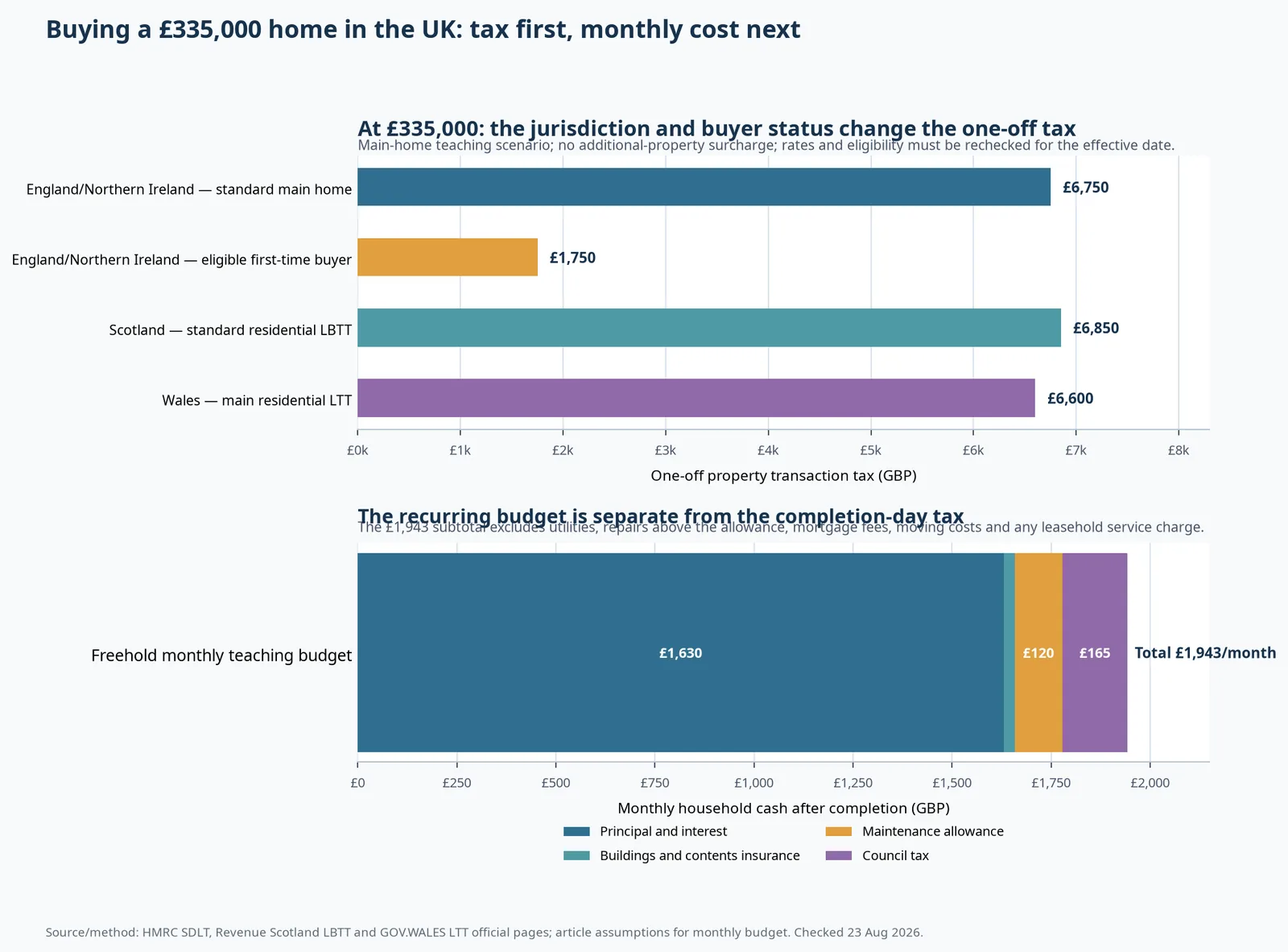
Text alternative for the chart: one-off tax is £6,750 for a standard England/Northern Ireland main home, £1,750 for an eligible first-time buyer, £6,850 for standard Scottish LBTT and £6,600 for main Welsh LTT at £335,000. The recurring freehold teaching subtotal is £1,630 principal and interest + £28 insurance + £120 maintenance + £165 council tax = £1,943 per month, excluding utilities, repairs above the allowance, service charge, moving and transaction costs.
A UK purchase has a habit of collecting costs quietly, so write the list before you offer. Legal fees for conveyancing commonly run from roughly £800 to £1,500 plus VAT, and you pay for the searches and the land-registry fees on top. A mortgage lender will want a valuation; you should want your own survey, from a few hundred pounds for a basic condition report to £1,000 or more for a full building survey on an older or unusual home. Add a broker fee if you use one, bank transfer fees, and — if you are moving from a rental — a deposit on the new home that is separate from any mortgage deposit you have quoted.
- Solicitor's conveyancing fee, plus disbursements: searches, land registry, identity checks
- Survey: condition report, home buyer report, or full building survey depending on the home
- Lender fees: arrangement fee, valuation fee, possibly a higher-lending charge
- Stamp duty (or the Scottish or Welsh equivalent) on whatever bands apply on completion day
- Moving costs and the overlap of two sets of bills on completion month
Rule of thumb: budget 3 to 5 percent of the price for costs on top of your deposit, and treat any figure from an agent that excludes stamp duty as an incomplete sentence. The worked budget above put a £335,000 freehold house near £1,943 a month before utilities; the completion-day cheque is the deposit plus this cost list, and it will be bigger than the brochure implied.
Buying as a non-resident or expat
Non-residents can buy and own property in the UK, but lender underwriting and tax treatment are fact-specific. A lender may ask for different evidence, a larger deposit or a higher rate, and HMRC says a 2% SDLT surcharge usually applies to non-UK residents buying residential property in England and Northern Ireland, subject to the detailed rules and exceptions. If you let the property, UK income tax and future disposal taxes may also matter. Confirm the current position with HMRC's non-UK-resident SDLT guidance and a qualified adviser; do not rely on a generic deposit percentage.
One administrative point saves people real money: open the UK bank account and get the identity paperwork moving early, and keep a paper trail of where your deposit came from. Lenders and solicitors will ask, and the answer must be provable, not just true.
New build versus existing home
New builds in England and Wales normally carry an NHBC or similar warranty covering structural defects for up to ten years, which is a real advantage, and buying direct from a developer can come with incentives such as help with legal fees. The costs hide elsewhere: new homes are often priced at a premium over equivalent second-hand stock, some lenders are cautious about certain developments, and a leasehold new-build house is a structure some buyers later spend money undoing. On an older home you trade the warranty for character, lower entry price, and usually more land — but you pay the surveyor to find what the warranty would have covered on a new build.
The survey ladder: which report do you need
UK surveys come in steps, and buying the wrong rung is either wasted money or a false sense of security. A condition report is a light overview, suited to a modern home in obvious good order. A home buyer-level report is the standard for most purchases: a condition assessment with a traffic-light rating, aimed at the average buyer of an average home. A full building survey is the deep one — structure, defects, and advice — and it is the right choice for older, larger, or unusual homes, or when you plan structural work. The lender's valuation is not a rung on this ladder at all; it is a risk note for the bank. On a 1890 terrace, saving £400 by dropping from a full survey to a condition report is not a saving. It is a gamble dressed as one.
A worked stamp duty slice on the £335,000 house
Apply the band method used earlier to the £335,000 example, again as an illustration rather than current law: nothing on the first £250,000, and 5 percent on the remaining £85,000. That is £4,250 of stamp duty on completion day — a real cheque, and one the monthly budget does not show. Add it to the legal fees, survey, and moving costs, and the true cash-to-complete on this house is the £67,000 deposit plus something in the region of £6,000 to £9,000 of costs, depending on the survey level and the solicitor.
That is why the discipline of running the numbers before you offer is not a personality trait. A buyer who budgets only the deposit will arrive at the solicitor's letter with the mortgage offer already in place and an invoice they did not expect. The Stamp Duty Calculator exists to rehearse this; the solicitor exists to confirm it against the live bands. Use both, in that order.
Sources
- HMRC — Residential SDLT rates — bands, first-time-buyer relief and non-UK-resident link, checked 23 August 2026
- HMRC — Higher rates for additional properties — rates from 1 April 2025 and 14-day return guidance, checked 23 August 2026
- HMRC — Non-UK resident SDLT rates — surcharge guidance, checked 23 August 2026
- Revenue Scotland — Residential LBTT — bands, first-time-buyer relief and return guidance, checked 23 August 2026
- Welsh Revenue Authority — LTT rates and bands — main and higher residential rates, updated 10 December 2024 and checked 23 August 2026
- GOV.UK — How to buy a home — process, surveys, searches and cost checklist, checked 23 August 2026
- GOV.UK — Leasehold service charges and other expenses — service charges, ground rent and reserve funds, checked 23 August 2026
- RICS — House surveys: costs, types and benefits — survey versus lender valuation, checked 23 August 2026
- HMRC — Stamp Duty Land Tax — overview and calculator path, checked 23 August 2026
- UK Finance — Mortgage lending statistics — industry data route, checked 23 August 2026
Related reading
Continue reading: Australia Stamp Duty: Buyer Guide · Buying Property in Australia: Costs · Buying Property in Canada: Guide (2026). Run your own numbers with the Stamp Duty & Transfer Tax Calculator — it takes under a minute and beats guessing.
Frequently asked questions
How much deposit do I need to buy a house in the UK?
First-time buyers can often buy with 5 percent under backed schemes, and many lenders accept 10 to 15 percent. The worked example above uses a 20 percent deposit of £67,000 on a £335,000 house. Thinner deposits mean higher rates and sometimes a higher-lending charge.
What is stamp duty and who pays it?
Stamp duty is a tax on the purchase price, charged in bands so each slice is taxed at its own rate. The buyer pays it around completion. It applies in England and Northern Ireland as SDLT, with separate taxes in Scotland and Wales, and surcharges can apply for additional or non-resident purchases.
How long does buying a house take in the UK?
From accepted offer to completion, 8 to 14 weeks is common, and chains or slow searches can stretch it. Searches and the leasehold pack are the usual delays. A cash buyer with a responsive solicitor is still the fastest route in most markets.
What is the difference between freehold and leasehold?
Freehold means you own the building and the land indefinitely. Leasehold means you own the right to occupy for a fixed term, with ground rent and service charges, and a short remaining term can hurt value and mortgageability. Most flats in England and Wales are leasehold.
Can I buy property in the UK as a foreigner?
Yes. There are no nationality restrictions on owning UK property. Expect lenders to ask for a larger deposit and charge higher rates to non-residents, and check whether the non-resident stamp duty surcharge applies to you, along with your UK tax position if you let the property.
What costs should I budget beyond the UK deposit?
Budget for SDLT, LBTT or LTT where applicable, conveyancing and searches, a survey, lender or broker fees, insurance, moving costs, repairs, and recurring council tax or leasehold charges. The exact tax depends on jurisdiction, buyer status and the effective date, so use the official calculator and solicitor's completion statement.
This guide is educational only. It is not legal advice, tax advice, a mortgage offer, a survey, or a stamp-duty assessment. Rules differ across England/Northern Ireland, Wales and Scotland, and they change. Confirm current bands, reliefs, surcharges, filing deadlines and property documents with HMRC or the relevant devolved revenue authority, a lender and a solicitor/conveyancer acting for you.