 By Nirmal Lashkari · Founder · Indore, Madhya Pradesh, India
$320,000 at 6.5% over 30 years produces an estimated monthly payment of $2,022.62 and total interest of $408,142.36. These figures use the standard fixed-payment amortization formula with 360 monthly installments; displayed values are rounded to cents.
Monthly payment: $2,022.62
| Year | Paid | Interest | Principal | Balance |
|---|---|---|---|---|
| 1 | $24,271.41 | $20,694.69 | $3,576.72 | $316,423.28 |
| 2 | $24,271.41 | $20,455.15 | $3,816.26 | $312,607.02 |
| 3 | $24,271.41 | $20,199.57 | $4,071.84 | $308,535.17 |
| 4 | $24,271.41 | $19,926.87 | $4,344.54 | $304,190.63 |
| 5 | $24,271.41 | $19,635.91 | $4,635.50 | $299,555.13 |
| 6 | $24,271.41 | $19,325.46 | $4,945.95 | $294,609.18 |
| 7 | $24,271.41 | $18,994.22 | $5,277.19 | $289,331.98 |
| 8 | $24,271.41 | $18,640.80 | $5,630.62 | $283,701.37 |
| 9 | $24,271.41 | $18,263.70 | $6,007.71 | $277,693.66 |
| 10 | $24,271.41 | $17,861.36 | $6,410.06 | $271,283.60 |
| 11 | $24,271.41 | $17,432.06 | $6,839.35 | $264,444.26 |
| 12 | $24,271.41 | $16,974.02 | $7,297.39 | $257,146.86 |
| 13 | $24,271.41 | $16,485.30 | $7,786.11 | $249,360.75 |
| 14 | $24,271.41 | $15,963.85 | $8,307.56 | $241,053.19 |
| 15 | $24,271.41 | $15,407.48 | $8,863.94 | $232,189.25 |
| 16 | $24,271.41 | $14,813.84 | $9,457.57 | $222,731.68 |
| 17 | $24,271.41 | $14,180.45 | $10,090.96 | $212,640.72 |
| 18 | $24,271.41 | $13,504.64 | $10,766.77 | $201,873.95 |
| 19 | $24,271.41 | $12,783.57 | $11,487.84 | $190,386.11 |
| 20 | $24,271.41 | $12,014.21 | $12,257.20 | $178,128.90 |
| 21 | $24,271.41 | $11,193.32 | $13,078.09 | $165,050.81 |
| 22 | $24,271.41 | $10,317.46 | $13,953.96 | $151,096.86 |
| 23 | $24,271.41 | $9,382.93 | $14,888.48 | $136,208.38 |
| 24 | $24,271.41 | $8,385.83 | $15,885.59 | $120,322.79 |
| 25 | $24,271.41 | $7,321.94 | $16,949.47 | $103,373.32 |
| 26 | $24,271.41 | $6,186.80 | $18,084.61 | $85,288.71 |
| 27 | $24,271.41 | $4,975.64 | $19,295.77 | $65,992.94 |
| 28 | $24,271.41 | $3,683.37 | $20,588.05 | $45,404.89 |
| 29 | $24,271.41 | $2,304.55 | $21,966.86 | $23,438.03 |
| 30 | $24,271.41 | $833.39 | $23,438.03 | $0.00 |

An amortization schedule turns three decisions into a payment-by-payment timeline: the loan amount, the annual interest rate, and the term in years. This calculator accepts those values directly, then shows a monthly payment, total interest, and a yearly breakdown. It is designed for a fixed-rate repayment pattern in which each scheduled payment contains both interest and principal.
The headline monthly payment is not a complete household budget. It represents the calculated loan payment from the supplied amount, rate, and term. Property taxes, insurance, association dues, optional extra payments, and lender-specific charges are outside this component. Keeping that boundary clear makes the result more useful: first understand how the debt itself declines, then add other ownership costs separately.
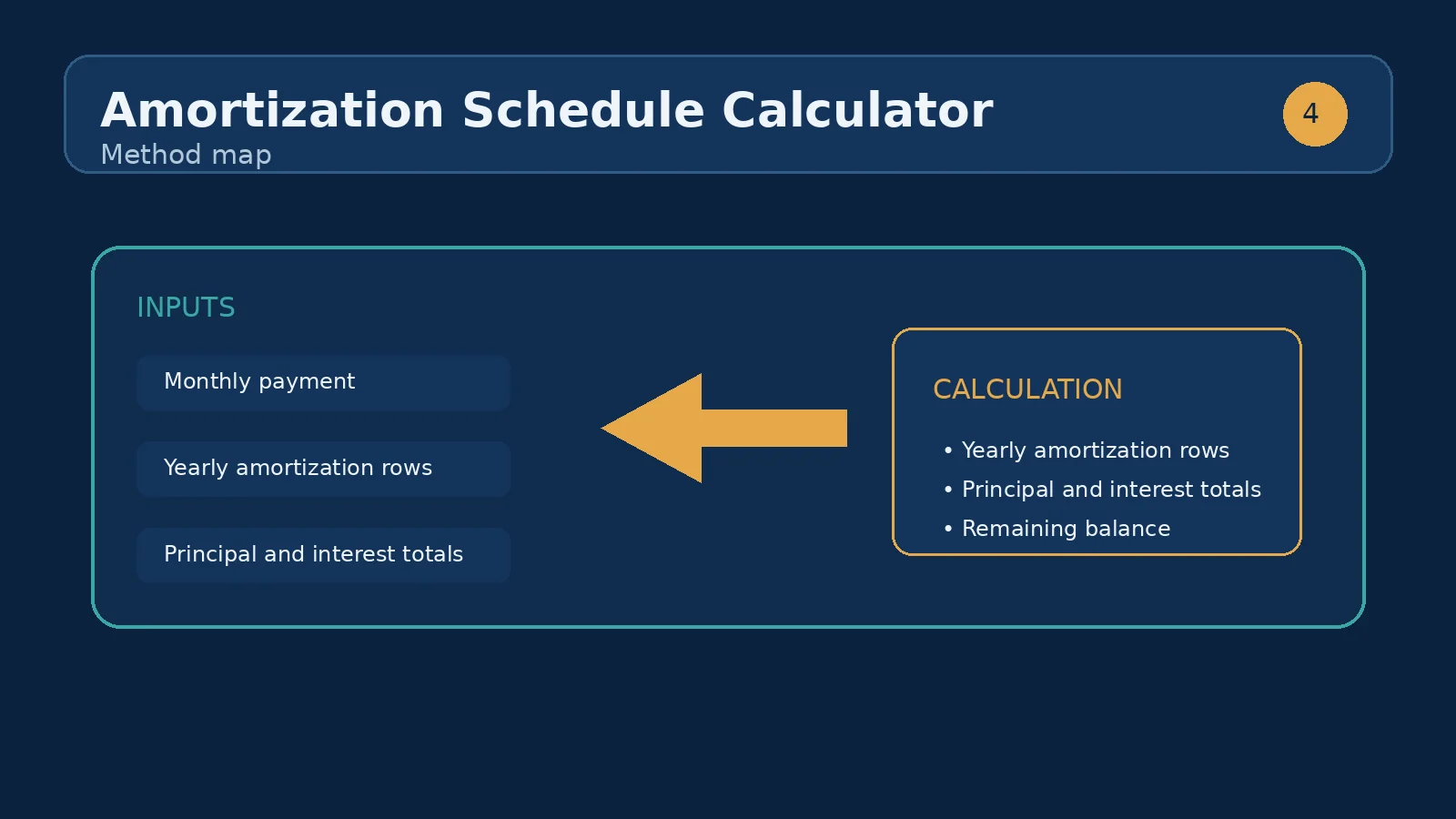
Loan amount is the starting principal. Enter the amount actually borrowed, not the property price unless the entire price is financed. The field is dollar-denominated and cannot be negative. A larger principal raises the required monthly payment and generally raises lifetime interest because interest is calculated against a larger outstanding balance.
Interest rate is the annual percentage entered in the rate field. The control accepts increments of 0.1 percentage point and does not allow a negative value. Term is the repayment length in years; the component allows values from 1 through 50 years. Together, rate and term determine how many monthly periods are used and how quickly the balance must be retired.
For a positive rate, the standard fixed-payment calculation converts the annual percentage to a monthly rate and converts years to monthly periods. Each period begins with the current balance. Monthly interest is calculated from that balance, and the remainder of the scheduled payment reduces principal. Because the balance changes after every payment, the interest portion changes too.
A zero-rate entry is a useful comparison case: with no interest, the borrowed amount is distributed evenly across the scheduled months. At positive rates, the payment must be higher than a simple principal-only division because it also covers financing cost. The calculator recomputes immediately when an input changes, so the cleanest comparison is to change one variable while holding the other two constant.
Use the component's visible defaults as a factual test case: loan amount $320,000, annual rate 6.5%, and term 30 years. That combination creates 360 scheduled monthly periods. The result card reports the calculated monthly payment and total interest, while the yearly table groups the same repayment path into Year 1 through Year 30 rows. The first-year row aggregates twelve monthly payments rather than representing a single installment.
The important reading habit is to compare the Year 1 and Year 30 rows. In the first year, the interest column is relatively large because the opening balance is still close to $320,000. The principal column is the portion that permanently lowers the balance. Near the end, the balance is small, so interest is correspondingly small and most of the payment is principal. The final balance should approach zero, subject to the calculator's currency rounding.
Monthly payment is the recurring scheduled amount produced by the inputs. Total interest is the sum of the interest portions over the full modeled schedule; it is not the amount borrowed and it does not include taxes, insurance, fees, or optional prepayments. Use these two result-card values for a quick affordability and lifetime-cost comparison, but use the table to understand when those costs occur.
In the yearly breakdown, Paid is the total scheduled payment during that year. Interest is the financing cost allocated to those payments. Principal is the amount that reduces the balance. Balance is the remaining amount after that year's scheduled payments. A useful consistency check is that Paid is approximately Interest plus Principal, while the balance falls by approximately the reported Principal amount from one row to the next. Small differences can appear because displayed currency values are rounded.
Hold the $320,000 loan amount and 6.5% rate constant, then compare a 15-year term with a 30-year term. The 15-year case has 180 payments, so it must retire the same principal in half as many periods. Its monthly payment is higher, but its schedule reaches a zero balance sooner and contains far fewer months in which interest can accrue. The 30-year case lowers the required monthly payment by spreading repayment over 360 periods, but its total-interest output is higher.
This is not a recommendation to choose one term. It is a comparison of cash-flow shape. A shorter term may fit a borrower who prioritizes rapid balance reduction; a longer term may preserve flexibility. Enter each term separately and compare monthly payment, total interest, and the year-by-year balance rather than judging from one number.
The most common mistake is entering the purchase price as the loan amount when a down payment or other financing structure means the borrowed amount is smaller. Another is entering an APR, promotional rate, or periodic rate without confirming that it matches the calculator's annual-rate input. A third is treating total interest as an upfront bill; the table shows that it is distributed across the modeled payments and changes as the balance declines.
For a reliable review, begin with the amount shown on the loan estimate, enter the quoted annual rate, and select the contractual term. Record the monthly payment and total interest. Then inspect the first, middle, and final yearly rows for a declining balance and a sensible shift from interest toward principal. Finally, rerun the calculation with one changed assumption, such as a shorter term or different rate, and label the comparison clearly so scenarios are not mixed.
This calculator describes the scheduled baseline; it does not expose a field for extra principal, irregular lump sums, or a revised payoff date. If the yearly table makes you wonder what would happen after adding a fixed amount to each payment, the next useful step is an extra-payment calculator. Carry over the same loan amount, annual rate, and term so the baseline is comparable, then add the proposed extra amount and compare payoff timing and interest savings.
If the question instead concerns replacing an existing loan with a new rate or term, use a refinance calculator after establishing this baseline. The amortization schedule remains valuable in either case because it provides the balance path and interest pattern against which a modified plan can be judged.
Interest is charged on the outstanding balance, which is highest at the start. As the balance falls, the interest portion shrinks and more of each payment reduces the principal.
Typically past the midpoint of the term, once the principal portion of each payment overtakes the interest portion.
The payment calculation is monthly, but the visible table groups the results into yearly rows with Paid, Interest, Principal, and Balance columns.
It is the modeled sum of scheduled loan interest over the selected term. It does not include taxes, insurance, fees, or optional extra payments.
Interest is calculated from the outstanding balance. The balance is largest at the beginning and becomes smaller as principal is repaid, so later yearly rows generally contain less interest.
Yes. The visible term control permits values from 1 through 50 years, subject to the product's normal numeric input behavior.
The schedule represents principal distributed across the selected monthly periods without an interest charge. It is a useful mathematical comparison, not a claim about a particular loan offer.
No. The component models the scheduled payment from loan amount, annual rate, and term only. Use an extra-payment calculator for an additional-principal scenario.
How we calculate: calcAmortizationSchedule in calculators.ts; regression checks in calculators.test.ts
Last reviewed: . Learn more about Nirmal Lashkari and LashkariProperties.
Disclaimer: This calculator provides estimates for informational purposes only and is not financial, tax, or legal advice. Verify figures with a qualified professional before making decisions.