 By Nirmal Lashkari · Founder · Indore, Madhya Pradesh, India
$350,000 at 6% interest produces a $1,750.00 monthly interest-only payment for the first 5 years, followed by an estimated $2,255.05 monthly payment over the remaining 25-year amortization period. That is a $505.05 monthly increase, with $105,000.00 in interest paid during the interest-only period.
Interest-only payment: $1,750.00

An interest-only payment covers the interest calculated for the current balance, without reducing the loan amount through scheduled principal repayment. This calculator makes that early-period figure visible, then shows the payment required after the interest-only period ends. It is therefore a payment-transition tool, not a complete affordability decision by itself.
For example, a $350,000 balance at 6% produces an interest-only payment of $1,750 per month because $350,000 × 0.06 ÷ 12 equals $1,750. The balance remains $350,000 under the simplified assumptions represented by the component. The later payment must amortize that balance over the remaining years, which is why the second payment can be materially higher.
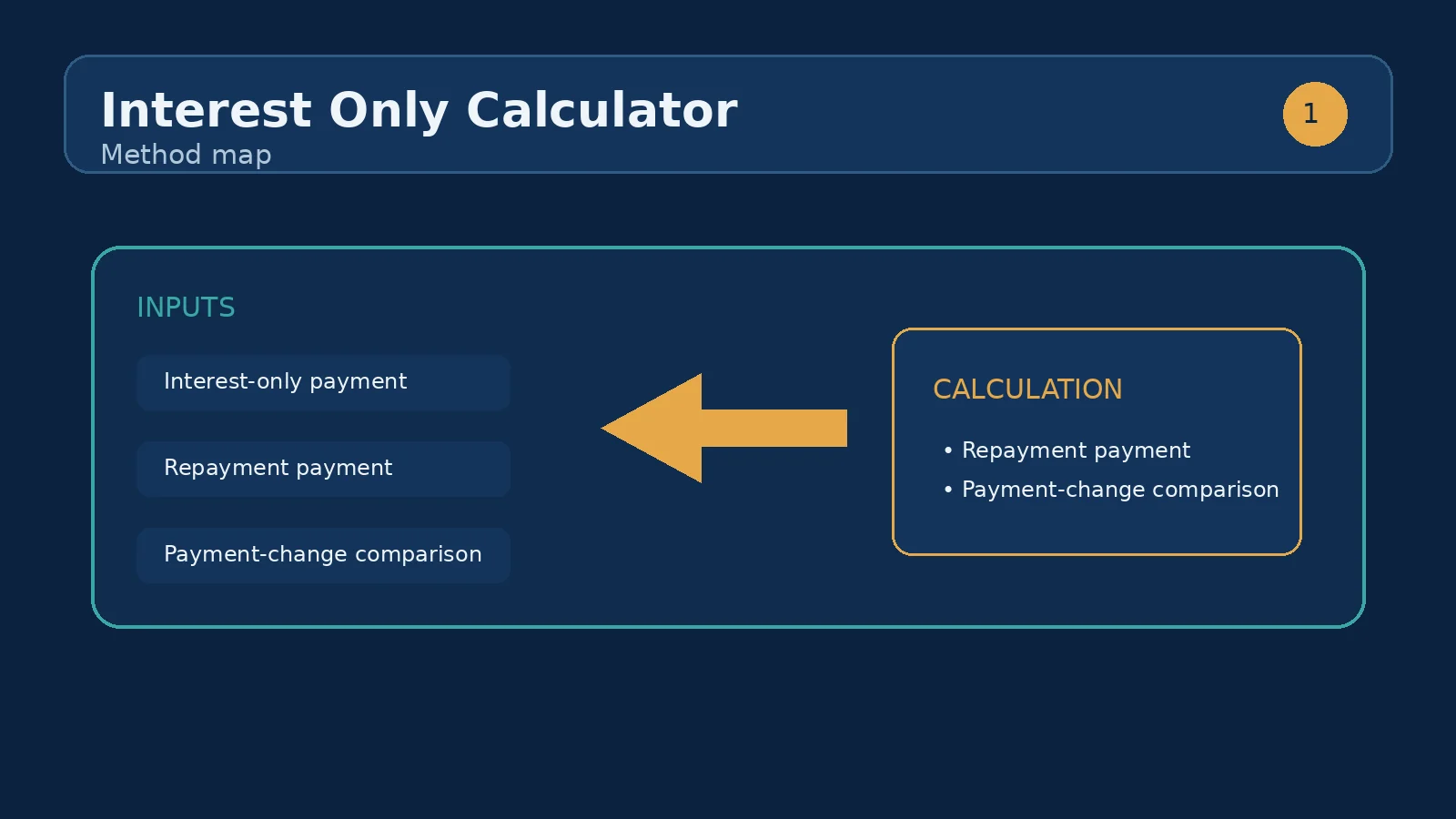
The visible inputs are loan amount, interest rate, interest-only period, and total term. Loan amount is the starting principal. Interest rate is entered as an annual percentage, with one decimal place available for rate testing. Interest-only period is the number of years before principal repayment begins, while total term is the full planned duration of the loan.
The component passes those values to its interest-only calculation and displays four outputs: interest-only payment, payment after period, payment increase, and interest paid during period. The total term gives the full horizon; the interest-only years identify the opening phase inside that horizon. Entering an interest-only period that is not shorter than the total term would not describe a normal transition, so compare those fields carefully.
Use the component's visible starting values as a factual test case: loan amount $350,000, rate 6%, interest-only period 5 years, and total term 30 years. The interest-only payment is $1,750 per month. Across 60 months, the displayed interest paid during period is $105,000, assuming the balance and rate remain as entered.
After month 60, the remaining $350,000 must be repaid over the remaining 25 years. On a conventional fully amortizing calculation at the same 6% rate, that payment is about $2,255.11 per month. The increase is about $505.11, or roughly 28.9% above the opening payment. These figures show the key risk clearly: a lower initial payment can be a delayed principal obligation rather than a permanent saving.
Interest-only payment is the amount associated with the opening phase. It is the headline result, but it does not indicate that the debt is shrinking. Payment after period is the later scheduled amount needed to repay the balance within the remaining term under the calculator's assumptions. Payment increase is the difference between those two payment levels, and its hint explicitly frames the number as the amount by which the payment jumps.
Interest paid during period is a cumulative figure for the interest-only years. It should not be read as total lifetime interest, nor as the amount of principal repaid. In the worked scenario, $105,000 paid during the first five years does not lower the $350,000 balance. To understand the full cost beyond this screen, pair the result with an amortization schedule or the relevant loan documents.
Keeping the $350,000 loan and 6% rate fixed, a five-year interest-only period produces 60 months of the $1,750 opening payment before the later payment begins. A ten-year period would produce 120 months at that opening amount, but only 20 years would remain for repayment if the total term stayed at 30 years. The later payment would therefore need to be higher than in the five-year case because the same balance is compressed into fewer amortizing months.
A shorter opening period usually reduces the size of the later payment shock, while a longer opening period postpones principal reduction for more time. Compare scenarios by looking at all four outputs together: opening payment, later payment, increase, and interest accumulated during the opening phase. A low first number is not enough evidence that one scenario is cheaper or safer.
During an interest-only phase, the opening payment changes directly with the entered rate when the balance is unchanged. On a $350,000 balance, 5% corresponds to about $1,458.33 per month, 6% to $1,750, and 7% to about $2,041.67. That one-percentage-point step changes the opening payment by about $291.67 per month and changes five-year interest during the period by $17,500.
The later payment is also rate-sensitive because the remaining balance must be amortized at the entered rate. Test a small range rather than relying on one rate. The calculator accepts a zero minimum and a 0.1 percentage-point step, but a zero rate is a mathematical test case, not a promise that a real loan will be offered on those terms.
The most common mistake is treating the interest-only payment as if it were a normal repayment payment. A second is entering the interest-only period as the entire loan term, which removes the meaningful distinction between the opening and later phases. A third is comparing two scenarios with different loan amounts while attributing every payment change to the interest-only feature.
Another mistake is forgetting costs that are outside this component. The screen accepts no taxes, insurance, fees, points, escrow, or additional principal payments, so its outputs describe the loan-payment calculation only. Do not add those omitted costs implicitly to one scenario but not another. Use identical external assumptions when comparing alternatives, and verify the actual repayment rules before acting.
Start with the balance you are actually evaluating, then enter the quoted annual rate rather than a rounded guess. Set the interest-only years and total term exactly as stated in the offer or scenario. Record the opening payment and the later payment before changing anything. The payment increase is the amount that must fit into a future budget, not merely a descriptive statistic.
Next, run a comparison with a shorter interest-only period and another with no delayed principal phase if your surrounding tools provide that option. For a detailed balance-by-balance view, use the sibling amortization schedule calculator. That next tool use is especially helpful when you need to see how quickly principal falls after the transition and how cumulative interest develops over time.
During the interest-only period no principal is repaid, so the full balance must be amortized over the shorter remaining term.
It is the loan balance times the annual rate divided by 12, with no principal repayment. On the defaults, $350,000 at 6% is $1,750 a month for the first 5 years.
Once the interest-only period ends, the full $350,000 must be repaid over the remaining 25 years, producing an estimated $2,255.05 a month — a $505.05 monthly increase you should budget for before the change hits.
Interest accrues on the full balance the whole time. On the default example, $1,750 × 60 months means $105,000 of interest is paid without reducing the loan at all.
When the cash-flow relief is genuinely necessary and you have a credible repayment plan — sale, refinance, or a large future income. Without one, it simply defers principal repayment and raises the total interest cost.
Not in the simplified calculation represented here. The opening payment is calculated as interest on the entered loan amount, so scheduled principal reduction is not included during that period.
It is the payment shown for the phase after the interest-only years end, when the remaining balance must be repaid over the remaining portion of the total term.
It makes the transition visible by showing the difference between the later payment and the interest-only payment.
No. It covers the interest accumulated during the entered interest-only period and does not represent all later interest, fees, or other loan costs.
More months use the opening interest-only payment, leaving fewer months within the same total term to repay principal. The later payment can therefore become higher.
Yes. The visible rate field uses percentage units and supports tenth-of-a-percentage-point steps, such as 6.1%.
Use an amortization schedule calculator when you want a period-by-period view of principal, interest, and the remaining balance after the interest-only phase.
Interest-only mortgages explained: how payments work, the repayment shock after the interest-only term, and who they suit.
How we calculate: calcInterestOnly in calculators.ts; regression checks in calculators.test.ts
Last reviewed: . Learn more about Nirmal Lashkari and LashkariProperties.
Disclaimer: This calculator provides estimates for informational purposes only and is not financial, tax, or legal advice. Verify figures with a qualified professional before making decisions.