


Ask ten prospective home buyers what a "safe" down payment is, and nine will say 20%. Ask them why, and the answers get murky. The truth is that 20% is neither a legal requirement nor an economic law — it is a threshold that lenders use to price risk. Cross it, and mortgage insurance falls away and you usually get a better rate. Fall short of it, and you can still buy a home; you simply pay for the extra risk in another way.
That distinction matters. Treating 20% as a rigid barrier keeps millions of otherwise-qualified renters out of ownership for years while their rent, and often the target property, keep rising. On the other hand, blindly stretching to 3% down without understanding LTV, PMI, closing costs and cash reserves can put buyers into a fragile financial position where a single job change or rate shock forces a distressed sale.
This guide gives you the framework professional lenders and financial planners actually use. You will learn what LTV really measures, how PMI is priced, how loan programs across the USA, UK, Canada, Australia and UAE compare, and how to model — with real numbers — whether a smaller or larger down payment is the right move for your situation. You will also get a step-by-step decision process you can pair with the free calculators on LashkariProperties to test scenarios in minutes rather than months.
Educational, not personal advice
Everything below is for education. Down payment rules, tax treatments and program eligibility change often and vary by country, state and lender. Confirm any decision with a qualified mortgage professional and, where relevant, a tax adviser or solicitor in your jurisdiction.
Where the 20% "rule" actually comes from
The 20% figure predates most modern mortgage products. In the early 20th century, US banks typically offered short-term, high-down-payment loans — often 50% down over 5 to 10 years. After the Great Depression, government-backed programs such as the Federal Housing Administration (FHA, created in 1934) began insuring longer-term, lower-down-payment loans, expanding home ownership dramatically.
Private mortgage insurance (PMI) emerged in the late 1950s as a way for private lenders to safely offer conventional loans with less than 20% down. The 20% number was chosen for a practical reason: historical loss data suggested that a 20% equity buffer was usually enough to absorb a moderate housing downturn, resale costs and the lender's foreclosure expenses. Above 80% LTV, lenders wanted the borrower to buy insurance that covered their risk of loss.
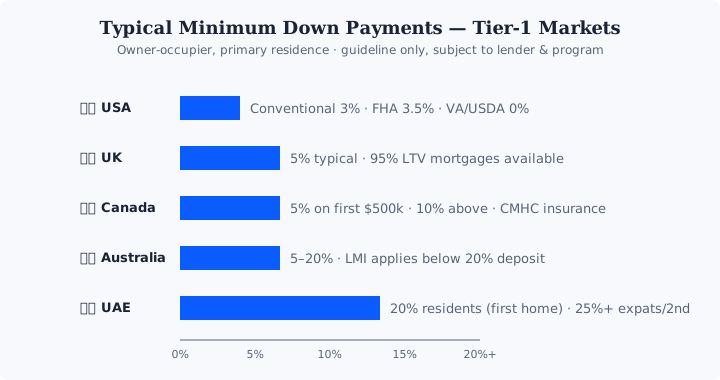
Fast-forward to 2026 and the mechanics are unchanged, but the products have proliferated. Conventional loans in the US can be written with as little as 3% down. FHA loans start at 3.5%. VA and USDA loans allow qualifying borrowers to buy with 0% down. The UK, Canada, Australia and UAE each have their own low-deposit routes. So the question "Is 20% required?" is technically obsolete — the useful questions are "What down payment fitsmyrisk profile?" and "How do I optimise total cost, not just the sticker price?".
What has genuinely shifted since the last cycle is the gap between the 20% ideal and what buyers actually achieve. In the USA, the National Association of Realtors has repeatedly reported that the median first-time buyer down payment sits closer to 6–8%, not 20%. Repeat buyers land higher because they roll equity from a previous property forward. In the UK, the Council of Mortgage Lenders and Bank of England data show the modal first-time buyer deposit hovering around 10–15% in most regions, with London slightly higher because of price levels rather than a different rule. In Canada, roughly two in three first-time buyers use an insured mortgage — by definition below 20% down. Australia's ABS lending data tells the same story: sub-20% deposits dominate the first-home segment.
Framed this way, 20% is not the norm; it is the upper end of the range. Buyers who insist on hitting it before they act are pursuing a benchmark that most successful home owners never actually crossed on entry — many only reached 20% equity years later, courtesy of appreciation and amortisation. That doesn't mean 20% is wrong. It means it needs a real justification for each buyer, not a reflex.
"Twenty percent isn't a rule. It is a price point on a risk curve — and the curve is negotiable."— How lenders actually see it
Key definitions: down payment, LTV, PMI, equity
Down payment
The cash portion of a property purchase paid up-front, expressed either in currency or as a percentage of the purchase price. If you buy a $400,000 home with $40,000 in cash and borrow the rest, your down payment is $40,000 or 10%.
Loan-to-Value (LTV) ratio
The size of your mortgage relative to the property's value, expressed as a percentage. It is the single most important underwriting metric on the loan side of any purchase.
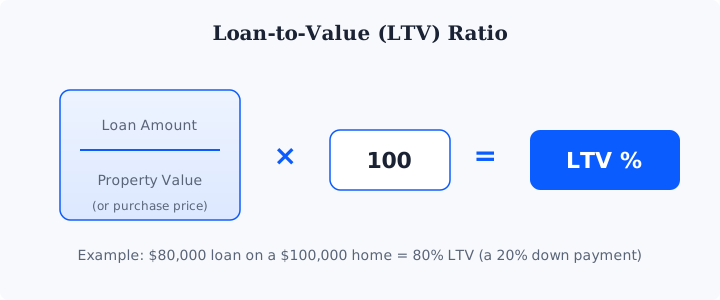
LTV = (Loan Amount ÷ Property Value) × 100
Down payment and LTV are two sides of the same coin: a 20% down payment equals 80% LTV, a 5% down payment equals 95% LTV. Lenders build their entire risk framework around LTV — including rate pricing, mortgage insurance requirements and approval odds. If you want a deeper explanation, see our guide What Is LTV Ratio and Why Lenders Care.
Private Mortgage Insurance (PMI) and its cousins
PMI is an insurance policy that protects the lender, not you, in case of default. It is required on most US conventional loans above 80% LTV. Similar products exist internationally:
- USA: Private Mortgage Insurance (PMI) on conventional loans; Mortgage Insurance Premium (MIP) on FHA loans.
- Canada: Mortgage default insurance from CMHC, Sagen or Canada Guaranty is mandatory below 20% down.
- Australia: Lenders Mortgage Insurance (LMI), one-off premium, usually below 20% deposit.
- UK: Historically Higher Lending Charge (HLC); today typically priced into higher-LTV rates rather than charged separately.
- UAE: No standard mortgage insurance market; risk is priced into loan rates and the Central Bank's LTV caps.
Equity
The value of the property minus what you still owe. Equity grows with each principal payment and with any appreciation. It shrinks with market declines. Yourstartingequity equals your down payment. A useful mental picture: equity is the portion of the home you would keep if you sold today and paid off the mortgage, before agent, legal and tax costs. In the first few years of a long-amortisation loan, principal repayment adds equity slowly; the majority of your equity growth in years 1–5 usually comes from price appreciation, not amortisation. Understanding this ratio matters because it determines when you can request PMI removal, refinance into a lower LTV band, or extract equity through a cash-out refinance or HELOC.Closing costs
Fees paid at completion of the purchase separately from the down payment: legal fees, lender fees, title insurance, taxes such as stamp duty or the Dubai Land Department (DLD) fee, appraisal, inspection and prepaid items. We cover them in depth in Closing Costs Explained: What Home Buyers Actually Pay. As a rough calibration: expect closing costs to add 2–5% in the USA and Canada, 1–4% in the UK (stamp duty dominant on higher price points), 4–6% in Australia (stamp duty is the big line), and 6–8% in the UAE (DLD transfer fee plus registration and agency fees). None of this is negotiable in the same way price is — you must budget for it on top of the deposit, not out of it.
Reserves
The cash that stays in your account after closing. Reserves are what turn a stressful ownership year into a manageable one. Most professional lenders require investors to show 2–6 months of reserves at underwriting; the same logic applies to owner-occupiers even when the lender does not enforce it. A larger deposit that empties reserves is often riskier than a smaller deposit that leaves them intact.
Why deposit size matters more than most buyers realise
Choosing a down payment is not simply a savings goal. It is a lever that touches at least six financial dimensions simultaneously:
- Monthly principal & interest. Larger deposit → smaller loan → lower payment.
- Interest rate tier. Most lenders price loans in LTV bands, so crossing a threshold (e.g. 95% → 90% → 85% → 80%) can meaningfully lower the rate.
- Mortgage insurance.PMI/LMI/CMHC can add hundreds per month; larger deposits shrink or eliminate it.
- Approval odds. Below 80% LTV, more lenders will approve you, and debt-to-income (DTI) limits become easier to hit.
- Cash reserves. Every extra dollar in a deposit is a dollar not in savings — and reserves are what carry you through job loss, rate shocks or emergencies.
- Long-term wealth allocation. Money locked as home equity is generally illiquid and cannot be redeployed easily into diversified investments.
The right deposit is not the one that eliminates PMI at all costs, nor the smallest one that gets you the keys. It is the amount that best balances these six levers for your income, risk tolerance and time horizon.
A useful way to see this trade-off is to imagine two families with the same $150,000 in cash buying the same $500,000 home. Family A puts $100,000 down (20%), leaving $30,000 for closing costs and $20,000 in reserves. Family B puts $50,000 down (10%), pays PMI of roughly $180/month, but keeps $80,000 in reserves after closing costs. Family A has a lower monthly payment. Family B has four extra months of expenses on hand. If both households lose an income for a quarter next year, Family B refinances and continues; Family A sells under duress. The monthly saving on paper looked better; the resilience on the ground was worse. Neither choice is objectively right — but the framing must include resilience, not only cost. Illustrative monthly cost stack at five different down payment levels on the same $400,000 home.
Notice something important in that chart: between 3% down and 20% down, the total monthly outlay differs by roughly $720. Meaningful, but not transformational — and less than most buyers expect. Whatistransformational is the total cash required up-front, which we address next.
The counter-intuitive insight
For many buyers, waiting five extra years to save 20% costs more than paying PMI for a few years and buying now — because rent, home prices and rates keep changing. The right question is not "How do I get to 20%?" but "What is the total cost of waiting versus buying today?".
Low-down loan programs in Tier-1 markets
Here is a working summary of the main low-deposit routes available in 2026. Rules change; always verify with a licensed local mortgage broker before relying on any specific number.
- Conventional 97 (Fannie Mae/Freddie Mac):3% down for qualifying first-time buyers, requires PMI.
- FHA:3.5% down with a credit score of 580+, 10% down if score 500–579. Requires upfront and annual MIP.
- VA loan:0% down for eligible veterans, active-duty service members and some spouses. No PMI. Funding fee applies.
- USDA loan:0% down in eligible rural/suburban areas, income limits apply.
- State & local Down Payment Assistance (DPA): Grants and second-lien programs, often for teachers, first responders and first-time buyers.
- 95% LTV mortgages: Widely available for first-time buyers with the Mortgage Guarantee Scheme extended in recent budgets.
- Lifetime ISA: Up to £4,000/year saved, with a 25% government bonus, usable for a first home up to a set price cap.
- Shared Ownership: Buy 25%–75% of a home and pay rent on the rest, effectively lowering the cash needed.
- Family assistance / guarantor mortgages: Family savings held as security to enable a 100% mortgage.
Canada
- Insured mortgages:5% down on the first CAD 500,000, 10% on the portion above, up to a set price cap. Default insurance required.
- Home Buyers' Plan (HBP): Withdraw up to CAD 60,000 (CAD 120,000 per couple) from an RRSP for a first home, repayable over 15 years.
- First Home Savings Account (FHSA): Tax-advantaged account combining features of an RRSP and TFSA for first-time buyers.
Australia
- First Home Guarantee: Buy with as little as 5% deposit, government guarantees the LMI portion (subject to caps and eligibility).
- Family Home Guarantee:2% deposits for eligible single parents.
- First Home Super Saver Scheme (FHSSS): Save inside superannuation and withdraw for a first-home deposit, subject to caps.
- Stamp duty concessions: Many states offer partial or full waivers for first-time buyers below a price threshold.
- Residents, first home under AED 5m: Minimum 20% down (LTV cap 80%).
- Residents, first home above AED 5m: Minimum 30% down.
- Non-residents / expats abroad: Typically 25%+ down.
- Second properties & investors:35%+ down is common.
- Off-plan purchases: Staged payments to the developer, but bank financing still subject to Central Bank LTV caps.
Not sure which program applies to you?
Use our free Down Payment Calculatorto compare total up-front cost across different loan structures in seconds.
Step-by-step: how to decide your down payment
Below is the six-step process we recommend. It works in every Tier-1 market with only cosmetic changes.
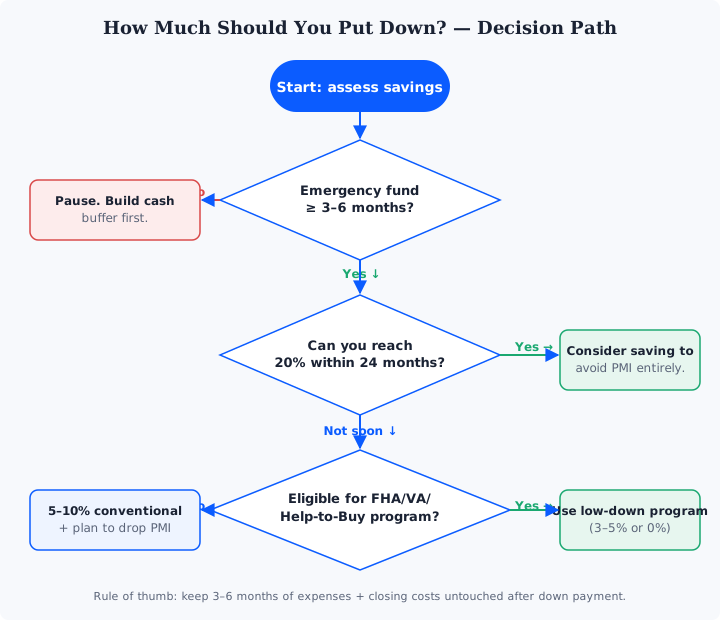
Step 1 — Confirm your emergency fund
Before allocating a single dollar to a down payment, verify you have at least three to six months of essential expenses in cash. If you don't, pause the home search. Buying without reserves converts every minor life event — a car repair, a slow month of income, a boiler replacement — into a debt-financed emergency.
Step 2 — Establish your maximum sensible home price
Deposit size is meaningless without a target price. A common approach is to keep housing costs (P&I + tax + insurance + HOA/strata) under 28% of gross monthly income, and total debt payments under 36–43%. Our companion piece How Much House Can I Afford? A Practical Numbers Frameworkwalks through this in detail.
Step 3 — Get multi-tier quotes
Ask two or three lenders to quote your target property at 5%, 10%, 15% and 20% down. Note the interest rate, PMI/LMI/CMHC, and any lender credits. Do this within a two-week window so hard credit pulls count as a single inquiry for scoring purposes in most markets.
Step 4 — Model true monthly cost
Include principal, interest, property tax, home insurance, mortgage insurance, HOA/strata, and 1–2% of the home's value annually for maintenance and reserves. The number that ends up on your bank statement each month is what matters, not the "starting from" rate quoted in adverts.
Step 5 — Stress-test
Ask three "what if" questions and make sure the payment is still survivable:
- What if rates rise 2% at my next renewal (Canada, UK) or my ARM adjusts (USA)?
- What if my household income drops 30% for six months?
- What if home prices fall 10% and I need to sell? Would I still be above water?
Step 6 — Pick the smallest safe down payment
Contrary to popular framing, the goal is not to pay as much as possible up-front. It is to put down the smallest amount that (a) meets lender requirements, (b) keeps your reserves intact, and (c) delivers a monthly payment you can survive under stress-test conditions. Everything else stays liquid.
Where the framework changes for investors
If you are buying a rental property rather than a primary residence, add three more filters to the six above. First, the loan will almost certainly require 20–30% down regardless of your personal preference; treat this as a hard input, not a choice. Second, model rental income conservatively — use a 92–95% occupancy assumption, not 100% — and require the resulting cash flow to cover the mortgage payment with at least a 1.20× DSCR cushion. Third, keep separate reserves for the property (typically 6 months of the property's own carrying cost) on top of your personal emergency fund. Investors who blur these two reserve buckets are the ones who force-sell in the first downturn.
Where the framework changes for landlords with several properties
Portfolio landlords face a different constraint: total lender exposure. Once you own three to five financed properties, most retail lenders begin to decline further loans and you have to move to portfolio or commercial lenders whose deposit minimums start at 25–30%. Planning your fourth deposit at 25% before you buy your third property protects you from a nasty surprise. In this segment, a larger deposit is often the price of access, not of rate improvement.
Best practice
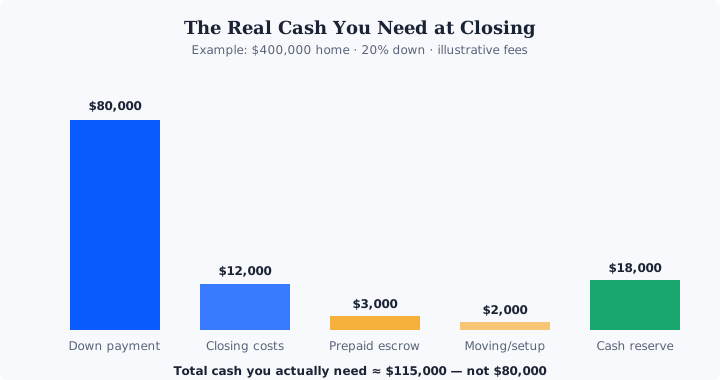
Treat your down payment and closing-cost cash as two separate savings buckets. Reach the closing-cost target first; only then push additional savings into the deposit bucket. This prevents the classic mistake of "I have my 20%!" only to discover another 3–5% is needed for closing.
Worked examples: 3%, 10%, 20% side by side
The numbers below are illustrative and rounded. They use plausible 2026 conditions but should not be interpreted as current rate quotes.
Example 1 — First-time US buyer, $400,000 home
Assume a 30-year fixed rate at 6.5% for the 20%-down scenario, with modest rate premiums for higher LTVs, and PMI at 0.6% annually of the loan balance. Property tax and homeowners insurance combined: $500/month.
Monthly and up-front cost comparison for a $400,000 US home at 3%, 10% and 20% down payment.
Observations: Moving from 3% to 20% down cuts the monthly payment by ~$688 but requires an extra $68,000 in cash up-front. If the buyer only has $30,000 saved, the 3%-down plan is the only viable choice and PMI is a fair price for entry. If the buyer has $150,000 saved and stable income, 20% down might be optimal — but only if $60,000 remains as post-close reserves.
Example 2 — UK London flat, £500,000
Assume a 5-year fixed rate mortgage at 4.75% for a 5% deposit, 4.5% for 10%, and 4.25% for 20%, over 25 years. Stamp Duty Land Tax varies by buyer status; we assume a first-time buyer at £500,000, which broadly qualifies for reduced SDLT.
UK £500,000 flat: comparison of 5%, 10% and 20% deposit outcomes.
Observations: Doubling the deposit from £25k to £50k saves about £206/month; quadrupling it to £100k saves roughly £540/month. In a market where London rents easily exceed £2,500/month for a comparable flat, a 5%-deposit purchase may still be cheaper than continuing to rent, provided the buyer expects to hold for 5+ years. Layer in the tax picture — first-time buyer SDLT relief on £500,000 saves several thousand pounds versus a repeat buyer at the same price — and the case for buying earlier rather than saving to 20% often strengthens further. What breaks the case is a short expected holding period: paying 1–4% in transaction costs to enter and 1–3% to exit means you need at least modest appreciation or several years of amortisation to break even against renting.
Example 3 — Dubai apartment, AED 1.5m
UAE Central Bank rules cap LTV at 80% for residents buying their first home under AED 5m. Assume a 25-year mortgage at 4.99% and the standard Dubai Land Department (DLD) transfer fee of 4% plus agency and registration costs.
UAE AED 1.5m apartment: down payment scenarios for resident and expat buyers.
Observations: UAE buyers face two features simultaneously: a legally enforced minimum LTV cap set by the Central Bank of the UAE, and one of the highest transaction-cost stacks among Tier-1 markets. Budgeting for closing costs equal to a further 6–8% of the property price is essential. Compare your scenarios in AED with the down payment calculator.
What the three examples show together
Across three currencies, three regulatory regimes and three price points, the same three patterns repeat: (1) moving from the minimum deposit to a mid-range deposit produces meaningful monthly savings, but the marginal benefit shrinks as you approach 20%; (2) closing costs are a very large second bucket that first-time buyers routinely underestimate; and (3) the headline deposit percentage is a poor summary of the real cash effort — the total up-front outlay including fees is what should drive planning. In each example, we would counsel a buyer with borderline reserves to take the smaller deposit and preserve liquidity; a buyer with abundant reserves and a long horizon can rationally choose the larger one.
Consistency note
All monthly payment figures above are calculated using the standard amortisation formula M = P × [ r (1+r)ⁿ / ((1+r)ⁿ − 1) ] where r is the monthly rate and n is the number of months. Rounding to the nearest whole currency unit accounts for minor differences.
Country-by-country nuances
USA — the LTV band lender
American lenders price loans in distinct LTV tiers, so getting to the next band (usually 95%, 90%, 85%, 80%) can improve rate and eliminate PMI. Look at total cost across the entire holding period, not year-one payment alone. PMI can be removed automatically once the loan reaches 78% LTV of the original value, or on request at 80%.
UK — deposit ladder, not cliff
British lenders think in 5% bands: 95%, 90%, 85%, 80%, 75%, 60% LTV, with rate improvements at each step. The most dramatic rate drops usually occur going from 90% to 85% and from 75% to 60%. Because most UK mortgages are 2- or 5-year fixes, deposit strategy also interacts with refinance risk.
Canada — insured vs uninsured
Below 20% down, the mortgage is "insured" (with CMHC or a private insurer) and often carries alowerrate because the lender bears no default risk. Above 20%, loans are "uninsured" with slightly higher posted rates. The stress test at the government-set qualifying rate applies to both.
Australia — LMI and the guarantee schemes
Lenders Mortgage Insurance is charged as a one-off premium that can be capitalised into the loan. A 5% deposit purchase of an AUD 750,000 property can attract LMI of AUD 20,000+. Government guarantees can waive this for eligible first-home buyers, single parents and regional buyers — check current caps and eligibility.
UAE — regulated LTV caps
Unlike the other four markets, UAE deposit minimums are set by regulation rather than lender risk appetite. Residents buying a first home under AED 5m must put at least 20% down; above AED 5m, 30%. Second properties and expat non-residents face higher minimums. This makes the "should I put 20% down?" question moot for many UAE buyers — the floor is legal. What buyers can control is the interaction between deposit and off-plan payment plans: many developers offer a staged schedule (e.g. 10% on booking, 10% on 30% construction, 20% on handover, 60% post-handover over 5 years). Bank financing usually kicks in only at handover, and the Central Bank LTV cap still applies at that point, so an off-plan buyer must line up bank financing at handover with the same 20/25/30% down requirement — the developer plan does not replace it.
Cross-market summary
Across all five markets, one pattern is consistent: the deposit norm for owner-occupiers has drifteddownward, not upward, over the past two decades. Governments have expanded first-time buyer support (US Conventional 97, UK Mortgage Guarantee Scheme, Canada FHSA, Australia First Home Guarantee, various UAE developer incentives) precisely because pushing everyone to 20% would freeze younger cohorts out of ownership. Investors, meanwhile, face the opposite drift: tighter capital rules and macroprudential policy have pushed the effective minimum up in most markets — 25% is now the practical floor for buy-to-let in the UK, and Canada's stress test squeezes marginal borrowers out even at 20%. The two-track pattern — easier for first homes, harder for additional properties — is the defining regulatory feature of the current cycle.
Seven expensive myths and mistakes
Myth 1: "You can't buy without 20% down"
Roughly half of first-time buyers in the USA in recent years used less than 10% down. The 20% myth persists mainly because it is repeated in personal-finance blogs; the mortgage industry has been financing sub-20% loans for over 60 years.
Myth 2: "PMI is wasted money"
PMI is a fee for capital access. If it lets you buy today at $400,000 and the home appreciates 3–4% annually while you build equity through principal payments, the PMI you paid can be dramatically smaller than the appreciation captured. In a flat or falling market, that math reverses — which is why stress-testing matters.
Myth 3: "A bigger down payment always makes financial sense"
Only if the "return" on that extra cash — measured as avoided interest, avoided PMI and any rate improvement — beats what the cash could earn elsewhere on a risk-adjusted basis, and you don't need the liquidity. For many buyers, an emergency fund + moderate deposit outperforms a maxed-out 20% deposit.
Myth 4: "I'll wait until I have 20% saved"
If prices and rents rise faster than you can save, waiting is a losing race. Model the total cost of an extra 3 years of rent + potential price appreciation vs the total cost of PMI for those same 3 years. Sometimes waiting wins; often it doesn't.
Myth 5: "PMI stays forever"
In the US, under the Homeowners Protection Act, PMI on most conventional loans terminates automatically at 78% LTV based on the original amortisation schedule. You can request cancellation at 80%. FHA MIP has different rules — for many loans originated after 2013, it stays for the life of the loan unless refinanced.
Myth 6: "Down payment size affects loan approval more than credit"
For most conventional loans, credit score, debt-to-income ratio and employment stability are equal or more important than deposit size. A 750 credit score with a 5% deposit is often stronger than a 640 score with 20% down.
Myth 7: "I need to keep my down payment in cash"
Most lenders accept documented gift funds, employer grants, DPA programs and — with appropriate seasoning — proceeds from investments or retirement accounts. Verify sourcing requirements with your loan officer early to avoid last-minute surprises.
The biggest mistake of all
Emptying your savings to hit 20% and closing costs with no reserves left. Lenders may still approve, but the day after closing you become one boiler failure away from credit-card debt. Always keep at least 3–6 months of expenses in accessible cash after the purchase.
How this connects to other property metrics
Deposit decisions do not exist in isolation. They ripple into every other calculation you'll do as a buyer or investor.
Debt-to-Income (DTI)
A bigger deposit lowers the loan, which lowers the monthly payment, which lowers DTI. If you're on the edge of a DTI cap, a small extra deposit can be the difference between approval and decline.
Cash-on-Cash return (investors)
The percentage of annual cash flow relative to cash invested. A smaller deposit boosts CoC in nominal terms when the property produces positive cash flow, because the denominator (cash in) is smaller. Investors should look at CoC together with DSCR and total risk.
Debt Service Coverage Ratio (DSCR)
Rental income divided by mortgage payment. Common lender minimums are 1.20–1.25. A larger deposit reduces the mortgage payment, improving DSCR — often the difference between qualifying for an investment loan or not.
Break-even occupancy
For rental investors, the minimum occupancy needed to cover expenses. Larger deposits reduce required break-even occupancy, providing a bigger safety margin against vacancy.
Break-even hold period
The years needed for appreciation and equity build-up to offset transaction costs. Larger deposits shorten this only when the equity is genuinely liquid. In markets with high transaction costs (UAE, Australia, London), the break-even period is usually 3–7 years regardless of deposit size.
Loan payment mechanics
Understanding amortisation is essential. See our detailed walkthrough How to Calculate Mortgage Payments Step by Stepfor the formulas and worked calculations.
Run the numbers with LashkariProperties calculators
The article above gives you the framework; the calculators below turn it into personalised numbers in minutes. Every tool is free, no signup required.
🏠 Down Payment Calculator
Enter target home price, deposit percentage and closing cost estimate to see cash needed to close and the loan amount produced. Compare deposit levels side-by-side.
💰 Down Payment Savings Calculator
Given your monthly savings capacity, target deposit and expected return on savings, model how long it will take to hit your goal — and how that timeline shifts if you increase savings by 10% or 25%.
📊 LTV Calculator
Instantly convert between deposit percentage and LTV, and see which lender pricing band you land in. Test what a small extra deposit does to your tier.
🛡️ PMI Calculator
Estimate the monthly PMI cost based on your credit tier, LTV band and loan amount — and see when PMI would automatically fall away as principal is paid down.
Prefer a broader view first? Browse the full library at LashkariProperties Tools, or read our companion pieces such as What Is PMI and When Can You Remove Itand How Much House Can I Afford?.
Actionable framework and checklist
Print this checklist. Work through it in order. If you cannot tick a box, do not sign a contract until you can.
Pre-purchase financial readiness
- Three to six months of essential expenses held in liquid cash outside the down-payment fund.
- Credit score checked in the last 90 days; disputes resolved.
- Total debt payments below ~36–43% of gross income (varies by market).
- Employment/self-employment income documented for at least the last 12–24 months.
Deposit sizing
- Target price identified using an affordability calculation, not a wish list.
- Quotes obtained at multiple deposit levels (e.g. 5%, 10%, 15%, 20%).
- PMI/LMI/CMHC cost quoted for any deposit below the local threshold.
- Rate differences between LTV bands documented in writing.
- Total monthly PITI (or local equivalent) calculated for each scenario.
Stress tests passed
- Payment survives a 2% rate rise at renewal (or ARM adjustment).
- Payment survives a 30% household income drop for 6 months from reserves.
- Loan-to-value stays below 100% after a hypothetical 10% market decline.
Cash allocation confirmed
- Down payment allocated.
- Closing costs allocated (with cushion for surprises).
- Prepaid escrow / first-year taxes and insurance allocated.
- Moving, immediate repairs, essential furniture allocated.
- Emergency fund fully intact post-closing.
The best down payment is the smallest one that lets you sleep soundly the night after closing.
Frequently asked questions
Is a 20% down payment legally required to buy a house?
No. There is no law in the USA, UK, Canada, Australia or UAE requiring a 20% down payment. It is an underwriting threshold used by lenders to waive private mortgage insurance (PMI) on conventional loans and to price loans more favourably, not a legal minimum. Regulatory LTV caps exist in some markets (notably UAE), but even there the minimum deposit is set by the regulator rather than being "20% everywhere".
What is the minimum down payment for a first-time buyer?
Minimums vary by country and program. In the USA it is as low as 3% (conventional) or 3.5% (FHA), 0% for VA/USDA. In the UK, 5% deposits are common under the extended Mortgage Guarantee Scheme. Canada requires 5% on the first CAD 500,000 with mortgage default insurance. Australia allows deposits as low as 5% with LMI or under the First Home Guarantee. UAE typically requires 20% for resident first-home buyers.
What is LTV and how does it relate to down payment?
Loan-to-Value (LTV) is the loan amount divided by the property value, expressed as a percentage. A 20% down payment produces an 80% LTV. Lower LTVs mean less lender risk, better interest rates, and no requirement for mortgage insurance on most conventional loans. Deposit and LTV are mirror images: if you know one, you know the other.
Private mortgage insurance in the USA typically costs between 0.3% and 1.5% of the loan amount per year, depending on credit score, LTV and loan type. On a $320,000 loan at 0.6% that is roughly $160 per month. Higher LTVs and lower credit scores push the cost up. PMI is usually removed automatically once you reach 22% equity of the original home value, or you can request removal at 20%.
Is it smarter to put less than 20% down and invest the difference?
It depends on the expected after-tax return of your investments, your mortgage rate, PMI cost and your risk tolerance. When mortgage rates are high, paying down more can be a guaranteed "return". When rates are low and your investment horizon is long, keeping cash liquid and diversified may outperform. Never invest money that leaves you without an emergency fund or unable to survive a job loss.
Can I avoid PMI without putting 20% down?
Yes, in several ways: use a VA loan (no PMI); use lender-paid mortgage insurance where the cost is baked into a slightly higher rate; use a piggyback 80-10-10 loan; qualify for physician, professional or credit-union portfolio loans; or find state and local programs that fund a second-position lien. Trade-offs apply to each — usually a higher headline rate or restricted eligibility.
Does a bigger down payment lower my interest rate?
Often yes, but usually in tiers rather than continuously. Most lenders price loans in LTV bands (e.g. 95%, 90%, 85%, 80%). Crossing into a lower band can improve the rate by roughly 0.125–0.375 percentage points. Below 80% LTV, further rate reductions from larger deposits tend to be modest.
What is the true cash needed at closing beyond the down payment?
Plan for closing costs — roughly 2–5% of the price in the USA and Canada, 1–4% in the UK, 4–6% in Australia including stamp duty, and 6–8% in the UAE including DLD fees — plus prepaid escrow for taxes and insurance, moving costs, immediate repairs, and a post-closing cash reserve of three to six months of expenses. A useful mental model: budget total up-front cash of roughly 1.4× your deposit for a typical 20%-down US purchase.
Should investors and landlords put down more than 20%?
Most lenders require 20–25% down on investment properties in the USA, 25% in the UK for buy-to-let, and 20–30% in Canada and Australia. Higher deposits improve cash flow and DSCR ratios, which is often the deciding factor for approval on rental properties. The right investment deposit is the one that produces a DSCR above the lender's floor with your realistic — not best-case — rent assumptions.
Do gift funds count toward my down payment?
Yes, in most Tier-1 markets. Lenders typically require a signed gift letter stating the funds are not a loan, plus evidence of the money seasoning in your account (usually 60–90 days) or a clear paper trail from the donor's account to yours. Some programs cap the percentage that can come from gifts, particularly for investment properties.
When does putting 20% down actually make sense?
When your income and reserves are strong, you plan to stay in the home 7+ years, PMI would meaningfully raise your monthly cost, or you want the lowest possible headline rate on a conventional loan. It rarely makes sense if reaching 20% would empty your savings, delay the purchase by many years while prices rise, or force you into a marginal property to hit the number.
Can I use retirement funds for a down payment?
Rules vary by country. In the USA, first-time buyers can withdraw up to $10,000 from an IRA penalty-free (taxes may still apply). In Canada, the Home Buyers' Plan allows up to CAD 60,000 from an RRSP, repayable over 15 years. The UK Lifetime ISA and Australian First Home Super Saver Scheme offer similar routes. Always weigh the long-term retirement cost — money withdrawn early loses decades of compound growth.
Conclusion and next steps
The 20% down payment is a lender's convenience, not a legal or economic rule. Underneath it sits a more useful truth: the size of your deposit changes your LTV, your rate tier, your mortgage insurance cost, your reserves and your risk profile — all at the same time. The buyer who understands those levers can consciously choose a deposit that balances entry cost against long-term safety, rather than treating "20% or nothing" as a moral test.
If you take one thing away from this guide, make it this: the correct deposit is the smallest amount that keeps your reserves intact, satisfies your lender, and produces a monthly payment you can survive under a real stress test. Everything above that number is a portfolio allocation decision, not a home-buying decision.
Ready to convert this framework into your own numbers? Start with our Down Payment Calculatorto size the cash needed, then use the LTV Calculatorand PMI Calculatorto test how deposit changes affect your rate and monthly cost. If you're still building toward the deposit, the Down Payment Savings Calculatorwill show you the fastest realistic path.
Also worth reading next:
- How Much House Can I Afford? A Practical Numbers Framework
- What Is LTV Ratio and Why Lenders Care
- What Is PMI and When Can You Remove It
- How to Calculate Mortgage Payments Step by Step
- Closing Costs Explained: What Home Buyers Actually Pay
Disclaimer: This article is educational only and does not constitute personalised financial, tax, mortgage, investment or legal advice. Down payment rules, mortgage insurance costs, tax treatments and program eligibility differ by country, state/province and lender, and change over time. Always confirm current rules and specific numbers with a licensed mortgage professional, tax adviser or solicitor in your jurisdiction before acting.
Sources
Related reading
Continue reading: The 28/36 Rule: Still Useful in 2026? · Closing Costs Explained for Buyers · Debt-to-Income Ratio for Home Buyers. Run your own numbers with the Loan-to-Value (LTV) Calculator — it takes under a minute and beats guessing.
Frequently asked questions
Is a 20 percent down payment required?
No. It is neither a legal requirement nor an economic law — it is the threshold where most lenders stop charging mortgage insurance and offer their best rates. Many buyers purchase successfully with 3 to 10 percent down.
What happens if I put down less than 20 percent?
You typically pay private mortgage insurance (PMI, LMI, or a higher rate) until your equity reaches the lender's threshold. The insurance protects the lender, not you, and should be priced into your monthly cost before you compare deals.
How does PMI affect the math?
PMI commonly runs about 0.2 to 2.25 percent of the loan per year depending on credit and LTV. On a $380,000 loan that is roughly $63 to $713 a month, which can make a thin-deposit purchase more expensive than waiting and saving.
What down payment do you need to avoid PMI entirely?
Exactly 20 percent on a conventional loan, or any amount on a VA loan (which has no mortgage insurance at all). FHA loans require insurance for the life of the loan regardless of down payment. If you can't reach 20 percent, you can pay lender-paid PMI with a slightly higher rate, or refinance out of PMI once your loan-to-value hits 80 percent — most borrowers do that after five to seven years of payments and appreciation.