


SCOPE BANNER — Cross-market comparison checked 23 August 2026. Deposit rules are jurisdiction-, product-, buyer-status- and property-specific. The figures below are planning examples, not current lender quotes or approvals; use the official routes and obtain a written offer before acting.
At a glance: how much deposit should you plan?
- Start with three buckets: lender deposit, purchase/closing costs, and a post-closing reserve. Cash-to-complete is larger than the deposit.
- 20% is a useful pricing and insurance milestone in many markets, not a universal legal minimum.
- US FHA can be a 3.5% route for eligible borrowers; the UK scheme supports eligible buyers from 5%; Australia's government scheme starts at 5% for eligible first-home buyers or 2% for eligible single parents; CBUAE rules imply 20% for an expat first owner-occupier below AED 5m and 50% for off-plan.
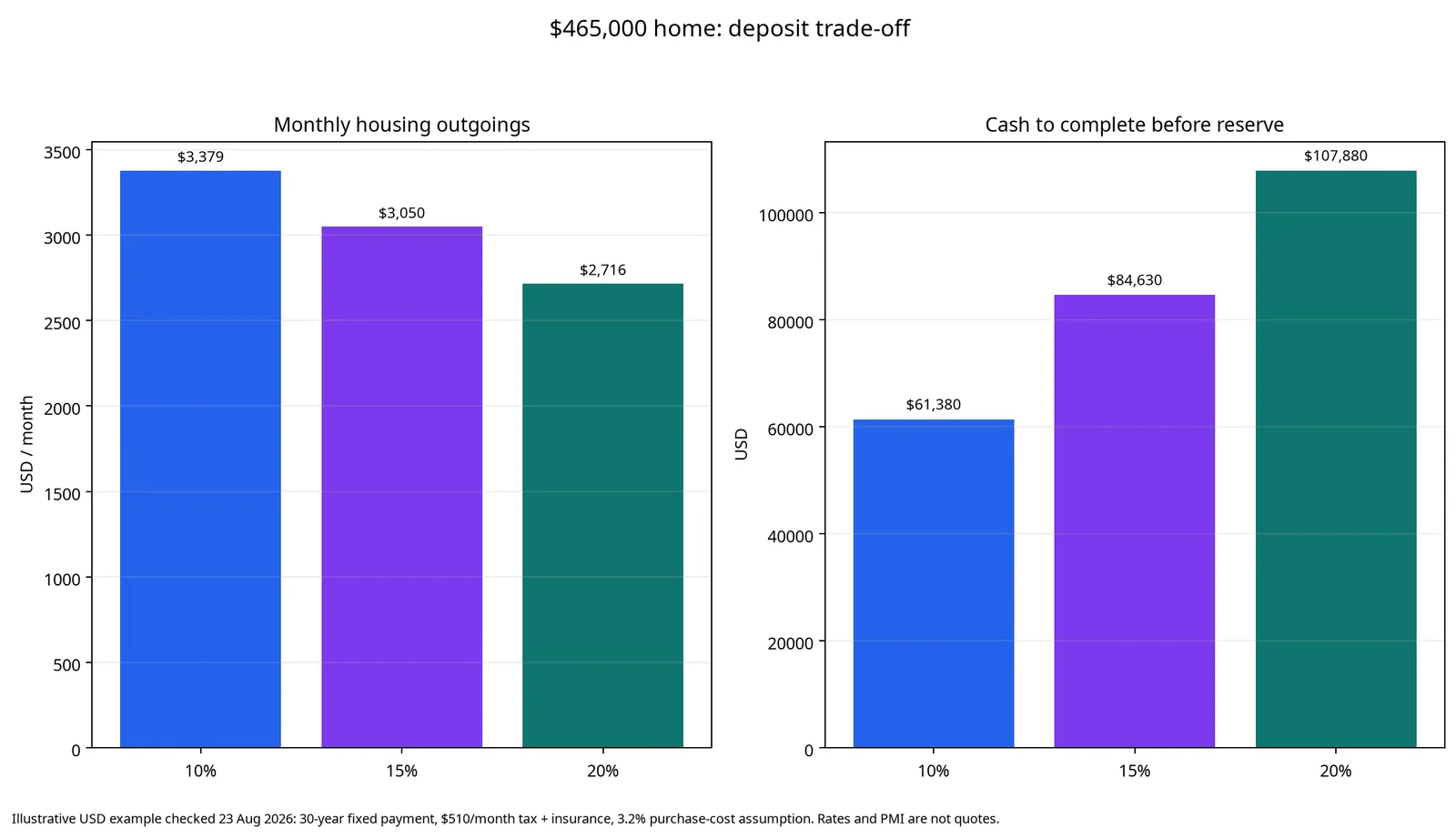
- For the worked USD example, moving from 10% to 20% down raises cash-to-complete from $61,380 to $107,880 but lowers the illustrative monthly outgoings from $3,379 to $2,716.
Editorial and commercial note: LashkariProperties' examples are deterministic planning illustrations; no lender, insurer or government scheme is promising the rates, PMI/LMI amounts or eligibility shown. Verify the current product terms and do not enter identity numbers or sensitive documents into calculators.
| Route | Starting deposit / LTV signal | What it is—and what it is not |
|---|---|---|
| US FHA | 3.5% on an eligible FHA route | HUD loan program; borrower, property, loan-limit and mortgage-insurance rules apply |
| UK 2025 Mortgage Guarantee Scheme | 5% deposit / 95% LTV route | Permanent guarantee supports participating lenders; eligibility and lender terms apply |
| Australia 5% Deposit Scheme | 5% first-home buyer; 2% single parent/legal guardian | Government guarantee through participating lender; price caps and owner-occupier obligations apply |
| UAE expat first owner-occupier | CBUAE maximum 80% LTV below AED 5m = 20% deposit | Regulatory maximum, not a guaranteed bank offer; higher deposit for larger, investment or off-plan property |
People ask how much deposit they need as if there is a single legal minimum. There is not. There is a lender minimum, a market-competitive minimum, and a cash-on-completion number that is always larger than the deposit. Confusing those three is how buyers either wait two years too long or arrive at the solicitor's office a few thousand short.
The deposit is the slice of the price you do not borrow. Lenders care because it is their cushion if they have to sell the home in a hurry. A larger deposit usually means a lower loan-to-value ratio, a wider choice of products, and often a better rate. It is not a moral achievement. It is a risk-sharing arrangement.
Why 20 percent became the dinner-party number
In many markets, 20 percent is the point where lenders stop charging mortgage insurance or a high loan-to-value fee. At that threshold the loan is 80 percent of the value, which is a ratio credit committees have lived with for a long time. Below it, you can often still buy. You just rent the extra risk from an insurer, or you pay a thicker interest rate, or both.
Some schemes, family guarantees, and first-time-buyer products allow deposits of 5 or 10 percent. Those products exist because governments and lenders want transactions to happen, not because a 5 percent cushion is comfortable. If the valuation comes in light, or prices dip in the first year, a thin deposit can vanish on paper while you still owe the full loan.
The cash you need is not the deposit
Completion day also wants purchase costs: legal fees, searches, land-registry fees, lender arrangement fees, a survey, and in some countries a transfer tax. On top of that you still need a household reserve. A buyer who spends the last dollar on the deposit has financed the purchase and defunded the life that follows it.
A useful personal rule is to treat cash in three buckets. Bucket one is the deposit the lender will accept. Bucket two is the purchase-cost budget, which you should estimate before you offer. Bucket three is three to six months of the full housing payment plus a repair float. If filling bucket one empties the other two, the deposit is too large for your savings, even if it looks respectable as a percentage.
Worked comparison on a $465,000 home
Take a home priced at $465,000. This is a USD/US planning worksheet checked 23 August 2026, not a quote. Assumptions: 30-year fixed-payment loan; purchase costs 3.2% ($14,880); property tax plus insurance $510/month; illustrative rates of 6.4%, 6.15% and 5.9% for 10%, 15% and 20% down; illustrative PMI of $251, $132 and $0. Replace every input with your lender, tax bill, insurance quote and product rules.
- 10% down: $46,500 deposit; $418,500 loan; illustrative rate 6.4%; P&I $2,617.74; PMI assumption $251; tax/insurance $510; total $3,378.74/month; cash-to-complete $61,380.
- 15% down: $69,750 deposit; $395,250 loan; illustrative rate 6.15%; P&I $2,407.97; PMI assumption $132; tax/insurance $510; total $3,049.97/month; cash-to-complete $84,630.
- 20% down: $93,000 deposit; $372,000 loan; illustrative rate 5.9%; P&I $2,206.47; PMI assumption $0; tax/insurance $510; total $2,716.47/month; cash-to-complete $107,880.
| Deposit | Deposit + loan | Monthly total | Cash-to-complete before reserve |
|---|---|---|---|
| 10% | $46,500 + $418,500 | $3,378.74 | $61,380 |
| 15% | $69,750 + $395,250 | $3,049.97 | $84,630 |
| 20% | $93,000 + $372,000 | $2,716.47 | $107,880 |
Moving from 10% to 20% costs an extra $46,500 of savings today and lowers this illustrative monthly total by $662.27. That monthly gap is not a promise: it depends on the rate, insurance and costs available to the actual borrower. The 20% buyer still has to produce the extra cash first, so compare the saving against the reserve you would give up.
The cost of waiting for 20 percent
Suppose you already have the 10 percent path covered and you can save $1,400 a month toward the extra $46,500. That is about 33 months. If prices on this street rise 4 percent a year, the same home is about $518,000 by the time you arrive. Ten percent of that new price is already $51,800, and 20 percent is $103,600. You spent almost three years chasing a percentage that moved while you saved. You also paid rent in the meantime.
The opposite mistake is rushing in with a thin deposit in a market that is already stretching your income. Mortgage insurance is not the villain in that story. The villain is a payment that only works if nobody needs a new car, a baby, or a quieter job. The 10 percent example above is a $3,379 housing outgoing. On a $78,000 household income that is more than half of pre-tax pay once you add utilities and a repair budget. The deposit percentage cannot rescue that.
How to choose a number that fits the year you are living
Start from the payment you can carry on a slightly worse rate than you have been quoted, not from a target percentage you saw online. Then ask what deposit produces that payment on this price. Then ask whether that deposit still leaves purchase costs and a reserve. If the answer is no, the house is too expensive, or the timeline is too short, or both. A smaller home with a thicker reserve is a more grown-up purchase than a larger home that makes you one boiler away from the overdraft.
Family gifts and borrowed deposits need extra care. Lenders will ask where the money came from. A gift usually needs a letter. A loan from a relative is often treated as more debt, which can shrink the mortgage you are offered. Do not invent a paper trail after the fact.
Common mistakes
- Treating 20 percent as a law rather than a pricing threshold
- Budgeting the deposit and forgetting purchase costs
- Draining emergency savings to avoid mortgage insurance
- Ignoring the rate improvement that a larger deposit can buy, or overstating it
- Waiting for a round-number deposit while rents and prices both rise
- Using a borrowed deposit that the lender will count against affordability
How to use the free calculators
Use the Down Payment Calculator to see how each deposit percentage changes the loan size on your target price. Run the PMI Calculator on the same loan so the insurance line is a number, not a rumour. If you are still saving, the Down Payment Savings Calculator will tell you how many months a given monthly transfer actually takes, which is the input you need before you decide to wait. Finally, put legal fees, taxes, and lender fees through the Closing Cost Calculator so the cash-on-completion figure includes more than the deposit.
Deposit expectations by country
The minimums below are starting points, not promises. In the US, HUD's FHA route says a down payment can be as low as 3.5% for eligible borrowers, while conventional and VA products have separate lender/program rules; do not use a blanket 5% or 20% rule. In the UK, HM Treasury's permanent 2025 Mortgage Guarantee Scheme supports eligible first-time buyers and home movers with a deposit as small as 5% through participating lenders. In Australia, the government 5% Deposit Scheme states eligible first-home buyers can use 5% and eligible single parents/legal guardians 2%, with price caps and obligations; outside that scheme, Moneysmart says 20% avoids LMI and smaller deposits can cost more. In the UAE, CBUAE's current maximums imply 20% for an expat first owner-occupier below AED 5m, 30% above AED 5m, 40% for second/investment property and 50% for off-plan; bank policy can be stricter.
- US: HUD FHA route from 3.5% for eligible borrowers; other products have distinct rules and PMI/fees
- UK: 5% is a supported route under HM Treasury's 2025 scheme for eligible first-time buyers and home movers
- Australia: 5% first-home buyer or 2% single-parent government scheme routes; 20% generally avoids LMI outside a guarantee
- UAE: CBUAE implies 20% expat first owner-occupier below AED 5m, 30% above, 40% investment/second and 50% off-plan
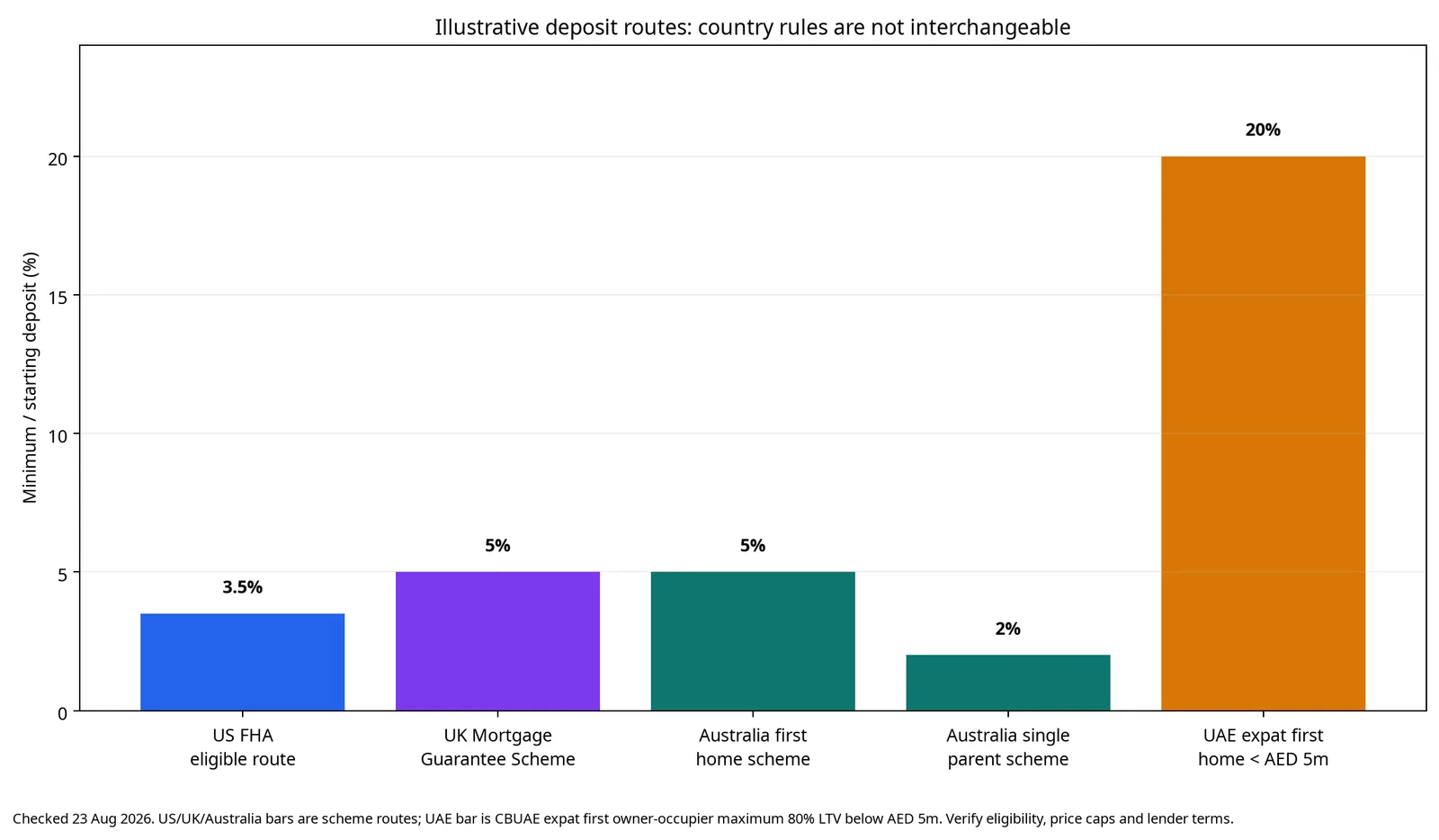
The pattern to notice is that the market with the smallest minimum usually has the loudest insurance industry. Thin deposits are not free anywhere. They are financed through insurance, higher rates, or both. Compare the monthly cost of a thin deposit against the years of saving for a thick one, using your own numbers rather than a percentage from a forum.
Deposit, loan-to-value, and the rate you are offered
Deposit percentage and loan-to-value are the same number seen from opposite sides: 20 percent down is an 80 percent loan. Lenders price risk in bands, so the rate can step down as the deposit grows. On the $465,000 example above, moving from 10 percent to 20 percent down cut the quoted rate from 6.4 percent to 5.9 percent and removed the insurance line entirely. The monthly saving was about $663 — roughly $1,100 of that from the smaller loan, the rest from the better rate and the vanished insurance.
- 80 percent LTV (20 percent down): typically the best mainstream rates, no mortgage insurance
- 85-90 percent LTV (10-15 percent down): slightly higher rates, mortgage insurance almost always applies
- 95 percent LTV (5 percent down): highest rates, insurance or a scheme required, thinnest cushion if prices dip
- A second valuation problem: a thin deposit plus a low valuation means the loan may shrink after you have offered
Ask lenders for the same loan at two deposit levels and write down both offers. The gap is the price of a thinner cushion, and it is the honest way to decide whether the extra saving months are worth it. A deposit that buys a 0.5 point rate drop on a large loan can repay itself faster than almost any other negotiation you will have with a lender.
Deposit myths that cost people money
Three myths do more damage than any lender's fine print. Myth one: 'the bigger the deposit, the better.' Not if it empties your reserve — a 30 percent deposit with nothing left for a broken boiler is a different kind of fragility than 10 percent with six months of payments in the bank. Myth two: 'the minimum deposit is what you should bring.' The minimum exists to let lenders make loans, not to protect you; bring the minimum only after you have priced the insurance and the higher rate it implies. Myth three: 'the deposit percentage is the whole cost of entry.' The cash-to-complete is the deposit plus purchase costs, and a buyer who forgets the second half of that sentence is the buyer who calls the solicitor in week seven asking for an extension.
- Bigger is not automatically better — the reserve matters more
- The minimum deposit is a lender's product, not a buyer's strategy
- Cash-to-complete = deposit + purchase costs, always
- A thin deposit financed by borrowed money is usually counted as more debt
Worked deposits on a $300,000 home, country by country
A $300,000 home makes the country differences concrete. In the US, an FHA buyer could enter at about $10,500 (3.5 percent) with mortgage insurance, or a conventional buyer at $15,000 (5 percent) with PMI until 20 percent equity. In the UK, a first-time buyer at 5 percent would put down £15,000 under a backed scheme, or £30,000 at a plain 10 percent. In Australia, a 5 percent deposit is A $15,000, and the Lenders Mortgage Insurance on a A $285,000 loan would be on the order of A $7,000 — a fee that exists purely because the deposit is thin. In the UAE, an expat buyer at 25 percent would need US $75,000.
- US: about $10,500 at 3.5 percent, or $15,000 at 5 percent, plus mortgage insurance
- UK: £15,000 at 5 percent under a first-time scheme, or £30,000 at 10 percent
- Australia: A $15,000 at 5 percent, plus roughly A $7,000 of LMI
- UAE: US $75,000 at 25 percent for a typical expat purchase
Notice that the markets with the lowest entry deposits charge for the privilege through insurance and higher rates, while the market with the highest minimum simply prices the risk into the deposit itself. Whichever country you buy in, the discipline is identical: decide the monthly payment you can carry at a stressed rate, work out which deposit produces it, and only then check whether the savings plan can reach that deposit without emptying your reserve.
In practice, the deposit question is really a question about two balances you cannot see on the same screen: the savings you have today and the payment you can carry tomorrow. The percentage is the language the market uses, but the decision is made in monthly cash at a stressed rate, with the reserve intact. Choose the deposit that keeps both of those lines healthy, ignore the round numbers other people quote, and let the calculators do the arithmetic that your optimism should never be allowed to do alone.
Sources and check dates
- [1] HUD — Let FHA Loans Help You — official FHA route identified; direct page access was Cloudflare-blocked during the 23 August 2026 check, so confirm current eligibility and loan limits with HUD/lender.
- [2] HM Treasury — 2025 Mortgage Guarantee Scheme — published 15 July 2025; permanent 5% deposit route for eligible first-time buyers and home movers through participating lenders; checked 23 August 2026.
- [3] Australian Government — 5% Deposit Scheme — 5% eligible first-home buyers / 2% eligible single parents or legal guardians; page checked 23 August 2026.
- [4] ASIC Moneysmart — Buying a house — last updated 14 July 2026; 20% avoids LMI, smaller deposits may cost more, compare lenders and add buying costs; checked 23 August 2026.
- [5] CBUAE — Regulations Regarding Mortgage Loans — in-force LTV framework: expat first owner-occupier 80% below AED 5m, 70% above, 60% investment/second, 50% off-plan; checked 23 August 2026.
- [6] MoneyHelper — How much deposit do I need to buy a house? — consumer route for UK deposit planning; checked 23 August 2026.
Related reading
Continue reading: The 28/36 Rule: Still Useful in 2026? · Closing Costs Explained for Buyers · Debt-to-Income Ratio for Home Buyers. Run your own numbers with the Down Payment Calculator — it takes under a minute and beats guessing.
Deposit requirements by buyer type
Buyer type changes the route, but it does not remove underwriting. In the US, HUD's FHA route can start at 3.5% for eligible borrowers and VA products have their own eligible-service-member rules; conventional lender/program rules differ. In the UK, HM Treasury's 2025 Mortgage Guarantee Scheme supports eligible first-time buyers and home movers from 5%. In Australia, the government scheme states 5% for eligible first-home buyers and 2% for eligible single parents/legal guardians; outside that route, Moneysmart says 20% avoids LMI. In the UAE, CBUAE's framework implies 20% for an expat first owner-occupier below AED 5m, 30% above, 40% for investment/second properties and 50% off-plan. Treat 20% as a comparison point, not a universal recommendation.
Frequently asked questions
What is the minimum deposit to buy a house?
There is no single global minimum. An eligible US FHA route can start at 3.5%; HM Treasury's UK scheme supports eligible buyers from 5%; Australia's government scheme starts at 5% for eligible first-home buyers or 2% for eligible single parents/legal guardians; and CBUAE implies 20% for an expat first owner-occupier below AED 5m, with higher deposits for other UAE categories. Lender, property, residency and scheme rules control.
Is a 20 percent deposit required?
No. Twenty percent is the threshold where most lenders stop charging mortgage insurance and start offering their best rates. It is a pricing milestone, not a legal requirement, and many buyers purchase successfully with 5 to 15 percent down.
How much deposit do I need for a first home?
First-time buyer schemes in several countries allow 5 percent or less. On a $465,000 home, 10 percent down is $46,500 but adds mortgage insurance and a higher rate; 20 percent is $93,000 and removes both. The right number depends on your savings, your monthly budget, and how long you can wait.
Do I need mortgage insurance if my deposit is under 20 percent?
It depends on the country and product. US FHA has mortgage-insurance rules; Australian LMI often applies below 20% outside an eligible government guarantee; UK fees and product pricing vary; Canadian default insurance is typically required below 20%; and UAE LTV rules are regulatory rather than a single PMI threshold. Confirm the lender/insurer terms and whether any insurance can be cancelled or ends automatically.
How long will it take me to save a deposit?
Divide the extra deposit you need by your monthly saving rate. In the example above, saving the additional $46,500 at $1,400 a month takes about 33 months — and if prices rise 4 percent a year meanwhile, the goal moves. Run the Down Payment Savings Calculator with your own numbers before deciding to wait.
Can I use a gift or a loan for my deposit?
Yes, but lenders scrutinise the source of the money. A gift usually needs a signed letter confirming it is not repayable, while a loan from a relative is often counted as additional debt, which can shrink the mortgage you are offered. Never invent a paper trail after the fact.
Can a 5 percent deposit really beat the PMI cost of waiting?
There is no universal answer because PMI/LMI pricing, cancellation, rate offers, rent and house prices are borrower- and market-specific. Compare the smaller-deposit path's monthly insurance/rate cost with the opportunity cost of waiting, and run both paths using dated assumptions in the Down Payment Calculator. Do not treat a 4% appreciation assumption or a generic PMI amount as a forecast.
This article is educational only. It is not financial advice, a lending decision, or a recommendation of any deposit size. Product rules, insurance thresholds, and minimum deposits differ by country and lender. Confirm the live requirements with your lender or broker before you offer.