


Why the refinance question is trickier than it sounds
Every time long-term interest rates move, an old question resurfaces: should I refinance my mortgage?Blogs answer it with a rule of thumb — "refinance if the rate drops by 1%" or "always refinance when you can save $100 a month." Both are half-truths that cost real money when applied to the wrong loan, in the wrong market, for the wrong borrower.
Refinancing is a swap. You retire an existing loan and replace it with a new one, usually by paying a stack of one-time costs — origination, appraisal, title, and various government or bank fees. In exchange, you get a lower rate, a different term, a switch from adjustable to fixed, cash from equity, or some combination. Whether that swap makes sense depends on three variables: the size of your rate delta, the size of your total refinance costs, and the length of your expected holding period.
This guide is a math-first walkthrough of every one of those variables. You will finish it able to open a Loan Estimate, plug the numbers into a calculator like the LashkariProperties Refinance Calculator, and know within twenty minutes whether refinancing helps you — or whether the shiny "save $237 a month!" headline is quietly hiding a break-even point longer than you plan to keep the house.
We will draw examples from all five Tier-1 property markets — the United States, the United Kingdom,Canada,Australia, and the UAE — because the mechanics are universal but the costs, terminology, and penalties differ dramatically.
The stakes: what a wrong refinance costs you
To put the stakes in concrete numbers: on a US$200,000 loan, a poorly-timed refinance that adds three years to your amortization schedule while lowering the rate 0.5% typically increases lifetime interest paid by roughly US$28,000–US$26,000, even though the monthly payment drops. Conversely, a well-timed refinance from 7.25% down to 5.75% on the same balance — with fees kept under US$2,500 and a 7-year hold — saves the household roughly US$28,000 in interest and reaches break-even in about 15 months. Same loan, same borrower, same market — a US$20,000+ swing between the good and the bad version of the same decision.
That gap exists because refinancing compounds three interacting variables. Get one wrong and the other two can't rescue you. Get all three right and the outcome is one of the largest, cleanest wins available to an ordinary household — better than any single investment decision most families will make in a decade.
Homeowners weighing a refinance, first-time landlords stress-testing an investment property, and anyone deciding between a refinance and a cheaper alternative such as recasting or making extra principal payments.
This article is educational. Refinance rules, tax treatment, and lender criteria vary by country, state and lender. Confirm your specific numbers with a licensed mortgage professional in your market before committing.
Key definitions and the break-even formula
Before running any numbers, standardise the vocabulary. Small terminology slips are the single most common reason DIY refinance math goes wrong.
Note rate vs APR
Thenote rate is the interest rate stamped on your promissory note — what actually accrues on your balance every month. The APR (annual percentage rate) is a legally-defined figure that layers in most closing costs to help you compare loans on the same footing. For monthly-payment math you always want the note rate. For comparing lenders, APR is the tiebreaker.
Principal & interest vs full PITI
Your full monthly housing payment is often called PITI: principal, interest, taxes and insurance. Only principal and interest (P&I) actually change when you refinance the mortgage itself — taxes and homeowner's insurance change on their own schedule. Comparing full PITI to full PITI will overstate your "savings" whenever your escrow account was under-collected before the refinance.
Loan-to-value (LTV)
LTV is the loan balance divided by the property's appraised value. It drives pricing tiers, mortgage insurance requirements, and whether a cash-out refinance is even possible. In the US, cash-out is typically capped at 80% LTV; in Australia the same limit triggers LMI (Lender's Mortgage Insurance) if crossed.
Break-even months — the one formula that matters
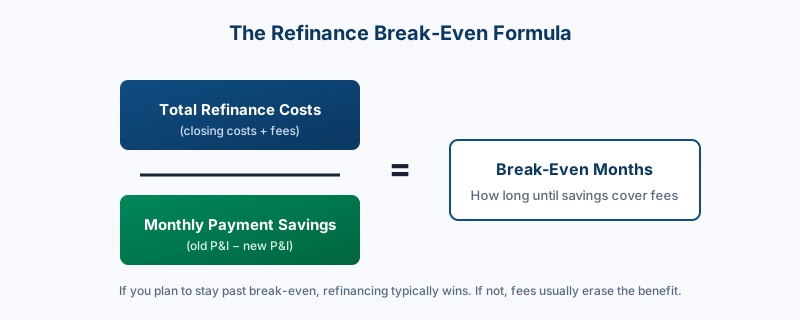
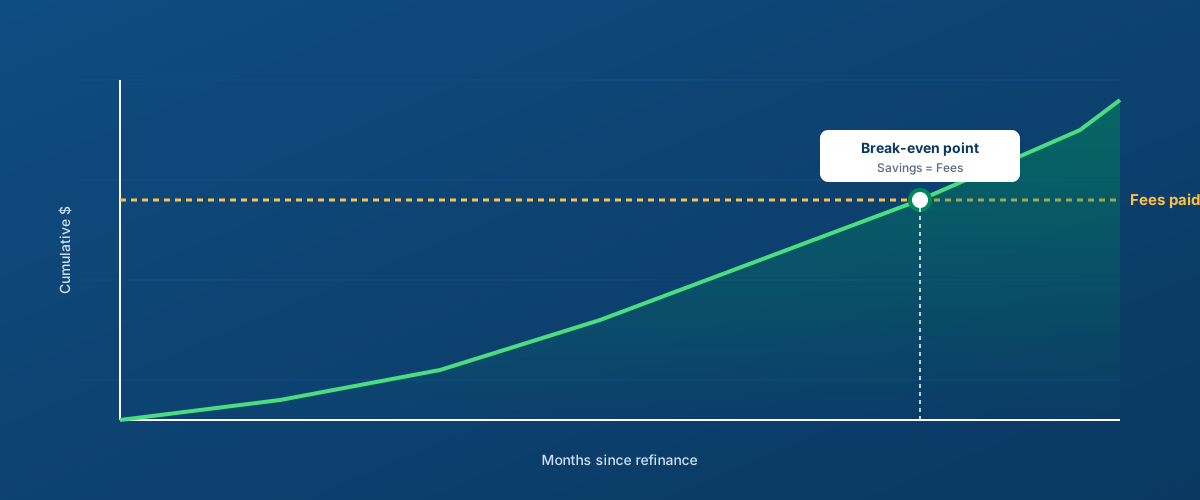
Break-Even (months) = Total Refinance Costs ÷ Monthly P&I Savings
If your total refinance costs are US$2,000 and the new loan lowers your principal-and-interest payment by US$280 per month, break-even is 6,000 ÷ 180 = 33.3 months. Refinance if you plan to hold the mortgage well past that point; skip it if you don't.
The formula is deceptively simple, and that's the problem: three sub-inputs — costs, savings, and holding period — each have quiet trip-wires we'll cover throughout the guide.
Why the decision matters for buyers, landlords and investors
The refinance decision is not equally consequential for every audience. Framing it by user type sharpens what to optimise for.
For homeowners
Lower rate ≠ lower lifetime cost. Reset the amortization clock on a 30-year loan five years in, and the new payment can be smaller while you end up paying more interest over the life of the loan. Homeowners who care about "monthly cash flow now" should refinance freely if break-even is favourable; those who care about "lifetime interest" should model the alternative of keeping the old loan and making extra principal payments — often a better answer.
For landlords and property investors
Landlords face a different arithmetic. Lower monthly P&I raises monthly cash flow directly. A cash-out refinance can free equity for the next acquisition. But refinance costs are usually not immediately deductible; they are amortised over the life of the loan in many jurisdictions, which changes the after-tax break-even and often stretches it by 8–14 months. Talk to a local tax adviser before assuming the pre-tax break-even holds.
For buyers about to close
If you have not yet closed the purchase, refinance math still matters — because the loan you originate now is the loan you will refinance later. Higher points, higher origination and higher lender-paid third-party fees today make the future refinance a smaller win. Ask for apar rate quote (no points, no lender credit) alongside your standard quote so you know the baseline.
Refinancing is not a rate decision. It is a rate times time minus fees decision — and time is the variable most people misjudge.
The behavioural trap: recency bias in rate shopping
There is one more reason the decision matters more than borrowers realise. Human beings anchor on the most recent rate they've seen. A borrower who signed at 7.5% at the peak of a rate cycle experiences 6.25% as a "huge win" and rushes to refinance. A borrower who signed at 3.0% during a trough experiences the same 6.25% as absurdly expensive and refuses to consider it — even if their situation (job change, divorce, cash-out for a growing family) would justify the switch. Neither reference point is relevant. The only rate that matters is what your current loan charges you today versus what a new loan would charge you tomorrow, adjusted for the fees and holding period we cover throughout this guide.
Purge the anchor. Look at the raw numbers.
A 6-step decision process
Use this exact sequence to move from "I'm curious" to "I've decided." It's ordered so you can quit at any step with a defensible answer.
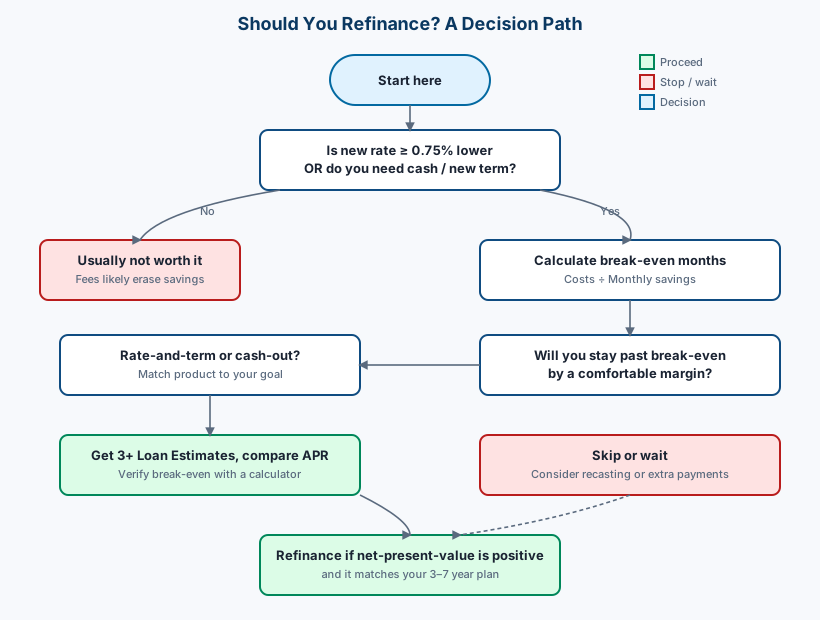
Step 1 — Confirm the true rate delta
Ask three lenders for a written Loan Estimate (US),Mortgage Illustration/ KFI (UK),mortgage disclosure (Canada),Key Facts Sheet (Australia) or Key Facts Statement (UAE). Use the same loan type and term. Ignore rate-only teasers on websites; only a real disclosure includes fees and points.
Step 2 — Add up the real refinance costs
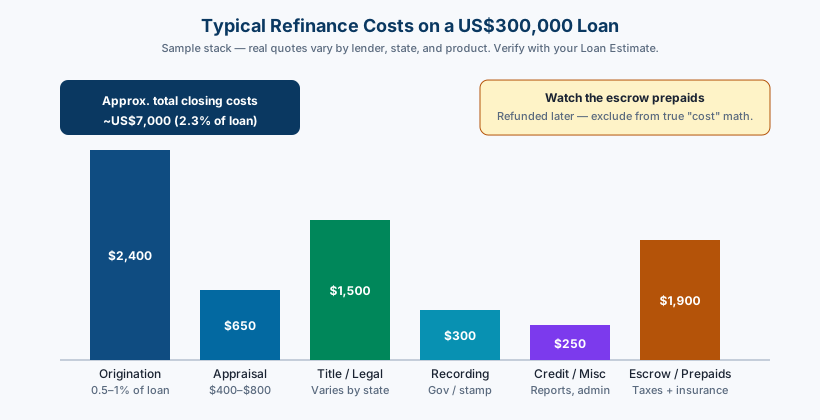
Sum origination, discount points, appraisal, credit report, title/attorney, government recording, and any lender-charged admin fees. Exclude prepaid escrow (property taxes and insurance you fund at closing) — those funds go into an account you would have paid into anyway, and your old escrow account will be refunded to you.
Step 3 — Recalculate the new P&I
Use the standard amortization formula, a spreadsheet, or the LashkariProperties Mortgage Calculator. Plug in your new balance (old balance + any rolled-in costs), new rate, and new term.
Step 4 — Compute the true monthly savings
Old P&I − New P&I = Monthly Savings. Do not include taxes or insurance in this line. If the new payment includes PMI you didn't have before (because you took a cash-out that pushed LTV above 80%), subtract the PMI premium from your savings first.
Step 5 — Divide, then sanity-check against your holding period
Divide costs by savings. That is your break-even in months. Compare to how long you honestly expect to keep this mortgage. If break-even is less than half your expected holding period, the refinance is a strong candidate. If it is more than 80% of your holding period, walk away — the margin of safety is gone.
Step 6 — Stress-test the plan
Run three what-ifs: (1) you move 24 months earlier than expected; (2) rates drop another 0.5% within 18 months and a fresh refinance beckons; (3) your income drops and you can't make voluntary principal payments. If the refinance still looks smart in at least two of the three, proceed. Otherwise, wait or take ano-cost refinance where the lender pays fees in exchange for a slightly higher rate — a safer bet when the holding period is uncertain.
Get all three Loan Estimates on the same day. Rates and fees move; comparing one lender's Monday quote to another's Thursday quote makes the difference look bigger than it is.
Documents to collect before Step 1
Refinance underwriting in every Tier-1 market runs on the same handful of documents. Pull them togetherbeforerequesting quotes so you can respond to lender questions inside 24 hours — the borrowers who close fastest almost always secure the tightest pricing because rate locks stay short.
- Two years of tax returns (self-employed borrowers should include profit-and-loss statements year-to-date).
- Two months of pay stubs, or the local equivalent employment verification.
- Two months of statements for every account you intend to reference for reserves.
- A current mortgage statement showing the exact payoff balance, note rate, and remaining term.
- A homeowners insurance declaration page. Refinance lenders re-verify coverage before closing.
- Photo ID and, in some markets, proof of residency or immigration status for non-citizens.
Timing: the calendar affects your rate more than most borrowers realise
Beyond documents, timing itself is a lever. Refinance applications historically spike whenever benchmark rates drop; lenders respond by widening their margins during those windows, meaning the quoted refinance rate lags the underlying index. Applyingbeforethe herd — often mid-week, mid-month, and outside of end-of-quarter volume rushes — can shave 5–15 basis points off your quote. Not enough to swing the break-even alone, but on a US$200,000 loan, 10 basis points equals roughly US$250 in first-year interest savings for free.
Three worked numerical examples
These examples use round numbers for clarity and illustrate the same formula applied to different scenarios. All figures are illustrative — your actual quote drives the real decision.
Example 1 — The classic rate-and-term win (USA)
- Current loan: US$200,000 balance, 6.75% fixed, 27 years remaining (originated as 30-year)
- Current P&I: $1,946
- New quote: 5.75% fixed, fresh 30-year term, closing costs US$2,000
- New P&I on $306,000 (rolling in costs): $1,786
- Monthly savings: $160
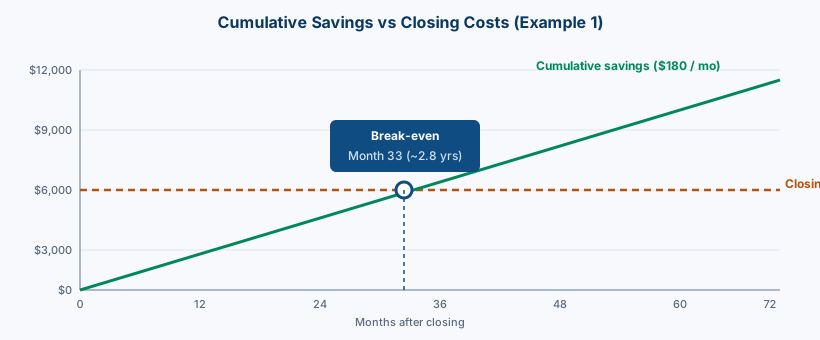
Break-even = 6,000 ÷ 160 = 37.5 months. If this borrower plans to stay 7+ years, they save meaningful money. If they might sell within four years, the refinance is a coin toss — and if they roll the fees into the loan (as here) they also lose the interest paid on those fees for the life of the loan.
Rolling from a 27-year loan into a fresh 30-year adds 3 years of interest. Even at a lower rate, a naïve refinance can raise lifetime interest cost. To avoid this, choose a 25- or 27-year custom term, or keep the 30 and voluntarily pay the old principal amount each month.
Example 2 — The break-even trap (Canada)
- Current loan: C$250,000 balance, 5.24% fixed, 3.5 years into a 5-year fix
- Contract rate available today: 4.24% (a full 1.00% lower)
- Prepayment penalty using the Interest Rate Differential: ~C$2,800
- Legal, appraisal and discharge: ~C$2,700
- Total cost: C$21,500. Monthly savings after re-amortising over a new 5-year fix: C$248
Break-even = 11,500 ÷ 248 = 46.4 months. That's longer than the remaining 18 months on the current fix. Waiting until the current term ends eliminates the IRD penalty entirely and reduces total cost to ~C$2,700, dropping break-even to under 7 months. In Canada,timing the refinance to the fixed-rate maturity is often worth more than shaving another 25 basis points off the rate.
Example 3 — A defensible cash-out (UK)
- Property value: £480,000. Current remortgage balance: £288,000 (60% LTV)
- Current rate: 5.14% tracker
- New remortgage: £360,000 at 4.39% 5-year fix (75% LTV), £30,000 released as cash to pay off a 22% APR credit-card balance and £42,000 held to fund a rental deposit
- Product + legal fees: £1,700
The comparison here is not just "old mortgage vs new mortgage." It is the blended cost of debt before and after. Before: £288K at 5.14% plus £30K at 22%. After: £360K at 4.39%. The weighted blended rate drops from ~6.7% to 4.39%, and the freed £42K supports a next-property purchase that projects agross rental yield around 6.1%. Even after fees, this cash-out remortgage is defensible — because it retires a very expensive debt and finances an asset that produces income above the new borrowing cost.
The maths above works only because expensive short-term debt is being retired and the freed equity funds a productive asset. Cash-out to finance depreciating purchases (cars, holidays) rarely survives a serious break-even test.
Example 4 — The investor's refinance (Australia)
- Investment property value: A$220,000. Current interest-only loan: A$270,000
- Current rate: 6.89% variable (interest-only) — monthly interest cost A$2,271
- New offer: 6.14% variable interest-only from a competing lender, plus A$2,500 cashback
- Switching costs: A$250 discharge, A$200 new lender fees. Net cost after cashback: A $-2,050 (a net rebate)
- New monthly interest cost: A$2,916
- Monthly savings: A$255
Because the cashback exceeds switching costs, the effective break-even is negative — the borrower is paid to switch. The trap: many Australian cashback offers come attached to a two-year clawback clause. Sell or refinance again within that window and the cashback is billed back to you. As long as the investor plans to hold both the property and the mortgage past the clawback period, this refinance is a straightforward win — one of the very rare mortgages where the honest break-even truly is "day one."
Example 5 — When you should walk away (USA)
- Current loan: US$218,000 balance, 5.99% fixed, 22 years remaining
- Current P&I: $806
- New quote: 5.375% fixed, fresh 30-year, closing costs US$2,400
- New P&I: $690 (with fees rolled in on a $123,400 balance)
- Monthly savings: $116
Break-even here is 5,400 ÷ 116 = 46.6 months. That looks acceptable if you'll stay another 8+ years. But look at the lifetime cost: the current loan pays about US$22,000 in remaining interest; the new 30-year loan pays about US$213,000 in interest. Even at the lower rate, extending the term by 8 years costs the borrower an extra US$21,000 over the life of the loan.
The rescue is to choose the term. Many US lenders will originate a refinance at any whole-year term from 8 to 30. Setting a custom 22-year term matches the current amortization schedule, keeps monthly savings at ~$70/month (smaller but real), and reduces lifetime interest instead of ballooning it. The lesson: never let the lender's default term dictate the deal.
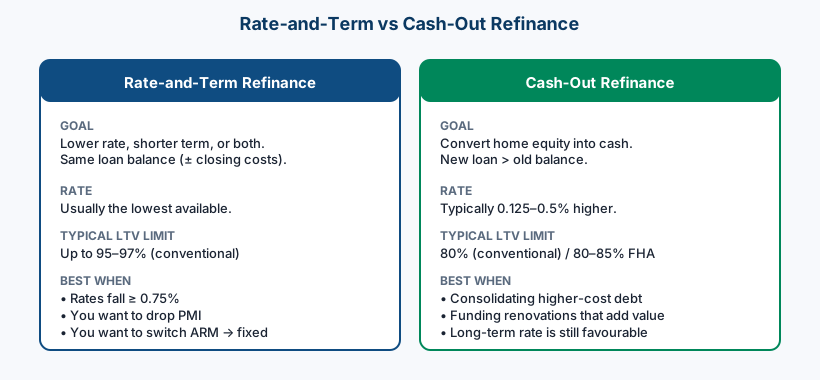
Rate-and-term vs cash-out refinance
The two products look similar on the outside — one loan replacing another — but they price and behave differently.
Rate-and-term: the pure cost swap
Rate-and-term refinancing keeps the loan balance roughly identical (the only change is any closing costs you elect to roll in). The goal is a lower rate, a shorter term, a longer term, an ARM-to-fixed conversion, or the removal of mortgage insurance once you have earned enough equity. Because there is no equity extraction, lenders offer their best pricing here and allow the highest LTVs.
Cash-out: leveraging equity
Cash-out increases your loan balance and hands you the difference. Lenders treat this as riskier and price accordingly — typically 0.125% to 0.5% higher than a rate-and-term at the same LTV. Conventional US cash-out is usually capped at 80% LTV; UK cash-out remortgages up to 85% LTV are common for owner-occupiers but often only 75% for buy-to-let landlords; Australia's cash-out policies vary by lender and often require a stated purpose above a threshold (e.g., A$20,000).
When each wins
Rate-and-term wins whenever your goal is simply "lower monthly P&I" or "off my ARM before its next reset." Cash-out wins only when the returns on the freed capital reliably exceed the new blended cost of debt after fees and taxes — for example retiring high-APR debt, funding value-additive renovations, or acquiring an income-producing property whose expected net yield beats the new mortgage rate by a comfortable margin.
When fees erase the benefit
This is the section most refinance write-ups skip. Fees don't just delay the win; on the wrong loan they eliminate it. Watch for these five silent killers.
1) A small loan balance
Refinance costs are largely fixed. On a US$200,000 loan a 1% rate drop saves about US$20 per month; on US$200,000 the same 1% saves about US$200 per month. Fees are similar in both cases (US$2,000–US$2,000). Break-even at $100K is 7+ years; at $500K it can be 20 months.
2) A short remaining holding period
Most borrowers overestimate how long they'll stay in a home. US Census data suggests a typical owner sells within ~13 years, but the median move for a mortgage refinancer is closer to 7 years, and for job-mobile professionals often 3–5. Use your realistic plan, not your emotional plan.
3) A near-final amortization schedule
Refinancing a loan with only 4–6 years remaining rarely pays. Nearly the entire monthly payment is now principal, so the rate savings on the interest portion are small; meanwhile you may reset amortization and pay materially more interest overall.
4) Discount points on a short hold
A discount point costs 1% of loan amount up front for typically 0.25% rate reduction. Payback runs 4–7 years depending on loan size. On short holds, points destroy the deal — take zero points even at a slightly higher rate.
5) A no-closing-cost quote hiding a rate hike
"No-cost" is a marketing term. Either the fees are rolled into the loan (so you pay interest on them) or the rate is bumped ~0.25%–0.5% and the lender pays fees from that spread. Neither is inherently bad — but always compare the true rate-and-term cost against a par-rate quote from the same lender to see which flavour actually breaks even faster for your holding period.
If the loan officer refuses to email you a full Loan Estimate and only quotes over the phone, walk. In the US, lenders are legally required to issue a Loan Estimate within three business days of a completed application.
Tier-1 market nuances
The break-even formula is universal. The inputs are not. Below are the practical differences that most affect the maths in each Tier-1 market.
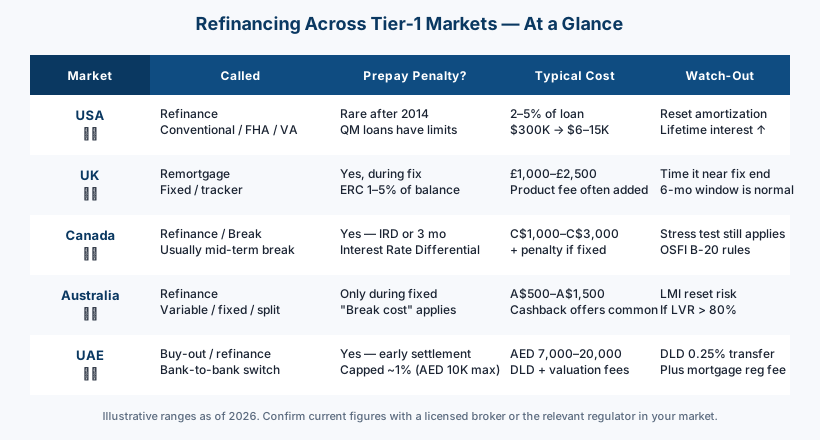
Prepayment penalties are effectively gone from mainstream conforming loans since the CFPB's Qualified Mortgage rule. Streamline programs — FHA Streamline, VA IRRRL, and USDA Streamlined-Assist — let borrowers refinance the same-agency loan with minimal documentation, often no appraisal, and lower fees. If you have one of those loans, price the streamline against a full conventional refinance before assuming the market rate is your best offer.
UK borrowers usually don't have a single 30-year fix; they have a 2-, 3-, 5- or 10-year fix followed by the lender's standard variable rate (SVR). The natural remortgage moment is the last six months of the fix, before rolling onto the (typically much higher) SVR. Breaking a fix triggers an Early Repayment Chargeof 1–5% of balance — often larger than any rate-drop savings.
Canada
The Financial Consumer Agency of Canadarequires clear disclosure of prepayment penalties, but the Interest Rate Differentialpenalty on a fixed rate can be five figures. Post-2018 OSFI B-20 rules also require refinance borrowers to pass a stress test at the greater of the contract rate + 2% or the Bank of Canada 5-year benchmark. A "yes" today does not guarantee a "yes" at renewal — plan accordingly.
Australia
Australia's competitive lender market has produced routine refinance cashback offers of A$2,000–A$2,000 that can offset most switching costs. Above 80% LVR, though, refinancing may retrigger Lender's Mortgage Insurance — a five-figure premium that instantly destroys break-even. Stay under 80% LVR or negotiate LMI portability with your new lender.
UAE
UAE borrowers face an early settlement fee capped by Central Bankregulations at 1% of the outstanding balance or AED 10,000 (whichever is lower). Refinancing means a full buy-out by the new bank, plus DLD 0.25% transfer fee, mortgage registration, and a fresh valuation. Non-resident borrowers should confirm current maximum LTVs (typically 60–65% for expatriates on properties above AED 5m) before assuming a cash-out is possible.
In every Tier-1 market except the US, prepayment or early-settlement charges are the single largest variable in the refinance cost stack. Ask for a written pay-off / redemption statement before touching a Loan Estimate.
Common mistakes and myths
Even numerate borrowers stumble on the same handful of errors. Avoid these to spare yourself an expensive lesson.
Myth 1 — "I should always refinance if the rate is lower"
Only if you clear the break-even hurdle. A 6.75% → 6.25% drop looks great, but on a US$200,000 loan it saves only ~$65/month and you may need 90+ months to recover fees.
Myth 2 — "Restarting the clock is a free way to lower payments"
Extending a 24-year remaining balance back to 30 years lowers the payment but almost always increases total interest paid, often by five figures. If cash flow is the real problem, model a recast before a refinance.
Myth 3 — "Cash-out is free money"
You are borrowing against your own home, at a rate that can outlast the reason you borrowed. Never cash-out for depreciating consumption.
Mistake 1 — Comparing lenders on rate alone
Lender A at 5.75% with 1 point can be worse than Lender B at 5.99% with zero points once you factor break-even. Use APR as the tiebreakerwithinthe same term structure — not across term structures.
Mistake 2 — Ignoring PMI or LMI restart
If your appraisal comes in low and pushes LTV above 80%, private mortgage insurance may attach to the new loan. Mid-cycle PMI can cost US$200–US$250/month and completely reverse the "savings" story.
Mistake 3 — Rate-locking on the wrong day
Rate locks are typically 30, 45 or 60 days. A 60-day lock costs roughly 0.125% more in rate. Match your lock length to your realistic closing timeline; overpaying to lock too long is a hidden fee.
Mistake 4 — Skipping the recast comparison
If your existing loan has an already-good rate and you have cash, a recast (US$250–US$200 fee, no credit pull) can drop your monthly payment more efficiently than refinancing.
Mistake 5 — Assuming your credit score is unchanged
Refinance pricing is tiered by credit score, typically in 20-point brackets (760+, 740–759, 720–739, and so on). A single missed payment or a rising credit utilisation ratio can push you into the next tier and add 0.125–0.375% to your rate. Pull a free credit report before applying and, if your score sits within 20 points of the next-higher tier, spend 30–60 days improving it (paying down cards, disputing errors) before submitting the application. A 20-point score bump often produces more rate reduction than an extra shopping round.
Mistake 6 — Locking the rate on the same day as the application
Rate locks start the clock. Locking before your documents are fully underwritten forces a lender to push closing hard, sometimes at the expense of catching appraisal or title issues that would otherwise let you renegotiate. A calmer sequence: apply on Monday, wait for the appraisal by end of week two, then lock once underwriting has cleared the file. If rates run against you in the meantime, the lender usually offers a modest "float-down" once the loan is clear-to-close.
Myth 4 — "I need perfect credit to refinance"
Refinance minimums are lower than most borrowers expect. Conventional refinances price competitively down to 620 in the US. FHA Streamlines can close with scores in the high 500s if the current loan is FHA-insured and payment history is clean. In the UK, remortgages are still available to borrowers with fair credit; specialist lenders serve the sub-prime segment. Do not self-select out of the process without a rate quote in hand.
How refinance interacts with PMI, LTV, DTI and prepayment
Refinancing doesn't happen in a vacuum. Four related metrics move at the same time — sometimes in your favour, sometimes not.
Refinance decisions ripple through four adjacent metrics
A low appraisal can force PMI or block a cash-out
Removed automatically if LTV ≤ 80%; added if crossed
Can wipe out 30–100% of monthly rate savings
Improves if payment drops; may worsen with cash-out
Affects your ability to qualify for future borrowing
Reset amortization means less principal per payment early on
You lose the "amortization gravity" already earned
Related LashkariProperties guides that pair well with this article: What Is PMI and When Can You Remove It,Closing Costs Explained,How Much House Can I Afford?, and Is a 20% Down Payment Required?.
The rental-yield connection for landlords
For landlords, the refinance decision is inseparable from rental yield. Lowering monthly principal and interest by A$255 raises net cash flow by roughly A$255 (some tax offset applies if interest is deductible in your market). On a A$220,000 property renting for A$2,900 per month, that shift moves the property from ~2.8% net yield to ~3.3% net yield — the difference between a marginal hold and a comfortable one. Investors weighing whether to keep or sell a property should always model the post-refinance yield, not the pre-refinance yield, because that is the number that matters for the next five years of ownership.
Capital growth and the equity-recycling loop
Investors with strong capital growth on an existing property often use a cash-out refinance to fund the deposit on the next acquisition — an approach sometimes called "equity recycling." The refinance math changes materially here because the freed capital produces its own return. A cash-out that raises the blended cost of debt from 4.9% to 5.4% is a bad move on its own, but a great move if the freed A$220,000 funds a 20% deposit on a A$200,000 property projected to grow at 5% annually and yield 4% net. The refinance's break-even should include the expected returns on the recycled capital, not just the mortgage-only maths.
Layering leverage magnifies both wins and losses. A single downturn can wipe out multiple properties funded by cross-collateralised equity. Model at least a 20% price drop before assuming an equity-recycling refinance is safe.
Run the numbers on LashkariProperties
Every calculation in this guide can be verified in a few minutes using the free tools on LashkariProperties. Use them together — no single calculator answers the refinance question alone.
Break-even months, lifetime interest change, and net savings after fees. Start here.
Confirm the new principal & interest at the new rate, balance and term.
Score two or three Loan Estimates head-to-head on APR, break-even and lifetime cost.
Test the "keep the old loan and pay extra principal" alternative before refinancing.
A practical workflow: use the Mortgage Calculatorto compute new P&I, feed that into the Refinance Calculatorfor break-even, then use the Extra Payment Calculatorto test whether making voluntary principal payments on the existing loan matches or beats the refinance's lifetime savings. If it does, keep your current mortgage and redirect the fee money into principal instead. Finally, run the winning quote against your runner-up in the Loan Comparison Calculatorto make sure lender B isn't quietly cheaper over your true holding period.
A one-page refinance checklist
Print this. Tick each box before signing.
- I have written Loan Estimates (or local equivalent) from at least three lenders, all dated within the same week.
- I know my exact break-even in months, based on true monthly P&I savings and total upfront costs.
- My realistic remaining holding period is at least twice my break-even months.
- The new loan does not restart amortization in a way that increases total lifetime interest — or I have voluntarily committed to paying the old principal amount each month.
- My post-refinance LTV keeps me clear of PMI, LMI or higher pricing tiers.
- Any prepayment penalty, ERC or early-settlement fee on my current loan is fully accounted for in the cost side.
- I have compared the winning refinance quote against the "keep the current loan + extra payments" alternative in a calculator.
- I have considered a recast if my current rate is already competitive.
- The refinance passes the three stress tests: early sale, further rate drop, income drop.
- I have a written pay-off / redemption statement from my current lender to verify closing figures.
Ready to run your own break-even?
The LashkariProperties Refinance Calculator gives you break-even months, lifetime interest change, and net savings after fees — free, no login.
The old 1% rule says refinance only if the new rate is at least 1 percentage point lower than the current rate. It is a useful floor for large loans but breaks down on small balances, where fees can outrun savings even at a 1.5% drop. Break-even math is more reliable than any rule of thumb.
How much does it cost to refinance a mortgage?
US refinance closing costs typically run 2%–5% of the loan amount, roughly US$2,000–US$25,000 on a US$200,000 loan. UK remortgages usually cost £1,000–£2,500; Canadian refinances add legal, appraisal and any prepayment penalty; UAE buy-outs incur DLD fees, valuation and early settlement charges.
Refinancing usually does not make sense if your break-even period is longer than the time you plan to stay in the home, if you would restart a nearly paid-off loan, if the new payment strains cash flow, or if credit changes leave you priced above your current rate.
What is the difference between rate-and-term and cash-out refinance?
A rate-and-term refinance replaces your loan to lower the interest rate, shorten or lengthen the term, or both, with roughly the same balance. A cash-out refinance replaces your loan with a larger one and returns the difference as cash — with a slightly higher rate, tighter LTV limits, and new loan-to-value math.
Refinancing from a 30-year to a 15- or 20-year term can save tens of thousands in lifetime interest if the higher monthly payment fits comfortably inside your budget with an emergency fund still intact. Many borrowers instead take the lower rate on the same term and make voluntary extra principal payments — a similar result with flexibility if income drops.
Is a no-closing-cost refinance really free?
No. A no-closing-cost refinance either rolls the fees into the loan balance or charges a higher rate as a lender credit. It can be smart when you may sell or refinance again within 3–5 years, but it can cost more over a long hold because you pay interest on the fees.
Refinance rate shopping causes a small, temporary dip from the hard inquiry. Most scoring models treat all mortgage inquiries inside a 14–45 day window as one event, so shop lenders quickly. The bigger long-term effect on your score is on-time payments after closing.
Most US conventional loans have no legal seasoning period for a rate-and-term refinance, though many lenders require six months of payments. Cash-out refinances typically require 6–12 months of seasoning. In the UK, borrowers usually remortgage at the end of each 2- or 5-year fixed rate; in Canada and the UAE, breaking mid-term triggers prepayment or early settlement fees.
Can I refinance with less than 20% equity?
Yes. Conventional rate-and-term refinances typically allow up to 95–97% LTV. FHA Streamline and VA IRRRL programs in the US permit refinancing with little or no new appraisal. Below 20% equity, however, you will usually still pay PMI or mortgage insurance, which eats into savings — model it in your break-even.
Should I refinance if I only have a few years left on my mortgage?
Rarely. Late in an amortization schedule almost every dollar of your payment already goes to principal, so lowering the rate produces small savings that fees easily erase. If cash flow is the goal, look at a partial paydown and a recast instead of a full refinance.
What is a mortgage recast, and is it better than refinancing?
A recast re-amortizes your existing loan after a lump-sum principal payment — the rate and term stay the same, but the monthly payment drops. It costs a few hundred dollars, not thousands, and does not require a credit check. It is often better than refinancing when your current rate is already competitive and you have cash to deploy.
Usually yes, but streamline programs (FHA Streamline, VA IRRRL) and some automated conventional refinances can waive the appraisal when the loan is with the same or an approved investor. A waived appraisal saves US$200–US$200 and speeds closing by 1–2 weeks.
Conclusion and next steps
Refinancing is a straightforward decision hiding inside a messy sales process. The formula is a single ratio — total costs divided by monthly savings — and the honest answer emerges from three inputs the lender cannot decide for you: the true rate delta, the true fees, and how long you plan to keep the loan. Everything else is noise.
If you're at the "curious" stage, start by pulling your current note rate, current balance and remaining term. Feed them into the Refinance Calculatoralongside one lender's quoted rate and estimated fees. If the break-even comes in under half your realistic holding period, get two more Loan Estimates and shop hard. If it doesn't, park the idea, keep making your payments, and set a rate alert — the market moves, and next quarter's numbers may be very different.
Above all, don't let a headline rate drop or a call from a broker rush the maths. A great refinance in the wrong month is a mediocre refinance. A patient borrower with a spreadsheet almost always beats the impulsive one — even when the impulsive one has "locked in" a shiny rate.
Continue with our step-by-step mortgage payment guide, understand your closing costs, or, if you're just starting out, our affordability framework.
The examples above are illustrative and not personalised financial, tax, or legal advice. Refinance rules, prepayment penalties, and tax deductibility of loan costs vary by country, state, province and lender. Confirm your specific numbers with a licensed mortgage professional in your jurisdiction before committing to any transaction.
Rates and figures last reviewed 5 August 2026.
Continue reading
How Much House Can I Afford? A Practical Numbers Framework
Pair affordability limits with your future refinance capacity.
How to Calculate Mortgage Payments Step by Step
Build the P&I formula from first principles — the same math powers every refinance quote.
Is a 20% Down Payment Required? What Buyers Actually Need
Understand LTV tiers before you refinance across them.
What Is PMI and When Can You Remove It
A refinance is only one route out of mortgage insurance — sometimes not the cheapest.
Closing Costs Explained: What Home Buyers Actually Pay
Same cost categories, whether you're buying or refinancing.
Sources
Related reading
Continue reading: The 28/36 Rule: Still Useful in 2026? · Closing Costs Explained for Buyers · Debt-to-Income Ratio for Home Buyers. Run your own numbers with the Free Mortgage Calculator — it takes under a minute and beats guessing.
Frequently asked questions
When should I refinance?
When the new rate and terms genuinely beat your current loan over the time you will actually keep it, after paying the upfront costs. A rate drop of around one point is a rough starting conversation, not a rule.
How do I calculate the refinance break-even?
Divide the total closing costs by the monthly savings. If refinancing costs $6,000 and saves $250 a month, the break-even is 24 months — and it only makes sense if you plan to keep the loan longer than that.
Is refinancing worth it if rates are similar?
Often not. If the savings do not beat the costs within your expected holding period, or if you are extending the term and paying more total interest, a lower monthly payment can still be the more expensive loan.
How do you calculate the break-even point on a refinance?
Divide the total closing costs by the monthly payment saving. If refinancing costs $6,000 and saves you $200 a month, the break-even is 30 months. The rule of thumb is to refinance only if you plan to keep the home past break-even, and most advisers want the savings to exceed costs within 24 to 36 months. Also weigh the lost years of amortisation: restarting a 30-year loan after 10 years means paying interest longer, which can quietly erase the rate savings.