


SCOPE BANNER — This is an educational luxury/prime-residential valuation framework checked 23 August 2026. Dollar figures are hypothetical USD planning examples, not appraisals, market averages, tax quotes or forecasts. Luxury definitions, taxes, ownership rules, insurance, liquidity and comparable-sales evidence are local; verify the specific property with a qualified valuer, solicitor, tax adviser, lender and insurer.
Byline and funding disclosure: Nirmal Lashkari is the editorial author of this property-tools guide; this byline is not a claim of regulated valuation, financial-adviser, legal or tax credentials. The calculations are deterministic editorial examples using the assumptions stated on this page. No agent, lender, listing service, developer or data sponsor paid for the examples, and no affiliate relationship is assumed from the linked tools.
Update cadence: market evidence and source links were reviewed on 23 August 2026. Industry indices are published on their own schedules and can be revised; calculator outputs are computed from reader inputs and are not a live prime-market feed. Recheck local tax, planning, title, insurance, financing and comparable-sale evidence before acting.
TL;DR: the three numbers to run before paying a luxury premium
- Scarcity test: name the hard-to-copy attribute and count true peers that share it; a branded finish or fashionable postcode is not automatically scarce.
- Carrying-cost test: calculate annual tax, insurance, security/staff, maintenance, utilities, service charges and the opportunity cost of the capital separately from any rent.
- Exit test: record buyer-pool depth, recent comparable sales and realistic marketing time; then ask whether you could hold the property if the market were flat for three years.
- Use local inputs in the housing-cost, price-per-area and appreciation calculators, and ask a qualified valuer/tax adviser to review a specific purchase; luxury is not synonymous with income.
Ask a prime-market agent what yield the house produces and you will often get a polite shrug. The buyer who sets the price is usually not underwriting rent. They are buying a scarce combination of plot, light, privacy, and a street that cannot be manufactured on the next block. Once you accept that, a lot of mainstream valuation habits become less useful, and a few unfashionable ones — holding cost, time to sell, replacement cost of the view — become more useful.
Luxury is not a finish schedule. A home can have marble and still trade like a normal house if a dozen substitutes sit within a ten-minute walk. The durable premium attaches to attributes that are hard to copy: a true waterfront line, a protected outlook, a historic fabric you are not allowed to fake, a plot ratio that planning will not grant again, or a building with a reputation that new money cannot print in a season.
Scarcity first, comparables second
Mainstream pricing leans on recent sales of similar homes. At the top end the sample shrinks. There may be three true peers in a decade, and one of them sold in a divorce. Agents still talk in price per square foot or square metre because they need a language, but the square-foot number is often a result, not a cause. Two penthouses with the same internal area can be a third apart because one owns the horizon and the other owns a service yard.
That is why 'it is only 4 percent above the last sale' can be a bad argument and a good one in the same afternoon. If the last sale lacked the garden, the last sale is not a peer. If five similar houses have traded in a tight band and this one is asking a third more for a new kitchen, the kitchen is not a luxury thesis. It is a refurbishment invoice.
The buyer pool is the market
A ordinary three-bed in a large city has thousands of potential buyers. A $5 million house has dozens, some of whom are not in the country this quarter, and some of whom will only buy if a particular school year is about to start. Liquidity is thinner. Marketing times are longer. A pricing error is punished more harshly because there is no deep bench of underbidders to catch you.
Currency, tax rules for non-residents, and the ease of visiting all change the size of that pool. Prime districts that became dependent on one nationality or one industry have learned this the expensive way. When that group pauses, the building does not become less beautiful. It becomes harder to exit. If you might need to sell on a timetable, thin liquidity is not a prestige feature. It is a risk factor.
Worked holding-cost example on a $4.85 million house
A house is offered at $4,850,000. If you let it, an illustrative rent is $12,400 a month, or $148,800 a year. That is a 3.07 percent gross yield before anything breaks (annual rent ÷ price). This USD scenario is not representative of a city, state or country; verify achieved rent, property tax, insurance and rebuild-cost quotes locally. Now the cost of keeping the lights on, whether you live there or not.
- Property tax at an illustrative 1.15 percent of value: $55,775
- Buildings and contents insurance suited to the rebuild cost: $18,500 (illustrative planning input)
- Security, garden, and limited staff: $42,000 (illustrative planning input)
- Maintenance budget at an illustrative 1.2 percent of value (roofs, plant, decoration on a large envelope): $58,200
- Cash holding cost before utilities and before any mortgage: $174,475 a year
| Item | Annual USD | Input treatment |
|---|---|---|
| Gross rent | $148,800 | $12,400/month illustrative rent |
| Property tax | $55,775 | 1.15% of $4.85m illustrative assumption; verify state/local rule |
| Insurance | $18,500 | Illustrative rebuild-cover planning input; obtain a quote |
| Security/garden/staff | $42,000 | Illustrative service-level assumption |
| Maintenance | $58,200 | 1.2% of value illustrative reserve |
| Cash holding cost | $174,475 | Sum of four listed costs before utilities/mortgage |
| Net rent after listed cash costs | −$25,675 | $148,800 rent minus $174,475 costs |
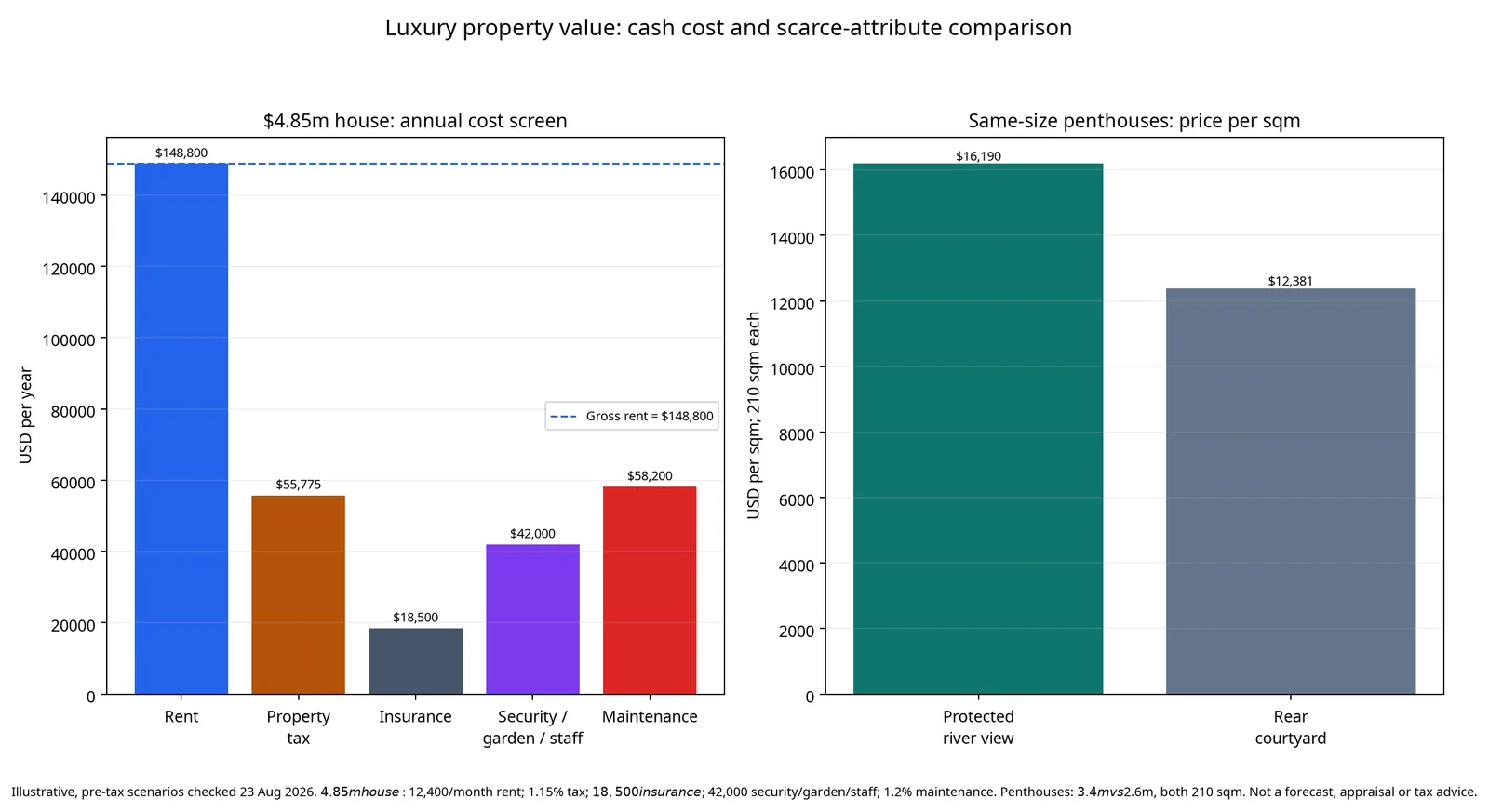
If you let the house, the rent does not cover the holding cost. Net yield on this sketch is about minus 0.5 percent. You would be paying for the privilege of having a tenant in a $4.85 million asset. That can still make sense as a lifestyle purchase or as a long bet on scarcity. It does not make sense as an income product, and dressing it up as one is how people overpay.
There is also the cost of the equity. If $3.4 million of your cash sits in the house, and you could earn a boring 4 percent elsewhere, that is $136,000 a year of alternative income you are not collecting. Add it to the $174,475 and the house has to do a lot of appreciation, or a lot of living, to justify itself. We are not saying it cannot. We are saying the bar should be visible.
Condition, story, and the line between prime and expensive
Prime buyers pay for a story they do not have to apologise for: the architect, the previous owner, the garden that is actually private, the fact that the second floor has not been carved into awkward suites. They discount for work, even when they claim they want a project, because a project at this level is not a weekend of paint. Plant rooms, hidden water damage, and listed-building constraints turn 'cosmetic' into a two-year programme.
Price per area is still worth calculating, if only to stop you comparing a 280-square-metre trophy with a 180-square-metre one as if they were the same object. Use it as a cross-check against peers that share the scarce attribute. Do not use it to argue that a house with no view is cheap because the marble is similar.
What tends not to drive the durable premium
Appliances, fashionable colours, and a furniture package almost never survive the second viewing as a reason for a higher capital value. They can help a sale happen faster. That is a liquidity point, not a value point. Yield arguments are similarly weak here unless the buyer is genuinely an investor, which at the top of many cities is the exception. If a listing leads with yield on a trophy house, ask why the scarcity story was not strong enough to lead.
Common mistakes
- Paying a scarcity premium for attributes that are not scarce
- Ignoring holding costs because 'we are not buying it for the yield'
- Assuming a thin buyer pool will still produce a quick sale when you need one
- Using mainstream price-per-area averages on a house whose peers are unique
- Confusing a costly renovation with an increase in land value
- Underwriting last cycle's foreign-buyer wave as if it were a fixture
How to use the free calculators
Put tax, insurance, staff, and maintenance into the Housing Cost Calculator so the annual cost of ownership is a number you can place next to the joy of the house. Use the Price Per Area Calculator to compare this home with the two or three true peers, not with the wider postcode. If your case for buying depends on value rising, run several modest growth rates through the Property Appreciation Calculator and ask whether the holding cost still feels civilised if growth is late.
Location tiers: irreplaceable, replaceable, and invented
Not all scarcity is equal, and the durability of the premium depends on which tier the location sits in. The irreplaceable tier is protected by law or physics: a waterfront line, a park outlook that cannot be built on, a plot with planning constraints that will not be relaxed, a street of listed fabric. These attributes survive downturns and can be rebuilt only at enormous cost, which is why they trade at the most persistent premiums. The replaceable tier is attractive but copyable: a fashionable neighbourhood, a good school catchment that can move, a 'lifestyle' district that the next development wave can dilute. These premiums are real while the fashion holds and can compress quickly when it does not. The invented tier is marketing: a name, a logo, a furniture package — attributes with no barrier to entry and therefore no durable premium.
- Irreplaceable: waterfront, protected outlook, constrained supply — premiums survive cycles
- Replaceable: fashion, catchments, convenience — real while the fashion holds
- Invented: branding and finish — a liquidity aid at sale time, not a value driver
Before you pay a premium, name the tier. If you cannot say why the scarcity cannot be replicated, you are probably paying replaceable prices for replaceable attributes, and the next wave of supply is the risk you are underwriting.
How prime markets behave in a downturn
Prime property can behave differently from the wider market, but do not turn that into a universal downside guarantee. Knight Frank's PIRI 100 report dated 23 April 2026 recorded 2025 price increases in 73 of 100 tracked prime markets, declines in 24, and 3.2% global prime-residential price growth; its regional results varied and North America was negative. In a downturn, a scarce feature may remain desirable while the buyer pool thins, marketing times stretch and sellers who must exit accept the visible price. Cash-rich, low-leverage owners can wait; an owner with a fixed sale timetable cannot. Treat the report as dated context, not a forecast or proof that a specific home will fall less or recover faster.
The numbers that matter when you buy prime
When the price is driven by scarcity rather than rent, the useful numbers change. Holding cost per year tells you what the house costs to keep while you wait for the market. Time to sell tells you the liquidity price of the exit. Replacement cost of the scarce attribute tells you how much it would take to recreate the view or the plot today. And the cost of the capital inside the house — the return you are giving up on the cash — is the benchmark the appreciation must beat. The four together turn a 'it's special' conversation into a number you can defend or abandon.
A checklist before you offer on a prime home
Before you fall in love with the light, run the prime purchase through a short checklist, because the failure modes are all emotional and none of them appear in the brochure. Name the scarce attribute in one sentence — if you cannot, you do not have a scarcity thesis yet. Ask how many true peers sold in the last five years and what the marketing time was on the last three. Cost the holding: tax, insurance, staff, maintenance, and the capital tied up, as a single annual number. Establish whether the current owner is selling on a timetable, and what the building's own history — service charges, major works, insurance claims — looks like. Then decide the price you would pay if the market went flat for three years, because that is the price you should actually negotiate from.
- Name the scarce attribute in one sentence
- Count true peers and their marketing times
- Cost the holding year as one number
- Ask why the owner is selling and on what timetable
- Set the price you would pay if the market went flat for three years
Two penthouses on the same street
Take two similar penthouses in the same building, offered at $3,400,000 and $2,600,000. The expensive one owns a protected view over a river bend; the cheaper one looks at the rear courtyard. Both have the same internal area, about 210 square metres. Price per area: about $16,200 versus $12,400 per square metre — a 30 percent premium for the view.
- Penthouse A (view): $3,400,000 ÷ 210 sqm = $16,190.48 per square metre
- Penthouse B (courtyard): $2,600,000 ÷ 210 sqm = $12,380.95 per square metre
- Holding cost on A at an illustrative 3 percent of value: $102,000 a year before mortgage
- The question is not whether A is nicer; it is whether the view is replaceable
| Property | Price | Area | Price per sqm | Scarce attribute |
|---|---|---|---|---|
| Penthouse A | $3,400,000 | 210 sqm | $16,190.48 | Protected river view |
| Penthouse B | $2,600,000 | 210 sqm | $12,380.95 | Rear courtyard |
| Premium for A | $800,000 | Same area | $3,809.52 per sqm difference | Only defensible if the view is durable and replaceable supply is constrained |
Reproducibility exports: download the holding-cost CSV and download the penthouse price-per-area CSV. Both files contain the currency, units, assumptions and checked date in their headers.
If the river bend is protected open space, the view cannot be manufactured and the premium is scarcity doing its job; A could keep that gap for decades. If the courtyard could one day host a taller building, or if the view exists only because of a temporary permission, then part of the $800,000 premium is borrowed against a future that is not guaranteed. Same building, same marble, different risk. The tier test from earlier decides which penthouse is the better buy — and it is not automatically the cheaper one.
In practice, buying prime comes down to three honest questions that do not appear on any listing. What exactly is scarce here, and can it be replicated in the next decade? What does this house cost to keep, as a single annual number that includes the capital sitting inside it? And what would the exit look like if the market were quiet when I needed to sell? Answer those three on paper, with numbers, and the marble, the address, and the agent's enthusiasm become what they always were — decoration around the decision, not the decision itself.
Sources and check dates
- Knight Frank — PIRI 100: The Wealth Report Prime Residential Property Index 2026 — report dated 23 April 2026; 2025 prime-market observations and regional caveats; checked 23 August 2026.
- LashkariProperties — methodology — calculator/formula and editorial methodology route; checked 23 August 2026.
- LashkariProperties — Housing Cost Calculator — use local tax, insurance, maintenance and service inputs; outputs are planning calculations, not quotes.
- LashkariProperties — Price Per Area Calculator — formula cross-check: price divided by internal area; compare only with genuine peers that share the scarce attribute.
- LashkariProperties — Property Appreciation Calculator — scenario tool for testing growth assumptions; not a market forecast.
Related reading
Continue reading: Break-Even Occupancy for Landlords · How to Calculate Rental Yield (2026) · Cap Rate Explained for Investors. Run your own numbers with the Monthly Housing Cost Calculator — it takes under a minute and beats guessing.
How the top 1 percent buys luxury property
Luxury buyers behave differently from the mass market in ways that directly shape value. They pay cash or use short-term bridge financing, which makes the transaction less dependent on interest rates. They buy through holding companies for privacy and estate planning, which is common in London and New York and increasingly in Dubai and Miami. And they benchmark against comparable sales in the same building or street rather than the metro average. The practical consequence for an investor: pricing in the luxury segment is set by a handful of comparable transactions, so accurate comps matter far more than broad market indices, and properties with a unique, un-replicable feature — a view, a garden, a listed facade — hold value better than generic square footage in a downturn.
Frequently asked questions
What makes a property luxury?
Not the finish. Luxury value attaches to scarce, hard-to-copy attributes — a true waterfront line, a protected view, a historic fabric, a plot that planning will not repeat. A home with marble but a dozen substitutes nearby trades like a normal house, whatever the brochure says.
Is luxury property a good investment?
It depends on the objective. Prime homes have historically been less volatile and have recovered well, but yields are often negative after holding costs and the buyer pool is thin. It can be an excellent store of value and a terrible income product — the two should not be confused.
Do luxury properties appreciate faster than normal homes?
Usually not on a percentage basis. Prime markets tend to move less than the mainstream in both directions. The durable premium protects the value and the exit, but expecting prime to outperform the broad market on growth is not what the evidence has generally shown.
What are the costs of owning a luxury home?
On the $4.85 million example above, property tax, insurance, security, and maintenance reached about $174,475 a year — before utilities, mortgage, or the cost of the capital itself. Holding costs at the top end can exceed the rent the home could ever produce.
How do you value a luxury property?
Use the two or three true peers that share the scarce attribute, not the wider postcode, and adjust for the specific view, plot, and privacy. Price per area is a cross-check, never a verdict. For a home whose peers are unique, a professional valuation and a lot of scepticism beat an algorithm.
What is the best time to sell a luxury home?
Prime homes sell when the right buyer is in the market, which is why marketing times can run months longer than mainstream homes regardless of the season. Plan the sale around your own timetable with a reserve that covers a slow exit, because thin buyer pools do not follow the calendar.
Do luxury properties appreciate faster than the rest of the market?
Usually slower in percentage terms, but in larger absolute pounds and dollars. Prime properties in global cities tend to be defensive — they fall less in downturns and recover first — but they rarely double as quickly as emerging neighbourhoods in the same city. The exception is when a market's super-prime segment is structurally undersupplied, as in Monaco, central London, or New York's trophy co-op market, where scarcity itself drives the price.
This article is educational. It is not an appraisal, a brokerage opinion, or financial advice. Prime markets are thin and local. Take advice from a valuer and a solicitor on a specific home, and do not treat a scarcity story as a substitute for due diligence.