


SCOPE BANNER — Primarily US-style fixed-rate repayment mortgage / USD worked example. Payment anatomy travels across markets, but escrow, mortgage insurance, points, prepayment and disclosure rules do not; use the local handoff table before relying on a result.
At a glance: read your payment in 60 seconds
- 1. Separate principal and interest (the loan contract) from taxes, insurance and mortgage insurance (additional payment components).
- 2. Compare the total monthly payment and cash to close, not only the advertised principal-and-interest figure.
- 3. Read one amortization checkpoint: early payments are interest-heavy; later payments apply more to principal as the balance falls.
- 4. Ask the lender how extra principal, recasting, prepayment penalties and a rate reset are handled before signing.
Scope and check date: this guide was checked on 23 August 2026. The worked case is a simplified USD/US planning example at 6.15 percent, not a current market quote, lender approval, appraisal, tax determination, insurance quote or personalized advice.
| Market | Replace the US-style assumption with |
|---|---|
| US | CFPB Loan Estimate guidance, lender Projected Payments, tax bill, insurance quote and PMI terms |
| UK | UK country hub, lender affordability method, council tax, insurance and product-specific early-repayment terms |
| Canada | Canada country hub, GDS/TDS and qualifying-rate rules, provincial charges and mortgage-insurance terms |
| Australia / UAE | Australia country hub or UAE country hub, lender serviceability/DBR-LTV method and state/emirate charges |
Open a mortgage statement and the headline payment is rarely the number that matters. The useful information is the split: how much of this month's money reduces the balance, how much is interest, and what else was collected into an escrow or separate account for taxes and insurance. Until you can read that split, it is hard to compare two loan offers or to know whether a cheaper rate is actually cheaper.
A repayment mortgage is built from three inputs. The loan amount is what you borrowed, not the house price. The interest rate is the annual cost of that debt, applied monthly on a standard amortizing loan. The term is how many years you have promised to finish. Together they produce a fixed principal-and-interest payment if the rate is fixed. Everything else you pay each month is a different contract sitting in the same envelope.
What the first page of a statement is trying to tell you
Most statements show a contractual payment, then a breakdown. Principal is the slice that lowers what you owe. Interest is the lender's fee for that month, calculated on the remaining balance. Escrow or a separate tax-and-insurance line is money the lender (or you) sets aside so the bill is there when the authority or insurer asks. The CFPB payment explainer confirms that total monthly payment can include principal, interest, mortgage insurance and escrow, while HOA fees are usually separate (page last reviewed 28 August 2023; checked here 23 August 2026). Miss the distinction and you will think a payment rise is 'the mortgage going up' when it was actually the insurance premium.
Early in the loan, interest dominates. That is not a trick. It is what happens when you apply a rate to a large balance. As the balance falls, the same contractual payment contains more principal and less interest. People call this amortization. It is the reason a 30-year loan feels slow in years one to seven and then, almost rudely, starts to look like progress.
Worked example: $412,000 at 6.15 percent over 30 years
Suppose you borrow $412,000 at 6.15 percent for 30 years on a standard monthly repayment. The principal-and-interest payment is about $2,510. In month one, roughly $2,112 is interest and only $399 is principal. You write a four-figure cheque and the balance barely moves. That is normal, and it is why extra principal payments at the beginning have more punch than the same dollars in year 22.
Over the first twelve months you pay about $30,120 toward the loan. Of that, about $25,201 is interest and about $4,919 is principal. The balance after a year is still about $407,081. You have not done anything wrong. You have rented $412,000 of capital for a year and chipped a little off the top.
- Monthly principal and interest: about $2,510
- Month-one interest: about $2,112; principal: about $399
- Year-one interest: about $25,201; principal: about $4,919
- Balance after 12 months: about $407,081
- Around year 19, a $2,510 payment is finally about half principal
By year 20 the remaining balance is about $224,600. The same $2,510 payment is then roughly $1,151 of interest and $1,359 of principal. Around month 226 — year 19 — the payment finally becomes more principal than interest. The contract did not become generous. The balance simply shrank until the interest slice had less to feed on.
| Payment layer | What it does in the worked US example |
|---|---|
| Principal + interest | $2,510.02/month on $412,000 at 6.15% for 30 years; principal reduces the balance and interest is the borrowing charge |
| Property tax + insurance | $450.00/month from $3,840 annual tax plus $1,560 annual insurance; escrow may be collected or bills may be paid directly |
| HOA and other costs | $95/month HOA is separate in this example; utilities, maintenance and closing costs are not included in P&I |
| Total cash leaving the account | $3,055.02/month before utilities, repairs or furniture; mortgage-insurance terms can add another line |
The rest of the housing payment
Lenders and brokers often talk about PITI: principal, interest, taxes, and insurance. If this home carries $3,840 a year in property tax and $1,560 in buildings insurance, that is $450 a month sitting next to the $2,510. A $95 homeowners-association fee takes the cash leaving your account to about $3,055 before utilities, repairs, or furniture. The mortgage calculator answers one piece. The housing-cost picture is wider.
Mortgage insurance is another line if your deposit is thin. The CFPB PMI explainer says PMI may be required on a conventional loan with less than 20 percent down, protects the lender rather than the borrower, and can be charged monthly, upfront or both (page last reviewed 28 August 2023; checked here 23 August 2026). Do not treat the tool's default as a universal percentage or promise a drop-off date: verify your product's Loan Estimate, cancellation rules and lender threshold. Treat it as a temporary cost of a smaller deposit, not as a permanent feature of homeownership.
What actually moves the payment
| Scenario on $412,000 at 6.15% | Monthly P&I | Lifetime interest | Decision use |
|---|---|---|---|
| 30-year term | $2,510.02 | $491,607.21 | Lowest payment in this comparison; longest interest runway |
| 25-year term | $2,692.43 | $395,728.02 | $182.41 more monthly; five years shorter |
| 15-year term | $3,510.17 | $219,829.99 | $1,000.15 more monthly; much lower lifetime interest |
| 30-year at 7.15% | $2,782.68 | Rate-change illustration | A one-point rate change is a payment stress test, not a forecast |
Rate and term are the two levers people underestimate. Keep the $412,000 loan and the 6.15 percent rate, but cut the term to 25 years. The payment rises to about $2,692. That is $182 more each month, and in exchange you finish five years earlier and pay less interest over the life of the loan. Keep the 30-year term and raise the rate by one point to 7.15 percent. The payment jumps to about $2,783. A single point of rate, on this balance, costs more per month than five extra years of term.
That is why shopping the rate is not a personality trait. It is arithmetic. It is also why a fee that buys a lower rate can be worth paying if you will keep the loan long enough to recoup the fee, and a waste if you intend to sell or refinance in three years. The payment is the starting exhibit, not the verdict. For a US offer, the CFPB Loan Estimate explainer recommends comparing multiple estimates and checking the rate, projected total payment, points, fees, prepayment penalty, cash to close and whether taxes/insurance are escrowed (last modified 29 October 2025; checked here 23 August 2026).
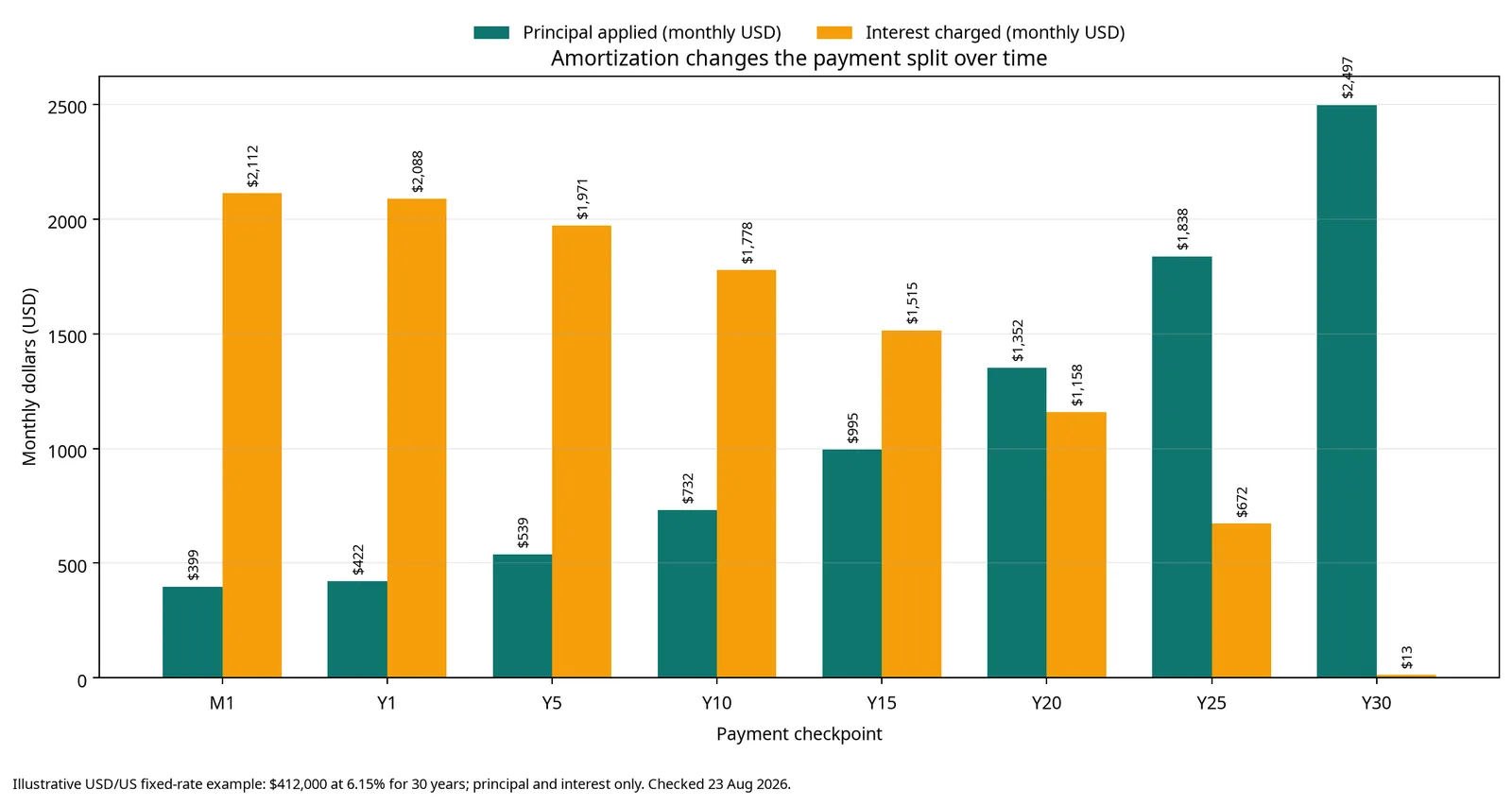
The chart is a quick visual alternative to the full schedule. Use the CSV when you need every month, want to print or share the schedule, or want to test a different loan in the site's Mortgage Calculator. Calculator note: the reviewed client-side tool exposes keyboard-focusable inputs, a readable result region and optional amortization schedule; do not enter SSNs, IDs or other sensitive information, and verify how your lender applies extra payments before acting.
When the payment is not fixed
A fixed-rate loan keeps the principal-and-interest piece still. Taxes and insurance can still rise. A tracker, variable, or adjustable loan can move the principal-and-interest piece as well, on dates set out in the offer. If you are on a two-year fix, the useful habit is to model the payment at a higher rate before the product ends, not the week the lender writes to you. A payment you can only afford at the teaser rate is not a payment you can afford.
Interest-only loans are a different animal. The monthly figure can look gentle because you are not reducing the balance. The principal is still there on the last day, and it has to be repaid from a sale, a refinance, or savings. If the repayment plan is 'the house will be worth more,' you have a plan that depends on a market, not a contract.
Common mistakes
- Comparing two offers on the monthly payment alone, and ignoring fees, the fixed period, and the follow-on rate
- Forgetting that tax and insurance can reprice even when the loan rate cannot
- Assuming extra payments automatically shorten the term. Some lenders hold them as a credit unless you instruct a term reduction.
- Taking a longer term to 'make it affordable' without checking the lifetime interest
- Budgeting only for the first-year escrow estimate, then being surprised by a shortage
- Ignoring how much of the early payment is interest when you decide how long you will stay
How to use the free calculators
Start with the Mortgage Calculator. Enter the loan amount (price minus deposit), the rate you have been quoted, and the term. Note the monthly principal-and-interest figure, then change one input at a time: a 0.5 point higher rate, a 25-year term, a smaller loan. When you want the number that actually leaves the household account, open the Housing Cost Calculator and add property tax, insurance, association fees, and a maintenance budget. The useful output is not a single payment. It is the gap between the loan and the life you would be living around it.
How to read an amortization table
An amortization table is the loan's biography, written one month at a time, and it has a signature shape. On this $412,000 loan, the balance after five years is still about $384,100 even though you have written more than $150,000 of cheques. After ten years it is about $346,200, and after fifteen about $294,600. The balance falls slowly at first and accelerates later, because the interest slice shrinks as the balance shrinks. Year 25 finds the loan at about $129,400 — less than a third of the original debt, with five years to go.
- End of year 5: balance about $384,100
- End of year 10: balance about $346,200
- End of year 15: balance about $294,600
- End of year 20: balance about $224,600, and the payment is now mostly principal
- End of year 25: balance about $129,400
Two habits follow from reading the table. First, do not judge the loan in year two. Judge it on the whole arc, because the early years are structurally interest-heavy. Second, notice that the shape is the argument for paying extra early: a dollar of principal at month one kills the interest that dollar would have generated for the next 29 years, which is a far bigger effect than the same dollar in year 22.
Points, APR, and the fee that buys a lower rate
A point is 1 percent of the loan amount paid upfront in exchange for a lower interest rate. On a $412,000 loan, one point is $4,120. Whether it is worth it is a pure break-even question: what does the lower rate save each month, and how many months of savings repay the fee? A 0.25 point reduction saves roughly $62 a month on this loan, so a one-point fee would take about 66 months to repay. If you plan to keep the loan that long, buying the point can win. If you expect to sell or refinance in three years, the fee is money spent on a rate you will not own long enough to enjoy.
The APR exists to stop this confusion becoming a trap. It takes the quoted rate plus the fees and spreads them over the life of the loan, so two offers with the same headline rate can be compared on one number. It is not perfect — it assumes you keep the loan the full term — but it is a better first screen than the monthly payment alone. When a lender says 'no closing costs', ask what the rate is paying for. Nothing is free; the fee is either on the table or inside the rate.
Should you pay extra each month?
Add $100 to the $2,510 payment on this loan and the arithmetic is quietly dramatic. The loan is repaid in about 27 years instead of 30, and the total interest bill falls from about $491,600 to about $433,600 — roughly $58,000 saved, on $100 a month. That is the compounding curve working for you instead of against you. Early extra payments are the powerful ones; the same $100 in year 20 saves a fraction of what it saves in year one.
Three conditions before you do it. First, only after your emergency reserve is intact — a house is a bad source of cash on a rainy Friday. Second, ask the servicer to apply the amount as a principal curtailment and confirm in writing whether the payment is recast, the term shortens, or the next due date is merely advanced; Fannie Mae's servicing guidance describes how an identified additional principal payment is processed, but your product and servicer control. Third, ask whether any prepayment penalty applies and whether the benefit survives a sale or refinance. If you are saving for a purchase in the next two years, that money may earn more freedom in the deposit fund than it saves in interest.
The payment is not the price of the loan
The monthly payment tells you what you can afford to hand over. It does not tell you what the loan costs, because two loans with identical payments can differ by tens of thousands of dollars in fees and lifetime interest. The total cost is the sum of every payment plus every fee, and the only honest way to compare offers is to lay that total out side by side with the fixed period and the follow-on rate attached. A payment that is $30 lower but comes with a two-year teaser and a fat early-repayment charge is not cheaper; it is a different risk. When a lender quotes a payment, ask for the APR, the fees, the rate after the initial period, and the total interest over the term — and compare those, not the headline monthly figure.
Fifteen years or thirty? The term is a second rate decision
The same $412,000 loan at the same 6.15 percent rate produces two very different lives, depending on the term. Over 30 years the payment is about $2,510 and the lifetime interest about $491,600. Over 15 years the payment is about $3,510 and the lifetime interest falls to about $219,800 — roughly $272,000 less interest, in exchange for $1,000 more every month for fifteen years instead of thirty.
- 30-year term: about $2,510 a month, about $491,600 of lifetime interest
- 15-year term: about $3,510 a month, about $219,800 of lifetime interest
- The 15-year borrower pays off in half the years and saves roughly $272,000 in interest
- The 30-year borrower keeps $1,000 a month of flexibility for other goals
There is no universally correct term. The 30-year loan is not lazy and the 15-year loan is not virtuous; they are different trades between monthly cash and lifetime cost. The honest question is what the $1,000 monthly gap would do elsewhere: if it earns more than the interest it avoids, a 30-year term plus disciplined investing can beat a 15-year term. If it would evaporate into lifestyle, the forced saving of the shorter term may win. Many borrowers find the middle path: take the 30-year payment for flexibility, and pay extra toward principal whenever the budget allows, converting the loan into a de facto 20-year term without ever being locked into it.
Sources and check dates
- [1] CFPB — Principal and interest versus total monthly payment — last reviewed 28 August 2023; checked 23 August 2026.
- [2] CFPB — Loan Estimate explainer — last modified 29 October 2025; checked 23 August 2026.
- [3] CFPB — Private mortgage insurance — last reviewed 28 August 2023; checked 23 August 2026.
- [4] Freddie Mac — Understanding amortization — official educational example and schedule explanation; checked 23 August 2026.
- [5] Fannie Mae — Processing additional principal payments — servicing guidance for identified principal curtailments; checked 23 August 2026.
Related reading
Continue reading: The 28/36 Rule: Still Useful in 2026? · Closing Costs Explained for Buyers · Debt-to-Income Ratio for Home Buyers. Run your own numbers with the Rent vs Buy Calculator — it takes under a minute and beats guessing.
Frequently asked questions
What is included in a mortgage payment?
On a standard repayment mortgage, the payment covers principal and interest, plus whatever your lender collects into escrow for property taxes and insurance. On this $412,000 example, principal and interest are about $2,510, and taxes and insurance add roughly $450 a month, with any HOA fee and maintenance on top.
How much of my mortgage payment goes to interest?
Most of it, early on. In month one of a $412,000 loan at 6.15 percent, about $2,112 of the $2,510 payment is interest and only about $399 reduces the balance. The split only reaches half principal around year 19, which is normal amortization, not a billing error.
How is my mortgage payment calculated?
Lenders use the loan amount, the annual interest rate divided into monthly installments, and the term in months. Those three inputs produce a fixed monthly payment that repays the loan by the end of the term. Your quoted payment is principal and interest; escrow for taxes and insurance is added separately.
Does paying extra each month lower my payment?
No, unless your lender recasts the loan. Extra payments normally shorten the term and reduce total interest instead. On this loan, $100 a month extra repays it in about 27 years instead of 30 and saves roughly $58,000 in interest, but the monthly bill stays $2,510.
What is PMI and when does it drop off?
Private mortgage insurance protects the lender when your deposit is below about 20 percent. It is added to your monthly payment and usually falls away automatically once your loan-to-value ratio reaches the lender's threshold, typically 80 percent. It is a temporary cost of a smaller deposit, not a permanent part of the loan.
What is the difference between principal and interest in a mortgage payment?
Principal is the amount that actually pays down what you borrowed; interest is the fee the lender charges for the loan. In the early years of a 30-year mortgage, roughly two-thirds of each payment is interest — after 5 years on a $300,000 loan at 6 percent, you have paid about $88,000 of interest and reduced the balance by only $18,000. Over the full term the split flips, which is why extra payments early in the loan are so powerful.
This guide is for education only. It is not a mortgage offer, a credit decision, or financial advice. Lenders use their own affordability tests and product rules. Speak to a mortgage broker or lender about a specific loan, and to a solicitor if you need advice on the documents.