


Introduction: the trade you are really making
An interest-only mortgage is, in one line, a bet that time will be your friend. You accept a lower monthly payment now in exchange for building no equity during the interest-only years — and you promise your future self that rising income, rising property values, or a clean exit will make the deferred principal easy to handle later.
For some borrowers, that trade is rational. A landlord in Manchester or a serial investor in Phoenix can use interest-only (IO) loans to keep cash flow positive on rent-generating properties and recycle capital into more deals. For others — most notably a first-time buyer stretching to afford a primary residence — the same product can quietly load the loan with concentrated risk that only reveals itself at the reset date.
This guide is a math-first walkthrough of interest-only mortgages. By the end you will know exactly how to calculate the payment, how to measure the “payment shock” at reset, when IO is a legitimate tool for investors, why it is dangerous as an affordability hack, and how the rules differ across the United States, United Kingdom, Canada, Australia, and the United Arab Emirates. You will also have a repeatable checklist you can use with our free interest-only calculator,mortgage calculator, and cash-flow calculator to test any deal before you sign.
Educational only — not financial advice
This article is educational content aimed at helping you understand mortgage mathematics. Loan availability, tax treatment, and lending rules differ by country, state, and lender, and they change frequently. Always confirm the specifics of your situation with a licensed mortgage broker, financial adviser, and tax professional in your jurisdiction.
What an interest-only mortgage actually is
Aninterest-only mortgage is a home loan structured so that, for a defined period, the borrower’s monthly payment covers only the interest charge on the outstanding balance. No principal is repaid during that window. The loan balance you owe on day one is identical to the balance you owe on the day the IO period ends.
The IO period is typically 3, 5, 7, or 10 years, though some UK buy-to-let and specialist lenders write mortgages that remain interest-only for the entire 25 or 30-year term. What happens next is defined in the loan contract, and it is where the risk lives.
Historically, IO mortgages trace back to commercial real estate, where sophisticated investors have used interest-only bullet loans for decades to match debt structure to project cash flow. The migration to the residential market accelerated in the 1990s and early 2000s, particularly in the United States, Ireland, Spain, the United Kingdom, and Australia. The 2008 global financial crisis exposed how badly the product had been mis-sold to borrowers who used IO simply to reach beyond their affordability limit — and the regulatory backlash that followed shapes the market you can access today.
Understanding that history matters because it explains why lending rules feel restrictive: they were rewritten specifically to prevent the mistakes of the last cycle. When your broker says an IO loan requires a documented repayment vehicle, a stricter LTV cap, or DSCR-based underwriting, those are not arbitrary hurdles — they are guardrails designed after regulators studied thousands of files from borrowers who ended up in negative equity.
The three possible endings
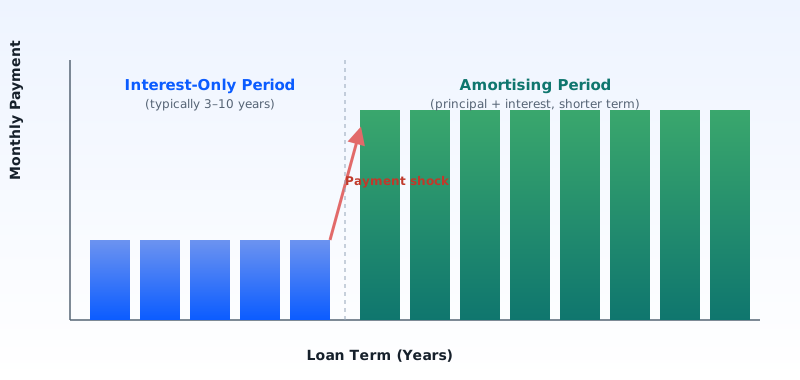
- Conversion to amortisation. The most common outcome in the US and Canada: at the end of the IO period the loan flips to principal-and-interest payments amortising over the remaining term. A 30-year loan with a 10-year IO period will therefore amortise over just 20 years, not 30.
- Refinance. The borrower takes out a new loan — often another IO term, or a standard amortising loan — using the original property as collateral. This is the standard playbook for UK buy-to-let investors.
- Balloon payment. The full principal falls due as a lump sum at term end. The borrower must repay from savings, an investment vehicle (ISA, endowment, brokerage), a property sale, or a new loan.
Each of these endings creates a different risk profile. The rest of this article walks through the numbers so you can see what actually happens in each case.
How IO differs from an offset or redraw account
Borrowers sometimes confuse interest-only structures with offset accounts (common in Australia and the UK) or redraw facilities. They are not the same. An offset account is a linked savings account whose balance is subtracted from the loan balance for interest-calculation purposes, effectively giving you a lower interest bill without touching the underlying loan structure. A redraw allows you to withdraw amounts you previously overpaid. Both let you reduce interest costs while preserving liquidity — often achieving many of the benefits people believe they want from IO, without the reset risk. If your goal is flexibility rather than absolute cash flow minimisation, ask your broker to model an offset-linked amortising loan before signing an IO product.
Fixed-rate vs variable-rate IO
IO products come in two rate flavours. A fixed-rate IO loan locks the interest rate for the entire IO period (or a defined portion of it), giving payment certainty during the low-payment phase. A variable-rate IO tracks a base rate (SOFR in the US, SONIA in the UK, cash rate in Australia) plus a lender margin, and monthly payments move with the underlying rate. Variable IO can be attractive when rates are trending down, but it stacks interest-rate risk directly on top of reset risk — a combination that punished many borrowers in the 2022–2024 tightening cycles. As a default, fixed-rate IO gives you cleaner arithmetic and one less variable to hedge.
The formula and key definitions
The math for the IO monthly payment is refreshingly simple — which is one reason the product is so tempting. If you have ever been intimidated by the standard mortgage amortisation formula, you are about to feel a lot better.
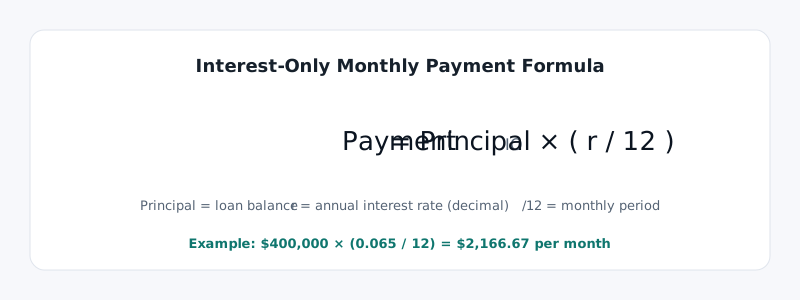
where r is the nominal annual interest rate as a decimal (e.g. 6.5% = 0.065)
For contrast, here is the standard fully-amortising payment formula that the loan will use once the IO period ends:
where i = monthly rate (r/12) and n = number of remaining monthly payments
Six terms every IO borrower must know
- Interest-only period — the window during which payments cover interest only. Everything about your loan resets when it ends.
- Amortisation period — the years remaining after the IO ends, over which principal is repaid. Shorter than the total term.
- Payment shock — the increase from the IO payment to the reset payment, usually expressed as a ratio or percentage.
- Loan-to-value (LTV)— the ratio of loan to property value. Lenders often cap IO loans at 75–80% LTV; UK BTL commonly at 75%.
- Debt Service Coverage Ratio (DSCR)— annual net operating income divided by annual debt service. IO loans are frequently qualified on DSCR for investment properties in the US.
- Balloon payment — a large lump-sum principal repayment due at loan maturity or at the end of an IO period.
Why the interest-only decision matters
The reason to spend a full guide on a product that looks like a simple monthly-payment discount is that IO loans concentrate risk in ways that many borrowers do not fully price in. Three forces are at work simultaneously.
1. Equity does not build automatically
In an amortising loan, every payment retires a small slice of principal. Over ten years, on a $400,000 loan at 6.5%, about $60,000 of principal quietly disappears — that is $60,000 of forced savings, protected from spending temptation. With an IO loan, that $60,000 stays in your bank account (good) or gets spent (bad). Whether IO is a “no-equity” product or a “flexible-equity” product depends entirely on the borrower’s discipline.
2. Payment shock is guaranteed unless you refinance
Because principal must eventually be repaid over a shorter remaining term, the reset payment is always higher than the payment on the equivalent 30-year amortising loan taken on day one. This is not a rate-risk story; it is arithmetic. Even if interest rates stay flat, the payment jumps.
3. Refinance risk stacks on top
If the IO borrower plans to refinance rather than absorb the reset, they take on three additional risks: (a) the property must appraise at or above the required LTV, (b) their income must qualify under whatever underwriting rules apply at that future date, and (c) prevailing interest rates must be reasonable. Any one of these can be broken by a downturn — which is exactly when a borrower can least afford to be forced into a reset.
“Interest-only borrowers are not choosing a cheaper loan. They are choosing to defer a decision — and the deferral itself is the risk.”
The step-by-step decision process
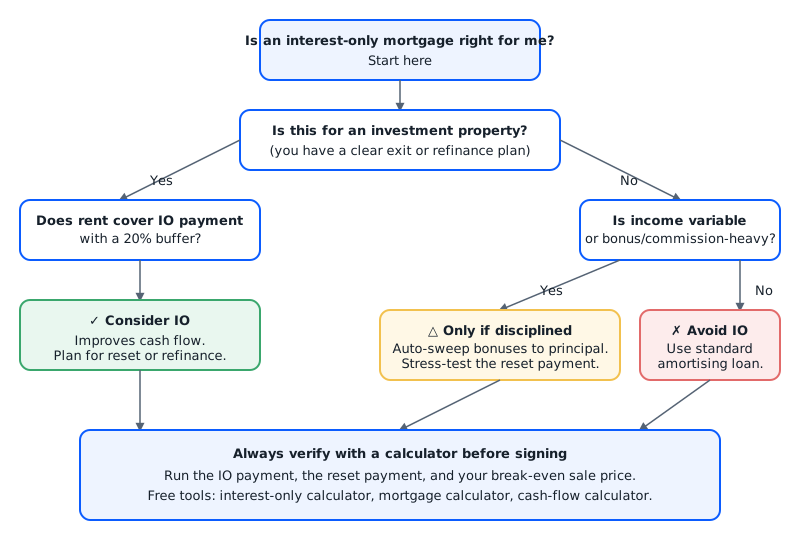
Before you take out an IO loan — or before you decide against one — walk through this six-step math sequence. It takes about thirty minutes with a calculator and a scrap of paper, and it is the single best defence against the emotional pull of a low monthly payment.
Step 1 — Calculate the IO payment
Use the formula from the previous section: Principal × r / 12. Write it down.
Step 2 — Calculate the reset payment
Assume the loan will amortise over the remaining term at the same rate. Use a mortgage calculator or the standard amortisation formula. Write it down next to the IO payment.
Step 3 — Compute the payment-shock ratio
Divide the reset payment by the IO payment. A ratio of 1.20 means a 20% jump; 1.40 means a 40% jump. Anything above 1.35 is worth serious attention.
Step 4 — Stress-test at higher rates
Recompute steps 1–3 with the interest rate 200 and 300 basis points higher. Ask yourself: “Can I still make the payment if rates and my reset happen together?”
Step 5 — Model rental income (if investing)
For an investment property, run the numbers through acash-flow calculator using realistic rent, vacancy (typically 5–8%), management fees, maintenance (1–2% of value per year), insurance, and taxes. Confirm the IO payment fits with at least a 20% cash-flow buffer.
Step 6 — Define the exit
Write one sentence describing exactly what will happen at the end of the IO period. Refinance? Sell? Convert to amortising and reduce spending? If you cannot finish the sentence in plain language, the loan is not ready to sign.
Three worked examples with real numbers
Nothing beats concrete math for making a decision feel real. Below are three worked examples built on the same $400,000 loan at 6.5% so you can compare apples to apples. The arithmetic checks out — reproduce it in the calculator and you will get the same numbers to the cent.
Example 1 — The primary-home “affordability stretch”
Scenario: A couple in Austin, Texas earns a combined $145,000. They want to buy a $500,000 home with 20% down ($100,000), leaving a $400,000 loan at 6.5%. They cannot comfortably afford the standard 30-year payment, so their lender offers a 10-year IO / 20-year amortising structure.
Primary-home IO vs 30-year amortising comparison
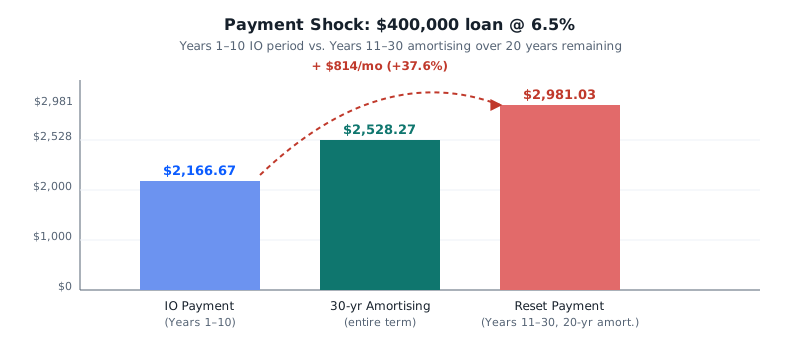
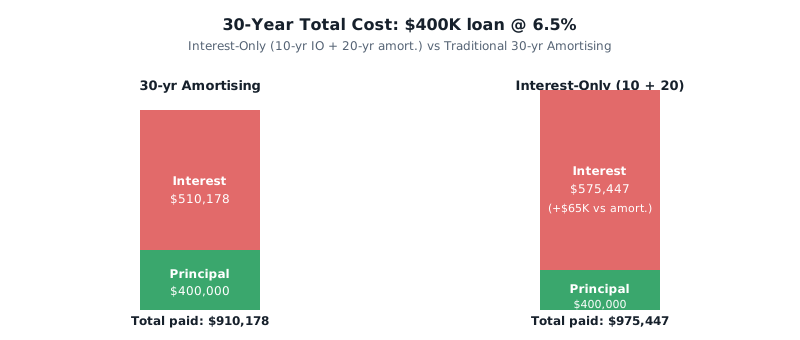
Verdict: The couple saves $362 per month for 10 years — a total of $43,440 in reduced payments. But at the reset, their monthly cost jumps by $814 above what a plain 30-year loan would have required them to pay all along, and they still owe the full $400,000 principal. Over 30 years they pay $65,269 more in interest. Unless they have a documented plan to increase income by roughly 40% within a decade, this is a dangerous product for their situation.
Example 2 — The investor cash-flow play
Scenario: A UK-based investor buys a £320,000 buy-to-let property in Manchester with a 25% deposit (£80,000). The £240,000 buy-to-let mortgage is priced at 5.5% on an interest-only basis over 25 years — standard for the UK BTL market. Rent achievable is £1,650/month.
UK buy-to-let interest-only vs amortising comparison
Operating costs (mgmt, ins., maint., voids ~25%)
Verdict: For this investor, IO is a legitimate tool. Under a repayment mortgage, the deal produces a small monthly loss of £235 — a bleeding position that consumes savings and blocks additional acquisitions. Under IO, the property is cash-flow positive and the investor can either use the surplus to pay down principal on their fastest-growing asset, save toward the next deposit, or hold as a repair reserve. The exit plan is typically to remortgage every 2–5 years to a new fixed rate, and eventually sell the property at retirement to repay principal from equity gains.
Investor tip
Thecash-flow calculator lets you toggle IO vs. repayment and instantly see the change in DSCR and monthly cash. Model at least three rate scenarios — current, +200 bps, and +300 bps — before committing.
Example 3 — The high-income variable earner
Scenario: A software sales director in Sydney earns AUD $180,000 in base salary plus an uneven AUD $60,000–$150,000 in commissions. She wants to buy a $1.2M home with 20% down (AUD $240,000), leaving a $960,000 mortgage at 6.2% on a 30-year term. Her broker offers a 5-year IO / 25-year amortising structure.
Verdict: This is the “consider carefully” case. IO gives the borrower breathing room during her fixed base pay months, and she can direct commission bonuses straight to principal via lump-sum prepayments — reducing the reset shock. But she must actually do that. If commissions dry up in a recession and she has spent the monthly savings on lifestyle, she arrives at Year 6 with the full $960,000 balance and a payment that consumes 60% of her guaranteed income. IO is only appropriate here with an explicit, automated, quarterly principal-sweep from bonus payments.
Advanced scenarios and edge cases
The three worked examples above cover the mainstream use cases. In practice, borrowers encounter several edge cases that deserve their own math. Skim the ones that apply to you.
The retiree drawdown strategy
Some retirees use an IO mortgage as a cash-flow bridge. The idea: replace an amortising mortgage with an IO structure in the last 5–15 years before selling and downsizing. Monthly outflows fall sharply during the peak retirement-spending years, and the principal is repaid from the eventual sale. The math works if — and only if — the property retains enough value to clear the loan plus transaction costs and leave the equity the retiree is counting on. A 15% market correction in the wrong year can wipe out a decade of planning. Retirees considering this strategy should model at least three property-value scenarios (base, −15%, −25%) and always keep a reserve of liquid savings equal to at least 12 months of the reset payment as an insurance layer.
Construction-to-permanent loans
New-build purchases in several markets bundle a construction loan (interest-only during the build phase) with a permanent take-out loan that amortises. Technically the first phase is IO, but it functions differently: interest is charged only on drawn funds, not the full commitment, and the IO phase ends when construction completes, not on a calendar. Treat this as a distinct product and model both phases separately. Draw-based interest bills grow through the build, so budget for the final month, not the first month, when planning liquidity.
Bridging finance
Bridging loans in the UK and short-term bridge loans in the US are almost always IO with terms of 6–24 months, priced at rates two to four times higher than a standard mortgage. The IO structure is defensible here because the exit is precise — sale of an existing property or completion of a refinance — but the risk is concentrated. If the bridging loan cannot be repaid on schedule, penalty rates can push the effective interest cost into double digits within months. Never enter a bridge loan without a signed sale contract or a fully underwritten refinance offer in hand.
Portfolio landlords with multiple IO loans
A landlord with five properties on IO mortgages faces correlated reset risk: several loans may reset within a narrow window. Best practice is to stagger reset dates by refinancing individual loans on a rolling basis rather than letting them all mature together. Model your portfolio not as five independent deals but as a single cash-flow entity, and ensure that even in a stressed scenario — say, three simultaneous rate increases and a 10% rent softening — the portfolio remains cash-flow positive after tax. Ourcash-flow calculator lets you enter multiple properties and sum the totals.
Tier-1 market nuances
Interest-only mortgages exist in every major English-speaking property market, but their availability, regulation, and typical use case vary enormously. If you are buying across borders, or comparing advice from friends in different countries, these differences matter.
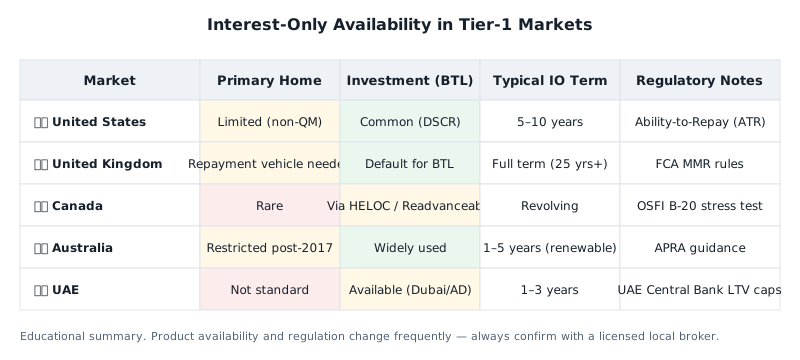
Post the 2008 mortgage crisis and the 2014 Ability-to-Repay (ATR) rule, IO loans for owner-occupied properties in the US are now classified asnon-Qualified Mortgages (non-QM). They exist, but from portfolio and specialty lenders rather than the conforming market. For investment properties, IO is common through DSCR loan programs, where the lender qualifies the deal based on rental cash flow rather than the borrower’s personal income. Typical IO periods are 5, 7, or 10 years; typical LTV caps are 75–80%. The Consumer Financial Protection Bureau publishes borrower guides on non-QM products worth reading.CFPB.gov
The UK has the most permissive IO market in the Tier-1 world — but only for buy-to-let, where IO is essentially the default structure. Roughly two-thirds of UK BTL mortgages are IO. For residential (owner-occupied) IO loans the FCA’s post-MMR rules (Mortgage Market Review) require the borrower to demonstrate a crediblerepayment vehicle — a documented plan such as an ISA, endowment, downsizing strategy, or investment portfolio expected to cover the principal at term end. The Bank of England’s Financial Policy Committee monitors IO stock closely because a large cohort matures in the late 2020s and 2030s. Bank of England
Canada
Pure IO mortgages on primary residences are uncommon in Canada. The typical route to interest-only-style flexibility is a readvanceable mortgage or a Home Equity Line of Credit (HELOC) portion, where the borrower can draw on available equity and pay interest only on the drawn balance. All uninsured mortgages must pass the OSFI Guideline B-20 stress test, currently the greater of the contract rate plus 2% or the qualifying rate. This effectively caps how much borrowers can borrow with any product, IO or amortising.OSFI
Australia
Australia has the strongest cultural association with IO investment lending, particularly for negatively-geared property strategies. After APRA's supervisory tightening in 2017, however, IO originations for owner-occupiers dropped sharply, and lenders now typically restrict IO periods on primary homes to 1–5 years, renewable subject to serviceability. Interest on investment loans generally remains tax-deductible against rental income, which is one of the largest single reasons for Australia's IO popularity.APRA
In the UAE, standard residential mortgages are amortising. Interest-only structures are found in specific Dubai and Abu Dhabi products aimed at high-net-worth investors or short-term flippers, typically with 1–3 year IO windows and hard LTV caps set by the UAE Central Bank (currently 80% for expats on first properties under AED 5M, 65% above). The market is smaller and more relationship-driven — private banks negotiate bespoke IO structures rather than offering off-the-shelf products. Central Bank of the UAE
Cross-border reminder
Regulations change often. Availability today does not guarantee availability in year 5 when you want to refinance. Never assume the product exists at reset — assume it might not, and plan accordingly.
The psychology behind IO borrowing
Numbers explain most of what you need to know about IO mortgages, but they do not explain why so many borrowers still make the wrong choice. Understanding the behavioural drivers is the difference between reading this article and internalising it.
Present bias and the low-payment illusion
Behavioural economists have documented for decades that humans discount future costs steeply. A$262 monthly saving today feels concrete and immediate; a $814 payment jump ten years from now feels abstract and distant. The IO structure exploits this cognitive bias by design — the good news is upfront, the bad news is deferred. Simply being aware of this asymmetry is the strongest defence.
The refinance mirage
Borrowers routinely tell themselves they will refinance before reset, treating the option as a certainty. In reality, refinance is a conditional right subject to future market conditions. A useful mental discipline: cross out the word "refinance" every time it appears in your plan and re-check whether the plan still holds without it. If the loan only works with a refinance escape hatch, you have a fragile plan disguised as a robust one.
Lifestyle creep
The single most reliable prediction about primary-home IO borrowers is that most of the monthly payment saving is absorbed by lifestyle rather than saved. Restaurants, vacations, subscriptions, and vehicle upgrades quietly consume the difference. If you cannot set up an automatic transfer of the IO saving into a separate investment or principal-sweep account on day one, do not rely on discretion to make the strategy work — it will not.
Confirmation bias in market timing
Borrowers who choose IO frequently do so during rising markets, assuming price growth will bail them out. Media coverage during boom periods reinforces the assumption; contradicting evidence is quietly filtered out. The most useful discipline here is to ask what you would do if the property fell 20% by year 5. If the answer is "I would be stuck," the loan is priced on an assumption you have not actually tested.
Common mistakes and dangerous myths
After thousands of hours of reader questions and deal reviews, six mistakes account for the vast majority of IO-loan regret. Read these carefully; each one is preventable in ten minutes with a calculator.
Myth 1: “I’ll just refinance before the reset”
This is the single most costly assumption in IO borrowing. Refinancing depends on future property values, future income, and future lending standards — none of which are guaranteed. Borrowers who used this logic in 2005–2007 discovered in 2010 that neither their equity nor their income could support a new loan. Build a plan that works without refinance, and treat refinance as an upside option.
Myth 2: “The lower payment means I can afford more house”
Most reputable lenders in the US, UK, Canada, and Australia now qualify borrowers on the fully-amortising payment specifically to prevent this reasoning. Even when a lender allows IO-based qualification, doing so simply moves your affordability constraint from month 1 to month 121. The math is the same; only the timing of the pain moves.
Myth 3: “I’ll invest the payment savings and beat the mortgage”
Sometimes true, often not. To beat a 6.5% mortgage after tax, a diversified stock portfolio has to average a pre-tax return north of 8%. Historically achievable — but not in any specific 10-year window. And the strategy only works if the borrower actually invests the savings every month, mechanically, in a separate account. Behavioural research consistently shows most people spend the difference.
Myth 4: “Interest-only means no equity — but property always goes up, so I’ll still gain”
Property does not always go up. US home prices fell 27% peak-to-trough from 2006–2012 (Case-Shiller). UK prices fell about 20% from 2007–2009. Australian capital-city prices fell 10–15% in 2022. Any borrower who bought at peak with a small deposit and an IO loan through those cycles ended up in negative equity — unable to refinance, unable to sell without a cash top-up. Equity accretion from amortisation is the only form of principal reduction you fully control.
Myth 5: “Interest-only rates are the same as amortising rates”
Almost never. Lenders typically charge a rate premium of 0.25–0.75% on IO products to compensate for higher default and prepayment risk. That premium — compounded over 30 years on the full balance — is the hidden second cost of IO alongside the deferred principal.
Myth 6: “IO is only for rich people / only for reckless people”
Neither. IO is a specific financial tool that is right for a narrow set of situations — mostly investment properties with strong rental coverage, plus a small number of variable-income primary borrowers who can automate principal sweeps. Outside those situations it is a bad fit, but the product itself is neither elite nor toxic.
Myth 7: “I can always sell if things go wrong”
Selling is a solution only when three conditions hold simultaneously: your property is worth more than the loan plus selling costs (typically 6–10% of value), buyers are active in your market, and you are willing to accept the price on offer. In a downturn, all three break at once. Forced sellers in 2008–2011 in Phoenix, Miami, and Dublin lost their entire deposit and years of payments — and still owed the shortfall in states or countries with recourse lending. Treat "just sell" as an emergency exit, not a plan.
Myth 8: “My broker recommended it, so it must be right for me”
Brokers earn commissions on loans they place, and IO products in several markets carry higher commissions than plain amortising loans. This does not make brokers dishonest — most are competent professionals — but it does mean the incentives are not perfectly aligned. Ask any broker recommending an IO product to show you the same file structured as a standard amortising loan, then compare the numbers yourself using the calculators referenced throughout this article.
How IO connects to other property metrics
An IO decision does not live in isolation. It ripples through every other number on your investment or affordability spreadsheet. Understanding those connections is what separates borrowers who use IO tactically from borrowers who use it desperately.
Loan-to-value (LTV) and equity
Because IO builds no equity from payments, your LTV moves only with property value. If prices are flat for 10 years, your LTV at reset is identical to day one. This is why IO loans often carry stricter initial LTV caps — the lender knows equity build-up is not doing the risk-reduction work an amortising loan does.
Rental yield and DSCR
For investors, gross yield (annual rent / property value) and net yield (annual rent minus opex / property value) determine whether IO is even considered. A general rule of thumb: net yield needs to exceed the mortgage rate by 100–150 basis points for an IO structure to produce comfortable positive cash flow. Use the cash-flow calculator to test this at three rate scenarios.
Debt-to-income (DTI)
Most lenders qualify borrowers using the reset payment for DTI purposes. This means IO usually doesnotexpand your affordability limit. If your DTI already sits at 42–45% on the amortising payment, IO does not help you buy more home — it only changes when you feel the pressure.
Capital growth versus cash flow
Investors typically pick one of two strategies: chase capital growth in expensive Tier-1 cities (Sydney, London Zone 1, Toronto) with low yields, or chase cash flow in regional markets with higher yields but slower price growth. IO is more useful in the first strategy because it lets an investor hold a low-yield asset without being crushed by monthly outflows. In cash-flow markets, a repayment mortgage is often perfectly manageable and the equity build-up is a bonus.
Total cost of ownership
Bring closing costs, property tax, insurance, and maintenance into the picture and you will see that the mortgage interest, though the biggest single line, is one component of a larger stack. Our companion guide,Closing Costs Explained, walks through the transaction-level costs;How Much House Can I Afford? unpacks affordability as a system rather than a single ratio.
Opportunity cost of deposit
A frequently overlooked link: your deposit is capital that could be earning a return elsewhere. Larger deposits reduce the IO monthly payment (because the loan is smaller) and improve the LTV — but they also lock capital into a single, illiquid asset. Investors comparing IO leverage strategies should quantify this by calculating cash-on-cash return: annual pre-tax cash flow divided by total cash invested (deposit + closing costs + reserves). A property producing $6,000 of annual cash flow on $100,000 of invested capital returns 6% cash-on-cash, before any price appreciation. Whether that beats other opportunities available to you is the deciding question — not whether the mortgage payment feels comfortable.
Property taxes and the effective mortgage cost
Property taxes vary enormously across Tier-1 markets and can dwarf the payment savings from an IO structure. Texas averages 1.6–2.2% of assessed value per year, New Jersey higher still, while UK council tax on a mid-band property might be under 0.5% of market value, and the UAE charges effectively no ongoing property tax. When you compare IO savings across markets, always express the saving as a percentage of total housing cost — mortgage plus tax plus insurance — not as a percentage of the mortgage payment alone. A$262 monthly saving looks impressive against a $2,528 mortgage payment; against a $4,100 total housing cost including tax and insurance, it is a much smaller share of the risk being taken.
How to run the numbers with free LashkariProperties calculators
Every claim in this article can be tested in about three minutes using our free tools. If a loan sounds appealing but you have not confirmed the numbers with a calculator, you are gambling on marketing language rather than on math.
Test the IO payment and reset
Enter your loan amount, rate, IO period, and full term. See the IO payment, the reset payment, and the payment-shock ratio side by side.
Compare against an amortising loan
Run the same principal and rate as a standard 15, 20, 25, or 30-year mortgage. Compare monthly payment, total interest, and payoff date.
Stress-test as an investor
Overlay rental income, vacancy, management fees, taxes, and maintenance to see monthly cash flow under IO versus repayment structures — with DSCR and cash-on-cash return.
The 3-calculator workflow we recommend
- Interest-Only Calculator: confirm the IO payment and reset payment for the exact term structure your lender offers.
- Mortgage Calculator: input the same loan as a standard amortising 30-year and note the payment. This is your baseline.
- Cash-Flow Calculator (investors) or DTI spreadsheet (primary buyers): plug the reset payment into your monthly budget, not the IO payment. If the reset is not comfortably affordable today, do not sign.
Actionable framework — the pre-signing checklist
Print this or save it as a PDF. Every item should have a written answer before you accept an IO mortgage offer.
- I have calculated my monthly IO payment: $______
- I have calculated my monthly reset payment: $______
- My payment-shock ratio is: ______ (target < 1.35)
- I can afford the reset payment on my current income today, not projected income
- I have stress-tested the loan with rates +200 and +300 bps higher
- My LTV at origination is: ______% (target ≤ 75% for IO)
- If investing: rent covers IO payment + opex with a ≥20% buffer
- If investing: DSCR ≥ 1.25 at current rates, ≥ 1.10 at stressed rates
- I have a written exit plan (refinance, sell, or convert) with dates
- I understand the tax treatment of interest in my jurisdiction
- I have set up an automated monthly transfer of the payment saving to a principal-sweep account (if borrower discipline is critical to my strategy)
- I have read the loan agreement’s prepayment, refinance, and reset clauses in full
- I have consulted a licensed local mortgage broker and tax adviser
Not sure where to start?
Run your specific loan through the interest-only calculator, compare it in the mortgage calculator, and — if it is an investment — stress-test the cash flow. Then read How to Calculate Mortgage Payments Step by Stepand Rent vs Buy: A Numbers-First Decision Frameworkfor context on the bigger picture.
Frequently asked questions
What is an interest-only mortgage in one sentence?
An interest-only mortgage is a loan where the borrower pays only the interest for a set period (typically 3–10 years), after which the loan either amortises over the remaining term, refinances, or becomes due as a balloon payment.
How do you calculate an interest-only mortgage payment?
Multiply the loan principal by the annual interest rate as a decimal, then divide by 12. Example: $400,000 × 0.065 ÷ 12 = $2,166.67 per month. Verify with the interest-only calculator.
Are interest-only mortgages a good idea for first-time home buyers?
Usually no. First-time buyers benefit from forced equity accumulation and reduced refinance risk, both of which amortising mortgages provide. IO is best reserved for investment properties or borrowers with a specific, documented reason for the structure.
Why do property investors prefer interest-only loans?
Interest-only loans maximise monthly cash flow, preserve capital for additional deals, and often align with tax treatment where mortgage interest is deductible against rental income. In the UK, IO is the default structure for buy-to-let mortgages.
What is payment shock, and how big can it be?
Payment shock is the jump from the IO payment to the reset amortising payment. On a 30-year loan with a 10-year IO period at 6.5%, payments rise about 37.6%. At higher rates the shock can exceed 50%.
Can I pay down principal on an interest-only mortgage?
Yes, most IO loans allow voluntary principal prepayments — but read your loan agreement for prepayment penalties, minimum amounts, and whether extra payments actually reduce the balance versus sitting in a redraw or offset account.
It depends. In the US, mortgage interest on a primary home may be deductible up to statutory caps. In Australia, interest on investment loans is generally deductible against rental income. In the UK, buy-to-let interest is treated as a tax credit rather than a deduction. Always confirm with a qualified tax professional in your country.
What happens at the end of the interest-only period?
One of three outcomes as defined in your loan agreement: the loan converts to a fully amortising schedule over the remaining term; you refinance into a new loan; or a balloon payment for the full principal falls due.
Are interest-only mortgages still available in 2026?
Yes, in every Tier-1 market, but with tighter rules than pre-2008. In the US they are typically non-QM. In the UK, primary-residence IO requires a repayment vehicle; buy-to-let IO remains standard. Australia and Canada have imposed stress-test frameworks that constrain availability.
Do interest-only loans charge higher interest rates than amortising loans?
Typically yes — a premium of about 0.25–0.75% above comparable amortising loans, reflecting higher default and prepayment risk. Exact spread depends on the market, LTV, and borrower profile.
What is the difference between an interest-only mortgage and a balloon mortgage?
An IO mortgage requires interest-only payments during the IO period. A balloon mortgage may include partial amortisation but requires a single lump-sum principal payment at maturity. Some IO products are structured with a balloon at the end of the IO window.
How much house can I afford with an interest-only mortgage?
Roughly the same as with an amortising loan, because reputable lenders qualify borrowers on the reset (amortising) payment. Never budget only against the IO payment. Read How Much House Can I Afford? for a full affordability framework.
Conclusion and next steps
An interest-only mortgage is a precision tool, not a general-purpose product. Used by an investor with strong rental coverage, a clear exit, and a disciplined refinance schedule, it can be the difference between a portfolio that compounds and one that stalls. Used as an affordability shortcut by a primary-home buyer stretching their budget, it can quietly convert today’s slightly-too-expensive house into tomorrow’s financial emergency.
The math itself is not complicated. The formula is one line. The reset payment is one calculator field. The payment shock is one ratio. What is hard is being honest with yourself about which category you are actually in — and being willing to walk away when the numbers say the loan is not the right fit for your situation.
Three steps to close this out:
- Run your specific loan through the LashkariProperties interest-only calculator and confirm both the IO and reset payments.
- Compare against a standard 30-year alternative using the mortgage calculator so you understand the true trade-off.
- If you are investing, drop the numbers into the cash-flow calculator and confirm rent covers everything with a 20% buffer at both today’s rate and a stress-tested rate.
For deeper reading, explore Is a 20% Down Payment Required? What Buyers Actually Need,How to Calculate Mortgage Payments Step by Step, and the full Buying Guides category.
Related guides
- How Much House Can I Afford? A Practical Numbers Framework
- How to Calculate Mortgage Payments Step by Step
- Is a 20% Down Payment Required? What Buyers Actually Need
- Closing Costs Explained: What Home Buyers Actually Pay
- Rent vs Buy: A Numbers-First Decision Framework
Disclaimer: This article is educational content and does not constitute personalised financial, tax, or legal advice. Interest rates, product availability, tax treatment, and lending regulations vary by country, state, and lender, and change frequently. Always consult a licensed mortgage broker, financial adviser, and tax professional in your jurisdiction before signing a mortgage agreement. Worked examples use illustrative numbers and are for demonstration only; your actual loan terms will differ.
Sources
Related reading
Continue reading: The 28/36 Rule: Still Useful in 2026? · Closing Costs Explained for Buyers · Debt-to-Income Ratio for Home Buyers. Run your own numbers with the Free Mortgage Calculator — it takes under a minute and beats guessing.
Frequently asked questions
What is an interest-only mortgage?
An interest-only mortgage pays only the interest during the IO period, so the monthly payment is lower but the balance does not fall. It is a bet that time will be your friend: lower payments now, no equity built, and the principal still due later.
What happens when the interest-only period ends?
The payment resets to include principal, producing a 'payment shock' that can be dramatically higher. The repayment plan must be a sale, a refinance, or savings — and the plan should be written down, not assumed.
Who should use an interest-only mortgage?
Investors who need positive cash flow on rent-generating properties and have a genuine exit plan can use IO loans as a legitimate tool. Homeowners stretching to buy with IO 'just to get in' are taking the risk with the least protection.
Can you convert an interest-only loan to a repayment loan?
Yes, at any remortgage or with most lenders through a product switch, though you may pay an early repayment charge within the initial term. The bigger cost is behavioural: converting to repayment sharply increases the monthly payment because you start repaying principal on a 20-to-25-year schedule. UK lenders also require proof of a credible repayment strategy at application, and interest-only mortgages are generally not allowed on buy-to-let in some countries — check the rules for your market first.