 By Nirmal Lashkari · Founder · Indore, Madhya Pradesh, India
$450,000 home, a $280,000 mortgage balance, and an 85% maximum LTV, the default result is $170,000 in home equity, 37.78% equity, and $102,500 potentially borrowable. Equity is calculated as market value less mortgage balance; borrowable capacity is 85% of market value less the outstanding balance, subject to lender approval and affordability.
Often 80%–90% for equity borrowing.
Home equity: $170,000.00

Home equity is the portion of the property’s current market value that is not matched by the outstanding mortgage balance. This calculator makes that relationship visible with three inputs: Current market value, Mortgage balance, and Lender maximum LTV. It then reports Home equity, Equity percentage, and Potentially borrowable. The result is an estimate of position, not a promise that a lender will advance the displayed amount.
The calculation begins with a simple subtraction. If a home is worth $450,000 and the mortgage balance is $280,000, the estimated equity is $170,000. Equity percentage expresses that $170,000 as a share of the $450,000 value, or 37.78%. The percentage can be more useful than the dollar figure when comparing homes with different prices because it puts ownership on a common scale.
Market value is not the same thing as the original purchase price, the tax assessment, or the amount an owner hopes to receive. Use a current, defensible estimate and remember that an eventual valuation may differ. Likewise, Mortgage balance means the debt amount used in this model; it is not a full payoff statement with daily interest, fees, or other obligations.
Current market value is the gross value assigned to the home for this estimate. The field accepts a nonnegative dollar amount. A recent valuation, a carefully reviewed comparable-sales estimate, or another realistic basis can be more informative than a stale purchase price. If the value is too high, every downstream result can look more favorable than the property supports.
Mortgage balance is the amount subtracted from the market value. Enter the relevant outstanding balance rather than the original loan amount. If there are multiple secured debts, the component exposes only one Mortgage balance field, so the figure should represent the debt you intend the calculation to account for, or you should treat the result as incomplete until all relevant borrowing is considered.
Lender maximum LTV is entered as a percentage and constrained by the component to a minimum of 0 and a maximum of 100. The hint notes that equity borrowing is often evaluated around 80%–90% LTV, but the calculator does not select a lender, product, rate, term, income test, or credit requirement. Changing this field changes the borrowing ceiling derived from the home value; it does not change the Home equity figure itself.
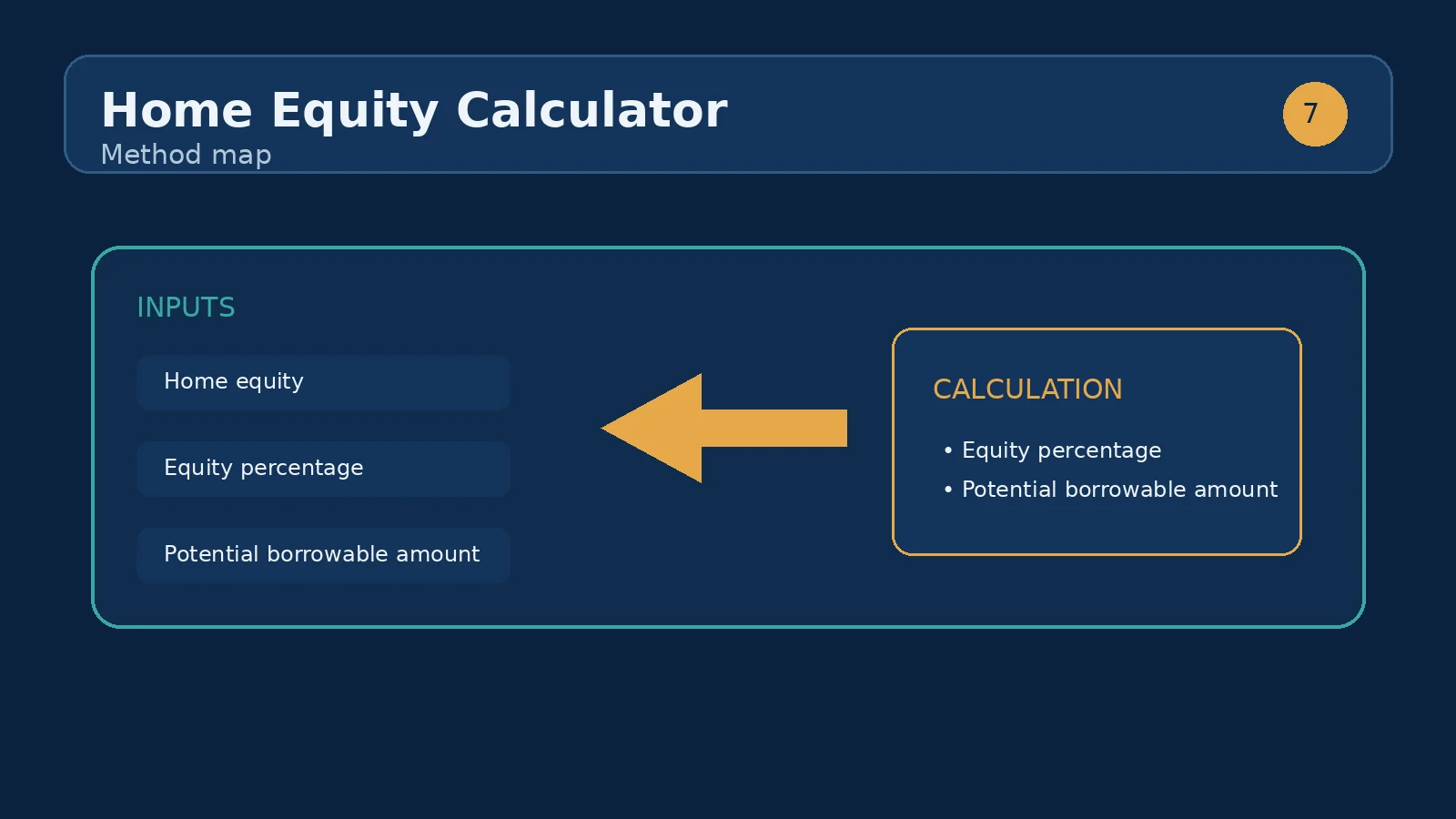
Home equity is the absolute ownership estimate: current market value minus mortgage balance. Equity percentage is that equity divided by current market value, expressed as a percentage. Potentially borrowable is the amount left after applying the selected maximum LTV and accounting for the existing mortgage balance. In compact form, the model is equity = value − balance, equity percentage = equity ÷ value, and potentially borrowable = max(0, value × maximum LTV − balance).
For the default inputs of $450,000, $280,000, and 85%, the maximum debt implied by the LTV setting is $382,500. Subtracting the $280,000 balance leaves $102,500 as Potentially borrowable. The same example therefore reads as $170,000 Home equity, 37.78% Equity percentage, and $102,500 Potentially borrowable. The first two outputs describe the ownership position; the third describes a borrowing ceiling under the selected LTV assumption.
The outputs should be read together. A large equity balance can coexist with a modest borrowing ceiling if the chosen maximum LTV is conservative. Conversely, a high LTV can produce a larger displayed borrowing amount without creating more equity. The calculator’s wording, “Potentially borrowable,” is important: approval and final proceeds remain subject to lender approval and affordability, as the result hint states.
Suppose the current market value is $500,000, the Mortgage balance is $300,000, and the Lender maximum LTV is 80%. Home equity is $200,000, and Equity percentage is 40%. The maximum debt at 80% LTV is $400,000, so Potentially borrowable is $100,000. In this scenario, a planned $60,000 project fits below the calculator’s displayed ceiling, while a $120,000 request does not.
That comparison is not an approval decision. A lender may use a different valuation, may include other liens, and may apply affordability or product rules that this component does not model. The practical use of the scenario is to identify what must be checked next: whether the value estimate is credible, whether the balance is current, whether the proposed borrowing purpose is sensible, and whether the resulting payment would fit the household budget.
Try changing one input at a time. If the market value falls to $460,000 while the balance remains $300,000, equity becomes $160,000 and the 80% LTV ceiling becomes $368,000, leaving $68,000 potentially borrowable. The comparison shows why a borrowing plan should not rely on a single optimistic valuation.
Using the same $450,000 market value and $280,000 balance, an 80% maximum LTV implies a debt ceiling of $360,000 and $80,000 Potentially borrowable. At 85%, the ceiling is $382,500 and the displayed amount is $102,500. At 90%, the ceiling is $405,000 and the displayed amount is $125,000. Home equity remains $170,000 and Equity percentage remains 37.78% in all three tests because only the LTV assumption changes.
This is the calculator’s clearest comparison: maximum LTV changes the amount of debt that could be secured against the home, not the amount already owned. A higher setting may increase the displayed room but also means a larger debt balance relative to the property value. A lower setting leaves more value as a cushion against valuation changes and future borrowing, although the component does not calculate interest, monthly payments, fees, or tax effects.
For a disciplined comparison, record the three outputs for each LTV setting rather than focusing only on the largest number. If the result changes materially when the setting moves by five percentage points, that sensitivity belongs in the decision discussion with a qualified lender or adviser.
The most common mistake is entering the purchase price or an aspirational resale value instead of a current market value. Another is entering the original mortgage amount instead of the present balance. Either error changes both equity measures and the borrowing estimate. A third mistake is treating the Lender maximum LTV as a guaranteed product limit; it is merely the assumption selected in the field.
Do not silently ignore other secured debts. A second mortgage, home-equity line, or other lien can reduce the room available even if it is not represented by the single balance field. Do not confuse gross equity with cash that can be withdrawn: transaction costs, lender charges, required reserves, and affordability checks are outside this calculator.
Finally, avoid interpreting a zero or negative Potentially borrowable value as proof that the property has no equity. The property can show positive Home equity while the selected LTV ceiling leaves no additional borrowing room. That is a difference between ownership and leverage, not a contradiction.
Use Home equity to understand the dollar value of the ownership stake represented by the inputs. Use Equity percentage to compare the stake with the property’s value. Use Potentially borrowable to frame a preliminary upper bound under one LTV assumption. None of these outputs is a monthly payment, interest quote, approval, or guarantee of proceeds because the component does not collect a rate, term, income, credit score, fees, or repayment structure.
A useful review asks whether the inputs are current, whether the result remains acceptable under a lower market value, and whether the proposed borrowing still makes sense after the balance rises. Re-run the calculator with conservative values and several LTV settings. Keep the estimate separate from any lender illustration, because the lender may calculate value, balance, allowable LTV, and costs differently.
When the question becomes “What would the payment be?”, move to a sibling tool that accepts the relevant loan amount, rate, and term, such as a home-loan or mortgage payment calculator if available in the product. The home-equity calculator is the screening step that estimates room; a payment calculator is the next step for testing repayment burden. Together, they separate collateral capacity from cash-flow affordability.
Start with the best supported Current market value you can obtain and enter the latest Mortgage balance. Read Home equity and Equity percentage before considering borrowing. Then select a Lender maximum LTV that matches the assumption you want to test, compare at least one lower setting, and note how Potentially borrowable changes.
Next, stress the estimate by lowering the market value and, if appropriate, increasing the balance to reflect other debt that should be included in the model. If the displayed room disappears under a modest change, avoid treating the initial result as dependable cash. If it remains, use the amount only as a starting figure for product research and affordability analysis.
The strongest workflow ends outside this calculator: verify the balance, obtain a credible valuation, list all secured debts and costs, and ask a lender how its underwriting treats the request. This tool gives a transparent arithmetic baseline so those conversations begin with explicit assumptions rather than a vague impression of available equity.
Equity is the portion of your property you own outright: current market value minus what you still owe on your mortgage.
No. Lenders cap total borrowing at a maximum loan-to-value ratio, commonly 80% to 90%, and you must still meet affordability checks.
It is Current market value minus Mortgage balance. With $450,000 of value and a $280,000 balance, the estimate is $170,000.
Equity percentage describes the share of the home represented by equity, while Potentially borrowable estimates additional debt room under the selected maximum LTV.
No. The component explicitly labels the figure as potentially borrowable and notes that lender approval and affordability still apply.
The borrowing ceiling changes, but Home equity and Equity percentage do not, provided Current market value and Mortgage balance stay the same.
There is only one Mortgage balance input. Include relevant secured debt in that figure when appropriate, or treat the result as incomplete and verify the structure separately.
It means the selected LTV ceiling leaves no modeled room above the entered balance. It does not necessarily mean Home equity is zero.
Home equity explained: how it builds over time, how to calculate it, and when borrowing against it makes sense for homeowners.
What is PMI and when can you remove it? See how mortgage insurance is calculated, what it costs, and the 20% equity rule.
How we calculate: calcHomeEquity in calculators.ts; regression checks in calculators.test.ts
Last reviewed: . Learn more about Nirmal Lashkari and LashkariProperties.
Disclaimer: This calculator provides estimates for informational purposes only and is not financial, tax, or legal advice. Verify figures with a qualified professional before making decisions.