
Investment Guides
What Is a Good Rental Yield in USA, UK, Australia, Canada & UAE? (2026 Guide)
By LashkariProperties Team · July 20, 2026 · 29 min read

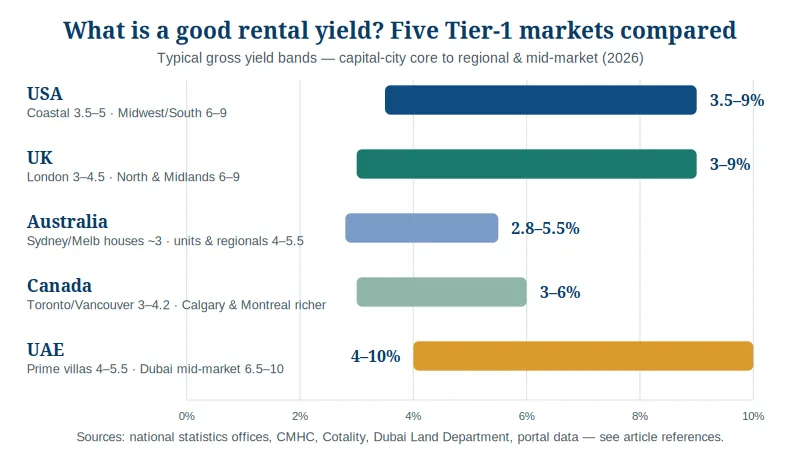
The 60-second answer
Agood gross rental yieldis one that beats the average for the market you are buying in, covers your cost of debt with room to spare, and survives the journey from gross to net. As a rule of thumb across the five markets covered here:
What counts as a good gross rental yield by market (2026)
Two things to hold onto before you read another word. First,net yield is the number that pays you. Gross yield is a marketing number; net yield is a decision number. Second, yield is only one-third of the verdict. The full picture is yield plus cash flow after debt plus expected capital growth, and the sections below show you how to weigh all three.
Educational content only
This guide is general education, not personalised financial, tax, or legal advice. Rental rules, taxes, and lending criteria differ by country, state, and even city. Verify anything that affects a real purchase with a local accountant, broker, or solicitor.
Key definitions and formulas
Rental yieldis the annual rental income of a property expressed as a percentage of what the property is worth (or what you paid for it). It is the property world's equivalent of a dividend yield on a share: a quick, comparable measure of how hard the asset's income works relative to its price.
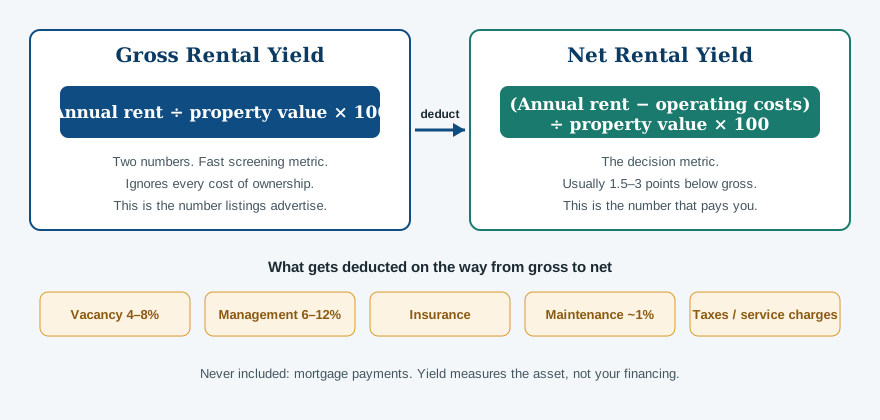
Gross rental yield
If a flat rents for $2,000 per month and is worth $400,000, the gross yield is ($24,000 ÷ $400,000) × 100 =6%. Gross yield ignores every cost of ownership. It is fast, it is comparable across listings, and it is the number portals and agents quote — but it flatters every property.
Net rental yield
Operating costs include vacancy allowance, letting and management fees, insurance, maintenance and repairs, council or property taxes, strata or service charges, and compliance costs. They donotinclude mortgage payments, because yield measures the asset, not your financing. Net yield usually lands1.5 to 3 percentage points below gross, and it is the figure that predicts whether a property puts money in your pocket.
Yield on cost vs yield on value
A subtle but important distinction:yield on costdivides rent by what you actually paid (including stamp duty or transfer taxes, legal fees, and renovation), whileyield on valuedivides rent by today's market value. If you bought a Dubai apartment for AED 1,000,000 and it is now worth AED 1,400,000, your yield on cost might be a healthy 7.2% while your yield on value has compressed to 5.1%. Yield on value is the honest test of whether your capital is still working hard, or whether you would redeploy it better elsewhere.
Why a good yield is market-relative, not absolute
Rental yield is the ratio of two prices: the price of shelter as a service (rent) and the price of shelter as an asset (property value). Those two prices are set by different forces. Rents track local wages, vacancy rates, and the supply of rental homes. Asset prices track those fundamentals too, but they also respond to interest rates, credit availability, tax settings, foreign-buyer demand, and how much capital growth buyers expect. When asset prices outrun rents — as they have for decades in Sydney, Toronto, and Vancouver — yields compress, even while the rental market underneath is brutally tight.
That is why a single global benchmark is meaningless. Three forces make each market's normal different:
1. Expected capital growth
Investors accept lower income today when they expect higher prices tomorrow. Prime London, Sydney's inner suburbs, and central Toronto have delivered decades of price appreciation, so buyers bid prices up and yields down. In markets where growth is slower or less certain — parts of the US Midwest, some northern English towns — the income itself must do the heavy lifting, so prices stay low relative to rents and yields stay high.
2. Risk and friction
Yield is also compensation for hassle and risk. A 9% gross yield on a terrace in a weak-demand postcode carries higher vacancy risk, more management intensity, and thinner resale demand than a 4.5% yield on a Dubai Marina apartment with a waiting list of tenants. Currency risk matters too: an overseas buyer earning dirhams, pounds, or Australian dollars is making a bet on the exchange rate as well as the building.
3. Interest rates and the cost of debt
What counts as good is anchored to what money costs. When central bank rates sit at 4–5%, a 4% net yield that leaves nothing after the mortgage is a very different proposition from the same yield when money costs 2%. Benchmarks from central banks — theUS Federal Reserve, theBank of England, theReserve Bank of Australia, theBank of Canada, and theCentral Bank of the UAE— are the gravity that pulls on every yield judgment in this article.
A good yield is not a number. It is a number, in a place, at an interest rate, for a particular investor's strategy.
Good rental yield ranges by Tier-1 market
The bands below synthesise recent data from national statistics offices and established housing research — including theUS Census Bureau's Housing Vacancy Survey, theUK Office for National Statistics private rental index,Cotality (formerly CoreLogic) Australia, theCanada Mortgage and Housing Corporation, and theDubai Land Department— cross-checked against major portals. Treat them as orientation, not gospel: every city contains neighbourhoods two points apart.
Gross rental yield benchmarks: weak, typical, good, and strong bands by market
4%–5.5% (Brisbane, Perth, units, regionals)
4.5%–6% (Calgary, Edmonton, Montreal, Halifax)
6.5%–9% (JVC, International City, mid-market)
Houses vs units: the property-type gap inside every market
Within each country band there is a second, quieter divide: detached houses almost always yield less than apartments and units. Land appreciates; buildings depreciate — so investors pay a premium for the land-heavy asset and accept a thinner income stream on it. In Sydney, a house might gross 2.8% while a unit in the same suburb grosses 4.2%. In Toronto, freehold houses yield less than condos on paper, though condo fees claw much of the difference back at net. In Dubai, mid-market apartments comfortably out-yield prime villas. When you benchmark a deal, compare like with like: a house measured against the city's unit average will always look weak, and a unit measured against the house average will always look like a bargain. Neither comparison tells you anything useful.
Reading the bands correctly
Notice the inverse relationship: the markets with the lowest typical yields (Sydney houses, Toronto condos, Vancouver) are precisely the markets where buyers have historically been paid in capital growth instead of income. The markets with the highest typical yields (Dubai mid-market, US Midwest, northern England) pay you in income today but ask you to accept slower appreciation, higher turnover costs, or more hands-on management. Neither is inherently better. They are different compensation structures, and the right one depends on whether you need cash flow now or wealth later.
Australia deserves a special note: national gross yields recovered through the mid-2020s as rents grew faster than prices in several capitals, with Cotality's research series tracking the rebound from record lows. Even so, Sydney house yields near 3% remain among the lowest in the Tier-1 world, which is why Australian investors lean so heavily on negative gearing and growth expectations — a point we return to in the market nuances section.
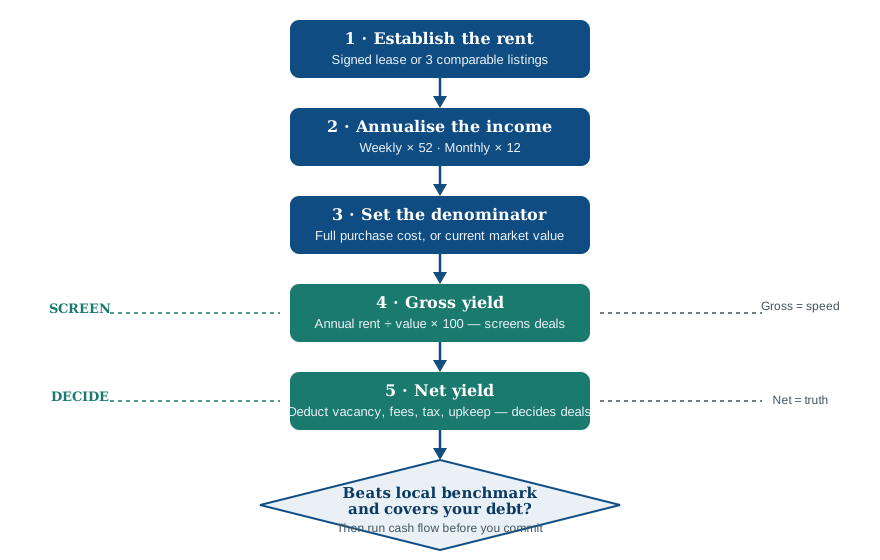
How to calculate rental yield in five steps
- Establish the rent.Use the actual lease rent if the property is tenanted. If it is vacant or off-plan, take a conservative market rent from at least three comparable listings — and shave 3–5% off the asking rents you see advertised, because asking is not achieving.
- Annualise the income.Weekly rent × 52, or monthly rent × 12. In the UK and Australia rents are usually quoted weekly; in North America and the UAE, monthly or annually.
- Set the denominator.For a purchase decision, use the full acquisition cost: price plus stamp duty or transfer tax, legal fees, and inspection costs. For an existing holding, use current market value as well — that is your opportunity-cost check.
- Calculate gross yield.Annual rent ÷ denominator × 100. This is your screening number.
- Calculate net yield.Subtract vacancy (4–8% of rent), management (6–12%), insurance, maintenance (a common allowance is ~1% of property value per year), rates or service charges, and letting fees. Divide by the same denominator. This is your decision number.
Stress-test before you celebrate
A yield that only works in the best-case scenario is not a yield — it is a hope. Before treating any number as good, re-run it three ways: rent 5% below your estimate, one extra vacancy month per year, and maintenance at 1.5% of value instead of 1%. Then run the financing at one to two percentage points above your quoted mortgage rate. If the deal still produces a net yield at or above the local band after those haircuts, it is genuinely robust. If it falls apart, you have learned something worth thousands for the price of a spreadsheet cell.
Best practice: calculate both yields twice
Run gross and net yield on (a) the purchase price and (b) today's market value. The first tells you whether the deal was good. The second tells you whether it still is. Experienced investors do this annually, and it routinely surfaces properties that should be refinanced, repriced, or sold.
Worked examples: three real-shaped deals
Numbers below are illustrative and use rounded, realistic mid-2020s figures. Local taxes, service charges, and lending rules vary — verify with local professionals before acting.
Example 1 — Austin, Texas, USA: the high-yield play
Single-family rental, Austin, Texas (USD)
A 6.6% gross yield screens as good for the USA. But look at the net: 3.2%, less than half. Texas property taxes and insurance do enormous damage to the gross-to-net journey. With a 30-year investor mortgage at roughly 7% on a 75% loan, annual debt service alone would be about $23,900 — meaning this positive-yield property iscash-flow negative by roughly $11,000 a year. The yield was fine; the deal, at that rate and price, was not. This is why yield can never be the last number you check.
Example 2 — Manchester, UK: the balanced performer
Two-bed city apartment, Manchester, England (GBP)
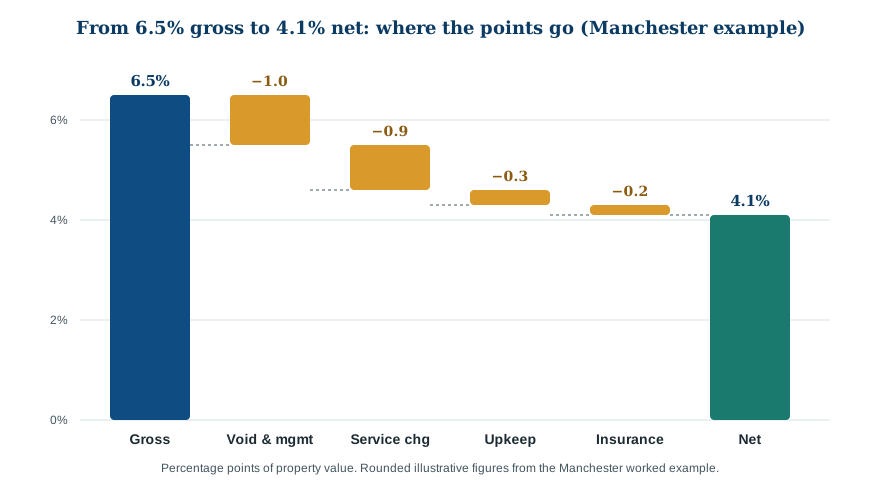
Manchester and other northern powerhouses (Leeds, Liverpool, Sheffield) routinely deliver 6–8% gross, roughly double prime London. After costs, 4.1% net is solid for the UK — enough to cover an interest-only buy-to-let mortgage at around 5% on a 65% loan and still leave a small surplus, subject to the lender's interest-coverage stress test. Note the UK's tax wrinkle: since Section 24 fully phased in, individual landlords cannot deduct mortgage interest from rental income before calculating tax, receiving a 20% credit instead. HMRC'sguidance on the changes to tax relief for residential landlordsis essential reading — it means high-rate taxpayers need a meaningfully higher gross yield to clear the same after-tax result.
Example 3 — Jumeirah Village Circle, Dubai, UAE: the income engine
Purchase price (incl. 4% DLD fee & agency)
Service charges (AED 14/sq ft on 750 sq ft)
Dubai's appeal in one table: a 7.2% gross yield becomes a 5.3% net yield because there is no annual property tax and no income tax on rent for most individual landlords (though foreign owners may owe tax in their home country — check locally). The drags are service charges, which vary wildly by building and can quietly move net yield by a full point, and the DLD's 4% transfer fee, which inflates your acquisition denominator. TheDubai Land Departmentpublishes the fee schedule and the official rental index, which caps permitted rent increases — a genuine yield consideration when your in-place rent sits below market.
Gross vs net: where the percentage points go
Across the three examples above, the gross-to-net drag ranged from 1.9 points (Dubai) to 3.4 points (Austin). Understanding each deduction is what separates investors who model reality from investors who model brochures:
- Vacancy allowance (4–8% of rent).Even in tight markets, budget two to four empty weeks a year for reletting, cleaning, and the occasional arrears write-off. National vacancy data from theUS Census BureauandCMHC in Canadashows how much this varies by metro — use your city's rate, not a national one.
- Management and letting fees (6–12% of rent).Full-service management in the US and Australia typically runs 7–10% plus letting fees; UK agents charge 10–15% including VAT for full management; Dubai is cheaper at around 5%. Self-managing saves the fee but costs your time — price it honestly.
- Property taxes and council rates.The single most market-specific line: near zero in the UAE, roughly 1–2% of value in much of the US (higher in Texas and New Jersey), council-tax-banded in the UK (often tenant-paid, but voids are yours), and municipal rates plus land tax for investors in Australia.
- Maintenance and capex (~1% of value per year).The 1% rule of thumb works for mid-life properties; new builds can run lower for a decade, older stock higher. Skipping this line is the most common way amateur net yields are overstated.
- Insurance.Landlord policies in the US and Australia; buildings insurance in the UK (sometimes embedded in the service charge for flats); typically modest in the UAE. US coastal premiums have risen sharply — get a real quote, not a guess.
- Service charges / strata / HOA fees.The silent killer for apartments and condos everywhere, and for Dubai towers in particular. Always read three years of minutes or statements before you buy.
Warning: the brochure-yield trap
Off-plan and new-build marketing frequently quotes guaranteed or projected gross yields of 7–9% using top-of-market asking rents and zero costs. If the net yield cannot be reproduced from the development's actual service-charge budget and signed comparable leases, treat the headline as advertising, not analysis.
Tier-1 market nuances that change what good means
USA: a continent of sub-markets
The average rental yield in the USA is almost meaningless because the spread is so wide: gross yields under 4.5% in the coastal gateway metros against 8–10% in parts of Ohio, Indiana, and Alabama. Three structural factors shape US yields. First,property taxesare local and can differ three-fold between states for the same price point. Second, the30-year fixed mortgagelets investors lock debt costs for a generation, which changes how yield thresholds behave across rate cycles. Third, DSCR loans — underwritten on the property's income rather than your salary — have professionalised small-scale landlording; our guide toDSCR, the investor loan metric that matters, explains how lenders convert your yield into a borrowing limit.
UK: the North–South divide is the whole story
UK rental yield is a tale of two markets. London and the South East offer 3–4.5% gross with deep liquidity and long-run growth; the North West, North East, Scotland, and Wales offer 6–9% gross with higher yield but thinner capital appreciation. ONS rental-price data has shown rents growing fastest exactly where yields were already highest, reinforcing the regional case. But UK landlords face the heaviest regulatory load of the five markets: the extra 3% stamp-duty surcharge on additional homes, Section 24 interest-relief restriction, energy-efficiency (EPC) requirements, and evolving tenancy law in England. Each of these pushes the required gross yield up — a deal that pencilled at 5% in 2015 often needs 6.5%+ to deliver the same after-tax result today.
Australia: the lowest yields, the strongest growth story
Australian capital-city houses carry some of the lowest gross yields in the developed world — around 3% in Sydney and Melbourne, with units and the smaller capitals (Perth, Brisbane, Adelaide) a point or so higher. What keeps capital flowing in is the combination of chronic housing undersupply, population growth, andnegative gearing: the ability to offset rental losses against other income, plus a capital-gains-tax discount on long holds. The practical consequence: Australian investors routinely buy 3% gross yields on purpose, accepting monthly top-ups in exchange for tax relief and expected appreciation. It works in a rising market with rising rents — as the mid-2020s delivered — but it concentrates all your risk in the exit price.
Canada: compressed yields, rent control, and condo math
Canada's big-two metros, Toronto and Vancouver, offer 3–4.2% gross, with Calgary, Edmonton, Montreal, and Halifax a point or two richer. Two nuances dominate. First,rent control: Ontario caps annual increases for most units first occupied before late 2018 (guideline increases have run around 2–2.5%), which means your yield on cost can fall behind the market every year you hold a long-term tenant. Second,condo feesin Toronto and Vancouver towers commonly consume 15–25% of rent, so the gross-to-net drag on condos is structurally heavier than on freehold houses. CMHC's rental-market reports are the authoritative source for metro vacancy and rent-growth benchmarks.
UAE: the highest yields in the Tier-1 world, with different risks
The UAE — Dubai in particular — is the outlier: a Tier-1 global city where 6.5–8% gross is ordinary and 9–10% is achievable in mid-market communities like JVC and International City. The structural reasons are a large, mobile expatriate tenant base, no annual property tax, no personal income tax on rent for most individuals, and a supply pipeline that keeps prices honest. The risks are different rather than absent: rents are cyclical and fell hard in past downturns; the dirham's US-dollar peg means non-USD buyers carry currency exposure; service charges vary enormously by building; and the official rental index caps increases for sitting tenants. Overseas buyers should model their returns in their home currency — the difference between an 8% dirham yield and what actually lands in pounds or euros is an exchange-rate question, not a property question.
When a lower rental yield still makes sense
Chasing the highest headline yield is the most common beginner error in property. There are at least six situations where deliberately accepting a lower yield is the rational, professional choice:
1. When capital growth does the compounding
Total return = net yield + capital growth. A Sydney unit yielding 3.5% net with 5% long-run price growth beats a regional 8% gross / 5.5% net property growing at 1% — on total return, 8.5% versus 6.5%. The catch is that growth is unrealised and cyclical while yield is cash. The growth play only suits investors with the income to fund any shortfall and the patience to hold through a full cycle.
2. When vacancy and tenant quality differ
A 7% yield that sits empty three months a year delivers 5.25% of actual income before costs. A 5% yield in a suburb with a 1% vacancy rate and professional tenants delivers what it says on the tin. Always haircut the high-yield property's rent by a realistic void allowance before comparing.
3. When liquidity matters
Prime low-yield markets are liquid: you can exit in weeks at a predictable price. High-yield secondary markets can take quarters to sell and require discounts in weak patches. If there is any chance you will need the capital back on a timetable, liquidity is worth yield points.
4. When you are buying currency and stability, not just income
For international investors, a 4% net yield in a USD-pegged, rule-of-law market can outperform an 8% yield in a volatile currency on a risk-adjusted, home-currency basis. Your true return is the property return plus or minus the FX move.
5. When the debt math still works
A 4% net yield is perfectly investable with cheap, fixed, long-term debt and moderate leverage. The same yield is a cash bonfire with short-term floating debt at 8%. Yield adequacy is always judged againstyourcost of funds — which is whyinterest-only mortgage structuresfeature so heavily in landlord finance, for better and worse.
6. When the alternative is worse
Every yield decision is relative to the opportunity set. If your realistic alternatives are cash at 3.5% or equity-market volatility you cannot stomach, a 4.5% net yield with modest growth on a hard asset may be the best seat available, even if a textbook says good starts at six.
The question is never is this yield high. It is is this yield high enough, for this risk, in this currency, against my alternatives.
How to improve a weak yield before you walk away
A below-benchmark yield is not always a reason to pass on a property. Sometimes it is a pricing signal — and sometimes it is fixable. Before discarding a deal, work through the levers that move the ratio:
Raise the numerator: rent and income
- Buy below-market rent with a path to market.A property let at 15% under market can be a gift: check the legal route and timeline to re-let at market (Dubai's rental index caps, Ontario's guideline increases, and UK periodic-tenancy rules all differ), and model the yield at the rent you can realistically achieve in year two, not year one.
- Add genuine value, not cosmetics.A third bedroom carved from a dining room, a dedicated home-office space, air conditioning in Australia, or permitted parking in London can lift rent more than a kitchen refresh of the same cost. Target improvements with a provable rent premium on comparable listings.
- Reduce structural vacancy.Allowing pets where local law permits, offering two-year leases with a pre-agreed review, or furnishing a unit in a corporate-let market can cut void weeks — which flows straight to net yield.
Lower the denominator: price and basis
- Negotiate the price, not the yield.Every 5% off the purchase price adds roughly a third of a point to a 7% gross yield. Motivated sellers, probate sales, and stale listings move the ratio more than any spreadsheet optimism.
- Audit the cost stack before exchange.Service charges, sinking-fund health, insurance quotes, and letting fees are all knowable before you buy. A building with a well-funded reserve and modest charges can be worth half a point of net yield against an identical flat next door.
If none of the levers move the deal into the local band with honest assumptions, that is your answer: the market is pricing this property for growth or for an owner-occupier, not for income — and you should only buy it if that is the strategy you actually intended.
Common mistakes and myths about rental yield
Mistake 1: Comparing gross to net
Agents quote gross; your bank account experiences net. Comparing one property's 8% gross against another's 5% net is apples to oranges. Normalise everything to net before ranking deals.
Mistake 2: Using asking rent as income
Asking rents are wishes. Use signed comparable leases, or shave 3–5% off asking. In Dubai, check the official rental index; in the UK, check achieved rents with local agents; in Australia, check the REA/Domain rent series for the suburb.
Mistake 3: Forgetting the acquisition costs in the denominator
Stamp duty in the UK (plus the 3% surcharge), the 4% DLD fee in Dubai, land transfer tax in Toronto, and stamp duty in Australia all inflate your true basis by 3–6%. Yields calculated on the bare price overstate the return on your actual invested capital.
Mistake 4: Believing the 2% rule
The 2% rule (monthly rent ≥ 2% of price) implies a 24% gross yield. It is a relic of distressed US Midwest housing and is essentially unachievable in Tier-1 metros. Even the 1% rule (12% gross) fails in every market in this guide except select US and UAE pockets. Use these as quick filters at most, never as targets.
Mistake 5: Ignoring the mortgage until the end
Yield is calculated before debt, which makes it easy to fall in love with a property that loses money every month once financed. The sequence that protects you is: gross yield → net yield → cash flow after debt service → cash-on-cash return. Our companion piece oncash-on-cash returncovers the final step.
Mistake 6: Assuming yield is static
Yields move when rents move, when values move, and when your costs move. Insurance repricing, service-charge increases, and special levies can quietly strip half a point from net yield in a single year. Recalculate annually — against current value, not just what you paid.
How rental yield connects to the other numbers that matter
Yield is the front door of property analysis, not the whole house. Four companion metrics complete the picture, and the order matters: each one answers the question the previous one cannot.
- Cap rateis net yield's institutional cousin: net operating income divided by current market value, using strict commercial expense conventions. For residential investors the two are near-identical, but cap rate is the language of valuers and lenders. Our guide tocap rates explained for property investorsmaps the differences.
- Cash flowis what remains after the mortgage is paid. Net yield can be 5% while cash flow is negative if debt is expensive; the tension between the two is the subject ofcap rate vs cash flow: which metric should guide your decision?
- Cash-on-cash returndivides pre-tax cash flow by the actual cash you invested (deposit plus costs), measuring the return on your money rather than the asset's. Leverage can turn a 4% net yield into a 9% cash-on-cash return — or a negative one.
- DSCR(debt service coverage ratio) is net operating income divided by annual debt service. Lenders use it to decide how much they will lend you; 1.20–1.25× is a common floor. Yield feeds DSCR, and DSCR feeds your maximum leverage.
Read as a chain, the logic is simple:gross yield screens → net yield evaluates the asset → cash flow evaluates the financing → cash-on-cash evaluates your capital → DSCR determines whether the bank will fund it at all.A deal must pass every gate in sequence, and a good yield is only ever the first gate — never the verdict.
Run the numbers with free calculators
Everything in this article can be verified in minutes with the free tools atLashkariProperties, a property-tools platform built to help buyers, landlords, and investors stress-test deals before committing capital:
- Rental Yield Calculator— compute gross and net yield side by side, with editable expense lines for vacancy, management, maintenance, and service charges, on either purchase price or current value.
- Cash Flow Calculator— add your mortgage terms and see the monthly reality after debt service, so a good yield never disguises a bad deal.
- Cap Rate Calculator— translate your net operating income into the valuation language lenders and agents use, and compare markets on a like-for-like basis.
- Currency Converter— essential for cross-border deals: convert price, rent, and yield components between USD, GBP, AUD, CAD, and AED before you compare a Dubai yield against a Manchester one.
A practical workflow: screen ten listings with the rental yield calculator, shortlist three, push each through the cash-flow calculator with your real mortgage quote, then sanity-check the winner's cap rate against recent local sales. Fifteen minutes of arithmetic has saved more investors than any hot tip ever has.
The good-yield checklist
Before you call any yield good, confirm each of these:
- Rent verified.Income based on a signed lease or three achieved-rent comparables, not an asking price.
- Denominator honest.Full acquisition cost including transfer taxes and fees — and a second pass at current market value.
- Net, not just gross.Vacancy, management, insurance, maintenance at ~1% of value, taxes or rates, and service charges all deducted from real quotes.
- Benchmarked locally.Compared against the city and property-type band in this guide, not a national average.
- Debt-tested.Cash flow modelled with your actual mortgage terms, at a stressed rate 1–2 points higher.
- Tax-checked.After-tax position confirmed with a local accountant — Section 24 in the UK, depreciation in the US, negative gearing in Australia, and home-country tax on UAE rent can each move the answer.
- Total-return framed.Realistic growth assumption added, so you know whether you are buying income, growth, or both.
- Exit considered.Liquidity, likely buyer pool, and selling costs thought through before entry.
Frequently asked questions
What is a good rental yield in the USA?
A gross rental yield of roughly 6–8% is considered good in many US metro areas, and above 8% is strong. In expensive coastal metros such as New York, San Francisco, and Los Angeles, 3.5–5% gross is normal, so investors there judge deals more on net cash flow and total return than on headline yield.
What is a good rental yield in the UK?
A gross yield of 5–7% is broadly considered good in the UK. Regional cities in the North and Midlands often achieve 7–9%, while much of London delivers only 3–4.5% gross, which is why many London landlords accept lower yields in exchange for liquidity and long-run capital growth.
Is a 5 percent rental yield good?
It depends on the market and whether the figure is gross or net. A 5% gross yield is weak in high-yield US or UK regional markets but solid for Sydney, Toronto, or Vancouver. A 5% net yield is respectable almost anywhere, because most properties lose 1.5–3 percentage points between gross and net.
What is the difference between gross and net rental yield?
Gross rental yield is annual rent divided by property value, before any costs. Net rental yield subtracts operating expenses such as vacancy, management fees, insurance, maintenance, service charges, and rates. Net yield is usually 1.5–3 percentage points lower and is the figure that predicts whether a property actually pays you.
Is rental yield the same as cap rate?
They are closely related but not identical. Net rental yield typically divides net operating income by the price you paid, while cap rate conventionally divides net operating income by current market value with stricter expense conventions. In practice the two numbers are near-twins and are used interchangeably in many markets.
What is a good rental yield in Dubai and the UAE?
Dubai is one of the highest-yielding Tier-1 markets. Gross yields of 6–8% are common, with studios and one-bed apartments in mid-market communities sometimes reaching 8–10%. Prime villa districts such as Palm Jumeirah and Emirates Hills typically yield 4–5.5% gross.
Why are rental yields so low in Sydney, Melbourne, Toronto, and Vancouver?
Because prices have risen much faster than rents in these supply-constrained cities, compressing yields to roughly 2.5–4% gross. Buyers in these markets have historically been compensated through capital growth, tax settings such as negative gearing in Australia, and deep, liquid resale markets.
How do you calculate rental yield?
Gross rental yield equals annual rental income divided by property value, multiplied by 100. Net rental yield equals annual rent minus operating expenses, divided by property value, multiplied by 100. For example, 24,000 in annual rent on a 400,000 property is a 6% gross yield.
Is a higher rental yield always better?
No. Very high yields often compensate for weaker tenant demand, slower capital growth, older building stock, or higher vacancy risk. The healthiest deals pair a yield that comfortably covers the cost of debt and expenses with a location that has durable employment and population growth.
What is the 2 percent rule in property investing?
The 2% rule is a US screening heuristic suggesting monthly rent should be at least 2% of the purchase price — equivalent to a 24% gross yield. It is rarely achievable in modern Tier-1 metros and was designed for inexpensive US Midwest housing. Most investors now use the 1% rule, about 12% gross, as a quick filter at best.
Does rental yield include the mortgage?
No. Gross and net rental yield are both calculated before mortgage payments, because yield measures the property rather than your financing. Cash flow and cash-on-cash return are the metrics that account for debt, which is why a positive-yield property can still lose money each month at high interest rates.
What expenses reduce gross yield to net yield?
The main deductions are a vacancy allowance of roughly 4–8% of rent, letting and management fees of 6–12%, landlord insurance, routine maintenance of around 1% of property value per year, council or property taxes, strata or service charges, and occasional letting fees and compliance costs.
When does a lower rental yield still make sense?
A lower yield can be rational when a market offers strong and reliable capital growth, very low vacancy, a stable currency, or portfolio diversification value. The correct comparison is total return and risk-adjusted cash flow after your actual cost of borrowing, not the headline gross yield in isolation.
How often should I recalculate my rental yield?
Review your yield at least once a year, at each rent renewal, and after any major expense change such as an insurance premium increase or a service-charge revision. Recalculate against current market value as well as purchase price, because a rising value can quietly turn a good deal into an underperforming one.
Conclusion: good is a comparison, not a number
A good rental yield is one that beats its local benchmark, survives the gross-to-net journey, covers your cost of debt with margin, and fits a total-return plan you have actually written down. In practical terms that means 6–8% gross in the USA's income markets, 5–7% in the UK, 4–5% in Australia's growth cities, 4.5–5.5% in Canada's major metros, and 6.5–8% in the UAE — always verified at net, and always stress-tested against your real mortgage.
Your next step takes fifteen minutes: pick a live listing, run it through therental yield calculator, then stress-test the winner in thecash flow calculator. If you are comparing markets across borders, normalise everything with thecurrency converterfirst. And to go deeper on the metrics that sit beside yield, read our guides tocap ratesandcash-on-cash return.
Disclaimer
This article is for general education only and is not personalised financial, tax, or legal advice. Rental yields, taxes, tenancy law, and lending criteria vary by country, state, and city and change over time. Figures shown are illustrative. Always verify numbers and rules with qualified local professionals before making any property decision.
Keep reading
- Cap Rate Explained for Property Investors
- Cap Rate vs Cash Flow: Which Metric Should Guide Your Decision?
- Cash-on-Cash Return: How to Calculate It Properly
- Interest-Only Mortgages Explained: Risks, Uses, and Math
- DSCR Explained: The Investor Loan Metric That Matters
Tools mentioned in this article
Rental Yield Calculator
Measure gross and net rental yield to compare income potential across properties.
Currency Converter
Convert property prices between currencies using a reference exchange rate.
Stamp Duty & Transfer Tax Calculator
Estimate property transfer tax or stamp duty using banded rates for major markets.
Related reading
- Cash-on-Cash Return: How to Calculate It Properly
Learn how to calculate cash-on-cash return correctly with clear formulas, worked examples with and without leverage, common mistakes to avoid, and a step-by-step framework for property investors in the USA, UK, Canada, A
- How to Calculate ROI on a Rental Property — The Complete 2026 Investor Guide
Learn how to calculate ROI on a rental property the right way. Total ROI vs cash-on-cash, hidden costs most investors forget, worked examples for USA, UK, Canada, Australia and UAE — plus free calculators.
- Price-to-Rent Ratio: What It Signals About Rent vs Buy Markets
Learn what the price-to-rent ratio really tells you about a housing market, how it differs across Tier-1 cities (US, UK, Canada, Australia, UAE), and how to combine it with a personal rent-vs-buy calculation before you b