
Buying Guides
What Is PMI and When Can You Remove It? A Buyer's Guide (2026)
By LashkariProperties Team · July 18, 2026 · 28 min read

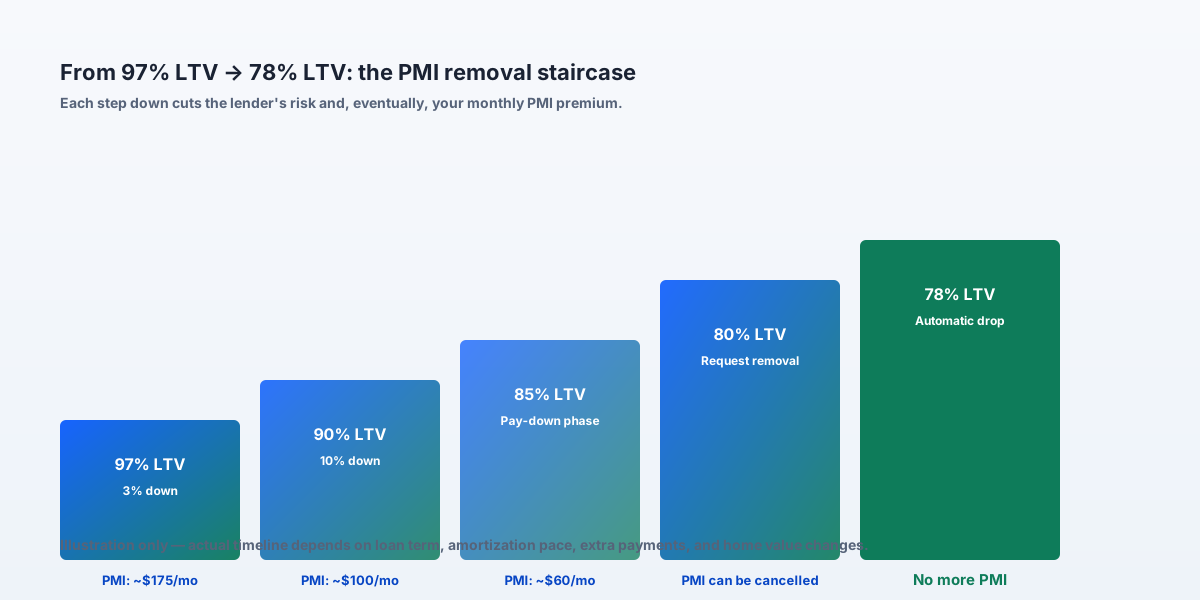
1. Why PMI keeps confusing buyers
If you have ever stared at a mortgage disclosure and wondered what the extra "PMI" line was doing on top of your principal, interest, tax, and insurance payment, you are not alone. Private mortgage insurance is the single most misunderstood cost in US home buying — and its rough equivalents in Canada, Australia, and the UK cause similar confusion abroad.
The confusion is understandable. PMI looks like homeowners insurance, but it does not protect you. It looks like a permanent cost, but for most conventional US loans it is temporary by law. It is quoted in fractions of a percent, but on a large loan those fractions can add up to more than $10,000 over the life of the mortgage. And the rules for cancelling it differ depending on which offourdifferent paths you take.
Layered on top of that, the mortgage industry uses at least five different names for what is essentially the same product: PMI, MIP, LMI, CMHC insurance, and Higher Lending Charge. Each has its own cancellation logic, its own regulator, and its own cost curve. A buyer who moves from London to Toronto to Austin over the course of a career will meet three completely different insurance products before turning 40 — and each one is priced against the same underlying risk: a lender losing money if a highly leveraged borrower defaults during a downturn.
The stakes for getting this right are also higher than most buyers realise. In 2026, the median US first-time buyer purchase price is above $360,000, and the median down payment sits in the mid-single digits. That combination puts almost every entry-level buyer inside the PMI zone for their first three-to-eight years of ownership. In that window, the difference between a well-managed PMI strategy and a passive one can easily reach $15,000–$25,000 — real money that could have paid down principal, bought appliances, funded a renovation, or seeded a second down payment.
This guide fixes that. By the time you finish reading, you will be able to (a) tell whether your loan currently carries PMI, (b) calculate to the dollar how much you are paying and how much removing it would save, and (c) execute the fastest legal path to cancel it — verified against real 2026 lender rules. You can double-check every number in this guide with the freeLashkariProperties PMI calculator, ourLTV calculator, or the full suite of free property tools atlashkariproperties.com/tools.
What you will be able to do
- Identify exactly when PMI is legally required and when it is not.
- Estimate your monthly PMI premium from your LTV and credit score.
- Choose between four PMI removal paths using a break-even calculation.
- Understand how the US model compares to insurance products in the UK, Canada, Australia, and the UAE.
2. Key definitions and formulas
2.1 What is PMI?
Private mortgage insurance (PMI)is an insurance policy your lender purchases (and you pay for) when you take out a conventional US mortgage with a down payment of less than 20% of the purchase price. If you default on the loan, PMI reimburses the lender —not you— for a portion of the loss.
Because PMI reduces the lender's risk, it is precisely what lets ordinary buyers get into a home with 3%, 5%, or 10% down instead of saving for years to reach 20%. In that sense, PMI is not a punishment for having a small down payment — it is the mechanism that made a small down payment possible.
2.2 What is LTV, and why does it drive everything?
Loan-to-value ratio (LTV)is the fraction of the property value that is financed by your mortgage. Every rule around PMI — when it applies, how much it costs, when it can be removed — is expressed as an LTV threshold.
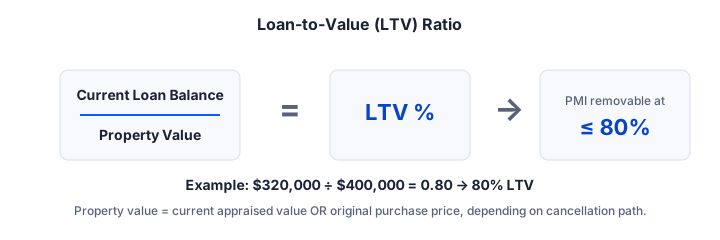
LTV % = (Current loan balance ÷ Property value) × 100
For PMI purposes, "property value" means one of two things depending on which cancellation path you are pursuing: theoriginalpurchase price for a borrower-initiated request at 80% LTV, or thecurrentappraised value if you are cancelling based on appreciation. This distinction matters enormously — we return to it inSection 6.
2.3 The PMI premium formula
Monthly PMI = (Loan amount × Annual PMI factor) ÷ 12
The annual PMI factor typically ranges from about0.20% to 2.25%of the original loan amount, depending on LTV, credit score, loan type, and whether the coverage is borrower-paid or lender-paid. Higher LTV and lower credit scores push the factor up.
2.4 Three related terms you should not confuse
- MIP (Mortgage Insurance Premium):the FHA equivalent. Different rules, generally not cancellable on loans originated after 2013 with less than 10% down.
- VA Funding Fee:a one-time fee on VA loans in lieu of ongoing insurance.
- USDA Guarantee Fee:the USDA loan equivalent — upfront plus annual, similar in feel to MIP.
For a deeper look at LTV mechanics, see our guide onwhat LTV ratio really means to lenders.
3. Why the PMI decision matters — buyers, investors, landlords
The size of the PMI decision depends on who you are and what you want the property to do.
3.1 For first-time buyers
For a first-time buyer choosing between waiting to hit 20% down and buying now with 5% and PMI, the calculation is essentially:How much will home prices, rents, and interest rates change while I save?In markets where prices are outrunning your savings rate, paying PMI for a few years and getting into the market earlier can be far cheaper than watching the goalpost move.
3.2 For investors and landlords
Investment properties usually cannot be financed with PMI — most lenders require 20–25% down on non-owner-occupied conventional loans. But for a house-hack, an owner-occupied duplex, or an ADU-eligible property that you will later convert, PMI can be an accelerator: it puts you into a cash-flowing asset years earlier and disappears once you build equity.
3.3 For refinance candidates
PMI is often the hidden reason a refinance makes sense. A borrower with a 4.5% loan and $200/month PMI might refuse to refinance at 5.5% based on the rate alone — but if the new loan is at 78% LTV and PMI disappears, the true break-even is far more favourable. Loan officers rarely lead with this framing because their commission is anchored to rate improvement, not total housing cost. If you evaluate a refinance offer only on interest rate, you can miss the single biggest saving on the table.
3.4 For move-up buyers using existing equity
Homeowners selling a first property to trade up frequently underestimate how PMI reshapes their new-purchase math. If your sale proceeds get you to 15% down on the new house rather than 20%, PMI slots straight back into your monthly payment. The right response is usually not to bring more cash to the closing table — that money often earns less than the mortgage rate — but to model an aggressive 12-to-24 month principal plan that pushes the new loan below 80% LTV quickly, killing PMI without draining reserves.
3.5 For self-employed and non-traditional-income borrowers
Self-employed borrowers, contractors, and gig workers frequently take non-QM or bank-statement loans that come with higher PMI factors and stricter cancellation seasoning. Read the loan estimate carefully: some non-QM programs impose a hard three-year no-cancellation window regardless of LTV, or use a fixed "life of loan" mortgage insurance layer that mirrors FHA MIP behaviour. When these constraints exist, the only realistic cancellation path is Path D — refinancing into a conventional loan the moment your file qualifies.
"PMI is not the enemy. The enemy is paying PMI one month longer than you have to."
4. How much does PMI actually cost?
The honest answer: it depends on four levers.
- Your LTV.Higher LTV = higher premium.
- Your credit score.A 760+ FICO borrower can pay less than half the premium of a 640 FICO borrower on the same loan.
- The loan term and type.30-year fixed loans typically cost more to insure than 15-year fixed loans.
- Whether it is borrower-paid (BPMI), lender-paid (LPMI), or single-premium.
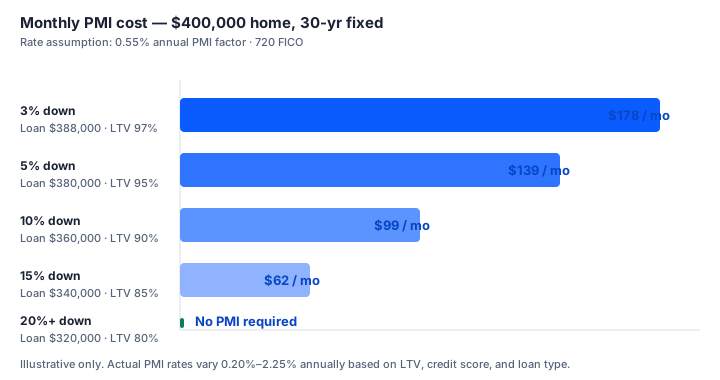
4.1 Realistic 2026 PMI factor bands
Table 1. Illustrative annual PMI factors, US conventional loans, 2026.
Bands are for illustration only. Actual quotes from MGIC, Radian, Essent, National MI, Enact, and Arch MI vary and change monthly.
4.2 Borrower-paid vs lender-paid PMI
Borrower-paid (BPMI)is the default: you pay a monthly premium that can be cancelled once you reach 80% LTV.Lender-paid (LPMI)hides the premium inside a slightly higher interest rate — usually 0.25% to 0.5% higher. LPMI cannot be cancelled without refinancing, so it only makes sense if you plan to keep the loan for a short time or you are confident rates will stay flat.
4.3 The lifetime cost — a number that will surprise you
On a $380,000 loan at 0.55% PMI, a borrower who reaches 80% LTV in year 8 pays roughly$174 × 12 × 8 = $16,704in PMI premiums. That is a used car. It is also money that could have paid down the loan directly. The reason we accept it: without PMI, the borrower would have needed another $60,000+ of down payment they did not have.
4.4 The four PMI structures you will see quoted
Loan officers routinely offer several PMI structures in a single loan estimate. Knowing which is which prevents accidentally locking in the most expensive version.
- Monthly BPMI:the default. A monthly premium added to your payment. Cancellable, refundable if you overpay past cancellation.
- Single-premium BPMI:a one-off lump sum at closing (typically 1.5%–3% of the loan). Cheaper over the long haul if you keep the loan more than five years, but not refundable if you refinance.
- Split-premium BPMI:a smaller upfront lump sum plus a reduced monthly premium. Useful when a seller credit can pay the upfront portion.
- Lender-paid MI (LPMI):baked into a permanently higher interest rate. Only removable by refinancing — dangerous in a low-rate environment where you will be locked in for 30 years.
4.5 A quick rule for choosing between them
If you expect to reach 80% LTV within three years — because your down payment is close to 20%, your loan amortizes fast, or your market is appreciating quickly —monthly BPMIis usually best because you will cancel it before the lump-sum structure pays back. If you expect PMI to run for six or more years,single-premium BPMIis often 20–30% cheaper in aggregate. LPMI only makes sense for a borrower who will refinance out within five years anyway (for example, a bridge to a doctor-loan refinance or a planned relocation).
5. The four legal paths to remove PMI
Every US conventional PMI cancellation falls into one of four buckets. Investors, buyers, and refinance shoppers should know all four because the fastest path depends entirely on your situation.
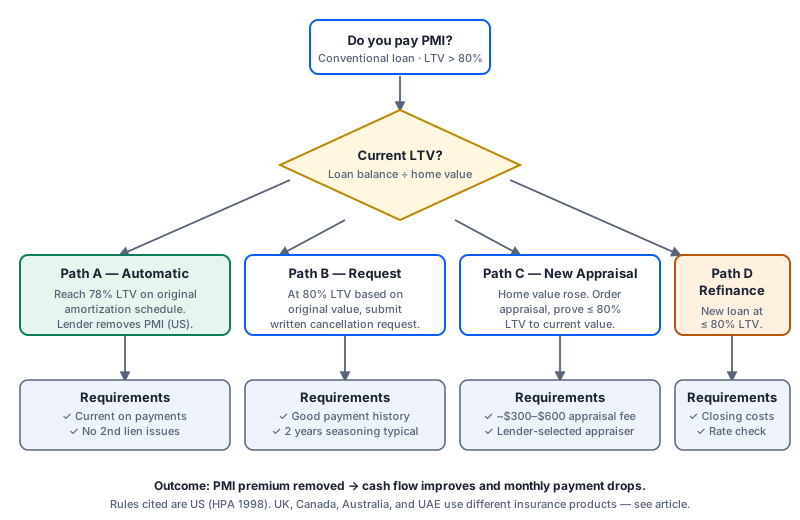
5.1 Path A — Automatic termination at 78% LTV
Under the USHomeowners Protection Act of 1998 (HPA), servicers must automatically cancel PMI on the date the loan balance isscheduledto reach 78% of the original property value, provided the borrower is current on payments. This path requires zero action from you — but it is also the slowest, because it follows the original amortization schedule regardless of what your home is actually worth today.
5.2 Path B — Borrower-requested cancellation at 80% LTV
The same law lets yourequestcancellation once the loan reaches 80% LTV based on the original value. You must be current, have a good payment history (no 30-day lates in the past 12 months, no 60-day lates in the past 24), and submit the request in writing to your servicer. This is faster than Path A because it triggers at 80% instead of 78%, and it can be accelerated with extra principal payments.
5.3 Path C — Cancellation based on current market value
If your home has appreciated, you can request cancellation based on thecurrentvalue rather than the original. Most servicers require the loan to be at least two years old and will insist on their own approved appraiser (typically $300–$600). Some require 75% LTV rather than 80% if the loan is less than five years old. This path is a favourite in fast-appreciating markets — Austin, Phoenix, Tampa, Toronto, Sydney's outer rings — where two years of price growth alone can create the equity you need.
5.4 Path D — Refinance
The nuclear option: refinance into a new loan at 80% LTV or lower. This is often the only path available for FHA MIP, LPMI, or borrowers whose original servicer is being difficult. You will pay closing costs of roughly 2–4% of the new loan amount, so a refinance only makes sense when the combined benefit (PMI removal + rate improvement) exceeds those costs within your expected holding period.
5.5 A fifth informal path: substantial improvements
Rarely discussed but explicitly allowed under HPA guidance: if you make substantial improvements to the home (a documented addition, ADU, full renovation, or new bathroom/kitchen combination) that materially increases the appraised value, you can pursue Path C at a 75% LTV threshold instead of 80%, even before the loan is two years old. The rules are stricter and the paperwork heavier, but for buyers who close on a fixer and complete a serious renovation in year one, this is a hidden shortcut worth asking the servicer about.
5.6 Timing rules you must respect
Whichever path you use, servicers apply consistent guardrails: you must be current on the mortgage, have no 30-day late payments in the last 12 months, no 60-day lates in the last 24 months, and the request must be made in writing (email or letter — never a phone call alone). If the property is a second home or was converted to a rental after purchase, the LTV threshold shifts to 75% rather than 80%. Missing any of these preconditions is the most common reason a technically-eligible cancellation is denied.
6. Worked examples: the math that actually matters
6.1 Example 1 — First-time buyer in Austin, Texas
Priya buys a $420,000 house in Austin with 5% down. Her 30-year fixed loan is $399,000 at 6.75%. Her FICO is 745, so her PMI factor is roughly 0.54% annually.
Monthly PMI = $399,000 × 0.0054 ÷ 12 ≈ $180
Priya's principal & interest is about $2,589/month. With PMI, her housing payment is closer to $2,769 plus taxes and insurance. If she makes only scheduled payments, she reaches 80% LTV at aboutyear 10. But Austin prices rise 4% annually for three years. In year 3, her home is worth roughly $472,600, and her loan balance is around $387,000 — giving her an LTV of about 82%. One more year of appreciation and modest extra principal, and she can order an appraisal (Path C) and cancel PMI four years into the loan instead of ten. Estimated saving: about$180 × 12 × 6 = $12,960.
6.2 Example 2 — Investor house-hack in Manchester, UK
James buys a two-bed flat in Manchester for £280,000 with a 90% LTV mortgage. UK lenders no longer typically charge a separate PMI premium; instead, higher-LTV rates are 0.5–1.0% above sub-80% rates. James pays 5.6% instead of 4.9% because of his LTV. Over the first two years, that costs him roughly£3,528in extra interest.
When rental value rises and the flat appraises at £310,000 in year 3, James remortgages. His outstanding balance is £245,000, giving an LTV of 79%. He now qualifies for the lower rate band and locks in a 5-year fix at 4.6%. His remortgage costs about £1,200 in fees, breaking even in under six months. The lesson: in the UK, "removing PMI" usually meansremortgaging out of the high-LTV rate bracket. See our companion guide oncalculating mortgage payments step by step.
6.3 Example 3 — Canadian buyer with CMHC insurance
Aisha buys a $650,000 townhouse in Mississauga with 10% down. CMHC insurance is mandatory below 20% down and cost her a one-time premium of 3.10% of the loan, or about$18,135, capitalised into the loan. Unlike US PMI, this premiumcannot be cancelled. Her only exit is to refinance once she has 20%+ equity, at which point she also stops paying interest on the capitalised premium. This is why Canadian buyers often refinance aggressively once their LVR crosses 80% — the ongoing cost of servicing the capitalised premium is real, even if the premium itself is done.
6.4 Example 4 — Break-even on a US appraisal-based cancellation
Devon has a $360,000 loan on a $440,000 home. His current LTV is 82%. His PMI is $175/month. A new appraisal will cost $500. Should he pull the trigger?
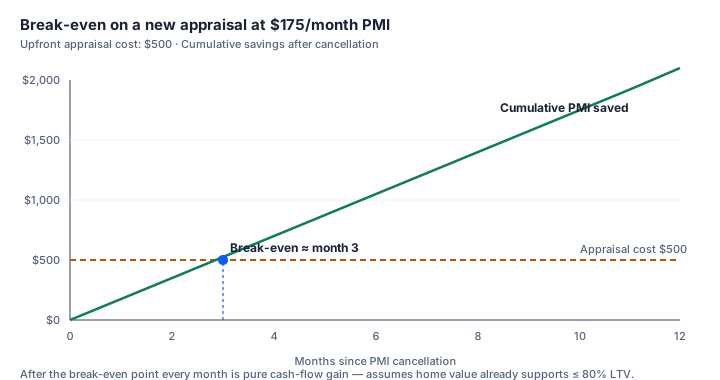
Break-even = $500 ÷ $175 =2.86 months. Devon holds the loan another five years. Net saving:$175 × 60 − $500 = $10,000. This is one of the highest-yield, lowest-risk moves available to any homeowner with recent appreciation.
6.5 Example 5 — When refinancing is worth it
Maya has a 30-year fixed at 7.1% with a $340,000 balance and $195/month PMI. Current market rate is 6.5%. Her home is worth $455,000, so a new loan at 80% LTV would be $364,000 — enough to cover her current balance and closing costs. Her savings work out as: PMI removed ($195) plus interest saved on rate improvement (approximately $170) = $365/month. Closing costs of $8,500 break even in about23 months. Since Maya plans to stay 8+ years, refinancing is a clear win. Verify with theLashkariProperties refinance calculator.
6.6 Example 6 — The Sydney LMI capitalisation trap
Ethan buys a A$780,000 apartment in Parramatta with 10% down. His lender charges A$14,900 LMI, capitalised into the loan at 6.15% over 30 years. That capitalised premium alone costs him roughlyA$92 per month in interest, and the total interest paid on the LMI over the life of the loan exceeds A$18,500 — more than the premium itself. Two years later, Ethan's LVR drops below 80% thanks to appreciation and principal. If he refinances to a new lender at a slightly better rate and drops the LMI-servicing burden, he saves roughly A$1,100 a year in avoided interest. Australian LMI is not cancellable, but escaping the capitalised drag through refinancing is a genuine PMI-equivalent win.
6.7 Example 7 — Extra-principal acceleration on a $500,000 loan
Sara borrows $500,000 on a 30-year fixed at 6.9% with 0.44% PMI ($183/month), starting at 95% LTV. Without extra payments, she reaches 80% LTV in month 108 (year 9) via scheduled amortization. She commits an extra $250 per month to principal. The additional principal shortens the 80% LTV date to roughlymonth 62— cutting almost four years off the PMI clock. Total PMI saved: about$183 × 46 = $8,418. Plus the extra principal earns her the loan's 6.9% rate on every dollar she prepays. Combined effective yield on the accelerated principal easily exceeds 10% — hard to beat inside a savings account.
7. How Tier-1 markets treat mortgage insurance
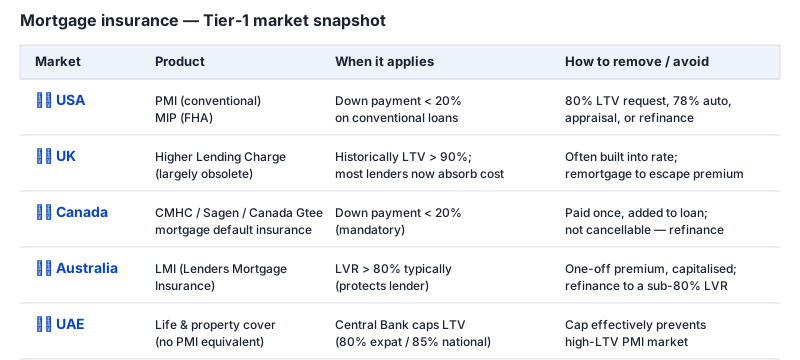
The word "PMI" is uniquely American. Every Tier-1 property market has its own product designed to solve the same problem — protecting lenders against high-LTV default — but the mechanics, cost structure, and exit paths vary dramatically.
7.1 United States
Conventional loans use PMI, governed by the HPA. FHA loans use MIP, which usually cannot be cancelled after 2013 without refinancing. VA and USDA loans use funding/guarantee fees.
7.2 United Kingdom
TheHigher Lending Charge(also known as Mortgage Indemnity Guarantee) once played the PMI role, but most UK lenders have absorbed the cost into their rate cards since the mid-2000s. Practically, high-LTV UK borrowers pay a rate premium of 0.5–1.0% until they remortgage into a lower-LTV band. That rate premium is your PMI, and remortgaging is your cancellation.
7.3 Canada
Mortgage default insuranceis provided by CMHC, Sagen, or Canada Guaranty and is mandatory for any federally regulated loan below 20% down. The premium is a one-time charge, usually capitalised into the loan. There is no cancellation — the only way to stop paying interest on it is to refinance once you cross 20% equity.
7.4 Australia
Lenders Mortgage Insurance (LMI)is charged whenever the LVR exceeds 80% (with some professional-borrower exceptions). Like Canada, it is typically a single premium capitalised into the loan, and it is not refundable. Refinancing to a new loan at ≤ 80% LVR is the exit — but Australian borrowers should be aware that LMI islender-specific, meaning a new lender at closing usually charges a fresh premium.
7.5 United Arab Emirates
The UAE Central Bank caps residential LTVs directly (approximately 80% for expats buying under AED 5 million, higher for Emirati nationals), effectively removing the need for a PMI-style product. Life insurance and property insurance are usually required, but no premium is tied to LTV in the way US PMI is.
⚠️ Local rules change
Mortgage insurance rules are set by regulators (CFPB, FCA, OSFI, APRA, CBUAE) and shift as market conditions change. Always confirm current rules with a licensed local mortgage broker before making a decision.
7.6 Cross-border buyers — what changes when you move
Buyers moving between Tier-1 markets frequently misapply mental models from their previous country. A US-to-Canada mover expects to cancel CMHC insurance at 80% LTV and is stunned to learn there is no cancellation mechanism. A UK-to-Australia mover assumes the LMI premium will be refunded on early repayment; it will not. A Canadian-to-US buyer over-optimises by rushing to Path C when their loan is under two years old and gets a polite refusal. The rule of thumb: if you are new to a market, treat the local mortgage insurance product as a completely separate instrument and confirm cancellation logic in writing before signing.
7.7 The one universal principle
In every Tier-1 market, mortgage insurance exists because the lender is exposed to a specific risk: a leveraged borrower defaulting during a price decline. Everything else — cancellation rules, premium size, refund policy — is downstream of that. The moment your equity buffer removes that risk, the cost that was priced against it should also disappear. Some markets automate the exit (US HPA), some make you refinance (Canada, Australia), but the direction is the same. Understanding this lets you plan your equity growth as an active exit strategy, not a passive hope.
8. Common PMI mistakes and myths
Myth 1: "PMI protects me if I lose my job."
False. PMI protects thelender. If you default, PMI reimburses the lender for a portion of the loss and the insurer may still pursue you for the deficiency. If you want personal protection, you are thinking ofmortgage protection insurance— a completely different, optional product.
Myth 2: "I have to wait for the lender to remove PMI."
False. Under HPA, you have the right torequestcancellation at 80% LTV. Many servicers will not proactively remind you.
Myth 3: "PMI is always a bad deal."
False. Compared to the opportunity cost of waiting years to save 20% while home prices rise, PMI is often the cheapest financing product in the mortgage stack — provided you actually remove it once you can.
Myth 4: "FHA MIP works like conventional PMI."
False. FHA MIP on most post-2013 loans lasts the life of the loan and cannot be cancelled without refinancing. This is one of the strongest arguments for choosing conventional over FHA when your credit score allows.
Myth 5: "Extra principal payments don't help me remove PMI."
False. Extra payments reduce the loan balance, which lowers LTV, which shortens the time to Path A or Path B. On a $400,000 loan, an extra $200/month can shave two to three years off the PMI clock.
✅ Best practice
Set a calendar reminder for the month your loan is scheduled to hit 80% LTV. Do not rely on your servicer to notify you. Submit a written request on that day.
9. How PMI connects to other property metrics
PMI does not live in a vacuum. It is bound to LTV, equity, cash flow, and DTI in ways that ripple through your entire property strategy.
9.1 PMI and LTV
Every dollar of principal you pay reduces LTV. Every dollar of appreciation the market delivers reduces LTV. Run the numbers with theLTV calculatorto see how close you are to the 80% threshold today.
9.2 PMI and home equity
Equity = property value − loan balance. PMI removal is essentially the moment your equity crosses 20% of the current value. Model this precisely with thehome equity calculator, and read our companion guide onhome equity explained.
9.3 PMI and cash flow
For a landlord or house-hacker, PMI is a direct hit to cash flow. Every $175/month of PMI is $2,100 per year that does not reach your NOI. On a rental property analysis, PMI should be modelled as an operating cost until removed, not a permanent fixed cost.
9.4 PMI and affordability
Do not underestimate this: PMI eats into the DTI ratio lenders use to qualify you. Removing PMI can free up borrowing capacity for a HELOC, a renovation loan, or a second property. Buyers early in the process should also reviewhow much house they can actually affordand whether a20% down payment is really required.
9.5 PMI and refinance timing
Refinance decisions are almost always modelled on interest-rate spreads, but PMI is the variable that most often flips a marginal refinance into a clear win. If your current loan carries $200/month of PMI and the refinance eliminates it, the effective rate saving is not just the headline spread — it is the spreadplusthe PMI you were paying, expressed as a percentage of the new balance. On a $300,000 loan, $200/month of PMI is equivalent to another 0.80% of interest rate. That is why some refinances that appear to be "only 0.25% better on rate" are actually 1.00%+ better on total cost.
9.6 PMI and the opportunity cost of a bigger down payment
The core trade-off every first-time buyer faces: put down 20% and skip PMI, or put down 5–10% and accept PMI to keep cash for other uses. The right answer depends on where your reserved cash would actually earn its next dollar. If it would sit in a savings account earning 3% while you pay 6.5% on the mortgage, larger down payment wins. If it would fund a renovation that adds real appraised value, or seed a rental deposit, or serve as an emergency reserve that keeps you out of high-interest debt in a crisis, the smaller down payment plus PMI can be superior — even after you total the PMI premiums. Never make this decision on gut feel; run both scenarios through thePMI calculatorand compare on a full-cost basis.
10. Run the numbers with free calculators
Estimation is fine for a first pass. Before you make a decision worth thousands of dollars, run the specific numbers using the free tools below. Every calculator on LashkariProperties is browser-only, requires no signup, and never stores your inputs.
PMI Calculator
Enter your loan amount, LTV, and credit band to see your estimated monthly PMI premium and lifetime cost.
LTV Calculator
See exactly where you sit on the LTV staircase — and how far you are from the 80% cancellation threshold.
Model the equity you have built through payments plus appreciation to check if you are cancellation-ready.
Test Path D — does a refinance clear PMI and pay for itself before you plan to move?
Pair these with our fulltools directoryfor affordability, rental yield, and cash-flow modelling.
11. Your PMI removal checklist
Use this as your action list. It works whether you are 6 months or 6 years into your loan.
- Pull your latest mortgage statement and confirm the PMI line item (labelled "MI" or "Mortgage Insurance").
- Calculate your current LTV based on both original valueandcurrent market value.
- Check whether your loan is conventional (PMI removable) or FHA (MIP usually not removable without refi).
- Verify your payment history — no 30-day lates in the last 12 months, no 60-day lates in the last 24.
- If you are close to 80% LTV on original value, prepare a written cancellation request.
- If your home has appreciated significantly, get a market estimate first, then order an appraisal.
- If you are stuck on FHA MIP or lender-paid PMI, run refinance numbers using the refinance calculator.
- Set a calendar reminder for the month your loan is scheduled to cross 78% LTV — the automatic cancellation date.
- Escalate to compliance or the CFPB if a servicer refuses a valid request.
- Update your monthly budget the day PMI drops — redirect the saved cash to principal, an emergency fund, or your next property.
💡 Insider tip
If you cancel PMI mid-year, ask your servicer for a payment recalculation letter, not just a verbal confirmation. This is your paper trail if a future refinance underwriter asks why your MI ended.
12. Frequently asked questions
PMI is an insurance policy your lender requires when your down payment is less than 20% on a conventional US mortgage. It protects the lender if you default. You pay the premium, but the benefit flows to the bank — not to you.
You can request cancellation at 80% LTV based on the original property value. Automatic termination happens at 78% LTV on the original amortization schedule under the US Homeowners Protection Act.
Typically 0.20% to 2.25% of the loan amount per year. On a $380,000 loan, that is roughly $63 to $713 per month, driven by credit score, LTV, and loan type.
Yes, on conventional US loans PMI must automatically terminate at 78% LTV on the original amortization schedule, assuming payments are current. FHA MIP on most post-2013 loans does not automatically terminate.
Can I cancel PMI early if my home has appreciated?
Yes. If current-value LTV drops to 80% or below, you can request cancellation and pay for a lender-approved appraisal. Most servicers require the loan to be at least two years old.
No. MIP applies to FHA loans and, for most loans originated after June 2013 with under 10% down, lasts the life of the loan. The usual way out is refinancing into a conventional mortgage.
Refinancing into a new loan at 80% LTV or lower removes PMI. This is often the fastest exit for FHA borrowers, provided rates and closing costs make sense for your holding period.
The US federal PMI deduction expired at the end of 2021 and has not been reinstated as of 2026. Some states offer limited deductions. Confirm with a licensed tax professional.
How does mortgage insurance work in the UK, Canada, and Australia?
UK: Higher Lending Charge is largely obsolete; high-LTV borrowers pay a rate premium instead. Canada: CMHC/Sagen/Canada Guaranty insurance is mandatory below 20% down and not cancellable. Australia: LMI is a one-off capitalised premium, not refundable — refinancing to sub-80% LVR is the exit.
Often yes. If your PMI factor is 0.55% and your mortgage rate is 6.5%, extra principal that hits 80% LTV effectively earns both the PMI saving and the mortgage rate — a strong risk-free return compared to a savings account.
Some servicers are slower than others, but the HPA sets clear rules. If a servicer refuses a valid 80% LTV request, escalate to their compliance department and, if needed, file a complaint with the Consumer Financial Protection Bureau.
Can PMI be paid upfront instead of monthly?
Yes. Single-premium PMI is paid as a lump sum at closing — usually 1.5% to 3% of the loan. It can be cheaper if you plan to keep the loan for many years but is not refunded if you refinance early.
13. Conclusion and next steps
Private mortgage insurance is not a permanent feature of home ownership. For US conventional borrowers it is a legally regulated, time-limited cost that you can actively shorten — and in some cases eliminate years earlier than the amortization schedule suggests. For borrowers in the UK, Canada, Australia, and the UAE, the equivalent products have different names and mechanics, but the principle is identical:lender risk gets priced somewhere, and when the risk falls, so should your cost.
The winning move is boringly consistent across markets. Track your LTV. Know the exact date your servicer is required to remove PMI. Order an appraisal the moment your local market makes early cancellation cheaper than waiting. And if you cannot escape lender-paid or FHA-style mortgage insurance any other way, run the refinance math with hard numbers, not assumptions.
Start with the PMI calculator
The 60-second check that tells you exactly what your PMI is costing you today — and how close you are to removing it.
Suggested next reads:
- What Is LTV Ratio and Why Lenders Care
- Home Equity Explained: How to Calculate and Use It
- Is a 20% Down Payment Required? What Buyers Actually Need
- How Much House Can I Afford? A Practical Numbers Framework
- How to Calculate Mortgage Payments Step by Step
This guide is for information purposes and does not constitute personalised financial, tax, or legal advice. Mortgage insurance rules and tax treatments vary by country, state or province, and lender, and change over time. Always verify current numbers with your loan servicer and a licensed local professional before making a decision.
References and further reading
- Consumer Financial Protection Bureau —What is private mortgage insurance?
- US Congress —Homeowners Protection Act of 1998 (Public Law 105-216)
- US Department of Housing and Urban Development —FHA mortgage insurance premium overview
- Canada Mortgage and Housing Corporation —Mortgage loan insurance for consumers
- Australian Prudential Regulation Authority —Lenders mortgage insurance guidance
- UK Financial Conduct Authority —Mortgages regulation overview
- Central Bank of the UAE —Residential mortgage loan-to-value guidance
The LashkariProperties Research Desk
Editorial team · Buying Guides
A cross-market team of writers and mortgage analysts covering the USA, UK, Canada, Australia, and UAE. Every guide is fact-checked against primary regulatory sources and re-verified before publication. Educational content only — never personalised advice.
Tools mentioned in this article
Mortgage Calculator
Estimate monthly mortgage payments, total interest, and payoff based on price, down payment, rate, and term.
Mortgage Insurance (PMI) Calculator
Find out whether mortgage insurance applies, what it costs monthly, and how to avoid it.
Home Equity Calculator
Calculate your home equity and estimate how much you could borrow against it.
Refinance Calculator
Compare your current mortgage against a new rate to see monthly savings and the break-even point.
Related reading
- How Much House Can I Afford? A Practical Numbers Framework
Calculate a sustainable home-buying budget using income, debts, rates, down payment, total housing costs and realistic stress tests.
- Are Extra Mortgage Payments Worth It? Interest Savings Math
Are extra mortgage payments worth it? See the interest-savings math behind biweekly, extra-monthly and lump-sum prepayments, plus when investing wins instead — with worked examples for US, UK, Canada, Australia and UAE b
- Closing Costs Explained: What Home Buyers Actually Pay
Closing costs surprise most first-time buyers. Learn exactly which fees you pay at closing, who covers what, how to estimate cash to close, and how to compare offers across the US, UK, Canada, Australia and UAE.