
Buying Guides
How Much House Can I Afford? A Practical Numbers Framework
By LashkariProperties Team · August 6, 2026 · 13 min read

The practical answer:the home you can afford is the price at which your total monthly housing cost still works after ordinary debts, savings, repairs and a realistic setback—not simply the largest mortgage a lender may approve. Start with income and recurring debts, set a personal monthly housing budget, convert it to a loan using an interest-rate and term assumption, then add your down payment and stress-test the result.
Use this page as a framework, not a mortgage offer.
Lending rules, tax treatment, insurance, property charges and consumer protections vary by country, state/province and borrower profile. Verify any real purchase decision with a regulated lender and appropriate local professional.
The affordability equation in plain English
Affordability has four linked layers. First, a lender considers whether documented income supports the proposed payment and existing obligations. Second, you decide whether that payment leaves enough room for life and savings. Third, the purchase must be fundable upfront: down payment, transaction costs and a cash reserve are separate from the monthly payment. Finally, the result must survive a higher rate, lower income or higher ownership costs. A number that fails any layer is not a useful ceiling.
Use gross monthly income for a conventional debt-to-income (DTI) screen:monthly debt payments ÷ gross monthly income × 100. The US Consumer Financial Protection Bureau (CFPB) describes DTI in those terms, but lender definitions and treatment of debts vary. Your personal cash-flow screen should also use after-tax income because bills are paid from take-home pay.CFPB’s DTI explaineris a useful starting point.
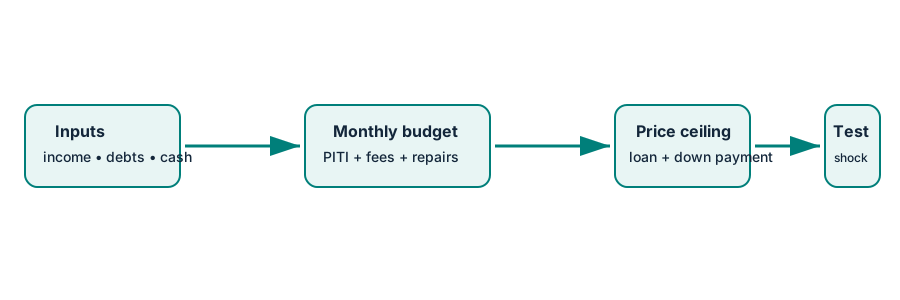
Core formulas
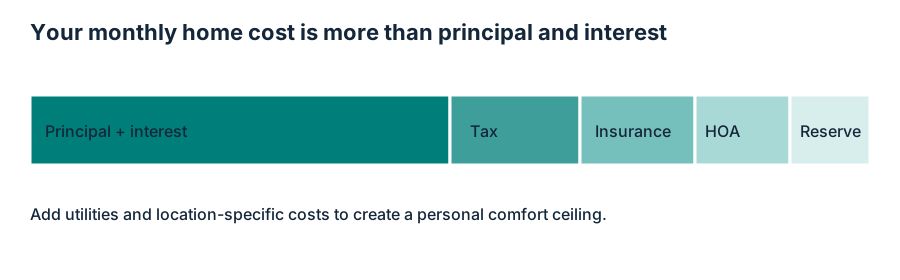
For a standard repayment mortgage, monthly principal-and-interest payment isM = P[r(1+r)n] ÷ [(1+r)n−1], where P is the loan principal, r is the monthly interest rate, and n is total monthly payments. A calculator reverses this formula to estimate the principal supported by a payment. Total monthly housing cost is broader:P&I + property tax/rates + building or home insurance + mortgage insurance where applicable + association/service charges + a maintenance reserve. Utilities, commuting changes, parking and ground rent can matter too.
The CFPB explicitly distinguishes principal and interest from the total payment, which can include taxes, insurance and mortgage insurance. Treat the full amount—not the headline repayment—as the relevant housing cost.Read the CFPB explanation.
Why the number matters more than the listing price
Price is emotionally visible; recurring cost is financially decisive. Two homes at the same price can carry different tax, insurance, service-charge, maintenance and commute profiles. Similarly, a larger down payment lowers the loan, but using every available dollar can leave no buffer for valuation gaps, moves, repairs or job disruption. A sound home-buying budget turns a vague target into limits that can be checked before viewings.
For an owner-occupier, affordability protects flexibility: retirement contributions, childcare, a career change and emergency savings should not be treated as optional merely because a lender can fit a payment into an underwriting ratio. For an investor, household affordability and property viability are distinct. Rental yield is annual rent divided by value or cost; it does not automatically cover vacancy, management, leasing, maintenance, financing, taxes or capital expenditure. Model cash flow after those items and treat capital growth as uncertain, not as the payment plan.
“The safer number is usually the one that still works when the spreadsheet is slightly wrong.”
A step-by-step practical numbers framework
1. Build a reliable income base
Use stable, documentable gross income for a lender-style comparison. Salary may be straightforward; commission, bonuses, self-employment, contract income and overseas income can be assessed differently by each lender. For your own plan, make a second, conservative take-home-income line. Do not solve a budget gap by assuming overtime, a future raise or a roommate contribution that is not dependable.
2. List debts and non-negotiable monthly commitments
Include car finance, student loans, personal loans, revolving-credit minimums, alimony/maintenance where relevant and any other debt payment. Then list commitments that underwriting ratios can underweight: childcare, medical costs, family support, transport, subscriptions you truly keep and savings contributions. Run a fast lender-style ratio in theLashkariProperties DTI calculator, then keep your more detailed household cash-flow version beside it.
3. Set a personal all-in housing budget
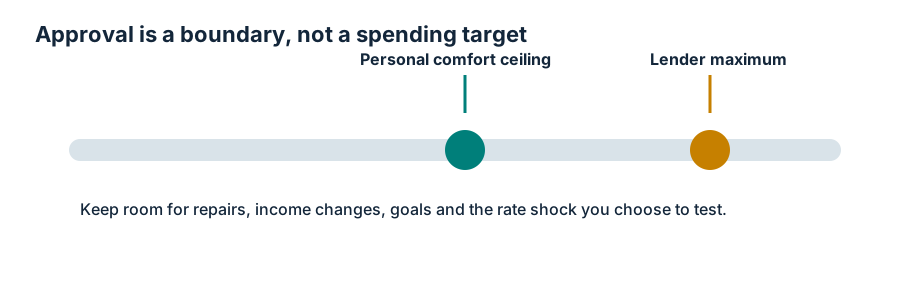
A ratio is a screening device, not a command. Choose an all-in ceiling that permits saving and normal living costs. Work backwards: take net income, subtract debt payments, essential spending, planned savings and a contingency; the remainder is the maximum housing cost you are prepared to carry. If this is lower than the amount a lender might allow, use the lower number.
4. Reserve the non-mortgage portion
Estimate property taxes or local rates, insurance, mortgage insurance if relevant, association/strata/service charges and an ongoing maintenance reserve. A condominium may make some exterior costs collective but can add service charges and special assessments. A free-standing home may need a larger repair reserve. Thehousing cost calculatorhelps separate these recurring items from the loan payment.
5. Convert the remaining payment to a loan
Subtract recurring non-mortgage costs from your all-in budget. Use the remainder as the P&I payment in themortgage calculator. Enter an illustrative interest rate and plausible term; rates are market- and borrower-specific, so do not copy an old article’s rate. The calculator output is a sensitivity tool, not a commitment from a lender.
6. Add down payment, but protect liquidity
Purchase price is approximately loan amount plus down payment, before any adjustments for fees. Preserve cash for closing/settlement costs, inspections or surveys, moving and post-close surprises. In the US, the CFPB says closing costs typically range from 2% to 5% of purchase price, excluding the down payment, while actual costs vary.See CFPB’s planning guidance. Readwhether 20% down is requiredandwhat buyers pay in closing costsbefore committing your savings.
7. Stress-test before calling it affordable
Repeat the calculation at 1 and 2 percentage points above the illustrative rate, with a 10% reduction in household income, and with a realistic repair or fee increase. If the purchase only works under the single best assumption, lower the price target, increase the cash buffer, reduce other debts or wait. Thehome affordability calculatoris the quickest way to compare inputs and scenarios.
Three worked examples: payment first, price second
Example 1: US buyer with a conservative comfort ceiling
Assume gross household income of $10,000 a month, monthly non-housing debts of $700 and take-home income of $7,600. The household decides $2,850 is the maximum all-in housing cost after maintaining its savings plan. It estimates $650 a month for property tax, insurance and maintenance reserve. That leaves$2,200for P&I. At an illustrative 6.50% fixed rate over 30 years, $2,200 supports approximately$348,000of loan principal. With $87,000 available for a 20% down payment on a $435,000 purchase, the price and loan align approximately: $435,000 minus $87,000 equals $348,000.
At 7.50%, the same $348,000 loan costs about $2,433 P&I, pushing all-in cost to roughly $3,083—above the chosen ceiling. At a 10% income reduction, take-home income falls to $6,840; the original $2,850 all-in cost consumes a much larger share of cash flow. The practical conclusion is not “buy $435,000”; it is “$435,000 is conditional on the assumed rate and reserve.” The buyer may search lower, add cash, or accept a smaller home to retain resilience.
Example 2: Canadian household using debt-service concepts
Assume gross income of C$12,000 monthly, C$900 in other monthly debt payments, and a chosen all-in housing ceiling of C$3,500. The household estimates C$850 for property taxes, heating/utility allowance, condo fees and insurance, leaving C$2,650 P&I. At an illustrative 5.25% over 25 years, that payment supports aboutC$430,000of principal. With a C$107,500 down payment, a rough price reference is C$537,500 before closing costs.
Canada’s mortgage qualification commonly uses gross debt service (GDS) and total debt service (TDS) concepts; their definitions and limits depend on the product and insurer/lender. CMHC explains how GDS and TDS are calculated and provides a debt-service calculator.CMHC’s GDS/TDS guideandits calculatorare better references than a generic percentage. A rate shock of two points materially lowers payment capacity; Canada’s stress-testing framework is designed to assess resilience to higher qualifying rates.Bank of Canada analysisprovides context.
Example 3: UK or Australia-style repayment budget
Assume a household has £7,000 gross monthly income, £450 of existing credit commitments and a self-imposed all-in housing budget of £2,450. It reserves £350 monthly for council-tax/rates equivalent, buildings insurance, service charges and maintenance, leaving £2,100 for repayment mortgage P&I. At an illustrative 5.75% rate over 25 years, that supports roughly£321,000of loan principal. A £80,000 deposit suggests a price target near £401,000, subject to lender assessment and purchase costs.
At 6.75%, the original £321,000 loan costs roughly £2,217 P&I, making all-in housing cost about £2,567. The £117 difference may look modest but is recurring and competes with savings. The buyer should also model a 10% income decline: the £2,450 all-in target then absorbs 39% of £6,300 gross income before existing debt. UK lenders must assess affordability, including income and expenditure, under FCA rules; the Bank of England explains the withdrawal of one FPC affordability-test recommendation did not remove those lender standards.Bank of England explanation.
Examples are illustrative assumptions, not market quotes or lending advice.
Actual quoted rates, terms, fees, insurance, taxes, lender criteria and eligibility can change the result substantially.
Tier-1 market nuances to verify locally
DTI, credit profile, loan program, taxes, insurance and HOA costs can all move the payment.
Compare Loan Estimates and total payment components; learn
Affordability assessment considers income and expenditure; loan-to-income is only one lens.
Check lender criteria, term, fixed-period refinance risk and local transaction costs.
GDS/TDS and qualifying-rate rules affect capacity; heating and condo costs can enter debt-service calculations.
Use CMHC definitions and test renewal-rate risk.
Lenders assess serviceability with a buffer above the loan rate; expenses and liabilities matter.
Debt burden ratio, nationality/residency, loan-to-value and property type can affect financing.
and a licensed lender’s current criteria.
Mistakes that make an affordable home unaffordable
Shopping from the pre-approval maximum
A pre-approval is useful for negotiating and narrowing searches, but it is not a lifestyle budget. Set your comfort ceiling first; then treat a lender maximum as a boundary, not a target.
Ignoring the cost stack
Taxes, insurance, strata/HOA dues, mortgage insurance, maintenance and special assessments can turn a comfortable P&I figure into a strained total. Re-price every listing with property-specific costs.
Using the entire cash balance as a down payment
A larger down payment can lower the payment and loan-to-value ratio, but a zero reserve converts any repair or income interruption into expensive debt. Learnwhy lenders care about LTV, then choose cash deployment deliberately.
Assuming rent covers an investment mortgage
Gross rent is not net cash flow. Vacancy, maintenance, property management, leasing, insurance, tax, financing and major capital items can all change the result. Underwrite conservative rent and expenses; do not count on price appreciation to rescue a weak cash flow.
Run the numbers with LashkariProperties tools
Use the tools in sequence rather than relying on one output. Start with theDTI calculatorto understand income and debt pressure. Use thehousing cost calculatorto assemble taxes, insurance, charges and reserves. Then test loan terms and rates with themortgage calculator. Finally, compare down payment, income and debt scenarios in thehome affordability calculator. Explore the completetools libraryand theBuying Guidescategory for the decision points around the calculation.
Affordability checklist before you offer
- Document stable gross income and conservative take-home income.
- List every recurring debt and real household commitment.
- Set a personal all-in housing ceiling that preserves saving.
- Estimate property-specific taxes/rates, insurance, service charges and repairs.
- Calculate loan principal from P&I, not from listing price.
- Keep closing/settlement costs and emergency cash outside the down payment.
- Test rates one and two points higher and income 10% lower.
- For investments, test vacancy, management, repairs and capital expenditure separately.
- Check current local lender rules and obtain regulated advice where appropriate.
Frequently asked questions
How much house can I afford on my salary?
Start with stable income, recurring debts and a personal all-in housing budget. Convert the portion available for principal and interest into a loan using a realistic rate and term, then add a down payment while keeping closing costs and reserves separate.
What is the difference between home affordability and mortgage pre-approval?
Pre-approval reflects a lender’s preliminary underwriting view. Affordability is your broader ability to pay total housing costs while maintaining savings, everyday spending and resilience to setbacks.
Should I use gross or net income for affordability?
Use gross income for a DTI-style lender screen because that is how the ratio is commonly defined. Use net income for your personal monthly cash-flow plan, since taxes and living costs are paid from take-home pay.
Does a 20% down payment mean I can afford the home?
No. It changes the loan size and can affect mortgage insurance or pricing, but it does not prove that the all-in monthly cost fits your income, debts and cash reserve.
What housing costs should I include besides the mortgage?
Include taxes or rates, home/buildings insurance, mortgage insurance if applicable, association or service charges, maintenance, utilities and relevant location-specific costs.
How does a higher interest rate affect how much house I can afford?
For a fixed payment budget, a higher rate supports less loan principal. Recalculate the same budget at one and two percentage points higher to see how much rate sensitivity your plan has.
Is debt-to-income ratio the only number lenders use?
No. Lenders can also assess credit, income stability, assets, loan-to-value, property type, expenses, term and local regulatory rules. DTI is a useful screen, not a universal approval rule.
How much should I keep after buying a house?
The appropriate reserve depends on income stability, property condition and local costs. Keep separate funds for closing, moving, early repairs and emergencies rather than treating every dollar as down payment.
Can rental income make an investment property affordable?
It may contribute to underwriting or cash flow depending on lender and local rules, but use conservative rent and allow for vacancy, management, repairs, taxes and capital expenditure. Rental yield alone is not cash flow.
Begin with DTI to map income and debt, then price recurring housing costs, model the loan payment and finally compare affordability scenarios. The order prevents a mortgage-only estimate from hiding other costs.
Conclusion: buy the payment that lets life continue
The best affordability number is not a universal percentage or a lender’s maximum. It is a scenario-tested price range built from full monthly housing cost, documented income, debts, cash available after transaction costs and a deliberate reserve. Use a lower comfort ceiling when it protects goals that matter to you. When a property passes that test at a higher rate and lower income, you have more than a number—you have a decision framework.
Turn your assumptions into a range
Start with theHome Affordability Calculator, then cross-check your payment with theMortgage Calculator. Continue withhow to calculate mortgage paymentsor return to theLashkariProperties blog.
Sources and methodology
This guide uses simplified repayment-mortgage arithmetic and educational assumptions. It does not quote current rates. Consult current lender disclosures and country-specific official guidance for an actual application.
- Consumer Financial Protection Bureau: debt-to-income ratio
- CFPB: determine how much to spend
- CMHC: calculating GDS and TDS
- Bank of Canada: mortgage stress tests
- APRA: macroprudential settings
- Central Bank of the UAE: important ratios
Tools mentioned in this article
Related reading
- Are Extra Mortgage Payments Worth It? Interest Savings Math
Are extra mortgage payments worth it? See the interest-savings math behind biweekly, extra-monthly and lump-sum prepayments, plus when investing wins instead — with worked examples for US, UK, Canada, Australia and UAE b
- Closing Costs Explained: What Home Buyers Actually Pay
Closing costs surprise most first-time buyers. Learn exactly which fees you pay at closing, who covers what, how to estimate cash to close, and how to compare offers across the US, UK, Canada, Australia and UAE.
- Home Equity Explained: How to Calculate and Use It
Home equity explained in plain English. Learn how to calculate home equity, compare HELOC vs cash-out refinance, avoid over-leveraging, and stress-test your numbers with free LashkariProperties calculators.