
Buying Guides
Home Equity Explained: How to Calculate and Use It
By LashkariProperties Team · August 5, 2026 · 32 min read

What is home equity?
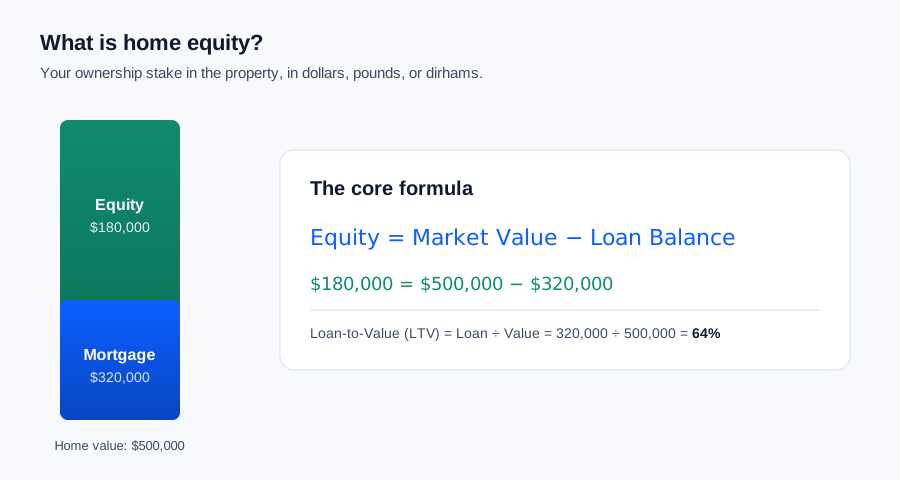
Home equity is the market value of your property minus every dollar of debt secured against it.If a house is worth $500,000 and the outstanding mortgage is $320,000, the homeowner has $180,000 of equity, or 36% of the property. That single number quietly decides whether a family can refinance, buy a second home, weather a downturn, or retire.
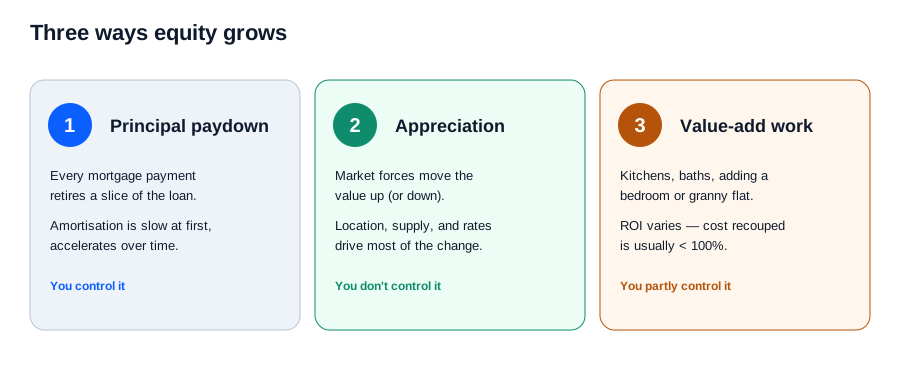
Equity is a stock (a snapshot at a point in time), not a flow. It changes every month for three reasons: you pay down principal, the market re-prices your home, or you improve the property. It is also entirely illiquid — you cannot buy groceries with it. Turning equity into spendable cash always involves either selling, borrowing against the home, or downsizing.
This "wealth on paper" quality is what makes equity so easily misunderstood. In every Tier-1 property market — the United States, United Kingdom, Canada, Australia, and the UAE — households routinely underestimate how quickly equity can be created through disciplined ownership, and how quickly it can be given back through fees, over-leveraging, or a housing correction. The 2008 US foreclosure crisis, the 2017 Sydney and Toronto corrections, the 2022 UK mini-budget fallout, and the 2015–2020 Dubai correction all share a common lesson: equity built over a decade can be wiped out in eighteen months, and households who had already borrowed against that equity were the most exposed.
There is also a psychological trap unique to home equity. Because the number appears on a mortgage statement or a bank app, people treat it like a savings balance. It is not. A savings account is fungible, liquid, and portable. Equity is none of those things. It is embedded in a single asset, in a specific location, subject to a specific market cycle. Two families with identical net worth on paper can experience the next recession in radically different ways depending on how much of that net worth sits inside their home.
Before you can decide whether touseyour equity, you have to be able tomeasureit. That starts with two formulas.
Think of your home as a stacked bar. The top slice (equity) is yours. The bottom slice (mortgage) is the bank's. Every mortgage payment shrinks the bank's slice; every price movement stretches or shrinks the whole bar; every renovation may lengthen the top slice, but only if the improvement is truly value-adding.
The formulas: equity, LTV and CLTV
You only need three formulas for 95% of real-world decisions.
Home equity (in currency)
Equity ($) = Current Market Value − Sum of All Secured Loan Balances
Home equity (percentage)
Equity (%) = Equity ($) ÷ Current Market Value × 100
Loan-to-Value (LTV) and Combined LTV (CLTV)
LTV (%) = Loan Balance ÷ Market Value × 100 CLTV (%) = (First Mortgage + HELOC + Any Other Secured Loans) ÷ Market Value × 100
LTV is the mirror image of equity: an 80% LTV mortgage means 20% equity. Every lender in every Tier-1 market decides refinance eligibility, HELOC eligibility, and mortgage insurance requirements primarily on CLTV — thecombinedfigure — not on the original loan alone. That is why a homeowner who has "always been at 60% LTV" can find themselves rejected for a second product when they forget to add the balance of a small second lien to the equation.
Every equity decision — buy, refinance, borrow, or sell — comes back to two numbers:equity in dollars(what you'd walk away with after selling and paying off debt, before costs) andCLTV(what the lender uses to say yes or no).
A fourth formula worth knowing: usable equity
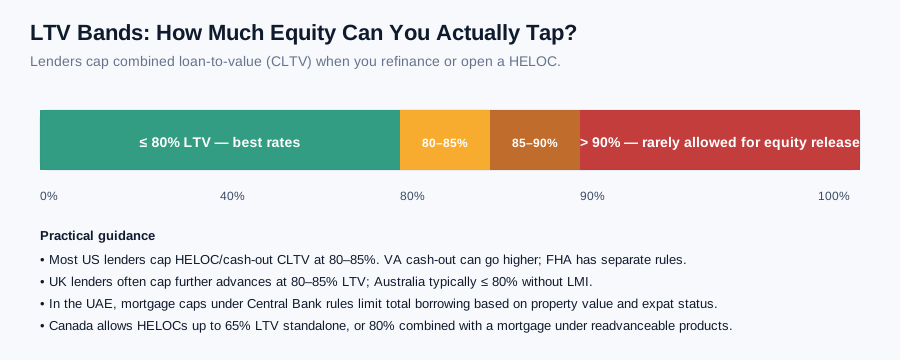
Lenders will never let you take your equity down to zero. In practice they will only let you borrow to a maximum CLTV, typically 80% or 85%. That means the maximum you can actually access — before fees — is:
Usable Equity = (Market Value × Max CLTV) − Existing Loan Balances
Worked example: a $600,000 home with a $340,000 mortgage. Raw equity is $260,000, or about 43%. But at an 80% CLTV cap, the lender will only extend total secured borrowing to $480,000. Subtracting the existing $340,000 leaves $140,000 of usable equity — roughly $120,000 lower than the raw figure. This gap between "headline equity" and "borrowable equity" is one of the most common surprises borrowers encounter when they first talk to a broker.
Equity vs. net home wealth
Equity is only one component of net home wealth. If you sold today, your walk-away cash would be equity minus (agent fees + legal fees + transfer taxes + any repair credits + capital gains tax where applicable). Depending on jurisdiction and holding period, these frictional costs can consume anywhere from 3% (a low-cost UAE cash sale) to 12% (a heavily taxed short-hold sale in parts of the UK or Ontario). Any equity plan that ignores exit costs overstates true household wealth.
Why home equity matters for buyers, investors and landlords
For a first-time buyer, equity is the finish line. For an investor, it is the ignition key. For a landlord, it is a buffer against risk. Each stakeholder should watch a different aspect of the same number.
For first-time buyers
Equity is the invisible reward for the discipline of paying a mortgage. The first years of amortisation feel painfully slow — most of your payment goes to interest — but by year seven or eight, principal paydown accelerates sharply. Reaching 20% equity is a milestone because it usually eliminates private mortgage insurance (PMI) in the US, lender's mortgage insurance (LMI) in Australia, or higher-LTV pricing add-ons in the UK, Canada, and UAE.
For investors
Equity is the reason a single-property owner can become a multi-property owner. Every 10% of appreciation on a fully owned $500,000 home creates $50,000 of new borrowing capacity, which — leveraged sensibly — can fund the deposit on a second property. The catch: leverage is symmetric. A 10% price fall destroys the same $50,000, and if you have already borrowed against it, you can be left with negative equity while still owing the second mortgage.
For landlords
Rental portfolios are stress-tested by lenders on debt service coverage. Higher equity in each property = lower CLTV = better refinance terms, easier vacancy tolerance, and a much smoother conversation with insurers. Equity is the buffer between a tough month and forced sale.
Equity is optionality. The more you have, the more choices you have — refinance, sell, borrow, wait, or do nothing at all.
For downsizers and retirees
An often-overlooked segment: households in their late 50s and 60s planning to trade a larger family home for a smaller one, sometimes releasing several hundred thousand in equity to top up retirement savings. In this scenario equity is closer to genuine cash — because the transaction is a full sale, not a borrowing event — but the timing, tax treatment, and reinvestment plan matter enormously. A rushed downsizing sale in a soft market can hand back a decade of equity growth in a single transaction.
For accidental landlords
Millions of Tier-1 households became landlords by accident — a job move, a relationship change, or a decision to keep an old home when buying a new one. These owners often have very low LTVs and substantial equity in a property that generates only modest rental income. For them the equity question is really a portfolio question: is the return on equity locked in the rental property higher or lower than alternatives such as paying down the primary mortgage, investing in indices, or selling and redeploying capital? Framing it as return-on-equity, not raw yield, changes the answer for many owners.
For couples and joint owners
Equity in a jointly owned home is one of the largest joint financial assets most couples will ever share. It also complicates separation, inheritance, and refinancing. If you own with a partner or family member, agree in writing how equity contributions are tracked and how proceeds will split if the property is sold or refinanced. Vague verbal agreements are the most common source of expensive disputes years down the line.
How to calculate your home equity — step by step
Here is the practical, low-friction method used by mortgage brokers and buy-side analysts alike. Budget 15 minutes.
Step 1 — Get an honest market value
Pick the most conservative of three sources:
- Recent independent appraisal(within 6 months) — most defensible.
- Three to five closed comparable saleswithin 800 metres / half a mile, same bedroom count, same condition, adjusted for size differences.
- Lender AVM(automated valuation model) or bank estimate — fast but noisy; use as a sanity check, not the primary number.
Avoid vanity numbers: Zillow's Zestimate, Rightmove's estimate, or Domain's estimate are useful anchors, but they are marketing tools, not appraisals.
Step 2 — Sum every secured balance
Pull your latest statements and add up:
- Outstanding first mortgage principal
- HELOC drawn balance (not the credit limit)
- Second mortgages or home equity loans
- Any tax liens, mechanic's liens, or judgment liens attached to the property
- Solar loans or PACE loans secured against the property (common in California, Arizona, and parts of Australia)
Step 3 — Do the subtraction and the ratio
Subtract the total in Step 2 from the value in Step 1. That is your equity in currency. Divide by the value again to get the percentage.
Step 4 — Discount for selling costs (optional but recommended)
If you're calculating "walk-away equity" for a real decision, subtract likely selling costs: agent fees (typically 4–6% in the US, 1–3% in the UK and Australia, 2% in Dubai), legal fees, transfer taxes or stamp duty on the buy side, and staging/repair costs. Yourusableequity is often 5–10% lower than the raw math suggests.
For planning purposes, treat 90% of raw equity as your usable figure in the US and UAE, 92% in the UK and Australia, and about 88% in Canada, where land transfer taxes and legal fees run higher.
Step 5 — Sanity-check against a lender's own valuation
If your equity plan involves borrowing, remember that the number your lender ultimately uses istheirvaluation, not yours. Bank appraisals routinely come in 3–8% below owner estimates, particularly in rising markets where recent comparable sales lag behind list-price sentiment. Build a 5% buffer into any plan that depends on hitting a specific LTV threshold. If you are within a hair of an 80% cap, expect a re-price or reduced offer at underwriting.
How often to re-run the numbers
At minimum, once a year. In practice, re-run the calculation whenever any of the following happens: a comparable home in your street or building sells, a lender advertises a new remortgage promotion, your income or employment status changes, interest rates in your market move by more than 50 basis points, or you complete a major renovation. Each of these events materially changes at least one input to the equity equation. Owners who track this quarterly — even informally on a phone notes app — spot refinance opportunities and risk build-ups months earlier than owners who only look at their equity when a life event forces them to.
Common calculation errors
Three mistakes appear again and again in real client conversations. First, using theoriginalpurchase price as the value long after prices have moved — either understating equity in a rising market or overstating it after a fall. Second, forgetting the balance of a small second lien, a solar PACE loan, or an old home-improvement loan that is still legally secured against the property. Third, using a single AVM as the sole value source; AVMs can be wildly off for renovated properties, unusual layouts, or non-standard lot sizes. Belt-and-braces: two value sources, every lien captured, updated at least quarterly.
Three worked examples in Tier-1 markets
Numbers do more teaching than paragraphs. Each example below uses realistic 2026 figures, rounded for clarity.
Example 1 — Established US owner in Austin, Texas
Priya bought in 2019 for $360,000, put 10% down, and has been paying a 30-year fixed mortgage at 3.75%. Six years later:
Priya has room to borrow. At an 80% CLTV cap, a lender could offer up to $404,000 total secured against the house. Subtracting the existing $282,600 leaves about $121,400 of accessible equity through a HELOC or cash-out refinance — before fees.
Example 2 — UK homeowner in Manchester considering a further advance
James bought a two-bed flat for £220,000 in 2021, put down £22,000, and has been paying a five-year fixed at 4.1%. He wants to fund a kitchen remodel and possibly a rental deposit.
James can access ~£38,750, but any FCA-regulated lender will re-apply an affordability stress test at the new payment, typically at rates 3 percentage points above the reversion rate. Themathallows it; theaffordabilitymay not.
Example 3 — Sydney investor building portfolio
Sanjay owns his primary residence outright, valued at A$1.4 million. He wants to buy an investment apartment for A$780,000 without touching cash savings.
Sanjay's equity release plan (Sydney, AU)
Sanjay'sportfolioLTV becomes A$780,000 / (A$1,400,000 + A$780,000) =35.8%— comfortable by any measure. But APRA requires the bank to assess him at an interest rate roughly 3 percentage points above the offered rate. That serviceability buffer, not the equity math, is what will decide the deal.
These figures are illustrative for educational purposes. Real transactions in every jurisdiction involve taxes, stamp duty, mortgage insurance, valuation fees, legal costs, and lender-specific affordability tests. Always confirm with a licensed adviser in your market.
Example 4 — Toronto couple deciding between paying down or investing
Rachel and Marc have a C$820,000 condo with a C$430,000 mortgage at 5.1% fixed. They have C$60,000 in a savings account earning 4.0%. Their raw equity is C$390,000, or 47.6%. They are debating whether to lump-sum the C$60,000 against the mortgage, invest it in a diversified index fund, or open a small HELOC as an emergency reserve.
The straightforward math favours the paydown: a 5.1% guaranteed after-tax return (the mortgage rate) beats a 4.0% pre-tax savings return, and beats the after-tax return on most low-risk investments. But the C$60,000 in savings is also theironlyliquidity. Once it is inside the home, retrieving it requires arranging a HELOC — and lenders are least willing to open new lines of credit at precisely the moment households are most likely to need one, during a downturn. For most Tier-1 households the correct answer is a hybrid: pay down enough to hit the next LTV band and shave the rate, keep three-to-six months of expenses genuinely liquid, and only then optimise for return.
Example 5 — Dubai expat approaching visa renewal
Aisha, a UAE resident on an employment visa, owns a Dubai Marina apartment worth AED 2.4 million with an AED 1.1 million mortgage. Raw equity is AED 1.3 million, or 54%. She is considering an equity release to fund a Sharjah investment property.
The complications are jurisdictional, not mathematical. UAE Central Bank rules cap her Debt Burden Ratio at 50% of monthly income across all debt. She must factor in a 4% Dubai Land Department transfer fee on any new purchase, a mortgage registration fee, and her lender's own valuation — which in Dubai frequently comes in 5–10% below owner estimate. She also must consider visa continuity: if her employment status changes, the mortgage on the second property becomes stress-tested against a materially different income picture. In this market the equity math is the smallest part of the decision.
How equity actually grows
Principal paydown (you control this fully)
The most reliable engine. Every scheduled payment retires a small slice of principal that grows month by month as the interest portion shrinks. On a 30-year fixed mortgage in the US, roughly 30% of the loan is paid down by year 15; on a 25-year UK repayment mortgage the pattern is similar. Adding one extra monthly payment per year — or "biweekly" scheduling — accelerates equity dramatically, often shortening a 30-year loan by 4–6 years.
Market appreciation (you control this hardly at all)
Location, macro rates, and local supply-and-demand drive most of the price change. Between 2011 and 2022 many Tier-1 markets saw exceptional appreciation; between 2022 and 2024 several saw stagnation or falls. Any equity plan that assumes future gains at recent-decade averages is fragile. Plan for zero real appreciation and treat any upside as a bonus.
Value-add improvements (you partly control this)
Renovation cost recouped almost never reaches 100%. Reliable data from remodelling cost-vs-value studies suggests bath and kitchen renos recoup 60–80% of cost in most Tier-1 markets, while cosmetic garage doors, exterior painting, and entry doors often exceed 90%. Pool additions in cool climates are famously value-negative. Do the ROI mathbeforespending — a $60,000 renovation that adds $40,000 of appraised value has cost you $20,000 of equity, not created it.
HELOC vs cash-out refinance: which one and when?
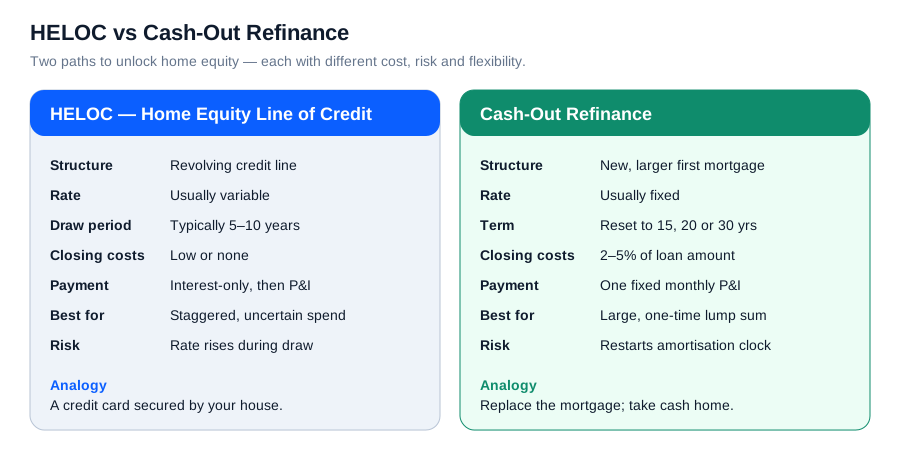
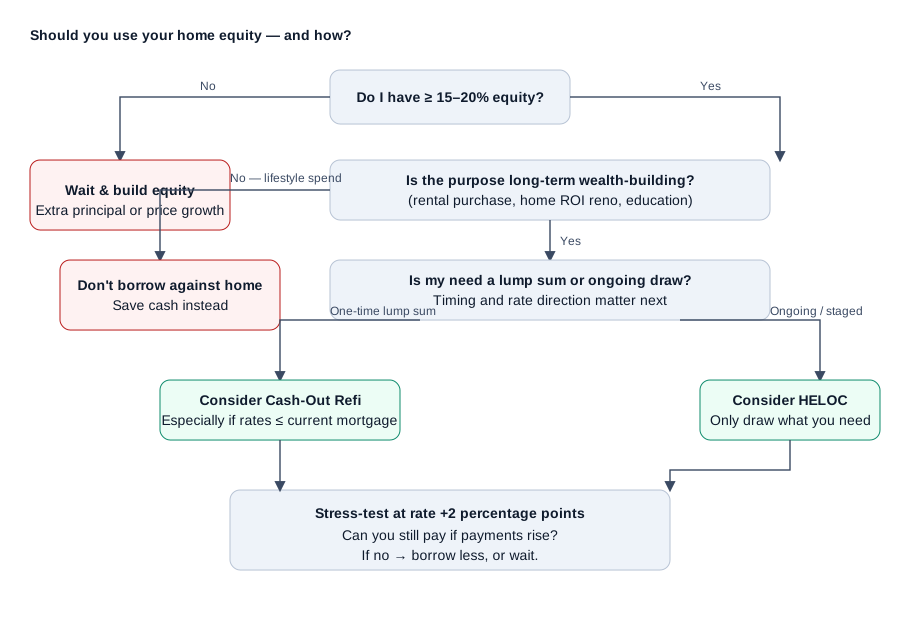
These two products dominate the equity-release conversation in North America, and equivalents exist in every Tier-1 market (further advances and remortgages in the UK; top-up loans and lines of credit in Australia; readvanceable mortgages in Canada; equity release loans in the UAE). Choose based onhowyou'll spend andwhererates are.
Choose a HELOC when…
- Your spending will be staged over months or years (multi-phase renovation, tuition, bridge funding).
- You want to draw only what you need and pay interest only on the drawn balance.
- You expect to repay quickly (24–36 months) — the interest-rate risk on the variable portion is limited.
- Your existing mortgage is at a lower rate than current market — you don't want to disturb it.
Choose a cash-out refinance when…
- You need one large lump sum with a defined use (deposit, business purchase, debt consolidation).
- You value fixed monthly payments and rate certainty over flexibility.
- Current market rates are equal to or lower than your existing mortgage rate.
- You can absorb closing costs (typically 2–5% of the new loan amount in the US, £1,000–£3,500 in the UK).
Combining both: a common hybrid
Homeowners with very low fixed-rate first mortgages often keep them and add a HELOC on top — sometimes called a "piggyback" strategy. This preserves the low rate on the bulk of the debt while adding flexibility on the marginal borrowing. The trade-off is variable-rate exposure on the second lien.
A third option: home equity loan (HELoan)
Often forgotten in the HELOC-vs-cash-out debate, a home equity loan is a fixed-rate, fixed-term second mortgage. You receive a lump sum at closing (like a cash-out refinance) but leave your existing first mortgage untouched (like a HELOC). This is often the cleanest option when you have a very low first-mortgage rate that you refuse to disturb, you need a defined lump sum rather than a line of credit, and you want the certainty of a fixed rate over a variable HELOC. Rates on HELoans usually sit between the first-mortgage rate and the HELOC rate, and closing costs sit between the two as well.
Reverse mortgages and equity release schemes
Homeowners aged 55+ in the US, UK, Canada, and Australia have access to a further category of products — reverse mortgages in the US, lifetime mortgages and equity release plans in the UK, reverse mortgages under the ASIC regime in Australia, and CHIP-type products in Canada. These convert equity into income without requiring monthly repayments, but the debt compounds against the property and can consume most or all of the remaining equity by the end of the borrower's life. They are conservatively appropriate for a narrow subset of retirees; they are aggressively mis-sold to a much wider group. Any consideration of a lifetime or reverse mortgage should include an independent adviser and, where possible, adult family members in the conversation. This article does not go into product-level detail because the rules vary sharply by jurisdiction and change often.
Which product wins on cost, honestly?
There is no universal winner. Over a 24-month horizon and a modest borrowing amount, a HELOC almost always wins on cost because the closing costs of a cash-out refinance take years to earn back. Over a 10-year horizon and a large fixed sum, a cash-out refinance typically wins because rate stability and full amortisation compound in your favour. The break-even between the two products, holding all else equal, is usually 3–5 years — which is why matching the product to the planned holding period is the most important single decision in the equity-release process.
A cash-out refinance that lowers your rate by 0.25% but costs 3% in fees will take 12 years to break even. Always calculate the break-even period: (Closing costs ÷ Monthly savings) = months to break even. If you plan to sell before then, the refinance destroys equity.
Rate direction: the single biggest external variable
Product selection cannot be separated from where interest rates are relative to your existing mortgage. Three scenarios drive most decisions. If current market rates are meaningfully below your existing rate, a cash-out refinance may pay for itself twice — once through the cash released, and again through the lower monthly payment. If current market rates are equal to your existing rate, a cash-out refinance is essentially a cash-release-only transaction, and closing costs must be justified purely by the value of the funds. If current market rates are above your existing rate, disturbing the first mortgage is almost always a mistake; a HELOC or HELoan is the natural choice. Anchor the product decision to the rate spread first, then to holding period, then to spending pattern.
Tier-1 market nuances
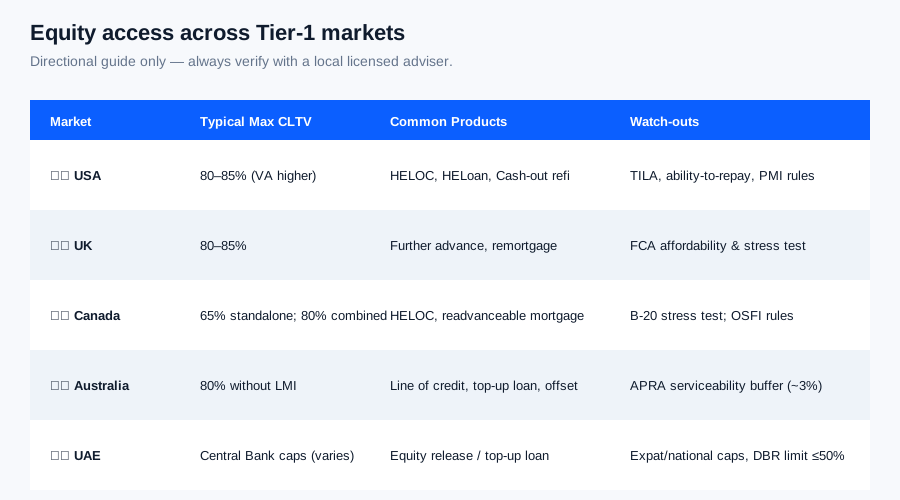
The most mature HELOC market. Cash-out refinance CLTV is typically capped at 80% for conventional loans, 85% for FHA, and up to 100% for VA borrowers (with funding fee). The Consumer Financial Protection Bureau publishes clear educational material onhome equity products and ability-to-repay standards. State law drives foreclosure timelines — Texas has particularly protective homestead rules that historically capped total loans at 80% CLTV even for cash-out.
The classic route is afurther advancefrom your existing lender, or a fullremortgageat a higher LTV with the difference paid to you. LTVs above 85% carry sharp rate premiums, and every application is subject to the FCA affordability rules (stress-tested typically at the reversion rate plus 1–3 percentage points). TheBank of England's money and credit statisticsare a useful reference for lending trends.
Canada
A standalone HELOC is capped at 65% LTV under OSFI rules, but a HELOC combined with a mortgage under a readvanceable product can reach 80% total. Every uninsured mortgage or HELOC applicant must pass theB-20 stress test— qualifying at either the contract rate + 2% or 5.25%, whichever is higher.
Australia
Borrowing above 80% LTV attracts Lender's Mortgage Insurance (LMI), which can run into the tens of thousands. APRA requires banks to assess serviceability at the interest rate plus a buffer (raised to 3.0% in 2021 and still in force). Offset accounts are the more elegant Australian equivalent of drawing equity — you keep the debt but reduce daily interest.
UAE Central Bank mortgage regulations cap LTVs based on property value tier and buyer status (UAE national vs expat). Equity release is possible but less common than in Anglo markets, and lenders enforce a Debt Burden Ratio (DBR) of 50% of income. For non-residents, LTV caps are lower still. Emirates-specific rules make it especially important to verify with a local mortgage adviser. TheUAE Central Bankpublishes updated mortgage regulations that supersede any commentary here.
Cross-jurisdictional considerations for global households
A rising number of Tier-1 households own property in more than one country — a family home in London and a Dubai apartment, an Australian PPOR and a US rental, a Toronto condo and a Costa del Sol villa. Cross-border equity strategies compound complexity: currency risk on the debt vs the asset, tax residency rules that determine where mortgage interest is deductible, and inheritance regimes that can differ radically. Nothing in this article is a substitute for coordinated advice from tax and legal professionals in every jurisdiction where you own property. As a rule of thumb, keep debt in the currency of the asset — a US-dollar loan against a US property, a sterling loan against a UK property — to avoid the compounding risk of your home value fallingandthe currency of your debt strengthening simultaneously.
Common mistakes and myths
Myth 1: "My home is my best investment"
Not always. A primary residence carries costs — property tax, maintenance (rule of thumb: 1% of value per year), insurance, HOA/service charge, transaction costs — that a stock portfolio does not. When you compare like-for-likeafterthose costs, long-run housing returns often trail broad equity indices. Housing wins on forced saving, on leverage, and on utility (you live there), not on unlevered return.
Myth 2: "I'll just use my HELOC for emergencies"
Banks can and do freeze or reduce undrawn HELOC limits during downturns. Two major waves of HELOC freezes occurred in North America during 2008–2010 and again in 2020. If your emergency plan depends on drawing a line of credit exactly when the economy is stressed, plan for that line to shrink or disappear.
Myth 3: "Equity is money"
Equity is optionality, not liquidity. Between deciding to sell and receiving the funds, 30–90 days typically pass in the US, UK, Australia, and Canada, and 45–120 days in the UAE. During that window your equity is unreachable.
Myth 4: "Renovation always adds value"
See Section 6. Most renovations recover 60–80% of cost. Highly personalised renovations recover far less. Pool additions in cool climates are often value-neutral or negative.
Myth 5: "Rates will always come back down"
Any equity strategy that requires refinancing at a lower rate within 24 months is a bet on macro policy. Plan for rates to stay flat or rise; treat future cuts as a bonus. The 2020–2022 mortgage-rate whiplash — from 30-year fixed rates below 3% in the US to above 7% within eighteen months — illustrated how quickly rate assumptions can invalidate a borrowing plan.
Myth 6: "Interest on home equity borrowing is tax-deductible"
Sometimes yes, sometimes no, and always depending on how you use the money and where you file. In the US, the 2017 Tax Cuts and Jobs Act limited home-equity interest deductibility to funds used to "buy, build, or substantially improve" the taxpayer's home securing the loan. In the UK, buy-to-let mortgage interest relief has been steadily reduced since 2017. In Canada, interest deductibility depends on whether the borrowed funds were used to earn investment income (the Smith Manoeuvre and similar strategies). In Australia, deductibility follows the use of funds, not the security. Never assume deductibility; confirm with a licensed tax adviser before letting deductibility change your decision.
Myth 7: "A HELOC is basically a free option"
Most HELOCs carry annual fees, inactivity fees, or minimum-draw requirements. Some include prepayment penalties in the first 3 years. Read the disclosure carefully. "Free" HELOCs almost always compensate the lender through a slightly higher rate or an obligation to keep at least a minimum balance drawn.
Myth 8: "My renovation added value equal to what I spent"
Almost never true, and even less often true when the renovation is highly personalised. A four-oven professional kitchen, a home theatre, a converted garage-to-gym — these oftenreduceresale value relative to standard configurations, because a buyer must factor in the cost of reversing them. If a renovation is being justified partly on equity grounds, do the ROI math against the neighbourhood ceiling price, not against your build cost.
Using home equity to fundconsumption— cars, holidays, weddings, everyday spending — is the fastest way to convert long-term wealth into short-term comfort. Reserve equity for asset purchases, high-ROI improvements, or emergencies of a kind you cannot cover any other way.
The risks of over-leveraging
Payment shock
Variable-rate HELOCs re-price with the underlying benchmark. A HELOC opened at 6% can quickly become an 8% or 9% debt if the base rate rises. Model your payment at the rate + 2% before signing. If the higher payment breaks your budget, you're borrowing too much.
Negative equity
Borrowing to 85% CLTV in a market that then falls 10% puts you at 95% CLTV — or above 100% if the fall is steeper. Negative equity is not a paper problem: it prevents refinancing, blocks sales, and forces owners to bring cash to the closing table if they must move.
Foreclosure risk
Every dollar drawn against home equity is secured by your home. Miss enough payments and the lender's remedy is foreclosure (repossession in the UK, mortgagee sale in Australia and NZ). Unsecured debt at higher rates is more expensive per dollar — but it never puts your family's shelter at risk.
The compounding effect of fees
Closing costs of 3% on a $400,000 cash-out refinance = $12,000 in one transaction. If you refinance three times over a decade, that's $36,000 of equity given away in fees. Each refinance must clear its own break-even test.
Cross-collateralisation
In Australia and to some extent in the UAE, lenders may cross-collateralise your primary residence with an investment loan. If either property falls, the bank can act against both. Where possible, keep loans property-specific.
Concentration risk
Households with 70% or more of their net worth in a single property face concentration risk that is often invisible until it matters. A local economic shock — a major employer leaving, an insurance-market withdrawal after natural disasters, a policy change that affects a neighbourhood — can move the value of one property meaningfully without touching diversified investments. Borrowing against an already concentrated position amplifies rather than reduces this risk. If your home is more than half of your net worth, using its equity to buy a second local property increases concentration further, not less.
The "drawing to survive" trap
The most dangerous pattern in retail lending is the household that opens a HELOC during a good year, draws down modestly for lifestyle top-ups during a normal year, and then depends on continued drawing to cover essentials during a bad year. Each year the debt grows, the interest bill grows, and the discretionary income shrinks. By the time the household recognises the pattern, refinancing options have narrowed and the property may have to be sold. Any HELOC should have a written repayment plan attached to it — even if only in a personal document — before the first draw.
Behavioural risk: the psychology of equity release
Academic research on consumer finance is consistent on one point: money released from home equity is spent differently than money earned through wages. Households who receive a lump sum from a cash-out refinance spend a materially higher share on discretionary categories than they would have from equivalent income. Awareness of this pattern is itself a mitigation. Separate the equity-release account from day-to-day banking, and require yourself to write down the intended purpose before initiating the transaction.
How equity connects to other property metrics
Home equity does not live alone. It is one node in a network of metrics that together describe the health of a property investment.
Down payment
Equity on day oneisthe down payment (minus closing costs). A larger deposit means a lower starting LTV and immediate protection against price falls. See our companion guide:Is a 20% Down Payment Required? What Buyers Actually Need.
LTV ratio
LTV is the mirror image of equity. Every lending decision — including whether you can drop PMI — hinges on it. Read:What Is LTV Ratio and Why Lenders Care.
Mortgage payments
Equity growth from principal paydown accelerates as the payment mix shifts from interest to principal. Understand the maths in:How to Calculate Mortgage Payments Step by Step.
Private mortgage insurance
PMI in the US is required when equity is below 20%; it usually falls away automatically at 78%. SeeWhat Is PMI and When Can You Remove It.
Affordability
Equity determines what youcanborrow. Affordability determines what youshould. Read:How Much House Can I Afford? A Practical Numbers Framework.
Rental yield and cash flow
Investors who release equity to buy a rental should re-check gross and net yield at higher combined debt levels. Marginal deals fail fast when debt rises.
Capital growth
Equity growth = principal paydown + capital growth ± value-add. Isolate the drivers to see which is doing the work.
Run the numbers with free calculators
Every framework in this article gets easier when the arithmetic is automated. LashkariProperties is a free property-tools platform that runs the underlying math instantly so you can focus on the decision — not the spreadsheet.
Recommended tools for equity decisions
Use these together — they draw on the same inputs and let you stress-test different scenarios in minutes.
- Home Equity Calculator— enter value and loan balance to see equity in currency and percentage, with an accessible-equity band based on lender caps.
- LTV Calculator— check where you sit against typical lender bands and how much a small price change moves you.
- Refinance Calculator— model closing costs, monthly savings, and break-even months for a cash-out refinance vs staying put.
A practical workflow: start with thehome equity calculatorto establish your current position, run theLTV calculatorto see how much a lender will let you borrow, and finish with therefinance calculatorto check whether the transaction actually pays for itself before you sign.
Your equity decision checklist
Print this. Tape it to the fridge. Walk through every linebeforetalking to a lender.
- I have a market value from at least two independent sources.
- I have addedeverysecured balance, including HELOC drawn amounts and any liens.
- My current CLTV is below 80% (or I understand the pricing consequences above).
- I know exactly what I will spend the released cash on.
- The purpose creates an asset, income, or high-ROI improvement — not lifestyle spending.
- I have run the new monthly payment at rate + 2% and I can still afford it.
- I have calculated the break-even period on any fees and I plan to stay past it.
- I understand the difference between fixed and variable exposure on the new debt.
- I have a plan to repay the additional borrowing within a defined horizon.
- I have consulted a licensed adviser in my jurisdiction on tax and legal implications.
Frequently asked questions
It's the portion of your property that you truly own — market value minus every loan secured against it. If a home is worth $500,000 and you owe $320,000, you have $180,000, or 36%, of equity.
Estimate current market value using comparable sales or an appraisal, subtract the outstanding mortgage plus any HELOC or lien balances, then divide the result by the market value to get an equity percentage.
What's the difference between a HELOC and a cash-out refinance?
A HELOC is a revolving, usually variable-rate line of credit secured by your home, with low closing costs. A cash-out refinance replaces your existing mortgage with a new, larger fixed-rate loan and gives you the difference in cash, typically at 2–5% closing costs.
How much equity do I need before I can borrow against my home?
Most Tier-1 lenders require you to retain at least 15–20% equity after the new borrowing is in place — a combined loan-to-value ratio of 80–85% or lower.
It counts toward your net worth on paper, but it is illiquid. Turning it into spendable cash requires selling, refinancing, or borrowing — each with fees, delays, and risks.
What are the risks of borrowing against home equity?
Your home is collateral, so missed payments can lead to foreclosure. Variable-rate products can rise, closing costs can be significant, and using equity for lifestyle spending erodes wealth.
Do extra mortgage payments really build equity faster?
Yes. Every extra dollar applied to principal reduces the loan balance and directly increases equity, while also shortening the term and cutting total interest paid.
Do I pay tax when I take equity out of my home?
Borrowing against equity is generally not taxable income, but rules on interest deductibility differ by country and by use of the funds. Verify with a licensed tax professional in your jurisdiction.
What is a good LTV ratio when I'm tapping equity?
80% or lower is usually the best-priced band. Above 85%, options narrow and pricing rises. Above 90%, most lenders won't release equity at all.
Can I use home equity to buy an investment property?
Yes — it's one of the most common uses in Tier-1 markets. Stress-test the new property's cash flow at higher interest rates and ensure the whole portfolio still works if either property's value falls.
Is a HELOC or cash-out refinance better for renovations?
HELOCs suit staged renovations where costs come in over time. Cash-out refinance suits large, defined-scope projects where a single lump sum and locked-in fixed rate matter.
How often should I recheck my home equity?
Review at least annually, and always before a big decision — refinance, borrow, list, or take out insurance. Prices and mortgage balances change every month.
Conclusion and next steps
Home equity is one of the few forms of household wealth that grows quietly, compounds automatically, and outlasts market cycles — as long as it is measured honestly and used sparingly. The right playbook is short:
- Calculate your equity today with a conservative market value.
- Understand your CLTV, not just your first-mortgage LTV.
- When (and only when) you have a productive use for the money, choose HELOC or cash-out refinance based on how you'll spend, current rate direction, and closing costs.
- Stress-test the new payment at +2% before signing.
- Never borrow against your home to fund consumption.
Start with thehome equity calculatorto lock in your current position, then read our related pieces onLTVandaffordabilityto sharpen the next decision. If you're planning a refinance, therefinance calculatoris the last check before you talk to a broker.
Ready to run your numbers?
Free, no sign-up required. Get an answer in under a minute.
Disclaimer:This article is educational and does not constitute personalised financial, tax, or legal advice. Rules on lending caps, mortgage insurance, interest deductibility, and equity release vary by country, state, and lender. Consult a licensed professional in your jurisdiction before making any borrowing or investment decision.
Tools mentioned in this article
Related reading
- How Much House Can I Afford? A Practical Numbers Framework
Calculate a sustainable home-buying budget using income, debts, rates, down payment, total housing costs and realistic stress tests.
- Are Extra Mortgage Payments Worth It? Interest Savings Math
Are extra mortgage payments worth it? See the interest-savings math behind biweekly, extra-monthly and lump-sum prepayments, plus when investing wins instead — with worked examples for US, UK, Canada, Australia and UAE b
- Closing Costs Explained: What Home Buyers Actually Pay
Closing costs surprise most first-time buyers. Learn exactly which fees you pay at closing, who covers what, how to estimate cash to close, and how to compare offers across the US, UK, Canada, Australia and UAE.