
Buying Guides
Are Extra Mortgage Payments Worth It? Interest Savings Math
By Aarav Lashkari · August 6, 2026 · 32 min read

Why this decision matters more than almost any other in home finance
A mortgage is usually the largest, longest and most interest-heavy contract a household ever signs. On a 30-year, $400,000 loan at 7.00%, the borrower repays roughly$958,000— more than$558,000 of that is pure interest. That single number is why the question“are extra mortgage payments worth it?”is one of the most consequential questions in personal finance. Get it right and you can free up years of your working life, or grow a retirement portfolio that easily out-earns the mortgage. Get it wrong and you either trap capital in an illiquid asset or leave tens of thousands of dollars in guaranteed savings on the table.
The internet is drowning in confident opinions — pay it off aggressively, never pay it off, always invest, always be debt-free. The honest answer is that this is a math problem with a few behavioural constraints. The purpose of this guide is to give you the math, the assumptions behind it, and the decision framework, so that by the end you can look at your own mortgage statement and give yourself a defensible answer. Along the way, we point you to the free calculators onLashkariProperties— including theExtra Payment Calculator— so you can plug in the exact numbers from your own loan.
How mortgage interest actually accrues, how biweekly and lump-sum payments compress that interest, the exact break-even point against investing, the Tier-1 market rules (US, UK, Canada, Australia, UAE) that change the answer, and a checklist you can apply in fifteen minutes.
Who this guide is for
This guide is written for four overlapping audiences. If you recognise yourself in any of the descriptions below, the framework in this article will help you make a defensible decision rather than a default one.
- First-time buyerswho are choosing between a 15-year and 30-year loan, or debating whether to stretch to a higher down payment.
- Existing homeownerswith 3–15 years remaining, sitting on a rate they took out before, during or after the 2020–2022 low-rate window, and wondering whether to attack the loan or top up an investment account.
- Property investors and landlordsdeciding whether to accelerate payoff on a rental in order to unlock cash flow, or to keep leverage and buy another property.
- Near-retireesfor whom being debt-free in retirement has become a specific, dated goal — usually within 5–15 years — and who need to know if extra payments will get them there.
What this guide will not do
This is not a personalised financial plan. Nothing here should be read as a recommendation to prepay or invest in your specific circumstances. We do not know your loan documents, tax residency, marginal rate, liquidity needs or behavioural risk tolerance. What we can do — and what we do here — is give you the math, the rules, and the framework, in enough detail that you can either make the call yourself with confidence or walk into a conversation with a licensed adviser already knowing which questions matter.
Key definitions and formulas
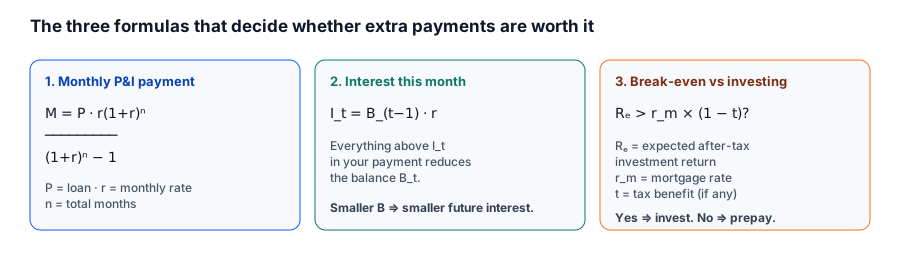
Before we can decide whether extra payments are worth it, we need three formulas. Everything else in the article — every scenario, every savings figure — is a straightforward application of these three ideas.
1. The monthly principal-and-interest payment
A fully amortising loan is set up so that a fixed payment covers all interest plus enough principal to reach a zero balance at the end of the term. The formula is:
M = P · r · (1 + r)n÷ [(1 + r)n− 1]
- M— monthly principal-and-interest payment
- P— original loan principal
- r— monthly interest rate (annual rate ÷ 12)
- n— total number of monthly payments (e.g. 360 for a 30-year loan)
For a $400,000 loan at 7% APR over 30 years: r = 0.005833, n = 360, givingM ≈ $2,661.21per month.
2. Monthly interest charge
Interest is charged on thecurrent outstanding balance, month by month:
It= Bt−1· r
The rest of your payment (M − It) is applied to principal, producing the new balance Bt. In the first month of that same loan, interest is 400,000 × 0.005833 =$2,333.33, and only$327.88goes to principal. That is why every extra dollar in year one is so powerful.
3. Break-even against investing
An extra dollar sent to the mortgage earns a guaranteed, risk-free, after-tax return equal to your mortgage rate — because it cancels that much future interest. So the honest test is whether your alternative use of the same money beats that hurdle:
Expected after-tax investment return > mortgage rate × (1 − tax benefit)
If yes, invest. If no, prepay. Sections below fill in the tax-benefit and risk-adjustment details for each Tier-1 market.
Extra mortgage payments, mortgage prepayment, biweekly mortgage payments, lump-sum principal reduction and "paying off mortgage early" all reduce to the same math: they lowerBt, which lowers every futureIt. Anything a lender or servicer calls "principal-only", "principal curtailment", "overpayment", or "additional repayment" belongs in this family.
Why extra payments move so much money
Amortising mortgages are “front-loaded” with interest. A 30-year fixed loan does not repay principal evenly across 360 months; it repays it slowly at first, then rapidly at the end. This is a structural consequence of the formula, not a hidden fee.
On the $400,000, 30-year, 7% example loan:
- Year 1: about$27,928interest paid, only$3,997principal reduction.
- Year 5: about$26,061interest,$5,876principal.
- Year 15 (the halfway point intime): the loan balance is still~$291,000, so only 27% of the principal has been paid off.
- Year 25: about$8,300interest,$23,600principal.
That asymmetry is the reason extra payments in years 1–10 pay for themselves several times over: every $1,000 of principal you kill at month 12 avoids interest on that $1,000 for the next 348 months.
“Amortisation is not the enemy — it’s just arithmetic. But that arithmetic makes the first ten years of a mortgage the highest-value years to attack.”— LashkariProperties Research
The compounding intuition, in plain English
Think of your mortgage as a fixed-rate savings account run in reverse: you owe the bank money at, say, 7% per year, and every dollar you leave in that account keeps accruing 7% against you until it is paid down. When you send an extra $1,000 to principal in month 12, the bank stops charging you 7% on that $1,000 for the remaining 348 months. In total, that single $1,000 avoids roughly$1,850 of future interest. Do the same in month 240, and the same $1,000 only avoids about$275. The dollar is identical; the timing does the work.
Why the middle years are the hidden trap
The 15-year midpoint of a 30-year loan feels like halftime, but it is nothing like it. On the $400,000 example at 7%, month 180 leaves you with roughly $291,000 still owing — 72.75% of the original principal. Buyers who assume they are “halfway there” at year 15 are usually a decade off. That perception gap is one of the reasons households under-appreciate how much runway an extra $100 or $200 a month buys them. It also explains why prepayment plans that only start in years 12–15 produce a fraction of the interest savings compared with the same amount contributed from year 1.
Why lenders design loans this way (and why it is not a scam)
Amortising loans are not a lender trick — they are the mathematically fair way to keep the payment fixed. If interest were charged evenly across the term, either the payment would balloon at the end or the balance would go negative in the middle. Fixed payments plus interest-on-balance mechanically produce the front-loaded structure. Understanding this defuses the internet myth that mortgages are “designed to extract interest” — the structure is the honest cost of borrowing money for 25–30 years. What you can influence is how long that structure has to run.
Step-by-step decision process
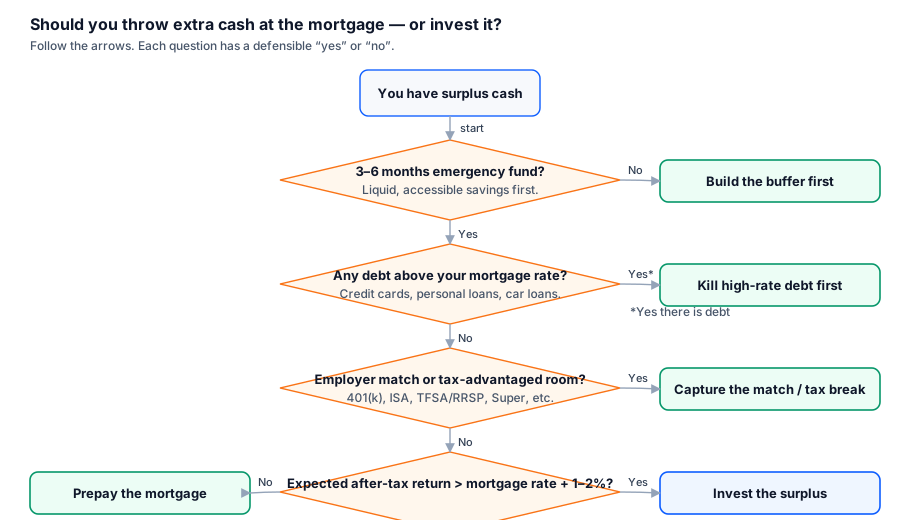
Use this sequence any time you have surplus cash and are wondering whether to route it to the mortgage. It is exactly how a fee-only financial planner would work through the problem — with the emotional layer stripped out.
Step 1 — Establish your baseline amortization
Open theAmortization Schedule Calculator. Enter your remaining balance, interest rate and remaining term. Note two numbers: total remaining interest, and the payoff date. This is your do-nothing baseline.
Step 2 — Model each prepayment scenario
In theExtra Payment Calculator, model each realistic strategy separately: (a) $100 or $200 extra per month; (b) one extra full monthly payment per year (the biweekly equivalent); (c) a specific lump sum at a specific future date. Record new total interest and new payoff date for each.
Step 3 — Compute the guaranteed rate of return
Divide interest saved by extra principal contributed, spread over the horizon, and you get an internal rate of return roughly equal to your mortgage rate. That is yourguaranteed, tax-free (in some markets), risk-freehurdle rate to beat.
Step 4 — Compare to your realistic investment alternative
Look at your available tax-advantaged accounts (401(k), IRA, ISA, TFSA/RRSP, Australian Super, UAE savings vehicles) and their expected long-run after-tax return. A globally-diversified stock/bond portfolio has historically returned around 5–7% real over long horizons, but nothing is guaranteed. Sources like theFederal Reserve Survey of Consumer Financesand theOECD Pensions and Financial Marketsoutlook provide well-documented benchmarks.
Step 5 — Check the guardrails
Before executing, confirm you have (a) a 3–6 month emergency fund, (b) no unsecured debt priced above your mortgage rate, (c) captured any employer retirement match, (d) checked for prepayment penalties, (e) modelled a stress case where income drops for six months.
Step 6 — Choose the delivery mechanism
The decision is not justwhetherto prepay buthow. Each mechanism has a different behavioural profile and a slightly different mathematical outcome:
- Recurring extra monthly principal.The most flexible and the easiest to sustain. Sets the annual saving on autopilot but can be paused in a bad year.
- Round-up payments.Round the payment up to the next $100 or $500 boundary. Small enough to be invisible to cash flow, disciplined enough to compound.
- True biweekly.Adds the equivalent of one extra monthly payment per year. Works best for salaried employees paid every two weeks.
- Annual lump sum.Suits bonus-driven earners, tax refunds and inheritances. Highest single-decision impact when applied early in the loan.
- Offset account.Where available (Australia, parts of UK/UAE), keeps liquidity and delivers the same interest reduction. Almost always dominant when your lender offers it at no extra cost.
- Recast after a lump sum.Combine a large one-off principal reduction with a re-amortisation thatlowersyour required payment. Reduces cash-flow risk while still cutting interest.
Step 7 — Automate and monitor
The single biggest reason prepayment plans fail is that they were never automated. Every plan you make should end in a standing instruction with your lender or bank, not a monthly reminder in your head. Once automated, do only one thing: check the January statement each year to confirm (a) the extra was applied to principal, (b) the balance dropped by at least the amount you sent, and (c) your prepayment allowance has not been exceeded. Ten minutes a year is enough.
Worked numerical examples
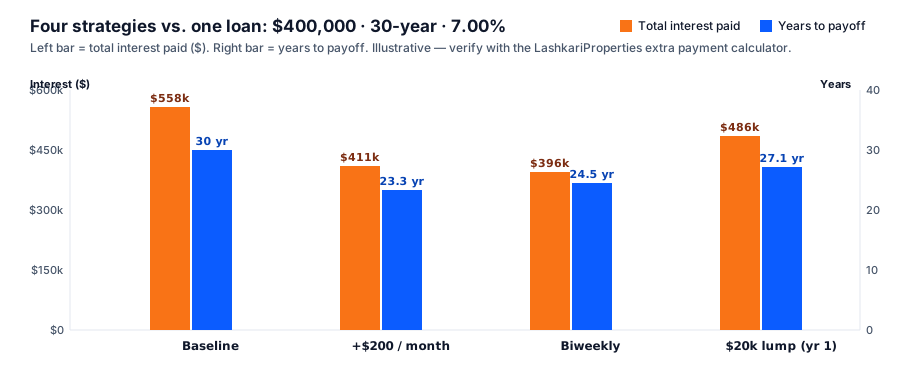
Below are four scenarios on the same $400,000, 30-year, 7.00% loan. All figures are computed from the standard amortisation formula. Round-off differences of a few dollars are expected; verify with theExtra Payment Calculator.
Interest paid and payoff time — $400,000 · 30-yr · 7.00% APR · $2,661.21 monthly P&I
Example 1 — The extra $200 a month buyer (USA, first-time homeowner)
Priya buys a $500,000 house in Austin with a 20% down payment, taking a $400,000 conventional 30-year fixed at 7.00%. Her required P&I payment is $2,661.21. She rounds up to $2,861.21 — an extra $200 a month automatically routed to principal via her lender's online portal.
- Total extra contributed:$200 × 280 months ≈ $56,000
- Interest saved:~$147,000
- Effective return on her $56,000:equivalent to earning roughly 7% guaranteed, after tax, on the money she chose not to leave in a savings account.
- Payoff:23 years 3 months instead of 30 years — she owns her home free and clear at age 51 instead of 58.
Example 2 — The true biweekly buyer (Canada, 5-year fixed)
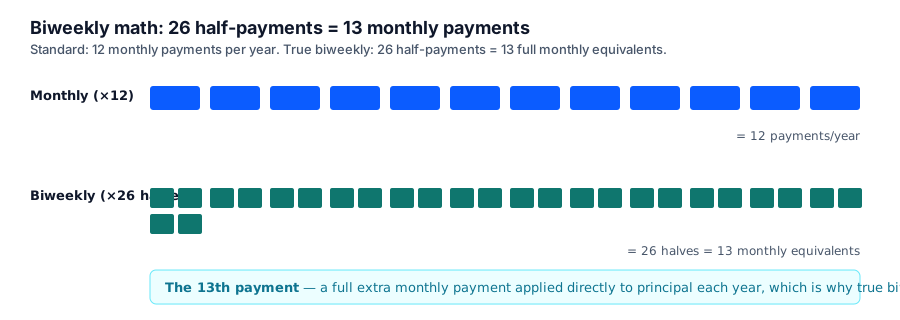
Rahim in Calgary has a CAD $500,000 mortgage on a 25-year amortisation at 5.79% (a typical Canadian 5-year fixed in the current environment). His monthly payment is roughly CAD $3,140. Instead of paying monthly, he switches toaccelerated biweekly— CAD $1,570 every two weeks. This produces 26 half-payments per year (13 monthly equivalents), one more than a monthly schedule.
- Effect:pays off in roughly 21 years 9 months instead of 25.
- Interest saved:approximately CAD $54,000–$60,000 (varies with the reset rate at each 5-year renewal).
- Caveat:he must stay within his lender's 15–20% annual prepayment privilege; on 5-year fixed loans, exceeding it can trigger an Interest Rate Differential (IRD) penalty.
Example 3 — The lump-sum investor (UK, 2-year fixed refi)
Sarah in Manchester has a £250,000 mortgage on a 25-year term at 5.25% fixed for 2 years, remortgaging in 18 months. She receives a £15,000 bonus. Her lender permits up to 10% of the outstanding balance in penalty-free overpayments per year.
- Applied now:£15,000 lump sum saves roughly £20,000–£25,000 in interest over the remaining term (assuming she rolls into a similar rate at remortgage).
- Payoff:shortened by roughly 22 months on the current schedule.
- Alternative:Sarah's Stocks & Shares ISA has averaged ~6% net over her holding period. If she is confident in that continuing and she already has an emergency fund, investing edges ahead on expected value — but the mortgage saving iscertain.
Example 4 — The offset-account investor (Australia)
Liam in Sydney has an AUD $750,000 variable-rate loan at 6.20% with a 100% offset account. He accumulates AUD $80,000 in the offset over three years. Because interest is charged only on the net balance (loan minus offset), he pays interest as if the loan were AUD $670,000.
- Annual interest saved:AUD $80,000 × 6.20% ≈AUD $4,960— tax-free, guaranteed, and the cash remains fully liquid.
- Comparable investment hurdle:for a top-rate taxpayer (~47% marginal), earning AUD $4,960 net requires roughly9.3% pre-taxreturn elsewhere.
- Verdict:in the Australian context, an offset account is almost always dominant over a plain savings account and often over risky investments too.
Example 5 — The near-retiree deciding between prepayment and a taxable brokerage account (USA)
Michelle is 55, lives in Denver, and has fifteen years remaining on a $220,000 loan at 6.75%. She takes the standard deduction, so her mortgage interest is not deductible. She has already maxed her 401(k), including catch-up contributions, and captured her full employer match. She has an extra $1,000 per month to deploy.
- Prepay path.Sending $1,000/month to principal shortens the payoff to~10.5 yearsand saves roughly$59,000in interest. Effective guaranteed after-tax return: 6.75%.
- Invest path.The same $1,000/month invested in a globally diversified 70/30 portfolio, assuming a 5.5% real return net of fees and long-term capital gains tax, produces roughly$183,000after 15 years — but with genuine volatility around that expectation.
- Verdict.Investing wins on expected value, but the horizon is short enough that a bad 10-year sequence could leave her worse offandstill owing on the house at 70. A common compromise: split 50/50 — half to principal, half to the taxable brokerage. She retires with a smaller mortgage and a smaller-but-real portfolio.
Example 6 — The buy-to-let landlord weighing leverage (UK)
Daniel owns a £280,000 rental in Nottingham on an interest-only buy-to-let mortgage at 5.75%, with £45,000 in a savings account after a recent tax refund. Because his mortgage is interest-only, prepayment reduces the balance immediately but does not shorten a scheduled amortisation (there isn’t one). Rental interest is deductible under UK Section 24 rules only at the basic rate as a tax credit — high-rate landlords typically see a reduced net benefit.
- Prepay path.£45,000 principal reduction cuts monthly interest by£216, which flows straight into rental cash flow — a guaranteed 5.75% pre-tax return on the £45,000.
- Reinvest path.Retaining the £45,000 as deposit toward a second property at 75% loan-to-value unlocks around £180,000 of additional property exposure. Historically that has been the accelerator in a UK BTL portfolio, but leverage cuts both ways in a rising-rate environment.
- Verdict.The right answer depends on Daniel’s appetite for concentration risk, his cash reserves and the health of his current rental’s yield. There is no universal answer — but the math above makes the trade-off explicit.
Example 7 — The UAE expat with early-settlement fees (UAE)
Fatima, an expat in Dubai, has an AED 2,000,000 mortgage at 4.75% with a 25-year term. She has AED 300,000 saved and is considering a partial early settlement. Her lender charges the Central Bank capped early-settlement fee (typically 1% of the amount settled, up to a fixed maximum).
- Fee cost:Approximately AED 3,000 (subject to lender cap).
- Interest saved over the remaining term:Roughly AED 260,000, depending on how many years remain.
- Effective return net of fee:Overwhelmingly positive — the one-off fee is dwarfed by the multi-year interest saving.
- Caveat:If Fatima might leave the UAE within a few years, the case for retaining liquidity is stronger. Property in Dubai can be sold, but the timing risk is real.
Example 8 — The low-rate homeowner who locked 2.75% in 2021 (USA)
Kevin refinanced a $350,000 loan to a 30-year fixed at 2.75% in 2021. He has 26 years left, a fully-funded 401(k) match, no high-interest debt, and $500/month of surplus cash flow. Should he prepay?
- Prepay math:$500/month extra shortens payoff by ~10 years and saves ~$56,000 in interest.
- Invest math:The same $500/month invested at a 6% expected real return produces ~$300,000 after 26 years.
- Verdict:This is the clearest expected-value case for investing. Kevin’s mortgage is priced below expected long-run inflation, meaning he is repaying tomorrow’s cheaper dollars. Unless being debt-free at 55 has a very high behavioural value, keep the low-rate mortgage running and invest the surplus.
Every extra dollar of principal you pay today saves interest that would have compounded on itself for hundreds of months. That is whyearlyextra payments are worth so much more than the same dollars applied in year 20 — and why the "small monthly extra" strategy dominates most single lump-sum plans over time.
Tier-1 market nuances
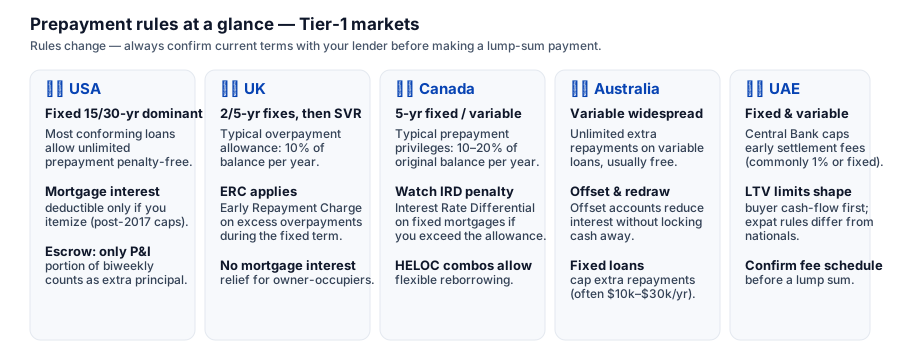
The math is universal; the rules around it are not. Below is a country-by-country cheat-sheet. It is educational only — always verify current terms with your lender and, where relevant, a local professional.
United States 🇺🇸
Most conforming (Fannie Mae / Freddie Mac) and government-backed loans issued today haveno prepayment penalty. Fifteen- and 30-year fixed products dominate, so borrowers can prepay freely. Post-2017 tax law caps the mortgage interest deduction; per theIRS Publication 936, interest is generally deductible on up to $750,000 of acquisition debt, and only if the borrower itemises. In practice, since the standard deduction was raised, only a minority of homeowners see any tax benefit — which strengthens the case for prepayment.
United Kingdom 🇬🇧
Most UK residential mortgages are short fixes (typically 2 or 5 years) that revert to a Standard Variable Rate. Lenders permit annual overpayments up to a cap — commonly10% of the outstanding balance— with no Early Repayment Charge. Exceed the cap during the fixed period and the ERC (often 1–5% of the overpaid amount) applies. TheFinancial Conduct Authorityrequires lenders to disclose ERCs transparently. Owner-occupier mortgage interest is not tax-deductible.
Canada 🇨🇦
Canadian mortgages typically use a 25-year amortisation with a shorter term (often 5 years) at which the rate resets. Lenders offerprepayment privileges— commonly 10–20% of the original balance per year, plus an option to increase the regular payment by a similar percentage. Exceeding the privilege on a fixed-rate loan can trigger an Interest Rate Differential (IRD) penalty, which in a falling-rate environment can be surprisingly large. TheFinancial Consumer Agency of Canadapublishes plain-language guidance on prepayment charges.
Australia 🇦🇺
Variable-rate loans dominate and typically accept unlimited extra repayments. The killer feature is theoffset account— a linked transaction account whose balance is deducted from the interest-bearing loan balance every day. Because you keep 100% of the cash liquid but only pay interest on the net, an offset is economically equivalent to prepayingwith no downside. Fixed-rate Australian loans usually cap extra repayments (commonly AUD $10,000–$30,000 per year). See theASIC MoneySmartguidance for current consumer rules.
United Arab Emirates 🇦🇪
The UAE Central Bank caps early-settlement fees — traditionally 1% of the outstanding balance or AED 10,000, whichever is lower, though borrowers should always confirm the specific figure in force at the time. Loan-to-value ceilings for expats and nationals differ and can affect how much surplus cash a household actually has. Check theCentral Bank of the UAEfor current regulations.
Cross-market takeaways
Zoom out and three patterns stand out across Tier-1 markets:
- Tax-deductibility is far less impactful than it once was.In the US, most households now take the standard deduction, so mortgage interest is effectively non-deductible. In the UK, owner-occupier interest has never been deductible. In Canada and Australia, only investment-property interest is deductible. This has systematicallyraisedthe effective after-tax cost of mortgages and, therefore, the after-tax return of prepayment.
- Interest-rate resets are the wild card.Short-fix markets like the UK and Canada expose borrowers to renewal shock. Voluntary prepayment during the fixed period lowers the balance that will be exposed to the reset rate — a hedge against a bad renewal.
- Product design matters as much as rate.An Australian offset-linked variable at 6.2% can be more valuable than a US 30-year fixed at 5.75%, because the offset preserves liquidity. Do not compare rates in isolation.
Country rules change, and the specifics in your loan documents override any general summary. Before making a lump-sum payment, confirm your lender's current prepayment charge schedule in writing and, where tax matters, speak to a licensed local professional.
When investing the same money is a better choice
Extra payments always cut interest. That is arithmetic. The genuinely open question is whether they are thebestuse of a marginal dollar. Investing wins the pure math case in four situations.
1. Your after-tax mortgage rate is materially below expected returns
Any homeowner who locked a 2.5–3.5% rate during the 2020–2022 window has a mortgage priced well below the long-run expected return on a diversified equity portfolio. Historical global stock-and-bond portfolios have delivered ~5–7% real returns over multi-decade horizons; a 60/40 portfolio has generally beaten a 3% mortgage rate on both nominal and real bases. Under those conditions, prepaying gives up meaningful expected value.
2. You have unused tax-advantaged room
Every dollar you send to the mortgage instead of an employer 401(k) match, a matched Australian Super contribution, or a UK ISA/pension foregoes an immediate, often 25–100%+ effective return. The match or tax benefit is a much higher hurdle than any residential mortgage rate.
3. Your horizon is long and your behaviour is stable
Investment returns are volatile in the short run and dependable in the long run. If you have a 15–30 year horizon and you have proven you will not panic-sell in downturns, the equity risk premium is much easier to capture. If your horizon is short or you have sold at market lows before, the guaranteed mortgage-rate return is worth more than the expected-value gap suggests.
4. Liquidity has a specific value to you
Every dollar you send to the mortgage is difficult to get back — you would need a cash-out refinance or a HELOC. Investable assets can be liquidated in days. For business owners, gig workers or households with volatile income, the liquidity premium can justify investing even when raw expected return is close to the mortgage rate.
Historical investment returns are not guarantees. A 30-year period could deliver less than the long-run average. Mortgage prepayment produces acertainreturn equal to your mortgage rate. That certainty has real value, especially near retirement.
Common mistakes and myths
Myth 1 — “Biweekly programs are magic”
They are not magic; they are just a 13th payment per year. If your servicer charges $3–$9 per biweekly draft or holds your money until a full payment accumulates, you are worse off than doing it yourself for free. Ask two questions:when is my extra half-payment applied?andis there any enrolment fee?. If the answers are "immediately" and "no", it is fine. Otherwise, mimic it manually.
Myth 2 — “Recasting is the same as prepaying”
Recasting keeps your rate and re-amortises your loan around a lower balance after a lump-sum principal reduction, lowering your required monthly payment. It doesnotshorten the term unless you keep paying the old higher amount. Some borrowers deliberately recast to lower cash-flow risk while still saving interest.
Myth 3 — “Extra payments always help my credit score”
They help via lower balances and a clean payment history, but eventually paying off the loan closes the tradeline, which can produce a small temporary dip. Do not manage a mortgage for a credit score you will not need for months.
Myth 4 — “Any extra payment is worth it”
Not if your mortgage rate is 3% and you have a 6% credit-card balance, no emergency fund, and unused employer matching. Order of operations matters. Extra mortgage payments come after emergency fund, expensive debt and matched retirement accounts.
Myth 5 — “I'll just refinance to a 15-year to force myself”
A 15-year loan lowers your rate and forces amortisation, but it also removes flexibility. On a 30-year with voluntary extra payments, you can slow down in a bad year; on a 15-year you cannot. For households with volatile income, voluntary prepayment on a 30-year is usually the more resilient design.
Mistake — Not explicitly directing the extra amount to principal
Most lenders default to applying an overpayment tothe next month's due, which does nothing to reduce interest. Every extra dollar must be marked "principal only". Verify on the next statement that your balance dropped by the exact overpayment amount.
Mistake — Prepaying with no emergency fund
Turning liquid cash into home equity is only useful if you never need to touch it. Job loss, medical emergencies or a rate reset can force households with home equity but no cash to borrow at high rates. Build a 3–6 month buffer first.
Mistake — Comparing pre-tax investment returns to a mortgage rate
The most common analytical error we see. A 7% expected stock-market return ispre-tax. A 6% mortgage rate ispost-taxfor most households, because interest is not deductible for them. Comparing 7% pre-tax to 6% post-tax is comparing apples to oranges. Do the tax adjustment before the comparison — often the "obvious" win for investing disappears once both sides are on the same basis.
Mistake — Ignoring the sequence-of-returns risk
If you invest the surplus and the first decade of returns is poor, the compounding math breaks down and you can end up behind the prepayment path with no time to recover. Near-retirees are especially exposed. Prepayment has zero sequence risk — its return arrives on a fixed schedule regardless of what markets do.
How this connects to related property metrics
Extra payments do not exist in a vacuum. They interact with almost every other number in a property purchase or investment decision.
Down payment vs future prepayment
A larger down payment reduces the loan you take out and, importantly, may eliminate private mortgage insurance in the US or Lenders Mortgage Insurance in Australia. See our companion guide,Is a 20% Down Payment Required? What Buyers Actually Need, for the trade-off analysis. As a rule of thumb, a larger down payment is worth more than an equivalent future prepayment when it cancels mortgage insurance.
Cash-flow ratios
Your monthly required payment drives affordability. Voluntary extra payments do not change that ratio for underwriting. OurHow Much House Can I Afford? A Practical Numbers Frameworkguide walks through the debt-to-income and stress-testing math.
Closing costs and effective interest
If you paid points to buy down the rate, your effective interest rate is lower than the note rate. OurClosing Costs Explainedguide shows how to compute that effective rate — use it in the break-even test above.
Rent vs buy
Aggressive prepayment strengthens the "buy" side of the equation because it accelerates the wealth-building portion of ownership. But if renting-and-investing beats owning on a total-return basis in your city, prepayment cannot fully close that gap. OurRent vs Buy: A Numbers-First Decision Frameworkputs a number on it.
Rental yield and cash flow (investors)
For landlords, extra payments improve long-term cash flow but reduce leverage-driven return on equity. If your rental property is in an appreciating market with strong yield, keeping leverage may outperform prepayment on a total-return basis — while a lower-yield property in a flat market is often better with less leverage.
Interaction with capital growth expectations
Prepayment does not change the underlying property’s price trajectory — appreciation happens on the whole asset, not on your equity share. Two homeowners with identical properties will see the same capital gain regardless of who prepaid faster. Where prepayment matters for capital growth isindirectly: it shifts your net worth from a leveraged asset to an unleveraged one, which materially reduces both volatility and expected return. Households who value smoother net-worth paths — retirees, business owners with lumpy income — often prefer that trade even when it costs them some expected value.
Interaction with insurance and refinancing
US buyers who have not yet crossed 20% equity are typically paying private mortgage insurance (PMI). Prepayment that pushes you across the 78–80% loan-to-value threshold usually allows PMI cancellation, adding roughly 0.3–1.2% to your effective return on prepayment. Australian buyers cross a similar threshold with Lenders Mortgage Insurance. This is a specific, sometimes very large, kicker that most calculators do not capture. Model it separately.
How to run the numbers with free LashkariProperties calculators
Everything above should be verified with your own inputs. Three free tools cover the full workflow:
1. Model the base loan
Start with theMortgage Calculatorto compute your required payment, total interest and total cost across the full term. This is your baseline.
2. Build the amortisation schedule
Use theAmortization Schedule Calculatorto see the exact split of interest and principal every month. This is where the "front-loaded" nature of the loan becomes visible.
Open the Amortization Schedule Calculator →
3. Test extra-payment scenarios
Finally, run theExtra Payment Calculatorto compare recurring extras, biweekly schedules and one-off lump sums side-by-side. Note the interest saved and the payoff-date change.
Actionable framework and checklist
If you have fifteen minutes, use this checklist end-to-end.
The four questions that dominate the answer
Everything above collapses into four questions. If you can answer all four with numbers you trust, you have your decision.
- What is my effective after-tax mortgage rate?Take the note rate, subtract any tax benefit you genuinely receive (not the maximum theoretically possible), and account for points already paid. That is your hurdle rate.
- What is my realistic after-tax investment return over the same horizon?Not the historic long-run stock market average. The return you actually get, after fees, tax and — critically — your behaviour in downturns.
- What is the value to me of liquidity and certainty?Two households can have identical spreadsheets and correctly choose opposite strategies. Volatile-income households and near-retirees rationally price certainty higher.
- What is my hard deadline?A retirement date, a re-fix date or an anticipated sale date. Prepayment is more valuable the closer that deadline is.
- I have 3–6 months of essential expenses in an accessible cash account.
- I have no debt priced above my mortgage rate (credit cards, personal loans, car loans).
- I am capturing any employer retirement match in full.
- I have modelled the baseline loan in theMortgage Calculator.
- I have generated the full amortisation schedule and know my current interest-vs-principal split.
- I have simulated at least two extra-payment strategies in theExtra Payment Calculator.
- I have checked my loan documents for prepayment penalties or overpayment limits.
- I have a realistic after-tax expected return for my alternative investment.
- I have confirmed my lender will apply extra payments to principal, not the next due date.
- I have stress-tested the decision against a 6-month income drop.
- I have made the decisionin writingfor my own records and set a reminder to re-review annually.
If your effective (after-tax) mortgage rate isabove 5–6%, prepayment is nearly always attractive after emergency fund and matched retirement contributions. If it isbelow 3–4%, investing in a diversified long-term portfolio tends to win on expected value. Between those bands, the answer depends on liquidity needs, risk tolerance and how badly you want to be debt-free.
Frequently asked questions
Are extra mortgage payments actually worth it?
Mathematically, yes — every extra dollar reduces the balance that future interest is charged on, so total interest always falls. Whether they are thebestuse of that dollar depends on your mortgage rate, your realistic after-tax investment alternative, tax treatment, prepayment penalties and how much you value being debt-free.
How much interest does a biweekly mortgage payment save?
A true biweekly schedule adds one extra monthly payment per year (26 half-payments = 13 full monthly equivalents). On a 30-year $400,000 loan at 7%, that saves roughly $160,000 in interest and about 5–6 years off the term. Savings scale with balance and rate.
Is it better to pay extra on the mortgage or invest?
Compare your mortgage rate to your realisticafter-taxinvestment return over the same horizon. If expected returns are one to two percentage points above your mortgage rate and you already have an emergency fund and no higher-interest debt, investing usually wins over long horizons. If not, prepaying gives a guaranteed return equal to your mortgage rate.
Should I make one lump-sum payment or a small monthly extra?
Both work. Consistency matters more than timing. Small monthly extras are easy to automate and, maintained across the full loan, often produce the largest total interest saving. A lump sum applied early in the loan is especially powerful because it kills principal while the loan is still interest-heavy.
Yes, two: some servicers charge fees, and some hold biweekly funds until a full monthly payment accumulates — which erases most of the benefit. You can replicate a true biweekly schedule for free by dividing your monthly payment by 12 and adding that amount to each monthly payment, applied to principal.
How do I make sure my extra payment is applied to principal?
Direct it explicitly. Most online portals have a "principal-only" option; if not, send a separate payment or add a note in the memo. Check the next statement — the balance should drop by the exact overpayment amount plus normal principal.
Will paying off my mortgage early hurt my credit score?
There may be a small, temporary dip because you close an installment tradeline, but on-time mortgage history stays on your credit file for years. The financial gain from paying off the loan typically dwarfs any score impact.
Are there prepayment penalties on my mortgage?
It depends on your loan and country. Most US conforming loans have no prepayment penalty; UK fixed-rate deals often charge an Early Repayment Charge above a 10% annual allowance; Canadian fixed mortgages can trigger an Interest Rate Differential penalty above the prepayment privilege; Australian variable loans are usually penalty-free but fixed loans cap extra repayments; UAE early-settlement fees are typically capped by the Central Bank. Always check your loan documents.
Is prepayment worth it when mortgage rates are low?
When your rate is well below the expected long-run investment return and below inflation, the mathematical case for prepayment weakens. Many households still prepay for behavioural reasons — the emotional value of a debt-free retirement is real, even if it is not on the spreadsheet.
What is the opportunity cost of paying down the mortgage?
Every dollar sent to the mortgage is one that cannot go into an investment account, an offset account, an emergency fund or a business. The opportunity cost is the after-tax return you could have earned on that money at a similar or acceptable risk level.
Should I recast or refinance instead of prepaying?
A recast keeps your rate and term but lowers the required monthly payment after a large lump-sum principal reduction. Refinancing changes the rate or term. If you want lower monthly commitment while still killing debt, recasting can be attractive; if rates have dropped materially, refinancing may free up more cash flow to prepay.
Can I use an offset account instead of extra payments?
In Australia and parts of the UAE and UK, an offset account reduces the interest-bearing balance while keeping your cash accessible. Economically it is very similar to prepaying, but with liquidity retained. When available, it is often the best of both worlds.
Conclusion and next steps
Extra mortgage payments are one of the few personal-finance moves with genuinely huge, quantifiable payoffs: interest savings measured in six figures and years shaved off working life. But they are not always the best marginal dollar. Order of operations matters — emergency fund, expensive debt, matched retirement accounts — and so does the honest comparison between your mortgage rate and your realistic after-tax investment return. In an offset-account market like Australia, or when your rate is well above 5–6%, prepayment is a near-obvious win. When your rate is below 3–4% and you have unused tax-advantaged room, investing usually pulls ahead on expected value.
Whatever you decide, decide with numbers. Model your baseline in theMortgage Calculator, generate the schedule in theAmortization Schedule Calculator, and compare strategies in theExtra Payment Calculator. Then decide once, in writing, and stress-test annually.
Ready to keep going? ReadHow to Calculate Mortgage Payments Step by Stepnext, or return to theBuying Guideshub.
Run your own numbers in the next five minutes
Free, no signup: model your loan, generate the amortisation schedule and test extra-payment strategies side-by-side.
Last updated:5 August 2026· Reviewed by the LashkariProperties Editorial Team.
Disclaimer.This article is educational and does not constitute personalised financial, tax, legal or investment advice. Mortgage rules, tax treatment, prepayment charges and product features differ by country, state, lender and individual circumstance, and change over time. Historical investment returns are not a guarantee of future results. Verify any figure with your lender, a licensed financial adviser and, where relevant, a qualified tax professional before making a decision. LashkariProperties provides free calculators to help you run your own numbers; the outputs depend on the inputs you provide.
Tools mentioned in this article
Mortgage Calculator
Estimate monthly mortgage payments, total interest, and payoff based on price, down payment, rate, and term.
Extra Payment Calculator
See how much interest and time you save by paying extra toward your mortgage each month.
Stamp Duty & Transfer Tax Calculator
Estimate property transfer tax or stamp duty using banded rates for major markets.
Related reading
- How Much House Can I Afford? A Practical Numbers Framework
Calculate a sustainable home-buying budget using income, debts, rates, down payment, total housing costs and realistic stress tests.
- Closing Costs Explained: What Home Buyers Actually Pay
Closing costs surprise most first-time buyers. Learn exactly which fees you pay at closing, who covers what, how to estimate cash to close, and how to compare offers across the US, UK, Canada, Australia and UAE.
- Home Equity Explained: How to Calculate and Use It
Home equity explained in plain English. Learn how to calculate home equity, compare HELOC vs cash-out refinance, avoid over-leveraging, and stress-test your numbers with free LashkariProperties calculators.