
Buying Guides
What Is LTV Ratio and Why Lenders Care
By LashkariProperties Editorial Team · July 20, 2026 · 29 min read

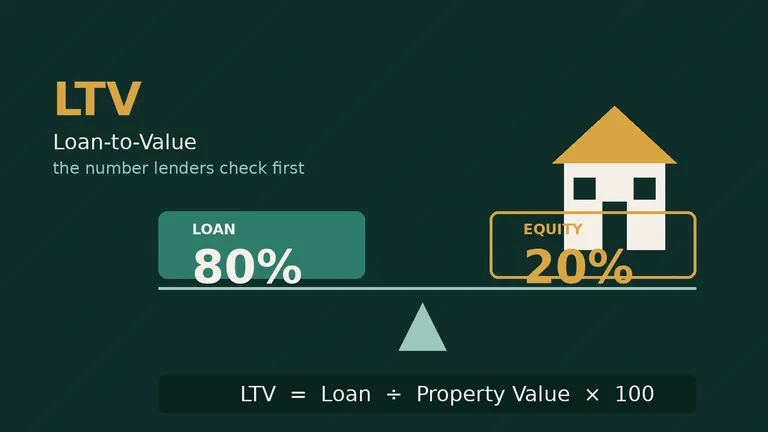
What is the LTV ratio?
Theloan-to-value ratio— usually shortened toLTV— compares the size of a mortgage loan to the value of the property securing it. It answers one question every lender asks before anything else:how much of this home is the bank buying, and how much is the borrower buying?
If you borrow $320,000 to buy a $400,000 home, your mortgage LTV is 80%. The remaining 20% is yourequity— the slice of the property you own outright from day one, funded by your down payment. Equity and LTV are mirror images:LTV + equity = 100%. Every point of LTV you remove is a point of equity you gain.
The LTV formula
LTV = (Loan amount ÷ Property value) × 100
Lenders use thelower of the purchase price or the appraised valueas the property value. If you agree to pay $410,000 but the appraisal comes back at $400,000, the lender calculates LTV against $400,000.
LTV vs. down payment: two ways of saying the same thing
Buyers talk about down payments; underwriters talk about LTV. A 20% down payment is an 80% LTV. A 5% deposit is a 95% LTV. If you already think in down-payment terms, you can convert instantly:LTV = 100% − down payment %. Where it matters is that lenders publish their rules — maximum loan sizes, insurance requirements, interest-rate tiers — in LTV language, so this is the vocabulary your application will be judged in.
What LTV is not
Three quick boundaries prevent most beginner confusion. First, LTV ignoresclosing costs— transfer taxes, legal fees, lender fees — because they are not part of the loan or the property value. Second, LTV is notthe same as DTI(debt-to-income), which compares your monthly payments to your income; a borrower can have a great LTV and still be declined on DTI. Third, LTV says nothing about theinterest rate by itself— it positions you in a pricing tier, and the market sets the rates inside each tier.
Why lenders care about LTV
To a lender, a mortgage is a bet that gets resolved in one of two ways: you repay, or they repossess and sell the property. LTV measures how much room the second outcome gives them. At 60% LTV, the property's value could fall by more than a third and a repossession sale would still repay the loan in full. At 95% LTV, a dip of just over 5% wipes out the cushion — every further point of decline becomes the bank's loss, not yours.
That asymmetry explains almost everything about mortgage pricing. The higher the LTV, the thinner the equity cushion, the greater the chance the lender loses money in a default — and the more they charge for that risk, either as a higher interest rate, a mandatory insurance premium, or stricter approval conditions.
Default risk rises sharply at high LTV
Borrowers with more equity have more to lose, and decades of loan-performance data confirm they default less often. Research from the US Federal Housing Finance Agency — which oversees Fannie Mae and Freddie Mac, the backbone of the American mortgage market — shows that foreclosure risk climbs steeply as combined LTV rises, particularly in periods when home prices are falling.Read the FHFA analysis.
This is also why high-LTV lending is where regulation concentrates. After the 2008 financial crisis — when 100%+ LTV products amplified losses worldwide — central banks and regulators in every Tier-1 market built LTV caps and affordability tests into the system. The IMF's Global Financial Stability Report now tracks LTV-based lending standards across 58 economies precisely because they are one of the main levers for keeping housing credit safe.Read the IMF chapter.
Why 80% became the magic number
Across Tier-1 markets, 80% LTV is the recurring dividing line: below it, US conventional loans need no PMI, UK pricing improves markedly, Australian loans avoid LMI, and many Canadian lenders offer their sharpest uninsured rates. It is not magic — it is roughly the cushion at which a severe-but-plausible price fall (20%) still leaves the lender whole after repossession costs. Regulators effectively codified this cushion after 2008.
Approval risk: the third channel buyers forget
Most guides mention rates and insurance, but high LTV also raisesapproval risk— the odds your application is declined outright or approved with conditions. High-LTV files get deeper scrutiny of credit history, income stability, and the property itself. A borderline valuation that a 75% LTV application would shrug off can kill a 95% application, because a small downward adjustment in value pushes the deal over the lender's cap. Treat LTV not just as a price lever but as an eligibility lever: each band you step down widens the pool of lenders and products willing to take you.
How LTV interacts with credit score and DTI in underwriting
Underwriters never read LTV alone — they read it alongside your credit profile and your debt-to-income ratio, and the three trade against each other. A 90% LTV application from a borrower with an excellent credit score and a low DTI is routine; the same 90% LTV from a borrower with a thin credit file and a stretched DTI is where conditions, higher pricing, and declines cluster. In the US this interaction is literally tabulated: Fannie Mae's LLPA grid charges more at each combination of higher LTVandlower credit score, so a buyer with a mid-range score pays a steeper penalty for high LTV than a buyer with a top-tier score.
The strategic takeaway is that LTV is the one underwriting input you fully control before you apply. You cannot change your credit history overnight, and your income is what it is — but you can choose your loan amount relative to your property price. Buyers who are borderline on credit or DTI should treat a lower LTV as compensation: it is the fastest way to move a file from "marginal" to "clean".
How LTV drives rates, PMI and approval risk
LTV does not move your costs gradually — it moves them insteps. Lenders sort applications into bands (95%, 90%, 85%, 80%, 75%, 60%), and crossing a boundary changes your pricing, your insurance requirement, or both. The practical implication: thelast few pointsof LTV before a boundary are the most expensive points on the entire mortgage.
Channel 1: interest-rate tiers
In the US, Fannie Mae and Freddie Mac applyloan-level price adjustments (LLPAs)— upfront risk fees that scale with LTV and credit score, which lenders pass through as higher rates.See Fannie Mae's LLPA matrix. UK lenders simply publish different products per band: a 60% LTV two-year fix might be priced meaningfully below the 90% LTV version of the same mortgage. Canada splits the market at 80% LTV (insured vs. uninsured), and Australian lenders price sharpest at or below 80%. The pattern is universal:your LTV band is set before negotiation even starts.
Channel 2: mortgage insurance — the borrower pays, the lender is protected
Above 80% LTV, most Tier-1 systems require insurance that protects thelenderwhile theborrowerpays. Names differ but the mechanism is the same:
- USA — PMI:private mortgage insurance on conventional loans above 80% LTV, typically 0.2–1.5% of the loan per year depending on LTV and credit, per theCFPB. FHA loans carry MIP instead, usually for the life of the loan at 90%+ LTV.
- Canada — default insurance:mandatory on insured loans above 80% LTV, with CMHC premiums of 2.8–4.0% of the loan amount depending on LTV, typically added to the balance.CMHC explainer.
- Australia — LMI:lenders mortgage insurance, commonly charged above 80% LTV; premiums rise steeply with LTV and can reach several percent of the loan.
- UK:no borrower-paid insurance, but the same risk shows up as higher rates and higher lending fees above 85–90% LTV.
Our companion guide,What Is PMI and When Can You Remove It, covers US removal rules — including the right to request cancellation at 80% LTV and automatic termination at 78% under the Homeowners Protection Act.CFPB removal rules.
Channel 3: approval and valuation risk
High-LTV applications fail in ways low-LTV ones rarely do. The appraisal matters more (a 3% valuation shortfall can break a 97% LTV deal), reserve requirements are stricter, and debt-to-income limits bite harder because the insurance premium inflates the monthly payment. Some lenders also applymaximum LTV overlaysbelow the official caps for certain property types — condos, new builds, or investment units — so the advertised 95% product may not exist for the property you want.
What typically changes at each LTV threshold (owner-occupier, Tier-1 patterns)
Highest insurance tier; FHA MIP often for loan life
Strictest; fewest lenders; overlays common
How to calculate your LTV in 5 steps
Calculating LTV takes less than five minutes. The only trap is choosing the right inputs — use these steps and your figure will match the one your lender computes.
Step 1: Confirm the property value
Use theagreed purchase price— unless the lender's appraisal comes in lower, in which case the appraisal wins. If you are refinancing rather than buying, skip the purchase price entirely and use thecurrent appraised value. Do not use an online estimate or your own guess for planning purposes: be conservative, because the lender's valuer has the final word.
Step 2: Add up the total loan amount
Counteverythingsecured against the property: the main mortgage, plus any fees or insurance premiums you finance into the loan, plus any second loan you intend to keep. In Canada, for example, the default-insurance premium is usually added to the balance — which nudges the effective LTV above the headline figure. If you have (or plan) a HELOC or second charge, note it separately for the CLTV calculation below.
Step 3: Divide loan by value
Loan ÷ value. A $360,000 loan against a $400,000 property gives 0.90. Sanity-check the result: it should be between 0 and 1 for any normal purchase.
Step 4: Convert to a percentage
Multiply by 100: 0.90 × 100 =90% LTV. Round to one decimal at most — lenders work in whole bands, so 89.4% and 90% are treated identically, but 90.1% may push you into the 95% product tier with some lenders.
Step 5: Compare against lender tiers
Lay your result against the thresholds that matter — 60, 75, 80, 85, 90, 95%. Ask two questions:which band am I in?andhow far am I from the next band down?If you are at 91% with £4,000 of spare cash, moving to 90% could save more than any negotiation with the lender. This is the step where LTV stops being arithmetic and becomes strategy — theframework sectionturns it into a checklist.
Quick verification
Check your maths instantly with the freeLashkariProperties LTV Calculator— enter the price and loan, and it returns your LTV, your equity, and which pricing band you fall into. If you already know your savings, thedown payment calculatorworks the problem backwards: tell it your target LTV and it tells you the cash you need.
Worked examples: LTV in real purchases
Formulas stick when they are attached to real numbers. Here are three complete scenarios from different markets, each fully consistent — check any line yourself.
Example 1 — First-time buyer in the US: 95% LTV and the true cost of PMI
Maya is buying a$350,000condo in Columbus, Ohio with5% down ($17,500)— a$332,500conventional loan.
- LTV = $332,500 ÷ $350,000 × 100 =95%
- Illustrative rate: 6.9% (30-year fixed) → principal & interest ≈$2,190/month
- PMI at an illustrative 0.90% of loan per year = $2,992.50/year ≈$249/month
- All-in financing cost ≈$2,439/monthbefore taxes and insurance
If Maya saved a further $17,500 to reach 10% down, the loan falls to $315,000 (90% LTV). At an illustrative 6.6% rate with 0.60% PMI, principal & interest ≈ $2,012 plus PMI ≈ $158 — about$269/month less, and she reaches the 80% PMI-removal threshold sooner. Whether waiting is worth it depends on local price growth and rent — the point is that LTV gives her the framework to compare.
Example 2 — Canadian insured buyer: the premium that changes the LTV
Daniel is buying aC$600,000townhouse outside Toronto with10% down (C$60,000). Because the loan exceeds 80% LTV, default insurance is mandatory. At 90% LTV the CMHC premium is3.10%of the loan:CMHC premium table.
- Base loan = C$600,000 − C$60,000 =C$540,000
- Insurance premium = 3.10% × C$540,000 =C$16,740, added to the balance
- Final loan = C$556,740 →effective LTV = 92.79%($556,740 ÷ $600,000 × 100)
The lesson: in systems where the insurance premium is capitalised, youreffectiveLTV is higher than your headline LTV. Daniel's payments are calculated on C$556,740, not C$540,000 — a detail that surprises many first-time buyers at the approval stage.
Example 3 — UK remortgage: dropping a band without paying in a penny
Priya bought a flat in Manchester for£280,000 at 90% LTV(loan £252,000). Three years later she has repaid £18,000 of principal (balance £234,000) and the flat is valued at£310,000.
- New LTV = £234,000 ÷ £310,000 × 100 =75.5%
- She has crossed from the 90% band to the75% bandwithout injecting new cash
- Result: materially cheaper remortgage products, and she can request the new lender price off the 75% tier
This is why your LTV is never static — amortisation plus market movement quietly re-bands you. UK owners should re-check LTV before every fixed-term renewal; US owners should check it against the 80% PMI-cancellation right; anyone can track the equity side of the ledger with thehome equity calculator.
Quick reference: down payment, loan and LTV on a $400,000 / £300,000-class property
LTV when you refinance or borrow against equity
Everything so far assumes a purchase. Refinancing changes two inputs at once: the loan amount becomes yourcurrent balance(plus anything you cash out), and the value becomes afresh appraisalrather than the price you once paid. Your refinance LTV is therefore a moving number that usually improves with time — balance down, value up — until you deliberately reset it.
Rate-and-term refinancing
A straightforward refinance replaces your loan with a cheaper one of similar size. Here, a lower LTV works exactly as it does on a purchase: crossing below 80% eliminates the insurance layer and opens better pricing, which is precisely why so many owners refinance in years three to seven — amortisation and appreciation have done the band-crossing for them. Priya's Example 3 above is this scenario in miniature.
Cash-out refinancing and home-equity borrowing
When you withdraw equity, you raise your LTV on purpose — and lenders cap how far. Typical Tier-1 ceilings: around80% LTVfor US conventional cash-out, similar or tighter limits in Canada and Australia for equity release, and UK further-advance products priced by the resulting LTV band. The discipline is to compute yourpost-withdrawalLTV, not your current one: a homeowner at 55% LTV who cashes out to 79% keeps the cheap band; one who goes to 82% triggers insurance-style pricing on theentirebalance, not just the new money. Check the resulting figure with thehome equity calculatorbefore you apply, so the product you request matches the band you will actually land in.
Second loans: where CLTV takes over
HELOCs and second charges sitbehindyour first mortgage, so their lenders underwrite to the combined figure. A first mortgage at 70% LTV plus a HELOC taking the total to 90% CLTV is a very different risk from either loan viewed alone. When you compare equity-access options, always compute both numbers — LTV for the first-lien conversation, CLTV for everything else.
LTV rules in five Tier-1 markets
The formula is global; the caps, insurance mechanics and stress tests are local. Here is how the five most-searched markets differ — always verify current rules with a local lender or broker, because regulators adjust these settings.
Owner-occupier LTV landscape across Tier-1 markets (typical maximums; exceptions exist)
96.5–97% (FHA / select conventional first-time programs)
LLPA risk fees scale with LTV; PMI cancellation rights at 80/78%
Sharp product pricing at 90/85/75/60% bands; FCA affordability rules
Mandatory default insurance 80.01–95% (CMHC/Sagen/Canada Guaranty)
Premium capitalised into loan (raises effective LTV); federal stress test
95% (some lenders 90–95% with conditions)
First Home Guarantee lets eligible buyers use 5% deposit with no LMI (places capped)
80% nationals / 75% expats (first home, ≤ AED 5M); 60% investment & second properties; 50% off-plan
Central Bank regulation explicitly ties fees (max 1%) and age/term limits to the same framework
Three patterns worth remembering
- The 80% line is nearly universal.It marks the boundary between "insured/high-scrutiny" and "standard" lending in the US, Canada and Australia, and the start of the best UK pricing bands. Crossing it is the single most valuable LTV move most buyers can make.
- Regulators use LTV as a policy dial.The IMF notes that LTV-based measures are among the most common and most effective macroprudential tools: when markets overheat, caps tighten; when regulators want to support first-time buyers, targeted exemptions appear (like Australia's guarantee scheme). Your maximum LTV can change between the day you start saving and the day you apply.IMF, 2025
- Investors play by tighter rules everywhere.Buy-to-let and investment mortgages cap out at 60–75% LTV in most Tier-1 markets — the UAE's 60% investment cap is explicit. Model investment deals conservatively and read the property-type overlays before assuming the headline cap applies to you.
Verify locally before you commit
LTV caps, insurance rules and exemptions differ by country, state or province, residency status, property type and even lender. Everything here is educational, not financial advice — confirm the rules that apply to your situation with a licensed local professional before relying on them.
LTV for investors and landlords
If you are buying rental property rather than a home, every rule in this guide tightens. Lenders view investment mortgages as higher risk — an owner-occupier fights to keep their home in a downturn, while a landlord facing negative cash flow may hand back the keys — so they respond with lower LTV ceilings, higher rates, and larger reserve requirements.
Lower caps are the norm
Across Tier-1 markets, buy-to-let and investment products typically max out at60–75% LTV: UK buy-to-let commonly caps at 75% (with the sharpest pricing at 60%), US investment conventional loans require 15–25% down, Australian investor loans price best at or below 80% with many lenders tighter, and the UAE Central Bank explicitly limits investment and second properties to 60% LTV. Plan your deal economics at the conservative end, then treat any higher allowance as upside.
Leverage cuts both ways
Investors choose their LTV as a risk setting, not just an affordability outcome. Consider a $400,000 rental yielding $24,000 a year gross. At 60% LTV ($240,000 borrowed), a 6% interest-only cost is $14,400 — the property carries its debt comfortably. At 80% LTV ($320,000), the same rate costs $19,200 — and a two-month vacancy or a rate reset can flip the deal negative. The higher-LTV version also amplifies capital outcomes: a 10% price fall erases half the equity at 80% LTV, but only a quarter at 60%. This is why experienced landlords model deals at a conservative LTV, stress-test the rate, and hold cash reserves rather than maximising leverage on every purchase.
Rent coverage and LTV work together
Buy-to-let underwriting adds a rental-coverage test (rent must exceed the payment by a margin, often 125–145% at a stressed rate) on top of the LTV cap. The two interact: at a lower LTV, the smaller payment passes coverage more easily, which is why landlords blocked on coverage sometimes solve it by adding deposit rather than by finding a cheaper property. Run both levers before you offer — theLTV calculatorgives you the leverage side in seconds.
How your LTV moves over time
Your LTV on completion day is the highest it needs to be. Two quiet forces push it down every year you hold the property, and understanding them turns LTV from a one-off hurdle into a long-term plan.
Force 1: amortisation
Every monthly payment repays some principal. In the early years of a long mortgage the share is small — on a 30-year loan at 6.5%, roughly one-eighth of the first payment is principal — but it compounds. A $320,000 loan at 6.5% repays about $3,500 of principal in year one and about $4,700 in year three; by year ten the annual principal share has more than doubled. Each dollar of principal is a direct point-for-point cut in the loan side of your LTV.
Force 2: value movement
The denominator moves too. Long-run Tier-1 housing markets have historically grown a few percent per year on average — with deep local variation and real downturns along the way, so never bank on a number. Even modest growth is powerful alongside amortisation: a $400,000 home appreciating 2% a year is worth roughly $424,500 after three years. Combine that with $12,000 of principal repaid on a $360,000 loan (90% start), and the LTV falls to about 82% in three years — near the 80% threshold without a single extra dollar paid.
Force 3: your decisions
Overpayments accelerate force one. Many Tier-1 lenders allow 10% a year in penalty-free overpayments inside fixed terms — a single $5,000 overpayment on the example above pulls the 80% crossing forward by well over a year. The opposite decision — cashing out equity — resets the clock, which is fine when done deliberately at a band boundary and expensive when done casually.
Illustrative LTV path: $400,000 purchase, 90% start ($360,000 loan, 6.5%, 30-year), 2% annual appreciation
Figures rounded; appreciation is illustrative, not a forecast — values can also fall, which slows or reverses the path. The habit that matters is the annual re-check: new balance, realistic value, new LTV, new options. It takes minutes with thehome equity calculatorand it is the cheapest financial review you will ever do.
Common LTV mistakes and myths
Mistake 1: Using the asking price instead of the appraised value
Buyers plan around the price they agreed; lenders calculate against the value they can prove. In a hot market where offers run above asking, an appraisal shortfall quietly raises your effective LTV — and can push you into an insurance tier or over a cap. Plan with a conservative value and treat any appraisal upside as a bonus.
Mistake 2: Forgetting financed fees and premiums
If insurance premiums, funding fees or lender charges are rolled into the loan, your loan amount — and therefore your LTV — is higher than price-minus-deposit arithmetic suggests. Daniel's Canadian example above moved from 90% to 92.79% effective LTV this way. Ask every lender:what exactly is financed into the balance?
Mistake 3: Ignoring CLTV when a second loan exists
A $300,000 first mortgage on a $400,000 home is 75% LTV. Add a $40,000 HELOC and yourcombinedLTV is 85%. Refinance lenders, PMI-removal requests and equity-release products all look at CLTV, not just the first mortgage. If you are stacking loans, calculate both figures.
Mistake 4: Assuming a bigger deposit is always the best use of cash
Moving from 95% to 80% LTV is usually excellent value. Moving from 60% to 50% often saves very little. Below the best pricing band, extra deposit earns no pricing improvement — it may work harder as an emergency fund, renovation budget, or higher-yielding use. Optimise to theband boundaries, not to round numbers.
Mistake 5: Believing LTV freezes on completion day
Your LTV is live. Principal repayment lowers it; price growth lowers it; price falls raise it. Owners who track LTV annually catch PMI-cancellation eligibility, better remortgage bands, and negative-equity risk early. Owners who don't, discover them by accident — usually the expensive kind.
Myth: "You need 20% down to buy a home"
No Tier-1 market requires 20% down for owner-occupiers. The US allows 3–3.5% minimums on some programs, the UK and Canada allow 5%, Australia 5% (2% under some guarantee expansions), and the UAE's caps translate to 20–25% deposits but that is a cap on lending, not a deposit rule. The honest version:20% down is where costs and risk improve sharply, not where eligibility starts. Our guideIs a 20% Down Payment Required?breaks down the trade-off in full.
How LTV connects to the rest of your numbers
LTV is one dial in a four-dial dashboard. Lenders and experienced buyers read them together:
- DTI (debt-to-income):your monthly obligations against your gross income. LTV measures theasset side; DTI measures theincome side. A strong application needs both. OurHow Much House Can I Afford?framework combines them into a target price range.
- Monthly payment:LTV sets the loan size and the insurance layer; the rate converts that into a payment. Model the full chain with ourstep-by-step mortgage payment guide.
- Equity:LTV's mirror image. Equity is what you can borrow against later, what protects you in a downturn, and what you walk away with when you sell. Tracking it is the long game of homeownership.
- Cash to close:down paymentplusclosing costs. Buyers who optimise LTV but forget the fees run out of cash at the worst possible moment. Budget both lines separately.
For investors, LTV also gates two more metrics:cash flow(a higher LTV means a bigger payment against the same rent) andcash-on-cash return(leverage amplifies returns and losses symmetrically). A rental deal that cash-flows at 60% LTV can go negative at 80% — which is why lender caps for investment property sit where they do.
"Your down payment is a decision about your own safety margin as much as the lender's. LTV is the language both sides use to describe it."
Run your numbers with free LashkariProperties calculators
LashkariProperties is a free property-tools platform built for exactly this moment in the buying journey: the point where a concept becomes a decision. Three tools cover the whole LTV workflow — and they take seconds, not spreadsheets.
LTV Calculator
Enter the property price and your planned loan. Get your LTV, your equity share, and which pricing band you land in — then slide the loan amount to see exactly how much cash each band boundary costs.
Calculate my LTV →
Work backwards: pick a target LTV (say, 80% to avoid PMI) and see the deposit required, or enter your savings and see the LTV they buy at different price points.
Plan my down payment →
Already own? Enter your balance and an estimated value to see your current LTV and equity — the numbers that decide PMI removal, remortgage bands and borrowing headroom.
Check my equity →
A practical session: run your planned purchase through the LTV calculator, note your band, then use the down payment calculator to price the move to the next band down. If that move costs less than the annual insurance plus rate difference it saves, you have found money. Browse the full set any time atlashkariproperties.com/tools.
The improve-your-LTV framework
Whether you are three months or three years from applying, this sequence turns LTV from a number you receive into a number you choose.
Step 1 — Establish your baseline
Calculate your current LTV (planned purchase) or live LTV (existing home) using the five-step method above. Write it down with the date. Everything else is measured against this line.
Step 2 — Identify your nearest band boundary
Mark the next threshold below you: 95 → 90, 90 → 85, 85 → 80, 80 → 75, 75 → 60. Compute thecash cost of crossing it: (current LTV − target band) × property value. At 91% on a $400,000 home, reaching 90% costs $4,000 — often cheaper than one year of the higher pricing tier.
Step 3 — Choose your levers
- Save the gap:set a monthly target and deadline tied to the band boundary, not to a round deposit figure.
- Reprice the asset:negotiate the purchase price — every $1,000 off the price lowers the loan need and the value denominator moves with it.
- Resize the target:a home 5% cheaper at the same deposit can drop you a full band.
- Use permitted gift funds:most US, UK, Canadian and Australian programs allow documented family gifts toward the deposit; confirm your lender's rules early.
- Check assistance schemes:shared equity (UK), guarantee schemes (Australia), and down-payment assistance (US state programs) can cross a band without new savings.
- Wait strategically:for existing owners, six more months of amortisation plus market movement sometimes does the work for you — check before adding cash.
Step 4 — Stress-test before you apply
Re-run your numbers at a value 5% lower than expected. If the deal still fits its band and your budget still works at a rate 1 point higher, your application is resilient to the two most common surprises: a soft appraisal and a rate move between pre-approval and lock.
Step 5 — Calendar your re-checks
Set an annual reminder: new balance, new estimated value, new LTV. For US owners, track the approach to 80% (PMI cancellation right) and 78% (automatic termination). For UK and other fixed-term borrowers, check three months before every renewal. One hour a year keeps you in the cheapest band you qualify for.
Best practice
Optimise to band boundaries, document everything (gift letters, deposit sourcing), and never drain your emergency fund to cross a band — a lower LTV bought with zero reserves trades one risk for a worse one.
Frequently asked questions
Most lenders treat 80% LTV or lower as good: you avoid mortgage insurance in the US and Australia, unlock better UK pricing bands, and signal lower risk. A 60–75% LTV typically qualifies for the very best interest rates in Tier-1 markets.
An 80% LTV means the loan equals 80% of the property value and the borrower holds 20% equity. On a $400,000 home, that is a $320,000 loan with an $80,000 down payment. It is the threshold below which US conventional loans do not require PMI.
Lower is better for pricing and approval: more equity means less lender risk, cheaper rates and usually no mortgage insurance. A higher LTV lets you buy sooner with less cash, but costs more each month and leaves less cushion if prices fall.
How can I lower my LTV before applying for a mortgage?
Increase the down payment, choose a less expensive property, negotiate the price, use gift funds where permitted, or delay the purchase to save more. Even moving from 95% to 90% can cut insurance costs and widen lender choice — see theframework section.
Does LTV affect my mortgage interest rate?
Yes. Lenders price in LTV bands, and rates step down as LTV falls. The moves from 95% to 90%, then 85%, 80% and 75%, each change the offered rate through US loan-level price adjustments, UK product tiers, or equivalent mechanisms elsewhere.
What is the difference between LTV and CLTV?
LTV measures only the first mortgage against the property value. Combined loan-to-value (CLTV) adds every loan secured on the home — first mortgage, HELOC, second charge — divided by the value. Lenders use CLTV when you stack loans or refinance with existing second debt.
Yes, in most Tier-1 markets. US conventional programs allow up to 97% for some first-time buyers and FHA 96.5%; the UK, Canada (insured) and Australia offer 95% LTV products. Expect mortgage insurance, stricter affordability checks and higher rates.
On a refinance, LTV uses the current loan balance divided by the current appraised value — not the original purchase price. If your home has risen in value or you have paid down principal, your refinance LTV may be lower than your purchase LTV.
Yes, every month. LTV falls as you repay principal and moves with your home's market value. Owners who bought at 90% often reach 80% within a few years through amortisation plus modest growth — which can end PMI or unlock cheaper refinancing.
What is negative equity and how is it linked to LTV?
Negative equity means your LTV is above 100% — you owe more than the property is worth. It happens when a high-LTV purchase meets falling prices. High-LTV buyers have the thinnest cushion, which is why lenders charge more and require insurance above 80%.
Does the down payment include closing costs in the LTV calculation?
No. LTV compares only the loan amount to the property value. Closing costs — taxes, fees, legal work — do not reduce the loan or the value, so they do not change LTV. Budget them separately from the down payment.
Do property investors face different LTV limits?
Yes. Buy-to-let and investment mortgages typically cap LTV at 60–75%, well below owner-occupier limits. UAE rules, for example, set lower caps for investment and second properties. Model deals at conservative LTVs and verify local rules.
Conclusion: make LTV a number you choose
The loan-to-value ratio is one formula — loan ÷ value × 100 — but it reaches into every part of a mortgage: the rate you are offered, the insurance you pay, and whether the answer is yes at all. Lenders care because LTV measures their cushion; you should care because it measures yours.
The buyers who get the best outcomes treat LTV as a design variable, not a verdict. They calculate it early, find the nearest band boundary, and use the levers — deposit, price, property, timing, assistance — to cross it before applying. Then they keep tracking it after completion, because amortisation and market movement never stop re-writing the number.
Your next step takes two minutes: run your own figures through the freeLashkariProperties LTV Calculator, then use thedown payment calculatorto price your move to the next band down. If you are still sizing your budget, start withHow Much House Can I Afford?, and readWhat Is PMI and When Can You Remove Itbefore you sign anything above 80% LTV.
Educational disclaimer:This article is general education, not personalised financial, tax or legal advice. Mortgage rules, insurance requirements and LTV caps vary by country, state or province, lender and borrower profile, and change over time. Verify the rules that apply to you with a licensed mortgage professional before making decisions.
Keep reading
- How Much House Can I Afford? A Practical Numbers Framework
- How to Calculate Mortgage Payments Step by Step
- Is a 20% Down Payment Required? What Buyers Actually Need
- What Is PMI and When Can You Remove It
- Closing Costs Explained: What Home Buyers Actually Pay
- All Buying Guides →
Tools mentioned in this article
Mortgage Calculator
Estimate monthly mortgage payments, total interest, and payoff based on price, down payment, rate, and term.
Loan-to-Value (LTV) Calculator
Calculate your loan-to-value ratio and see which lender risk band you fall into.
Mortgage Insurance (PMI) Calculator
Find out whether mortgage insurance applies, what it costs monthly, and how to avoid it.
Related reading
- How Much House Can I Afford? A Practical Numbers Framework
Calculate a sustainable home-buying budget using income, debts, rates, down payment, total housing costs and realistic stress tests.
- Are Extra Mortgage Payments Worth It? Interest Savings Math
Are extra mortgage payments worth it? See the interest-savings math behind biweekly, extra-monthly and lump-sum prepayments, plus when investing wins instead — with worked examples for US, UK, Canada, Australia and UAE b
- Closing Costs Explained: What Home Buyers Actually Pay
Closing costs surprise most first-time buyers. Learn exactly which fees you pay at closing, who covers what, how to estimate cash to close, and how to compare offers across the US, UK, Canada, Australia and UAE.