
Investment Guides
Renovation ROI: Which Home Improvements Actually Pay Back
By LashkariProperties Research Desk · July 20, 2026 · 31 min read

The $60,000 question hiding inside every renovation
Two homes go up for sale on the same street. The first owner spent $60,000 on a chef-grade kitchen the year before listing. The second spent $7,000 on a new steel front door, fresh paint, and a garage door replacement. Guess which one walked away with more money in their pocket?
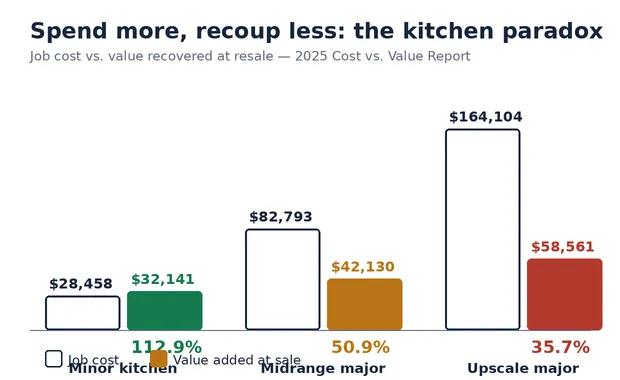
If you picked the $60,000 kitchen, you are in good company — most homeowners assume that big, visible, expensive projects must add the most value. The data says otherwise, and it has said so consistently for decades. In the 2025Cost vs. Value Report— the US industry's longest-running benchmark, now in its 38th year — that upscale kitchen overhaul recouped roughly36 cents per dollarat resale, while the humble garage door replacement returned roughly$2.68 per dollarZonda — 2025 Cost vs. Value Report.
That gap is not a rounding error. It is the difference between a renovation that behaves like an investment and one that behaves like consumption. Both are legitimate choices — but they should bechosen, not stumbled into.
By the end of this guide you will be able to:
- Rank any renovation project by its likely payback using a simple three-tier framework backed by current cost-vs-value data.
- Calculate renovation ROI properly — including the financing, holding, and selling costs that most online calculators quietly ignore.
- Stress-test a project against your street's price ceiling before you sign a contractor's quote.
- Adjust the logic for your goal: selling soon, holding long-term, or renovating a rental for yield.
- Verify every number yourself using free tools, including theRenovation ROI Calculatoron LashkariProperties — a free property-tools platform built to help buyers, investors, and landlords run the numbers before they commit.
One important framing before we begin: nothing here is personalised financial, tax, or legal advice. Renovation economics vary by country, state, and even street, and rules around permits, taxes, and lending differ across the USA, UK, Canada, Australia, and the UAE. Treat this as an educational framework and verify specifics with local professionals where the stakes justify it.
Why renovation ROI misleads most owners
Ask ten homeowners what a new kitchen "adds" to a house and you will hear confident numbers:"A kitchen adds ten grand," "a bathroom adds five percent."These folk figures survive because they are almost never tested. Most people renovate, enjoy the result for years, and sell in a rising market — so the sale price feels like proof the renovation "paid off," even when the market did all the work.
Three cognitive traps make renovation ROI uniquely slippery:
1. The appreciation attribution error
If your $400,000 home sells for $460,000 five years after a $30,000 renovation, it is tempting to credit the renovation with $60,000 of gains. But if comparable unrenovated homes on your street also rose from $400,000 to $440,000 over the same period, the renovation's true contribution is closer to $20,000 — aloss of $10,000against its cost. Always measure a renovation against the counterfactual: what would this home have sold forwithoutthe work?
2. The listing-price illusion
Owners routinely estimate value uplift by browsing renovated listings and comparing asking prices to their own home. Asking prices are marketing, not evidence. Onlysettledcomparable sales — adjusted for size, condition, and date — tell you what buyers actually paid for the upgrade you are considering.
3. The sticker-cost blind spot
The contractor's quote is rarely the true cost. Permits, design fees, a 10–20% contingency for hidden defects, financing interest on a HELOC or renovation loan, council or HOA approvals, temporary accommodation, and the holding costs of a delayed sale all belong in the denominator of your ROI calculation. A $40,000 quote routinely becomes a $52,000 all-in cost — which turns a marginal project into a clear loser.
Renovation ROI is not a property of the project — it is a property of the projectin a specific house, on a specific street, at a specific point in the market cycle. The same $25,000 bathroom can recoup 90% in one postcode and 30% two suburbs away.
Key definitions and formulas
Before ranking projects, lock down the vocabulary. Four terms do all the heavy lifting in renovation economics.
Cost recouped (the industry metric)
TheCost vs. Value Reportand most housing research express payback ascost recouped:
Cost recouped (%) = (Value added at sale ÷ Job cost) × 100
Example: spend $10,000, sell for $8,000 more than you otherwise would have → 80% cost recouped.
Renovation ROI (the investor metric)
Investors usually think in ROI terms — net gain relative to cost:
Renovation ROI (%) = ((Value added − Total project cost) ÷ Total project cost) × 100
Relationship: Renovation ROI = Cost recouped − 100%. An 80% recoup is a −20% ROI.
These two framings describe the same reality. This guide uses "cost recouped" when discussing resale data (because that is how the source data is published) and "ROI" when modelling decisions (because the −100% baseline makes wins and losses explicit).
Total project cost (the honest denominator)
Total cost = Contractor quote + Permits & design + Contingency (10–20%) + Financing costs + Holding costs
Holding costs = mortgage interest, taxes, insurance, and utilities during the work and any extra time on market.
Street ceiling (the value governor)
Thestreet ceilingis the maximum price buyers will pay for a home in your location regardless of finish quality, set by the best comparable sales nearby. It exists because buyers who can afford $900,000 usually choose a better street rather than the best house on a $700,000 street. The ceiling is why identical renovations produce wildly different ROIs in different postcodes — and why the first analytical step is always pricing your ceiling, never pricing your project.
US figures throughout this guide come from the 2025Cost vs. Value Report(Zonda/JLC, 38th edition), which surveys real estate professionals on resale value across 115+ US markets and prices jobs using Verisk estimating dataZonda. UK, Canadian, Australian, and UAE figures draw on national sources cited in the market section. Treat every figure as a starting point for your own local modelling, not a promise.
The 2025/26 payback ranking: what actually returns cash
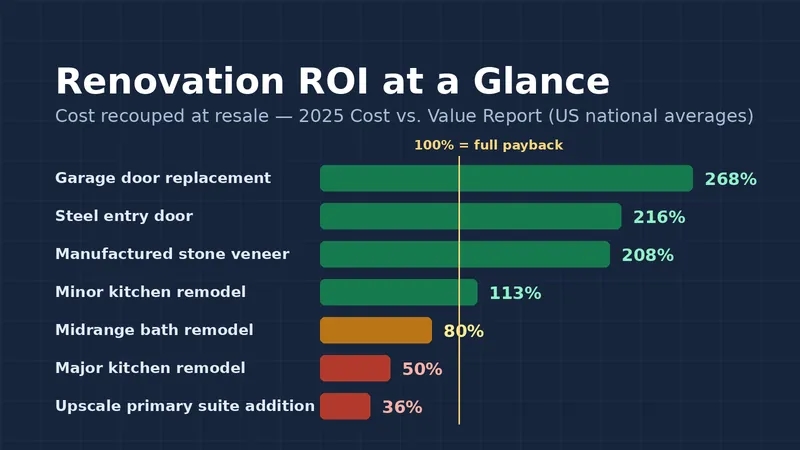
Here is the core of this guide: common renovation projects ranked by typical cost recouped at resale, using the 2025Cost vs. Value Reportnational averagesZonda,Zillow analysis of JLC data. The pattern is remarkably stable year to year, and it sorts cleanly into three tiers.
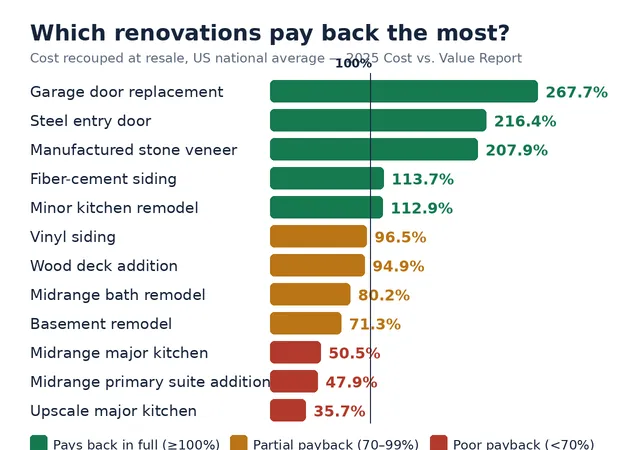
Renovation payback ranking — 2025 Cost vs. Value Report, US national averages
Tier 1 — Full payback and beyond (100%+)
The green tier shares a DNA:low absolute cost, high visual impact, and broad buyer appeal. A garage door costs under $5,000 but dominates the front elevation of most suburban homes — it is often the single largest visible surface a buyer sees from the kerb. Steel entry doors and stone veneer work the same way: small spend, outsized first impression. These projects also carry no taste risk. Nobody walks away from a house because the garage door istootasteful.
The one interior project in this tier — the minor kitchen remodel — earns its place precisely because it isminor: refaced cabinet fronts rather than new cabinets, new counters and hardware, matching appliances, fresh paint. It delivers a "new kitchen" impression at a third of the cost of a gut renovationZillow.
Tier 2 — Partial payback (70–99%)
Decks, siding, bathroom remodels, and basement finishes return most of their cost. Whether they make sense depends on your horizon: recoup 80% immediately on sale, or enjoy the space for five years and treat the unrecovered 20% as rent paid to yourself. That reframing — covered in the modelling section — turns many amber-tier projects from "losses" into reasonable purchases.
Tier 3 — Poor payback (<70%)
Major kitchens, suite additions, and anything labelled "upscale" sit at the bottom, year after year. The reason is structural, not cyclical: the more you personalise, the fewer buyers share your taste, and the more you spend, the more of the spend is invisible labour, wiring, and plumbing that buyers assume anyway. A $164,000 upscale kitchen still has to compete against the street ceiling.
"Exterior replacement projects remain the clear winners when it comes to adding resale value. While large interior remodels may be personally rewarding, their appeal is often too subjective to deliver the same return when it's time to sell."— Clay DeKorne, chief editor, Zonda JLC Group, 2025 Cost vs. Value Report commentary
Why exterior projects beat interior ones: the payback logic
The ranking is not random. Four forces explain almost every position on it, and once you internalise them you can predict the payback of projects that never appear in any report.
Force 1: First impressions price the whole house
Buyers anchor on the exterior within seconds and interpret everything inside through that anchor. A tired façade makes a decent kitchen look "tired too"; a crisp façade makes the same kitchen look "solid." Because the anchor is set by relatively cheap surfaces — doors, cladding, landscaping — small exterior spends move the perceived value of theentireproperty, not just the part you touched. This is why a $2,435 steel door can recoup 216%: it re-prices a $450,000 asset, not a $2,435 component.
Force 2: Functional obsolescence beats cosmetic datedness
Buyers discount homes for things that arewrongfar more than they reward things that arenice. A home with one bathroom in a three-bathroom neighbourhood, no parking where parking is standard, or an EPC/F energy rating will be discounted heavily — sometimes below the cost of fixing the problem, because buyers price in hassle and uncertainty. Fixing a deficiency often recoups over 100%; upgrading an already-adequate feature rarely does. This is the single most reliable rule in renovation ROI:remove objections before adding luxuries.
Force 3: The street ceiling caps everything
No buyer pays $1.1 million on a street where nothing has ever sold above $950,000 — the appraisal will not support the loan even if a buyer wants to. Every dollar of renovation beyond the ceiling recoups roughly zero. Before any project, pull the three highest comparable sales within half a mile or one kilometre, adjust for size, and treat that as your hard ceiling.
Force 4: Labour does not transfer, materials partly do
Roughly half of a major remodel's cost is labour, design, and project management — value that evaporates at sale because the buyer cannot see or transfer it. Durable, visible materials (stone, cladding, quality doors) transfer partially. This is why "upscale" tiers of the same project consistently recoup less than "midrange" tiers: the upscale premium is disproportionately labour and personalisation.
Before pricing any renovation, list your home's three biggest buyer objections (ask a local agent to be blunt). Budget to kill those objections first. Only then consider upgrades — and stop at the street ceiling.
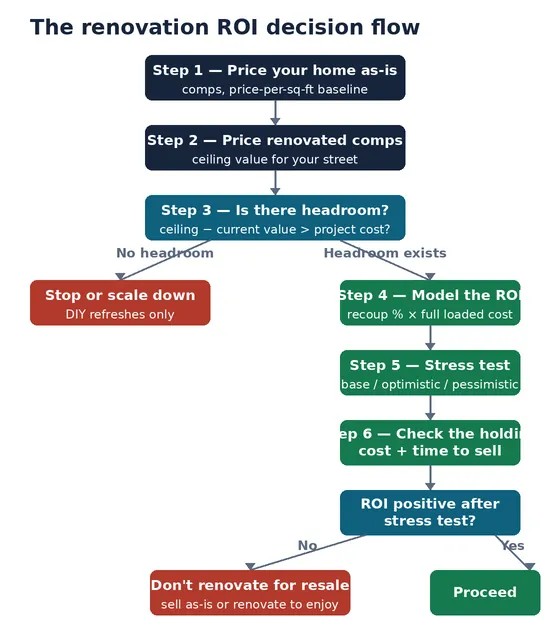
How to model renovation ROI before spending: a 6-step process
This is the decision process professional flippers and disciplined owner-occupiers use. It takes one evening and a spreadsheet — or ten minutes with the free calculators linked at the end.
Step 1 — Price your home as-is
Pull three to five recent settled sales of similar homes in similar condition within your immediate area. Compute the median price per unit of area, multiply by your home's area, and sanity-check against an agent's appraisal. This is yourbaseline value. Do not use portal estimates alone; they lag condition adjustments.
Step 2 — Price the renovated comparables (your ceiling)
Now pull settled sales of similar homeswith the upgrade you are considering. The gap between renovated comps and your baseline is themaximum plausible value uplift. If renovated homes on your street top out $35,000 above as-is homes, no kitchen — however beautiful — will add $60,000.
Step 3 — Test headroom
Headroom = Ceiling value − Baseline value
Proceed only if headroom comfortably exceeds your all-in project cost. A common rule of thumb: keep total project cost below 50–70% of headroom.
Step 4 — Model the honest ROI
ROI = (Uplift × Probability-adjustment − Total project cost) ÷ Total project cost
Probability-adjustment: discount the uplift for execution and market risk — 90% for straightforward cosmetic work, 70–80% for structural or permit-heavy projects.
Step 5 — Stress test three scenarios
Run the model three ways:base(comps uplift, quote + 10% contingency),optimistic(top comp uplift, quote on budget),pessimistic(uplift −30%, cost +20%, +3 months holding). A project that only works in the optimistic case is a gamble, not an investment. A project that is merely tolerable in the pessimistic case is usually acceptable for an owner-occupier, but not for a flip.
Step 6 — Add the holding and exit costs
Finally, subtract the costs ofwhenyou sell: agent commission (typically 5–6% in the US, 1–3% in the UK, 3–5% in Australia, ~2% in the UAE), transfer taxes, and any mortgage interest accrued during the works. A renovation that returns $20,000 on a $500,000 sale can lose a third of its paper gain to exit costs alone. This is also where capital gains rules matter — covered in the market section.
Worked examples: three real-world scenarios
Numbers make the framework concrete. All three examples use realistic 2025/26 figures; every calculation is shown so you can replicate it with your own numbers.
Example 1 — The pre-sale refresh (USA, selling in 6 months)
Situation.A $450,000 (as-is) suburban home. The owner considers three pre-sale projects: garage door ($4,672), steel entry door ($2,435), and a minor kitchen remodel ($28,458) — a $35,565 package, quoted all-in with permits and a 10% contingency at$39,100.
Comps.Renovated comparables on the street settle around $495,000–$505,000. Baseline $450,000 → ceiling ≈ $500,000 →headroom $50,000. Package cost is 78% of headroom — above the comfort zone, so the owner trims scope: drops the kitchen to a "paint + hardware + counters" micro-refresh at $9,500 all-in. New package:$16,600 all-in.
Expected uplift(conservative, 85% probability-adjustment on a $38,000 comp-implied uplift): $32,300.
ROI = ($32,300 − $16,600) ÷ $16,600 = +94.6%. Recoup ≈ 195% → proceed.
Pessimistic check:uplift −30% ($22,610), cost +20% ($19,920) → ROI +13.5%. Still positive → the project survives its stress test.
Example 2 — The major kitchen trap (UK, selling next year)
Situation.A £400,000 terrace. The owner is quoted£48,000for a full midrange kitchen renovation with layout changes (£52,000 with contingency and fees), and believes it will "add £60,000."
Comps.The best sale on the street — extended, magazine-finished — achieved £435,000.Headroom = £35,000.Even if the kitchen capturedallof that headroom (impossible — the comp was also extended), the £52,000 all-in cost exceeds headroom by £17,000.
Modelled ROI = (£35,000 × 0.85 − £52,000) ÷ £52,000 = −42.8% → do not proceed for resale.
What the owner did instead:a £6,500 refresh (painted units, new handles, worktop, re-grout, lighting) targeting an estimated £12,000–£15,000 uplift plus faster sale. Modelled ROI ≈ +100%, and the remaining budget stayed liquid for the next purchase. UK data supports the restrained approach: restrained kitchen updates are typically estimated to add 5–10% to value when replacing a visibly dated kitchen, while structural additions like loft conversions target 15–20%+ by adding floor area — and Nationwide research found a 10% increase in floor space adds about 5% to a typical house priceNationwide via Valuq,Propertymark.
Example 3 — The rental renovation (Canada, hold 7 years)
Situation.A C$520,000 rental condo with a tired kitchen and bath. The landlord considers a C$38,000 refresh (all-in with 15% contingency:C$43,700) that should lift rent from C$2,300 to C$2,650/month —+C$350/month = C$4,200/year.
Rental payback logic:Annual rent uplift ÷ all-in cost = 4,200 ÷ 43,700 =9.6% annual return on the renovation spend— a ~10.4-year simple payback from rent alone. That looks slow until the residual value uplift is added: renovated comps suggest ~C$30,000 higher resale value.
7-year total return = (7 × $4,200 + $30,000 − $43,700) ÷ $43,700 = +35.7% over 7 years ≈ 4.5% annualised — before tax effects.
Canadian estimates from the Appraisal Institute of Canada put kitchen refurbishment payback at roughly 75–100% of cost at resale, and bathroom renovations at similar levels — consistent with this example's residual-uplift assumptionAIC figures via Victoria Real Estate Pros. The decision hinges on hold period: at a 3-year hold the same project nets −3.4%; at 10 years, +55.6%.Rental renovations are a duration bet.
These examples are illustrative, use national-average cost data, and are not predictions of your outcome. Tax treatment of renovation costs (repairs vs. capital improvements), capital gains exemptions, and depreciation rules differ by country and personal circumstance — verify with a local tax professional before relying on any after-tax figure.
Tier-1 market nuances: USA, UK, Canada, Australia, UAE
The payback logic is universal, but its dials are set differently in each market. Here is what changes — and what does not — across the five regions this site serves.
The US has the richest renovation ROI dataset in the world. Beyond the national averages, the 2025 report shows pronounced regional variation: the Pacific region posts the strongest returns (a minor kitchen remodel recoups ~129% there versus ~94.5% in the West North Central), and storm-prone regions reward resilience upgrades — a backup power generator entered the national top 10 for the first time in 2025 with a 95.3% recoupZonda,Zillow. Tax angle: for primary residences, the Section 121 exclusion (up to $250,000 single / $500,000 married of gain, if ownership and use tests are met) means renovation-driven appreciation on your own home is often tax-free — while rental renovations interact with depreciation and the repairs-vs-capital-improvement distinction. Confirm treatment with the IRS guidance or a CPAIRS — Topic no. 701, Sale of your home.
UK payback is dominated byfloor space and energy performance. Nationwide's analysis found a 10% increase in floor space adds roughly 5% to a typical house price, and adding a bedroom or bathroom via extension is the classic value play — loft conversions are commonly estimated to add 15–20%+ when they create a genuine extra bedroomNationwide via Valuq. Meanwhile an EPC rating uplift can "add thousands" because lenders and buyers increasingly price energy costs into offersPropertymark. UK-specific watch-outs: (1) swimming pools are usually a valuenegative; (2) work without planning permission or building-regs sign-off can force costly retrospective approval at sale; (3) stamp duty (SDLT) on yournextpurchase raises the bar for "renovate vs. move" — moving a £400k→£550k family home can cost £20,000+ in tax and fees alone, which is budget that could have funded the extensionGOV.UK — Stamp Duty Land Tax.
Canada
Canadian appraisal estimates are similar in spirit to US data: the Appraisal Institute of Canada's long-standing figures put kitchen refurbishments at roughly 75–100% payback, bathrooms at 75–100%, and interior/exterior painting among the highest-return cosmetic spendsAIC figures via Victoria Real Estate Pros. Regional realities matter: basement suites are a strong ROI play in Vancouver and Toronto where secondary-suite income is priced into values, while energy-efficiency retrofits (insulation, heat pumps, windows) punch above their weight given heating costs and federal/provincial rebate programmes. Canadian principal residences are generally exempt from capital gains tax, but rental-property renovations fall under capital-vs-current expense rulesCRA — Capital gains.
Australia
Australia's renovation economics are shaped by outdoor living and energy efficiency. Decks, alfresco areas, and landscaping recoup well in most capitals; kitchens and bathrooms follow the same minor-beats-major pattern as the US. Distinctly Australian factors: (1)solar and energy ratingsincreasingly influence buyer decisions as power costs rise; (2) state-based stamp duty makes "renovate instead of move" arithmetic unusually favourable — duty on a A$1m purchase runs to roughly A$40,000–55,000 depending on the state; (3) strict licensing and certification rules mean unpermitted work surfaces painfully at sale. Investment-property renovations sit within the capital works deduction regime (Division 43) and depreciation schedulesATO — Rental property: repairs, maintenance and capital expenditure.
UAE (Dubai and Abu Dhabi)
The UAE market pricesfinish quality and community normsmore than incremental upgrades. In villa communities (Arabian Ranches, Palm Jumeirah, Dubai Hills), the comp set is everything: renovated-to-community-standard villas sell quickly at community-typical premiums, while over-spec finishes rarely recoup because the buyer pool expects to personalise. Practical nuances: developer/NOC approvals are required for structural changes; service charges keep running during works (a holding cost many owners forget); and there is no capital gains tax on property for individuals, which simplifies after-tax ROI modelling versus the other four markets. The UAE's 4% Dubai Land Department transfer fee on purchase raises the cost of "moving instead of renovating"Dubai Land Department.
Renovation ROI: what changes by market — and what stays the same
Regional variation (Pacific strongest); resilience upgrades in storm zones
5–6% agent commission; Section 121 exclusion on primary homes
Floor-space additions (loft, extension); EPC uplift
Price per m² of added space; energy ratings
Kitchen/bath refreshes; painting; basement suites
Legal secondary suites; energy retrofits with rebates
Principal residence exempt from capital gains
Outdoor living; cosmetic refreshes; solar/efficiency
High state stamp duty favours renovate-over-move
Community-standard villa upgrades; kitchens/baths
Community comp set; no personal capital gains tax
~4% DLD transfer fee; service charges during works
Tax rules, permit regimes, and agency-fee norms cited above are summaries current at publication and change frequently. Before committing to a renovation whose case depends on tax treatment, lending eligibility, or planning status, verify with the relevant authority (IRS, HMRC, CRA, ATO, DLD) or a licensed local professional.
The investor and landlord view: renovation as a yield decision
Everything above frames payback through resale. Landlords and buy-to-let investors need a second lens, because a rental renovation pays back throughtwo channels: higher rent (and lower vacancy) while held, plus residual value uplift at exit.
The rental renovation return formula
Annual renovation return = (Annual rent uplift + Annual vacancy savings) ÷ All-in renovation cost
Target: 14–20% (a 5–7 year payback). Below ~10%, the project relies entirely on residual value at exit — a weaker, less certain bet.
What actually moves rent
Rental ROI rewards a different project mix than resale ROI. Tenants pay premiums for: durable easy-clean surfaces, in-unit laundry, a second bathroom, air conditioning in warm climates, secure parking, and energy-efficient heating/cooling that cuts their bills. They pay almost nothing for statement backsplashes, designer taps, or stone veneer kerb appeal. The investor's version of "remove objections first" is fixing the things that generate maintenance calls and void periods — a new boiler recoups through reliability, not glamour.
Renovate-and-refinance (BRRRR-style) discipline
For value-add investors, renovation ROI feeds directly into refinance capacity: the uplift determines how much capital the next valuation releases. This is where honest modelling matters most — an appraiser will value against settled comps, not your spreadsheet. Discount the expected uplift, include financing costs on the renovation loan, and verify that the post-renovation yield still clears your target with our guide tocalculating ROI on a rental propertyand the metrics inCap Rate Explained for Property Investors.
Approve a rental renovation only if (1) the rent/vacancy channel alone repays the cost within 7 years,or(2) the residual value uplift is comp-proven and you plan to refinance or sell within 3 years. Projects that fail both are lifestyle spending on someone else's home.
Common mistakes and myths that destroy renovation ROI
Mistake 1 — Confusing the quote with the cost
Permits, design, contingency, financing interest, and holding costs routinely add 25–35% to the contractor's number. Every ROI figure you compute before adding them is fiction.
Mistake 2 — Over-improving past the street ceiling
The most expensive kitchen on the street does not sell for the most money — it sells for roughly the ceiling and gifts the overage to the buyer. Keep total home value after renovation within ~10–15% of the neighbourhood's top salesWest Shore Home — resale value guide.
Myth 3 — "A pool adds value"
In the UK pools are often a net negative; in Australia, the US Sun Belt, and the UAE they are frequentlyexpectedat certain price points — which means they defend value rather than create it. Either way, treat pools as lifestyle spendPropertymark.
Mistake 4 — Personalising at premium prices
Every bold choice narrows the buyer pool. The 2025 data is blunt: upscale, highly customised versions of projects recoup dramatically less than their midrange equivalents — 35.7% vs 112.9% for kitchensZonda.
Mistake 5 — Removing what the market prices
Garage conversions in parking-scarce areas, bedroom-count reductions to enlarge suites, and garden-to-extension trades can allsubtractvalue even when the workmanship is excellent, because they move the home out of its most valuable comp category. Propertymark's UK guidance flags off-street parking as carrying a "massive premium" in many areas — paving over it or converting it away is value destructionPropertymark.
Mistake 6 — Skipping permits to save money
Unpermitted work surfaces at survey/inspection, can void insurance, and in the UK can force retrospective approval before a sale completes. The savings are imaginary; the risk lands at the worst possible moment — mid-transaction.
Myth 7 — "Renovations always pay off in a rising market"
A rising market lifts renovated and unrenovated homes together. If the market rises 10% during your project year, your renovation did not add that 10% — the counterfactual did. Measure against the counterfactual, always.
Mistake 8 — Ignoring time-to-sell value
Some upgrades return little price premium but sell the home weeks faster — worth real money if you are carrying a mortgage and a bridging loan. Zillow found 38% of sellers who made pre-listing improvements chose the kitchen, largely for marketability rather than pure priceZillow. Model speed as a benefit line, not a rounding error.
How renovation ROI connects to your other property metrics
Renovation ROI never lives alone. It plugs into the same value-and-income engine as the metrics you use to evaluate the whole asset:
- Capital growth.Renovation uplift and market appreciation stack multiplicatively — which is why confusing them is so costly. Our guide onestimating property appreciation realisticallyshows how to separate the two before you credit your kitchen with the market's gains.
- Cap rate and yield.For rentals, a renovation changes both sides of the cap rate: rent uplift raises NOI, and the cost raises your effective basis. See how the pieces interact inCap Rate vs Cash Flow: Which Metric Should Guide Your Decision?
- Cash-on-cash return.If you finance the renovation with a HELOC or renovation loan, the interest cost flows straight into your cash-on-cash calculation — model it with the method inCash-on-Cash Return: How to Calculate It Properly.
- Price per area.The street-ceiling test is really a price-per-square-foot (or per-m²) comparison: if renovated comps trade at $310/sq ft and your post-renovation cost basis would reach $340/sq ft, the market is telling you the project overruns. A quick check with aprice per area calculatormakes the ceiling visible in one number.
- Capital gains at exit.The tax slice of your renovation-driven gain depends on residency, hold period, and jurisdiction — model the after-tax outcome before counting the money (ourcapital gain calculatorhandles the arithmetic; a local tax professional handles the rules).
Run the numbers free: the LashkariProperties toolkit
Every formula in this guide can be executed in minutes with the free calculators onLashkariProperties— no sign-up, no spreadsheet wrangling. Here is the recommended workflow, mapped to the six-step process above:
- Establish your baseline and ceiling (Steps 1–2).Pull your comps, then use thePrice per Area Calculatorto convert them into a clean per-sq-ft or per-m² comparison. This exposes the street ceiling as a single number and stops you from comparing a 1,400 sq ft comp against your 1,900 sq ft home as if size were free.
- Model the project (Steps 3–4).Enter your all-in cost, expected uplift, and hold period into theRenovation ROI Calculator. It applies the honest denominator — the full loaded cost, not the contractor's sticker — so the ROI it returns already reflects the discipline this guide teaches.
- Stress test the whole asset (Step 5).For rentals and flips, run the post-renovation property through theROI Calculatorwith pessimistic rent, realistic vacancy, and the financing cost of the renovation funds. If the asset-level return only works with optimistic inputs, the renovation is carrying risk the numbers are hiding.
- Model the exit (Step 6).Before counting paper gains, run the sale through theCapital Gain Calculatorwith your purchase price, renovation costs added to basis, selling costs, and hold period. The after-tax number — not the recoup percentage — is what actually lands in your account.
The full library lives atlashkariproperties.com/tools, and the companion guides in ourInvestment Guides categorywalk through each metric in the same depth as this article.
Model your renovation before you spend
Free, no sign-up. Four tools cover the full decision: ceiling check → project ROI → asset stress test → after-tax exit.
- Renovation ROI CalculatorWill this project pay back? All-in cost vs. expected uplift.
- Price per Area CalculatorFind your street ceiling from comparable sales.
- ROI CalculatorStress-test the whole property after the works.
- Capital Gain CalculatorSee the after-tax, after-cost exit number.
The pre-renovation ROI checklist
Print this. Do not sign a contractor agreement until every box is ticked.
- Comps pulled:3–5 settled as-is sales and 3–5 settled renovated sales within ~1 km / half a mile, adjusted for size via price per area.
- Ceiling set:the highest defensible renovated comp is written down as the hard ceiling.
- Headroom tested:all-in project cost ≤ 50–70% of (ceiling − baseline).
- Honest denominator:quote + permits + design + 10–20% contingency + financing + holding costs, all in one number.
- Objections first:defects and functional gaps (roof, damp, HVAC, bathroom count, parking, EPC/energy rating) ranked ahead of cosmetic upgrades.
- Scope matched to goal:selling within 2 years → Tier-1 exterior and minor refreshes only; holding 5+ years → amber-tier allowed with enjoyment value counted; rental → two-channel test passed.
- Three scenarios modelled:base, optimistic, pessimistic (uplift −30%, cost +20%, +3 months) — and the pessimistic case is survivable.
- Exit costs included:agent commission, transfer taxes, and capital gains impact modelled for your jurisdiction.
- Permits confirmed:every structural, electrical, plumbing, and exterior change verified against local planning/building rules before work starts.
- Taste risk audited:every premium finish pass the "would 8 out of 10 buyers keep this?" test.
Frequently asked questions
Garage door replacement leads the 2025Cost vs. Value Reportat roughly 268% cost recouped — about $4,672 spent returning about $12,507 at resale. Steel entry doors (216%) and manufactured stone veneer (208%) follow. All three are low-cost exterior replacements that transform kerb appeal for a few thousand dollars, which is exactly the profile that produces outsized paybackZonda.
Is a kitchen remodel worth it before selling?
Aminorremodel — refaced cabinet fronts, new counters, matching appliances, fresh paint — recoups about 113% of its ~$28,458 cost and is the only interior project in the top five. A major midrange remodel recoups about 51% and an upscale overhaul about 36%. Before selling: keep it minor, match what renovated comps actually sell for, and fix inspection-flagging defects firstZillow.
How do you calculate ROI on a renovation?
Renovation ROI = (value added at sale − total project cost) ÷ total project cost × 100. Total cost means quote plus permits, design, 10–20% contingency, financing, and holding costs. Value added is the gap between realistic as-is and post-renovation sale prices from settled comps — not listing prices. TheRenovation ROI Calculatorruns this for you.
Which home improvements do not add value?
Upscale major kitchens (~36% recouped), luxury primary suite additions (~36–48%), and swimming pools routinely return far less than they cost. Highly personalised finishes, garage conversions that eliminate prized parking, and any improvement that pushes your home past the street's price ceiling also destroy valueZonda,Propertymark.
What is a good ROI for a home renovation?
At resale, recouping 70%+ of cost is a good outcome for interior work; over 100% is exceptional and mostly limited to cheap exterior replacements. For rentals, target a rent uplift repaying the project within 5–7 years (a 14–20% annual return on spend). Owner-occupiers staying 5+ years can rationally accept lower returns because years of use value count too.
How much does a kitchen renovation add to house value?
On 2025 US data: a minor remodel costing ~$28,458 adds ~$32,141; a midrange major remodel costing ~$82,793 adds only ~$42,130. UK estimates put a new kitchen at +5–10% of value when replacing a dated one; Canadian appraisal estimates suggest 75–100% payback. Everywhere, the restrained version beats the lavish oneZillow,Valuq.
Do bathrooms add more value than kitchens?
No — kitchens edge bathrooms at resale: midrange bath remodels recoup ~80% versus ~113% for minor kitchens on 2025 US data. The exception isaddinga bathroom where one is missing (a second bath or ensuite): that changes the home's functional specification and can outperform both, especially in family markets where two bathrooms are the norm.
Often renovate, once transaction costs are counted. Selling and buying typically costs 8–10% of combined values in commissions, transfer taxes (SDLT in the UK, state duties in Australia, ~4% DLD fee in Dubai), legal fees, and moving. A $60,000 renovation only needs to deliver what a move burning $70,000+ in friction costs would have. Run both scenarios with full costs before deciding.
Should I renovate before selling my house?
Selectively. Fix defects that inspections will flag (roof, damp, electrical, HVAC), sharpen kerb appeal, and consider a minor kitchen or bath refresh only if yours is visibly dated against local comps. Avoid major remodels in the sale year: they recoup roughly half their cost and you carry the holding costs while work drags on.
How do I estimate renovation costs accurately?
Get three itemised quotes from licensed contractors, add 10–20% contingency for hidden defects, then layer in permits, design fees, temporary accommodation if needed, and financing or holding costs. Validate the total against the street ceiling: if all-in cost exceeds the gap between your as-is value and the best nearby comp, scale the project down.
What home renovations add value in a slow market?
Cheap, visible, risk-reducing projects hold up best: exterior replacements (doors, siding, veneer), fresh neutral paint, defect repairs, and energy-efficiency upgrades that cut running costs. Slow-market buyers negotiate hardest on visible flaws, so removing objections outperforms adding luxury.
Rarely what it costs. In the UK pools often deter buyers and can be a value negative. In warm US, Australian, and UAE submarkets, pools are frequentlyexpectedon premium homes — so they protect value rather than add a premium. Unless local comps prove a pool premium exists, treat it as lifestyle spendingPropertymark.
Conclusion: renovate with a model, not a mood
The central lesson of forty years of cost-vs-value data is uncomfortable but liberating:the renovations that feel the most impressive are usually the worst investments, and the ones that pay back are boring, cheap, and visible from the street.Garage doors beat gourmet kitchens. Restraint beats ambition. Removing objections beats adding luxuries.
That does not mean never build the dream kitchen — it meanslabel it honestly. If you will live with it for a decade, its unrecovered cost is rent you pay yourself for daily enjoyment, and that can be money well spent. What you should never do is confuse that consumption with investment, or discover the street ceiling after the dust sheets come down.
Your next steps:
- Pull your comps and set your ceiling with thePrice per Area Calculator.
- Model the project — honest denominator included — with theRenovation ROI Calculator.
- Stress-test the whole asset on theROI Calculator, and check the after-tax exit with theCapital Gain Calculator.
- Deepen the metrics behind this guide:How to Calculate ROI on a Rental PropertyandProperty Appreciation: How to Estimate Growth Realistically.
The best renovation decisions are made in a spreadsheet before a single tile is ordered. Now you have the framework — and the free tools — to make yours.
Before you sign the quote
Run your project through the free Renovation ROI Calculator — all-in cost, expected uplift, hold period, and stress test in one place.
- Open the Renovation ROI CalculatorFree · no sign-up · 2 minutes
- Read: How to Calculate ROI on a Rental PropertyCompanion guide · Investment Guides
Related guides and tools
Cap Rate Explained for Property Investors
Cap Rate vs Cash Flow: Which Metric Should Guide Your Decision?
Cash-on-Cash Return: How to Calculate It Properly
Property Appreciation: How to Estimate Growth Realistically
About the LashkariProperties Research Desk
Our research desk produces data-backed guides for property buyers, investors, landlords, and renters across the USA, UK, Canada, Australia, and the UAE. Every figure in this article is sourced from published industry data or government references, and every calculation is shown so you can verify it — or run your own numbers with ourfree property calculators.
Last updated:6 August 2026— reflects the 2025 Cost vs. Value Report (38th edition) and market sources current at publication. Renovation economics change with local markets; re-verify comps and costs before any decision. This article is educational content, not personalised financial, tax, or legal advice.
Tools mentioned in this article
Related reading
- Cash-on-Cash Return: How to Calculate It Properly
Learn how to calculate cash-on-cash return correctly with clear formulas, worked examples with and without leverage, common mistakes to avoid, and a step-by-step framework for property investors in the USA, UK, Canada, A
- How to Calculate ROI on a Rental Property — The Complete 2026 Investor Guide
Learn how to calculate ROI on a rental property the right way. Total ROI vs cash-on-cash, hidden costs most investors forget, worked examples for USA, UK, Canada, Australia and UAE — plus free calculators.
- Price-to-Rent Ratio: What It Signals About Rent vs Buy Markets
Learn what the price-to-rent ratio really tells you about a housing market, how it differs across Tier-1 cities (US, UK, Canada, Australia, UAE), and how to combine it with a personal rent-vs-buy calculation before you b