
Buying Guides
Debt-to-Income Ratio Explained for Home Buyers
By Maya Ellison · August 5, 2026 · 32 min read

Your debt-to-income ratio (DTI) is the quiet number that can make or break a mortgage application. Here is exactly how it works, what limits apply in the US, UK, Canada, Australia, and the UAE — and how to improve yours before you apply.
Ask a group of declined mortgage applicants what went wrong, and most will blame their credit score. In practice, a different number quietly sinks a huge share of applications long before a lender even looks closely at credit history: thedebt-to-income ratio, or DTI. It is the single most direct measure of whether your income can actually carry the mortgage you are asking for — and because most buyers never calculate it themselves, it tends to surface only when a loan officer or broker delivers the bad news.
That is why DTI is often called thesilent deal-breaker. You can have a strong deposit, an excellent credit score, and a stable job, and still be declined — or offered far less than you expected — because your existing car loan, student debt, or credit card minimums push your total obligations past the lender's ceiling. The good news: DTI is one of the few mortgage qualification factors you can measure precisely and improve deliberately, often within a few months.
This guide explains DTI from the ground up: what it is, the difference betweenfront-endandback-endratios, the limits that apply in the US, UK, Canada, Australia, and the UAE, three fully worked examples, and eight proven ways to bring your ratio down before you apply. Where you want to check your own numbers, the freeproperty calculators at LashkariProperties— including a dedicated DTI calculator — let you test scenarios in seconds, with no sign-up. All content here is educational, not personalised financial advice; lending rules differ by country, state, and lender, so always verify your specific situation with a licensed local professional.
Your DTI is the percentage of gross monthly income consumed by debt payments. Lenders judge it as two numbers — afront-endhousing ratio and aback-endtotal-debt ratio — and every major Tier-1 market enforces some version of it, whether as a hard cap, a flow limit, or a serviceability test.
What Is a Debt-to-Income Ratio?
Adebt-to-income ratiocompares two things: how much you owe each month and how much you earn each month. It expresses your recurring debt obligations as a percentage of yourgross monthly income— that is, your income before tax and other deductions. The result tells a lender, in one number, how much of your paycheque is already spoken for.
The core DTI formula. Note the denominator is gross income — before tax — in the US, Canada, and UAE.
For example, if you pay $1,900 a month across a car loan, student loan, and credit card minimums, and you earn $7,500 a month before tax, your DTI is $1,900 ÷ $7,500 × 100 =25.3%. When you apply for a mortgage, the lender swaps your current rent out and swaps the proposed housing payment in, then re-runs the ratio. If the new number breaches their ceiling, the application stalls — regardless of how strong the rest of your file looks.
What counts as a "debt" in DTI?
This is where most DIY calculations go wrong. Lenders countrecurring contractual debt obligations— the minimum payments you are legally committed to — not your general cost of living. The distinction matters enormously:
Table 1: What lenders count toward DTI — and what they ignore
Proposed housing payment (principal, interest, property taxes, homeowners insurance, HOA dues, mortgage insurance)
Credit card balances paid in full each month
Student loan payments (actual or lender-imputed)
Child support and alimony (court-ordered)
Co-signed loans (you are liable for them)
Utilities, phone, internet, council tax paid by renters
Existing mortgages or second-home payments
Health insurance premiums and medical bills not in collections
Excluding living costs from DTI does not mean lenders ignore them. In the UK, Canada, and Australia, affordability models deduct household expenses separately — so a "passing" DTI can still fail a full affordability assessment. DTI is necessary, not sufficient.
What counts as income?
Lenders usestable, verifiable gross income: base salary, documented bonuses averaged over (typically) two years, overtime with a track record, pension income, and rental income (usually discounted by 25% to account for vacancies and costs). Variable or recent income — a brand-new side business, a first-ever bonus — is often discounted or excluded. If part of your income is irregular, assume a lender will count less of it than you do, and model your DTI conservatively.
Front-End vs Back-End DTI: The Two Numbers Behind 28/36
When lenders talk about DTI, they almost always meantwo ratios, written as a pair such as28/36. Understanding the pair is essential, because you can pass one and fail the other.
Front-end DTI (the housing ratio)
Thefront-end ratioisolates housing. It divides your total monthly housing cost — principal, interest, property taxes, homeowners insurance, plus HOA dues or mortgage insurance where applicable (together often abbreviatedPITI) — by your gross monthly income. A 28% front-end cap means housing alone may not consume more than 28% of gross income. It answers the question:"Is this specific house affordable for this specific buyer?"
Back-end DTI (the total debt ratio)
Theback-end ratiois the one that usually bites. It adds every other recurring debt — car finance, student loans, credit card minimums, personal loans, child support — on top of the proposed housing payment, then divides by gross income. A 36% back-end cap meansallobligations together may not exceed 36% of gross income. It answers the broader question:"Can this buyer carry this house on top of everything else they already owe?"
Why the pair matters more than either number alone
Consider two buyers, each earning $8,000 a month and each looking at a $2,240 housing payment — exactly a 28% front-end ratio. Buyer A has no other debt: their back-end ratio is also 28%, comfortably inside a 36% cap. Buyer B carries a $520 car payment and $420 in student loans: their back-end ratio jumps to 39.75% and fails the same cap,even though the house itself is identically affordable. The house was never the problem — the rest of the debt stack was. This is why experienced buyers audit their back-end ratio first, and why the classic28/36 housing cost ruleremains a useful starting benchmark even where modern underwriting allows higher ceilings.
PITI— Principal, Interest, Taxes, and Insurance: the four components of a monthly housing payment used in front-end DTI. Add HOA dues and mortgage insurance where they apply.
Why DTI Is the Silent Deal-Breaker
Credit scores get all the attention because they are easy to check and heavily marketed. DTI is less visible — there is no free app score for it — yet it influences nearly every stage of a purchase, from the size of the loan you are offered to the stress level of your first years as an owner. Five consequences matter most.
1. It sets a hard ceiling on your borrowing power
For a given income, your back-end DTI cap defines the maximum total monthly debt load you can carry. Subtract your existing debts, and what remains is the largest housing payment a lender will approve. Translate that payment into a loan amount at current rates, and you have your realistic price ceiling — often tens of thousands below the headline "4.5 times income" figure a quick online estimate might suggest. Buyers who skip this step routinely shop above their true ceiling and discover the gap only after paying for inspections or valuation fees.
2. It shapes your rate and product options
Even where a high DTI can be approved, it narrows the field. Many lenders reserve their sharpest pricing for borrowers comfortably inside standard limits; applications at the ceiling attract more scrutiny, more conditions, and sometimes higher pricing through loan-level risk adjustments. A buyer at 33% DTI typically shops a far wider menu than an otherwise-identical buyer at 48%.
3. It interacts with everything else on your file
Underwriters read DTI alongside credit score, deposit size, and cash reserves. A borderline ratio with a thin deposit and minimal savings reads very differently from the same ratio with a 20% down payment and six months of reserves (so-calledcompensating factors). Knowing your DTI tells you how much strength the rest of your file needs to show.
4. It predicts your post-purchase cash flow
DTI is not just a lender's gate; it is a preview of your own budget. An owner at 45% back-end DTI has roughly 55 cents of every gross dollar left for tax, living costs, and saving — before any surprise boiler failure, special assessment, or rate reset. Many households that technically qualified at high DTIs later describe themselves ashouse-poor: owning the home but unable to furnish it, maintain it, or save alongside it.
5. It decides when — not just whether — you should buy
Because DTI is improvable, it functions as a timing tool. A buyer sitting at 47% today might reach 38% within six months by clearing a car loan and one credit card — unlocking materially better terms. The ratio turns "we can't buy" into "here is the specific debt standing between us and approval, and here is the date it disappears."
"Your credit score tells a lender how you have treated debt in the past. Your DTI tells them whether you can physically afford the debt you are asking for now. Both matter — but only one of them can be improved in a single quarter."
How to Calculate Your DTI in 5 Steps
You can compute a lender-accurate DTI in about fifteen minutes with a payslip, your credit report, and a calculator. Work through these steps in order.
Step 1 — Establish your gross monthly income
Start from incomebefore tax. Salaried employees: divide annual base salary by 12. Variable income (bonuses, commission, overtime): most lenders average the last two years, so do the same. Self-employed buyers: lenders generally use net business income from tax filings, averaged over two years — usually lower than your bank deposits suggest. Add rental income at a 25% discount if it will continue after purchase. When in doubt, use the conservative figure.
Step 2 — List every recurring debt payment
Pull your credit report and bank statements, then list theminimum contractual monthly paymentfor each obligation: credit cards (minimum, not your actual payment), car loans or leases, student loans, personal loans, buy-now-pay-later instalments that appear on your credit file, and any court-ordered support. Do not forget loans you co-signed — lenders count them in full.
Step 3 — Build the proposed housing payment
For the home you intend to buy, estimate the full monthly housing cost: principal and interest on the loan (at a realistic, not best-case, rate), property taxes divided by 12, homeowners insurance divided by 12, plus HOA dues and mortgage insurance where applicable. This is the PITI figure. If you are still deciding on a budget, our guide tohow much house you can affordwalks through this in detail, and thehome affordability calculatorcomputes it directly.
Step 4 — Run both ratios
Keep the results as a pair — for example, 27/38. Both numbers matter; the larger of the two relative to its cap is your binding constraint.
Step 5 — Compare against your target loan's limits
Check both ratios against the limits for your loan type and country (see the tables in the next two sections). Then stress-test: re-run the payment at an interest rate 1–2 percentage points higher, because many regulators — notably inCanadaandAustralia— require lenders to do exactly that. If your DTI passes at the stress rate with breathing room, you are in genuinely strong shape.
Run your DTI three times: with today's numbers, with the numbers as they will be after planned debt payoffs, and at a stressed interest rate. The gap between the first and second run is your action plan; the third run is your safety margin.
Worked Examples: DTI in the Real World
Abstract percentages become much clearer with actual numbers. The three scenarios below use realistic Tier-1 market figures. All arithmetic is shown so you can replicate it with your own data — or verify it instantly with the freeLashkariProperties DTI calculator.
Example 1 — US first-time buyer: the couple who passed comfortably
Amara and David earn a combined$96,000per year, or$8,000gross per month. They are buying a $340,000 townhouse in Texas with 10% down ($34,000), financing $306,000 over 30 years at 6.5%.
- Principal & interest:$1,934/month (standard amortising payment on $306,000 at 6.5% for 30 years)
- Property taxes:$425/month (1.5% of value annually ÷ 12)
- Homeowners insurance:$165/month
- Mortgage insurance (PMI):$128/month
- HOA dues:$60/month
Total housing payment (PITI+):1,934 + 425 + 165 + 128 + 60 =$2,712
Their other debts: a car loan at$380/month, student loans at$290/month, and credit card minimums of$95/month —$765in total.
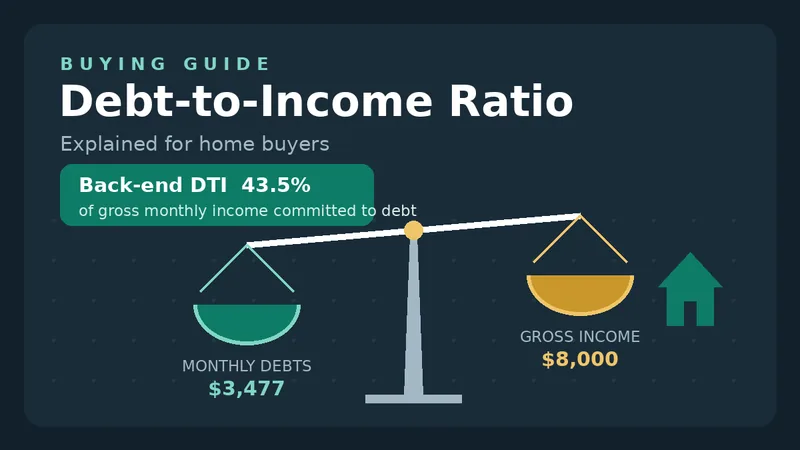
At 43.5% back-end, the couple fails the old 28/36 benchmark but passes comfortably under the50% ceiling Fannie Mae's Desktop Underwriter allowsfor conventional loans [Source:Fannie Mae Selling Guide B3-6-02]. Their result illustrates a key modern reality: the classic rule is a conservative household benchmark, not the legal limit.
Example 2 — Canadian buyer in Toronto: the GDS/TDS stress test
Priya earnsCAD $120,000annually ($10,000gross monthly) and is buying a CAD $700,000 condo with 20% down, financing $560,000 at 5.0% over 25 years. Canada measures affordability with two ratios directly analogous to front- and back-end DTI:GDS(gross debt service) capped at 39% andTDS(total debt service) capped at 44% for insured mortgages [Source:CMHC].
- Mortgage payment:$3,259/month
- Property taxes:$375/month
- Heating (required in GDS):$120/month
- Condo fees (50% counted):$250/month
GDS costs:3,259 + 375 + 120 + 250 =$4,004→ GDS = 4,004 ÷ 10,000 =40.0%— already above the 39% insured capbefore any other debt is added.
With a $480/month car loan, TDS = 4,484 ÷ 10,000 =44.8%— above the 44% TDS cap as well. Priya must also qualify at themortgage stress testrate (the higher of her contract rate plus 2%, or the regulator's floor) under thefederal minimum qualifying rate, which would push the ratios higher still. Her realistic paths to approval: a larger down payment, paying off the car loan first, or a lower purchase price. This example shows why Canadian buyers must model GDS and TDSbeforefalling in love with a property — the caps bite earlier than most expect.
Example 3 — UAE expat buyer in Dubai: the 50% DBR ceiling
Omar earnsAED 30,000per month and wants a mortgage with a proposed payment ofAED 11,500. His existing commitments: a car loan atAED 1,800/month and credit card minimums totallingAED 1,200(UAE banks typically count 5% of outstanding card limits). The UAE Central Bank caps thedebt burden ratio (DBR) at 50%of gross monthly income [Source:CBUAE Rulebook, Article 3].
Total obligations: 11,500 + 1,800 + 1,200 =AED 14,500. DBR = 14,500 ÷ 30,000 =48.3%— inside the 50% cap, but with only AED 500 of headroom. Any rate increase on a variable product, a new car lease, or extra card spending would breach the ceiling. Omar's practical move before applying: clear the card balances, cutting counted obligations by AED 1,200 and bringing DBR to a far safer 44.3%.
These scenarios are illustrative teaching examples with simplified figures, not quotations, pre-approvals, or personalised financial advice. Actual eligibility depends on your lender, loan product, credit history, and jurisdiction — verify your own numbers with a licensed mortgage professional.
Typical DTI Limits by Loan Type
Limits are not universal — they depend on the loan programme, the underwriting method, and the strength of the rest of your file. The table below summarises the most commonly referenced ceilings for US mortgage programmes, which anchor most global discussion of DTI. Automated underwriting (AUS) approvals can exceed manual ceilings when compensating factors are strong.
Table 2: Common DTI ceilings for major US mortgage programmes (verify current limits with your lender)
Manual underwriting typically caps at 36%, rising to 45% with strong credit and reserves [Source:
Up to 40% / 50% (manual) and ~57% with strong AUS findings
Higher caps require documented compensating factors such as reserves or minimal payment shock
Frequently exceeded with strong residual income
VA underwrites primarily on residual income; 41% is a benchmark, not a hard wall
Designed for eligible rural and suburban areas with income limits
Not agency-backed; pricing rises with risk and DTI
Two rules of thumb emerge from the data. First,the old 28/36 standard is a floor, not a ceiling: modern automated underwriting regularly approves back-end ratios in the 43–50% range for well-qualified borrowers. Second,approval at the ceiling is not the same as comfort at the ceiling— a 50% back-end DTI leaves half your gross income (and well over half your take-home pay after tax) committed before a single grocery is bought.
Healthy — comfortably inside standard limits
Stretched — needs strong compensating factors
Declined — reduce debt or income growth required
Tier-1 Market Nuances: How Five Systems Measure the Same Thing
Every major housing market answers the same question —can this borrower carry this debt?— but with different vocabulary, caps, and mechanics. If you are buying abroad, relocating, or comparing markets as an investor, the differences matter more than the similarities.
Table 3: Affordability frameworks across five Tier-1 markets (2026)
28/36 classic; up to 50% (conventional AUS), 31/43 standard FHA
Uses gross income; automated underwriting can stretch limits with compensating factors
Loan-to-income (LTI) + affordability assessment
Regulators limit the share of lending at or above 4.5× LTI; lenders run full income-and-expenditure models rather than a simple DTI [Source:
Heating and 50% of condo fees count in GDS; all borrowers face a federal stress test at the higher of contract +2% or the floor rate [Source:
Lenders must test repayment capacity at the loan rate plus a 3 percentage point buffer, maintained by APRA; some lenders cap DTI around 6× income internally [Source:
Central Bank caps total debt service at 50% of gross income; card limits (not just balances) can count at ~5% monthly [Source:
United Kingdom: income multiples instead of ratios
UK lenders rarely quote DTI. Instead they cap the loan at anincome multiple— historically around 4.5 times gross annual income — and simultaneously run an affordability model that deducts committed spending, dependants' costs, and stress-tested rates. The Bank of England's framework limits theshareof new lending at or above 4.5× LTI, a rule regulators have been reviewing with interim flexibility announced in 2025 [Source:Bank of England / PRA]. The practical effect mirrors back-end DTI: heavy existing commitments shrink what the affordability model will approve, even when the 4.5× headline multiple looks attainable.
Canada: the ratio pair with a stress-test twist
GDS and TDS map almost exactly onto front-end and back-end DTI, with two Canadian quirks: heating costs and half of condo fees enter GDS, and every borrower — insured or not — must qualify at thefederal minimum qualifying rate. A buyer whose TDS reads 41% at the contract rate may read 45% at the stress rate, so Canadian buyers should always compute both versions.
Australia: serviceability, not ratios
Australian lenders build a full household budget — verified income minus itemised living expenses minus stressed repayments — rather than applying a DTI cap. The binding constraint is APRA's3 percentage point serviceability buffer: a 6.0% mortgage is assessed as if it cost 9.0%. High existing debts reduce serviceable income just as they would under DTI, but the metric you will hear from a broker is "borrowing capacity," not a ratio.
UAE: one hard number
The UAE is the simplest system of the five: total monthly debt service — including the new mortgage and imputed credit card payments — may not exceed50% of gross monthly income, full stop. Maximum loan size is additionally bounded relative to annual income. For expat buyers, the key detail is that unused credit cardlimitscan inflate the counted obligations; closing or reducing unused cards before applying can move the DBR materially.
Lending rules change, and state, provincial, or lender-level overlays often sit on top of national frameworks. Treat every limit in this guide as a starting point and confirm the current rules with a licensed broker or lender in your specific market before making a purchase decision.
8 Proven Ways to Improve Your DTI Before Applying
DTI has only two moving parts — debt payments and income — so every improvement strategy attacks one or both. The levers below are ordered roughly by speed of impact. For a deeper look at how a smaller debt load changes your price ceiling, see our guide ondown payment requirementsand how deposit size interacts with qualification.
1. Pay off small instalment loans with few payments left
A personal loan at $190/month with seven payments remaining costs $1,330 to eliminate — and immediately removes $190 from your monthly obligations. On a $6,500 income, that alone cuts back-end DTI by roughly 2.9 points. Loans near maturity are the cheapest DTI reduction money can buy.
2. Pay down credit cards to shrink minimum payments
Most card issuers set the minimum as a percentage of the balance (often 1–3% plus interest). Halving a $6,000 balance can cut the counted minimum by $60–$120 per month. Even better: paying a card to zero removes the obligation entirely — and boosts your credit score at the same time.
3. Do not take on any new credit — including the car
A new $450 car payment on a $90,000 income consumes 6% of gross income, which at typical rates translates to roughly$40,000–$55,000 less mortgage. If a vehicle purchase can wait 6–12 months until after closing, let it wait. The same applies to furniture financing and buy-now-pay-later plans opened during the purchase window.
4. Document every income source the lender can count
Buyers routinely under-report countable income: a two-year bonus history, documented overtime, long-standing part-time work, rental income, or pension income. Gather the evidence early — two years of history is the usual bar — because an extra $400 of verifiable monthly income can offset roughly $180 of debt payments at a 45% cap.
5. Add a co-borrower with low debts
Combining incomes with a spouse, partner, or eligible co-buyer often improves the ratio dramatically — provided their debts are modest. Run the numbers both ways first: a co-borrower earning $3,000/month with a $600 car payment mayworsenyour combined DTI rather than improve it.
6. Refinance or restructure expensive debts
Consolidating card balances into a fixed instalment loan can lower the counted monthly obligation (and the interest cost). Federal student loan borrowers in the US may reduce counted payments via income-driven repayment plans. Caution: consolidation resets timelines and sometimes fees — and new credit enquiries can temporarily dent your score — so sequence this well before application, ideally 3–6 months ahead.
7. Target the housing payment, not just the debts
A cheaper home, a larger down payment (see ourdown payment guide), or a longer amortisation all shrink the proposed payment directly. Dropping the target price by $25,000 at 6.5% trims roughly $158 from the monthly payment — often the single most powerful DTI lever available, because it also reduces property taxes and insurance proportionally.
8. Time your application to your credit report
Payoffs only help once theyreport. Card balances typically update monthly; instalment payoffs can take 30–60 days to show as closed. Build a 60-day buffer between your debt-clearing sprint and the mortgage application, and re-pull your reports to confirm the obligations have disappeared before the lender does.
Common Mistakes and Myths About DTI
Misconceptions about DTI cost buyers time, money, and occasionally the house itself. These are the errors that recur most often in practice.
Myth 1: "My rent counts against me"
It does not. Rent is not a debt obligation, so it never appears in DTI. In fact, a renter paying $2,400/month can have a lower DTI than an owner paying $1,800/month, because the owner's housing cost counts while the renter's does not — until the renter applies for a mortgage, at which point theproposedpayment enters the calculation.
Myth 2: "Lenders use my take-home pay"
In the US, Canada, and the UAE, ratios are computed againstgross(pre-tax) income. This flatters the ratio relative to your actual budget — a 36% back-end DTI on gross income can feel like 50%+ of net pay in a high-tax jurisdiction. Always run a personal affordability check on net income as well; the lender's ceiling is not a household budget recommendation.
Myth 3: "Paying my cards in full every month means they don't count"
Half true. If your credit report shows balances being paid in full with no minimum due, many lenders will exclude them — but if any minimum payment appears, or if balances report mid-cycle, the minimum may be counted. In the UAE, cardlimitscan count regardless of usage. The safe practice: keep reported balances low in the two statement cycles before applying.
Mistake 4: Forgetting co-signed loans
Co-signing a relative's car loan makes that paymentyourobligation in the eyes of every lender, even if you have never made a single payment on it. Some programmes will exclude co-signed debt with 12 months of documented payments by the primary borrower — but you must prove it, with statements, in advance.
Mistake 5: Optimising for the cap instead of the buffer
Buyers who engineer their finances to land at exactly 49.9% leave zero margin for the surprises that routinely arrive between offer and closing: a revised insurance quote, a small rate drift, a property tax reassessment. Target at least three to five points of headroom below the applicable cap.
Mistake 6: Taking on "small" credit during the purchase window
A $90/month furniture plan feels trivial, but between pre-approval and closing it changes your ratios, adds a hard enquiry, and can force a re-underwrite. Lenders re-verify before funding. The rule from offer to keys:no new credit, no new debts, no large unexplained transfers.
Mistake 7: Confusing qualification with affordability
A lender's maximum is a risk ceiling fortheirportfolio, not a spending target for your life. The gap between "what the bank will approve" and "what lets you sleep at night" is exactly where the house-poor phenomenon lives. Use the approved maximum as a boundary, then set your own budget inside it — ouraffordability frameworkshows how to layer the two.
How DTI Connects to the Rest of Your Property Numbers
DTI never operates alone. It sits in a web of related metrics, and changing one moves the others. Understanding the connections turns a single number into a complete decision framework.
DTI and loan-to-value (LTV)
LTV measures the loan against the property value; DTI measures the payment against your income. Together they are the two pillars of underwriting. A larger down payment lowers both simultaneously — cutting LTV (better pricing, possibly no mortgage insurance) and cutting the payment (better DTI). This is why deposit strategy and DTI strategy should be planned together, as covered in ourguide to how much down payment buyers actually need.
DTI and the 28/36 rule
The28/36 housing cost ruleis simply DTI expressed as household wisdom: housing at or under 28% of gross income, total debt at or under 36%. Modern underwriting permits more, but the rule survives because households that respect it rarely end up house-poor. Treat it as your personal policy even when the lender's policy is looser.
DTI and the mortgage payment itself
Your DTI is only as accurate as the payment estimate inside it. Amortisation maths — how rate, term, and principal combine into a monthly figure — drives everything. If you want to compute payments by hand or verify a lender's quote, follow our step-by-step guide tocalculating mortgage payments.
DTI for investors: where it meets rental yield and cash flow
For buy-to-let and investment purchases, DTI works differently. Many investment lenders underwrite theproperty'scash flow (via a debt-service-coverage ratio) rather than the borrower's personal DTI, though personal DTI still gates conventional investor loans in most markets. Expected rental income typically counts at a 25% discount when it does enter your ratios. Investors should model both lenses: personal DTI for the application, and property-level yield and cash flow for the investment case — keeping in mind that leverage magnifies both capital growth and downside, and no return is guaranteed.
DTI and ownership structure
Recurring property charges feed directly into front-end ratios, so the type of ownership matters. A UK leasehold flat with ground rent and service charges, for example, carries monthly obligations a freehold house does not — obligations lenders count. Our explainer onUK leasehold vs freeholddetails exactly which costs to expect from each structure.
Run Your Own Numbers with Free Calculators
Reading about DTI is useful; measuring yours is decisive. LashkariProperties publishes a set of free, no-sign-up calculators designed for exactly this moment in the buying journey, and three of them map directly onto everything in this guide:
- DTI Calculator— enter your gross income and monthly obligations to get your front-end and back-end ratios instantly, see which side of the common limits you fall on, and test "what-if" payoffs before you commit to them.
- Home Affordability Calculator— works backwards from your income, debts, and deposit to a realistic maximum home price and monthly payment, so you shop inside your true ceiling from day one.
- Loan Eligibility Calculator— a pre-flight check that estimates how a lender is likely to read your file across DTI, income, and deposit, flagging the constraint most likely to block approval.
A practical workflow: start with theDTI calculatorto establish your baseline, use the payoff scenarios from Section 8 to model improvements, then confirm the resulting price ceiling in theaffordability calculator. Finally, run theeligibility checkbefore you pay for valuations or inspections — it is far cheaper to discover a constraint on a calculator than at the underwriting desk.
Check your DTI in under a minute
Free, private, and no sign-up required. See both ratios, compare them against typical limits, and model the payoff moves that would improve them.
Your Pre-Application DTI Checklist
Work through this list in the 60–90 days before you apply. Each item either improves your ratio or prevents an avoidable surprise during underwriting.
- Compute your baseline.Gross monthly income confirmed; every recurring debt listed from credit reports, not memory; front-end and back-end ratios calculated (or checked on theDTI calculator).
- Identify your binding constraint.Which ratio is closer to its cap — housing or total debt? That determines whether to attack debts, price, or deposit.
- Kill the cheap wins.Pay off instalment loans with few payments left; clear or heavily pay down card balances; document every countable income source.
- Freeze new credit.No car finance, no BNPL, no new cards from now until after closing — and co-signed obligations addressed or documented.
- Stress-test the payment.Re-run your ratios at a rate 1–2 points higher (mandatory in Canada and Australia; wise everywhere) and confirm you still pass with headroom.
- Set a personal ceiling below the lender's.Choose a target DTI — many households pick 36% back-end — and translate it into a maximum price with theaffordability calculator.
- Let the report catch up.Wait 30–60 days after payoffs, re-pull your credit reports, and verify cleared debts show as closed before applying.
- Confirm current local rules.Limits, stress tests, and overlays change; verify with a licensed broker or lender in your market, and keep this guide's numbers as orientation rather than gospel.
Frequently Asked Questions About DTI for Home Buyers
What is a good debt-to-income ratio for buying a house?
Most lenders consider a back-end DTI at or below 36% healthy, and under 28% excellent. In the US, automated underwriting can approve conventional loans up to 50% and FHA loans higher still with strong compensating factors — but lower ratios generally mean better pricing, more lender choice, and a more comfortable budget after closing.
How do I calculate my debt-to-income ratio?
Add all recurring monthly debt payments — minimum card payments, car and student loans, plus your future housing payment — divide by gross monthly income before tax, and multiply by 100. Example: $2,300 of monthly debts ÷ $7,500 gross income = 30.7% DTI. Thefree DTI calculatordoes this instantly.
No. Rent is not a debt obligation, so it is excluded. However, the mortgage payment you are applying for — principal, interest, taxes, and insurance — is counted in both front-end and back-end ratios when the lender assesses your application.
Does DTI include utilities, groceries, or insurance?
No. DTI counts only recurring debt obligations: loan instalments, minimum card payments, car finance, and court-ordered support. Living costs are excluded from DTI itself, although UK, Canadian, and Australian lenders assess them separately in affordability and serviceability models.
What is the difference between front-end and back-end DTI?
Front-end DTI (the housing ratio) is your total monthly housing cost ÷ gross monthly income. Back-end DTI is all monthly debt payments, including housing, ÷ gross monthly income. Lenders quote them as a pair — for example 28/36 — and both must pass.
What DTI do I need for a mortgage in the US, UK, Canada, Australia, or UAE?
US: conventional up to 50% via automated underwriting; FHA standard 31/43 with higher limits possible. UK: no DTI cap, but borrowing is typically limited to around 4.5× income with affordability stress tests. Canada: 39% GDS / 44% TDS for insured loans. Australia: no fixed cap, but a 3-point serviceability buffer applies. UAE: total debt burden capped at 50% by the Central Bank. Always confirm current rules locally.
Sometimes. Fannie Mae's Desktop Underwriter can approve up to 50% for borrowers with strong credit and reserves, and the UAE caps its debt burden ratio at exactly 50%. Approval at the ceiling is possible but brings tighter scrutiny, fewer product options, and very little monthly budget flexibility.
How can I lower my DTI quickly before applying?
The fastest levers: pay off small instalment loans with only a few payments left, pay down card balances to shrink minimums, avoid all new credit, document every eligible income source, and consider a low-debt co-borrower. Allow 30–60 days for payoffs to appear on credit reports before you apply.
Does a car loan affect my mortgage eligibility?
Yes — significantly. A car payment counts in full toward back-end DTI. On a $90,000 income, a $450 monthly payment consumes about 6% of gross income and can reduce your maximum mortgage by roughly $40,000–$55,000 depending on rates. Clearing or avoiding car finance before applying is one of the highest-impact moves available.
Do lenders use gross or net income for DTI?
In the US, Canada, and the UAE, ratios use gross (pre-tax) income. UK and Australian lenders use full affordability or serviceability models instead of a simple ratio. Because gross income flatters the ratio, always sanity-check the payment against your actual take-home pay too.
Does DTI affect my mortgage interest rate?
Mostly indirectly. DTI is rarely a standalone pricing adjustment like credit score or LTV, but a high DTI can exclude you from the best-priced products and shrinks the pool of willing lenders. A lower ratio typically means more competitive offers.
Is rent-to-income the same as debt-to-income ratio?
No. Rent-to-income compares your current rent with your income and is used by landlords when screening tenants. DTI measures recurring debt obligations against income and is used by mortgage lenders. Your current rent does not appear in DTI — but your future housing payment does.
Conclusion: Make DTI Work for You Before It Works Against You
The debt-to-income ratio will not appear on any property listing, but it shapes every purchase you will ever finance. Now you know what most buyers learn too late: that DTI comes in two parts — the front-end housing ratio and the back-end total-debt ratio; that every Tier-1 market enforces some version of it, from the US's 50% automated-underwriting ceiling to Canada's 39/44 GDS/TDS pair, Australia's 3-point buffer, the UK's income-multiple framework, and the UAE's hard 50% DBR cap; and that the ratio isimprovable, often within a single quarter, through targeted payoffs, income documentation, and disciplined timing.
Your next step takes less than a minute: measure your own ratios on the freeLashkariProperties DTI calculator, then translate the result into a real price ceiling with thehome affordability calculatorand stress-test your file with theloan eligibility calculator. If the numbers need work, the checklist above gives you a 90-day plan. And when you are ready to go deeper, continue with our guides onhow much house you can affordandthe 28/36 housing cost rule— the natural companions to everything in this article.
Related Guides and Tools
How Much House Can I Afford? A Practical Numbers Framework
Turn income, debts, and deposit into a realistic price ceiling before you shop.
How to Calculate Mortgage Payments Step by Step
The amortisation maths behind every payment estimate in this guide.
Is a 20% Down Payment Required? What Buyers Actually Need
How deposit size interacts with DTI, pricing, and mortgage insurance.
The 28/36 Housing Cost Rule: Useful Benchmark or Outdated Myth?
Where the classic DTI benchmark still holds — and where modern underwriting moves past it.
UK Leasehold vs Freehold: What Buyers Must Know
Ownership structures and the recurring charges that feed your front-end ratio.
DTI, affordability, eligibility, mortgage, and rental yield tools — free, no sign-up.
Sources and Further Reading
- Fannie Mae,Selling Guide B3-6-02: Debt-to-Income Ratios—selling-guide.fanniemae.com
- Consumer Financial Protection Bureau,Debt-to-income calculator and mortgage guidance—consumerfinance.gov
- CMHC,Calculating GDS / TDS for Mortgage Loan Insurance—cmhc-schl.gc.ca
- Financial Consumer Agency of Canada,Mortgages and the minimum qualifying rate—canada.ca
- Financial Conduct Authority,FG17/2: The FPC's recommendation on loan to income ratios—fca.org.uk
- Bank of England / PRA,Review of the LTI flow limit rule—bankofengland.co.uk
- APRA,Update on macroprudential settings (serviceability buffer)—apra.gov.au
- Central Bank of the UAE,Rulebook — Article 3: Important Ratios (DBR)—rulebook.centralbank.ae
This guide is reviewed and updated periodically to reflect current lending rules across the markets covered.Last updated:5 August 2026.It is educational content, not personalised financial, tax, or legal advice; lending criteria vary by country, state, lender, and individual circumstances. Always verify figures with a licensed mortgage professional before making a purchase decision.
About the author — Maya Ellison
Maya is Senior Editor for Property Finance atLashkariProperties, where she writes buying guides that turn mortgage maths into plain-English decisions. Her work covers affordability frameworks, deposit strategy, and cross-border lending rules across the US, UK, Canada, Australia, and the UAE.
Reviewed by the LashkariProperties editorial team. Questions or corrections? Reach us viathe blog.
Tools mentioned in this article
Mortgage Calculator
Estimate monthly mortgage payments, total interest, and payoff based on price, down payment, rate, and term.
Debt-to-Income Ratio Calculator
Measure your front-end and back-end debt-to-income ratios the way lenders do.
Stamp Duty & Transfer Tax Calculator
Estimate property transfer tax or stamp duty using banded rates for major markets.
Related reading
- How Much House Can I Afford? A Practical Numbers Framework
Calculate a sustainable home-buying budget using income, debts, rates, down payment, total housing costs and realistic stress tests.
- Are Extra Mortgage Payments Worth It? Interest Savings Math
Are extra mortgage payments worth it? See the interest-savings math behind biweekly, extra-monthly and lump-sum prepayments, plus when investing wins instead — with worked examples for US, UK, Canada, Australia and UAE b
- Closing Costs Explained: What Home Buyers Actually Pay
Closing costs surprise most first-time buyers. Learn exactly which fees you pay at closing, who covers what, how to estimate cash to close, and how to compare offers across the US, UK, Canada, Australia and UAE.