
Buying Guides
The 28/36 Housing Cost Rule: Useful Benchmark or Outdated Myth?
By LashkariProperties Team · August 5, 2026 · 32 min read

The rule in one paragraph — and why we're still arguing about it in 2026
The28/36 housing cost rulesays that a household should spend no more than28% of gross monthly income on housingand no more than36% on all debt combined, housing included. It was popularised in the United States when 30-year fixed mortgages were priced in the mid-to-high single digits and Fannie Mae was standardising underwriting for the secondary market. Nearly half a century later, the numbers keep reappearing in home-buying articles, on bank websites, in personal finance books and inside AI-generated buying guides — often with no discussion of whether they still fit reality.
That reality has shifted. According to Freddie Mac's Primary Mortgage Market Survey, the average US 30-year fixed rate stood at6.66% at the end of July 2026, up from a pandemic-era low near 2.65% — a level unseen since the early 1990s. In the UK, the Bank of England's Financial Policy Committee spent the first half of 2026consulting on whether to soften its 15% flow limiton high loan-to-income mortgages. In Australia, APRAreaffirmed the 3-percentage-point serviceability bufferthat squeezes borrowing capacity even when advertised rates fall. And in Toronto and Sydney, benchmark home prices sit near CA$941,000 and A$1.3 million respectively — putting the 28% ceiling out of reach for many first-time buyers even on a strong dual income.
So the honest answer to the headline question is:both. The specific numbers are dated. The framework — separating housing costs from total debt and comparing both to gross income — is one of the cleanest personal budgeting tests available and is worth running before every purchase. If you'd rather skip the math, LashkariProperties' freeHousing Cost Calculatorwill produce the same answer in about 90 seconds. This guide explains how to run the test yourself, what to change for today's market, and how to combine 28/36 with three other metrics so you don't over-rely on any single number.
Key definitions and formulas
Before we can debate whether the rule works, we need to agree on what it actually measures. There are only three inputs — but each of them is a common failure point.
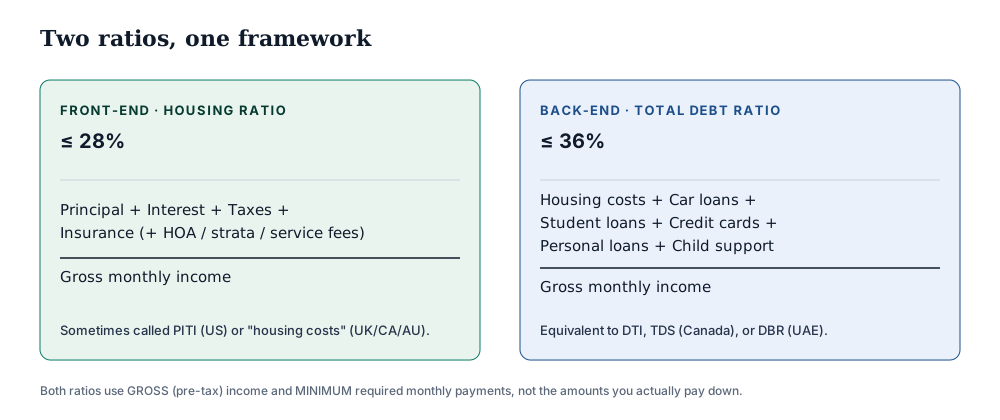
1. Front-end ratio (housing ratio) ≤ 28%
= (Principal + Interest + Property Tax + Insurance + HOA / strata / service charge) ÷ Gross monthly income
In the US this is often abbreviatedPITI. In the UK a lender may talk about "monthly housing costs" — mortgage payment plus ground rent, service charge and buildings insurance. In Canada, it maps to theGross Debt Service (GDS)ratio, which also adds 50% of condominium fees and, for detached homes, an estimate of heating costs. In Australia the equivalent is themortgage repayment share of income, and in the UAE the housing-only view is folded into the broader Debt Burden Ratio.
2. Back-end ratio (total debt ratio) ≤ 36%
= (Housing costs + Auto loan + Student loan + Credit card minimums + Personal loan + Court-ordered support) ÷ Gross monthly income
The back-end ratio is the direct sibling of the term you see most often today:debt-to-income (DTI). When Fannie Mae, HUD or a UK broker quotes "DTI", they usually mean this back-end figure. Note the two words that trip up most first-time buyers:
- Minimummonthly payments — not what you voluntarily pay down each month. If your credit card statement says a $45 minimum on a $5,000 balance, use $45.
- Grossincome — pre-tax. This makes the rule feel more generous than a net-income version, and it's an argument for running your own tighter personal test alongside the lender view.
Quick reference
Take your annual household income, divide by 12, then multiply by 0.28 and 0.36. Those two numbers are your rule-of-thumb monthly ceilings. Everything else in this guide is nuance aroundwhenthose two numbers still make sense.
3. What's in "housing costs"
Every buyer we speak to at LashkariProperties underestimates at least one line here. A complete housing-cost stack usually contains:
- Mortgage principal & interest at the actual quoted rate
- Property tax, council tax or municipal rates
- Buildings and hazard insurance (compulsory in most markets)
- Mortgage insurance where LTV exceeds a threshold — PMI (US), LMI (Australia), CMHC premium (Canada) or the equivalent in the UK
- HOA, condo, strata or service charge — a huge and rising line for apartment owners in cities such as Dubai, Toronto and London
- Ground rent or leasehold service charge (common in England and Wales)
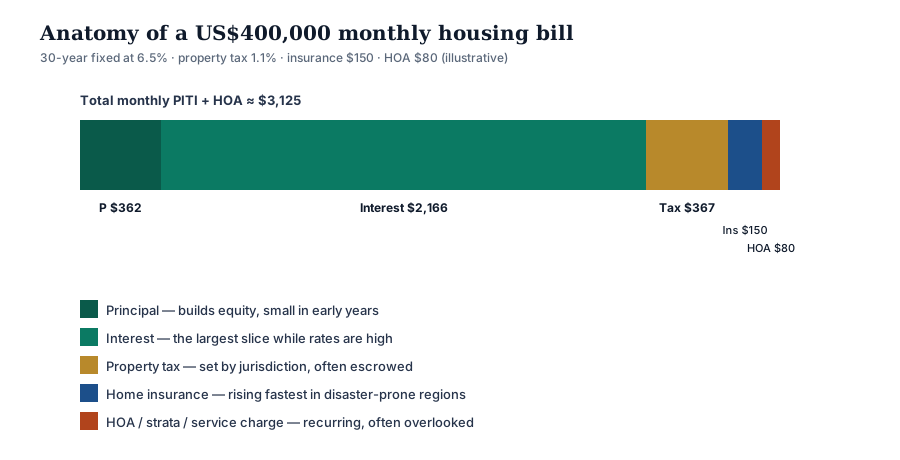
Where the 28/36 rule actually came from
The rule did not descend from the mountain fully formed. It is the codified output of decades of American secondary-market underwriting. When the Federal National Mortgage Association (Fannie Mae) began buying conventional mortgages from originators, it needed a consistent framework to price and pool loan risk. Two housing-affordability ratios — one for the mortgage alone, one for total debt — were the cleanest way to compare borrowers of very different profiles. Fannie Mae's current selling guide still cites the same structure, noting that itsmaximum standard total DTI is 36% of stable monthly income, with room to stretch to 45-50% when compensating factors are present. That baseline is what earlier generations of loan officers turned into the memorable "28/36".
The 28% front-end ceiling reflects a specific historical moment: property taxes and insurance were smaller shares of housing cost, homeowners insurance was inexpensive, and default modelling suggested that above 28% of gross income the probability of missed payments climbed sharply. FHA loans came in with looser numbers (traditionally 31/43), VA loans focused on residual income rather than pure ratios, and the mortgage insurers overlaid their own thresholds. But the underlying two-ratio idea remained the common language of underwriting.
Personal-finance authors then popularised the same numbers as a household budgeting tool — separating the lender question (will I be approved?) from the borrower question (should I be approved?). That is the version most buyers meet first, and it's why we still talk about the rule outside of any single country's lending system.
Three eras that shaped the rule
The 28/36 rule did not stay static. In three distinct waves it was tightened, loosened and then quietly recalibrated by the market itself:
- 1970s–1980s foundation.Savings-and-loan associations, thrifts and early Fannie Mae buyers standardised the two-ratio structure. Rates ran between 8% and 18%, which meant even conservative borrowers regularly bumped into the ceilings — the rule was built to be binding, not aspirational.
- 1990s–2000s expansion.Automated underwriting engines (Fannie Mae's Desktop Underwriter arrived in 1995, Freddie Mac's Loan Prospector shortly after) began to substitute a multivariate risk score for a rigid ratio. Lenders discovered they could safely lend to borrowers well above 36% back-end if credit score, reserves and LTV compensated. By the mid-2000s, some conventional loans reached 55% back-end without triggering an obvious red flag.
- Post-2008 recalibration.The financial crisis and the subsequent Ability-to-Repay rule under Dodd-Frank forced lenders to document affordability more rigorously. The 43% Qualified Mortgage (QM) DTI ceiling replaced the more generous stretches — until the CFPB moved to a price-based QM definition in 2021 that de-emphasised the ratio itself. The 28/36 numbers, meanwhile, stayed alive as a personal benchmark long after they stopped being a hard lender rule.
"The 28/36 rule is really two rules pretending to be one — an underwriting benchmark and a household budgeting heuristic. Confusing them is where most homebuyers get into trouble."
Why this metric still matters for buyers, investors and landlords
For first-time buyers
Most first-time buyers dramatically overestimate what they can comfortably carry. Lenders will typically approve loans that push back-end DTI into the 45-50% range for a strong credit profile. That is not the same as saying youshouldtake that loan. The 28/36 rule is a personal sanity check that survives long after your mortgage broker's spreadsheet has been closed. It exists precisely to stopapprovalfrom becoming your definition ofaffordable.
For investors
Investors use 28/36 differently. Your primary residence still counts against your personal DTI, but rental income from an investment property will partially offset the new mortgage in the lender's calculation. In most Tier-1 markets the offset is between 65% and 75% of expected rent — an allowance for vacancy and maintenance. Once you're past two or three properties, banks shift to Debt Service Coverage Ratio (DSCR) and stop leaning on personal DTI at all. For solo investors, 28/36 is still a usefulceiling on lifestyle spendthat protects your cash-out capacity for future deals.
For landlords tracking cash flow
If you're already an owner-occupier considering a buy-to-let, the 28/36 rule can help you set a maximum extra debt you're willing to add before you compromise your primary residence's cushion. Combined with a 1% rule test on the target property and a stressed cash-flow model, it forces you to answer, in advance:at what mortgage rate does this deal stop working?
For renters deciding whether to buy
Rent-vs-buy analyses often stall because renters don't know what "affordable" looks like from a lender's perspective. Running the 28/36 numbers alongside arent vs buy decision frameworkgives you a concrete borrowing envelope, which is the input you need for any serious model.
For dual-income households vs. single earners
The rule is neutral about how many earners contribute to the gross income figure — but the risk it hides is not. A single earner blowing through 30% front-end has one income event to protect. A dual-earner household inside 28% may have two smaller income events that can compound: one partner's job loss combined with a temporary rate reset can force a sale that a single earner might have anticipated and prepared for. This is why many financial planners advise dual-income households to keep the front-end closer to 25% and to maintain six to nine months of PITI reserves rather than the standard three.
For borrowers with irregular or self-employed income
Freelancers, commission-based sales professionals and business owners face a different problem: lenders average two years of tax-return income while the borrower knows their pipeline is much larger. The 28/36 rule should be applied to the two-year average, not to the peak year. If your income variance is above ±30%, run a second stressed test at 80% of the two-year average as your personal red line — that is closer to what a lender will actually credit you with.
Step-by-step: how to actually apply the rule in 2026
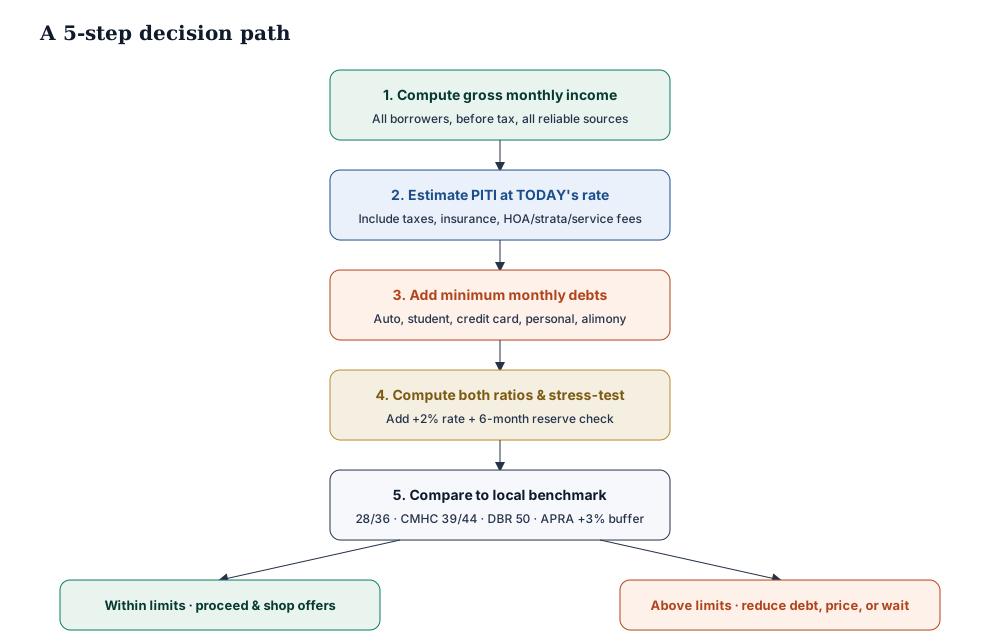
Step 1 — Compute gross monthly income accurately
Add together every reliable pre-tax income source for every borrower on the loan. Salary, guaranteed bonus, self-employment income averaged over two years, rental income from other properties, verifiable pension and annuity income, and legally documented alimony or child support you receive. Divide any annual figure by 12 to get the monthly base.
Donotcount irregular tips you can't document, expected raises, or income from a co-borrower who won't be on the mortgage. Lenders won't; neither should you.
Step 2 — Estimate PITI at today's rate
Get a realistic rate quote — Freddie Mac's weekly PMMS is a good US anchor, the Bank of England publishes UK effective rates, the Reserve Bank of Australia publishes indicator lending rates, and the CBUAE publishes weighted average mortgage rates. Then use a mortgage payment formula:
− 1 ] where P = principal, r = monthly rate (annual ÷ 12), n = total months
Or skip the formula and use the LashkariPropertiesHousing Cost Calculator— it wraps principal, interest, taxes, insurance and HOA into a single monthly figure.
Step 3 — Add every minimum monthly debt
Pull your credit report and listminimumrequired payments for every open trade line. Ignore the balances — the ratio only cares about the payment amount. Add court-ordered obligations even if they don't appear on your credit report.
Step 4 — Compute both ratios
Divide housing costs by gross income to get your front-end. Divide total monthly debt by gross income to get your back-end. Cross-check both against the 0.28 and 0.36 targets.
Step 5 — Stress-test
Re-run the calculation with the mortgage rate two full percentage points higher. If your front-end blows through 33% or your back-end climbs above 43% in that scenario, treat it as a red flag. This is essentially the logic behind Canada's federal mortgage stress test and Australia's APRA serviceability buffer — both of which use a similar shock size.
Best practice · use the calculator, not the phone calculator
PITI math is not hard, but small compounding errors add up. Our freeHousing Cost Calculatorhandles the amortization formula, adds tax and insurance, and outputs both the 28% and 36% ratios in a single view. Use it as your source of truth, then keep the phone calculator for quick sanity checks.
Three worked examples at 2026 rates
Numbers make the rule concrete. Each example below uses conservative real-world inputs and a mortgage rate close to today's market averages. All figures are illustrative only.
Example 1 · US dual-income first-time buyer
Setup:combined gross income US$120,000 (US$10,000/month). Existing debts: US$450 auto payment, US$200 student loan minimum, US$50 credit card minimum. Looking at a US$450,000 home with 10% down (US$405,000 loan) in a 1.1% property-tax jurisdiction. Rate: 6.66% (Freddie Mac PMMS late-July 2026). Insurance: US$150/month. PMI: US$140/month. No HOA.
Principal & interest (US$405,000 at 6.66%, 30 yr)
Ratios:front-end = 3,308 ÷ 10,000 =33.1%(above 28%). Back-end = 4,008 ÷ 10,000 =40.1%(above 36%). A traditional 28/36 lens says this purchase is a stretch. Most US lenders would still approve it — Fannie Mae will go to 45-50% back-end with good credit — but the household would be running with less buffer than the classic rule allows. The realistic options: increase the down payment to remove PMI and drop principal, or step down to a US$400,000 home.
Example 2 · UK single-income buyer, London commuter belt
Setup:gross salary £72,000 (£6,000/month). Debts: £250 car finance, £0 credit card. Buying a £340,000 flat with 15% deposit (£289,000 loan) at a 4.85% five-year fix — close to average UK rates in mid-2026. Buildings insurance £30/month. Service charge £180/month. Council tax £180/month (Band D typical for outer London).
Principal & interest (£289,000 at 4.85%, 25 yr)
Ratios:front-end = 2,062 ÷ 6,000 =34.4%. Back-end = 2,312 ÷ 6,000 =38.5%. Both are above the classic ceilings. However, the UK loan-to-income multiple is 289,000 ÷ 72,000 =4.01×, comfortably inside the standard 4.5× cap. A UK lender will typically approve this borrower; a personal 28/36 lens says the buffer is thinner than it feels and future rate resets should be modelled carefully.
Example 3 · UAE expat buyer in Dubai
Setup:gross monthly income AED 40,000 (~US$10,890). Existing debt: AED 1,200 car loan, AED 400 credit card minimums. Purchasing an AED 1.8 million apartment in Dubai Marina with 20% down (AED 1.44 million loan) at 4.5% over 25 years (mortgage rates in the UAE tracked between 4-5% in mid-2026). Service charge AED 20/sq ft on a 900 sq ft flat = AED 1,500/month. Insurance AED 200/month.
Principal & interest (AED 1.44M at 4.5%, 25 yr)
Ratios:front-end = 9,706 ÷ 40,000 =24.3%. Back-end = 11,306 ÷ 40,000 =28.3%. Both sit inside the classic 28/36 ruleandcomfortably below the CBUAE's 50% DBR cap. This is a healthy purchase profile — provided the borrower keeps a reserve equivalent to at least six monthly payments and understands that expat resale liquidity and end-of-service benefit changes can materially shift the picture.
Not personalised advice
These examples use simplified inputs. Property taxes, insurance costs, service charges and lender fees vary by jurisdiction and by property. Always verify a specific purchase with a locally qualified mortgage adviser and a tax professional.
The missing third number: reserves
The classic rule has two variables. In practice, a third is almost as important:cash reserves measured in months of housing cost. Two households at identical 28/36 ratios have completely different resilience if one has one month of PITI in savings and the other has nine.
A useful heuristic:28/36/6. Keep housing at or below 28%, total debt at or below 36%, and liquid reserves of at least six months of PITI on top of your down payment. In markets with variable-rate mortgages or aggressive property tax escalation (California under Mello-Roos, Australian variable-rate portfolios, UAE service-charge revisions), consider stretching the reserves target to nine or twelve months and pulling the front-end ceiling back toward 25%.
Reserves also decouple you from the two most common forced-sale triggers: temporary income disruption and unexpected repair events. Data from CoreLogic and equivalent country-level distress-sale trackers consistently show that homeowners who lose their homes to foreclosure or forced sale typically had adequate income-based ratios but zero liquid buffer. The 28/36 rule cannot see that risk. The reserves check can.
The three-question sanity test
Before every purchase, answer three questions in writing: (1) What is my front-end ratio at today's rate? (2) What is my back-end ratio? (3) How many months of PITI do I have in fully liquid savingsafterclosing costs and moving costs? If the answers are not ≤28%, ≤36% and ≥6, be honest about which one you are choosing to compromise — and why.
Tier-1 market nuances: five countries, five different ceilings
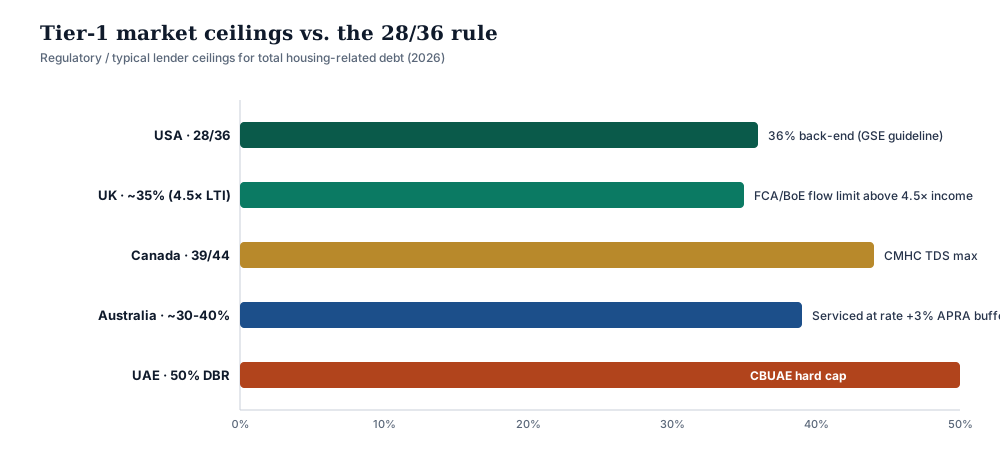
Fannie Mae's stated maximum total DTI is 36%, with allowance up to 45% (or 50% with automated underwriting and strong compensating factors), per its selling guide. FHA loans use a looser 31/43 baseline. VA underwriters emphasiseresidual income— the amount left after debt and taxes — over a rigid ratio. In 2026, with the 30-year fixed averaging 6.66% (Freddie Mac PMMS) and median existing-home price near US$440,600 (NAR), the classic 28% front-end has become genuinely hard for buyers earning under six figures, especially in high-tax coastal states.
The UK does not officially use "28/36". Its practical ceiling is theloan-to-income multiple— a household can generally borrow up to 4.5× annual income, with the Bank of England limiting industry-wide flow of loans above that ratio to 15% of new lending. On typical rates and 25-year terms, 4.5× LTI translates to a housing-cost share near 30-35% of gross income for many buyers. NatWest and a handful of specialist lenders have pushed to 6.5× for high-earning joint applications, and the FPC's 2026 consultation flagged possible easing to expand first-time-buyer access.
Canada
Canada uses two ratios directly comparable to 28/36:Gross Debt Service (GDS)andTotal Debt Service (TDS). CMHC-insured mortgages allow up to39% GDS and 44% TDS. Federally regulated lenders also apply the mortgage stress test — you must qualify at the greater of your contract rate + 2% or 5.25%. With the GTA benchmark near CA$941,000 in mid-2026, GDS above 30% is now typical for entry-level buyers, and CMHC insurance is a common necessity below 20% down.
Australia
Australia does not codify 28/36 explicitly. Instead, APRArequires ADIs to assess serviceability at the contract rate plus a 3 percentage-point buffer. On a 6% variable, banks calculate whether you can service the loan at 9% — dramatically compressing the amount you can borrow. Non-bank lenders sometimes use a 200 bp buffer instead. With Sydney median dwelling values around A$1.28 million in mid-2026, back-end ratios above 40% are common even for qualified borrowers, and lenders lean heavily on HEM (Household Expenditure Measure) benchmarks alongside DTI.
The Central Bank of the UAE caps theDebt Burden Ratio at 50%of gross monthly income for salaried residents, with a stricter 30% cap for pensioners. That is materially more generous than 36%. But mortgageLTVis separately restricted: first UAE-national buyer typically 85%, first expatriate buyer 80% on properties under AED 5 million and 65% above, with lower caps for second properties. Practical outcome: DBR is rarely the binding constraint for a Dubai expat mortgage; the down-payment requirement usually is.
Comparison of housing affordability ceilings across five Tier-1 markets, mid-2026
How modern rates change whether the rule still fits
The mathematical problem with the 28/36 rule at higher rates is straightforward: the housing ceiling is a share of income, but the mortgage payment behind it is dominated by interest, and interest is a share of the loan principal at whatever rate the market sets. When rates double, the principal that fits inside the same 28% envelope roughly falls by a third.
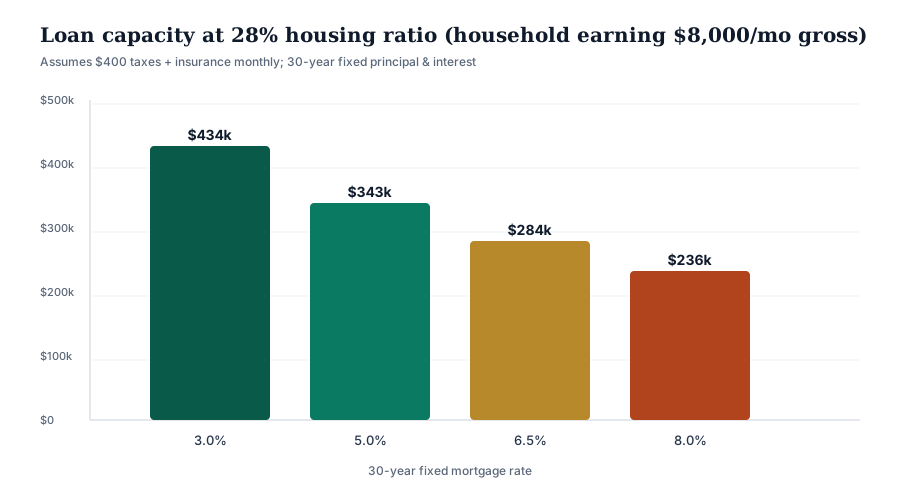
A household earning US$8,000 gross per month can carry a US$2,240 housing payment under the 28% rule. Assuming US$400 of that goes to property tax and insurance, the mortgage payment ceiling is US$1,840. At 3.0% on a 30-year term, that supports roughly US$434,000 of loan principal. At 6.5% — the neighbourhood of mid-2026 rates — the same US$1,840 supports only about US$284,000. At 8%, the loan capacity drops to around US$236,000 — a 46% cut in nominal buying power for identical income.
Three practical implications:
- Fixed-rate stability matters more when rates are elevated.A US 30-year fixed removes rate risk you cannot easily hedge; UK five-year fixes lock in the payment through the near-term policy cycle. Both are worth paying a premium for.
- Down payment size becomes the dominant lever.When you cannot force rates down, you can force principal down. Every US$10,000 of extra deposit at a 6.5% rate reduces the monthly payment by about US$63.
- The 28% target should scale to your income, not your ambition.Households earning well above their market's median have more room to breach 28% because their absolute discretionary income is larger. Households earning below the median almost never should.
Rate-shock risk isn't just an ARM problem
UK and Canadian mortgages typically reset every 2-5 years. Australian variable-rate loans reset with the RBA cash rate. Even without a floating structure, most non-US borrowers face rate reset within the life of any home purchase. Always run the 28/36 ratios twice: at today's rate and at today's rate + 2 percentage points.
How local rents change the answer
The 28/36 rule assumes that buying replaces renting one-for-one. In markets where rents have risen far faster than incomes, that assumption still holds — and the rule can actually be too conservative. In markets where rents remain well below the equivalent purchase payment, breaching 28% just to own is much harder to justify.
Consider three snapshots from mid-2026:
- London.The Office for National Statistics reported average UK rents rising 3.4% in the twelve months to March 2026, with Greater London asking rents near £2,716/month by year-end 2026 (Rightmove). A tenant paying that already commits a large slice of net income to housing; buying at 30-33% of gross may not be worse than staying rented for another five years.
- Toronto.One-bed rents in the GTA hover in the CA$2,300-2,500 range, while a benchmark condo purchase near CA$700,000 with 20% down at 5% rates produces a similar housing bill. The buy-versus-rent decision hinges more on price appreciation expectations than on the 28% ratio.
- Dubai.Rents have risen sharply through 2025-26, with some communities up 15-20% year-on-year (Bayut). Many long-standing tenants now pay more in rent than a comparable mortgage would cost, which is why UAE mortgage originations have accelerated even at 4-5% loan pricing.
The upshot: use the 28/36 rule to testwhether the debt is safe, not to testwhether renting is cheaper. Those are separate questions that need separate tools. Ourrent vs buy decision frameworkwalks through the second one in detail.
Adjusting the rule where rents are structurally high
Buyers in London, Vancouver, Sydney and Dubai often ask whether it is rational to accept a 30-32% front-end because rents in the same neighbourhood already consume 35%+ of gross income. The economic answer is a qualified yes — provided three conditions hold: the mortgage is fixed for at least five years, reserves cover at least six months of PITI plus one insurance renewal cycle, and the buyer has genuine long-term certainty about staying in the property (transaction costs of a forced sale within three years typically wipe out any rental savings). Without those conditions, staying rented at 35% is often lower risk than owning at 30%, even though the ratios suggest otherwise.
Why the same 36% back-end can be safe or dangerous
Two households can each land at exactly 36% back-end DTI and have wildly different risk profiles. The rule ignoresdurationandrate structureof the underlying debt, and that omission matters more today than it did in the 1970s.
Two 36% back-end households — same ratio, different risk
8% (long-tenure student loan at low fixed rate)
Low. Long-duration, fixed-cost debt. Payments predictable for years.
High. Both housing and non-housing exposure to near-term rate resets or minimum-payment traps.
Two things follow. First, when auditing your own 36%, weight the risk not just by size but by thetypeof debt inside it. Second, if you must be above 36%, aim for a debt mix skewed toward long-duration, fixed-rate obligations. That's why prepaying credit cards before a mortgage application often improves your position more than paying down a longer-dated auto loan of the same size.
Common mistakes and enduring myths
Myth 1 · "The 28% ceiling applies to net income"
It doesn't. The classic rule uses gross monthly income, matching how every major lender in the US, UK, Canada and Australia measures ratios. If you want a stricter personal test, run the 28/36 numbers a second time against net income and treat that as your comfort target.
Myth 2 · "If a lender approves the loan, I passed 28/36"
Approval and 28/36 compliance are two different things. Lenders now routinely approve back-end DTIs above 36% — sometimes above 45% — when compensating factors are present. Approval means the lender thinks the loan is bankable. It does not mean the loan is comfortable.
Myth 3 · "Housing includes utilities"
In the classic definition, no. In Canada's GDS ratio, an estimate of heating cost is added. In some Australian lender models, "council rates" are included but not electricity. Always work to the exact definition used by your lenderanda second definition that includes utilities for your own planning.
Myth 4 · "The rule prevents you from ever being house-poor"
It reduces the risk, but does not eliminate it. If your income is highly variable, if you have insufficient emergency reserves, or if your neighbourhood is exposed to catastrophic insurance repricing, you can still end up house-poor at a 25% front-end. The rule is necessary but not sufficient.
Myth 5 · "It's the same as the 50/30/20 budget"
They are complementary, not identical. 50/30/20 splits after-tax income across needs, wants and savings. The 28/36 rule targets a specific debt structure inside the "needs" bucket. Applying both simultaneously is a good discipline.
Myth 6 · "Investors don't need the rule"
Portfolio investors move to DSCR-based underwriting, but small investors with 1-3 properties still hit personal DTI walls. Keeping your combined housing costs below 28% of gross income on your primary residence is the cleanest way to preserve borrowing capacity for the next deal.
Myth 7 · "28/36 works everywhere the same way"
The rule was calibrated on US owner-occupier mortgages. In leasehold-heavy markets like England and Wales, the service-charge line can push a technically-compliant front-end into practical distress. In markets with property tax collected via a separate municipal cycle (Canada, parts of Australia), the monthly figure inside the ratio may under-represent lumpy real-world outlays. Always translate the rule into the specific cost stack your jurisdiction actually produces before you trust the result.
Common calculation mistakes
- Forgetting the HOA / service charge.Often the largest missed line for apartment buyers.
- Using the actual credit-card payment.The rule uses the minimum required payment, not what you choose to pay.
- Missing mortgage insurance.PMI (US), LMI (Australia) and CMHC premiums (Canada) can each add 0.5-1.5% of the loan per year.
- Averaging bonuses incorrectly.Lenders typically require a two-year track record of bonus income before including it — don't count what won't be counted.
- Ignoring council or property tax escalation.Council tax bands, US local property taxes and Dubai service charges have all risen faster than headline inflation in recent years.
Scenario planning: when to break the rule on purpose
There are legitimate reasons to consciously cross 28% or 36%. The rule doesn't forbid it — it just insists that you know exactly why. Four scenarios where deliberate breach can be defensible:
Scenario A · High-income growth trajectory
A junior doctor, associate lawyer or software engineer at the start of a well-defined income ladder may legitimately buy at 32-33% front-end if the trajectory over the next three years drops the ratio back below 28% purely from income growth. The risk is real — promotions can be delayed, career paths can shift — but the maths is defensible if the buffer to a stressed scenario is preserved.
Scenario B · Locking in a fixed rate before an expected hike
If policy rates are trending up and the borrower has a long-term view of the property, stretching the ratio to secure a fixed rate today can be lower risk than waiting and buying at a rate 100 bp higher. Model both outcomes explicitly — do not rely on "rates will rise" alone.
Scenario C · Substituting equity for cash flow
Making a larger down payment shrinks the loan and drops the front-end ratio. If your capital pool allows, borrowing less at higher rates can be a better outcome than staying rented. This is the mirror image of the classic "20% down" question — covered in our companion piece onwhether a 20% down payment is really required.
Scenario D · Cash-flowing investment property
An investor whose target property produces net rental income above the mortgage payment can technically breach personal DTI limits because the property itself generates cash flow. Lenders will typically credit 65-75% of expected rent toward DTI. In this case, run a DSCR calculation as your primary check and use 28/36 only on your personal residence.
In all four scenarios the common thread is the same: you are consciously trading against a well-defined future event, not hoping the numbers work out. The 28/36 rule flags the deviation; the scenario framework justifies it.
How 28/36 connects to related property metrics
The rule is one of several affordability lenses. Best practice is to run at least three of the following before signing any purchase contract:
Complementary affordability metrics for buyers and investors
Says nothing about non-mortgage obligations
Hourly wage needed to afford rent/mortgage
Read our companion guides ondebt-to-income ratio for home buyers,how to calculate mortgage payments step by step, andwhether a 20% down payment is really requiredto see how these metrics fit together in practice.
Running the numbers with free LashkariProperties calculators
The framework in this article is only useful if it's fast to apply — a buyer under time pressure will not open a spreadsheet. LashkariProperties runs a free, no-signup suite of property calculators for exactly this reason.
Enters full PITI plus HOA and returns your front-end ratio versus the 28% target. Use this first when you're evaluating a specific listing.
DTI Calculator
Handles the back-end 36% calculation. Add your minimum monthly debts and it returns both a total DTI and a housing-only ratio side-by-side.
Works in reverse: enter your income, existing debts and target ratios and it returns the maximum sensible purchase price at today's rates. Ideal before you start viewings.
All three tools accept inputs in USD, GBP, CAD, AUD and AED, and each includes a "+2% stress test" toggle so you can view the classic and stressed ratios side by side.
A modern 28/36 framework and checklist
Put the pieces together and you get a rate-adjusted version of the classic rule that still delivers the safety the original was designed for. Use it once before shopping, once for every specific property you shortlist, and one more time before signing a purchase contract.
- Compute gross monthly income for every borrower on the loan
- Estimate PITI + HOA at today's actual quoted rate — not last year's
- Add every minimum debt payment from your credit report
- Compute front-end and back-end ratios; compare to 0.28 and 0.36
- Re-run at rate + 2 percentage points as a stress test
- Check your local benchmark (Fannie Mae 36%, CMHC 39/44, APRA-buffered, CBUAE 50% DBR)
- Confirm at least six months of PITI in liquid reserves after down payment
- Verify insurance quotes for the specific property — not the state average
- Confirm HOA/strata financial statements if buying an apartment
- Model the after-tax picture with a local accountant if the numbers are tight
Rule of thumb, not rule of law
Aim for 28/36 as your default target. Treat 30/40 as a soft ceiling that requires strong reserves and a fixed-rate loan. Treat 33/43 as a hard ceiling that should only be crossed when a lender's compensating factors (large deposit, stable long-tenure income, high credit score) are genuinely in place.
Frequently asked questions
Is the 28/36 rule still used by mortgage lenders in 2026?
Yes, in modified form. Fannie Mae and Freddie Mac in the US, most major UK lenders, Canadian CMHC-insured lenders, Australian ADIs and UAE banks all still reference housing and total-debt ratios, but many will stretch past 36% back-end when other factors — reserves, credit score, LTV — are strong. The 28/36 numbers work well as a personal safety benchmark even where lenders will approve more.
It covers principal, interest, property tax, home insurance and any homeowners association or strata fee — commonly summarised as PITI + HOA. Utilities, maintenance and repairs are not included in the ratio, but you should still budget for them separately.
How is the 28/36 rule different from DTI?
DTI, or debt-to-income, is the general term. The 28/36 rule is one specific version of the DTI framework, splitting it into a 28% housing ceiling (front-end) and a 36% total-debt ceiling (back-end). Some programs quote only a single 36-50% total DTI without splitting the two.
Does the 28/36 rule use gross or net income?
Gross — pre-tax — monthly income. That is how lenders in the US, UK, Canada and Australia calculate it. Using net income is a stricter personal test but not how the industry benchmark is defined.
Should I follow the 28/36 rule when mortgage rates are above 6%?
The 28% ceiling becomes harder to hit in expensive markets when rates are elevated. In that environment, treat 28% as an aspirational target and use a stress-tested 30-33% as a personal red line, provided your total debt still sits at or below 36% and you keep six months of reserves.
Not directly. UK affordability is anchored to a loan-to-income multiple — typically capped around 4.5× annual income under Bank of England guidance — plus stressed monthly payment tests. In practice this produces a housing cost near 30-35% of gross income for a typical borrower, close to the 28/36 spirit.
Canada uses GDS (Gross Debt Service) and TDS (Total Debt Service). CMHC-insured mortgages allow up to 39% GDS and 44% TDS. The federal mortgage stress test also requires you to qualify at the greater of your contract rate plus 2% or 5.25%.
The Central Bank of the UAE caps the Debt Burden Ratio at 50% of gross monthly income for salaried residents, with a lower cap of around 30% for pensioners. Mortgage LTV is separately restricted, typically 80% for first Emirati properties.
Does the 28/36 rule apply to investment properties?
Partially. Lenders will still measure your personal DTI, but they will also allow a share of expected rental income to offset the new mortgage. The 28/36 rule is a poor stand-alone test for investors — use cash-on-cash return and debt service coverage ratio (DSCR) as the primary metrics.
The specific numbers pre-date current mortgage rates, insurance costs and property prices, so they miss important nuance. The framework — capping housing separately from total debt — remains one of the cleanest personal budgeting tests available and is still worth running before every purchase.
How do I quickly test the 28/36 rule for my situation?
Multiply your gross monthly income by 0.28 to get your maximum housing budget and by 0.36 to get your total debt ceiling. LashkariProperties' freeHousing Cost,DTIandHome Affordabilitycalculators run the same math in a few clicks.
What if my back-end DTI is above 36% but my front-end is below 28%?
You have too much non-mortgage debt. Focus on paying down high-interest credit card and personal loan balances before increasing your housing budget. This scenario is more dangerous than a marginally high front-end because non-mortgage debt tends to have shorter maturities and higher rates.
How often should I re-run the 28/36 check after buying?
At least annually, and any time your income, debts, insurance premium, property tax bill or mortgage rate changes. In markets with variable or reset mortgages, run the check before every reset window opens so you have time to remediate.
Conclusion and next steps
The 28/36 housing cost rule survives because its underlying idea — separating what you spend on shelter from what you spend on all debt combined — is genuinely useful. What has aged is the illusion that the two ceilings alone are enough. In a market with 6-7% US mortgage rates, insurance repricing in disaster-prone regions, and record property prices in Sydney, London and Toronto, the rule needs to be paired with a stress test, a reserves check and, where relevant, a local regulatory ceiling.
Used that way, the rule is neither a myth nor a magic formula. It's a fast, reliable first filter that keeps you out of the loans that are most likely to hurt you. Whether the numbers themselves stay 28 and 36 or drift toward 30 and 40 in future editions of underwriting guides matters less than whether you actually run the calculation before every purchase.
Ready to run your own 28/36 check?
Start with theHome Affordability Calculatorfor a maximum-price view, then verify a specific property with theHousing Cost Calculator. If you want to dig deeper, read our companion guide onhow much house you can affordor explore the fullBuying Guides library.
Educational content only. This article is not personalised financial, tax or legal advice. Lending rules, tax rules and regulations vary by country, state and lender and change over time. Always verify a specific decision with a locally licensed mortgage adviser, tax professional or solicitor before signing a purchase contract.
Tools mentioned in this article
Related reading
- How Much House Can I Afford? A Practical Numbers Framework
Calculate a sustainable home-buying budget using income, debts, rates, down payment, total housing costs and realistic stress tests.
- Are Extra Mortgage Payments Worth It? Interest Savings Math
Are extra mortgage payments worth it? See the interest-savings math behind biweekly, extra-monthly and lump-sum prepayments, plus when investing wins instead — with worked examples for US, UK, Canada, Australia and UAE b
- Closing Costs Explained: What Home Buyers Actually Pay
Closing costs surprise most first-time buyers. Learn exactly which fees you pay at closing, who covers what, how to estimate cash to close, and how to compare offers across the US, UK, Canada, Australia and UAE.